evic JEEP LIBERTY 2002 KJ / 1.G Owner's Manual
[x] Cancel search | Manufacturer: JEEP, Model Year: 2002, Model line: LIBERTY, Model: JEEP LIBERTY 2002 KJ / 1.GPages: 1803, PDF Size: 62.3 MB
Page 373 of 1803

(4) Connect the negative lead of the voltmeter to
the right side bus bar and touch each grid line at its
midpoint with the positive lead (Fig. 3). A reading of
approximately six volts indicates a line is good. A
reading of zero volts indicates a break in the grid
line between the midpoint of the grid line and the
left side bus bar. A reading of ten to fourteen volts
indicates a break between the midpoint of the grid
line and the right side bus bar. Move the positive
lead on the grid line towards the break and the volt-
age reading will change as soon as the break is
crossed.
REAR WINDOW DEFOGGER
RELAY
DESCRIPTION
The rear window defogger relay is a International
Standards Organization (ISO)-type relay. The rear
window defogger relay is a electromechanical device
that switches fused battery current to the rear glass
and outside mirror heating grids, and the indicator
lamp of the defogger switch, when the HVAC control
head rear window defogger timer and logic circuitrygrounds the relay coil. (Refer to 8 - ELECTRICAL/
HEATED GLASS/REAR WINDOW DEFOGGER
RELAY - DIAGNOSIS AND TESTING)
The rear window defogger relay is located in the
junction block, on the left side of the instrument
panel inboard to the center of the vehicle (just to the
left and above the brake pedal or behind the knee
blocker). The rear window defogger relay cannot be
repaired and, if faulty or damaged, it must be
replaced.
OPERATION
The ISO relay consists of an electromagnetic coil, a
resistor or diode, and three (two fixed and one mov-
able) electrical contacts. The movable (common feed)
relay contact is held against one of the fixed contacts
(normally closed) by spring pressure. When the elec-
tromagnetic coil is energized, it draws the movable
contact away from the normally closed fixed contact,
and holds it against the other (normally open) fixed
contact.
When the electromagnetic coil is de-energized,
spring pressure returns the movable contact to the
normally closed position. The resistor is connected in
parallel with the electromagnetic coil in the relay,
and helps to dissipate voltage spikes that are pro-
duced when the coil is de-energized.
DIAGNOSIS AND TESTING - REAR WINDOW
DEFOGGER RELAY
WARNING: ON VEHICLES EQUIPPED WITH AIR-
BAGS, DISABLE THE AIRBAG SYSTEM BEFORE
ATTEMPTING ANY STEERING WHEEL, STEERING
COLUMN, OR INSTRUMENT PANEL COMPONENT
DIAGNOSIS OR SERVICE. DISCONNECT AND ISO-
LATE THE BATTERY NEGATIVE (GROUND) CABLE,
THEN WAIT TWO MINUTES FOR THE AIRBAG SYS-
TEM CAPACITOR TO DISCHARGE BEFORE PER-
FORMING FURTHER DIAGNOSIS OR SERVICE. THIS
IS THE ONLY SURE WAY TO DISABLE THE AIRBAG
SYSTEM. FAILURE TO TAKE THE PROPER PRE-
CAUTIONS COULD RESULT IN AN ACCIDENTAL
AIRBAG DEPLOYMENT AND POSSIBLE PERSONAL
INJURY.
RELAY TEST
The defogger relay (Fig. 4) is located in the junc-
tion block, on the left side of the instrument panel
inboard to the center of the vehicle (just to the right
and above the brake pedal or behind the knee
blocker). Remove the defogger relay from the junction
block to perform the following tests:
(1) A relay in the de-energized position should
have continuity between terminals 87A and 30, and
Fig. 3 REAR WINDOW DEFOGGER
1 - DEFOGGER BACKGLASS
2 - HEATED GLASS CONNECTOR9A9
3 - HINDGE MOUNTING SCREWS (2)
4 - HINDGE (LEFT SIDE)
5 - HINDGE MOUNTING SCREWS (2)
6 - HINDGE (RIGHT SIDE)
7 - HEATED GLASS CONNECTOR9B9
8 - BACKGLASS DEFOGGER GRID
8G - 6 WINDOW DEFOGGERKJ
REAR WINDOW DEFOGGER GRID (Continued)
Page 379 of 1803

OPERATION
There are three positions that can be selected with
each of the heated seat switches: Off, Low, and High.
When the front of the switch rocker is fully
depressed, the High position is selected and the high
position LED indicator illuminates. When the rear of
the switch rocker is fully depressed, the Low position
is selected and the low position LED indicator illumi-
nates. When the switch rocker is depressed a second
time in either direction, Off is selected and both LED
indicators are extinguished.
Both switches provide separate resistor multi-
plexed hard wire inputs to the Heated Seat Module
to indicate the selected switch position. The heated
seat module monitors the switch inputs and responds
to the heated seat switch status messages by control-
ling the output to the seat heater elements of the
selected seat. The Low heat position set point is
about 36É C (97É F), and the High heat position set
point is about 41É C (105É F).
DIAGNOSIS AND TESTING - HEATED SEAT
SWITCH
If a heated seat fails to heat and one or both of the
indicator lamps on a heated seat switch flash, refer
toHeated Seat System Diagnosis and Testingin
this section for flashing LED failure identification.
Refer toWiring Diagramsfor complete heated seat
system wiring diagrams.
(1) If the problem being diagnosed involves a
heated seat switch indicator lamp that remains illu-
minated after the heated seat has been turned Off,refer toDiagnosis and Testing the Heated Seat
Modulein the Electronic Control Modules section for
heated seat module diagnosis and testing procedures.
If not, go to Step 2
(2) Remove the heated seat switch (Refer to 8 -
ELECTRICAL/HEATED SEATS/DRIVER HEATED
SEAT SWITCH - REMOVAL). Check for continuity
between the ground circuit cavity #5 of the heated
seat switch connector and a good ground. There
should be continuity. If OK, go to Step 3. If not OK,
repair the open ground circuit as required.
(3) Turn the ignition switch to the ON position.
Check for battery voltage at the fused ignition switch
output circuit cavity #1 of the heated seat switch con-
nector. If OK, go to Step 4. If not OK, repair the open
fused ignition switch output circuit as required.
(4) Check the continuity between pin #1 and pin
#3 of the heated seat switch (Fig. 2). If the readings
do not correspond to those in the Heated Seat Switch
Continuity table below, replace the heated seat
switch. If OK, and the heated seat system is still not
operating properly refer toDiagnosis and Testing
the Heated Seat Module.
NOTE: ANY RESISTANCE VALUES (OHMSV) GIVEN
IN THE FOLLOWING TEXT ARE SUPPLIED USING
THE AUTOMATIC RANGE GENERATED BY A
FLUKETAUTOMOTIVE METER. IF ANOTHER TYPE
OF MEASURING DEVICE IS USED, THE VALUES
GENERATED MAY NOT BE THE SAME AS THE
RESULTS SHOWN HERE, OR MAY HAVE TO BE
CONVERTED TO THE RANGE USED HERE.
Fig. 1 KJ POWER / HEATED SEAT
Fig. 2 Heated Seat Switches
8G - 12 HEATED SEAT SYSTEMKJ
DRIVER SEAT HEATER SWITCH (Continued)
Page 381 of 1803

HEATED SEAT SENSOR
DIAGNOSIS AND TESTING - HEATED SEAT
SENSOR
For complete circuit diagrams, refer toWIRING.
NOTE: ANY RESISTANCE VALUES (OHMSV) GIVEN
IN THE FOLLOWING TEXT ARE SUPPLIED USING
THE AUTOMATIC RANGE GENERATED BY A
FLUKETAUTOMOTIVE METER. IF ANOTHER TYPE
OF MEASURING DEVICE IS USED THE VALUES
GENERATED MAY NOT BE THE SAME AS THE
RESULTS SHOWN HERE, OR MAY HAVE TO BE
CONVERTED TO THE RANGE USED HERE.
(1) Disconnect the heated seat wire harness con-
nector from under the seat. Using an ohmmeter,
check the resistance between the heated seat sensor
input circuit cavity and the heated seat sensor feed
circuit cavity in the heated seat wire harness connec-
tor. The heated seat sensor resistance should be
between 1 kilohm and 100 kilohms. If OK, go to Step
2. If not OK, replace the faulty seat heating element
assembly.
(2) Test the seat wire harness between the heated
seat module connector and the heated seat wire har-
ness connector for a shorted or open circuit. If OK,
refer toDiagnosis and Testing the Heated Seat
Modulein Electronic Control Modules, for the
proper heated seat module diagnosis and testing pro-
cedures. If not OK, repair the shorted or open heated
seat wire harness as required.
PASSENGER SEAT HEATER
SWITCH
DESCRIPTION
The heated seat switches are located on the out-
board cushion side shield of the driver and passenger
front seats (Fig. 3). The two, three-position rocker
type switches provide a resistor multiplexed signal to
the Heated Seat Module through separate hard wired
circuits. Each switch has an Off, Low and High set-
ting. Each switch contains two light emitting diodes
(LED), one for each High and Low setting to let the
occupant know that the seat heater system is on.
The heated seat switches and their LED's cannot
be repaired. If either switch is faulty or damaged the
entire switch must be replaced.
OPERATION
There are three positions that can be selected with
each of the heated seat switches: Off, Low, and High.
When the front of the switch rocker is fullydepressed, the High position is selected and the high
position LED indicator illuminates. When the rear of
the switch rocker is fully depressed, the Low position
is selected and the low position LED indicator illumi-
nates. When the switch rocker is depressed a second
time in either direction, Off is selected and both LED
indicators are extinguished.
Both switches provide separate resistor multi-
plexed hard wire inputs to the Heated Seat Module
to indicate the selected switch position. The heated
seat module monitors the switch inputs and responds
to the heated seat switch status messages by control-
ling the output to the seat heater elements of the
selected seat. The Low heat position set point is
about 36É C (97É F), and the High heat position set
point is about 41É C (105É F).
DIAGNOSIS AND TESTING - HEATED SEAT
SWITCH
If a heated seat fails to heat and one or both of the
indicator lamps on a heated seat switch flash, refer
toHeated Seat System Diagnosis and Testingin
this section for flashing LED failure identification.
Refer toWiring Diagramsfor complete heated seat
system wiring diagrams.
(1) If the problem being diagnosed involves a
heated seat switch indicator lamp that remains illu-
minated after the heated seat has been turned Off,
refer toDiagnosis and Testing the Heated Seat
Modulein the Electronic Control Modules section for
heated seat module diagnosis and testing procedures.
If not, go to Step 2
Fig. 3 KJ POWER / HEATED SEAT
8G - 14 HEATED SEAT SYSTEMKJ
Page 382 of 1803
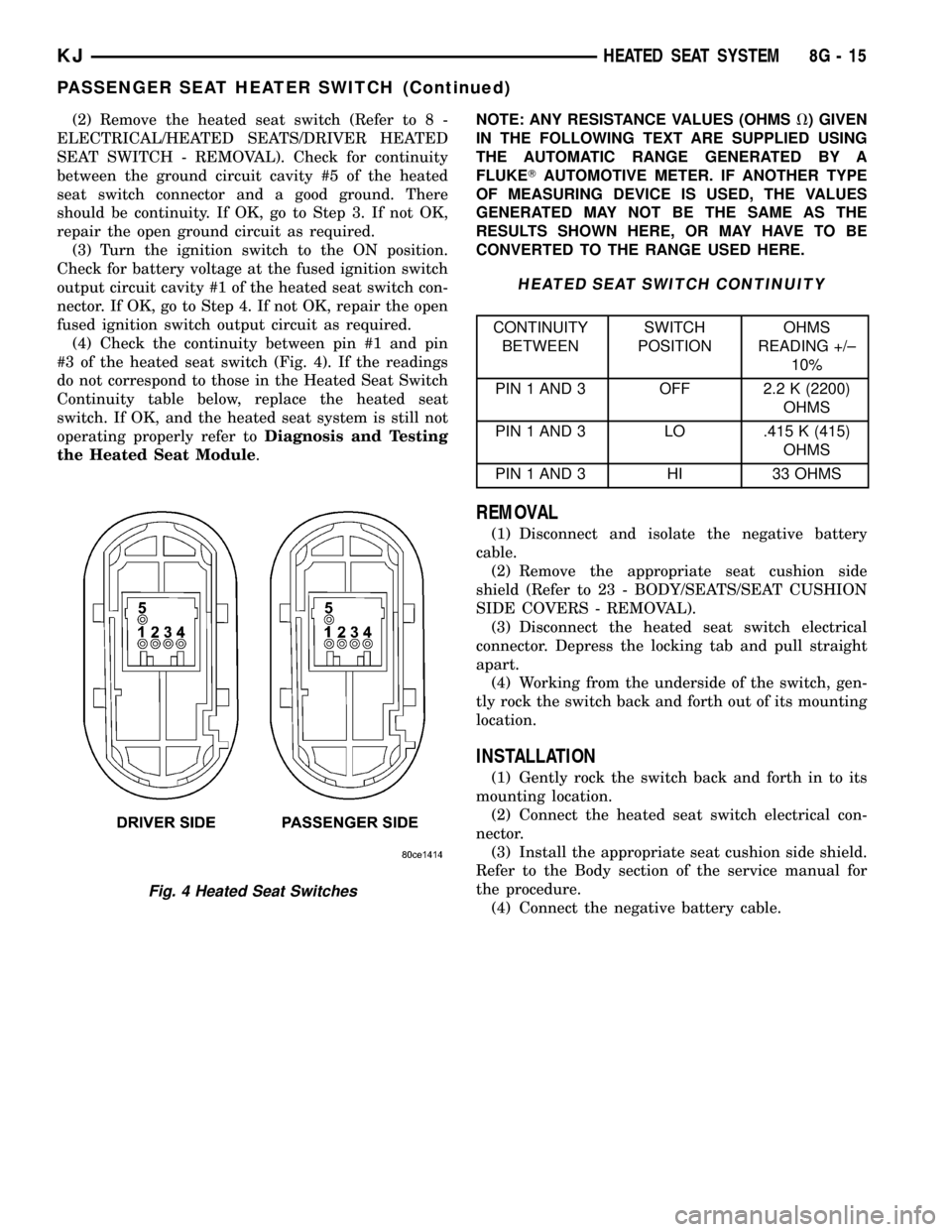
(2) Remove the heated seat switch (Refer to 8 -
ELECTRICAL/HEATED SEATS/DRIVER HEATED
SEAT SWITCH - REMOVAL). Check for continuity
between the ground circuit cavity #5 of the heated
seat switch connector and a good ground. There
should be continuity. If OK, go to Step 3. If not OK,
repair the open ground circuit as required.
(3) Turn the ignition switch to the ON position.
Check for battery voltage at the fused ignition switch
output circuit cavity #1 of the heated seat switch con-
nector. If OK, go to Step 4. If not OK, repair the open
fused ignition switch output circuit as required.
(4) Check the continuity between pin #1 and pin
#3 of the heated seat switch (Fig. 4). If the readings
do not correspond to those in the Heated Seat Switch
Continuity table below, replace the heated seat
switch. If OK, and the heated seat system is still not
operating properly refer toDiagnosis and Testing
the Heated Seat Module.NOTE: ANY RESISTANCE VALUES (OHMSV) GIVEN
IN THE FOLLOWING TEXT ARE SUPPLIED USING
THE AUTOMATIC RANGE GENERATED BY A
FLUKETAUTOMOTIVE METER. IF ANOTHER TYPE
OF MEASURING DEVICE IS USED, THE VALUES
GENERATED MAY NOT BE THE SAME AS THE
RESULTS SHOWN HERE, OR MAY HAVE TO BE
CONVERTED TO THE RANGE USED HERE.
HEATED SEAT SWITCH CONTINUITY
CONTINUITY
BETWEENSWITCH
POSITIONOHMS
READING +/±
10%
PIN 1 AND 3 OFF 2.2 K (2200)
OHMS
PIN 1 AND 3 LO .415 K (415)
OHMS
PIN 1 AND 3 HI 33 OHMS
REMOVAL
(1) Disconnect and isolate the negative battery
cable.
(2) Remove the appropriate seat cushion side
shield (Refer to 23 - BODY/SEATS/SEAT CUSHION
SIDE COVERS - REMOVAL).
(3) Disconnect the heated seat switch electrical
connector. Depress the locking tab and pull straight
apart.
(4) Working from the underside of the switch, gen-
tly rock the switch back and forth out of its mounting
location.
INSTALLATION
(1) Gently rock the switch back and forth in to its
mounting location.
(2) Connect the heated seat switch electrical con-
nector.
(3) Install the appropriate seat cushion side shield.
Refer to the Body section of the service manual for
the procedure.
(4) Connect the negative battery cable.
Fig. 4 Heated Seat Switches
KJHEATED SEAT SYSTEM 8G - 15
PASSENGER SEAT HEATER SWITCH (Continued)
Page 393 of 1803

DESCRIPTION-3.7L
The Camshaft Position Sensor (CMP) on the 3.7L
6±cylinder engine is bolted to the right-front side of
the right cylinder head (Fig. 6).
OPERATION
OPERATION - 2.4L
The Camshaft Position Sensor (CMP) sensor con-
tains a hall effect device referred to as a sync signal
generator. A rotating target wheel (tonewheel) for the
CMP is located behind the exhaust valve-camshaft
drive gear (Fig. 7). The target wheel is equipped with
a cutout (notch) around 180 degrees of the wheel.
The CMP detects this cutout every 180 degrees of
camshaft gear rotation. Its signal is used in conjunc-
tion with the Crankshaft Position Sensor (CKP) to
differentiate between fuel injection and spark events.
It is also used to synchronize the fuel injectors with
their respective cylinders.
When the leading edge of the target wheel cutout
enters the tip of the CMP, the interruption of mag-
netic field causes the voltage to switch high, result-
ing in a sync signal of approximately 5 volts.
When the trailing edge of the target wheel cutout
leaves the tip of the CMP, the change of the magnetic
field causes the sync signal voltage to switch low to 0
volts.
OPERATION - 3.7L
The Camshaft Position Sensor (CMP) sensor con-
tains a hall effect device referred to as a sync signal
generator. A rotating target wheel (tonewheel) for the
CMP is located at the front of the camshaft for the
right cylinder head (Fig. 8). This sync signal genera-
tor detects notches located on a tonewheel. As the
tonewheel rotates, the notches pass through the sync
signal generator. The signal from the CMP sensor is
used in conjunction with the Crankshaft Position
Sensor (CKP) to differentiate between fuel injection
and spark events. It is also used to synchronize the
fuel injectors with their respective cylinders.
When the leading edge of the tonewheel notch
enters the tip of the CMP, the interruption of mag-
netic field causes the voltage to switch high, result-
ing in a sync signal of approximately 5 volts.
When the trailing edge of the tonewheel notch
leaves then tip of the CMP, the change of the mag-
netic field causes the sync signal voltage to switch
low to 0 volts.
Fig. 6 CAMSHAFT POSITION SENSOR - 3.7L
1 - RIGHT/FRONT OF RIGHT CYLINDER HEAD
2 - CMP MOUNTING BOLT
3 - CMP LOCATION
Fig. 7 CMP FACE AT TARGET WHEEL-2.4L
1 - CAMSHAFT DRIVE GEAR
2 - TARGETWHEEL (TONEWHEEL)
3 - FACE OF CMP SENSOR
4 - CUTOUT (NOTCH)
8I - 6 IGNITION CONTROLKJ
CAMSHAFT POSITION SENSOR (Continued)
Page 488 of 1803

stalk can also be pulled outward to select those
lamps. Each control stalk also features a knurled
control ring located just below the control knob. The
left control stalk is dedicated to providing driver con-
trols for the interior and exterior lighting systems,
while the right control stalk is dedicated to providing
driver controls for the front and rear wiper systems.
Two integral connector receptacles on the forward
facing surface of the multi-function switch housing
connect the switch two the vehicle electrical system
through two take outs and connectors of the instru-
ment panel wire harness. The left connector recepta-
cle contains nine terminal pins for the lighting
control circuits of the switch, while the right connec-
tor receptacle contains six terminal pins for the
wiper control circuits of the switch. The multi-func-
tion switch cannot be adjusted or repaired and, if
faulty or damaged, it must be replaced.
LEFT CONTROL STALK The left (lighting) control
stalk of the multi-function switch supports the fol-
lowing functions and features:
²Front Fog Lamps- For vehicles so equipped,
the internal circuitry and hardware of the multi-
function switch left (lighting) control stalk provide
detent switching for the optional front fog lamps.
²Headlamps- The internal circuitry and hard-
ware of the multi-function switch left (lighting) con-
trol stalk provide detent switching for the
headlamps.²Headlamp Beam Selection- The internal cir-
cuitry and hardware of the multi-function switch left
(lighting) control stalk provide detent switching for
selection of the headlamp high or low beams.
²Headlamp Optical Horn- The internal cir-
cuitry and hardware of the multi-function switch left
(lighting) control stalk includes momentary switching
of the headlamp high beam circuits to provide an
optical horn feature (sometimes referred to as flash-
to-pass), which allows the vehicle operator to momen-
tarily flash the headlamp high beams as an optical
signalling device.
²Interior Lamps Defeat- The internal circuitry
and hardware of the multi-function switch left (light-
ing) control stalk provide detent switching to defeat
the illumination of all interior courtesy lamps when a
door, the rear flip-up glass, or the tailgate are
opened.
²Interior Lamps On- The internal circuitry and
hardware of the multi-function switch left (lighting)
control stalk provide detent switching to simulta-
neously illuminate all interior courtesy lamps.
²Panel Lamps Dimming- The internal cir-
cuitry and hardware of the multi-function switch left
(lighting) control stalk provide simultaneous adjust-
able control of the illumination intensity of all instru-
ment panel lighting at one of six available
illumination intensity levels.
²Parade Mode- The internal circuitry and hard-
ware of the multi-function switch left (lighting) con-
Fig. 50 Multi-Function Switch
1 - MULTI-FUNCTION SWITCH
2 - RIGHT (WIPER) CONTROL STALK
3 - LEFT (LIGHTING) CONTROL STALK
4 - TURN SIGNAL CANCEL ACTUATOR
5 - RIGHT (WIPER) CONTROL KNOB6 - RIGHT (WIPER) CONTROL RING
7 - LEFT (LIGHTING) CONTROL RING
8 - LEFT (LIGHTING) CONTROL KNOB
KJLAMPS/LIGHTING - EXTERIOR 8L - 47
MULTI-FUNCTION SWITCH (Continued)
Page 572 of 1803

knob on its end with a flattened face to allow it to be
easily rotated. On vehicles equipped with optional
front fog lamps, the knob on the end of left control
stalk can also be pulled outward to select those
lamps. Each control stalk also features a knurled
control ring located just below the control knob. The
left control stalk is dedicated to providing driver con-
trols for the interior and exterior lighting systems,
while the right control stalk is dedicated to providing
driver controls for the front and rear wiper systems.
Two integral connector receptacles on the forward
facing surface of the multi-function switch housing
connect the switch two the vehicle electrical system
through two take outs and connectors of the instru-
ment panel wire harness. The left connector recepta-
cle contains nine terminal pins for the lighting
control circuits of the switch, while the right connec-
tor receptacle contains six terminal pins for the
wiper control circuits of the switch. The multi-func-
tion switch cannot be adjusted or repaired and, if
faulty or damaged, it must be replaced.
LEFT CONTROL STALK The left (lighting) control
stalk of the multi-function switch supports the fol-
lowing functions and features:
²Front Fog Lamps- For vehicles so equipped,
the internal circuitry and hardware of the multi-
function switch left (lighting) control stalk provide
detent switching for the optional front fog lamps.
²Headlamps- The internal circuitry and hard-
ware of the multi-function switch left (lighting) con-trol stalk provide detent switching for the
headlamps.
²Headlamp Beam Selection- The internal cir-
cuitry and hardware of the multi-function switch left
(lighting) control stalk provide detent switching for
selection of the headlamp high or low beams.
²Headlamp Optical Horn- The internal cir-
cuitry and hardware of the multi-function switch left
(lighting) control stalk includes momentary switching
of the headlamp high beam circuits to provide an
optical horn feature (sometimes referred to as flash-
to-pass), which allows the vehicle operator to momen-
tarily flash the headlamp high beams as an optical
signalling device.
²Interior Lamps Defeat- The internal circuitry
and hardware of the multi-function switch left (light-
ing) control stalk provide detent switching to defeat
the illumination of all interior courtesy lamps when a
door, the rear flip-up glass, or the tailgate are
opened.
²Interior Lamps On- The internal circuitry and
hardware of the multi-function switch left (lighting)
control stalk provide detent switching to simulta-
neously illuminate all interior courtesy lamps.
²Panel Lamps Dimming- The internal cir-
cuitry and hardware of the multi-function switch left
(lighting) control stalk provide simultaneous adjust-
able control of the illumination intensity of all instru-
ment panel lighting at one of six available
illumination intensity levels.
Fig. 50 Multi-Function Switch
1 - MULTI-FUNCTION SWITCH
2 - RIGHT (WIPER) CONTROL STALK
3 - LEFT (LIGHTING) CONTROL STALK
4 - TURN SIGNAL CANCEL ACTUATOR5 - RIGHT (WIPER) CONTROL KNOB
6 - RIGHT (WIPER) CONTROL RING
7 - LEFT (LIGHTING) CONTROL RING
8 - LEFT (LIGHTING) CONTROL KNOB
KJLAMPS8Ls-47
MULTI-FUNCTION SWITCH (Continued)
Page 601 of 1803

(3) Remove the compass mini-trip computer from
the overhead console.
INSTALLATION
(1) Install the compass mini-trip computer in the
overhead console. Align the compass mini-trip com-
puter guides on the housing with the grooves of the
console.
(2) Install the mounting screws and install the
map lamp wire connector on the compass mini-trip
computer. Make sure the LOOP of wire that was
clipped into the compass mini-trip computer module
housing is properly clipped into the new module
before the console is placed back into the headliner.
(3) Install the overhead console, refer to Console
Installation in this section.
UNIVERSAL TRANSMITTER
DESCRIPTION
On some KJ models a Universal Transmitter trans-
ceiver is standard factory-installed equipment. The
universal transmitter transceiver is integral to the
Compass Mini-Trip Computer (CMTC), which is
located in the overhead console. The only visible com-
ponent of the universal transmitter are the three
transmitter push buttons (Fig. 7) centered between
the four CMTC push buttons located just rearward of
the CMTC display screen in the overhead console.
The three universal transmitter push buttons are
identified with one, two or three light indicators so
that they be easily identified by sight or by feel.
Each of the three universal transmitter push but-
tons controls an independent radio transmitter chan-
nel. Each of these three channels can be trained totransmit a different radio frequency signal for the
remote operation of garage door openers, motorized
gate openers, home or office lighting, security sys-
tems or just about any other device that can be
equipped with a radio receiver in the 286 to 399
MegaHertz (MHz) frequency range for remote opera-
tion. The universal transmitter is capable of operat-
ing systems using either rolling code or non-rolling
code technology.
The CMTC module displays messages and a small
house-shaped icon with one, two or three dots corre-
sponding to the three transmitter buttons to indicate
the status of the Universal Transmitter.
The Universal Transmitter cannot be repaired, and
is available for service only as a unit with the CMTC
module. This unit includes the push button switches
and the plastic module and display lens. If any of
these components is faulty or damaged, the complete
CMTC module must be replaced.
OPERATION
The universal transmitter operates on a non-
switched source of battery current so the unit will
remain functional, regardless of the ignition switch
position. For more information on the features, pro-
gramming procedures and operation of the universal
transmitter, see the owner's manual in the vehicle
glove box.
DIAGNOSIS AND TESTING - UNIVERSAL
TRANSMITTER
If the Universal Transmitter is inoperative, but the
Compass Mini-Trip Computer (CMTC) is operating
normally, see the owner's manual in the vehicle glove
box for instructions on training the universal trans-
mitter. Retrain the universal transmitter with a
known good transmitter as instructed in the owner's
manual and test the universal transmitter operation
again. If the unit is still inoperative, replace the
faulty universal transmitter and CMTC module as a
unit. If both the universal transmitter and the CMTC
module are inoperative, refer toDiagnosis and
Testing the Compass Mini-Trip Computerin this
section for further diagnosis. For complete circuit
diagrams, refer toOverhead Consolein Wiring
Diagrams.
STANDARD PROCEDURE
STANDARD PROCEDURE - ERASING
TRANSMITTER CODES
To erase the universal transmitter codes, simply
hold down buttons 1 and 3 until the two green dots
below the house symbol begin to flash.
Fig. 7 Overhead Console With Universal Transmitter
8M - 8 MESSAGE SYSTEMSKJ
COMPASS/MINI-TRIP COMPUTER (Continued)
Page 606 of 1803

The tailgate will lock and can not be unlocked if
the rear wiper switch is activated. The tailgate will
also lock if battery power is lost and then restored.
The tailgate/flip-up glass will not function with the
battery discharged or disconnected.
COMBINATION FLASHER
This flasher can be energized by the BCM to flash
all of the park/turn signal lamps as a optical alert for
the RKE panic function and, if the Flash Lights with
Lock programmable feature is enabled, as an optical
verification for the RKE lock event.
HORN RELAY
This relay can be energized by the BCM to sound
the horns as an audible alert for the RKE panic func-
tion and, if the Sound Horn on Lock programmable
feature is enabled, as an audible verification for the
RKE lock event.
LOW BEAM HEADLAMP RELAY
This relay can be energized by the BCM to flash
the headlamp low beams as an optical alert for the
RKE panic function.
OPERATION
POWER LOCKS
The Body Control Module (BCM) locks or unlocks
the doors when an actuation input signal from a door
lock switch or Remote Keyless Entry Module (RKE)
is received. The BCM turns on the output drivers
and provides a voltage level to the door lock motor
for a specified time. All passenger doors can be
locked or unlocked using a mechanical button
mounted on the door trim panel. The front passenger
doors and tailgate can be locked or unlocked by using
the key cylinder (tailgate cylinder does not lock/un-
lock vehicle. It only unlocks the tailgate). The tail-
gate will lock and can not be unlocked if the rear
wiper switch is activated (this prevents the wiper
from operating when the tailgate is ajar). The tail-
gate will also lock if battery power is lost and then
restored.
AUTOMATIC DOOR LOCKS
When the automatic door locks are ENABLED the
door locks will lock when the vehicle is moving at
about 25.7 Km/h (15 mph), all doors are closed and
the accelerator pedal is depressed. This feature can
be switched ON or OFF as desired. When the system
is DISABLED the door locks will operate normally,
but will not lock automatically when the vehicle is
rolling. Once the automatic door locks have been
actuated, they will not try to lock the doors again
until a door is opened.
DOOR LOCK INHIBIT
If the key is in the ignition, in any position, and
either front door is ajar, the doors can not be locked,
but the unlock function still operates. Pressing the
RKE lock/unlock button under these conditions will
result in a normal lock/unlock activation.
After the key is removed from the Ignition Switch,
or the doors are closed, the power door locks will
operate normally.
DOOR LOCK CIRCUIT PROTECTION
The BCM controls the door lock relays. If the door
lock switch is actuated continuously for more than
five seconds the BCM will turn the output driver
OFF (the BCM would consider the switch stuck).
Each lock motor is protected with a Positive Temper-
ature Coefficient device that prevents motor burn
out.
REMOTE KEYLESS ENTRY
²LOCK: Pressing the LOCK button locks all
doors, sounds horn (chirp) if enabled, and arms the
Vehicle Theft Security System, if enabled. The chirp
verifies that the RKE receiver has sent a message to
the BCM for door lock operation. If a door has not
been closed before pressing the LOCK button, the
vehicle may not be secured and the VTSS (if
equipped) will not arm until the door is closed.
²UNLOCK: Pressing the UNLOCK button once
will unlock the driver's door and activate the illumi-
nated entry system and disarm Vehicle Theft Secu-
rity System, if equipped. Pressing the UNLOCK
button twice within five seconds will unlock all doors.
²TAILGATE: Pressing the TAILGATE BUTTON
unlocks the tailgate remotely and opens the flip-up
glass.
²PANIC: Pressing the PANIC button sounds the
horns at half second intervals, flashes the exterior
lamps, and turns ON the interior lamps. The panic
alarm will remain on for three minutes, or until the
PANIC button is actuated again or the ignition
switch is turned to the RUN position.
The Remote Keyless Entry Module is capable of
retaining the transmitter Vehicle Access Code(s) in
its memory even after vehicle power has been inter-
rupted.
DIAGNOSIS AND TESTING - POWER LOCKS
The Body Control Module (BCM) enters a
reduced power mode after the key is turned
OFF. All diagnosis and testing of the power lock
system must be done with the key in the ON
position unless otherwise stated.
The most reliable, efficient, and accurate
means to diagnose the power lock system
requires the use of a DRBIIItscan tool and the
KJPOWER LOCKS 8N - 3
POWER LOCKS (Continued)
Page 609 of 1803

(4) Using an ohmmeter, check for continuity
between the pins of the wire harness connector while
pulling on the tailgate handle.
(5) If no continuity is found, replace the tailgate
handle assembly (Refer to 23 - BODY/DECKLID/
HATCH/LIFTGATE/TAILGATE/EXTERIOR HAN-
DLE - REMOVAL).
DOOR LOCK RELAY
DESCRIPTION
The power door lock system uses the following
relays for the front and rear passenger doors only:
²Driver door unlock relay
²Door lock relay
²Passenger Doors unlock relay
The tailgate uses outputs from the Body Control
Module (BCM).
The relays are electromechanical devices that
switch battery current to the door lock circuit when
the Body Control Module (BCM) grounds the relay
coil. These relays are located in the Junction Block
(JB). For complete circuit diagrams, refer to the
appropriate wiring information. The wiring informa-
tion includes wiring diagrams, proper wire and con-
nector repair procedures, details of wire harness
routing and retention, connector pin-out information
and location views for the various wire harness con-
nectors, splices and grounds.
The relays are a International Standards Organi-
zation (ISO) micro-relay. Relays conforming to the
ISO specifications have common physical dimensions,
current capacities, terminal patterns, and terminal
functions. The ISO micro-relay terminal functions
are the same as a conventional ISO relay. However,
the ISO micro-relay terminal pattern (or footprint) is
different, the current capacity is lower, and the phys-
ical dimensions are smaller than those of the conven-
tional ISO relay.
The relay cannot be repaired or adjusted and, if
faulty or damaged, it must be replaced.
OPERATION
The ISO relay consists of an electromagnetic coil, a
resistor and three (two fixed and one movable) elec-
trical contacts. The movable (common feed) relay con-
tact is held against one of the fixed contacts
(normally closed) by spring pressure. When the elec-
tromagnetic coil is energized, it draws the movable
contact away from the normally closed fixed contact,
and holds it against the other (normally open) fixed
contact.When the electromagnetic coil is de-energized,
spring pressure returns the movable contact to the
normally closed position. The resistor is connected in
parallel with the electromagnetic coil in the relay,
and helps to dissipate voltage spikes that are pro-
duced when the coil is de-energized.
DIAGNOSIS AND TESTING - DOOR LOCK
RELAY
The power lock relays (Fig. 4) are located in the
Junction Block (JB) under the instrument panel. For
complete circuit diagrams, refer to the appropriate
wiring information. The wiring information includes
wiring diagrams, proper wire and connector repair
procedures, details of wire harness routing and
retention, connector pin-out information and location
views for the various wire harness connectors, splices
and grounds.
WARNING: DISABLE THE AIRBAG SYSTEM
BEFORE ATTEMPTING ANY STEERING WHEEL,
STEERING COLUMN, SEAT BELT TENSIONER, SIDE
AIRBAG, OR INSTRUMENT PANEL COMPONENT
DIAGNOSIS OR SERVICE. DISCONNECT AND ISO-
LATE THE BATTERY NEGATIVE (GROUND) CABLE,
THEN WAIT TWO MINUTES FOR THE AIRBAG SYS-
TEM CAPACITOR TO DISCHARGE BEFORE PER-
FORMING FURTHER DIAGNOSIS OR SERVICE. THIS
IS THE ONLY SURE WAY TO DISABLE THE AIRBAG
SYSTEM. FAILURE TO TAKE THE PROPER PRE-
CAUTIONS COULD RESULT IN ACCIDENTAL AIR-
BAG DEPLOYMENT AND POSSIBLE PERSONAL
INJURY.
(1) Remove suspected faulty relay from the (JB).
(2) A relay in the de-energized position should
have continuity between terminals 87A and 30, and
no continuity between terminals 87 and 30. If OK, go
to Step 3. If not OK, replace the faulty relay.
(3) Resistance between terminals 85 and 86 (elec-
tromagnet) should be 75 8 ohms. If OK, go to Step
4. If not OK, replace the faulty relay.
(4) Connect a battery to terminals 85 and 86.
There should now be continuity between terminals
30 and 87, and no continuity between terminals 87A
and 30. If not OK, replace the faulty relay.
REMOVAL
(1) Disconnect and isolate the battery negative
cable.
(2) Reach up under instrument panel and remove
the relay from Junction Block (JB).
8N - 6 POWER LOCKSKJ
FLIP-UP GLASS RELEASE SWITCH (Continued)