removing JEEP LIBERTY 2002 KJ / 1.G Owner's Guide
[x] Cancel search | Manufacturer: JEEP, Model Year: 2002, Model line: LIBERTY, Model: JEEP LIBERTY 2002 KJ / 1.GPages: 1803, PDF Size: 62.3 MB
Page 376 of 1803

DIAGNOSIS AND TESTING - REAR HVAC
CONTROL ASSEMBLY WINDOW DEFOGGER
FUNCTION
Before performing this test, complete the Defogger
Switch and Defogger Relay tests as described in this
group. For circuit descriptions and diagrams, (Refer
to Appropriate Wiring Information).
WARNING: ON VEHICLES EQUIPPED WITH AIR-
BAGS, DISABLE THE AIRBAG SYSTEM BEFORE
ATTEMPTING ANY STEERING WHEEL, STEERING
COLUMN, OR INSTRUMENT PANEL COMPONENT
DIAGNOSIS OR SERVICE. DISCONNECT AND ISO-
LATE THE BATTERY NEGATIVE (GROUND) CABLE,
THEN WAIT TWO MINUTES FOR THE AIRBAG SYS-
TEM CAPACITOR TO DISCHARGE BEFORE PER-
FORMING FURTHER DIAGNOSIS OR SERVICE. THIS
IS THE ONLY SURE WAY TO DISABLE THE AIRBAG
SYSTEM. FAILURE TO TAKE THE PROPER PRE-
CAUTIONS COULD RESULT IN AN ACCIDENTAL
AIRBAG DEPLOYMENT AND POSSIBLE PERSONAL
INJURY.
(1) Disconnect and isolate the battery negative
cable. Remove the defogger relay from the junction
block and unplug the defogger switch wire harness
connector.
(2) Remove the HVAC control head from the
instrument panel. This is accomplished by removing
the ashtray and the screw behind the ashtray and
uncliping the center bezel.
(3) Check for continuity between the rear window
defogger switch sense circuit cavity of the cluster
wire harness connector (connector B) and a good
ground. There should be no continuity. If OK, go to
Step 4. If not OK, repair the short circuit as
required.
(4) Check for continuity between the rear window
defogger switch sense circuit cavity of the right
instrument cluster wire harness connector (connector
B) and the defogger switch wire harness connector.
There should be continuity. If OK, go to Step 5. If not
OK, repair the open circuit as required.
(5) Check for continuity between the rear window
defogger relay control circuit cavity of the right
instrument cluster wire harness connector (connectorB) and a good ground. There should be no continuity.
If OK, go to Step 6. If not OK, repair the short circuit
as required.
(6) Check for continuity between the rear window
defogger relay control circuit cavities of the right
instrument cluster wire harness connector (connector
B) and the defogger relay receptacle (the cavity for
ISO relay terminal 85) in the junction block. There
should be continuity. If OK, replace the faulty HVAC
control head. If not OK, repair the open circuit as
required.
REMOVAL
WARNING: ON VEHICLES EQUIPPED WITH AIR-
BAGS, DISABLE THE AIRBAG SYSTEM BEFORE
ATTEMPTING ANY STEERING WHEEL, STEERING
COLUMN, OR INSTRUMENT PANEL COMPONENT
DIAGNOSIS OR SERVICE. DISCONNECT AND ISO-
LATE THE BATTERY NEGATIVE (GROUND) CABLE,
THEN WAIT TWO MINUTES FOR THE AIRBAG SYS-
TEM CAPACITOR TO DISCHARGE BEFORE PER-
FORMING FURTHER DIAGNOSIS OR SERVICE. THIS
IS THE ONLY SURE WAY TO DISABLE THE AIRBAG
SYSTEM. FAILURE TO TAKE THE PROPER PRE-
CAUTIONS COULD RESULT IN AN ACCIDENTAL
AIRBAG DEPLOYMENT AND POSSIBLE PERSONAL
INJURY.
(1) Disconnect and isolate the battery negative
cable.
(2) The Rear Window Defogger switch is part of
the HVAC assembly and if damaged or inoperative
the entire HVAC control assembly must be replace-
d(Refer to 24 - HEATING & AIR CONDITIONING/
CONTROLS/A/C HEATER CONTROL - REMOVAL).
INSTALLATION
(1) The Rear Window Defogger switch is part of
the HVAC control assembly and if damaged or inop-
erative you must replace the entire HVEAC control
head assembly(Refer to 24 - HEATING & AIR CON-
DITIONING/CONTROLS/A/C HEATER CONTROL -
INSTALLATION).
(2) Connect the battery negative cable.
KJWINDOW DEFOGGER 8G - 9
REAR WINDOW DEFOGGER SWITCH (Continued)
Page 384 of 1803

HORN
TABLE OF CONTENTS
page page
HORN SYSTEM
DESCRIPTION..........................1
OPERATION............................1
DIAGNOSIS AND TESTING - HORN SYSTEM . . . 1
HORN
DIAGNOSIS AND TESTING - HORN..........2
REMOVAL.............................3
INSTALLATION..........................3HORN RELAY
DIAGNOSIS AND TESTING - HORN RELAY....3
REMOVAL.............................3
INSTALLATION..........................3
HORN SWITCH
DESCRIPTION..........................4
DIAGNOSIS AND TESTING - HORN SWITCH . . . 4
HORN SYSTEM
DESCRIPTION
A dual-note electric horn system is standard facto-
ry-installed equipment on this model (Fig. 1).
The dual-note horn system features dual electro-
magnetic horn units. The horn system includes the
following major components:
²Horn- The two horns are located below the
Power Distribution Center (PDC).
²Horn Relay- The horn relay is located in the
Junction Block (JB).²Horn Switch- The horn switch is molded into
the driver airbag assembly.OPERATION
The horn system operates on battery current
received through fuse 3 in the Junction Block (JB).
The horn system circuit is designed so that the sys-
tem will remain operational, regardless of the igni-
tion switch position.
DIAGNOSIS AND TESTING - HORN SYSTEM
In most cases, any problem involving continually
sounding horns can be quickly alleviated by removing
the horn relay from the Junction Block (JB). Refer to
horn relay for the removal procedure. Refer to the
appropriate wiring information. The wiring informa-
tion includes wiring diagrams, proper wire and con-
nector repair procedures, further details on wire
harness routing and retention, as well as pin-out and
location views for the various wire harness connec-
tors, splices and grounds.
WARNING: DISABLE THE AIRBAG SYSTEM
BEFORE ATTEMPTING ANY STEERING WHEEL,
STEERING COLUMN, SEAT BELT TENSIONER, SIDE
AIRBAG, OR INSTRUMENT PANEL COMPONENT
DIAGNOSIS OR SERVICE. DISCONNECT AND ISO-
LATE THE BATTERY NEGATIVE (GROUND) CABLE,
THEN WAIT TWO MINUTES FOR THE AIRBAG SYS-
TEM CAPACITOR TO DISCHARGE BEFORE PER-
FORMING FURTHER DIAGNOSIS OR SERVICE. THIS
IS THE ONLY SURE WAY TO DISABLE THE AIRBAG
SYSTEM. FAILURE TO TAKE THE PROPER PRE-
CAUTIONS COULD RESULT IN ACCIDENTAL AIR-
BAG DEPLOYMENT AND POSSIBLE PERSONAL
INJURY.
Fig. 1 HORN LOCATION
1 - HIGH NOTE HORN
2 - LOW NOTE HORN
KJHORN 8H - 1
Page 395 of 1803

INSTALLATION
2.4L
The Camshaft Position Sensor (CMP) on the 2.4L
4±cylinder engine is bolted to the right-front side of
the cylinder head.Sensor position (depth) is
adjustable.
(1) Remove plastic, upper timing belt cover (timing
gear cover) (Fig. 11) by removing 3 bolts. Before
attempting to remove cover, remove electrical connec-
tor from Engine Coolant Temperature (ECT) sensor
(Fig. 11). This will prevent damage to sensor.
(2) Rotate (bump over) engine until camshaft tim-
ing gear and target wheel (tonewheel) are positioned
and aligned to face of sensor as shown in (Fig. 12).If
not positioned as shown in (Fig. 12), damage to
both sensor and target wheel will occur when
attempting to start engine. Face of sensor
MUST be behind target wheel while adjusting.
(3) Position sensor to cylinder head and install 2
sensor mounting bolts finger tight.
(4)SENSOR AIR GAP: .030ºSet air gap between
rear of target wheel and face of sensor to .030º. This
can best be accomplished using an L-shaped, wire-
type spark plug gapping gauge (Fig. 13). A piece of
.030º brass shim stock may also be used.
(5) Gently push sensor forward until it contacts
gapping gauge.Do not push hard on sensor.
Tighten 2 sensor mounting bolts. Refer to torque
specifications.CAUTION: After tightening sensor mounting bolts,
recheck air gap and adjust as necessary. Retorque
bolts.
(6) Install upper timing belt cover and 3 bolts.
(7) Connect electrical connector to ECT sensor.
(8) Connect electrical connector to CMP sensor.
Fig. 11 UPPER TIMING BELT COVER/BOLTS-2.4L
1 - UPPER TIMING BELT COVER
2 - ELECTRICAL CONNECTOR (ECT)
3 - MOUNTING BOLTS (3)
Fig. 12 CMP FACE AT TARGET WHEEL-2.4L
1 - CAMSHAFT DRIVE GEAR
2 - TARGETWHEEL (TONEWHEEL)
3 - FACE OF CMP SENSOR
4 - CUTOUT (NOTCH)
Fig. 13 CMP ADJUSTMENT - 2.4L
1 - FACE OF SENSOR
2 - WIRE GAPPING TOOL
8I - 8 IGNITION CONTROLKJ
CAMSHAFT POSITION SENSOR (Continued)
Page 402 of 1803

REMOVAL
2.4L
If spark plug for #2 or #3 cylinder is being
removed, throttle body must be removed. Refer to
Throttle Body Removal.
(1) Remove air cleaner tube and housing.
(2) Twist secondary cable at cylinder head to break
loose at spark plug. Remove cable from plug.
(3) Prior to removing spark plug, spray com-
pressed air into cylinder head opening. This will help
prevent foreign material from entering combustion
chamber.
(4) Remove spark plug from cylinder head using a
quality socket with a rubber or foam insert.
(5) Inspect spark plug condition. Refer to Spark
Plug Conditions.
3.7L
Each individual spark plug is located under each
ignition coil. Each individual ignition coil must be
removed to gain access to each spark plug. Refer to
Ignition Coil Removal/Installation.
(1) Prior to removing ignition coil, spray com-
pressed air around coil base at cylinder head.
(2) Prior to removing spark plug, spray com-
pressed air into cylinder head opening. This will help
prevent foreign material from entering combustion
chamber.
(3) Remove spark plug from cylinder head using a
quality socket with a rubber or foam insert. Also
check condition of ignition coil o-ring and replace as
necessary.
(4) Inspect spark plug condition. Refer to Spark
Plug Conditions.
CLEANING SPARK PLUGS
The plugs may be cleaned using commercially
available spark plug cleaning equipment. After clean-
ing, file the center electrode flat with a small point
file or jewelers file before adjusting gap.
CAUTION: Never use a motorized wire wheel brush
to clean the spark plugs. Metallic deposits will
remain on the spark plug insulator and will cause
plug misfire.
INSTALLATION
2.4L
CAUTION: Spark plug tightening on the 2.4L is
torque critical. The plugs are equipped with tapered
seats. Do not exceed 15 ft. lbs. torque.
Special care should be taken when installing spark
plugs into the cylinder head spark plug wells. Be
sure the plugs do not drop into the plug wells as elec-
trodes can be damaged.
Always tighten spark plugs to the specified torque.
Over tightening can cause distortion resulting in a
change in the spark plug gap or a cracked porcelain
insulator.
(1) Start the spark plug into the cylinder head by
hand to avoid cross threading.
(2) Tighten spark plugs. Refer to torque specifica-
tions.
(3) Install throttle body. Refer to Throttle Body
Installation.
(4) Install air cleaner tube and housing.
3.7L
Special care should be taken when installing spark
plugs into the cylinder head spark plug wells. Be
Fig. 26 Preignition Damage
1 - GROUND ELECTRODE STARTING TO DISSOLVE
2 - CENTER ELECTRODE DISSOLVED
Fig. 27 Spark Plug Overheating
1 - BLISTERED WHITE OR GRAY COLORED INSULATOR
KJIGNITION CONTROL 8I - 15
SPARK PLUG (Continued)
Page 592 of 1803

LAMP BAR SWITCH
DESCRIPTION
The lamp bar switch is intended to close the elec-
trical circuit which feeds the lamp bar. The switch
assembly contains a relay unit that is energized or
de-energized by a manually operated momentary
rocker switch. The switch is mounted on the instru-
ment panel left of the steering wheel.
REMOVAL
CAUTION: Care must be taken not to damage the
dash or instrument panel when removing the lamp
bar switch bezel.
(1) Disconnect negative battery cable.
(2) Using a suitable pry tool, carefully remove the
lamp bar switch bezel from the instrument panel.
(3) Disconnect the electrical connector.
(4) Depress the lamp bar switch retaining tabs and
remove the switch from the bezel.
INSTALLATION
(1) Press the lamp bar switch into the instrument
panel bezel and assure that the switch is seated
properly (Fig. 70).
(2) Connect the electrical connector.
(3) Press the instrument panel bezel into position
and seat the bezal retaining clips.(4) Reconnect negative battery cable.
Fig. 70 LAMP BAR SWITCH
1 - Bezel
2 - Lamp Bar Switch
KJLAMPS8Ls-67
Page 621 of 1803
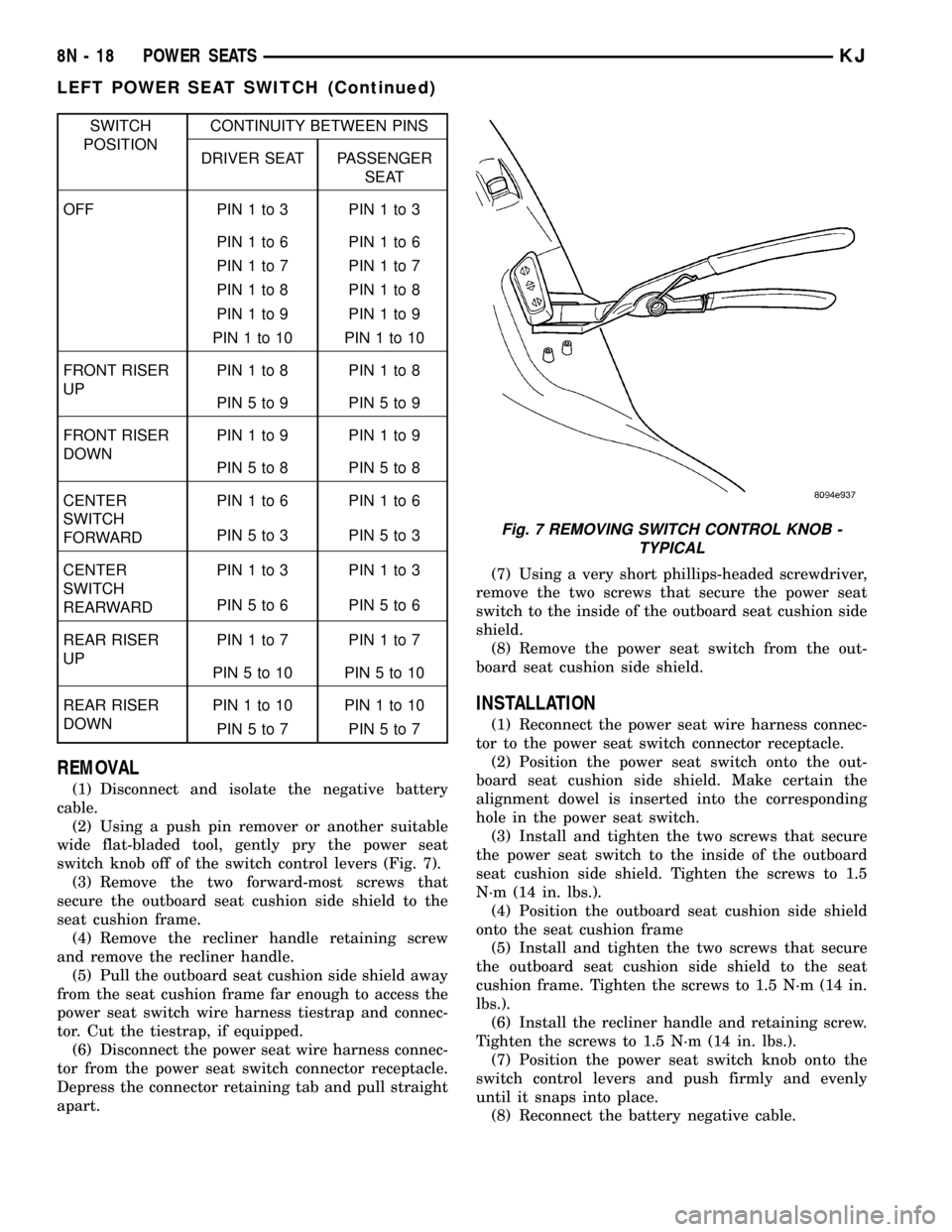
SWITCH
POSITIONCONTINUITY BETWEEN PINS
DRIVER SEAT PASSENGER
SEAT
OFF PIN1to3 PIN1to3
PIN1to6 PIN1to6
PIN1to7 PIN1to7
PIN1to8 PIN1to8
PIN1to9 PIN1to9
PIN1to10 PIN1to10
FRONT RISER
UPPIN1to8 PIN1to8
PIN5to9 PIN5to9
FRONT RISER
DOWNPIN1to9 PIN1to9
PIN5to8 PIN5to8
CENTER
SWITCH
FORWARDPIN1to6 PIN1to6
PIN5to3 PIN5to3
CENTER
SWITCH
REARWARDPIN1to3 PIN1to3
PIN5to6 PIN5to6
REAR RISER
UPPIN1to7 PIN1to7
PIN5to10 PIN5to10
REAR RISER
DOWNPIN1to10 PIN1to10
PIN5to7 PIN5to7
REMOVAL
(1) Disconnect and isolate the negative battery
cable.
(2) Using a push pin remover or another suitable
wide flat-bladed tool, gently pry the power seat
switch knob off of the switch control levers (Fig. 7).
(3) Remove the two forward-most screws that
secure the outboard seat cushion side shield to the
seat cushion frame.
(4) Remove the recliner handle retaining screw
and remove the recliner handle.
(5) Pull the outboard seat cushion side shield away
from the seat cushion frame far enough to access the
power seat switch wire harness tiestrap and connec-
tor. Cut the tiestrap, if equipped.
(6) Disconnect the power seat wire harness connec-
tor from the power seat switch connector receptacle.
Depress the connector retaining tab and pull straight
apart.(7) Using a very short phillips-headed screwdriver,
remove the two screws that secure the power seat
switch to the inside of the outboard seat cushion side
shield.
(8) Remove the power seat switch from the out-
board seat cushion side shield.
INSTALLATION
(1) Reconnect the power seat wire harness connec-
tor to the power seat switch connector receptacle.
(2) Position the power seat switch onto the out-
board seat cushion side shield. Make certain the
alignment dowel is inserted into the corresponding
hole in the power seat switch.
(3) Install and tighten the two screws that secure
the power seat switch to the inside of the outboard
seat cushion side shield. Tighten the screws to 1.5
N´m (14 in. lbs.).
(4) Position the outboard seat cushion side shield
onto the seat cushion frame
(5) Install and tighten the two screws that secure
the outboard seat cushion side shield to the seat
cushion frame. Tighten the screws to 1.5 N´m (14 in.
lbs.).
(6) Install the recliner handle and retaining screw.
Tighten the screws to 1.5 N´m (14 in. lbs.).
(7) Position the power seat switch knob onto the
switch control levers and push firmly and evenly
until it snaps into place.
(8) Reconnect the battery negative cable.
Fig. 7 REMOVING SWITCH CONTROL KNOB -
TYPICAL
8N - 18 POWER SEATSKJ
LEFT POWER SEAT SWITCH (Continued)
Page 623 of 1803
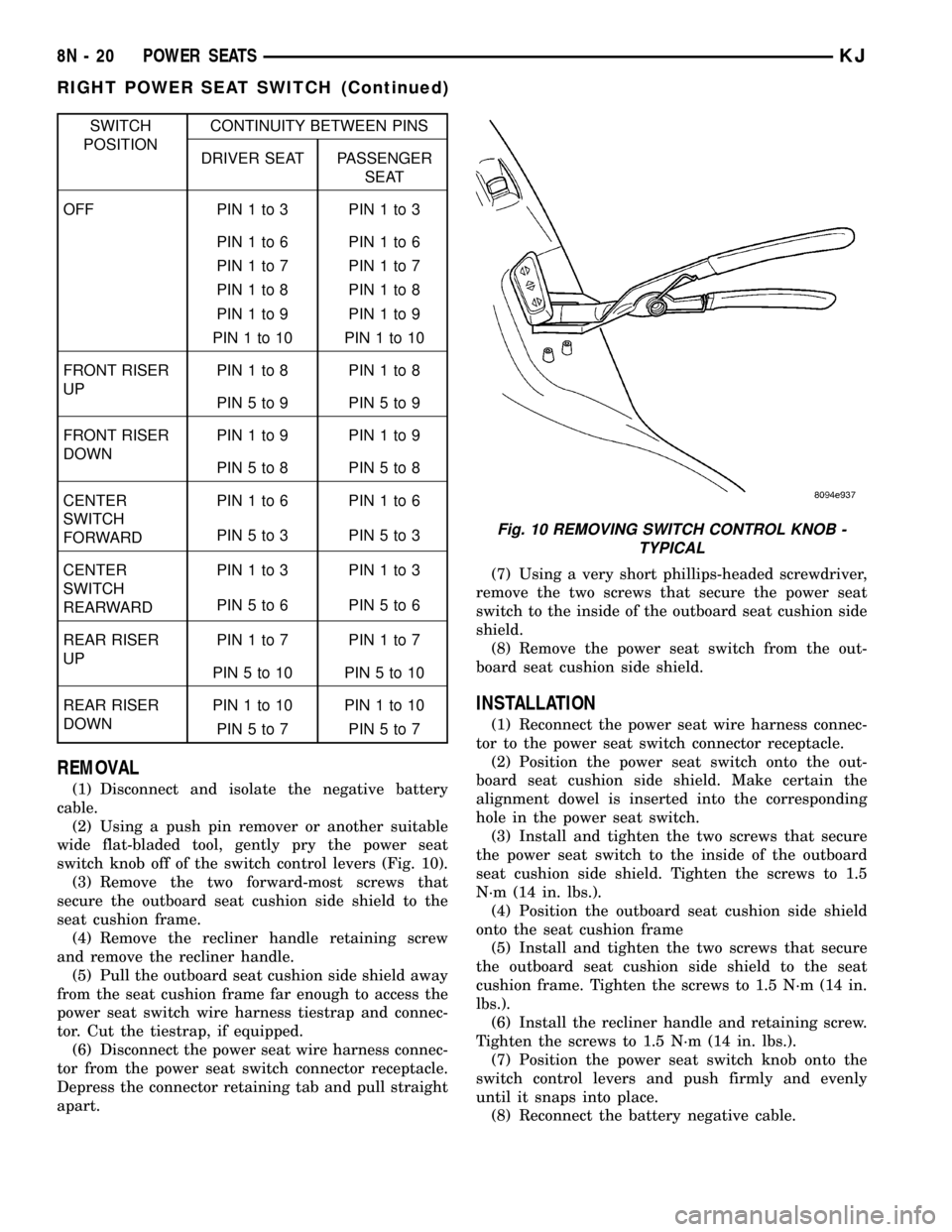
SWITCH
POSITIONCONTINUITY BETWEEN PINS
DRIVER SEAT PASSENGER
SEAT
OFF PIN1to3 PIN1to3
PIN1to6 PIN1to6
PIN1to7 PIN1to7
PIN1to8 PIN1to8
PIN1to9 PIN1to9
PIN1to10 PIN1to10
FRONT RISER
UPPIN1to8 PIN1to8
PIN5to9 PIN5to9
FRONT RISER
DOWNPIN1to9 PIN1to9
PIN5to8 PIN5to8
CENTER
SWITCH
FORWARDPIN1to6 PIN1to6
PIN5to3 PIN5to3
CENTER
SWITCH
REARWARDPIN1to3 PIN1to3
PIN5to6 PIN5to6
REAR RISER
UPPIN1to7 PIN1to7
PIN5to10 PIN5to10
REAR RISER
DOWNPIN1to10 PIN1to10
PIN5to7 PIN5to7
REMOVAL
(1) Disconnect and isolate the negative battery
cable.
(2) Using a push pin remover or another suitable
wide flat-bladed tool, gently pry the power seat
switch knob off of the switch control levers (Fig. 10).
(3) Remove the two forward-most screws that
secure the outboard seat cushion side shield to the
seat cushion frame.
(4) Remove the recliner handle retaining screw
and remove the recliner handle.
(5) Pull the outboard seat cushion side shield away
from the seat cushion frame far enough to access the
power seat switch wire harness tiestrap and connec-
tor. Cut the tiestrap, if equipped.
(6) Disconnect the power seat wire harness connec-
tor from the power seat switch connector receptacle.
Depress the connector retaining tab and pull straight
apart.(7) Using a very short phillips-headed screwdriver,
remove the two screws that secure the power seat
switch to the inside of the outboard seat cushion side
shield.
(8) Remove the power seat switch from the out-
board seat cushion side shield.
INSTALLATION
(1) Reconnect the power seat wire harness connec-
tor to the power seat switch connector receptacle.
(2) Position the power seat switch onto the out-
board seat cushion side shield. Make certain the
alignment dowel is inserted into the corresponding
hole in the power seat switch.
(3) Install and tighten the two screws that secure
the power seat switch to the inside of the outboard
seat cushion side shield. Tighten the screws to 1.5
N´m (14 in. lbs.).
(4) Position the outboard seat cushion side shield
onto the seat cushion frame
(5) Install and tighten the two screws that secure
the outboard seat cushion side shield to the seat
cushion frame. Tighten the screws to 1.5 N´m (14 in.
lbs.).
(6) Install the recliner handle and retaining screw.
Tighten the screws to 1.5 N´m (14 in. lbs.).
(7) Position the power seat switch knob onto the
switch control levers and push firmly and evenly
until it snaps into place.
(8) Reconnect the battery negative cable.
Fig. 10 REMOVING SWITCH CONTROL KNOB -
TYPICAL
8N - 20 POWER SEATSKJ
RIGHT POWER SEAT SWITCH (Continued)
Page 646 of 1803

REMOVAL
The following procedure is for replacement of a
faulty or damaged driver airbag. If the driver airbag
has been deployed, review the recommended proce-
dures for service after a passive restraint deployment
before removing the airbag from the vehicle. (Refer to
8 - ELECTRICAL/RESTRAINTS - STANDARD PRO-
CEDURE - SERVICE AFTER A SUPPLEMENTAL
RESTRAINT DEPLOYMENT).
WARNING: ON VEHICLES EQUIPPED WITH AIR-
BAGS, DISABLE THE SUPPLEMENTAL RESTRAINT
SYSTEM BEFORE ATTEMPTING ANY STEERING
WHEEL, STEERING COLUMN, DRIVER AIRBAG,
PASSENGER AIRBAG, SEAT BELT TENSIONER,
FRONT IMPACT SENSORS, SIDE CURTAIN AIRBAG,
OR INSTRUMENT PANEL COMPONENT DIAGNOSIS
OR SERVICE. DISCONNECT AND ISOLATE THE
BATTERY NEGATIVE (GROUND) CABLE, THEN
WAIT TWO MINUTES FOR THE SYSTEM CAPACI-
TOR TO DISCHARGE BEFORE PERFORMING FUR-
THER DIAGNOSIS OR SERVICE. THIS IS THE ONLYSURE WAY TO DISABLE THE SUPPLEMENTAL
RESTRAINT SYSTEM. FAILURE TO TAKE THE
PROPER PRECAUTIONS COULD RESULT IN ACCI-
DENTAL AIRBAG DEPLOYMENT AND POSSIBLE
PERSONAL INJURY.
WARNING: WHEN REMOVING A DEPLOYED AIR-
BAG, RUBBER GLOVES, EYE PROTECTION, AND A
LONG-SLEEVED SHIRT SHOULD BE WORN. THERE
MAY BE DEPOSITS ON THE AIRBAG CUSHION AND
OTHER INTERIOR SURFACES. IN LARGE DOSES,
THESE DEPOSITS MAY CAUSE IRRITATION TO THE
SKIN AND EYES.
(1) Disconnect and isolate the battery negative
cable. Wait two minutes for the system capacitor to
discharge before further service.
(2) From the underside of the steering wheel,
remove the two screws that secure the driver airbag
to the steering wheel armature (Fig. 16).
(3) Pull the driver airbag away from the steering
wheel far enough to access the three electrical con-
nections on the back of the airbag housing.
Fig. 16 Driver Airbag Remove/Install
1 - DRIVER AIRBAG
2 - HORN SWITCH FEED WIRE CONNECTOR
3 - WIRE HARNESS CONNECTOR
4 - STEERING WHEEL
5 - TO CLOCKSPRING6 - INSTRUMENT PANEL
7 - STEERING COLUMN
8 - CLOCKSPRING PIGTAIL WIRE CONNECTOR (2)
9 - SCREW (2)
KJRESTRAINTS 8O - 19
DRIVER AIRBAG (Continued)
Page 655 of 1803

The hybrid-type inflator assembly includes a small
canister of highly compressed gas. When the ACM
sends the proper electrical signal to the airbag infla-
tor, the initiator converts the electrical energy into
chemical energy. This chemical energy opens up a
burst disk to allow the inert gas to flow into the air-
bag cushion. The inflator is sealed to the airbag
cushion so that all of the released inert gas is
directed into the airbag cushion, causing the cushion
to inflate. As the cushion inflates, the passenger air-
bag door will split at predetermined tear seam lines
on the inside surface of the door and the door will
pivot downwards out of the way. Following a passen-
ger airbag deployment, the airbag cushion quickly
deflates by venting the inert gas through vent holes
within the fabric used to construct the sides of the
airbag cushion.
Typically, both initiators are used during an airbag
deployment event. However, it is possible for only one
initiator to be used during a deployment due to an
airbag system fault; therefore, it is necessary to
always confirm that both initiators have been used in
order to avoid the improper disposal of potentially
live pyrotechnic materials. (Refer to 8 - ELECTRI-
CAL/RESTRAINTS - STANDARD PROCEDURE -
SERVICE AFTER A SUPPLEMENTAL RESTRAINT
DEPLOYMENT).
REMOVAL
The following procedure is for replacement of a
faulty or damaged passenger airbag. If the passenger
airbag has been deployed, review the recommended
procedures for service after a supplemental restraint
deployment before removing the airbag from the
vehicle. (Refer to 8 - ELECTRICAL/RESTRAINTS -
STANDARD PROCEDURE - SERVICE AFTER A
SUPPLEMENTAL RESTRAINT DEPLOYMENT).
WARNING: ON VEHICLES EQUIPPED WITH AIR-
BAGS, DISABLE THE SUPPLEMENTAL RESTRAINT
SYSTEM BEFORE ATTEMPTING ANY STEERING
WHEEL, STEERING COLUMN, DRIVER AIRBAG,
PASSENGER AIRBAG, SEAT BELT TENSIONER,
FRONT IMPACT SENSORS, SIDE CURTAIN AIRBAG,
OR INSTRUMENT PANEL COMPONENT DIAGNOSIS
OR SERVICE. DISCONNECT AND ISOLATE THE
BATTERY NEGATIVE (GROUND) CABLE, THEN
WAIT TWO MINUTES FOR THE SYSTEM CAPACI-
TOR TO DISCHARGE BEFORE PERFORMING FUR-
THER DIAGNOSIS OR SERVICE. THIS IS THE ONLY
SURE WAY TO DISABLE THE SUPPLEMENTAL
RESTRAINT SYSTEM. FAILURE TO TAKE THE
PROPER PRECAUTIONS COULD RESULT IN ACCI-
DENTAL AIRBAG DEPLOYMENT AND POSSIBLE
PERSONAL INJURY.WARNING: WHEN REMOVING A DEPLOYED AIR-
BAG, RUBBER GLOVES, EYE PROTECTION, AND A
LONG-SLEEVED SHIRT SHOULD BE WORN. THERE
MAY BE DEPOSITS ON THE AIRBAG UNIT AND
OTHER INTERIOR SURFACES. IN LARGE DOSES,
THESE DEPOSITS MAY CAUSE IRRITATION TO THE
SKIN AND EYES.
(1) Disconnect and isolate the battery negative
cable. Wait two minutes for the system capacitor to
discharge before further service.
(2) Remove the passenger airbag door from the
instrument panel. (Refer to 8 - ELECTRICAL/RE-
STRAINTS/PASSENGER AIRBAG DOOR - REMOV-
AL).
(3) Remove the two screws on each side of the pas-
senger airbag that secure the passenger airbag to the
metal brackets on the instrument panel support
structure (Fig. 25).
(4) Disengage the passenger airbag wire harness
connector from the retainer securing the connector to
the metal bracket on the instrument panel support
structure above the airbag by sliding both halves of
the connector to the left.
(5) Disconnect the passenger airbag pigtail wire
connector from the instrument panel wire harness
connector for the airbag. To disconnect the connector:
(a) Slide the red Connector Position Assurance
(CPA) lock on the top of the connector toward the
side of the connector.
(b) Depress the connector latch tab and pull the
two halves of the connector straight away from
each other.
Fig. 25 Passenger Airbag Remove/Install
1 - PASSENGER AIRBAG
2 - WIRE HARNESS CONNECTOR
3 - SCREW (4)
4 - GLOVE BOX LATCH STRIKER
8O - 28 RESTRAINTSKJ
PASSENGER AIRBAG (Continued)
Page 656 of 1803

(6) Remove the passenger airbag from the instru-
ment panel as a unit.
(7) If the passenger airbag has been deployed, both
passenger airbag mounting brackets on the instru-
ment panel must be replaced. (Refer to 8 - ELECTRI-
CAL/RESTRAINTS/PASSENGER AIRBAG
MOUNTING BRACKET - REMOVAL).
INSTALLATION
The following procedure is for replacement of a
faulty or damaged passenger airbag. If the passenger
airbag has been deployed, both passenger airbag
mounting brackets on the instrument panel must
also be replaced. (Refer to 8 - ELECTRICAL/RE-
STRAINTS/PASSENGER AIRBAG MOUNTING
BRACKET - INSTALLATION).
WARNING: ON VEHICLES EQUIPPED WITH AIR-
BAGS, DISABLE THE SUPPLEMENTAL RESTRAINT
SYSTEM BEFORE ATTEMPTING ANY STEERING
WHEEL, STEERING COLUMN, DRIVER AIRBAG,
PASSENGER AIRBAG, SEAT BELT TENSIONER,
FRONT IMPACT SENSORS, SIDE CURTAIN AIRBAG,
OR INSTRUMENT PANEL COMPONENT DIAGNOSIS
OR SERVICE. DISCONNECT AND ISOLATE THE
BATTERY NEGATIVE (GROUND) CABLE, THEN
WAIT TWO MINUTES FOR THE SYSTEM CAPACI-
TOR TO DISCHARGE BEFORE PERFORMING FUR-
THER DIAGNOSIS OR SERVICE. THIS IS THE ONLY
SURE WAY TO DISABLE THE SUPPLEMENTAL
RESTRAINT SYSTEM. FAILURE TO TAKE THE
PROPER PRECAUTIONS COULD RESULT IN ACCI-
DENTAL AIRBAG DEPLOYMENT AND POSSIBLE
PERSONAL INJURY.
WARNING: WHEN REMOVING A DEPLOYED AIR-
BAG, RUBBER GLOVES, EYE PROTECTION, AND A
LONG-SLEEVED SHIRT SHOULD BE WORN. THERE
MAY BE DEPOSITS ON THE AIRBAG UNIT AND
OTHER INTERIOR SURFACES. IN LARGE DOSES,
THESE DEPOSITS MAY CAUSE IRRITATION TO THE
SKIN AND EYES.
WARNING: USE EXTREME CARE TO PREVENT ANY
FOREIGN MATERIAL FROM ENTERING THE PAS-
SENGER AIRBAG, OR BECOMING ENTRAPPED
BETWEEN THE PASSENGER AIRBAG CUSHION
AND THE PASSENGER AIRBAG DOOR. FAILURE TO
OBSERVE THIS WARNING COULD RESULT IN
OCCUPANT INJURIES UPON AIRBAG DEPLOY-
MENT.
(1) Position the passenger airbag unit into the
instrument panel (Fig. 25).(2) Reconnect the passenger airbag pigtail wire
connector to the instrument panel wire harness con-
nector for the airbag. Be certain that the latch on the
connector and the red Connector Position Assurance
(CPA) lock are each fully engaged.
(3) Engage the passenger airbag wire harness con-
nector onto the retainer that secures the connector to
the metal bracket on the instrument panel support
structure above the airbag by aligning the right end
of the connector slot with the left end of the retainer
and sliding both halves of the connector to the right.
(4) Carefully position the passenger airbag unit
onto the two metal brackets on the instrument panel
support structure, being certain that the alignment
pin features on each side of the airbag are engaged
in the alignment holes in the metal brackets.
(5) Install and tighten the two screws on each side
of the passenger airbag that secure the passenger
airbag to the metal brackets on the instrument panel
support structure. Tighten the screws to 6 N´m (55
in. lbs.).
(6) Reinstall the passenger airbag door onto the
instrument panel. (Refer to 8 - ELECTRICAL/RE-
STRAINTS/PASSENGER AIRBAG DOOR - INSTAL-
LATION).
(7) Do not reconnect the battery negative cable at
this time. The airbag system verification test proce-
dure should be performed following service of any
supplemental restraint system component. (Refer to
8 - ELECTRICAL/RESTRAINTS - STANDARD PRO-
CEDURE - VERIFICATION TEST).
PASSENGER AIRBAG DOOR
REMOVAL
WARNING: ON VEHICLES EQUIPPED WITH AIR-
BAGS, DISABLE THE SUPPLEMENTAL RESTRAINT
SYSTEM BEFORE ATTEMPTING ANY STEERING
WHEEL, STEERING COLUMN, DRIVER AIRBAG,
PASSENGER AIRBAG, SEAT BELT TENSIONER,
FRONT IMPACT SENSORS, SIDE CURTAIN AIRBAG,
OR INSTRUMENT PANEL COMPONENT DIAGNOSIS
OR SERVICE. DISCONNECT AND ISOLATE THE
BATTERY NEGATIVE (GROUND) CABLE, THEN
WAIT TWO MINUTES FOR THE SYSTEM CAPACI-
TOR TO DISCHARGE BEFORE PERFORMING FUR-
THER DIAGNOSIS OR SERVICE. THIS IS THE ONLY
SURE WAY TO DISABLE THE SUPPLEMENTAL
RESTRAINT SYSTEM. FAILURE TO TAKE THE
PROPER PRECAUTIONS COULD RESULT IN ACCI-
DENTAL AIRBAG DEPLOYMENT AND POSSIBLE
PERSONAL INJURY.
KJRESTRAINTS 8O - 29
PASSENGER AIRBAG (Continued)