cluster JEEP LIBERTY 2002 KJ / 1.G Repair Manual
[x] Cancel search | Manufacturer: JEEP, Model Year: 2002, Model line: LIBERTY, Model: JEEP LIBERTY 2002 KJ / 1.GPages: 1803, PDF Size: 62.3 MB
Page 509 of 1803

path to the switches using another internal driver
through the courtesy lamp load shed circuit. The
BCM provides a battery saver (load shedding) feature
for all courtesy lamps, which will automatically turn
these lamps off if they are left on for more than
about eight minutes with the ignition switch in the
Off position.
PANEL LAMPS DIMMER CIRCUIT The panel
lamps dimmer circuit includes the ElectroMechanical
Instrument Cluster (EMIC), heater-air conditioner
control, hazard switch and, depending upon the
selected vehicle options, ash receiver, and automatic
transmission range indicator illumination lamps. All
lamps in the panel lamps dimmer circuit are pro-
vided a path to ground at all times through a hard
wired ground circuit. These lamps illuminate based
upon inputs to the Body Control Module (BCM) from
the exterior lighting control knob and the interior
lighting control ring on the left (lighting) control
stalk of the multi-function switch. The control knob
on the left control stalk of the multi-function switch
selects the exterior lights, while the control ring
selects the panel lamps intensity (dimming) level.
When the exterior lighting is turned On, the BCM
energizes the park lamp relay and provides an elec-
tronic dimming level message to the ElectroMechani-
cal Instrument Cluster (EMIC), the radio, and the
Compass Mini-Trip Computer (CMTC) over the Pro-
grammable Communications Interface (PCI) data
bus. The energized park lamp relay provides a hard
wired battery current signal input to the EMIC on
the park lamp relay output circuit. The EMIC
responds to these inputs by supplying a 12-volt Pulse
Width Modulated (PWM) output to all of the incan-
descent lamps in the panel lamps dimmer circuit
over the fused panel lamps dimmer switch signal cir-
cuit. This shared PWM output synchronizes the
selected illumination intensity level of all of the
incandescent lamps in the panel lamps dimmer cir-
cuit.
The EMIC and the radio each use the electronic
dimming level message from the BCM to control and
synchronize the illumination intensity of their own
Vacuum Fluorescent Display (VFD), while the CMTC
uses the dimming level message to control the illumi-
nation intensity of both its VFD and its incandescent
lighting. In addition, when the control ring on the
left (lighting) control stalk of the multi-function
switch is moved to the Parade Mode detent position,
all of the VFDs are illuminated at their full intensity
levels for increased visibility when the vehicle is
driven during daylight hours with the exterior lights
turned On.DIAGNOSIS AND TESTING - LAMPS/LIGHTING
- INTERIOR
The hard wired circuits and components of the
interior lighting system may be diagnosed and tested
using conventional diagnostic tools and procedures.
However, conventional diagnostic methods may not
prove conclusive in the diagnosis of the Body Control
Module (BCM), the ElectroMechanical Instrument
Cluster (EMIC), or the Programmable Communica-
tions Interface (PCI) data bus network. The most
reliable, efficient, and accurate means to diagnose
the BCM, the EMIC, and the PCI data bus network
inputs and outputs related to the various interior
lighting systems requires the use of a DRBIIItscan
tool. Refer to the appropriate diagnostic information.
When diagnosing the interior lighting circuits,
remember that high generator output can burn out
bulbs rapidly and repeatedly; and, that dim or flick-
ering bulbs can be caused by low generator output or
poor battery condition. If one of these symptoms is a
problem on the vehicle being diagnosed, be certain to
diagnose and repair the battery and charging system
as required. Also keep in mind that a good ground is
necessary for proper lighting operation. If a lighting
problem is being diagnosed that involves multiple
symptoms, systems, or components the problem can
often be traced to a loose, corroded, or open ground.
For complete circuit diagrams, refer to the appropri-
ate wiring information. The wiring information
includes wiring diagrams, proper wire and connector
repair procedures, details of wire harness routing
and retention, connector pin-out information and
location views for the various wire harness connec-
tors, splices and grounds.
WARNING: ON VEHICLES EQUIPPED WITH AIR-
BAGS, DISABLE THE SUPPLEMENTAL RESTRAINT
SYSTEM BEFORE ATTEMPTING ANY STEERING
WHEEL, STEERING COLUMN, DRIVER AIRBAG,
PASSENGER AIRBAG, SEAT BELT TENSIONER,
FRONT IMPACT SENSORS, SIDE CURTAIN AIRBAG,
OR INSTRUMENT PANEL COMPONENT DIAGNOSIS
OR SERVICE. DISCONNECT AND ISOLATE THE
BATTERY NEGATIVE (GROUND) CABLE, THEN
WAIT TWO MINUTES FOR THE SYSTEM CAPACI-
TOR TO DISCHARGE BEFORE PERFORMING FUR-
THER DIAGNOSIS OR SERVICE. THIS IS THE ONLY
SURE WAY TO DISABLE THE SUPPLEMENTAL
RESTRAINT SYSTEM. FAILURE TO TAKE THE
PROPER PRECAUTIONS COULD RESULT IN ACCI-
DENTAL AIRBAG DEPLOYMENT AND POSSIBLE
PERSONAL INJURY.
8L - 68 LAMPS/LIGHTING - INTERIORKJ
LAMPS/LIGHTING - INTERIOR (Continued)
Page 511 of 1803

PANEL LAMPS DIMMER CIRCUIT
CONDITION POSSIBLE CAUSES CORRECTION
A SINGLE LAMP DOES
NOT ILLUMINATE1. Faulty or missing bulb. 1. Test and replace lamp bulb as required.
2. Faulty ground circuit. 2. Test and repair lamp ground circuit as
required.
3. Faulty feed circuit. 3. Test and repair open fused panel lamps
dimmer switch signal circuit as required.
A SINGLE LAMP DOES
NOT EXTINGUISH1. Faulty feed circuit. 1. Test and repair shorted fused panel
lamps dimmer switch signal circuit as
required.
ALL LAMPS DO NOT
ILLUMINATE1. Faulty fused park lamp relay
output circuit.1. Test and repair open fused park lamp
relay output circuit as required.
2. Faulty or missing park
lamp relay.2. Test and replace park lamp relay as
required.
3. Faulty fused panel lamps dimmer
switch signal circuit.3. Test and repair open fused panel lamps
dimmer switch signal circuit as required.
4. Faulty Body Control Module
(BCM), BCM input, or BCM output.4. Use a DRBIIITscan tool to test the BCM,
its inputs, and its outputs. Refer to the
appropriate diagnostic information.
5. Faulty ElectroMechanical
Instrument Cluster (EMIC), EMIC
input, or EMIC output.5. Use a DRBIIITscan tool to test the
EMIC, its inputs, and its outputs. Refer to
the appropriate diagnostic information.
6. Faulty multi-function switch. 6. Test and replace the multi-function switch
as required.
ALL LAMPS EXCEPT
CLUSTER ILLUMINATION
DO NOT EXTINGUISH1. Faulty feed circuit. 1. Test and repair shorted fused panel
lamps dimmer switch signal circuit as
required.
8L - 70 LAMPS/LIGHTING - INTERIORKJ
LAMPS/LIGHTING - INTERIOR (Continued)
Page 512 of 1803
SPECIFICATIONS - LAMPS/LIGHTING -
INTERIOR
BULB SPECIFICATIONS
LAMP BULB
Ash Receiver 161
Cargo 214-2
Cluster Illumination 103
Compass Mini-Trip
IlluminationMOPAR 4437661
Courtesy 906
Heater-A/C Control
Illumination74
Map/Reading 192
Transmission Range
Indicator IlluminationS14V
Vanity Mirror MOPAR 6501966
ASH RECEIVER LAMP BULB
REMOVAL
WARNING: ON VEHICLES EQUIPPED WITH AIR-
BAGS, DISABLE THE SUPPLEMENTAL RESTRAINT
SYSTEM BEFORE ATTEMPTING ANY STEERING
WHEEL, STEERING COLUMN, DRIVER AIRBAG,
PASSENGER AIRBAG, SEAT BELT TENSIONER,
FRONT IMPACT SENSORS, SIDE CURTAIN AIRBAG,
OR INSTRUMENT PANEL COMPONENT DIAGNOSIS
OR SERVICE. DISCONNECT AND ISOLATE THE
BATTERY NEGATIVE (GROUND) CABLE, THEN
WAIT TWO MINUTES FOR THE SYSTEM CAPACI-
TOR TO DISCHARGE BEFORE PERFORMING FUR-
THER DIAGNOSIS OR SERVICE. THIS IS THE ONLY
SURE WAY TO DISABLE THE SUPPLEMENTAL
RESTRAINT SYSTEM. FAILURE TO TAKE THE
PROPER PRECAUTIONS COULD RESULT IN ACCI-
DENTAL AIRBAG DEPLOYMENT AND POSSIBLE
PERSONAL INJURY.
(1) Disconnect and isolate the battery negative
cable.
(2) Remove the ash receiver lamp unit from the
top of the ash receiver housing. (Refer to 8 - ELEC-
TRICAL/LAMPS/LIGHTING - INTERIOR/ASH
RECEIVER LAMP UNIT - REMOVAL).
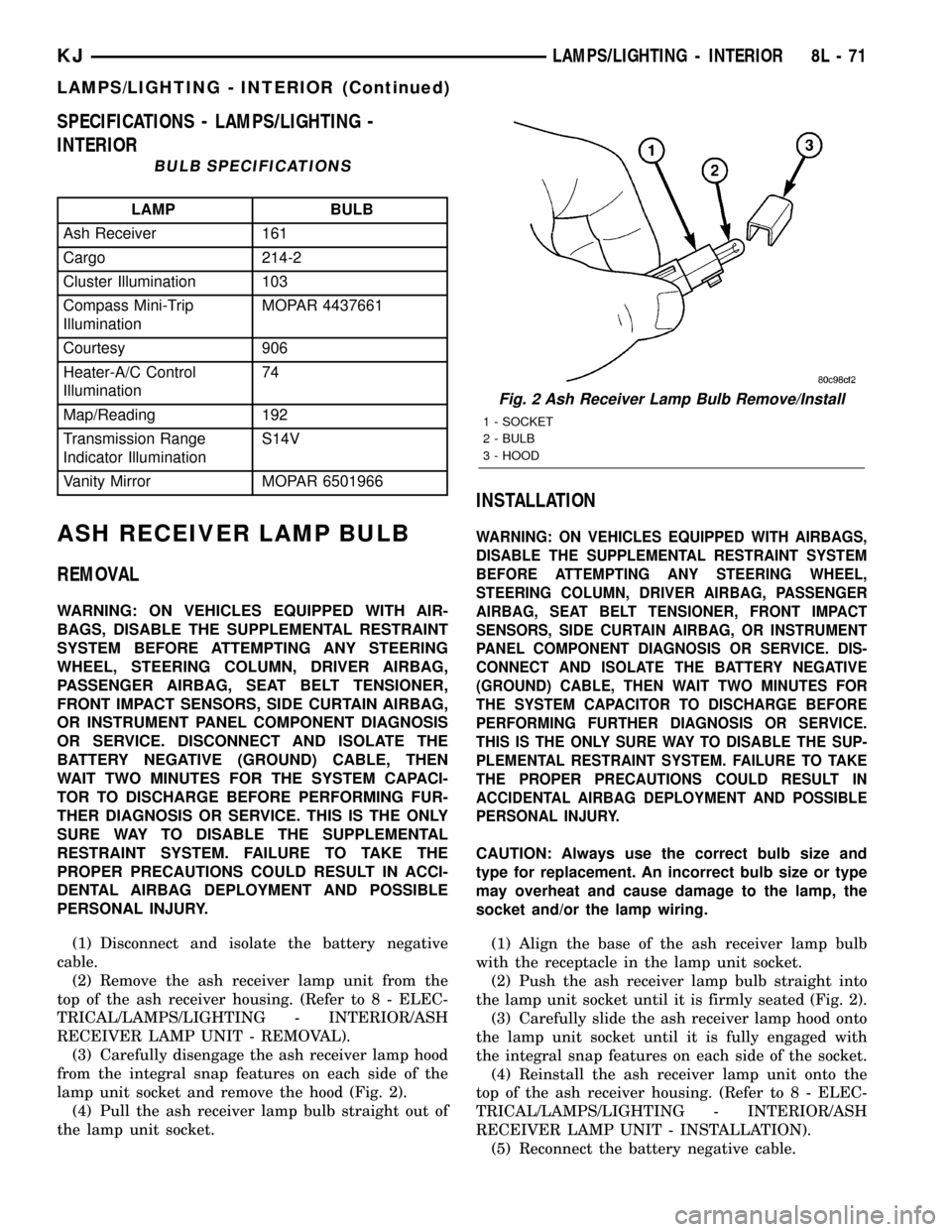
(3) Carefully disengage the ash receiver lamp hood
from the integral snap features on each side of the
lamp unit socket and remove the hood (Fig. 2).
(4) Pull the ash receiver lamp bulb straight out of
the lamp unit socket.
INSTALLATION
WARNING: ON VEHICLES EQUIPPED WITH AIRBAGS,
DISABLE THE SUPPLEMENTAL RESTRAINT SYSTEM
BEFORE ATTEMPTING ANY STEERING WHEEL,
STEERING COLUMN, DRIVER AIRBAG, PASSENGER
AIRBAG, SEAT BELT TENSIONER, FRONT IMPACT
SENSORS, SIDE CURTAIN AIRBAG, OR INSTRUMENT
PANEL COMPONENT DIAGNOSIS OR SERVICE. DIS-
CONNECT AND ISOLATE THE BATTERY NEGATIVE
(GROUND) CABLE, THEN WAIT TWO MINUTES FOR
THE SYSTEM CAPACITOR TO DISCHARGE BEFORE
PERFORMING FURTHER DIAGNOSIS OR SERVICE.
THIS IS THE ONLY SURE WAY TO DISABLE THE SUP-
PLEMENTAL RESTRAINT SYSTEM. FAILURE TO TAKE
THE PROPER PRECAUTIONS COULD RESULT IN
ACCIDENTAL AIRBAG DEPLOYMENT AND POSSIBLE
PERSONAL INJURY.
CAUTION: Always use the correct bulb size and
type for replacement. An incorrect bulb size or type
may overheat and cause damage to the lamp, the
socket and/or the lamp wiring.
(1) Align the base of the ash receiver lamp bulb
with the receptacle in the lamp unit socket.
(2) Push the ash receiver lamp bulb straight into
the lamp unit socket until it is firmly seated (Fig. 2).
(3) Carefully slide the ash receiver lamp hood onto
the lamp unit socket until it is fully engaged with
the integral snap features on each side of the socket.
(4) Reinstall the ash receiver lamp unit onto the
top of the ash receiver housing. (Refer to 8 - ELEC-
TRICAL/LAMPS/LIGHTING - INTERIOR/ASH
RECEIVER LAMP UNIT - INSTALLATION).
(5) Reconnect the battery negative cable.
Fig. 2 Ash Receiver Lamp Bulb Remove/Install
1 - SOCKET
2 - BULB
3 - HOOD
KJLAMPS/LIGHTING - INTERIOR 8L - 71
LAMPS/LIGHTING - INTERIOR (Continued)
Page 530 of 1803

²Trailer Tow Adapter- Vehicles equipped with
a factory-installed trailer towing package have an
adapter provided that adapts the factory-installed
heavy duty 7-way trailer tow connector to a conven-
tional 4-way light duty connector.
²Trailer Tow Connector- Vehicles equipped
with a factory-installed trailer towing package have a
heavy duty 7-way trailer tow connector installed in a
bracket on the trailer hitch receiver.
²Trailer Tow Relays- Vehicles equipped with a
factory-installed trailer towing package have a con-
nector bank containing four relays located behind the
right quarter trim panel and over the right rear
wheel housing. The four relays are used to supply
fused ignition switch output (run), brake lamps, right
turn signal, and left turn signal outputs to a trailer
through the trailer tow wiring and connectors.
Hard wired circuitry connects the exterior lighting
system components to the electrical system of the
vehicle. These hard wired circuits are integral to sev-
eral wire harnesses, which are routed throughout the
vehicle and retained by many different methods.
These circuits may be connected to each other, to the
vehicle electrical system and to the exterior lighting
system components through the use of a combination
of soldered splices, splice block connectors, and many
different types of wire harness terminal connectors
and insulators. Refer to the appropriate wiring infor-
mation. The wiring information includes wiring dia-
grams, proper wire and connector repair procedures,
further details on wire harness routing and reten-
tion, as well as pin-out and location views for the
various wire harness connectors, splices and grounds.
OPERATION
Following are paragraphs that briefly describe the
operation of each of the major exterior lighting sys-
tems. The hard wired circuits and components of the
exterior lighting systems may be diagnosed and
tested using conventional diagnostic tools and proce-
dures. However, conventional diagnostic methods
may not prove conclusive in the diagnosis of the Body
Control Module (BCM), the ElectroMechanical
Instrument Cluster (EMIC), the Powertrain Control
Module (PCM), or the Programmable Communica-
tions Interface (PCI) data bus network. The most
reliable, efficient, and accurate means to diagnose
the BCM, the EMIC, the PCM, and the PCI data bus
network inputs and outputs related to the various
exterior lighting systems requires the use of a
DRBIIItscan tool. Refer to the appropriate diagnos-
tic information.BACKUP LAMPS
The backup (or reverse) lamps have a path to
ground at all times through their connection to the
rear lighting wire harness from a take out of the rear
body wire harness with an eyelet terminal connector
that is secured by a ground screw to the base of the
right D-pillar behind the quarter trim panel. The
backup lamps receive battery current from a fused
ignition switch output (run) fuse in the Junction
Block (JB) on the back-up lamp feed circuit only
when the backup lamp switch (manual transmission),
or backup lamp switch circuit of the Transmission
Range Sensor (TRS - electronic automatic transmis-
sion) is closed by the gearshift mechanism within the
transmission.
BRAKE LAMPS
The brake (or stop) lamps have a path to ground at
all times through their connection to the rear light-
ing wire harness from a take out of the rear body
wire harness with an eyelet terminal connector that
is secured by a screw to the base of the right D-pillar
behind the quarter trim panel. The Center High
Mounted Stop Lamp (CHMSL) has a path to ground
at all times through its connection to the rear body
wire harness from a take out of the rear body wire
harness with an eyelet terminal connector that is
secured by a ground screw to the driver side D-pillar
(left side D-pillar for left-hand drive, right side D-pil-
lar for right-hand drive) behind the quarter trim
panel. The brake lamps and CHMSL receive battery
current from a fused B(+) fuse in the Junction Block
(JB) on the brake lamp switch output circuit only
when the brake lamp switch circuit of the brake
lamp switch is closed by the brake pedal arm.
DAYTIME RUNNING LAMPS
Vehicles manufactured for sale in Canada illumi-
nate the high beam filament at a reduced intensity
when the engine is running and the exterior lamps
are turned off. This feature is enabled by the Body
Control Module (BCM) and a solid state Daytime
Running Lamps (DRL) relay, which is installed in the
Junction Block (JB) and the high beam relay is omit-
ted. When the BCM monitors an engine speed signal
of greater than 450 RPM and the status of the exte-
rior lighting switch input from the multi-function
switch is Off, the BCM duty cycles the DRL relay to
produce illumination of the headlamp high beam fil-
aments at a reduced intensity. The BCM also pro-
vides normal headlamp high beam operation through
the DRL relay on vehicles so equipped. When the
DRL relay is energized, it provides battery current
from a fused B(+) fuse in the JB to the headlamp
high beam filament through the DRL relay output
circuit.
KJLAMPS8Ls-5
LAMPS/LIGHTING - EXTERIOR (Continued)
Page 531 of 1803

FRONT FOG LAMPS
Vehicles equipped with optional front fog lamps
have a premium Body Control Module (BCM), a front
fog lamp relay installed in the Junction Block (JB),
and a front fog lamp switch integral to the left (light-
ing) control stalk of the multi-function switch. The
front fog lamps have a path to ground at all times
through their connection to the front fascia wire har-
ness from two take outs of the headlamp and dash
wire harness with eyelet terminal connectors that
are secured by ground screws to the left inner fender
shield in the engine compartment. The BCM controls
front fog lamp operation by monitoring the exterior
lighting switch input from the multi-function switch,
then energizing or de-energizing the front fog lamp
relay control coil; and, by sending the appropriate
electronic message to the instrument cluster over the
Programmable Communications Interface (PCI) data
bus to turn the front fog lamp indicator on or off.
When the front fog lamp relay is energized, it pro-
vides battery current from a fused B(+) fuse in the
JB to the front fog lamps through the front fog lamp
relay output circuit. The BCM provides a battery
saver (load shedding) feature for the front fog lamps,
which will turn these lamps off if they are left on for
more than about eight minutes with the ignition
switch in the Off position. In certain markets where
required, the front fog lamps are also turned off by
the BCM whenever the headlamp high beams are
selected. Each front fog lamp includes an integral
adjustment screw to be used for static aiming the fog
lamp beams.
HAZARD WARNING LAMPS
With the hazard switch in the On position, the
hazard warning system is activated causing the haz-
ard switch button illumination lamp, the right and
left turn signal indicators, and the right and left turn
signal lamps to flash on and off. When the hazard
warning system is activated, the circuitry within the
hazard switch and electronic combination flasher
unit will repeatedly energize and de-energize two
internal relays that switch battery current from a
fused B(+) fuse in the Junction Block (JB) to the
right side and left side turn signal indicators, and
turn signal lamps through the right and left turn sig-
nal circuits. The flashing of the hazard switch button
illumination lamp is performed internally by the haz-
ard switch and combination flasher unit circuit
board. The hazard warning lamps can also be ener-
gized by the Body Control Module (BCM) through a
hazard lamp control circuit input to the hazard
switch and combination flasher unit.HEADLAMPS
The headlamp system includes the Body Control
Module (BCM), a low beam relay installed in the
Junction Block (JB), a high beam relay installed in
the JB (except Canada), a solid state Daytime Run-
ning Lamps (DRL) relay installed in the JB (Canada
only), and the exterior lighting (headlamp and dim-
mer) switches integral to the left (lighting) control
stalk of the multi-function switch. The headlamp
bulbs have a path to ground at all times through
their connection to the grille opening reinforcement
wire harness from two take outs of the headlamp and
dash wire harness with eyelet terminal connectors
that are secured by ground screws to the left inner
fender shield in the engine compartment. The BCM
controls the headlamp operation by monitoring the
exterior lighting switch inputs from the multi-func-
tion switch, then energizing or de-energizing the con-
trol coils of the low beam relay, the high beam relay,
or the solid state circuitry of the DRL relay; and, by
sending the appropriate electronic message to the
instrument cluster over the Programmable Commu-
nications Interface (PCI) data bus to turn the high
beam indicator on or off. When each respective relay
is energized, it provides battery current from a fused
B(+) fuse in the Power Distribution Center (PDC)
through a relay (low beam, high beam, or DRL) out-
put circuit and four separate fuses in the JB through
individual fused right and left, low and high beam
output circuits to the appropriate headlamp bulb fil-
aments. The BCM provides a battery saver (load
shedding) feature for the headlamps, which will turn
these lamps off if they are left on for more than
about eight minutes with the ignition switch in the
Off position; and, a headlamp delay feature with a
DRBIIItscan tool programmable delay interval.
Each headlamp includes an integral adjustment
screw to be used for static aiming of the headlamp
beams.
HEADLAMP LEVELING
In certain markets where required, a headlamp
leveling system is provided on the vehicle. The head-
lamp leveling system includes unique headlamp units
equipped with a headlamp leveling actuator motor,
and a rotary thumbwheel actuated headlamp leveling
switch on the instrument panel. The headlamp level-
ing system allows the headlamp beams to be
adjusted to one of four vertical positions to compen-
sate for changes in inclination caused by the loading
of the vehicle suspension. The actuator motors are
mechanically connected through an integral pushrod
to an adjustable headlamp reflector. The headlamp
leveling switch is a resistor multiplexed unit that
provides one of four voltage outputs to the headlamp
leveling motors. The headlamp leveling motors will
8Ls - 6 LAMPSKJ
LAMPS/LIGHTING - EXTERIOR (Continued)
Page 532 of 1803

move the headlamps to the selected position based
upon the voltage input received from the switch. The
headlamp leveling motors and switch have a path to
ground at all times. The headlamp leveling compo-
nents operate on battery current received through
the fused park lamp relay output circuit so that the
system will only operate when the exterior lighting is
turned on.
PARK LAMPS
The park lamps system includes the Body Control
Module (BCM), a park lamp relay installed in the
Junction Block (JB), and the exterior lighting switch
integral to the left (lighting) control stalk of the
multi-function switch. The front park lamp and side
marker or, if equipped, the front position lamp bulbs
each have a path to ground at all times through their
connections to the grille opening reinforcement wire
harness from two take outs of the headlamp and
dash wire harness with eyelet terminal connectors
that are secured by ground screws to the left inner
fender shield in the engine compartment. The rear
park lamp bulbs and license plate lamp have a path
to ground at all times through their connection to the
rear lighting wire harness from a take out of the rear
body wire harness with an eyelet terminal connector
that is secured by a ground screw to the base of the
right D-pillar behind the quarter trim panel. The
BCM controls the park lamp operation by monitoring
the exterior lighting switch inputs from the multi-
function switch, then energizing or de-energizing the
control coil of the park lamp relay. When the park
lamp relay is energized, it provides battery current
from a fused B(+) fuse in the Power Distribution
Center (PDC) through a park lamp relay output cir-
cuit and a separate fuse in the JB through a fused
park lamp relay output circuit to the appropriate
lamp bulb filaments. The BCM provides a battery
saver (load shedding) feature for the park lamps,
which will turn these lamps off if they are left on for
more than about eight minutes with the ignition
switch in the Off position.
REAR FOG LAMPS
Rear fog lamps are installed on vehicles manufac-
tured for certain markets where they are required.
The rear fog lamp system includes a premium Body
Control Module (BCM), a rear fog lamp relay
installed in the Junction Block (JB), and a rear fog
lamp switch integral to the left (lighting) control
stalk of the multi-function switch. The rear fog lamps
have a path to ground at all times through their con-
nection to the rear lighting wire harness from a take
out of the rear body wire harness with an eyelet ter-
minal connector that is secured by a ground screw to
the base of the right D-pillar behind the quarter trimpanel. The BCM controls rear fog lamp operation by
monitoring the exterior lighting switch input from
the multi-function switch, then energizing or de-ener-
gizing the rear fog lamp relay control coil; and, by
sending the appropriate electronic message to the
instrument cluster over the Programmable Commu-
nications Interface (PCI) data bus to turn the rear
fog lamp indicator on or off. When the rear fog lamp
relay is energized, it provides battery current from a
fused B(+) fuse in the JB to the rear fog lamps
through the rear fog lamp relay output circuit. The
BCM provides a battery saver (load shedding) feature
for the rear fog lamps, which will turn these lamps
off if they are left on for more than about eight min-
utes with the ignition switch in the Off position.
TURN SIGNAL LAMPS
When the left control stalk of the multi-function
switch is moved up (right turn) or down (left turn),
the turn signal system is activated causing the
selected right or left turn signal indicator, and right
or left turn signal lamps to flash on and off. When
the turn signal system is activated, the circuitry
within the turn signal switch and the hazard switch/
electronic combination flasher unit will repeatedly
energize and de-energize one of two internal relays
that switch battery current from a fused ignition
switch output (run) fuse in the Junction Block (JB) to
the right side or left side turn signal indicators and
turn signal lamps through the right or left turn sig-
nal circuits. The ElectroMechanical Instrument Clus-
ter (EMIC) chime tone generator will generate an
audible turn signal cancel warning each time the
vehicle is driven for a distance of about 3.2 kilome-
ters (about two miles) with a turn signal indicator
flashing. The EMIC uses Programmable Communica-
tions Interface (PCI) data bus distance messages
from the Powertrain Control Module (PCM) and a
hard wired input from the turn signal switch cir-
cuitry of the multi-function switch to determine when
to sound the turn signal cancel warning.
DIAGNOSIS AND TESTING - LAMPS/LIGHTING
- EXTERIOR
The hard wired circuits and components of the
exterior lighting systems may be diagnosed and
tested using conventional diagnostic tools and proce-
dures. However, conventional diagnostic methods
may not prove conclusive in the diagnosis of the Body
Control Module (BCM), the ElectroMechanical
Instrument Cluster (EMIC), the Powertrain Control
Module (PCM), or the Programmable Communica-
tions Interface (PCI) data bus network. The most
reliable, efficient, and accurate means to diagnose
the BCM, the EMIC, the PCM, and the PCI data bus
network inputs and outputs related to the various
KJLAMPS8Ls-7
LAMPS/LIGHTING - EXTERIOR (Continued)
Page 574 of 1803

²Headlamp Optical Horn- The left (lighting)
control stalk of the multi-function switch is pulled
towards the steering wheel to just before a detent, to
momentarily activate the headlamp optical horn fea-
ture. The high beams will remain illuminated until
the control stalk is released. The multi-function
switch provides a ground output on a high beam
relay control circuit to energize the headlamp high
beam relay (Daytime Running Lamp relay in Cana-
dian vehicles) in the Junction Block (JB) as required.
²Interior Lamps Defeat- The control ring on
the multi-function switch left (lighting) control stalk
is rotated to a full rearward (clockwise) detent to
defeat the illumination of all interior courtesy lamps.
The multi-function switch provides a resistor multi-
plexed output to the Body Control Module (BCM) on
a panel lamps dimmer switch mux circuit, and the
BCM responds by de-energizing its internal courtesy
lamp driver circuit.
²Interior Lamps On- The control ring on the
multi-function switch left (lighting) control stalk is
rotated to a full forward (counterclockwise) detent to
illuminate all interior courtesy lamps. The multi-
function switch provides a resistor multiplexed out-
put to the Body Control Module (BCM) on a panel
lamps dimmer switch mux circuit, and the BCM
responds by energizing its internal courtesy lamp
driver circuit.
²Panel Lamps Dimming- The control ring on
the multi-function switch left (lighting) control stalk
is rotated to one of six minor intermediate detents to
simultaneously select the desired illumination inten-
sity of all adjustable instrument panel and instru-
ment cluster lighting. The control ring is rotated
rearward (clockwise) to dim, or forward (counter-
clockwise) to brighten. The multi-function switch pro-
vides a resistor multiplexed output to the Body
Control Module (BCM) on a panel lamps dimmer
switch mux circuit, and the BCM responds by send-
ing an electronic panel lamps dimming level message
to the ElectroMechanical Instrument Cluster (EMIC)
over the Programmable Communications Interface
(PCI) data bus. The EMIC electronic circuitry then
provides the proper PWM output to the cluster illu-
mination lamps and the VFD on the EMIC circuit
board, then provides a matching PWM output on the
hard wired fused panel lamps dimmer switch signal
circuit.
²Parade Mode- The control ring on the multi-
function switch left (lighting) control stalk is rotated
to an intermediate detent that is one detent rear-
ward (clockwise) from the full forward (counterclock-
wise) detent to select the Parade mode. The multi-
function switch provides a resistor multiplexed
output to the Body Control Module (BCM) on a panel
lamps dimmer switch mux circuit, and the BCMresponds by sending an electronic panel lamps dim-
ming level message to the ElectroMechanical Instru-
ment Cluster (EMIC) over the Programmable
Communications Interface (PCI) data bus. The EMIC
electronic circuitry then provides the proper PWM
output to the cluster illumination lamps and the
VFD on the EMIC circuit board, then provides a
matching PWM output on the hard wired fused panel
lamps dimmer switch signal circuit to illuminate all
lamps at full (daylight) intensity with the exterior
lamps turned On.
²Park Lamps- The control knob on the end of
the multi-function switch left (lighting) control stalk
is rotated forward (counterclockwise) to its first
detent from the Off position to activate the park
lamps. The multi-function switch provides a resistor
multiplexed output to the Body Control Module
(BCM) on a headlamp switch sense circuit, and the
BCM responds by energizing or de-energizing the
park lamp relay in the Junction Block (JB) as
required.
²Rear Fog Lamps- For vehicles so equipped,
the control knob on the end of the multi-function
switch left (lighting) control stalk is rotated forward
(counterclockwise) to its third detent position to acti-
vate the rear fog lamps. The multi-function switch
provides a resistor multiplexed output to the Body
Control Module (BCM) on a headlamp switch sense
circuit, and the BCM responds by energizing or de-
energizing the rear fog lamp relay in the Junction
Block (JB) as required. Rear fog lamps are optional
only for vehicles manufactured for certain markets,
where they are required.
²Turn Signal Control- The left (lighting) con-
trol stalk of the multi-function switch is moved
upward to activate the right turn signal circuitry,
and, downward to activate the left turn signal cir-
cuitry. The turn signal switch has a detent position
in each direction that provides turn signals with
automatic cancellation, and an intermediate, momen-
tary position in each direction that provides turn sig-
nals only until the left multi-function switch control
stalk is released. When the control stalk is moved to
a turn signal switch detent position, the cancel
actuator extends toward the center of the steering
column. A turn signal cancel cam that is integral to
the clockspring rotates with the steering wheel and
the cam lobes contact the cancel actuator when it is
extended from the left multi-function switch. When
the steering wheel is rotated during a turning
maneuver, one of the two turn signal cancel cam
lobes will contact the turn signal cancel actuator. The
cancel actuator latches against the cancel cam rota-
tion in the direction opposite that which is signaled.
In other words, if the left turn signal detent is
selected, the lobes of the cancel cam will ratchet past
KJLAMPS8Ls-49
MULTI-FUNCTION SWITCH (Continued)
Page 600 of 1803

and the BCM use the DRB llltscan tool and proper
Body Diagnostic Procedure Manual.
INSTANTANEOUS FUEL ECONOMY
The compass mini-trip computer receives instanta-
neous fuel economy information from the BCM over
the PCI bus line. If compass mini-trip computer dis-
plays a dash (-) instead of an instantaneous fuel
economy value, it is not receiving a PCI bus message
for the instantaneous fuel economy from the BCM. To
check out the PCI bus line and the BCM use the
DRB llltscan tool and proper Body Diagnostic Pro-
cedure Manual.
TRIP ODOMETER
The compass mini-trip computer receives trip
odometer information from the Cluster over the PCI
bus line. If compass mini-trip computer displays
dashes - - instead of the trip odometer value, it is not
receiving a PCI bus message for the trip odometer
from the cluster. To check out the PCI bus line and
the Cluster, use the DRB llltscan tool and proper
Body Diagnostic Procedure Manual.
ELAPSED TIME
The compass mini-trip computer receives a PCI
bus message containing elapsed time information. If
compass mini-trip computer displays dashes --
instead of the elapsed time, it is not receiving a PCI
bus message for the elapsed time from the BCM. To
check out the PCI bus line and the BCM, use the
DRB llltscan tool and proper Body Diagnostic Pro-
cedure Manual.
COMPASS DISPLAY
To display the vehicle direction, the compass mini-
trip computer processes information from a sensor
internal to the module. The compass mini-trip com-
puter is self- calibrating and requires only variance
adjustments dependent upon location. The compass
mini-trip computer displays the label CAL whenever
the compass is in the fast calibration mode.
If all three of the following conditions listed below
occur, the vehicle must be demagnetized.
²Compass portion of the display is blank
²Temperature portion of the display is OK
²The label CAL is illuminated
If demagnetizing the vehicle is needed, refer to the
demagnetizing procedure in this section. After
demagnetizing, to calibrate the compass refer to Cal-
ibration Procedure and to set the variance refer to
Variance Procedure, both within this section. If the
compass portion of the display is still blank, replace
the compass mini-trip computer.
COMPASS MINI-TRIP COMPUTER - SELF
DIAGNOSTIC TEST
(1) With the ignition switch in the OFF position
simultaneously press the C/T and STEP buttons and
hold.
(2) Turn the ignition switch ON, then release C/T
and STEP buttons.
(3) The Compass mini-trip computer should light
all segments on the VF Display Screen for 2-4 sec-
onds. Check for segments that are not illuminated.
(4) If the compass mini-trip computer displays
PASS, the module is OK.
(5) If the compass mini-trip computer displays
FAIL, replace the module.
(6) If the compass mini-trip computer displays
bUS, check for an open or a short on the PCI bus
communication circuit.
(7) Press the C/T or the STEP button to exit the
self-diagnostic test.
REMOVAL
(1) Remove overhead console, refer to Console
Removal and Installation in this section.
(2) Remove mounting screws and release the map
lamp wire connector from the compass mini-trip com-
puter. (Fig. 6).
Fig. 6 Compass Mini-Trip Computer Retaining
Screws
1 - LAMPS
2 - MOUNTING SCREWS
KJMESSAGE SYSTEMS 8M - 7
COMPASS/MINI-TRIP COMPUTER (Continued)
Page 612 of 1803

Press and hold the transmitter UNLOCK button
for four to ten seconds. While pressing the UNLOCK
button in, press the LOCK button. Release both but-
tons.
This will toggle between Driver door first and
Unlock all doors function.
STANDARD PROCEDURE - RKE TRANSMITTER
PROGRAMING
New Remote Keyless Entry (RKE) transmitters can
be programed using the DRBIIItscan tool and the
proper Diagnostic Procedures manual. The DRBIIIt
scan tool can provide confirmation that the PCI data
bus is functional, and that all of the electronic mod-
ules are sending and receiving the proper messages
on the PCI data bus.
The following procedure can be used as long as one
functioning transmitter is available:
(1) Using the original transmitter, press the
UNLOCK button for 4 to 10 seconds.
(2) Without releasing the UNLOCK button, press
the PANIC button (within the 4 to 10 second inter-
val).
(3) Release both buttons.
(4) Press LOCK and UNLOCK simultaneously on
the original transmitter.
(5) Release both buttons.
(6) Press any button on the ORIGINAL transmit-
ter. A chime tone from the instrument cluster will
confirm the programming of the ORIGINAL trans-
mitter.
(7) On NEW transmitter, press LOCK and
UNLOCK simultaneously.
(8) Release both buttons.
(9) Press any button on the NEW transmitter. A
chime tone from the instrument cluster will confirm
the programming of the NEW transmitter.
(10) Up to four transmitters can be programed for
one vehicle.
SPECIFICATIONS - REMOTE KEYLESS ENTRY
TRANSMITTER
RANGE
Normal operation range is up to a distance of 3 to
7 meters (10 to 23 ft.) of the vehicle. Range may be
better or worse depending on the environment
around the vehicle.
TAILGATE CYLINDER LOCK
SWITCH
DESCRIPTION
The tailgate cylinder lock switch is integral to the
key lock cylinder inside the tailgate. The tailgate cyl-
inder lock switch is a normally-open momentary
switch that is hard wired directly to the Body Con-
trol Module (BCM), and closes a path to ground
through an internal resistor when the lock cylinder is
rotated to the unlock or lock position.
The tailgate cylinder lock switch cannot be
adjusted or repaired.
OPERATION
The tailgate cylinder lock switch is actuated when
the key is inserted in the lock cylinder and turned to
the unlock or lock position. The tailgate cylinder lock
switch closes a path to ground through an internal
resistor for the Body Control Module (BCM) when
the tailgate key lock cylinder is in the lock or unlock
position, and opens the ground path when the lock
cylinder is in the neutral position. The BCM reads
the switch status, then sends the proper switch sta-
tus messages to other electronic modules over the
Programmable Communications Interface (PCI) data
bus network. The tailgate cylinder lock switch unlock
status message is used by the BCM as an input for
Vehicle Theft Security System (VTSS) operation and
to tell the BCM to lock or unlock the tailgate. There
is no mechanical linkage between the tailgate key
cylinder and the latches.
DIAGNOSIS AND TESTING - TAILGATE
CYLINDER LOCK SWITCH
(1) Disconnect and isolate the battery negative
cable.
(2) Remove tailgate trim panel (Refer to 23 -
BODY/DECKLID/HATCH/LIFTGATE/TAILGATE/
TRIM PANEL - REMOVAL).
(3) Disconnect tailgate cylinder lock switch har-
ness connector.
(4) Using a ohmmeter, test for resistances as
shown in the Tailgate Cylinder Lock Switch Table.
KJPOWER LOCKS 8N - 9
REMOTE KEYLESS ENTRY TRANSMITTER (Continued)
Page 630 of 1803

An occupant restraint system is standard factory-
installed safety equipment on this model. Available
occupant restraints for this model include both active
and passive types. Active restraints are those which
require the vehicle occupants to take some action to
employ, such as fastening a seat belt; while passive
restraints require no action by the vehicle occupants
to be employed (Fig. 1).
ACTIVE RESTRAINTS The active restraints for
this model include:
²Front Seat Belts- Both front seating positions
are equipped with three-point seat belt systems
employing a lower B-pillar mounted inertia latch-
type retractor, height-adjustable upper B-pillar
mounted turning loops, a traveling lower seat belt
anchor secured to the outboard side of the seat
frame, and a traveling end-release seat belt buckle
secured to the inboard side of the seat frame. Both
front seat belt buckles include an integral Hall-effect
seat belt switch that detects whether its respective
seat belt has been fastened.
²Rear Seat Belts- All three rear seating posi-
tions are equipped with three-point seat belt sys-
tems. The outboard seating position belts employ a
lower C-pillar mounted inertia latch-type retractor, a
fixed position upper C-pillar mounted turning loop,
and a fixed lower seat belt anchor secured to the
floor panel. The rear seat center seating position belt
has an inertia latch-type retractor that is integral to
the rear seat back panel, and a cable from the seat
back latch locks the center belt retractor spool unless
the seat back is fully latched. The rear seat center
seating position belt lower anchor is secured to the
floor panel. All three rear seat belts have fixed end-
release seat belt buckles secured to the floor panel, a
single buckle unit on the right side and a double
buckle unit on the left side.
²Child Seat Tether Anchors- All vehicles are
equipped with three, fixed-position, child seat tether
anchors. Two anchors are integral to the back of the
right rear seat back panel, and one is integral to the
left rear seat back panel.
PASSIVE RESTRAINTS The passive restraints
available for this model include the following:
²Dual Front Airbags- Multistage driver and
front passenger airbags are available for this model.
This airbag system is a passive, inflatable, Supple-
mental Restraint System (SRS) and vehicles with
this equipment can be readily identified by the ªSRS
- AIRBAGº logo molded into the driver airbag trim
cover in the center of the steering wheel and also
into the passenger airbag door on the instrument
panel above the glove box (Fig. 2). Vehicles with the
airbag system can also be identified by the airbag
indicator, which will illuminate in the instrument
cluster for about seven seconds as a bulb test eachtime the ignition switch is turned to the On position.
A pyrotechnic-type seat belt tensioner is integral to
the driver side front seat belt retractor mounted on
the lower B-pillar of all models equipped with dual
front airbags.
²Side Curtain Airbags- Optional side curtain
airbags are available for this model when it is also
equipped with dual front airbags. This airbag system
is a passive, inflatable, Supplemental Restraint Sys-
tem (SRS) and vehicles with this equipment can be
readily identified by a molded identification trim but-
ton with the ªSRS - AIRBAGº logo located on the
headliner above each B-pillar (Fig. 2).
The supplemental restraint system includes the
following major components, which are described in
further detail elsewhere in this service information:
²Airbag Control Module- The Airbag Control
Module (ACM) is also sometimes referred to as the
Occupant Restraint Controller (ORC). The ACM is
located on a mount on the floor panel transmission
tunnel, below the center of the instrument panel.
²Airbag Indicator- The airbag indicator is inte-
gral to the ElectroMechanical Instrument Cluster
(EMIC), which is located on the instrument panel in
front of the driver.
²Clockspring- The clockspring is located near
the top of the steering column, directly beneath the
steering wheel.
²Driver Airbag- The driver airbag is located in
the center of the steering wheel, beneath the driver
airbag trim cover.
²Driver Knee Blocker- The driver knee blocker
is a structural unit secured to the back side of and
integral to the instrument panel steering column
opening cover.
²Front Impact Sensor- Two front impact sen-
sors are used on vehicles equipped with dual front
airbags, one left side and one right side. One sensor
Fig. 2 SRS Logo
KJRESTRAINTS 8O - 3
RESTRAINTS (Continued)