removing JEEP LIBERTY 2002 KJ / 1.G Workshop Manual
[x] Cancel search | Manufacturer: JEEP, Model Year: 2002, Model line: LIBERTY, Model: JEEP LIBERTY 2002 KJ / 1.GPages: 1803, PDF Size: 62.3 MB
Page 41 of 1803
INSTALLATION
(1) Position the upper suspension arm in the
frame rail brackets (Fig. 8).
(2) Install the mounting bolts and tighten to 100
N´m (74 ft. lbs.).
(3) Retighten the heat shield back into place.
(4) Pull the arm down on the differential housing
bracket and install the pinch bolt and nut. Tighten
the nut to 95 N´m (70 ft. lbs.) (Fig. 7).
(5) Remove the supports and lower the vehicle.
LOWER CONTROL ARM
DESCRIPTION
The lower suspension arms are stamped steel and
welded and use voided round bushings at the axle
end and solid rubber at the body end of the arm.
OPERATION
The bushings provide isolation from the axle. The
arms mount to the unibody frame rail bracket and
the axle brackets. The arm and bushings provide
location and react to loads.
REMOVAL
(1) Raise the vehicle and support the rear axle.
(2) Remove the stabilizer bar retaining bolts from
the suspension arm.
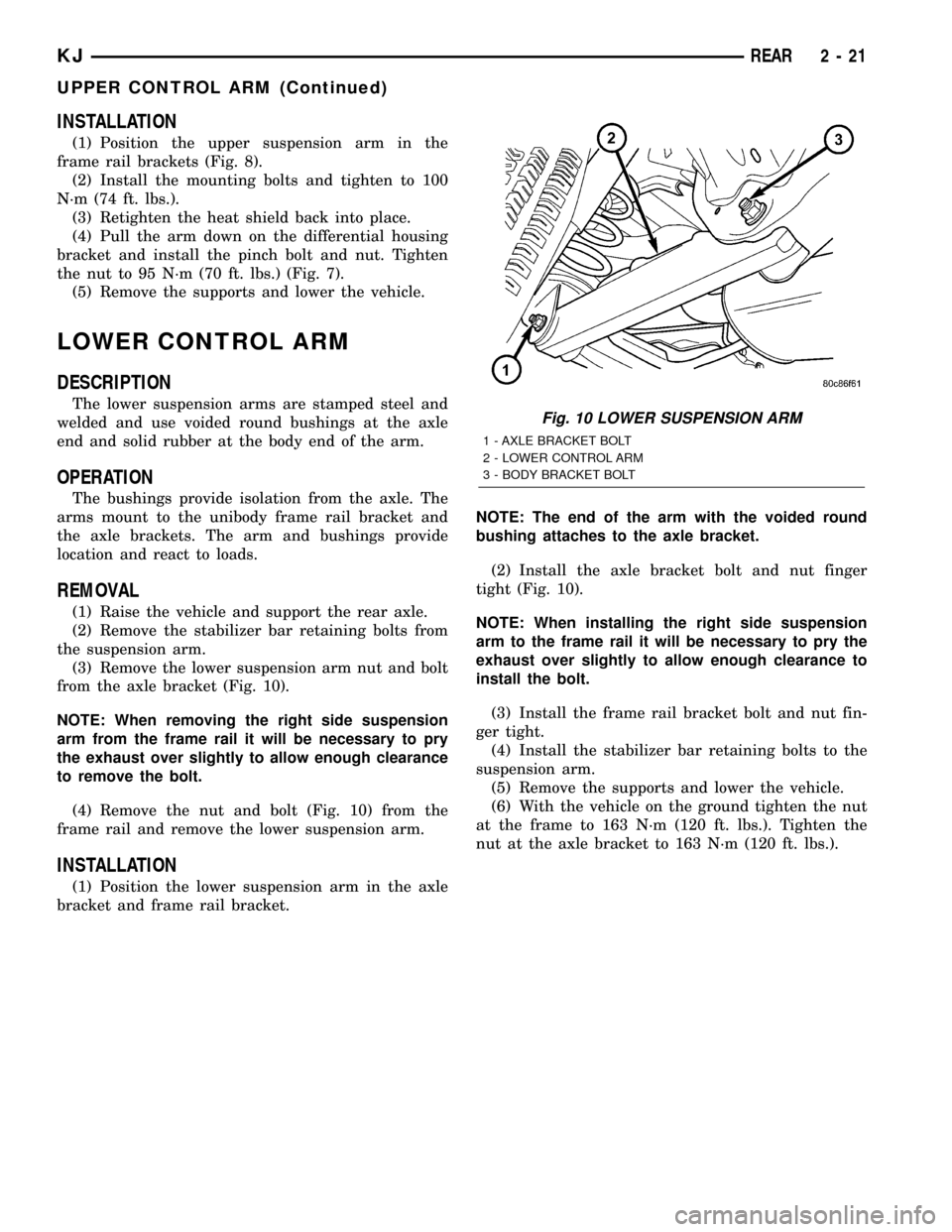
(3) Remove the lower suspension arm nut and bolt
from the axle bracket (Fig. 10).
NOTE: When removing the right side suspension
arm from the frame rail it will be necessary to pry
the exhaust over slightly to allow enough clearance
to remove the bolt.
(4) Remove the nut and bolt (Fig. 10) from the
frame rail and remove the lower suspension arm.
INSTALLATION
(1) Position the lower suspension arm in the axle
bracket and frame rail bracket.NOTE: The end of the arm with the voided round
bushing attaches to the axle bracket.
(2) Install the axle bracket bolt and nut finger
tight (Fig. 10).
NOTE: When installing the right side suspension
arm to the frame rail it will be necessary to pry the
exhaust over slightly to allow enough clearance to
install the bolt.
(3) Install the frame rail bracket bolt and nut fin-
ger tight.
(4) Install the stabilizer bar retaining bolts to the
suspension arm.
(5) Remove the supports and lower the vehicle.
(6) With the vehicle on the ground tighten the nut
at the frame to 163 N´m (120 ft. lbs.). Tighten the
nut at the axle bracket to 163 N´m (120 ft. lbs.).
Fig. 10 LOWER SUSPENSION ARM
1 - AXLE BRACKET BOLT
2 - LOWER CONTROL ARM
3 - BODY BRACKET BOLT
KJREAR 2 - 21
UPPER CONTROL ARM (Continued)
Page 51 of 1803
DRIVELINE VIBRATION
Drive Condition Possible Cause Correction
Propeller Shaft Noise 1. Undercoating or other foreign
material on shaft.1. Clean exterior of shaft and wash
with solvent.
2. Loose U-joint clamp screws. 2. Install new clamps and screws
and tighten to proper torque.
3. Loose or bent U-joint yoke or
excessive runout.3. Install new yoke.
4. Incorrect driveline angularity. 4. Measure and correct driveline
angles.
5. Worn joint. 5. Install new joint.
6. Propeller shaft damaged or out
of balance.6. Installl new propeller shaft.
7. Broken rear spring. 7. Install new rear spring.
8. Excessive runout or unbalanced
condition.8. Re-index propeller shaft, test, and
evaluate.
9. Excessive drive pinion gear shaft
runout.9. Re-index propeller shaft and
evaluate.
10. Excessive axle yoke deflection. 10. Inspect and replace yoke if
necessary.
11. Excessive transfer case runout. 11. Inspect and repair as necessary.
Joint Noise 1. Loose U-joint clamp screws. 1. Install new clamps and screws
and tighten to proper torque.
2. Lack of lubrication. 2. Replace joints as necessary.
BALANCE
NOTE: Removing and re-indexing the propeller
shaft 180É relative to the yoke may eliminate some
vibrations.
If propeller shaft is suspected of being unbalanced,
it can be verified with the following procedure:
(1) Raise the vehicle.
(2) Clean all the foreign material from the propel-
ler shaft and the universal joints.
(3) Inspect the propeller shaft for missing balance
weights, broken welds, and bent areas.If the pro-
peller shaft is bent, it must be replaced.
(4) Inspect the universal joints to ensure that they
are not worn, are properly installed, and are cor-
rectly aligned with the shaft.
(5) Check the universal joint clamp screws torque.
(6) Remove the wheels and tires. Install the wheel
lug nuts to retain the brake drums or rotors.
(7) Mark and number the shaft six inches from the
yoke end at four positions 90É apart.
(8) Run and accelerate the vehicle until vibration
occurs. Note the intensity and speed the vibration
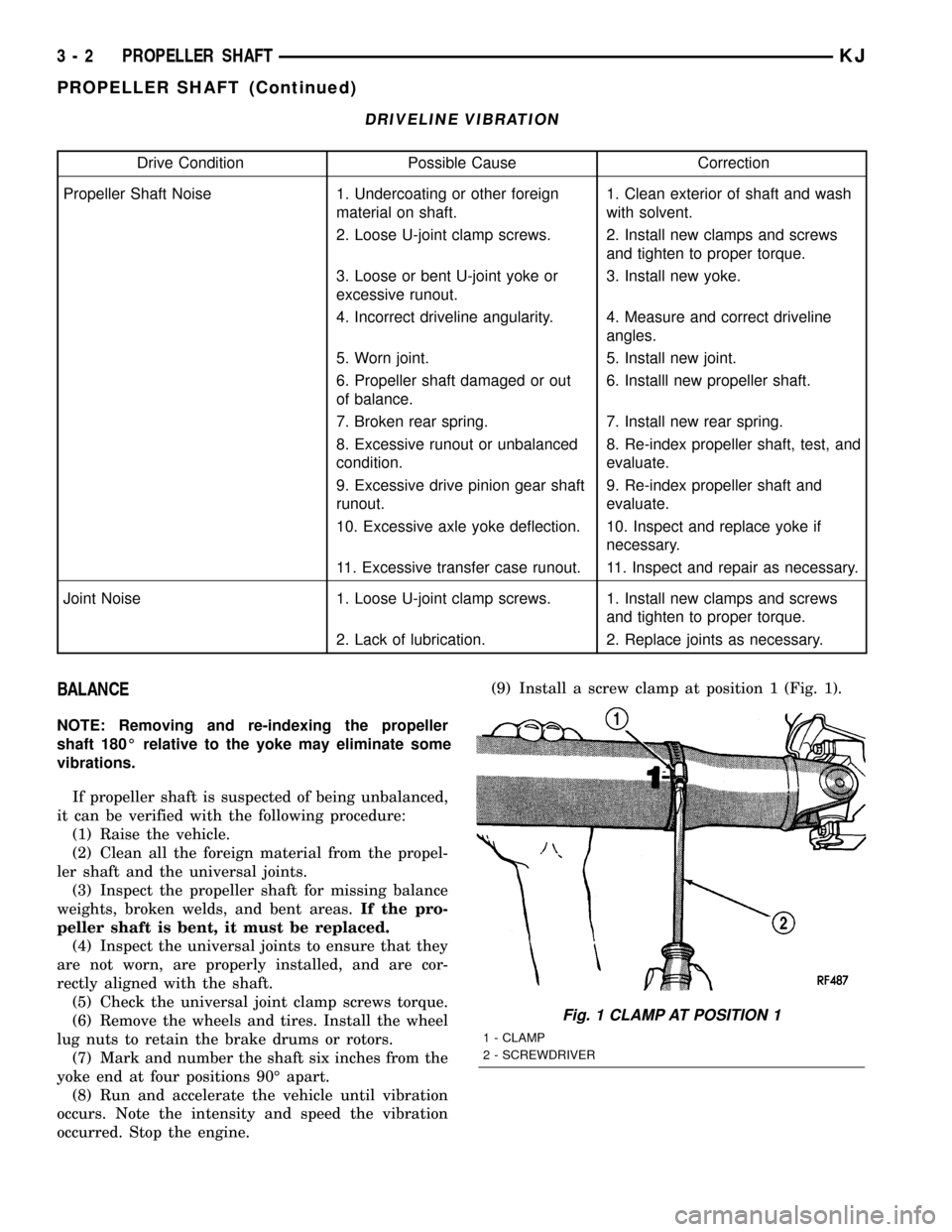
occurred. Stop the engine.(9) Install a screw clamp at position 1 (Fig. 1).
Fig. 1 CLAMP AT POSITION 1
1 - CLAMP
2 - SCREWDRIVER
3 - 2 PROPELLER SHAFTKJ
PROPELLER SHAFT (Continued)
Page 68 of 1803

FRONT AXLE - 186FIA
TABLE OF CONTENTS
page page
FRONT AXLE - 186FIA
DESCRIPTION.........................19
OPERATION...........................19
DIAGNOSIS AND TESTING - AXLE..........20
REMOVAL.............................24
INSTALLATION.........................24
ADJUSTMENTS........................25
SPECIFICATIONS - FRONT AXLE...........33
SPECIAL TOOLS
FRONT AXLE........................34
AXLE SHAFTS
REMOVAL.............................37
INSTALLATION.........................37
AXLE SHAFT SEALS
REMOVAL.............................37
INSTALLATION.........................38
AXLE BEARINGS
REMOVAL.............................38INSTALLATION.........................38
PINION SEAL
REMOVAL.............................38
INSTALLATION.........................39
DIFFERENTIAL
REMOVAL.............................40
DISASSEMBLY.........................41
ASSEMBLY............................41
INSTALLATION.........................42
DIFFERENTIAL CASE BEARINGS
REMOVAL.............................43
INSTALLATION.........................44
PINION GEAR/RING GEAR
REMOVAL.............................44
INSTALLATION.........................46
FRONT AXLE - 186FIA
DESCRIPTION
The 186FIA (Model 30) axle consists of an alumu-
num center section with an axle tube extending from
one side. The tube is pressed into the differential
housing. The integral type housing, hypoid gear
design has the centerline of the pinion set below the
centerline of the ring gear.
The differential case is a one-piece design. The differ-
ential pinion mate shaft is retained with a roll-pin. Dif-
ferential bearing preload and ring gear backlash is
adjusted by the use of shims (select thickness). The
shims are located between the differential bearing cups
and the axle housing. Pinion bearing preload is set and
maintained by the use of a collapsible spacer.
The power is transferred from the axle through two
constant velocity (C/V) drive shafts to the wheel hubs.
The differential cover provides a means for inspec-
tion and service without removing the axle from the
vehicle. The cover has a vent tube used to relieve
internal pressure caused by vaporization and inter-
nal expansion.
OPERATION
The axle receives power from the transfer case through
the front propeller shaft. The front propeller shaft is con-
nected to the pinion gear which rotates the differential
through the gear mesh with the ring gear bolted to thedifferential case. The engine power is transmitted to the
axle shafts through the pinion mate and side gears. The
side gears are splined to the axle shafts.
During straight-ahead driving, the differential pin-
ion gears do not rotate on the pinion mate shaft. This
occurs because input torque applied to the gears is
divided and distributed equally between the two side
gears. As a result, the pinion gears revolve with the
pinion mate shaft but do not rotate around it (Fig. 1).
Fig. 1 DIFFERENTIAL-STRAIGHT AHEAD DRIVING
1 - STRAIGHT AHEAD DRIVING
2 - PINION GEAR
3 - SIDE GEAR
4 - PINION GEARS ROTATE WITH CASE
KJFRONT AXLE - 186FIA 3 - 19
Page 98 of 1803

REAR AXLE - 198RBI
TABLE OF CONTENTS
page page
REAR AXLE - 198RBI
DESCRIPTION.........................49
OPERATION...........................49
DIAGNOSIS AND TESTING - AXLE..........51
REMOVAL.............................54
INSTALLATION.........................54
ADJUSTMENTS
ADJUSTMENT........................55
SPECIFICATIONS - REAR AXLE............62
SPECIAL TOOLS
REAR AXLE..........................63
AXLE SHAFTS
REMOVAL.............................65
INSTALLATION.........................65
AXLE BEARING/SEAL
REMOVAL.............................66
INSTALLATION.........................67
PINION SEAL
REMOVAL.............................68INSTALLATION.........................68
COLLAPSIBLE SPACER
REMOVAL.............................70
INSTALLATION.........................70
DIFFERENTIAL
REMOVAL.............................71
INSTALLATION.........................73
DIFFERENTIAL - TRAC-LOK
DIAGNOSIS AND TESTING - TRAC-LOKT.....74
DISASSEMBLY.........................75
CLEANING............................77
INSPECTION..........................77
ASSEMBLY............................77
DIFFERENTIAL CASE BEARINGS
REMOVAL.............................79
INSTALLATION.........................79
PINION GEAR/RING GEAR/TONE RING
REMOVAL.............................79
INSTALLATION.........................82
REAR AXLE - 198RBI
DESCRIPTION
The Rear Beam-design Iron (RBI) axle housing has
an iron center casting (differential housing) with axle
shaft tubes extending from either side. The tubes are
pressed into and welded to the differential housing to
form a one-piece axle housing. The axles are
equipped with semi±floating axle shafts, meaning
that loads are supported by the axle shaft and bear-
ings. The axle shafts are retained by the unit bear-
ing, retainer plate and bolts.
The integral type, hypoid gear design, housing has
the centerline of the pinion set below the centerline
of the ring gear. The differential case is a one-piece
design. The differential pinion mate shaft is retained
with a threaded screw. Differential bearing preload
and ring gear backlash is adjusted by the use of
selective spacer shims. Pinion bearing preload is set
and maintained by the use of a collapsible spacer
(Fig. 1).
The cover provides a means for servicing the differ-
ential without removing the axle. The axle has a vent
hose to relieve internal pressure caused by lubricant
vaporization and internal expansion.
Axles equipped with a Trac-Loktdifferential are
optional. A Trac-Loktdifferential has a one-piece dif-ferential case, and the same internal components as
a standard differential, plus two clutch disc packs.
OPERATION
The axle receives power from the transmission/
transfer case through the rear propeller shaft. The
Fig. 1 SHIM LOCATIONS
1 - PINION GEAR DEPTH SHIM
2 - DIFFERENTIAL BEARING SHIM-PINION GEAR SIDE
3 - RING GEAR
4 - DIFFERENTIAL BEARING SHIM-RING GEAR SIDE
5 - COLLAPSIBLE SPACER
KJREAR AXLE - 198RBI 3 - 49
Page 123 of 1803
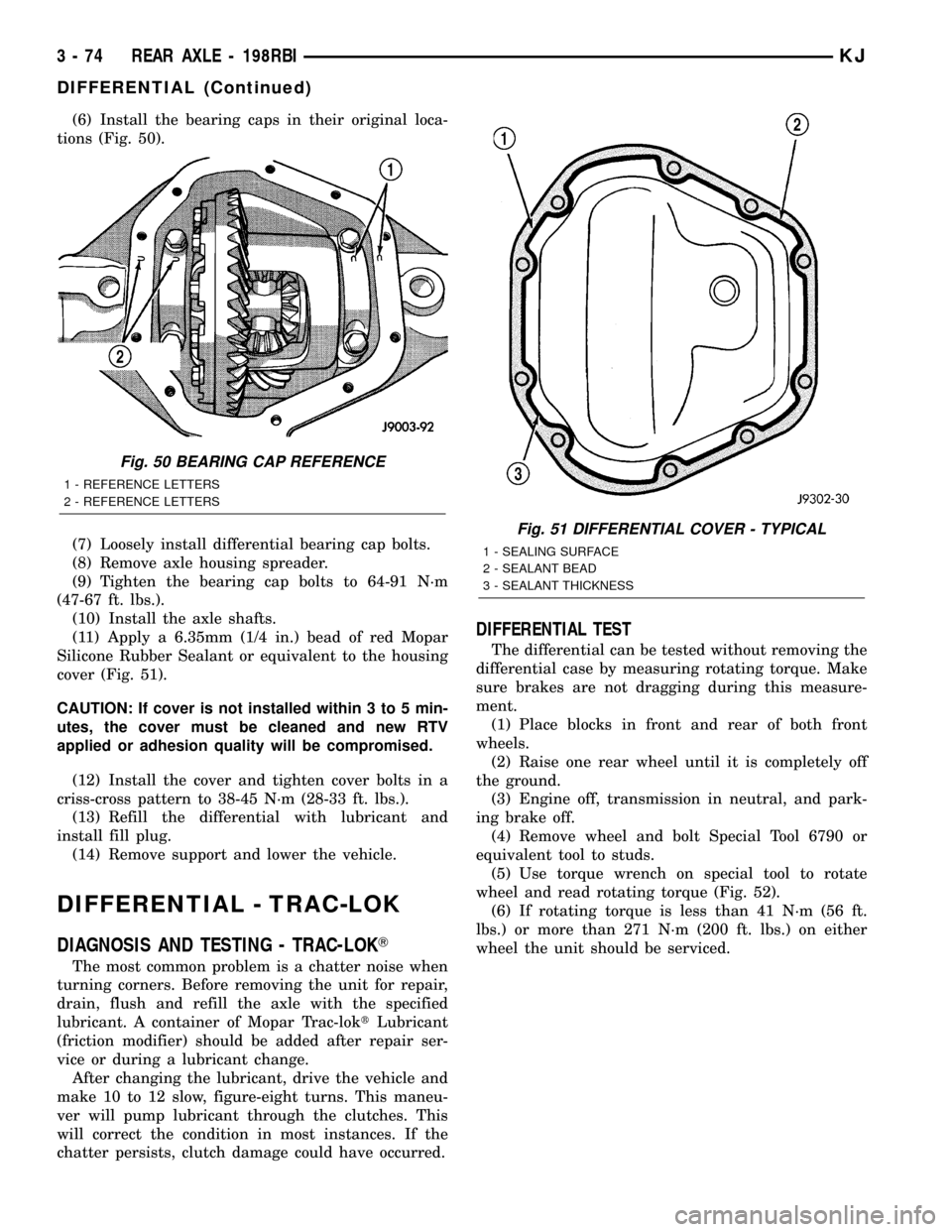
(6) Install the bearing caps in their original loca-
tions (Fig. 50).
(7) Loosely install differential bearing cap bolts.
(8) Remove axle housing spreader.
(9) Tighten the bearing cap bolts to 64-91 N´m
(47-67 ft. lbs.).
(10) Install the axle shafts.
(11) Apply a 6.35mm (1/4 in.) bead of red Mopar
Silicone Rubber Sealant or equivalent to the housing
cover (Fig. 51).
CAUTION: If cover is not installed within 3 to 5 min-
utes, the cover must be cleaned and new RTV
applied or adhesion quality will be compromised.
(12) Install the cover and tighten cover bolts in a
criss-cross pattern to 38-45 N´m (28-33 ft. lbs.).
(13) Refill the differential with lubricant and
install fill plug.
(14) Remove support and lower the vehicle.
DIFFERENTIAL - TRAC-LOK
DIAGNOSIS AND TESTING - TRAC-LOKT
The most common problem is a chatter noise when
turning corners. Before removing the unit for repair,
drain, flush and refill the axle with the specified
lubricant. A container of Mopar Trac-loktLubricant
(friction modifier) should be added after repair ser-
vice or during a lubricant change.
After changing the lubricant, drive the vehicle and
make 10 to 12 slow, figure-eight turns. This maneu-
ver will pump lubricant through the clutches. This
will correct the condition in most instances. If the
chatter persists, clutch damage could have occurred.
DIFFERENTIAL TEST
The differential can be tested without removing the
differential case by measuring rotating torque. Make
sure brakes are not dragging during this measure-
ment.
(1) Place blocks in front and rear of both front
wheels.
(2) Raise one rear wheel until it is completely off
the ground.
(3) Engine off, transmission in neutral, and park-
ing brake off.
(4) Remove wheel and bolt Special Tool 6790 or
equivalent tool to studs.
(5) Use torque wrench on special tool to rotate
wheel and read rotating torque (Fig. 52).
(6) If rotating torque is less than 41 N´m (56 ft.
lbs.) or more than 271 N´m (200 ft. lbs.) on either
wheel the unit should be serviced.
Fig. 50 BEARING CAP REFERENCE
1 - REFERENCE LETTERS
2 - REFERENCE LETTERS
Fig. 51 DIFFERENTIAL COVER - TYPICAL
1 - SEALING SURFACE
2 - SEALANT BEAD
3 - SEALANT THICKNESS
3 - 74 REAR AXLE - 198RBIKJ
DIFFERENTIAL (Continued)
Page 135 of 1803

REAR AXLE-81/4
TABLE OF CONTENTS
page page
REAR AXLE-81/4
DESCRIPTION.........................86
OPERATION...........................86
DIAGNOSIS AND TESTING - AXLE..........88
REMOVAL.............................91
INSTALLATION.........................91
ADJUSTMENTS........................92
SPECIFICATIONS
REAR AXLE..........................98
SPECIAL TOOLS
8 1/4 AXLE..........................98
AXLE SHAFTS
REMOVAL............................101
INSTALLATION........................101
AXLE SHAFT SEALS
REMOVAL............................101
INSTALLATION........................102
AXLE BEARINGS
REMOVAL............................102
INSTALLATION........................102PINION SEAL
REMOVAL............................102
INSTALLATION........................103
DIFFERENTIAL
REMOVAL............................104
DISASSEMBLY........................105
ASSEMBLY...........................105
INSTALLATION........................105
DIFFERENTIAL - TRAC-LOK
DIAGNOSIS AND TESTING - TRAC-LOKT....106
DISASSEMBLY........................107
CLEANING...........................109
INSPECTION.........................109
ASSEMBLY...........................109
DIFFERENTIAL CASE BEARINGS
REMOVAL............................110
INSTALLATION........................110
PINION GEAR/RING GEAR/TONE RING
REMOVAL............................110
INSTALLATION........................112
REAR AXLE-81/4
DESCRIPTION
The axle housings consist of a cast iron center sec-
tion with axle tubes extending from either side. The
tubes are pressed into and welded to the differential
housing to form a one-piece axle housing. The axles
are equipped with semi-floating axle shafts, meaning
vehicle loads are supported by the axle shaft and
bearings. The axle shafts are retained by C-locks in
the differential side gears.
The differential case is a one-piece design. The dif-
ferential pinion mate shaft is retained with a
threaded pin. Differential bearing preload and ring
gear backlash are set and maintained by threaded
adjusters at the outside of the differential housing.
Pinion bearing preload is set and maintained by the
use of a collapsible spacer.
The differential cover provides a means for inspec-
tion and service without removing the complete axlefrom the vehicle. A vent hose is used to relieve inter-
nal pressure caused by lubricant vaporization and
internal expansion.
Axles equipped with a Trac-Loktdifferential are
optional. A differential has a one-piece differential
case, and the same internal components as a stan-
dard differential, plus two clutch disc packs.
OPERATION
The axle receives power from the transmission/
transfer case through the rear propeller shaft. The
rear propeller shaft is connected to the pinion gear
which rotates the differential through the gear mesh
with the ring gear bolted to the differential case. The
engine power is transmitted to the axle shafts
through the pinion mate and side gears. The side
gears are splined to the axle shafts.
3 - 86 REAR AXLE-81/4KJ
Page 154 of 1803
(9) Hold the differential case while removing bear-
ing caps and adjusters.
(10) Remove the differential case.
NOTE: Tag bearing cups and threaded adjusters
location, for installation reference.
DISASSEMBLY
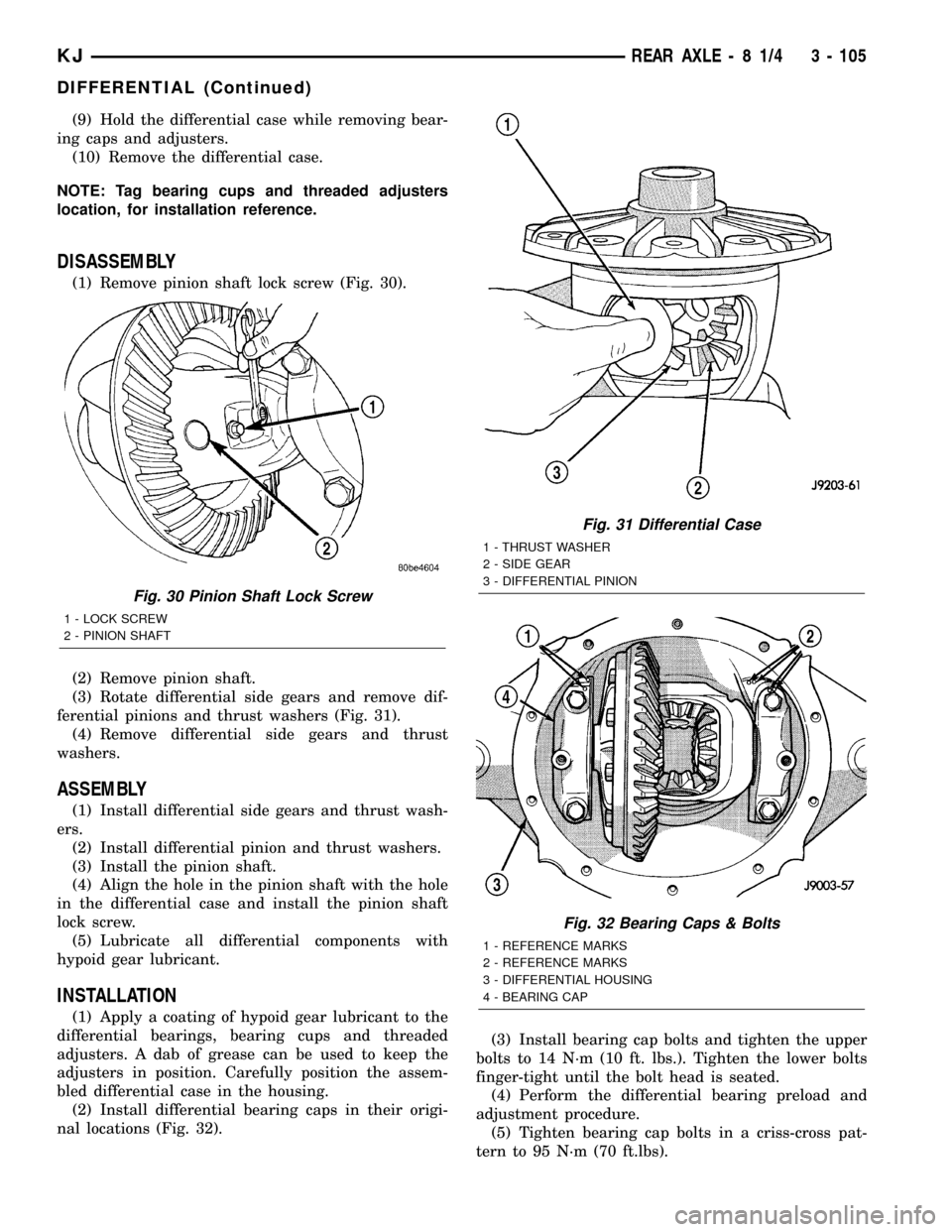
(1) Remove pinion shaft lock screw (Fig. 30).
(2) Remove pinion shaft.
(3) Rotate differential side gears and remove dif-
ferential pinions and thrust washers (Fig. 31).
(4) Remove differential side gears and thrust
washers.
ASSEMBLY
(1) Install differential side gears and thrust wash-
ers.
(2) Install differential pinion and thrust washers.
(3) Install the pinion shaft.
(4) Align the hole in the pinion shaft with the hole
in the differential case and install the pinion shaft
lock screw.
(5) Lubricate all differential components with
hypoid gear lubricant.
INSTALLATION
(1) Apply a coating of hypoid gear lubricant to the
differential bearings, bearing cups and threaded
adjusters. A dab of grease can be used to keep the
adjusters in position. Carefully position the assem-
bled differential case in the housing.
(2) Install differential bearing caps in their origi-
nal locations (Fig. 32).(3) Install bearing cap bolts and tighten the upper
bolts to 14 N´m (10 ft. lbs.). Tighten the lower bolts
finger-tight until the bolt head is seated.
(4) Perform the differential bearing preload and
adjustment procedure.
(5) Tighten bearing cap bolts in a criss-cross pat-
tern to 95 N´m (70 ft.lbs).
Fig. 30 Pinion Shaft Lock Screw
1 - LOCK SCREW
2 - PINION SHAFT
Fig. 31 Differential Case
1 - THRUST WASHER
2 - SIDE GEAR
3 - DIFFERENTIAL PINION
Fig. 32 Bearing Caps & Bolts
1 - REFERENCE MARKS
2 - REFERENCE MARKS
3 - DIFFERENTIAL HOUSING
4 - BEARING CAP
KJREAR AXLE - 8 1/4 3 - 105
DIFFERENTIAL (Continued)
Page 155 of 1803
(6) Install adjuster locks on the bearing caps.
(7) Install axle shafts.
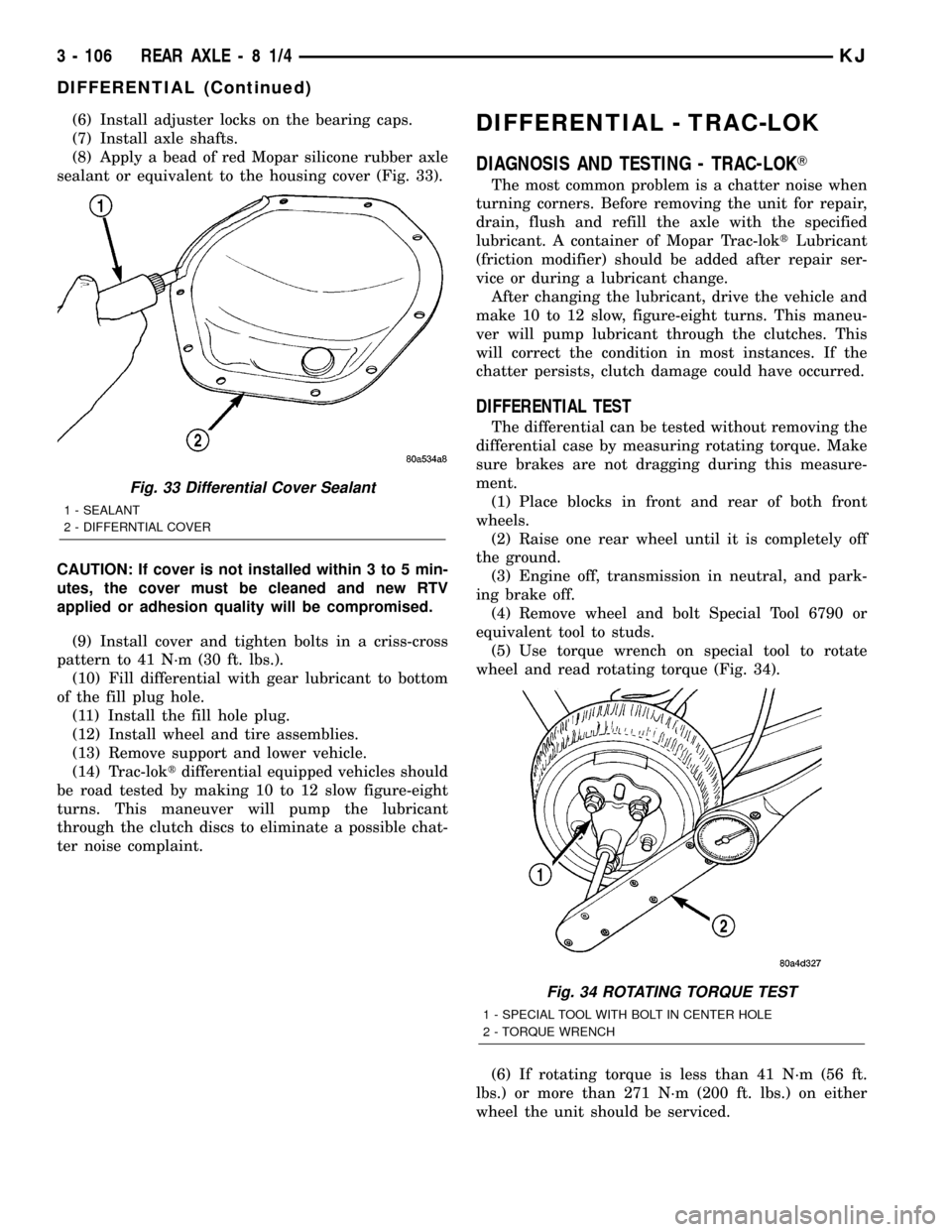
(8) Apply a bead of red Mopar silicone rubber axle
sealant or equivalent to the housing cover (Fig. 33).
CAUTION: If cover is not installed within 3 to 5 min-
utes, the cover must be cleaned and new RTV
applied or adhesion quality will be compromised.
(9) Install cover and tighten bolts in a criss-cross
pattern to 41 N´m (30 ft. lbs.).
(10) Fill differential with gear lubricant to bottom
of the fill plug hole.
(11) Install the fill hole plug.
(12) Install wheel and tire assemblies.
(13) Remove support and lower vehicle.
(14) Trac-loktdifferential equipped vehicles should
be road tested by making 10 to 12 slow figure-eight
turns. This maneuver will pump the lubricant
through the clutch discs to eliminate a possible chat-
ter noise complaint.DIFFERENTIAL - TRAC-LOK
DIAGNOSIS AND TESTING - TRAC-LOKT
The most common problem is a chatter noise when
turning corners. Before removing the unit for repair,
drain, flush and refill the axle with the specified
lubricant. A container of Mopar Trac-loktLubricant
(friction modifier) should be added after repair ser-
vice or during a lubricant change.
After changing the lubricant, drive the vehicle and
make 10 to 12 slow, figure-eight turns. This maneu-
ver will pump lubricant through the clutches. This
will correct the condition in most instances. If the
chatter persists, clutch damage could have occurred.
DIFFERENTIAL TEST
The differential can be tested without removing the
differential case by measuring rotating torque. Make
sure brakes are not dragging during this measure-
ment.
(1) Place blocks in front and rear of both front
wheels.
(2) Raise one rear wheel until it is completely off
the ground.
(3) Engine off, transmission in neutral, and park-
ing brake off.
(4) Remove wheel and bolt Special Tool 6790 or
equivalent tool to studs.
(5) Use torque wrench on special tool to rotate
wheel and read rotating torque (Fig. 34).
(6) If rotating torque is less than 41 N´m (56 ft.
lbs.) or more than 271 N´m (200 ft. lbs.) on either
wheel the unit should be serviced.
Fig. 33 Differential Cover Sealant
1 - SEALANT
2 - DIFFERNTIAL COVER
Fig. 34 ROTATING TORQUE TEST
1 - SPECIAL TOOL WITH BOLT IN CENTER HOLE
2 - TORQUE WRENCH
3 - 106 REAR AXLE-81/4KJ
DIFFERENTIAL (Continued)
Page 206 of 1803

WARNING
WARNING:: EXERCISE CARE WHEN SERVICING
CLUTCH COMPONENTS. FACTORY INSTALLED
CLUTCH DISCS DO NOT CONTAIN ASBESTOS
FIBERS. DUST AND DIRT ON CLUTCH PARTS MAY
CONTAIN ASBESTOS FIBERS FROM AFTERMAR-
KET COMPONENTS. BREATHING EXCESSIVE CON-
CENTRATIONS OF THESE FIBERS CAN CAUSE
SERIOUS BODILY HARM. WEAR A RESPIRATOR
DURING SERVICE AND NEVER CLEAN CLUTCH
COMPONENTS WITH COMPRESSED AIR OR WITH
A DRY BRUSH. EITHER CLEAN THE COMPONENTS
WITH A WATER DAMPENED RAGS OR USE A VAC-
UUM CLEANER SPECIFICALLY DESIGNED FOR
REMOVING ASBESTOS FIBERS AND DUST. DO NOT
CREATE DUST BY SANDING A CLUTCH DISC.
REPLACE THE DISC IF THE FRICTION MATERIAL IS
DAMAGED OR CONTAMINATED. DISPOSE OF ALL
DUST AND DIRT CONTAINING ASBESTOS FIBERS
IN SEALED BAGS OR CONTAINERS. THIS WILL
HELP MINIMIZE EXPOSURE TO YOURSELF AND TO
OTHERS. FOLLOW ALL RECOMMENDED SAFETY
PRACTICES PRESCRIBED BY THE OCCUPATIONAL
SAFETY AND HEALTH ADMINISTRATION (OSHA)
AND THE ENVIRONMENTAL SAFETY AGENCY
(EPA), FOR THE HANDLING AND DISPOSAL OF
PRODUCTS CONTAINING ASBESTOS.
DIAGNOSIS AND TESTING - CLUTCH
Drive the vehicle at normal speeds. Shift the trans-
mission through all gear ranges and observe clutch
action. If the clutch chatters, grabs, slips or does not
release properly, remove and inspect the clutch com-
ponents. If the problem is noise or hard shifting, fur-
ther diagnosis may be needed as the transmission or
another driveline component may be at fault.
NOTE: Vehicles equipped with a Dual Mass Fly-
wheel may produce a rattle when the engine is shut
off. This noise is considered normal.
CLUTCH CONTAMINATION
Fluid contamination is a frequent cause of clutch
malfunctions. Oil, water or clutch fluid on the clutch
disc and pressure plate surfaces will cause chatter,
slip and grab. Inspect components for oil, hydraulic
fluid or water/road splash contamination.
Oil contamination indicates a leak at either the
rear main seal or transmission input shaft. Clutch
fluid leaks are usually from damaged slave cylinder
push rod seals. Heat buildup caused by slippage
between the pressure plate, disc and flywheel can
bake the oil residue onto the components. The glaze-
like residue ranges in color from amber to black.Road splash contamination is dirt/water entering
the clutch housing due to loose bolts, housing cracks.
Driving through deep water puddles can force water/
road splash into the housing through such openings.
IMPROPER RELEASE OR CLUTCH ENGAGEMENT
Clutch release or engagement problems are caused
by wear or damage clutch components. A visual
inspection of the release components will usually
reveal the problem part.
Release problems can result in hard shifting and
noise. Look for leaks at the clutch cylinders and
interconnecting line and loose slave cylinder bolts.
Also worn/loose release fork, pivot stud, clutch disc,
pressure plate or release bearing.
Engagement problems can result in slip, chatter/
shudder and noisy operation. The causes may be
clutch disc contamination, wear, distortion or fly-
wheel damage. Visually inspect to determine the
actual cause of the problem.
CLUTCH MISALIGNMENT
Clutch components must be in proper alignment
with the crankshaft and transmission input shaft.
Misalignment caused by excessive runout or warpage
of any clutch component will cause grab, chatter and
improper clutch release.
PRESSURE PLATE AND DISC RUNOUT
Check the clutch disc before installation. Axial
(face) runout of anewdisc should not exceed 0.50
mm (0.020 in.). Measure runout about 6 mm (1/4 in.)
from the outer edge of the disc facing. Obtain
another disc if runout is excessive.
Check condition of the clutch before installation. A
warped cover or diaphragm spring will cause grab
and incomplete release or engagement. Be careful
when handling the cover and disc. Impact can distort
the cover, diaphragm spring, release fingers and the
hub of the clutch disc.
Use an alignment tool when positioning the disc on
the flywheel. The tool prevents accidental misalign-
ment which could result in cover distortion and disc
damage.
A frequent cause of clutch cover distortion (and
consequent misalignment) is improper bolt tighten-
ing.
FLYWHEEL RUNOUT
Check flywheel runout whenever misalignment is
suspected. Flywheel runout should not exceed 0.08
mm (0.003 in.). Measure runout at the outer edge of
the flywheel face with a dial indicator. Mount the
indicator on a stud installed in place of one of the fly-
wheel bolts.
6 - 2 CLUTCHKJ
CLUTCH (Continued)
Page 213 of 1803
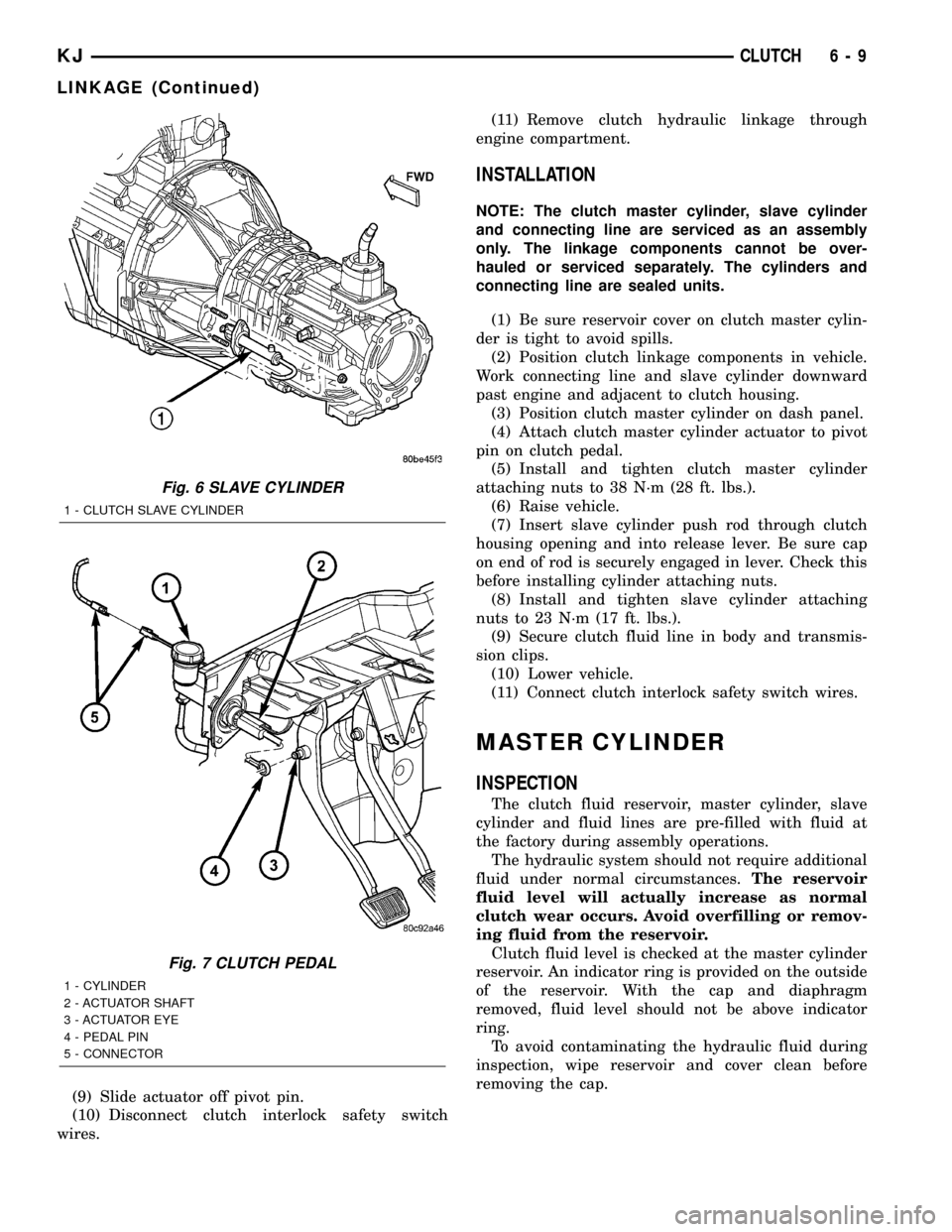
(9) Slide actuator off pivot pin.
(10) Disconnect clutch interlock safety switch
wires.(11) Remove clutch hydraulic linkage through
engine compartment.
INSTALLATION
NOTE: The clutch master cylinder, slave cylinder
and connecting line are serviced as an assembly
only. The linkage components cannot be over-
hauled or serviced separately. The cylinders and
connecting line are sealed units.
(1) Be sure reservoir cover on clutch master cylin-
der is tight to avoid spills.
(2) Position clutch linkage components in vehicle.
Work connecting line and slave cylinder downward
past engine and adjacent to clutch housing.
(3) Position clutch master cylinder on dash panel.
(4) Attach clutch master cylinder actuator to pivot
pin on clutch pedal.
(5) Install and tighten clutch master cylinder
attaching nuts to 38 N´m (28 ft. lbs.).
(6) Raise vehicle.
(7) Insert slave cylinder push rod through clutch
housing opening and into release lever. Be sure cap
on end of rod is securely engaged in lever. Check this
before installing cylinder attaching nuts.
(8) Install and tighten slave cylinder attaching
nuts to 23 N´m (17 ft. lbs.).
(9) Secure clutch fluid line in body and transmis-
sion clips.
(10) Lower vehicle.
(11) Connect clutch interlock safety switch wires.
MASTER CYLINDER
INSPECTION
The clutch fluid reservoir, master cylinder, slave
cylinder and fluid lines are pre-filled with fluid at
the factory during assembly operations.
The hydraulic system should not require additional
fluid under normal circumstances.The reservoir
fluid level will actually increase as normal
clutch wear occurs. Avoid overfilling or remov-
ing fluid from the reservoir.
Clutch fluid level is checked at the master cylinder
reservoir. An indicator ring is provided on the outside
of the reservoir. With the cap and diaphragm
removed, fluid level should not be above indicator
ring.
To avoid contaminating the hydraulic fluid during
inspection, wipe reservoir and cover clean before
removing the cap.
Fig. 6 SLAVE CYLINDER
1 - CLUTCH SLAVE CYLINDER
Fig. 7 CLUTCH PEDAL
1 - CYLINDER
2 - ACTUATOR SHAFT
3 - ACTUATOR EYE
4 - PEDAL PIN
5 - CONNECTOR
KJCLUTCH 6 - 9
LINKAGE (Continued)