ESP JEEP RENEGADE 2014 1.G User Guide
[x] Cancel search | Manufacturer: JEEP, Model Year: 2014, Model line: RENEGADE, Model: JEEP RENEGADE 2014 1.GPages: 212, PDF Size: 17.48 MB
Page 69 of 212
Systems disabled
Pressing thebutton on the central
tunnel for more than 5 seconds
completely deactivates the ESC
system, as well as the TSC and ERM
systems; the TC system will be limited
to braking action on the individual
drive wheels. The other systems remain
enabled.
Activation of this mode is highlighted by
the
warning light on the instrument
panel switching on (on some versions,
together with a message on the
display).
IMPORTANT If a speed of
approximately 65 km/h (40 mph) is
exceeded, the systems will behave as
described for "Systems partially
disabled" mode.
To restore "Systems enabled" operating
mode, press the button on the central
tunnel again.
"Systems enabled" mode will
automatically reactivate every time the
engine is started.
Versions withSelec-Terrain™
device
On versions withSelec-Terrain™
device, the activation of certain driving
modes partially or totally deactivates
certain active safety systems in order to
optimise performance in the specific
mode.When active safety systems are partially
or totally deactivated, the
warning
light will turn on in the instrument panel.
In "SAND" and "MUD" modes, the
active safety systems are partially
disabled and fine-tuned to ensure
maximum performance in the specific
operating modes. It is in any case
possible to reactivate them completely
at any time by pressing the
button on
the central tunnel should you wish to
favour safety over "off-road"
performance.
IMPORTANT In 4WD LOW modes, the
active safety systems are completely
disabled in order to ensure maximum
off-road driving performance and it will
not be possible to reactivate them.
59) 60) 61) 62)
WARNING
31)When the ABS intervenes and you feel
the brake pedal pulsating, do not reduce
the pressure, but hold it down firmly and
confidently; in doing so you will brake
in the shortest distance possible,
depending on the current road conditions.
32)For maximum efficiency of the braking
system, a bedding-in period of about
500 km is required: during this period it is
advisable to avoid sharp, repeated and
prolonged braking.33)If the ABS intervenes, this indicates
that the grip of the tyres on the road is
nearing its limit: you must slow down to a
speed compatible with the available grip.
34)The ABS can’t overrule the natural laws
of physics, and can’t increase the grip
available according to the condition of the
road.
35)The ABS cannot prevent accidents,
including those due to excessive speed on
corners, driving on low-grip surfaces or
aquaplaning.
36)The capability of the ABS must never
be tested irresponsibly and dangerously, in
such a way as to compromise personal
safety and the safety of others.
37)For the correct operation of the ABS,
the tyres must of necessity be the same
make and type on all wheels, in perfect
condition and, above all, of the prescribed
type and size.
38)The ESC system cannot alter the
natural laws of physics, and cannot
increase grip, which depends on the
condition of the road.
39)The ESC system cannot prevent
accidents, including those due to excessive
speed on corners, driving on low-grip
surfaces or aquaplaning.
40)The capability of the ESC system must
never be tested irresponsibly and
dangerously, in such a way as to
compromise personal safety and the safety
of others.
41)For the correct operation of the ESC
system, the tyres must of necessity be the
same make and type on all wheels, in
perfect condition and, above all, of the
prescribed type and size.
67
Page 70 of 212
42)ESC performance features must not
induce the driver to take unnecessary
or unfounded risks. Your driving style must
always be suited to the road conditions,
visibility and traffic. The driver is, in any
case, responsible for safe driving.
43)For the correct operation of the TC
system, the tyres must of necessity be the
same make and type on all wheels, in
perfect condition and, above all, of the
prescribed type and size.
44)TC performance features must not
induce the driver to take unnecessary or
unfounded risks. Your driving style must
always be suited to the road conditions,
visibility and traffic. The driver is, in any
case, responsible for safe driving.
45)The TC system can’t overrule the
natural laws of physics, and can’t increase
the grip available according to the
condition of the road.
46)The TC system cannot prevent
accidents, including those due to excessive
speed on corners, driving on low-grip
surfaces or aquaplaning.
47)The capability of the TC must never be
tested irresponsibly and dangerously, in
such a way as to compromise personal
safety and the safety of others.
48)The PBA system can’t overrule the
natural laws of physics, and can’t increase
the grip available according to the
condition of the road.
49)The PBA system cannot prevent
accidents, including those due to excessive
speed on corners, driving on low-grip
surfaces or aquaplaning.50)The capability of the PBA system must
never be tested irresponsibly and
dangerously, in such a way as to
compromise the safety of the driver, the
other occupants of the vehicle or any other
road user.
51)The Hill Start Assist system is not a
parking brake; therefore, never leave the
vehicle without having engaged the electric
parking brake, turned the engine off and
engaged first gear, so that it is parked
in safe conditions (for further information
read the "Parking" paragraph in the
"Starting and driving" chapter).
52)There may be situations on small
gradients (less than 8%), with vehicle
laden, in which the Hill Start Assist system
may not activate, causing a slight reversing
motion and increasing the risk of collision
with another vehicle or object. The driver is,
in any case, responsible for safe driving.
53)DST is an aid for driving and does not
relieve the driver of responsibility for driving
the vehicle.
54)The performance of a vehicle with ERM
must never be tested in imprudent or
dangerous ways, with the possibility of
putting the safety of the driver or other
people at risk.
55)When towing trailers, the utmost
caution at the wheel is advised. Never
exceed the maximum permitted loads (see
the description in the "Weights" paragraph
in the "Technical Specifications" chapter).56)The TSC system cannot prevent
swerving for all trailers. If the system
activates during driving, reduce the speed,
stop the vehicle in a safe place and arrange
the load correctly to prevent the trailer
from swerving.
57)Prolonged use of the system may
overheat the braking system. If the brakes
overheat, the HDC system, when active,
will be gradually deactivated after suitably
informing the driver (LED on button off):
it can be reactivated only when the brakes
have cooled sufficiently. The distance
that can be covered depends on the
temperature of the brakes and therefore on
the gradient, load and speed of the
vehicle.
58)The performance of a vehicle with HDC
must never be tested in imprudent or
dangerous ways, with the possibility of
putting the safety of the driver or other
people at risk.
59)When "Systems partially disabled"
mode is selected, the intervention of the
TC function is limited to braking action on
the individual drive wheels and the
warning lights switches on in the
instrument panel. In "systems partially
disabled" mode, the engine torque value
that the ESC system may require will
not be guaranteed and the stability of the
vehicle will therefore be reduced.
60)With "Systems partially disabled" mode
selected, the TSC (Trailer Sway Control)
system is disabled.
61)Your driving style must always be
suited to the road conditions, visibility and
traffic. The driver is, in any case,
responsible for safe driving.
68
SAFETY
Page 72 of 212
The detection area of the system
covers about a lane on both sides of
the vehicle (around 3 metres). This area
begins from the door mirror and
extends for about 6 metres towards the
rear part of the vehicle.
When the sensors are active the system
monitors the detection areas on both
sides of the vehicle and warns the
driver about the possible presence of
vehicles in these areas.
While driving the system monitors the
detection area from three different input
points (side, rear and front) to check
whether a signal needs to be sent
to the driver. The system can detect the
presence of a vehicle in one of these
three areas.
Important
63)The system does not signal the
presence of fixed object (e.g. safety
barriers, poles, walls, etc.). However, in
some circumstances, the system may
activate in the presence of these
objects. This is normal and does not
indicate a system malfunction.
The system does not warn the driver
about the presence of vehicles coming
from the opposite direction, in the
adjacent lanes.
If a trailer is hitched to the vehicle, the
system automatically deactivates.The rear bumper area where the radar
sensors are located must stay free from
snow, ice and dirt gathered from the
road surface for the system to operate
correctly.
Do not cover the rear bumper area
where the radar sensors are located
with any object (e.g. adhesives, bike
rack, etc.).
Rear view: the system detects vehicles
approaching to the rear part of your
vehicle on both sides and entering the
rear detection area with a speed delta
lower than 50 km/h with respect to your
vehicle.
Overtaking vehicles: if another vehicle
is overtaken slowly (with a speed delta
lower than about 25 km/h) and this
stays in the blind spot for about 1.5
seconds, the warning light on the door
mirror of the corresponding side lights
up. If the speed delta between the
two vehicles is higher than about 25
km/h, the warning light does not light
up.
RCP (Rear Cross Path
detection) system
This system helps the driver during
reverse manoeuvres in the case of
reduced visibility. During "RCP"
operating mode, the system emits
acoustic and visual warnings if
the presence of an object is detected.
When an acoustic warning is sent,
theUconnect™volume is lowered.
The system can be activated/
deactivated through the display Menu
or theUconnect™system.
The system monitors the rear detection
areas on both sides of the vehicle, to
detect objects moving towards the
sides of the vehicle at a minimum
speed comprised between about 1
km/h and 3 km/h and objects moving
at a maximum speed of 35 km/h, as
generally happens in the parking areas.
The system activation is signalled to
the driver by means of a visual and
acoustic warning.
IMPORTANT If the sensors are covered
by objects or vehicles, the system will
not warn the driver.
70
SAFETY
Page 76 of 212
IMPORTANT The TPMS is designed for
original tyres and wheels. Pressure
and alarms signalled by the TPMS are
defined according to the size of the
tyres fitted on the vehicle. Using spare
wheels of a size, type and/or design
different from the original ones may
cause an irregular operation of the
system and damage the sensors.
Aftermarket fitted wheels may damage
the sensors. Using aftermarket tyre
sealants may damage the Tyre Pressure
Monitoring System sensor. If
aftermarket tyre sealant is used it is
recommended to go to a Jeep
Dealership to have the sensors
checked. After tyre pressure check and
adjustment, always refit the valve plug
to prevent humidity and dirt from
entering, these may damage the Tyre
Pressure Monitoring System sensor.
TPMS check message
If a system failure is present, the
warning light flashes for about 75
seconds and then stays on constantly.
An acoustic signal is also issued.
TPMS deactivation
The TPMS can be deactivated by
replacing the wheels equipped with
TPMS with others that are not (e.g.
upon replacement of the wheel
assemblies in winter). Then drive the
vehicle for at least 20 minutes at a
speed higher than about 25 km/h (15
mph). The TPMS will emit an acoustic
warning, the
warning light will flash
for about 75 seconds, then will stay
on constantly and the instrument panel
will display the "TPMS check" message
with some dashes (– –) instead of the
pressure values.
At the next engine start, the system will
not emit any acoustic signal and the
display will not show the message
"TPMS check", but the dashes (– –) will
be still displayed instead of the pressure
value.
WARNING
63)The system is an aid for vehicle driving,
it DOES NOT warn the driver about
incoming vehicles outside of the detection
areas. The driver must always maintain a
sufficient level of attention to the traffic and
road conditions and for controlling the
trajectory of the vehicle.64)The system is an aid for the driver, who
must always pay full attention while driving.
The responsibility always rests with the
driver, who must take into account the
traffic conditions in order to drive in
complete safety. The driver must always
maintain a safe distance from the vehicle in
front.
65)If the driver depresses the brake pedal
fully or carries out a fast steering during
system operation, the automatic braking
function may stop (e.g. to allow a possible
manoeuvre to avoid the obstacle).
66)The system intervenes on vehicles
travelling in the same lane. People, animals
and things (e.g. pushchairs) are not taken
into consideration.
67)If the vehicle must be placed on a roller
bench for maintenance interventions or if
it is washed in an automatic roller washing
tunnel with an obstacle in the front part
(e.g. another vehicle, a wall or another
obstacle), the system may detect its
presence and activate. In this case the
system must be deactivated through the
settings of theUconnect™system.
68)The presence of the TPMS does not
permit the driver to neglect regular checks
of the tyre pressure, including for the
spare wheel, and correct maintenance: the
system is not used to signal a possible
fault to a tyre.
69)Tyre pressure must be checked with
tyres rested and cold. Should it become
necessary for whatever reason to check
pressure with warm tyres, do not reduce
pressure even though it is higher than
the prescribed value. Repeat the check
when the tyres are cold.
74
SAFETY
Page 77 of 212
70)Should one or more wheels be fitted
without sensors (e.g. if the spare wheel
is fitted), the system will no longer be
available for the replaced wheel and a
warning message will be shown on the
display, until the wheels with sensors are
fitted again.
71)The TPMS cannot indicate sudden tyre
pressure drops (e.g. if a tyre bursts). In
this case, stop the vehicle, braking with
care and avoiding sharp steering actions.
72)Replacing the normal tyres with winter
tyres and vice versa requires an inspection
of the TPMS, which should be carried
out only by a Jeep Dealership.
73)Changes in outside temperature may
cause tyre pressures to vary. The system
may temporarily indicate insufficient
pressure. In this case check the tyre
inflation pressure with the tyres cold and, if
necessary top up the inflation pressure.
74)When a tyre is removed, it is advisable
to replace the rubber gasket for the valve:
go to a Jeep Dealership. The fitting/
removal of the tyres and/or rims require
special care. To avoid damaging or fitting
the sensors incorrectly, tyre and/or rim
fitting/removal operations should only be
carried out by specialised staff. Go to a
Jeep Dealership.
WARNING
23)The system may have limited or absent
operation due to weather conditions such
as: heavy rain, hail, thick fog, heavy snow.
24)The section of the bumper before
the sensor must not be covered with
adhesives, auxiliary headlights or any other
object.
25)System intervention might be
unexpected or delayed when other vehicles
transport loads projecting from the side,
above or from the rear, with respect to the
normal size of the vehicle.
26)Operation can be adversely affected by
any structural change made to the vehicle,
such as a modification to the front
geometry, tyre change, or a heavier load
than the standard load of the vehicle.
27)Incorrect repairs made on the front part
of the vehicle (e.g. bumper, chassis) may
alter the position of the radar sensor,
and adversely affect its operation. Go to a
Jeep Dealership for any operation of this
type.
28)Do not tamper nor carry out any
intervention on the radar sensor or on the
camera on the windscreen. In the event
of a sensor failure, contact a Jeep
Dealership.
29)When towing a trailer (with modules
installed after purchasing the vehicle),
a vehicle or during loading manoeuvres on
a vehicle transporter (or in vehicle for
transport), the system must be deactivated
via theUconnect™system.30)Do not wash with high-pressure jets in
the bumper lower area: in particular do
not operate on the system's electrical
connector.
31)Be careful in the case of repairs and
new paintings in the area around the
sensor (panel covering the sensor on the
left side of the bumper). In the event of
a frontal impact the sensor may
automatically deactivate and display a
warning to indicate that the sensor needs
to be repaired. Even without a malfunction
warning, deactivate the system operation
if you think that the position of the radar
sensor has changed (e.g. due to
low-speed frontal impact as during parking
manoeuvres). In these cases, go to a
Jeep Dealership to have the radar sensor
realigned or replaced.
32)The tyre quick repair kit (TireKit),
provided with the vehicle, is compatible
with the TPMS sensors. Using sealants
different from that in the original kit may
compromise its operation. If sealants not
equivalent with the original one are used, it
is recommended to have the TPMS sensor
operation checked by a qualified repair
centre.
75
Page 78 of 212
OCCUPANT
PROTECTION
SYSTEMS
The most important safety equipment
of the vehicle comprise the following
protection systems:
❒seat belts;
❒SBR (Seat Belt Reminder) system;
❒head restraints;
❒child restraint systems;
❒front airbags and side bags.
Read the information given the
following pages with the utmost care. It
is of fundamental importance that the
protection systems are used in the
correct way to guarantee the maximum
possible safety level for the driver and
the passengers.
For the description of the head restraint
adjustment see paragraph "Head
restraints" in chapter "Knowing your
vehicle".
SEAT BELTS
USING THE SEAT BELTS
The driver is responsible for respecting,
and ensuring that all the other
occupants of the vehicle also respect,
the local laws in force in relation to
the use of the seat belts.
Always fasten the seat belts before
setting off.
The seat belt should be worn keeping
the torso straight and rested against
the backrest.
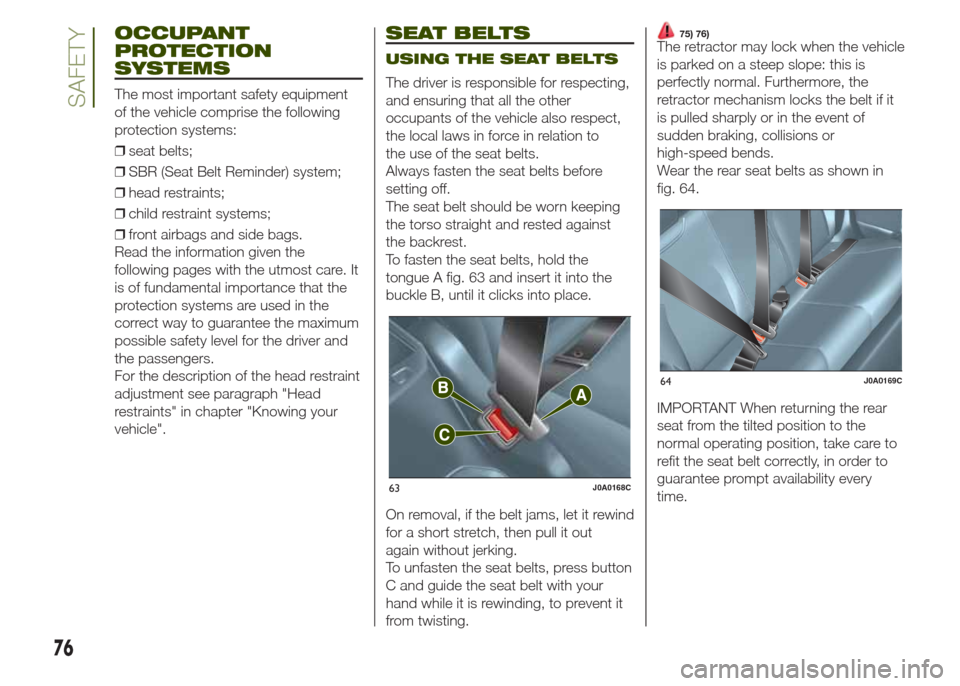
To fasten the seat belts, hold the
tongue A fig. 63 and insert it into the
buckle B, until it clicks into place.
On removal, if the belt jams, let it rewind
for a short stretch, then pull it out
again without jerking.
To unfasten the seat belts, press button
C and guide the seat belt with your
hand while it is rewinding, to prevent it
from twisting.
75) 76)The retractor may lock when the vehicle
is parked on a steep slope: this is
perfectly normal. Furthermore, the
retractor mechanism locks the belt if it
is pulled sharply or in the event of
sudden braking, collisions or
high-speed bends.
Wear the rear seat belts as shown in
fig. 64.
IMPORTANT When returning the rear
seat from the tilted position to the
normal operating position, take care to
refit the seat belt correctly, in order to
guarantee prompt availability every
time.
63J0A0168C
64J0A0169C
76
SAFETY
Page 80 of 212
As soon as a speed threshold of 8
km/h is maintained for more than 10
continuous seconds (or 50
discontinuous seconds), with driver
side seat belt or the passenger side
seat belt (with occupant seated)
unfastened, an acoustic signal is
activated simultaneously with warning
light
flashing for about 105 seconds.
When this cycle of warnings is activated
it will stay on for its entire length
(regardless of the vehicle speed) or until
the seat belts are fastened again.
When the reverse is engaged, during
the cycle of warnings, the acoustic
signal is deactivated and the
warning
light turns on constantly. The cycle of
warnings will be reactivated as soon as
speed exceeds 8 km/h again.
Operation of rear seat belt
icons
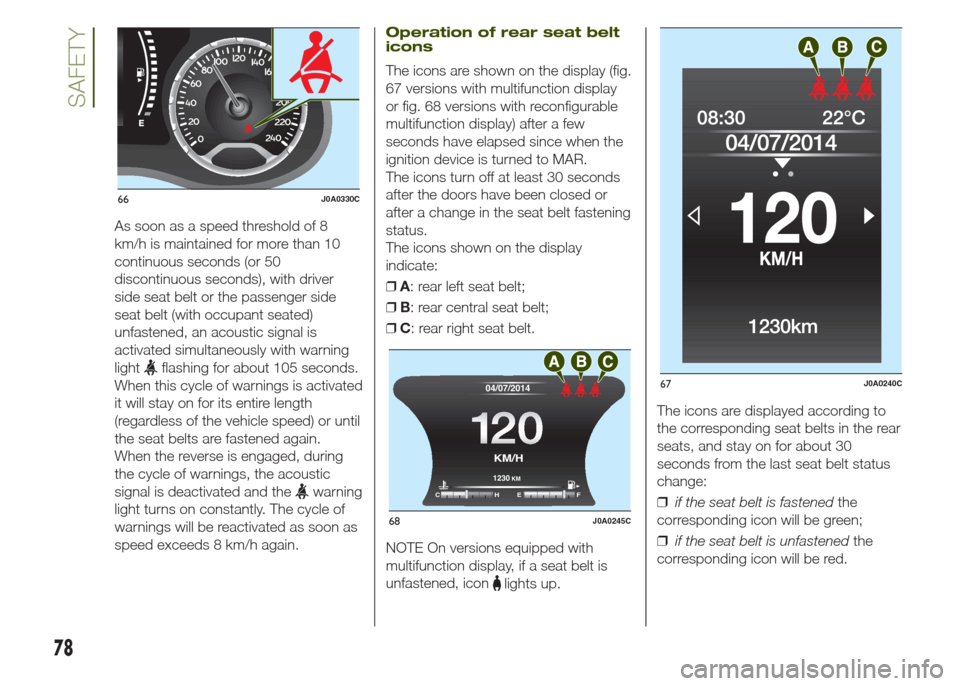
The icons are shown on the display (fig.
67 versions with multifunction display
or fig. 68 versions with reconfigurable
multifunction display) after a few
seconds have elapsed since when the
ignition device is turned to MAR.
The icons turn off at least 30 seconds
after the doors have been closed or
after a change in the seat belt fastening
status.
The icons shown on the display
indicate:
❒A: rear left seat belt;
❒B: rear central seat belt;
❒C: rear right seat belt.
NOTE On versions equipped with
multifunction display, if a seat belt is
unfastened, icon
lights up.The icons are displayed according to
the corresponding seat belts in the rear
seats, and stay on for about 30
seconds from the last seat belt status
change:
❒if the seat belt is fastenedthe
corresponding icon will be green;
❒if the seat belt is unfastenedthe
corresponding icon will be red.
0 204060
140120 100 80
km/h
MPH
66J0A0330C
12 0120
04/07/2014
1230 KM
CHE F
KM/H
68J0A0245C
67J0A0240C
78
SAFETY
Page 81 of 212
If the rear seat belt is unfastened, an
acoustic warning (3 "beeps") will be
activated along with the relevant icon
lighting up in the display.
Furthermore the icons will light up again
for 90 seconds each time one of the
rear doors is closed.
The icon will turn green after the
corresponding seat has been fastened.
The rear seat icons will go out,
regardless of the state of the belt (red
icon or green icon), approximately
30 seconds after the last signal.
IMPORTANT
As far as the rear seats are concerned,
the SBR system will only indicate
whether the seat belts are unfastened
(red icon) or fastened (green icon),
not the presence of any passengers.
The warning lights/icons are all off if all
seat belts (front and rear) are fastened
when the ignition device is at MAR.
For the rear seats, the icons will
activate after a few seconds after the
ignition device has been turned to
MAR, regardless of the status of the
seat belts (even if the seat belts are all
fastened).
All the warning lights/icons will come on
when at least one belt changes from
fastened to unfastened status or vice
versa.
PRETENSIONERS
79) 80) 81) 82)33)
The vehicle is equipped with front seat
belt pretensioners, which draw back
the seat belts by several centimetres in
the event of a strong frontal impact.
This guarantees the perfect adherence
of the seat belts to the occupant's
bodies before the retention action
begins.
It is evident that the pretensioners have
been activated when the belt withdraws
toward the retractor.
This vehicle is also equipped with a
second pretensioner (fitted in the kick
plate area). Its activation is signalled by
the shortening of the metal cable.
A slight discharge of smoke may be
produced during the activation of the
pretensioner which is not harmful and
does not indicate any fire hazard.
The pretensioner does not require any
maintenance or lubrication: any
changes to its original conditions will
invalidate its efficiency.
If, due to unusual natural events (floods,
sea storms, etc.), the device has been
affected by water and/or mud, contact
a Jeep Dealership to have it replaced.IMPORTANT To obtain the highest
degree of protection from the action of
the pretensioner, wear the seat belt
tight to the torso and pelvis.
LOAD LIMITERS
To increase safety in the event of an
accident, the front seat belt retractors
contain a load limiter which controls the
force acting on the chest and
shoulders during the belt restraining
action in the event of a head-on
collision.
GENERAL
INSTRUCTIONS FOR
USING THE SEAT BELTS
Respect and ensure that all the other
occupants of the vehicle comply with
the local laws in force regarding the use
of seat belts. Always fasten the seat
belts before setting off.
Seat belts must also be worn by
pregnant women: the risk of injury in
the event of an accident is reduced for
them and the unborn child if they are
wearing a seat belt.
79
Page 84 of 212
The ECE-R44 standard was recently
paired with the ECE R-129 regulation,
which defines the characteristics of
the new i-Size child restraint systems
(see the "Suitability of passenger seats
for i-Size child restraint system use"
paragraph).
All restraint devices must bear the
certification data, together with the
control mark, on a label solidly fixed to
the child restraint system which must
never be removed.
Lineaccessori Jeep offers child restraint
systems for each weight group. These
devices are recommended, having
been specifically designed for Jeep
vehicles.
FITTING A CHILD
RESTRAINT SYSTEM
WITH SEAT BELTS
The Universal child restraint systems
installed with the seat belts only are
type-approved on the basis of the ECE
R44 standard and are divided into
various weight groups.
IMPORTANT The figures are indicative
and provided for assembly purposes
only. Fit the child restraint system
according to the instructions, which
must be included.
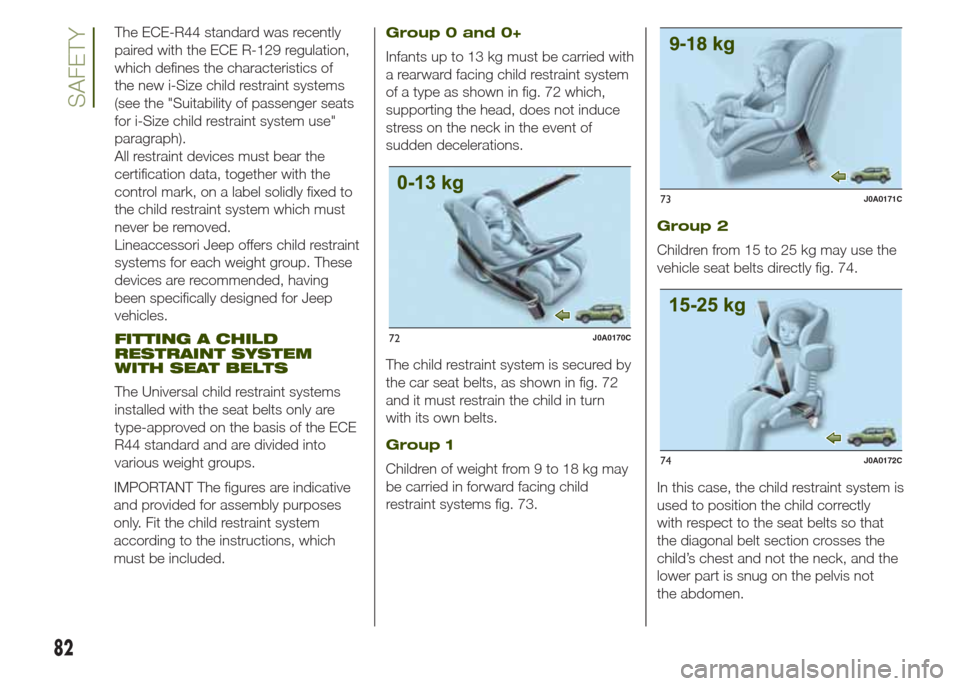
Group 0 and 0+
Infants up to 13 kg must be carried with
a rearward facing child restraint system
of a type as shown in fig. 72 which,
supporting the head, does not induce
stress on the neck in the event of
sudden decelerations.
The child restraint system is secured by
the car seat belts, as shown in fig. 72
and it must restrain the child in turn
with its own belts.
Group 1
Children of weight from 9 to 18 kg may
be carried in forward facing child
restraint systems fig. 73.
Group 2
Children from 15 to 25 kg may use the
vehicle seat belts directly fig. 74.
In this case, the child restraint system is
used to position the child correctly
with respect to the seat belts so that
the diagonal belt section crosses the
child’s chest and not the neck, and the
lower part is snug on the pelvis not
the abdomen.
72J0A0170C
73J0A0171C
74J0A0172C
82
SAFETY
Page 103 of 212
A slight movement of the brake pedal
may be detected when engaging the
electric parking brake with the brake
pedal pressed.
With the electric parking brake
engaged, the warning light
on the
instrument panel and the LED on the
switch turn on.
IMPORTANT With the EPB failure
warning light on, some functions of the
electric parking brake are deactivated.
In this case the driver is responsible
for brake activation and vehicle parking
in complete safety conditions.
If, under exceptional circumstances, the
use of the brake is required with the
vehicle in motion, keep the switch on
the central tunnel pulled as long as the
brake action is necessary.
The warning light
may switch on
with the hydraulic system temporarily
unavailable; in this case braking is
controlled by the motors.
The brake lights (stop) will also
automatically switch on in the same
way as for normal braking with the use
of the brake pedal.
Release the switch on the central tunnel
to stop the braking action with the
vehicle in motion.If, through this procedure, the vehicle is
braked until a speed below 3 km/h is
reached and the switch is kept pulled,
the parking brake will definitively
engage.
IMPORTANT Driving the vehicle with
the electric parking brake engaged, or
using it several times to slow down
the vehicle, may cause severe damage
to the braking system.
Disengaging the electric
parking brake manually
To manually disengage the parking
brake, the ignition device must be at
MAR. It is also necessary to press the
brake pedal, then slightly press the
switch on the central tunnel.
Noise may be heard from the rear of the
vehicle and a slight movement of the
brake pedal may be detected during
disengagement.
With the electric parking brake
engaged, the warning light
on the
instrument panel and the LED on the
switch turn off.
If the warning light
on the
instrument panel remains on with the
electric parking brake disengaged, this
indicates a fault: in this case contact
a Jeep Dealership.IMPORTANT On versions with
automatic transmission never use the P
(Park) position instead of the electric
parking brake. Always engage the
electric parking brake when parking the
vehicle to prevent injury or damage
caused by the unexpected movement
of the vehicle.
IMPORTANT For vehicles equipped
with manual gearbox, if the clutch pedal
is released simultaneously with the
press of the accelerator, the electric
handbrake automatically releases.
ELECTRIC PARKING
BRAKE OPERATING
MODES
The electric parking brake may operate
as follows:
❒"Dynamic operating mode": this
mode is activated by pulling the switch
repeatedly whilst deriving;
❒"Static engagement and release
mode": with the vehicle stationary, the
electric parking brake can be activated
by pulling the switch on the central
tunnel once. On the other hand, press
the switch and the brake pedal at
the same time to disengage the brake;
101