ESP JEEP RENEGADE 2014 1.G Owners Manual
[x] Cancel search | Manufacturer: JEEP, Model Year: 2014, Model line: RENEGADE, Model: JEEP RENEGADE 2014 1.GPages: 212, PDF Size: 17.48 MB
Page 4 of 212
READ THIS CAREFULLY
REFUELLING
Petrol engines: only refuel with unleaded petrol with octane rating (RON) not less than 95 in compliance with the European specification
EN228. Do not use petrol containing methanol or ethanol E85. Using these mixtures may cause misfiring and driving issues, as well as
damage fundamental components of the supply system.
Diesel engines: refuel only with diesel fuel conforming to the European specification EN590. The use of other products or mixtures may
damage the engine beyond repair and consequently invalidate the warranty, due to the damage caused.
For further details on the use of the correct fuel see paragraph "Refuelling the vehicle" in the "Starting and driving" chapter.
STARTING THE ENGINE
Versions with manual gearbox (petrol engines): make sure that the parking brake is engaged; set the gear lever to neutral, fully depress
the clutch pedal without pressing the accelerator, then bring the ignition device to AVV or press the ignition device button and release the
key or the button as soon as the engine has started.
Versions with manual gearbox (diesel engines): make sure that the parking brake is engaged; set the gear lever to neutral, fully depress
the clutch pedal without pressing the accelerator, then bring the ignition device to MAR and wait for warning lights
andto switch
off. Bring the ignition device to AVV or press the ignition device button and finally release the key or the button as soon as the engine has
started.
Versions with automatic transmission: make sure that the parking brake is engaged and that the gear lever is in P (Park) or N (Neutral),
fully depress the brake pedal, then bring the ignition device to AVV or press the ignition device button.
PARKING ON FLAMMABLE MATERIAL
The catalytic converter develops high temperatures during operation. Do not park the vehicle on grass, dry leaves, pine needles or other
flammable material: fire hazard.
RESPECTING THE ENVIRONMENT
The vehicle is fitted with a system that carries out a continuous diagnosis of the emission-related components in order to help protect the
environment.
ELECTRICAL ACCESSORIES
If, after buying the vehicle, you decide to add electrical accessories (with the risk of gradually draining the battery), contact a Jeep Dealership.
They can calculate the overall electrical requirement and check that the vehicle's electric system can support the required load.
SCHEDULED SERVICING
Correct maintenance of the vehicle is essential for ensuring that it maintains its performance and its safety features, its environmental
friendliness and low running costs unchanged in time.
Page 6 of 212
USE OF THE OWNER HANDBOOK
OPERATING INSTRUCTIONS
Each time direction instructions (left/right or forwards/backwards) about the vehicle are given, these must be intended as
regarding an occupant in the driver's seat. Special cases not complying with this rule will be properly specified in the text.
The figures in the Owner Handbook are provided by way of example only: this might imply that some details of the image do
not correspond to the actual arrangement of your vehicle. In addition, the Handbook has been conceived considering vehicles
with steering wheel on the left side; it is therefore possible that on vehicles with steering wheel on the right side, some controls
position or construction is not exactly mirror-like with respect to the figure.
To identify the chapter with the information needed you can consult the index at the end of this Owner Handbook.
Chapters can be rapidly identified with dedicated graphic tabs, at the side of each odd page. A few pages further there is a key
for getting to know the chapter order and the relevant symbols in the tabs. There is anyway a textual indication of the current
chapter at the side of each even page.
WARNINGS AND PRECAUTIONS
While reading this Owner Handbook you will find a series ofWARNINGSto prevent procedures that could damage your
vehicle.
There are alsoPRECAUTIONSthat must be carefully followed to prevent incorrect use of the components of the vehicle,
which could cause accidents or injuries.
Therefore allWARNINGSandPRECAUTIONSmust always be carefully followed.
WARNINGSandPRECAUTIONSare recalled in the text with the following symbols:
personal safety;
vehicle safety;
environmental protection.
NOTE These symbols, when necessary, are indicated besides the title or at the end of the line and are followed by a number.
That number recalls the corresponding warning at the end of the relevant section.
Page 9 of 212
THE KEYS
KEY WITH REMOTE
CONTROL
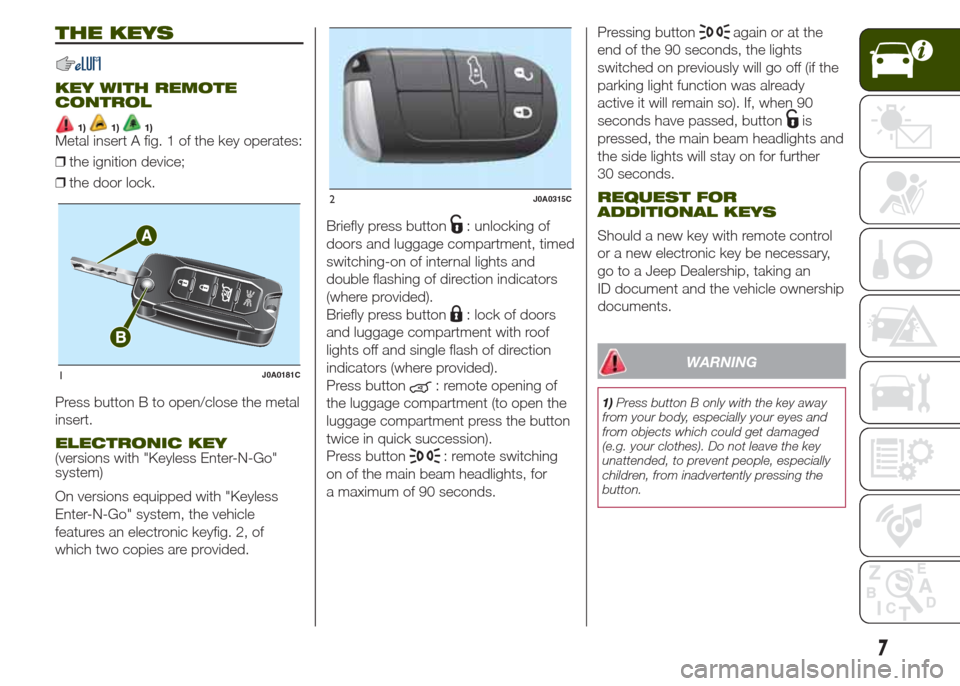
1)1)1)Metal insert A fig. 1 of the key operates:
❒the ignition device;
❒the door lock.
Press button B to open/close the metal
insert.
ELECTRONIC KEY(versions with "Keyless Enter-N-Go"
system)
On versions equipped with "Keyless
Enter-N-Go" system, the vehicle
features an electronic keyfig. 2, of
which two copies are provided.Briefly press button
: unlocking of
doors and luggage compartment, timed
switching-on of internal lights and
double flashing of direction indicators
(where provided).
Briefly press button
: lock of doors
and luggage compartment with roof
lights off and single flash of direction
indicators (where provided).
Press button
: remote opening of
the luggage compartment (to open the
luggage compartment press the button
twice in quick succession).
Press button
: remote switching
on of the main beam headlights, for
a maximum of 90 seconds.Pressing button
again or at the
end of the 90 seconds, the lights
switched on previously will go off (if the
parking light function was already
active it will remain so). If, when 90
seconds have passed, button
is
pressed, the main beam headlights and
the side lights will stay on for further
30 seconds.
REQUEST FOR
ADDITIONAL KEYS
Should a new key with remote control
or a new electronic key be necessary,
go to a Jeep Dealership, taking an
ID document and the vehicle ownership
documents.
WARNING
1)Press button B only with the key away
from your body, especially your eyes and
from objects which could get damaged
(e.g. your clothes). Do not leave the key
unattended, to prevent people, especially
children, from inadvertently pressing the
button.
1J0A0181C
2J0A0315C
7
Page 17 of 212
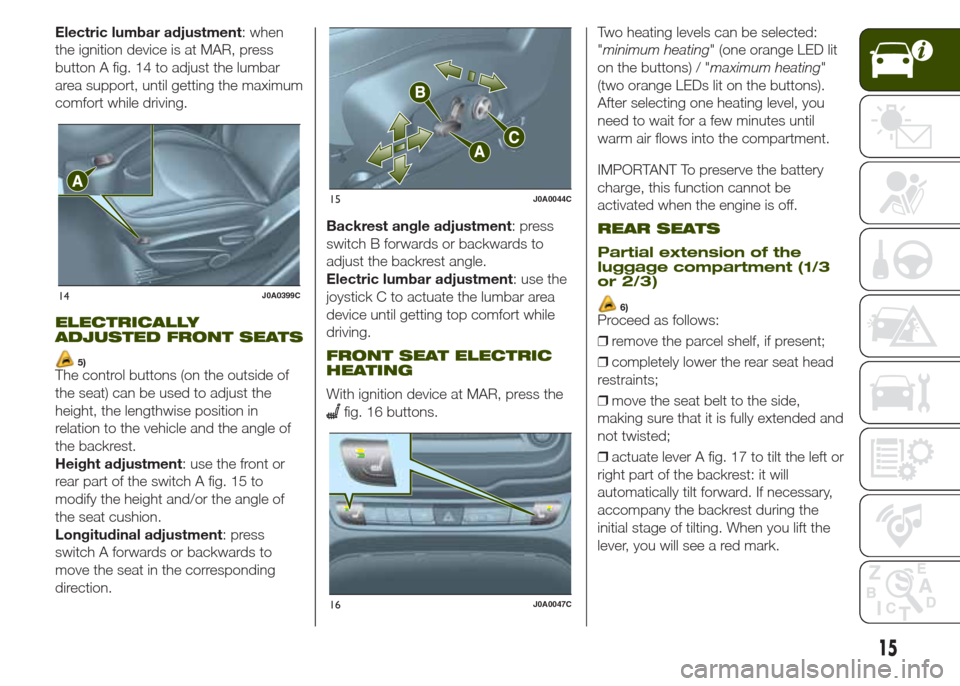
Electric lumbar adjustment: when
the ignition device is at MAR, press
button A fig. 14 to adjust the lumbar
area support, until getting the maximum
comfort while driving.
ELECTRICALLY
ADJUSTED FRONT SEATS
5)The control buttons (on the outside of
the seat) can be used to adjust the
height, the lengthwise position in
relation to the vehicle and the angle of
the backrest.
Height adjustment: use the front or
rear part of the switch A fig. 15 to
modify the height and/or the angle of
the seat cushion.
Longitudinal adjustment: press
switch A forwards or backwards to
move the seat in the corresponding
direction.Backrest angle adjustment: press
switch B forwards or backwards to
adjust the backrest angle.
Electric lumbar adjustment: use the
joystick C to actuate the lumbar area
device until getting top comfort while
driving.
FRONT SEAT ELECTRIC
HEATING
With ignition device at MAR, press the
fig. 16 buttons.Two heating levels can be selected:
"minimum heating" (one orange LED lit
on the buttons) / "maximum heating"
(two orange LEDs lit on the buttons).
After selecting one heating level, you
need to wait for a few minutes until
warm air flows into the compartment.
IMPORTANT To preserve the battery
charge, this function cannot be
activated when the engine is off.
REAR SEATS
Partial extension of the
luggage compartment (1/3
or 2/3)
6)Proceed as follows:
❒remove the parcel shelf, if present;
❒completely lower the rear seat head
restraints;
❒move the seat belt to the side,
making sure that it is fully extended and
not twisted;
❒actuate lever A fig. 17 to tilt the left or
right part of the backrest: it will
automatically tilt forward. If necessary,
accompany the backrest during the
initial stage of tilting. When you lift the
lever, you will see a red mark.
14J0A0399C
15J0A0044C
16J0A0047C
15
Page 29 of 212
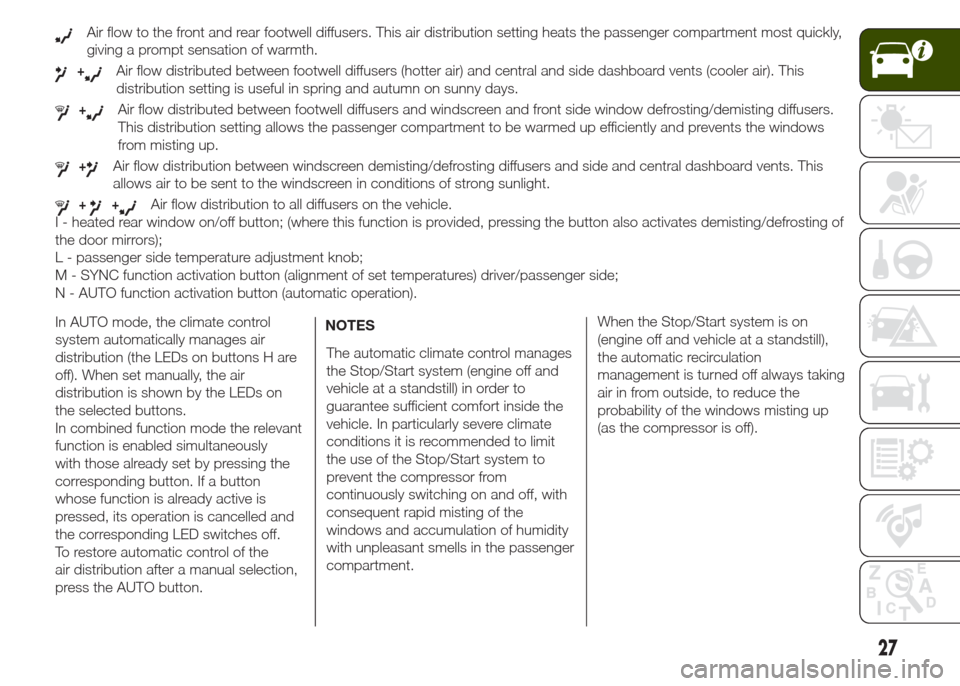
Air flow to the front and rear footwell diffusers. This air distribution setting heats the passenger compartment most quickly,
giving a prompt sensation of warmth.
+Air flow distributed between footwell diffusers (hotter air) and central and side dashboard vents (cooler air). This
distribution setting is useful in spring and autumn on sunny days.
+Air flow distributed between footwell diffusers and windscreen and front side window defrosting/demisting diffusers.
This distribution setting allows the passenger compartment to be warmed up efficiently and prevents the windows
from misting up.
+Air flow distribution between windscreen demisting/defrosting diffusers and side and central dashboard vents. This
allows air to be sent to the windscreen in conditions of strong sunlight.
++Air flow distribution to all diffusers on the vehicle.
I - heated rear window on/off button; (where this function is provided, pressing the button also activates demisting/defrosting of
the door mirrors);
L - passenger side temperature adjustment knob;
M - SYNC function activation button (alignment of set temperatures) driver/passenger side;
N - AUTO function activation button (automatic operation).
In AUTO mode, the climate control
system automatically manages air
distribution (the LEDs on buttons H are
off). When set manually, the air
distribution is shown by the LEDs on
the selected buttons.
In combined function mode the relevant
function is enabled simultaneously
with those already set by pressing the
corresponding button. If a button
whose function is already active is
pressed, its operation is cancelled and
the corresponding LED switches off.
To restore automatic control of the
air distribution after a manual selection,
press the AUTO button.NOTES
The automatic climate control manages
the Stop/Start system (engine off and
vehicle at a standstill) in order to
guarantee sufficient comfort inside the
vehicle. In particularly severe climate
conditions it is recommended to limit
the use of the Stop/Start system to
prevent the compressor from
continuously switching on and off, with
consequent rapid misting of the
windows and accumulation of humidity
with unpleasant smells in the passenger
compartment.When the Stop/Start system is on
(engine off and vehicle at a standstill),
the automatic recirculation
management is turned off always taking
air in from outside, to reduce the
probability of the windows misting up
(as the compressor is off).
27
Page 31 of 212
❒after the window has reached the
upper end of travel, hold the up button
down for at least 3 seconds.
WARNING
21)Incorrect use of the electric windows
may be dangerous. Before and during their
operation, ensure that any passengers
are not at risk from the moving glass either
by personal objects getting caught in the
mechanism or by being hit by it directly.
When leaving the vehicle (equipped with
mechanical key with remote control),
always remove the key from the ignition
device to prevent accidental operation of
the electric windows from being a hazard
for those still on board.
ELECTRIC SUN
ROOF
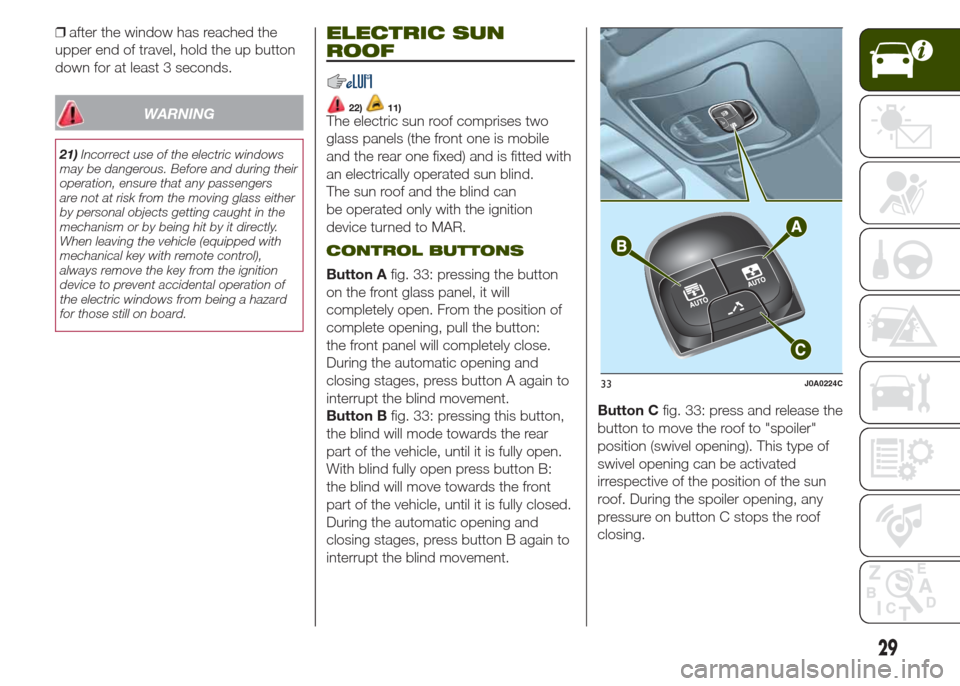
22)11)The electric sun roof comprises two
glass panels (the front one is mobile
and the rear one fixed) and is fitted with
an electrically operated sun blind.
The sun roof and the blind can
be operated only with the ignition
device turned to MAR.
CONTROL BUTTONS
Button Afig. 33: pressing the button
on the front glass panel, it will
completely open. From the position of
complete opening, pull the button:
the front panel will completely close.
During the automatic opening and
closing stages, press button A again to
interrupt the blind movement.
Button Bfig. 33: pressing this button,
the blind will mode towards the rear
part of the vehicle, until it is fully open.
With blind fully open press button B:
the blind will move towards the front
part of the vehicle, until it is fully closed.
During the automatic opening and
closing stages, press button B again to
interrupt the blind movement.Button Cfig. 33: press and release the
button to move the roof to "spoiler"
position (swivel opening). This type of
swivel opening can be activated
irrespective of the position of the sun
roof. During the spoiler opening, any
pressure on button C stops the roof
closing.
33J0A0224C
29
Page 49 of 212
Amber warning lights
Warning light What it means
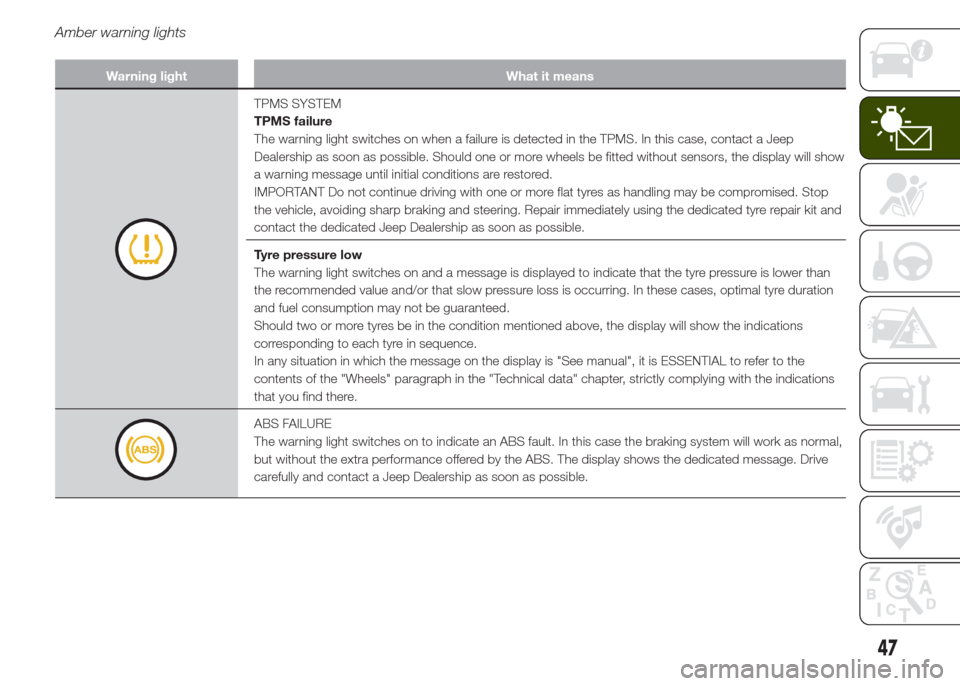
TPMS SYSTEM
TPMS failure
The warning light switches on when a failure is detected in the TPMS. In this case, contact a Jeep
Dealership as soon as possible. Should one or more wheels be fitted without sensors, the display will show
a warning message until initial conditions are restored.
IMPORTANT Do not continue driving with one or more flat tyres as handling may be compromised. Stop
the vehicle, avoiding sharp braking and steering. Repair immediately using the dedicated tyre repair kit and
contact the dedicated Jeep Dealership as soon as possible.
Tyre pressure low
The warning light switches on and a message is displayed to indicate that the tyre pressure is lower than
the recommended value and/or that slow pressure loss is occurring. In these cases, optimal tyre duration
and fuel consumption may not be guaranteed.
Should two or more tyres be in the condition mentioned above, the display will show the indications
corresponding to each tyre in sequence.
In any situation in which the message on the display is "See manual", it is ESSENTIAL to refer to the
contents of the "Wheels" paragraph in the "Technical data" chapter, strictly complying with the indications
that you find there.
ABS FAILURE
The warning light switches on to indicate an ABS fault. In this case the braking system will work as normal,
but without the extra performance offered by the ABS. The display shows the dedicated message. Drive
carefully and contact a Jeep Dealership as soon as possible.
47
Page 54 of 212
Blue warning lights
Warning light What it means
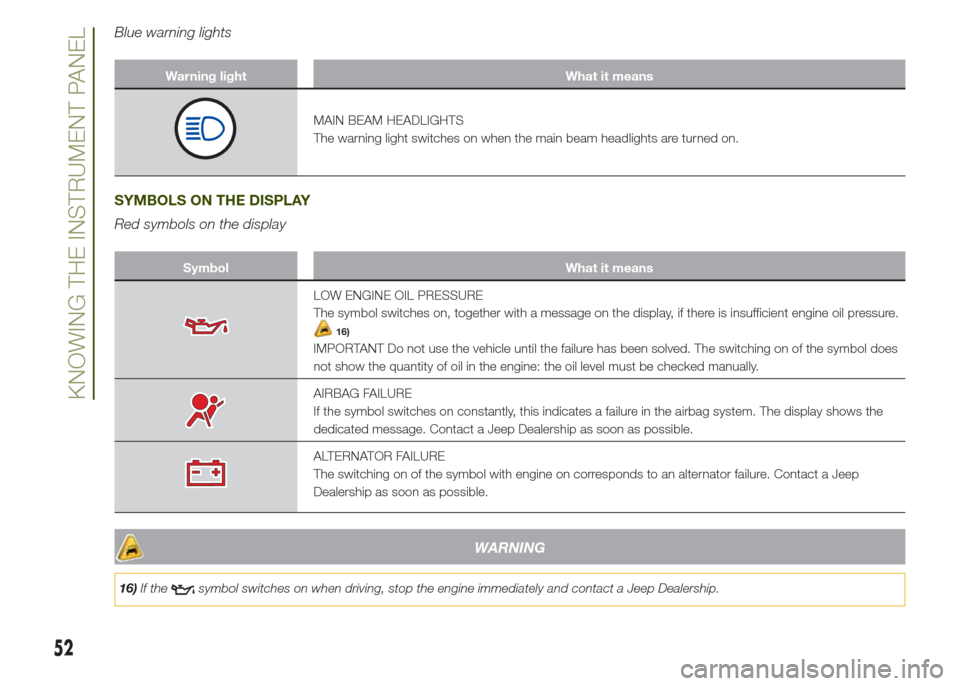
MAIN BEAM HEADLIGHTS
The warning light switches on when the main beam headlights are turned on.
SYMBOLS ON THE DISPLAY
Red symbols on the display
Symbol What it means
LOW ENGINE OIL PRESSURE
The symbol switches on, together with a message on the display, if there is insufficient engine oil pressure.
16)
IMPORTANT Do not use the vehicle until the failure has been solved. The switching on of the symbol does
not show the quantity of oil in the engine: the oil level must be checked manually.
AIRBAG FAILURE
If the symbol switches on constantly, this indicates a failure in the airbag system. The display shows the
dedicated message. Contact a Jeep Dealership as soon as possible.
ALTERNATOR FAILURE
The switching on of the symbol with engine on corresponds to an alternator failure. Contact a Jeep
Dealership as soon as possible.
WARNING
16)If thesymbol switches on when driving, stop the engine immediately and contact a Jeep Dealership.
52
KNOWING THE INSTRUMENT PANEL
Page 66 of 212
ACTIVE SAFETY
SYSTEMS
ABS (Anti-lock Braking
System)
This system, which is an integral part of
the braking system, prevents one or
more wheels from locking and slipping
in all road surface conditions,
irrespective of the intensity of the
braking action, ensuring that the vehicle
can be controlled even during
emergency braking and optimising
stopping distances.
System intervention
The driver can feel that the ABS system
has come into action because the
brake pedal pulsates slightly and the
system gets noisier: this is entirely
normal with the system operating.
31) 32) 33) 34) 35) 36) 37)
DTC (Drag Torque
Control) SYSTEM
The system intervenes in the event of
sudden downshifting, or during ABS
braking, restoring torque to the engine
and thus preventing excessive drag
at the drive wheels, which may lead the
wheels to lock and a loss of vehicle
stability, above all in low-grip
conditions.
ESC (Electronic Stability
Control) SYSTEM
The ESC system improves the
directional control and stability of the
vehicle in various driving conditions,
correcting understeer and oversteer,
distributing the brake force on the
appropriate wheels.
System intervention
The intervention of the system is
indicated by the flashing of the
warning light on the instrument
panel, to inform the driver that
the vehicle is in critical stability and grip
conditions.
38) 39) 40) 41) 42)
TC (Traction Control)
SYSTEM
The system automatically operates in
the event of slipping, loss of grip on wet
roads (aquaplaning) and acceleration
on slippery, snowy or icy roads, etc. on
one or both drive wheels.
System intervention
The intervention of the system is
indicated by the flashing of the
warning light on the instrument
panel, to inform the driver that
the vehicle is in critical stability and grip
conditions.
43) 44) 45) 46) 47)
PBA (Panic Brake
Assist) SYSTEM
The PBA system is designed to
improve the vehicle’s braking capacity
during emergency braking.
The brake pedal should be pressed
continuously during braking, avoiding
intermittent presses, to get the most
out of the system. Do not reduce
pressure on the brake pedal until
braking is not necessary anymore.
The PBA system is deactivated when
the brake pedal is released.
48) 49) 50)
HSA (Hill Start Assist)
SYSTEM
This system is an integral part of the
ESC system and facilitates starting on
slopes.
System deactivation
The Hill Start Assist system can be
deactivated using the display Menu
(see the instructions in the "Display"
paragraph, "Knowing the instrument
panel" chapter).
51) 52)
64
SAFETY
Page 67 of 212
DST SYSTEM (Dynamic
Steering Torque)
The DST function uses the integration
of the ESC system with the electric
power steering to increase the safety
level of the whole vehicle.
53)
ERM (Electronic Rollover
Mitigation) SYSTEM
The system monitors the tendency of
the wheels to rise from the ground if the
driver performs extreme manoeuvres
like quick steering to avoid an obstacle,
especially in poor road conditions.
If these conditions occur, the system
intervenes on the brakes and engine
power to reduce the possibility that the
wheels are raised from the ground. It
is not possible to avoid tendency to roll
over if the phenomenon is due to
reasons such as driving on high side
gradients, collision with objects or other
vehicles.
54)
TSC (Trailer Sway
Control) SYSTEM
The system employs a series of
sensors located on the vehicle to
identify excessive swerving of the trailer
and take the necessary precautions
to eliminate it.
System intervention
When the system is active, the
warning light flashes on the
instrument panel, the engine power is
reduced and braking can be felt on the
individual wheels, following the attempt
to eliminate the swerving of the trailer.
The system is active only with ESC
engaged.
When the ESC system is deactivated
(by pressing the button on the central
tunnel), the TSC system is deactivated
as well.
55) 56)
HDC (Hill Descent
Control) SYSTEM
(where provided)
It is an integral part of the ESC system
and is aimed at keeping the vehicle at a
constant speed during a descent,
operating autonomously on the brakes
in various ways at the same time.
In this way the vehicle stability and
completely safe driving are guaranteed,
above all in poor grip conditions and
steep descents.
Enabling the system
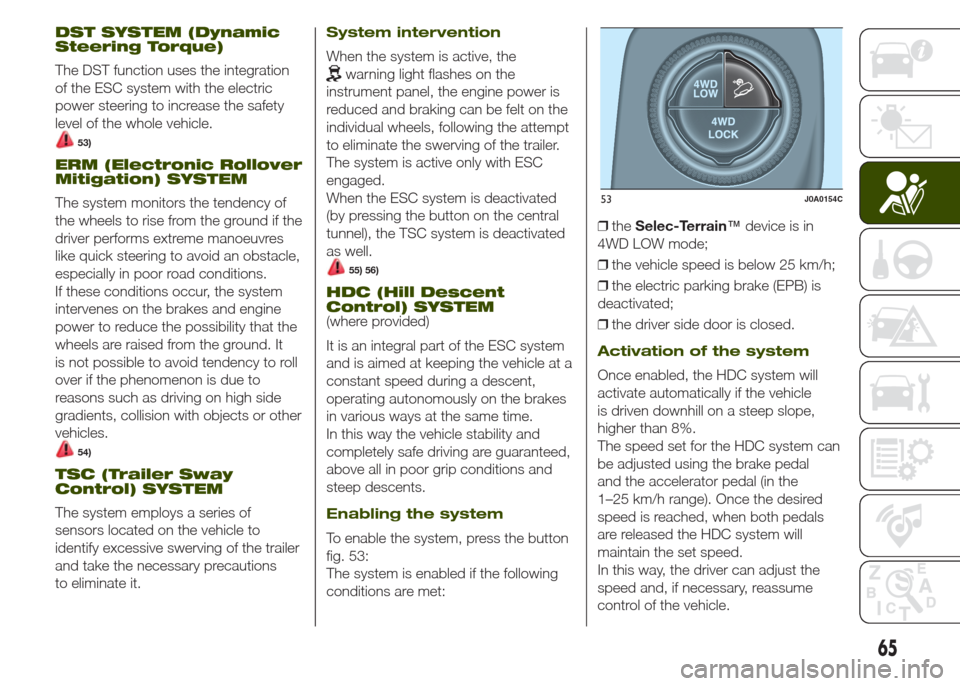
To enable the system, press the button
fig. 53:
The system is enabled if the following
conditions are met:❒theSelec-Terrain™device is in
4WD LOW mode;
❒the vehicle speed is below 25 km/h;
❒the electric parking brake (EPB) is
deactivated;
❒the driver side door is closed.
Activation of the system
Once enabled, the HDC system will
activate automatically if the vehicle
is driven downhill on a steep slope,
higher than 8%.
The speed set for the HDC system can
be adjusted using the brake pedal
and the accelerator pedal (in the
1–25 km/h range). Once the desired
speed is reached, when both pedals
are released the HDC system will
maintain the set speed.
In this way, the driver can adjust the
speed and, if necessary, reassume
control of the vehicle.
53J0A0154C
65