ESP JEEP RENEGADE 2014 1.G Owner's Manual
[x] Cancel search | Manufacturer: JEEP, Model Year: 2014, Model line: RENEGADE, Model: JEEP RENEGADE 2014 1.GPages: 212, PDF Size: 17.48 MB
Page 115 of 212
The sensors are automatically
reactivated when the trailer's cable plug
is removed. Before using thePark-
Sense® system, it is recommended to
remove the tow hook ball assembly and
the relevant attachment from the vehi-
cle when the latter is not used for tow-
ing operations. Failure to comply with
this prescription may cause personal
injuries or damages to vehicles or
obstacles since, when the continuous
acoustic signal is emitted, the tow hook
ball is already in a position that is much
closer to the obstacle than the rear
bumper.
In addition, the sensors may detect the
tow hook ball assembly and the
relevant attachment (depending on its
size and shape), providing a false
indication of the presence of an
obstacle in the area behind the vehicle.
GENERAL WARNINGS
Some conditions may influence the
performance of the parking system:
❒reduced sensor sensitivity and a
reduction in the parking assistance
system performance could be due to
the presence of: ice, snow, mud, thick
paint, on the surface of the sensor;
❒the sensor may detect a non-existent
obstacle ("echo interference") due to
mechanical interference, for example
when washing the vehicle, in rain
(strong wind), hail;❒the signals sent by the sensor can
also be altered by the presence of
ultrasonic systems (e.g. pneumatic
brake systems of trucks or pneumatic
drills) near the vehicle;
❒Parking assistance system
performance can also be influenced by
the position of the sensors, for example
due to a change in the ride setting
(caused by wear to the shock
absorbers, suspension), or by changing
tyres, overloading the vehicle or
carrying out specific tuning operations
that require the vehicle to be lowered.
❒the presence of a tow hook without
trailer, which may interfere with the
correct operation of the parking
sensors.
❒the presence of adhesives on the
sensors. Thus take care not to place
adhesives on the sensors.
WARNING
126)Parking and other potentially
dangerous manoeuvres are, however,
always the driver’s responsibility. When
performing these operations, always make
sure that there are no other people
(especially children) or animals on the route
you want to drive into. The parking
sensors are an aid for the driver, but the
driver must never allow their attention
to lapse during potentially dangerous
manoeuvres, even those executed at low
speeds.
WARNING
42)The sensors must be clean of mud,
dirt, snow or ice in order for the system to
operate correctly. Be careful not to scratch
or damage the sensors while cleaning
them. Avoid using dry, rough or hard
cloths. The sensors should be washed
using clean water with the addition of car
shampoo if necessary. When using special
washing equipment such as high pressure
jets or steam cleaning, clean the sensors
very quickly keeping the jet more than
10 cm away.
43)Only have interventions on the bumper
in the area of the sensors carried out by
a Jeep Dealership. Interventions on the
bumper that are not carried out properly
may compromise the operation of the
parking sensors.
113
Page 116 of 212
LANESENSE
SYSTEM (lane
crossing warning)
DESCRIPTION
44) 45) 46) 47) 48) 49)
The LaneSense system makes use of a
camera located on the windscreen to
detect the lane limits and calculate
the position of the vehicle within such
limits, in order to make sure that it
remains inside the lane.
When both limits of the lane are
detected and the vehicle crosses one of
them without the awareness of the
driver (direction indicator off), the
system provides a tactile warning by
applying torque to the steering wheel,
signalling the driver that he must take
an action to remain into the lane.
If the vehicle continues going beyond
the line of the lane without any
intervention from the driver, the
warning light (or the corresponding
graphic icon on the reconfigurable
multifunction display) will be displayed
on the instrument panel to urge the
driver to bring the vehicle back into the
limits of the lane.IMPORTANT The system monitors the
presence of the driver's hands on
the steering wheel. If they are
not detected, the system emits an
acoustic signal and deactivates until it is
reactivated by pressing the dedicated
button.
When one limit of the lane is detected
and the vehicle crosses it (direction
indicator off), warning light
(or the
icon on the reconfigurable multifunction
display) will be displayed on the
instrument panel to urge the driver to
bring the vehicle back into the lane.
In this case, the tactile warning (torque
on the steering wheel) is not provided.
SYSTEM ACTIVATION/
DEACTIVATION
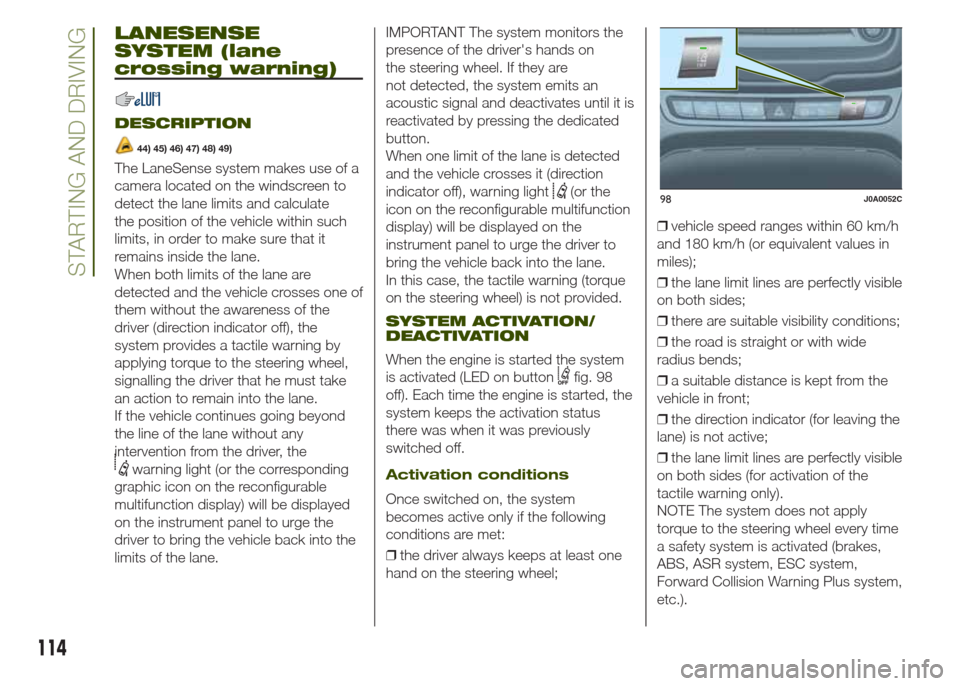
When the engine is started the system
is activated (LED on button
fig. 98
off). Each time the engine is started, the
system keeps the activation status
there was when it was previously
switched off.
Activation conditions
Once switched on, the system
becomes active only if the following
conditions are met:
❒the driver always keeps at least one
hand on the steering wheel;❒vehicle speed ranges within 60 km/h
and 180 km/h (or equivalent values in
miles);
❒the lane limit lines are perfectly visible
on both sides;
❒there are suitable visibility conditions;
❒the road is straight or with wide
radius bends;
❒a suitable distance is kept from the
vehicle in front;
❒the direction indicator (for leaving the
lane) is not active;
❒the lane limit lines are perfectly visible
on both sides (for activation of the
tactile warning only).
NOTE The system does not apply
torque to the steering wheel every time
a safety system is activated (brakes,
ABS, ASR system, ESC system,
Forward Collision Warning Plus system,
etc.).
98J0A0052C
114
STARTING AND DRIVING
Page 118 of 212
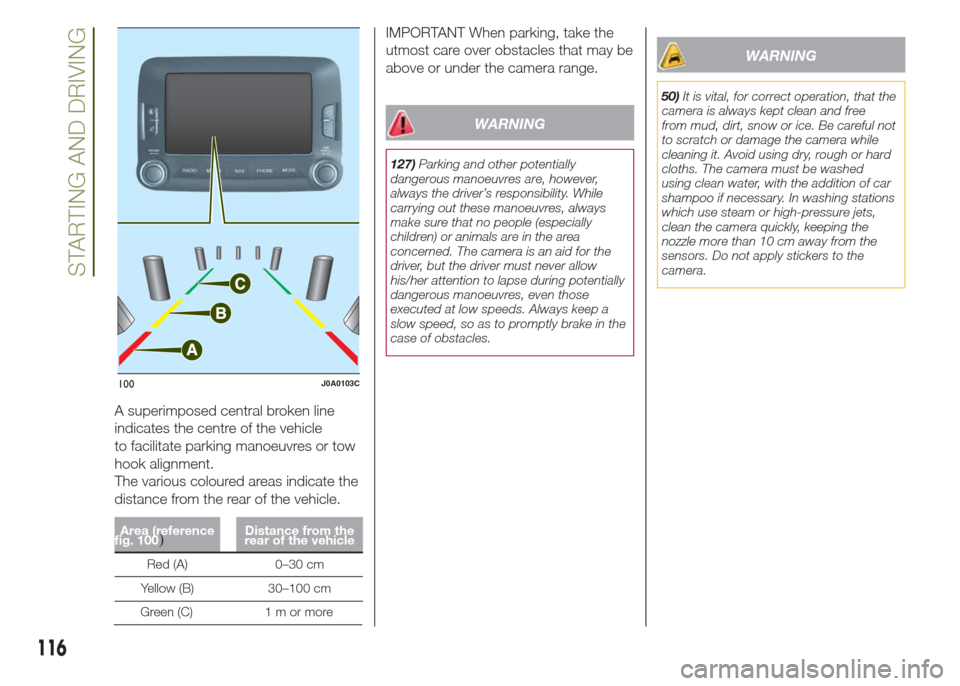
A superimposed central broken line
indicates the centre of the vehicle
to facilitate parking manoeuvres or tow
hook alignment.
The various coloured areas indicate the
distance from the rear of the vehicle.
Area (reference
fig. 100)Distance from the
rear of the vehicle
Red (A) 0–30 cm
Yellow (B) 30–100 cm
Green (C) 1 m or more
IMPORTANT When parking, take the
utmost care over obstacles that may be
above or under the camera range.
WARNING
127)Parking and other potentially
dangerous manoeuvres are, however,
always the driver’s responsibility. While
carrying out these manoeuvres, always
make sure that no people (especially
children) or animals are in the area
concerned. The camera is an aid for the
driver, but the driver must never allow
his/her attention to lapse during potentially
dangerous manoeuvres, even those
executed at low speeds. Always keep a
slow speed, so as to promptly brake in the
case of obstacles.
WARNING
50)It is vital, for correct operation, that the
camera is always kept clean and free
from mud, dirt, snow or ice. Be careful not
to scratch or damage the camera while
cleaning it. Avoid using dry, rough or hard
cloths. The camera must be washed
using clean water, with the addition of car
shampoo if necessary. In washing stations
which use steam or high-pressure jets,
clean the camera quickly, keeping the
nozzle more than 10 cm away from the
sensors. Do not apply stickers to the
camera.
100J0A0103C
116
STARTING AND DRIVING
Page 121 of 212
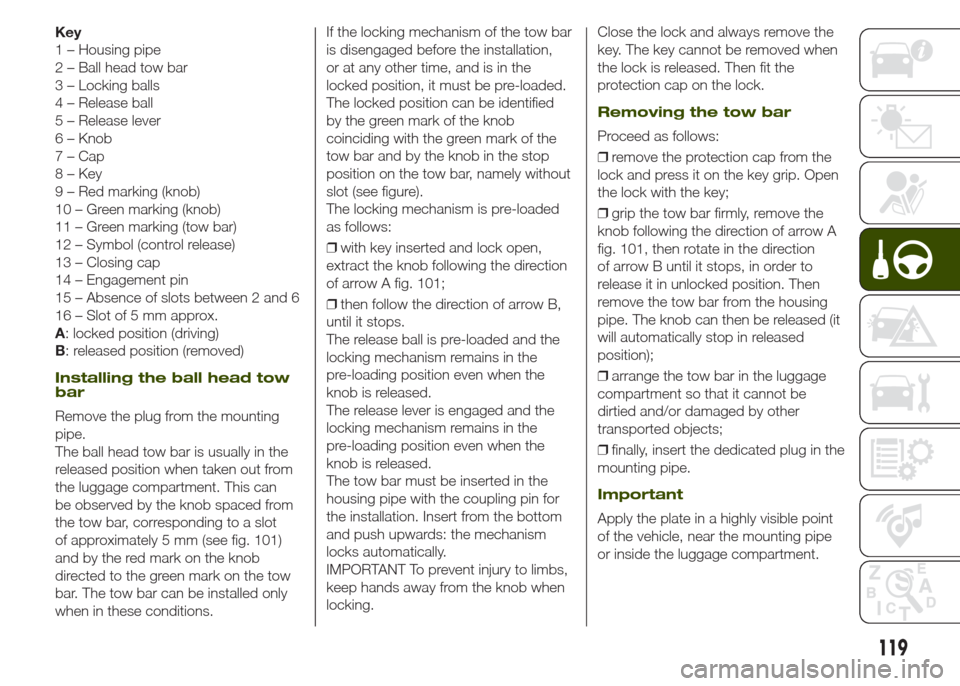
Key
1 – Housing pipe
2 – Ball head tow bar
3 – Locking balls
4 – Release ball
5 – Release lever
6 – Knob
7 – Cap
8 – Key
9 – Red marking (knob)
10 – Green marking (knob)
11 – Green marking (tow bar)
12 – Symbol (control release)
13 – Closing cap
14 – Engagement pin
15 – Absence of slots between 2 and 6
16 – Slot of 5 mm approx.
A: locked position (driving)
B: released position (removed)
Installing the ball head tow
bar
Remove the plug from the mounting
pipe.
The ball head tow bar is usually in the
released position when taken out from
the luggage compartment. This can
be observed by the knob spaced from
the tow bar, corresponding to a slot
of approximately 5 mm (see fig. 101)
and by the red mark on the knob
directed to the green mark on the tow
bar. The tow bar can be installed only
when in these conditions.If the locking mechanism of the tow bar
is disengaged before the installation,
or at any other time, and is in the
locked position, it must be pre-loaded.
The locked position can be identified
by the green mark of the knob
coinciding with the green mark of the
tow bar and by the knob in the stop
position on the tow bar, namely without
slot (see figure).
The locking mechanism is pre-loaded
as follows:
❒with key inserted and lock open,
extract the knob following the direction
of arrow A fig. 101;
❒then follow the direction of arrow B,
until it stops.
The release ball is pre-loaded and the
locking mechanism remains in the
pre-loading position even when the
knob is released.
The release lever is engaged and the
locking mechanism remains in the
pre-loading position even when the
knob is released.
The tow bar must be inserted in the
housing pipe with the coupling pin for
the installation. Insert from the bottom
and push upwards: the mechanism
locks automatically.
IMPORTANT To prevent injury to limbs,
keep hands away from the knob when
locking.Close the lock and always remove the
key. The key cannot be removed when
the lock is released. Then fit the
protection cap on the lock.
Removing the tow bar
Proceed as follows:
❒remove the protection cap from the
lock and press it on the key grip. Open
the lock with the key;
❒grip the tow bar firmly, remove the
knob following the direction of arrow A
fig. 101, then rotate in the direction
of arrow B until it stops, in order to
release it in unlocked position. Then
remove the tow bar from the housing
pipe. The knob can then be released (it
will automatically stop in released
position);
❒arrange the tow bar in the luggage
compartment so that it cannot be
dirtied and/or damaged by other
transported objects;
❒finally, insert the dedicated plug in the
mounting pipe.
Important
Apply the plate in a highly visible point
of the vehicle, near the mounting pipe
or inside the luggage compartment.
119
Page 126 of 212
HAZARD WARNING
LIGHTS
CONTROL
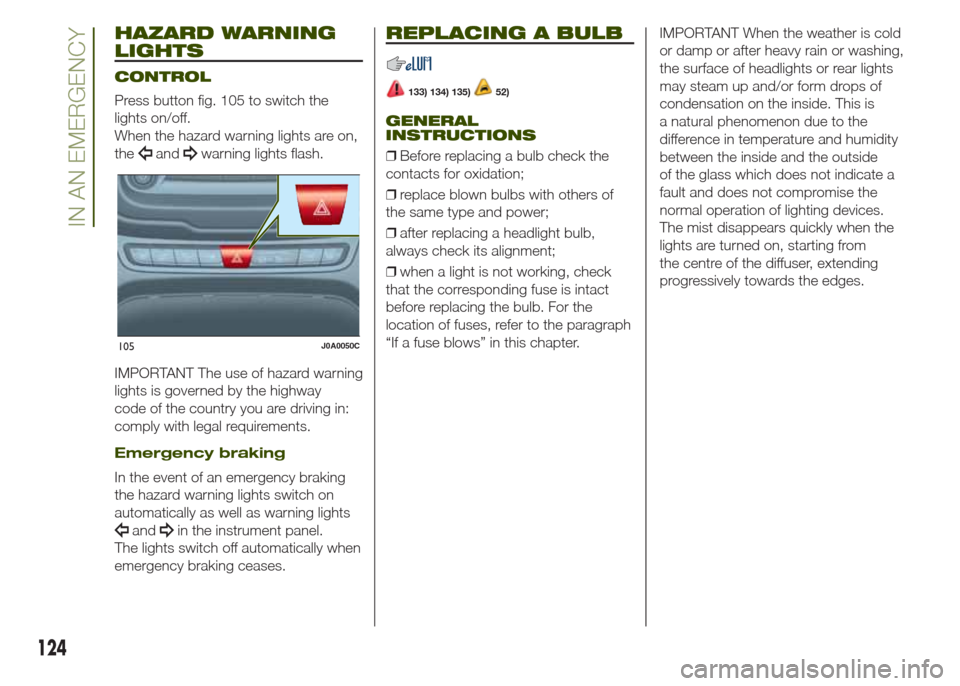
Press button fig. 105 to switch the
lights on/off.
When the hazard warning lights are on,
the
andwarning lights flash.
IMPORTANT The use of hazard warning
lights is governed by the highway
code of the country you are driving in:
comply with legal requirements.
Emergency braking
In the event of an emergency braking
the hazard warning lights switch on
automatically as well as warning lights
andin the instrument panel.
The lights switch off automatically when
emergency braking ceases.
REPLACING A BULB
133) 134) 135)52)
GENERAL
INSTRUCTIONS
❒Before replacing a bulb check the
contacts for oxidation;
❒replace blown bulbs with others of
the same type and power;
❒after replacing a headlight bulb,
always check its alignment;
❒when a light is not working, check
that the corresponding fuse is intact
before replacing the bulb. For the
location of fuses, refer to the paragraph
“If a fuse blows” in this chapter.IMPORTANT When the weather is cold
or damp or after heavy rain or washing,
the surface of headlights or rear lights
may steam up and/or form drops of
condensation on the inside. This is
a natural phenomenon due to the
difference in temperature and humidity
between the inside and the outside
of the glass which does not indicate a
fault and does not compromise the
normal operation of lighting devices.
The mist disappears quickly when the
lights are turned on, starting from
the centre of the diffuser, extending
progressively towards the edges.
105J0A0050C
124
IN AN EMERGENCY
Page 129 of 212
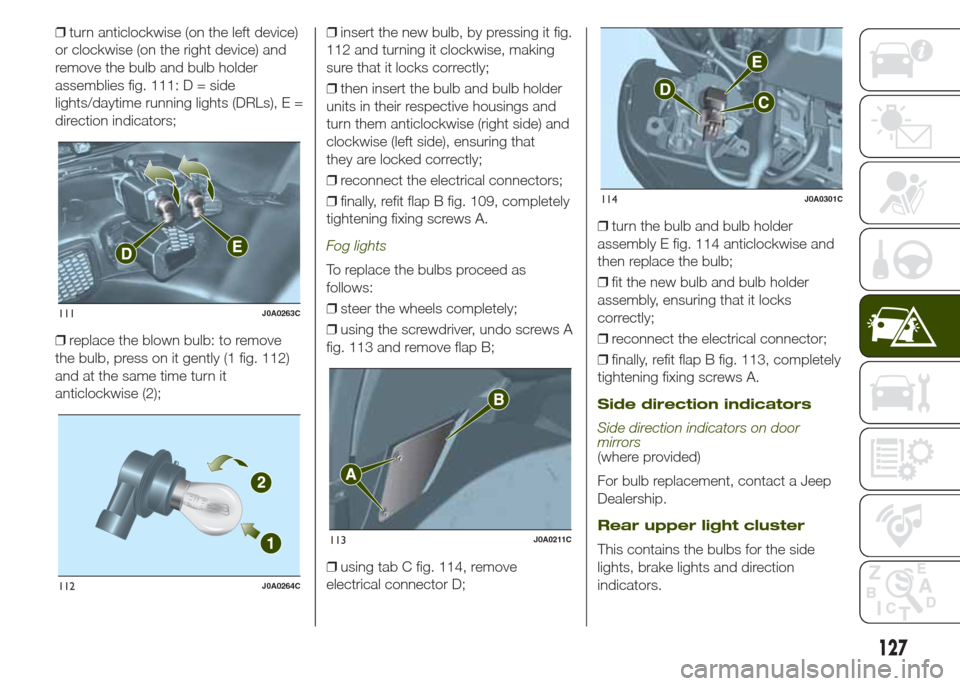
❒turn anticlockwise (on the left device)
or clockwise (on the right device) and
remove the bulb and bulb holder
assemblies fig. 111: D = side
lights/daytime running lights (DRLs), E =
direction indicators;
❒replace the blown bulb: to remove
the bulb, press on it gently (1 fig. 112)
and at the same time turn it
anticlockwise (2);❒insert the new bulb, by pressing it fig.
112 and turning it clockwise, making
sure that it locks correctly;
❒then insert the bulb and bulb holder
units in their respective housings and
turn them anticlockwise (right side) and
clockwise (left side), ensuring that
they are locked correctly;
❒reconnect the electrical connectors;
❒finally, refit flap B fig. 109, completely
tightening fixing screws A.
Fog lights
To replace the bulbs proceed as
follows:
❒steer the wheels completely;
❒using the screwdriver, undo screws A
fig. 113 and remove flap B;
❒using tab C fig. 114, remove
electrical connector D;❒turn the bulb and bulb holder
assembly E fig. 114 anticlockwise and
then replace the bulb;
❒fit the new bulb and bulb holder
assembly, ensuring that it locks
correctly;
❒reconnect the electrical connector;
❒finally, refit flap B fig. 113, completely
tightening fixing screws A.
Side direction indicators
Side direction indicators on door
mirrors
(where provided)
For bulb replacement, contact a Jeep
Dealership.
Rear upper light cluster
This contains the bulbs for the side
lights, brake lights and direction
indicators.
111J0A0263C
112J0A0264C
113J0A0211C
114J0A0301C
127
Page 132 of 212
WARNING
133)Before replacing the bulb, wait for the
exhaust ducts to cool down: RISK OF
BURNS!
134)Changes or repairs to the electrical
system carried out incorrectly and without
due consideration for the technical
specifications of the system may lead to
malfunctioning and generate a fire hazard.
135)Halogen bulbs contain pressurised
gas. If they break, glass fragments could fly
everywhere.
WARNING
52)Halogen bulbs must be handled by
holding the metallic part only. Touching the
transparent part of the bulb with your
fingers may reduce the intensity of the
emitted light and even reduce the lifespan
of the bulb. In the case of accidental
contact, rub the lamp with a cloth and
spirit and leave to dry.
REPLACING FUSES
INTRODUCTION
136) 137) 138) 139) 140)
53) 54)
Fuse extracting pliers
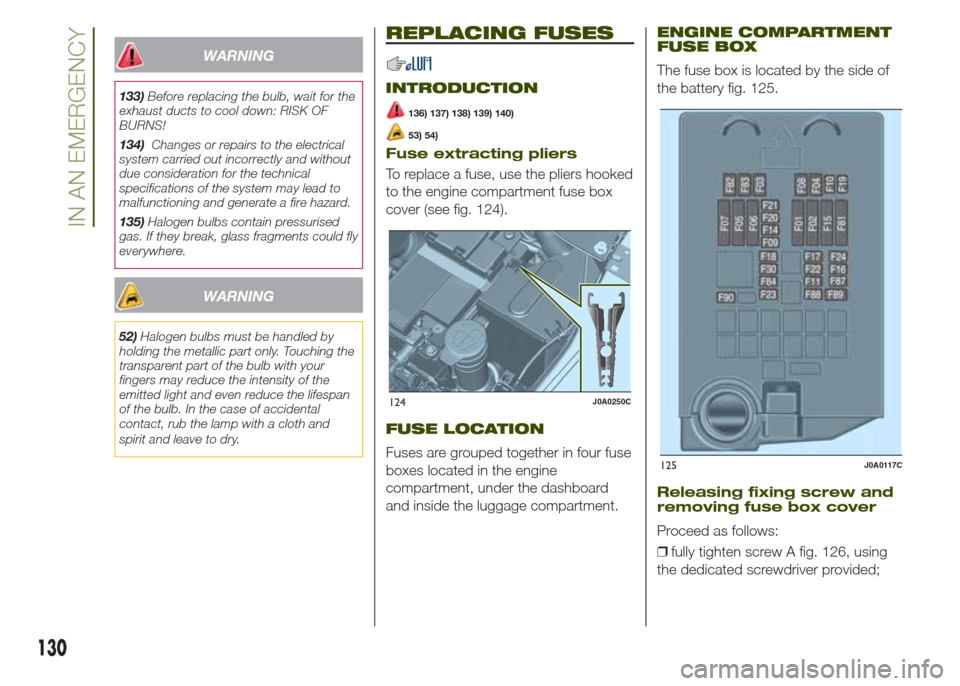
To replace a fuse, use the pliers hooked
to the engine compartment fuse box
cover (see fig. 124).
FUSE LOCATION
Fuses are grouped together in four fuse
boxes located in the engine
compartment, under the dashboard
and inside the luggage compartment.
ENGINE COMPARTMENT
FUSE BOX
The fuse box is located by the side of
the battery fig. 125.
Releasing fixing screw and
removing fuse box cover
Proceed as follows:
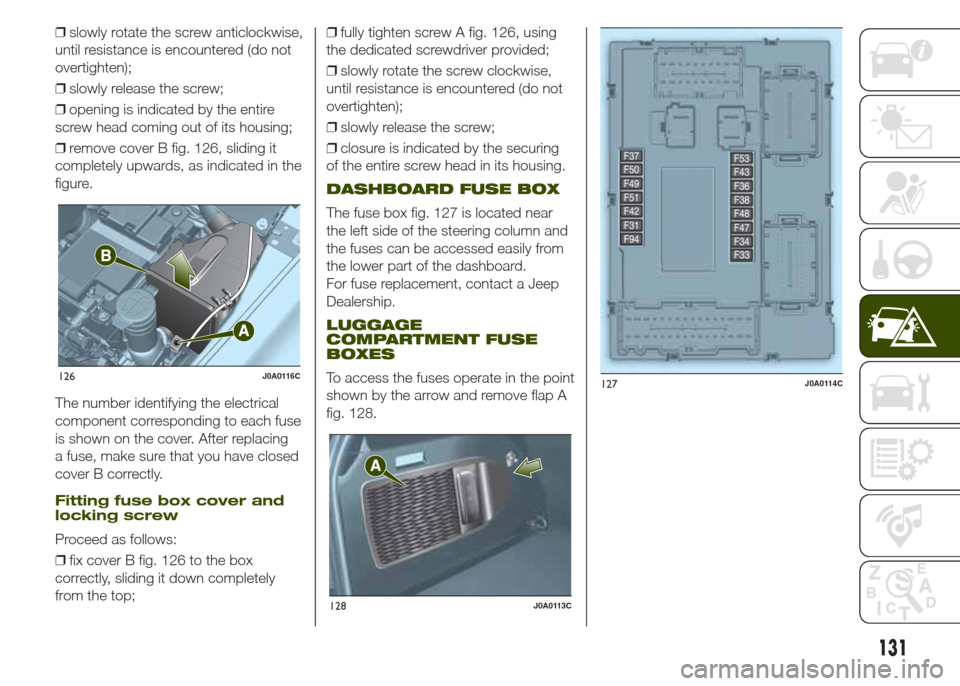
❒fully tighten screw A fig. 126, using
the dedicated screwdriver provided;
124J0A0250C
125J0A0117C
130
IN AN EMERGENCY
Page 133 of 212
❒slowly rotate the screw anticlockwise,
until resistance is encountered (do not
overtighten);
❒slowly release the screw;
❒opening is indicated by the entire
screw head coming out of its housing;
❒remove cover B fig. 126, sliding it
completely upwards, as indicated in the
figure.
The number identifying the electrical
component corresponding to each fuse
is shown on the cover. After replacing
a fuse, make sure that you have closed
cover B correctly.
Fitting fuse box cover and
locking screw
Proceed as follows:
❒fix cover B fig. 126 to the box
correctly, sliding it down completely
from the top;❒fully tighten screw A fig. 126, using
the dedicated screwdriver provided;
❒slowly rotate the screw clockwise,
until resistance is encountered (do not
overtighten);
❒slowly release the screw;
❒closure is indicated by the securing
of the entire screw head in its housing.
DASHBOARD FUSE BOX
The fuse box fig. 127 is located near
the left side of the steering column and
the fuses can be accessed easily from
the lower part of the dashboard.
For fuse replacement, contact a Jeep
Dealership.
LUGGAGE
COMPARTMENT FUSE
BOXES
To access the fuses operate in the point
shown by the arrow and remove flap A
fig. 128.126J0A0116C
128J0A0113C
127J0A0114C
131
Page 138 of 212
❒remove the fixing device for the jack
and the spare wheel;
❒remove the wheel chock;
❒remove the jack unit and the key for
removing the bolts from the spare
wheel. Turn the screw of the jack to
loosen the key and separate it from the
jack assembly;
❒take the spare wheel out of the
luggage compartment.
Tool box (where provided)
On versions with spare wheel there
is also, inside the luggage compartment
(right side), a tool box secured to the
luggage compartment carpet with
dedicated fastenings.
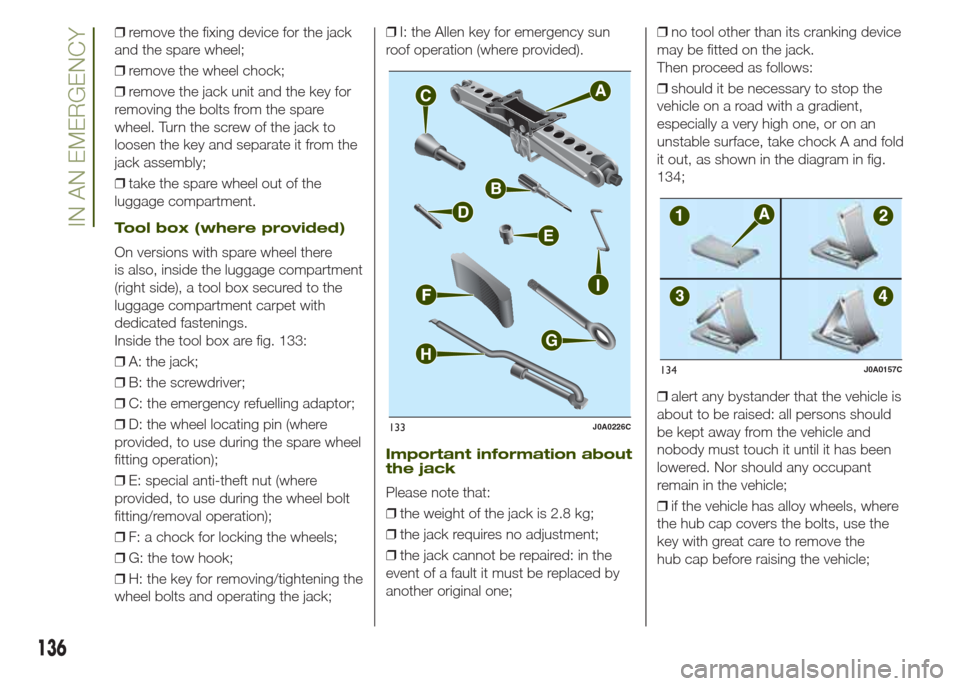
Inside the tool box are fig. 133:
❒A: the jack;
❒B: the screwdriver;
❒C: the emergency refuelling adaptor;
❒D: the wheel locating pin (where
provided, to use during the spare wheel
fitting operation);
❒E: special anti-theft nut (where
provided, to use during the wheel bolt
fitting/removal operation);
❒F: a chock for locking the wheels;
❒G: the tow hook;
❒H: the key for removing/tightening the
wheel bolts and operating the jack;❒I: the Allen key for emergency sun
roof operation (where provided).
Important information about
the jack
Please note that:
❒the weight of the jack is 2.8 kg;
❒the jack requires no adjustment;
❒the jack cannot be repaired: in the
event of a fault it must be replaced by
another original one;❒no tool other than its cranking device
may be fitted on the jack.
Then proceed as follows:
❒should it be necessary to stop the
vehicle on a road with a gradient,
especially a very high one, or on an
unstable surface, take chock A and fold
it out, as shown in the diagram in fig.
134;
❒alert any bystander that the vehicle is
about to be raised: all persons should
be kept away from the vehicle and
nobody must touch it until it has been
lowered. Nor should any occupant
remain in the vehicle;
❒if the vehicle has alloy wheels, where
the hub cap covers the bolts, use the
key with great care to remove the
hub cap before raising the vehicle;
A
C
B
D
E
I
F
G
H
133J0A0226C
134J0A0157C
136
IN AN EMERGENCY
Page 148 of 212
163)The front and rear tow hooks should
be used only for emergencies on the road.
You are allowed to tow the vehicle for
short distances using an appropriate
device in accordance with the highway
code (a rigid bar), to move the vehicle on
the road in readiness for towing or
transport via a breakdown vehicle. Tow
hooks MUST NOT be used to tow vehicles
off the road or where there are obstacles
and/or for towing operations using ropes or
other non-rigid devices. Respecting the
above conditions, towing must take place
with two vehicles (one towing, the other
towed) aligned as much as possible along
the same centre line.BROKEN-DOWN
VEHICLE TOWING
It is recommended to tow the vehicle
with all four wheels lifted from the
ground on the platform of a rescue
vehicle.
VERSIONS WITH FOUR-WHEEL
DRIVE (4WD) AND AUTOMATIC
TRANSMISSION
IMPORTANT Avoid lifting the front (or
rear) wheels only. Lifting the front (or
rear) wheels only while towing might
damage the transmission or the transfer
unit.
IMPORTANT If a vehicle is towed
without complying with the above
requirements, the transmission and/or
the transfer unit might be seriously
damaged. Damage due to an incorrect
towing will not be covered by the
warranty.
146
IN AN EMERGENCY