warning light JEEP RENEGADE 2014 1.G Owner's Manual
[x] Cancel search | Manufacturer: JEEP, Model Year: 2014, Model line: RENEGADE, Model: JEEP RENEGADE 2014 1.GPages: 212, PDF Size: 17.48 MB
Page 51 of 212
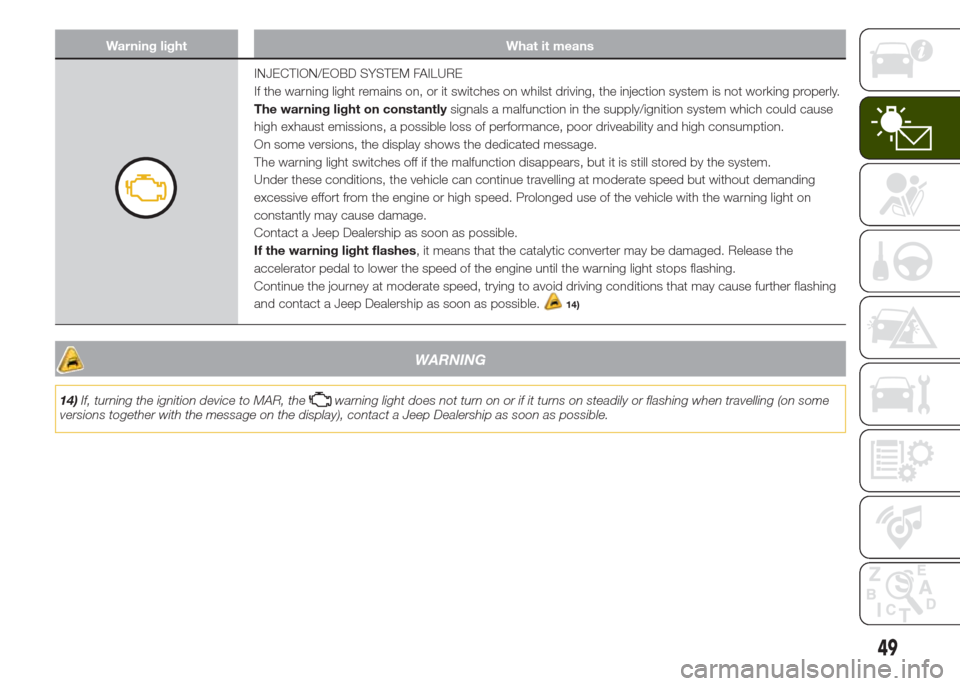
Warning light What it means
INJECTION/EOBD SYSTEM FAILURE
If the warning light remains on, or it switches on whilst driving, the injection system is not working properly.
The warning light on constantlysignals a malfunction in the supply/ignition system which could cause
high exhaust emissions, a possible loss of performance, poor driveability and high consumption.
On some versions, the display shows the dedicated message.
The warning light switches off if the malfunction disappears, but it is still stored by the system.
Under these conditions, the vehicle can continue travelling at moderate speed but without demanding
excessive effort from the engine or high speed. Prolonged use of the vehicle with the warning light on
constantly may cause damage.
Contact a Jeep Dealership as soon as possible.
If the warning light flashes, it means that the catalytic converter may be damaged. Release the
accelerator pedal to lower the speed of the engine until the warning light stops flashing.
Continue the journey at moderate speed, trying to avoid driving conditions that may cause further flashing
and contact a Jeep Dealership as soon as possible.
14)
WARNING
14)If, turning the ignition device to MAR, thewarning light does not turn on or if it turns on steadily or flashing when travelling (on some
versions together with the message on the display), contact a Jeep Dealership as soon as possible.
49
Page 52 of 212
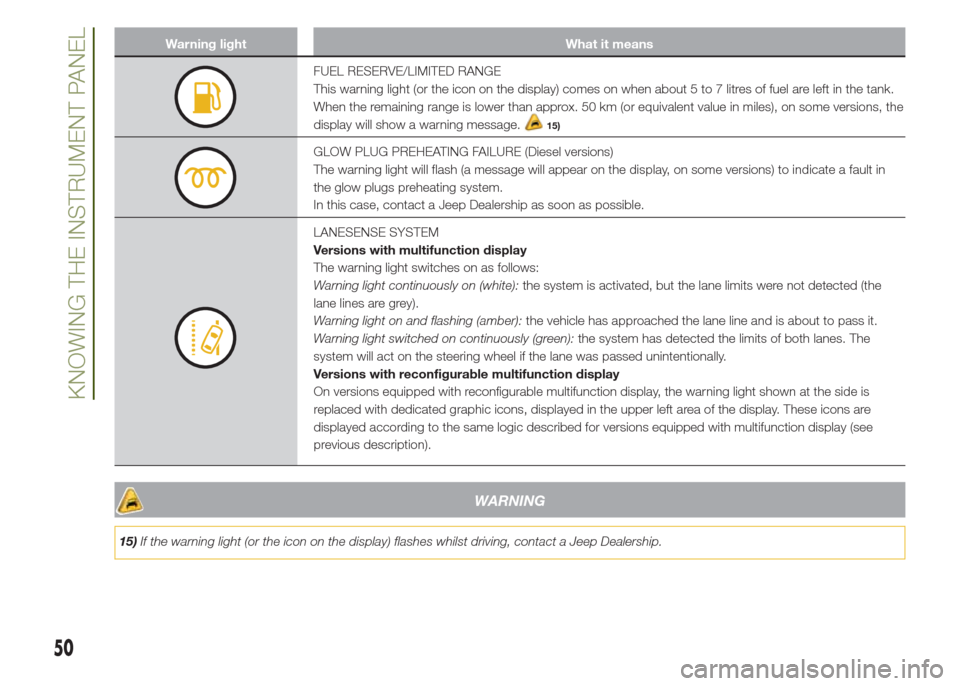
Warning light What it means
FUEL RESERVE/LIMITED RANGE
This warning light (or the icon on the display) comes on when about 5 to 7 litres of fuel are left in the tank.
When the remaining range is lower than approx. 50 km (or equivalent value in miles), on some versions, the
display will show a warning message.
15)
GLOW PLUG PREHEATING FAILURE (Diesel versions)
The warning light will flash (a message will appear on the display, on some versions) to indicate a fault in
the glow plugs preheating system.
In this case, contact a Jeep Dealership as soon as possible.
LANESENSE SYSTEM
Versions with multifunction display
The warning light switches on as follows:
Warning light continuously on (white):the system is activated, but the lane limits were not detected (the
lane lines are grey).
Warning light on and flashing (amber):the vehicle has approached the lane line and is about to pass it.
Warning light switched on continuously (green):the system has detected the limits of both lanes. The
system will act on the steering wheel if the lane was passed unintentionally.
Versions with reconfigurable multifunction display
On versions equipped with reconfigurable multifunction display, the warning light shown at the side is
replaced with dedicated graphic icons, displayed in the upper left area of the display. These icons are
displayed according to the same logic described for versions equipped with multifunction display (see
previous description).
WARNING
15)If the warning light (or the icon on the display) flashes whilst driving, contact a Jeep Dealership.
50
KNOWING THE INSTRUMENT PANEL
Page 53 of 212
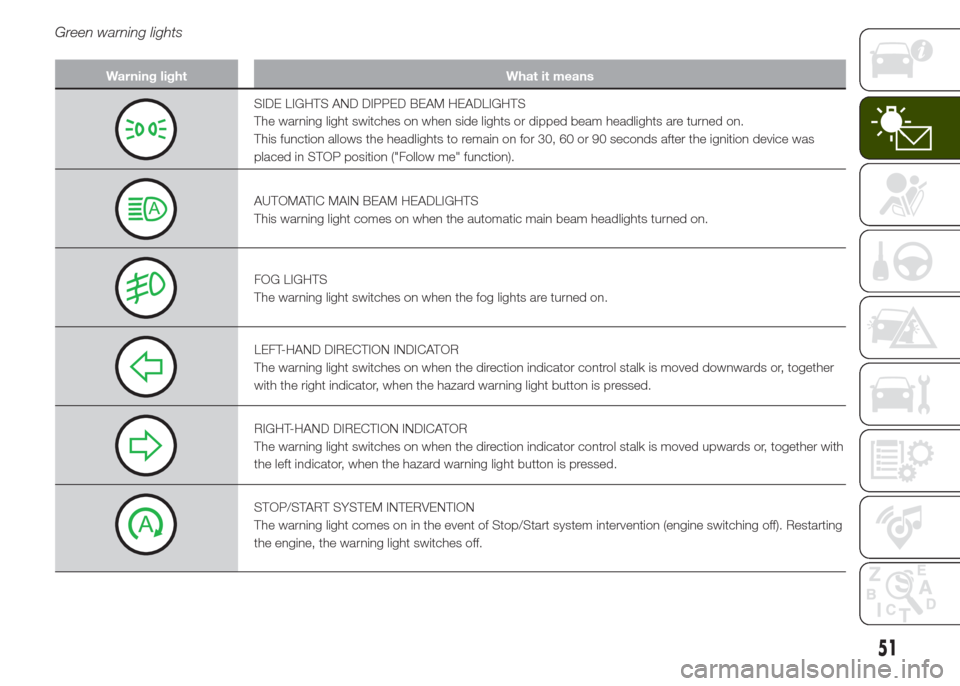
Green warning lights
Warning light What it means
SIDE LIGHTS AND DIPPED BEAM HEADLIGHTS
The warning light switches on when side lights or dipped beam headlights are turned on.
This function allows the headlights to remain on for 30, 60 or 90 seconds after the ignition device was
placed in STOP position ("Follow me" function).
AUTOMATIC MAIN BEAM HEADLIGHTS
This warning light comes on when the automatic main beam headlights turned on.
FOG LIGHTS
The warning light switches on when the fog lights are turned on.
LEFT-HAND DIRECTION INDICATOR
The warning light switches on when the direction indicator control stalk is moved downwards or, together
with the right indicator, when the hazard warning light button is pressed.
RIGHT-HAND DIRECTION INDICATOR
The warning light switches on when the direction indicator control stalk is moved upwards or, together with
the left indicator, when the hazard warning light button is pressed.
STOP/START SYSTEM INTERVENTION
The warning light comes on in the event of Stop/Start system intervention (engine switching off). Restarting
the engine, the warning light switches off.
51
Page 54 of 212
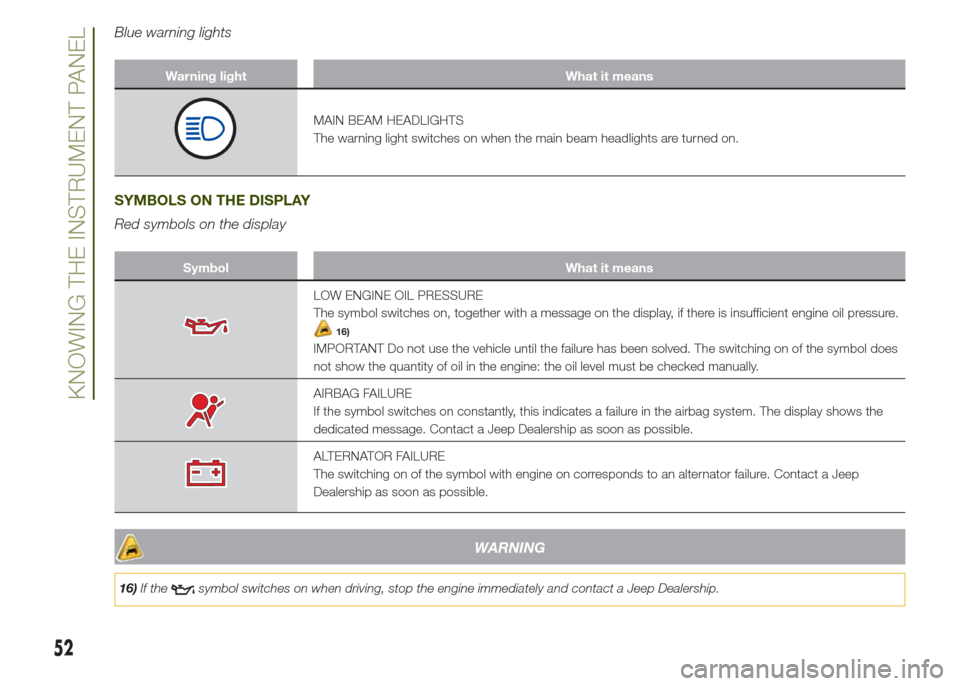
Blue warning lights
Warning light What it means
MAIN BEAM HEADLIGHTS
The warning light switches on when the main beam headlights are turned on.
SYMBOLS ON THE DISPLAY
Red symbols on the display
Symbol What it means
LOW ENGINE OIL PRESSURE
The symbol switches on, together with a message on the display, if there is insufficient engine oil pressure.
16)
IMPORTANT Do not use the vehicle until the failure has been solved. The switching on of the symbol does
not show the quantity of oil in the engine: the oil level must be checked manually.
AIRBAG FAILURE
If the symbol switches on constantly, this indicates a failure in the airbag system. The display shows the
dedicated message. Contact a Jeep Dealership as soon as possible.
ALTERNATOR FAILURE
The switching on of the symbol with engine on corresponds to an alternator failure. Contact a Jeep
Dealership as soon as possible.
WARNING
16)If thesymbol switches on when driving, stop the engine immediately and contact a Jeep Dealership.
52
KNOWING THE INSTRUMENT PANEL
Page 57 of 212
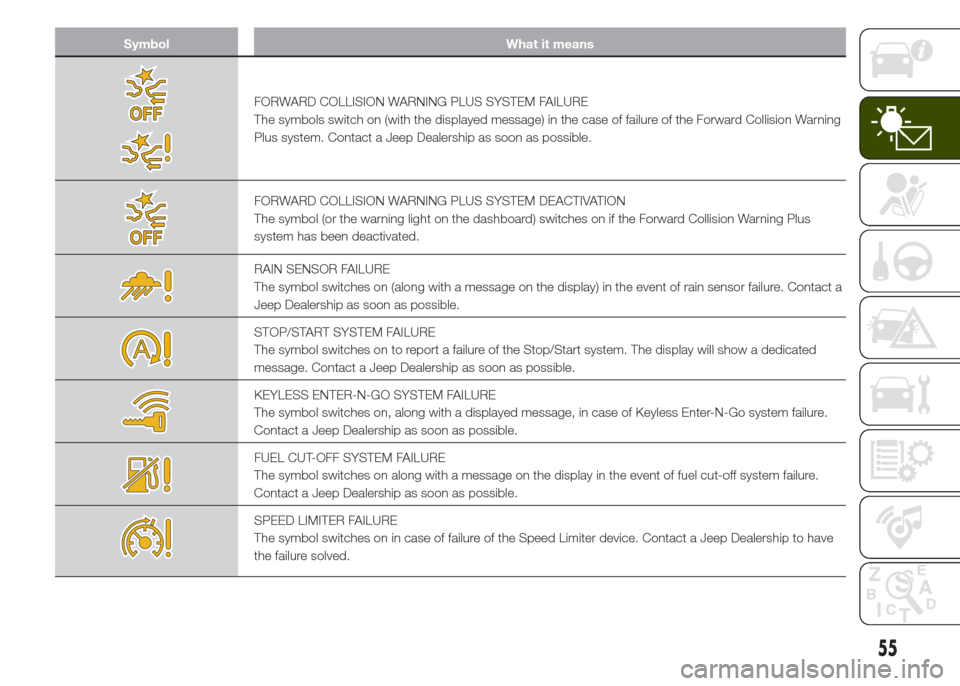
Symbol What it means
FORWARD COLLISION WARNING PLUS SYSTEM FAILURE
The symbols switch on (with the displayed message) in the case of failure of the Forward Collision Warning
Plus system. Contact a Jeep Dealership as soon as possible.
FORWARD COLLISION WARNING PLUS SYSTEM DEACTIVATION
The symbol (or the warning light on the dashboard) switches on if the Forward Collision Warning Plus
system has been deactivated.
RAIN SENSOR FAILURE
The symbol switches on (along with a message on the display) in the event of rain sensor failure. Contact a
Jeep Dealership as soon as possible.
STOP/START SYSTEM FAILURE
The symbol switches on to report a failure of the Stop/Start system. The display will show a dedicated
message. Contact a Jeep Dealership as soon as possible.
KEYLESS ENTER-N-GO SYSTEM FAILURE
The symbol switches on, along with a displayed message, in case of Keyless Enter-N-Go system failure.
Contact a Jeep Dealership as soon as possible.
FUEL CUT-OFF SYSTEM FAILURE
The symbol switches on along with a message on the display in the event of fuel cut-off system failure.
Contact a Jeep Dealership as soon as possible.
SPEED LIMITER FAILURE
The symbol switches on in case of failure of the Speed Limiter device. Contact a Jeep Dealership to have
the failure solved.
55
Page 61 of 212
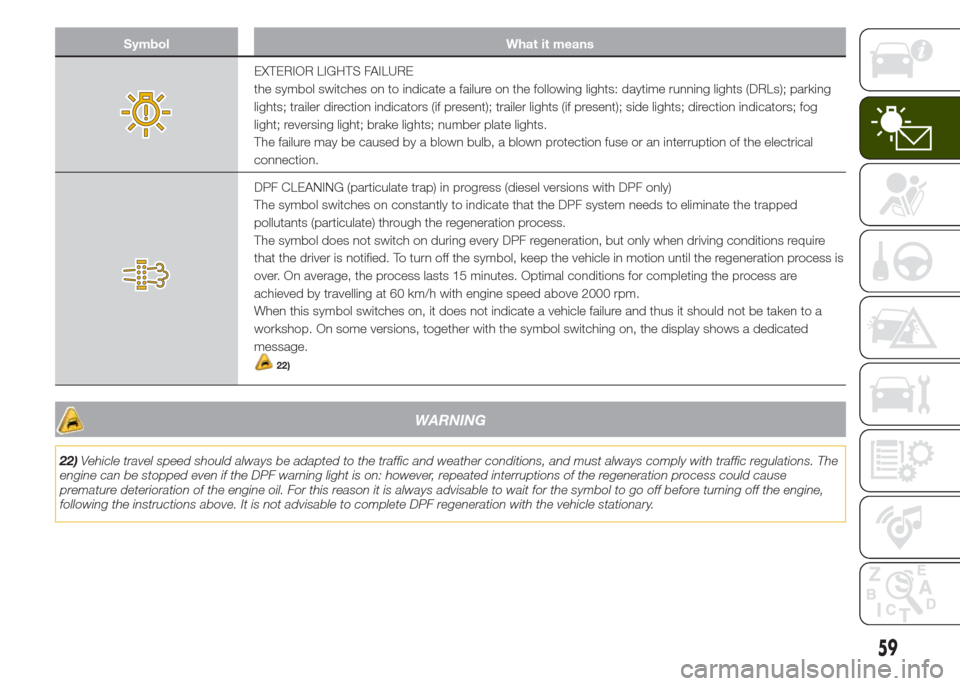
Symbol What it means
EXTERIOR LIGHTS FAILURE
the symbol switches on to indicate a failure on the following lights: daytime running lights (DRLs); parking
lights; trailer direction indicators (if present); trailer lights (if present); side lights; direction indicators; fog
light; reversing light; brake lights; number plate lights.
The failure may be caused by a blown bulb, a blown protection fuse or an interruption of the electrical
connection.
DPF CLEANING (particulate trap) in progress (diesel versions with DPF only)
The symbol switches on constantly to indicate that the DPF system needs to eliminate the trapped
pollutants (particulate) through the regeneration process.
The symbol does not switch on during every DPF regeneration, but only when driving conditions require
that the driver is notified. To turn off the symbol, keep the vehicle in motion until the regeneration process is
over. On average, the process lasts 15 minutes. Optimal conditions for completing the process are
achieved by travelling at 60 km/h with engine speed above 2000 rpm.
When this symbol switches on, it does not indicate a vehicle failure and thus it should not be taken to a
workshop. On some versions, together with the symbol switching on, the display shows a dedicated
message.
22)
WARNING
22)Vehicle travel speed should always be adapted to the traffic and weather conditions, and must always comply with traffic regulations. The
engine can be stopped even if the DPF warning light is on: however, repeated interruptions of the regeneration process could cause
premature deterioration of the engine oil. For this reason it is always advisable to wait for the symbol to go off before turning off the engine,
following the instructions above. It is not advisable to complete DPF regeneration with the vehicle stationary.
59
Page 66 of 212
ACTIVE SAFETY
SYSTEMS
ABS (Anti-lock Braking
System)
This system, which is an integral part of
the braking system, prevents one or
more wheels from locking and slipping
in all road surface conditions,
irrespective of the intensity of the
braking action, ensuring that the vehicle
can be controlled even during
emergency braking and optimising
stopping distances.
System intervention
The driver can feel that the ABS system
has come into action because the
brake pedal pulsates slightly and the
system gets noisier: this is entirely
normal with the system operating.
31) 32) 33) 34) 35) 36) 37)
DTC (Drag Torque
Control) SYSTEM
The system intervenes in the event of
sudden downshifting, or during ABS
braking, restoring torque to the engine
and thus preventing excessive drag
at the drive wheels, which may lead the
wheels to lock and a loss of vehicle
stability, above all in low-grip
conditions.
ESC (Electronic Stability
Control) SYSTEM
The ESC system improves the
directional control and stability of the
vehicle in various driving conditions,
correcting understeer and oversteer,
distributing the brake force on the
appropriate wheels.
System intervention
The intervention of the system is
indicated by the flashing of the
warning light on the instrument
panel, to inform the driver that
the vehicle is in critical stability and grip
conditions.
38) 39) 40) 41) 42)
TC (Traction Control)
SYSTEM
The system automatically operates in
the event of slipping, loss of grip on wet
roads (aquaplaning) and acceleration
on slippery, snowy or icy roads, etc. on
one or both drive wheels.
System intervention
The intervention of the system is
indicated by the flashing of the
warning light on the instrument
panel, to inform the driver that
the vehicle is in critical stability and grip
conditions.
43) 44) 45) 46) 47)
PBA (Panic Brake
Assist) SYSTEM
The PBA system is designed to
improve the vehicle’s braking capacity
during emergency braking.
The brake pedal should be pressed
continuously during braking, avoiding
intermittent presses, to get the most
out of the system. Do not reduce
pressure on the brake pedal until
braking is not necessary anymore.
The PBA system is deactivated when
the brake pedal is released.
48) 49) 50)
HSA (Hill Start Assist)
SYSTEM
This system is an integral part of the
ESC system and facilitates starting on
slopes.
System deactivation
The Hill Start Assist system can be
deactivated using the display Menu
(see the instructions in the "Display"
paragraph, "Knowing the instrument
panel" chapter).
51) 52)
64
SAFETY
Page 67 of 212
DST SYSTEM (Dynamic
Steering Torque)
The DST function uses the integration
of the ESC system with the electric
power steering to increase the safety
level of the whole vehicle.
53)
ERM (Electronic Rollover
Mitigation) SYSTEM
The system monitors the tendency of
the wheels to rise from the ground if the
driver performs extreme manoeuvres
like quick steering to avoid an obstacle,
especially in poor road conditions.
If these conditions occur, the system
intervenes on the brakes and engine
power to reduce the possibility that the
wheels are raised from the ground. It
is not possible to avoid tendency to roll
over if the phenomenon is due to
reasons such as driving on high side
gradients, collision with objects or other
vehicles.
54)
TSC (Trailer Sway
Control) SYSTEM
The system employs a series of
sensors located on the vehicle to
identify excessive swerving of the trailer
and take the necessary precautions
to eliminate it.
System intervention
When the system is active, the
warning light flashes on the
instrument panel, the engine power is
reduced and braking can be felt on the
individual wheels, following the attempt
to eliminate the swerving of the trailer.
The system is active only with ESC
engaged.
When the ESC system is deactivated
(by pressing the button on the central
tunnel), the TSC system is deactivated
as well.
55) 56)
HDC (Hill Descent
Control) SYSTEM
(where provided)
It is an integral part of the ESC system
and is aimed at keeping the vehicle at a
constant speed during a descent,
operating autonomously on the brakes
in various ways at the same time.
In this way the vehicle stability and
completely safe driving are guaranteed,
above all in poor grip conditions and
steep descents.
Enabling the system
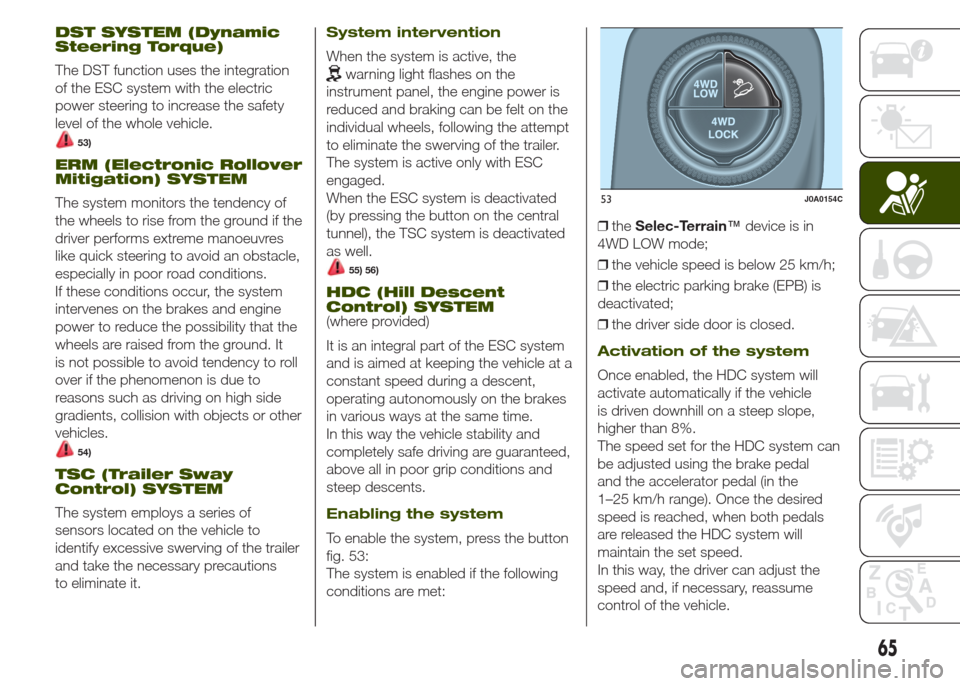
To enable the system, press the button
fig. 53:
The system is enabled if the following
conditions are met:❒theSelec-Terrain™device is in
4WD LOW mode;
❒the vehicle speed is below 25 km/h;
❒the electric parking brake (EPB) is
deactivated;
❒the driver side door is closed.
Activation of the system
Once enabled, the HDC system will
activate automatically if the vehicle
is driven downhill on a steep slope,
higher than 8%.
The speed set for the HDC system can
be adjusted using the brake pedal
and the accelerator pedal (in the
1–25 km/h range). Once the desired
speed is reached, when both pedals
are released the HDC system will
maintain the set speed.
In this way, the driver can adjust the
speed and, if necessary, reassume
control of the vehicle.
53J0A0154C
65
Page 68 of 212
With gear lever in neutral, speed
adjustment using the accelerator pedal
is not available.
The driver can cancel the intervention of
the HDC system at any time by
completely depressing the accelerator
pedal or the brake pedal.
System deactivation
The HDC system is deactivated, but
remains available, if one of the following
conditions is met:
❒the speed of the vehicle exceeds
25 km/h but remains below 40 km/h;
❒the vehicle is on a descent with
insufficient gradient, below 8%, or a
level surface, or is going uphill;
❒the gear lever is in P (Park) position.
Disabling the system
The system is deactivated and disabled
if one of the following conditions is
met:
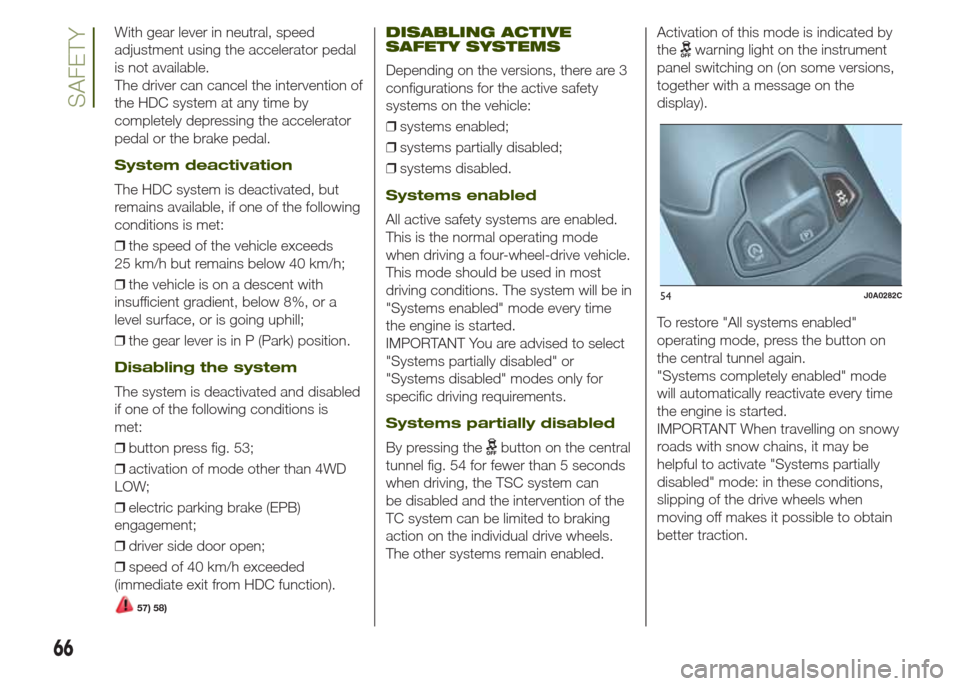
❒button press fig. 53;
❒activation of mode other than 4WD
LOW;
❒electric parking brake (EPB)
engagement;
❒driver side door open;
❒speed of 40 km/h exceeded
(immediate exit from HDC function).
57) 58)
DISABLING ACTIVE
SAFETY SYSTEMS
Depending on the versions, there are 3
configurations for the active safety
systems on the vehicle:
❒systems enabled;
❒systems partially disabled;
❒systems disabled.
Systems enabled
All active safety systems are enabled.
This is the normal operating mode
when driving a four-wheel-drive vehicle.
This mode should be used in most
driving conditions. The system will be in
"Systems enabled" mode every time
the engine is started.
IMPORTANT You are advised to select
"Systems partially disabled" or
"Systems disabled" modes only for
specific driving requirements.
Systems partially disabled
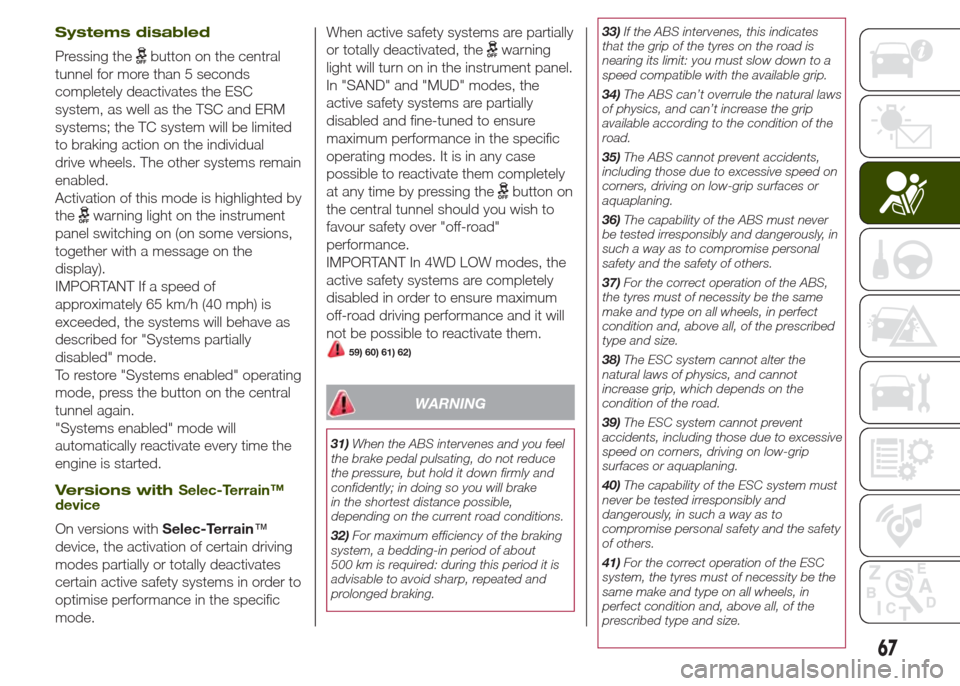
By pressing thebutton on the central
tunnel fig. 54 for fewer than 5 seconds
when driving, the TSC system can
be disabled and the intervention of the
TC system can be limited to braking
action on the individual drive wheels.
The other systems remain enabled.Activation of this mode is indicated by
the
warning light on the instrument
panel switching on (on some versions,
together with a message on the
display).
To restore "All systems enabled"
operating mode, press the button on
the central tunnel again.
"Systems completely enabled" mode
will automatically reactivate every time
the engine is started.
IMPORTANT When travelling on snowy
roads with snow chains, it may be
helpful to activate "Systems partially
disabled" mode: in these conditions,
slipping of the drive wheels when
moving off makes it possible to obtain
better traction.
54J0A0282C
66
SAFETY
Page 69 of 212
Systems disabled
Pressing thebutton on the central
tunnel for more than 5 seconds
completely deactivates the ESC
system, as well as the TSC and ERM
systems; the TC system will be limited
to braking action on the individual
drive wheels. The other systems remain
enabled.
Activation of this mode is highlighted by
the
warning light on the instrument
panel switching on (on some versions,
together with a message on the
display).
IMPORTANT If a speed of
approximately 65 km/h (40 mph) is
exceeded, the systems will behave as
described for "Systems partially
disabled" mode.
To restore "Systems enabled" operating
mode, press the button on the central
tunnel again.
"Systems enabled" mode will
automatically reactivate every time the
engine is started.
Versions withSelec-Terrain™
device
On versions withSelec-Terrain™
device, the activation of certain driving
modes partially or totally deactivates
certain active safety systems in order to
optimise performance in the specific
mode.When active safety systems are partially
or totally deactivated, the
warning
light will turn on in the instrument panel.
In "SAND" and "MUD" modes, the
active safety systems are partially
disabled and fine-tuned to ensure
maximum performance in the specific
operating modes. It is in any case
possible to reactivate them completely
at any time by pressing the
button on
the central tunnel should you wish to
favour safety over "off-road"
performance.
IMPORTANT In 4WD LOW modes, the
active safety systems are completely
disabled in order to ensure maximum
off-road driving performance and it will
not be possible to reactivate them.
59) 60) 61) 62)
WARNING
31)When the ABS intervenes and you feel
the brake pedal pulsating, do not reduce
the pressure, but hold it down firmly and
confidently; in doing so you will brake
in the shortest distance possible,
depending on the current road conditions.
32)For maximum efficiency of the braking
system, a bedding-in period of about
500 km is required: during this period it is
advisable to avoid sharp, repeated and
prolonged braking.33)If the ABS intervenes, this indicates
that the grip of the tyres on the road is
nearing its limit: you must slow down to a
speed compatible with the available grip.
34)The ABS can’t overrule the natural laws
of physics, and can’t increase the grip
available according to the condition of the
road.
35)The ABS cannot prevent accidents,
including those due to excessive speed on
corners, driving on low-grip surfaces or
aquaplaning.
36)The capability of the ABS must never
be tested irresponsibly and dangerously, in
such a way as to compromise personal
safety and the safety of others.
37)For the correct operation of the ABS,
the tyres must of necessity be the same
make and type on all wheels, in perfect
condition and, above all, of the prescribed
type and size.
38)The ESC system cannot alter the
natural laws of physics, and cannot
increase grip, which depends on the
condition of the road.
39)The ESC system cannot prevent
accidents, including those due to excessive
speed on corners, driving on low-grip
surfaces or aquaplaning.
40)The capability of the ESC system must
never be tested irresponsibly and
dangerously, in such a way as to
compromise personal safety and the safety
of others.
41)For the correct operation of the ESC
system, the tyres must of necessity be the
same make and type on all wheels, in
perfect condition and, above all, of the
prescribed type and size.
67