wheel JEEP RENEGADE 2015 1.G User Guide
[x] Cancel search | Manufacturer: JEEP, Model Year: 2015, Model line: RENEGADE, Model: JEEP RENEGADE 2015 1.GPages: 678, PDF Size: 29.84 MB
Page 83 of 678
early or may not turn on when the steering wheel is
already warm. The heated steering wheel control
button is located on the center of the instrument panel
below the radio screen.
WARNING!
•Persons who are unable to feel pain to the skin
because of advanced age, chronic illness, diabetes,
spinal cord injury, medication, alcohol use, exhaus-
tion, or other physical conditions must exercise
care when using the steering wheel heater. It may
cause burns even at low temperatures, especially if
used for long periods.
•Do not place anything on the steering wheel that
insulates against heat, such as a blanket or steering
wheel covers of any type and material. This may
cause the steering wheel heater to overheat.
REAR-VIEW MIRRORS
Inside Day/Night Mirror
The mirror can be adjusted up, down, left, and right. The
mirror should be adjusted to center on the view through
the rear window. Headlight glare from vehicles behind
you can be reduced by moving the lever under the mirror
to the night position (toward the rear of the vehicle). The
mirror should be adjusted while the lever under the
mirror is set in the day position (toward the windshield).
4
GETTING TO KNOW YOUR VEHICLE 81
Page 107 of 678
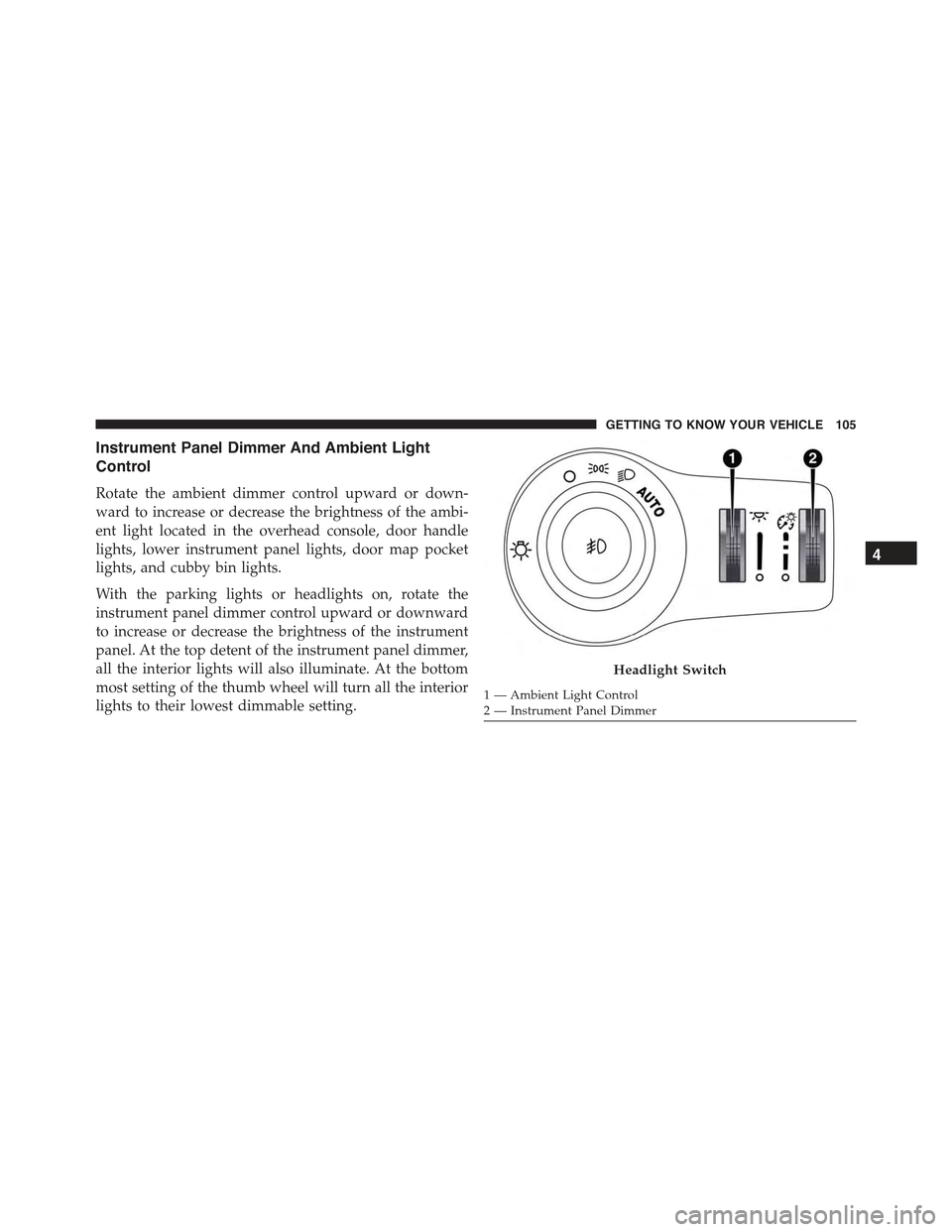
Instrument Panel Dimmer And Ambient Light
Control
Rotate the ambient dimmer control upward or down-
ward to increase or decrease the brightness of the ambi-
ent light located in the overhead console, door handle
lights, lower instrument panel lights, door map pocket
lights, and cubby bin lights.
With the parking lights or headlights on, rotate the
instrument panel dimmer control upward or downward
to increase or decrease the brightness of the instrument
panel. At the top detent of the instrument panel dimmer,
all the interior lights will also illuminate. At the bottom
most setting of the thumb wheel will turn all the interior
lights to their lowest dimmable setting.
Headlight Switch
1—AmbientLightControl2—InstrumentPanelDimmer
4
GETTING TO KNOW YOUR VEHICLE 105
Page 128 of 678
•Panel Mode – Air flow is distributed between the
footwell diffusers and the central and side instrument
panel vents.
•Floor Mode – Air flow is directed from the front and
rear footwell diffusers.
•Floor and Panel Modes – Air flow is distributed
between the footwell diffusers and the central and side
instrument panel vents.
•Floor and Defrost Modes – Air flow distributed be-
tween footwell diffusers and windshield and front side
window defrosting diffusers. This distribution setting
allows the passenger compartment to be warmed
effectively and prevents the windows from misting.
•Defrost and Panel Modes – Air flow distribution
between windshield defrosting diffusers and side and
central instrument panel vents.
•Defrost, Panel and Floor Modes – Air flow distribution
to all the diffusers.
NOTE:Air always flows from the side instrument panel
diffusers: it is, however, possible to interrupt the air flow
by operating the wheel located near the corresponding
vents.
In AUTO mode, the climate control system automatically
manages air distribution (LEDs on the Mode Control
buttons are off).
When set manually, the air distribution is indicated by
the LEDs on the selected buttons turning on.
In combined function mode, functions are enabled to-
gether with those already set when the relevant button is
pushed. If a button whose function is already active is
pushed, the operation is cancelled and the corresponding
LED turns off.
126 GETTING TO KNOW YOUR VEHICLE
Page 187 of 678
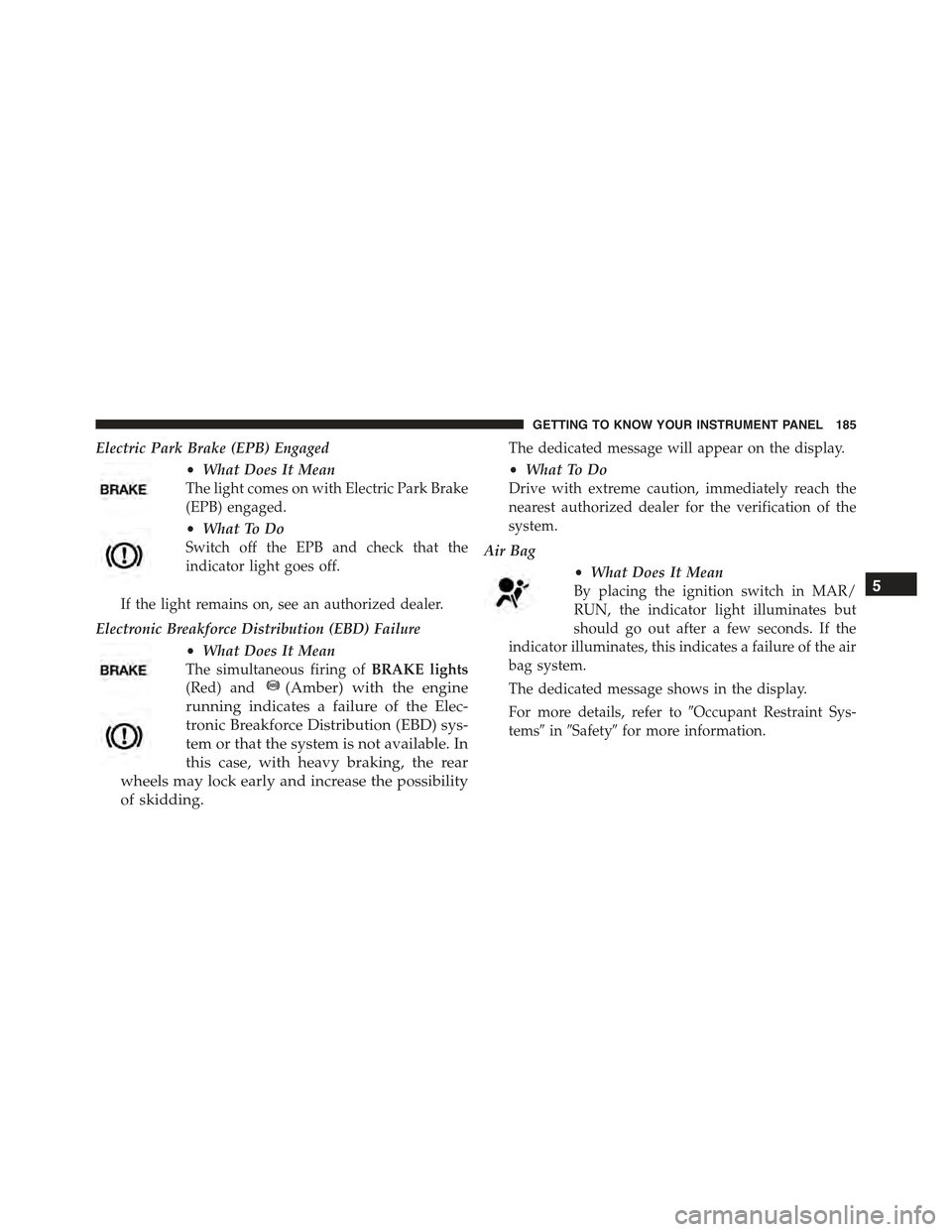
Electric Park Brake (EPB) Engaged
•What Does It Mean
The light comes on with Electric Park Brake
(EPB) engaged.
•What To Do
Switch off the EPB and check that the
indicator light goes off.
If the light remains on, see an authorized dealer.
Electronic Breakforce Distribution (EBD) Failure
•What Does It Mean
The simultaneous firing ofBRAKE lights
(Red) and(Amber) with the engine
running indicates a failure of the Elec-
tronic Breakforce Distribution (EBD) sys-
tem or that the system is not available. In
this case, with heavy braking, the rear
wheels may lock early and increase the possibility
of skidding.
The dedicated message will appear on the display.
•What To Do
Drive with extreme caution, immediately reach the
nearest authorized dealer for the verification of the
system.
Air Bag
•What Does It Mean
By placing the ignition switch in MAR/
RUN, the indicator light illuminates but
should go out after a few seconds. If the
indicator illuminates, this indicates a failure of the air
bag system.
The dedicated message shows in the display.
For more details, refer to#Occupant Restraint Sys-
tems#in#Safety#for more information.
5
GETTING TO KNOW YOUR INSTRUMENT PANEL 185
Page 189 of 678
•What To Do
In the case of normal gear:stop the car, shut off the
engine, and check that the level of coolant inside the
tank is not below the minimum (MIN). In this case,
wait for the engine to cool, then slowly and carefully
open the cap, fill with coolant, make sure it is
between the MIN and MAX marks. Also, check for
coolant leaks. If at the next start-up, the light (or the
icon on the display) would once again illuminate,
contact an authorized dealer.
In the case of heavy use of the car (e.g. In terms of
performance):slow down and, if the light stays on,
stop the car. For two or three minutes, keep the
engine running and slightly accelerate to help the
flow of coolant in the system. Then, turn the engine
off. Check for the correct level of coolant as described
above.
Electric Park Brake Failure
•What Does It Mean
By placing the ignition in the MAR/RUN
position, the light (If Equipped) will illumi-
nate but should go out after a few seconds.
The light comes on when it detects a failure
in Electric Parking Brake.
The display shows the dedicated message.
•What To Do
Please contact your authorized dealer as soon as
possible.
NOTE:In this case, with heavy braking, the rear wheels
may lock early and increase the possibility of skidding.
5
GETTING TO KNOW YOUR INSTRUMENT PANEL 187
Page 191 of 678
proper pressure. Driving on a significantly under-
inflated tire causes the tire to overheat and can lead to
tire failure. Under-inflation also reduces fuel effi-
ciency and tire tread life, and may affect the vehicle’s
handling and stopping ability.
Please note that the TPMS is not a substitute for
proper tire maintenance, and it is the driver ’s respon-
sibility to maintain correct tire pressure, even if
under-inflation has not reached the level to trigger
illumination of the TPMS low tire pressure telltale.
Your vehicle has also been equipped with a TPMS
malfunction indicator to indicate when the system is
not operating properly. The TPMS malfunction indi-
cator is combined with the low tire pressure telltale.
When the system detects a malfunction, the telltale
will flash for approximately one minute and then
remain continuously illuminated. This sequence will
continue upon subsequent vehicle start-ups as long
as the malfunction exists. When the malfunction
indicator is illuminated, the system may not be able
to detect or signal low tire pressure as intended.
TPMS malfunctions may occur for a variety of rea-
sons, including the installation of replacement or
alternate tires or wheels on the vehicle that prevent
the TPMS from functioning properly. Always check
the TPMS malfunction telltale after replacing one or
more tires or wheels on your vehicle, to ensure that
the replacement or alternate tires and wheels allow
the TPMS to continue to function properly.
CAUTION!
The TPMS has been optimized for the original
equipment tires and wheels. TPMS pressures and
warning have been established for the tire size
(Continued)
5
GETTING TO KNOW YOUR INSTRUMENT PANEL 189
Page 192 of 678
CAUTION!(Continued)
equipped on your vehicle. Undesirable system opera-
tion or sensor damage may result when using re-
placement equipment that is not of the same size,
type, and/or style. Aftermarket wheels can cause
sensor damage. Using aftermarket tire sealants may
cause the Tire Pressure Monitoring System (TPMS)
sensor to become inoperable. After using an after-
market tire sealant it is recommended that you take
your vehicle to an authorized dealership to have your
sensor function checked.
•What To Do
Do not drive your vehicle with one or more tires
deflated because the driveability of the car could be
compromised. Stop the car and avoid braking and
sharp turns. Contact your authorized dealer as soon
as possible.
ESC System
•What Does It Mean
Intervention ESC System:The light will
start to flash as soon as the tires lose
traction and the ESC system becomes ac-
tive. If the “ESC Activation/Malfunction Indicator
Light” begins to flash during acceleration, ease up on
the accelerator and apply as little throttle as possible.
Be sure to adapt your speed and driving to the
prevailing road conditions.
Failure ESC System:If the light remains perma-
nently on after four second of the engine running,
there may be a failure in ESC system.
190 GETTING TO KNOW YOUR INSTRUMENT PANEL
Page 194 of 678
LaneSense System
•What Does It Mean
Electronic Vehicle Information Center
(EVIC) — If Equipped
The light comes on in the following ways:
Light illuminated (white):indicates that the system
is active and both of the lane markings have been
detected (the lines of the aisle are gray in color).
Light on as flashing light (amber):indicates that the
vehicle is going to cross over the lane marking.
Light illuminated (green):indicates that both lane
markings have been detected, and the system is
“armed.” The system will provide a torque warning
in the steering wheel if an unintentional lane depar-
ture occurs.
Driver Information Display (DID) — If Equipped
On the vehicles equipped with DID, the light on the
side of the screen will be replaced by an icon in the
upper left area of the display.
These icons are displayed in the same way as vehicles
equipped with EVIC (see as previously described).
Park/Headlight ON Indicator
•What Does It Mean
The light comes on by activating the park-
ing lights or headlights.
This feature allows you to maintain the lights for a
period of 30, 60, or 90 seconds after placing the
ignition in the STOP position.
In some conditions, such as the poor quality of the
fuel, the light may come on only after starting the
engine.
192 GETTING TO KNOW YOUR INSTRUMENT PANEL
Page 202 of 678
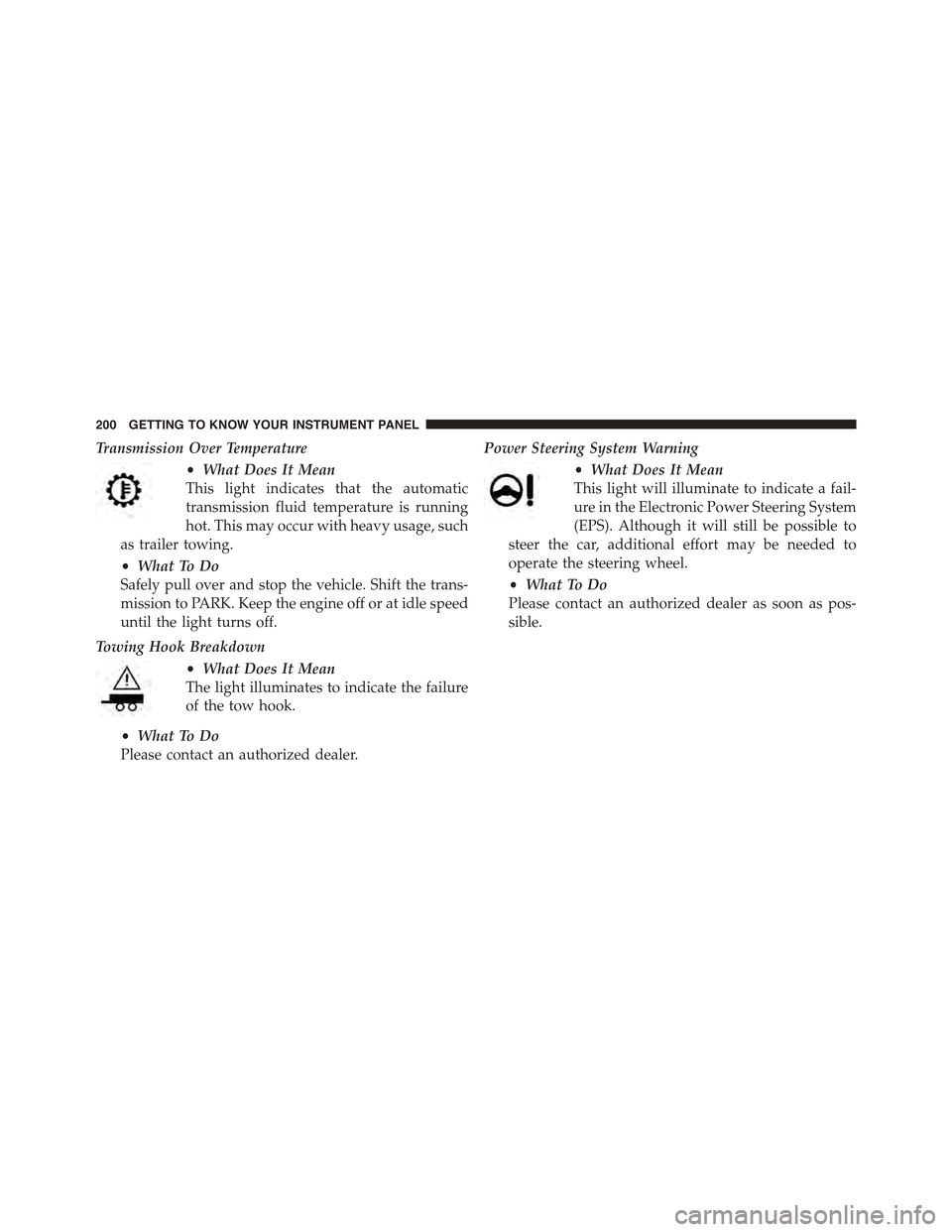
Transmission Over Temperature
•What Does It Mean
This light indicates that the automatic
transmission fluid temperature is running
hot. This may occur with heavy usage, such
as trailer towing.
•What To Do
Safely pull over and stop the vehicle. Shift the trans-
mission to PARK. Keep the engine off or at idle speed
until the light turns off.
Towing Hook Breakdown
•What Does It Mean
The light illuminates to indicate the failure
of the tow hook.
•What To Do
Please contact an authorized dealer.
Power Steering System Warning
•What Does It Mean
This light will illuminate to indicate a fail-
ure in the Electronic Power Steering System
(EPS). Although it will still be possible to
steer the car, additional effort may be needed to
operate the steering wheel.
•What To Do
Please contact an authorized dealer as soon as pos-
sible.
200 GETTING TO KNOW YOUR INSTRUMENT PANEL
Page 208 of 678
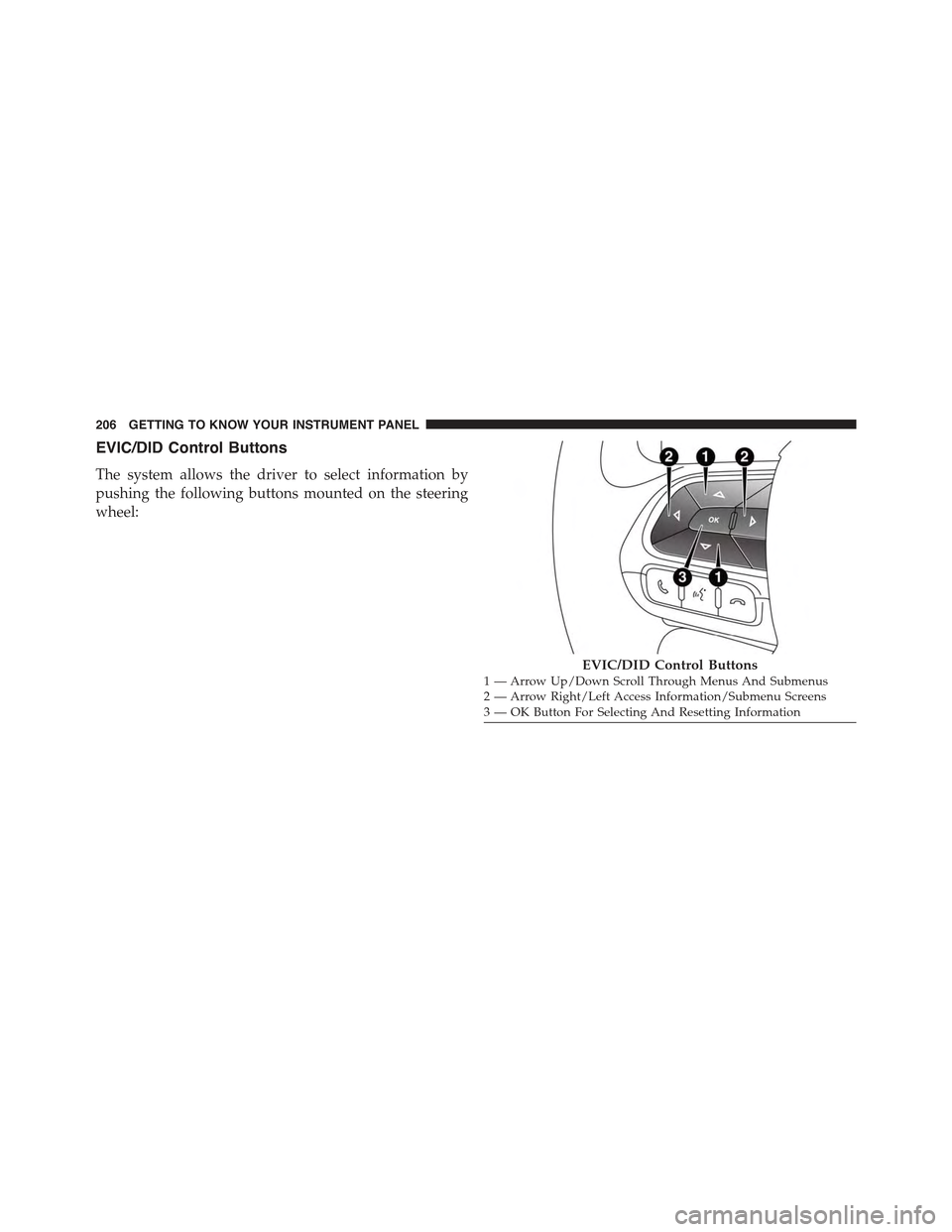
EVIC/DID Control Buttons
The system allows the driver to select information by
pushing the following buttons mounted on the steering
wheel:
EVIC/DID Control Buttons1—ArrowUp/DownScrollThroughMenusAndSubmenus2 — Arrow Right/Left Access Information/Submenu Screens3 — OK Button For Selecting And Resetting Information
206 GETTING TO KNOW YOUR INSTRUMENT PANEL