lock JEEP RENEGADE 2015 1.G Owner's Manual
[x] Cancel search | Manufacturer: JEEP, Model Year: 2015, Model line: RENEGADE, Model: JEEP RENEGADE 2015 1.GPages: 678, PDF Size: 29.84 MB
Page 60 of 678

To Unlock From The Passenger Side
With a valid Passive Entry RKE transmitter within 5 ft
(1.5 m) of the passenger door handle, grab the front
passenger door handle to unlock all four doors and the
liftgate automatically.
NOTE:All doors will unlock when the front passenger
door handle is grabbed regardless of the driver ’s door
unlock preference setting (“Unlock Driver Door 1st
Press” or “Unlock All Doors 1st Press”).
To Lock The Vehicle’s Doors And Liftgate
With one of the vehicle’s Passive Entry RKE transmitters
within 5 ft (1.5 m) of the driver or passenger front door
handles, push the door handle LOCK button to lock all
four doors.
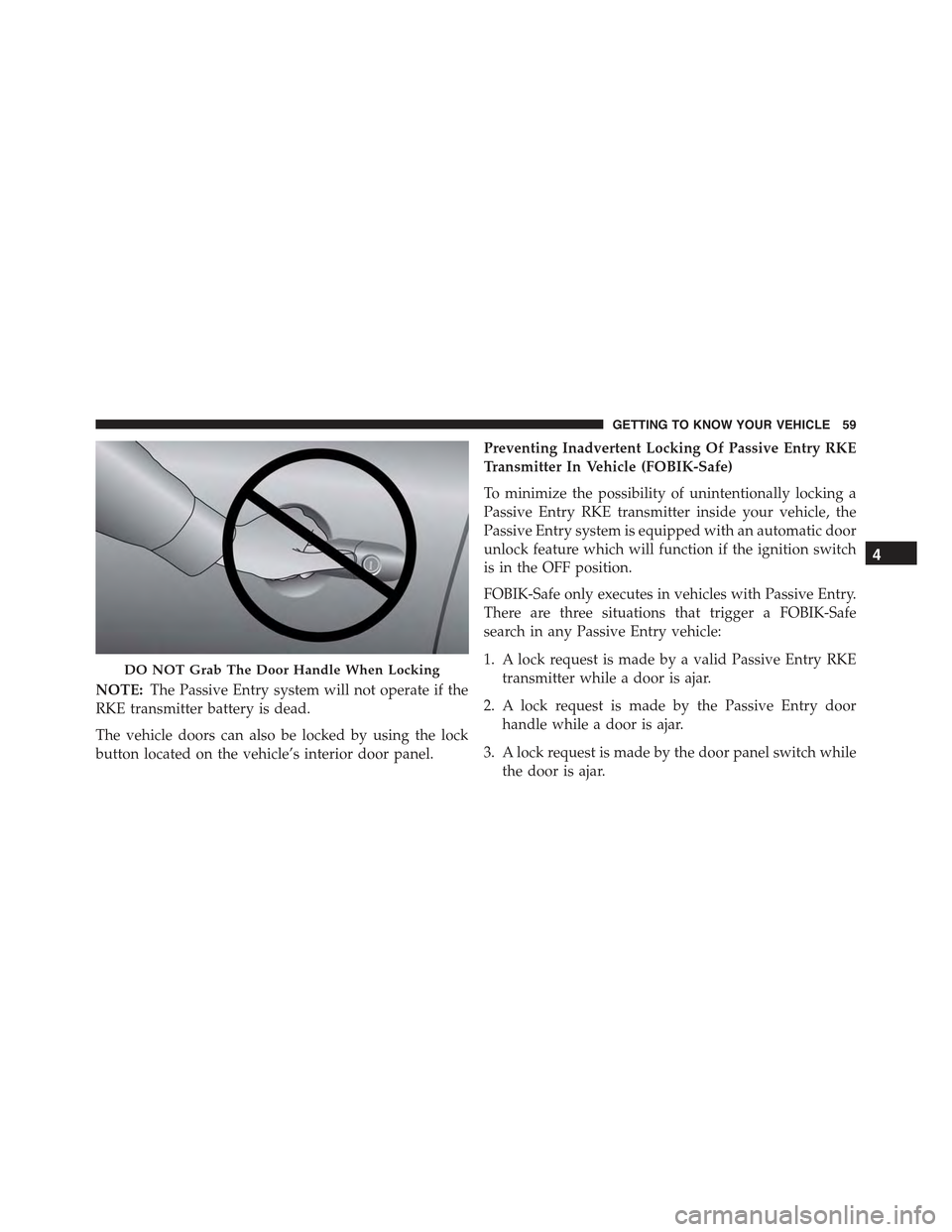
Do NOT grab the door handle when pushing the door
handle LOCK button. This could unlock the door(s).
Push The Door Handle Button To Lock
58 GETTING TO KNOW YOUR VEHICLE
Page 61 of 678
NOTE:The Passive Entry system will not operate if the
RKE transmitter battery is dead.
The vehicle doors can also be locked by using the lock
button located on the vehicle’s interior door panel.
Preventing Inadvertent Locking Of Passive Entry RKE
Transmitter In Vehicle (FOBIK-Safe)
To minimize the possibility of unintentionally locking a
Passive Entry RKE transmitter inside your vehicle, the
Passive Entry system is equipped with an automatic door
unlock feature which will function if the ignition switch
is in the OFF position.
FOBIK-Safe only executes in vehicles with Passive Entry.
There are three situations that trigger a FOBIK-Safe
search in any Passive Entry vehicle:
1. A lock request is made by a valid Passive Entry RKE
transmitter while a door is ajar.
2. A lock request is made by the Passive Entry door
handle while a door is ajar.
3. A lock request is made by the door panel switch while
the door is ajar.
DO NOT Grab The Door Handle When Locking
4
GETTING TO KNOW YOUR VEHICLE 59
Page 62 of 678
When any of these situations occur, after all ajar doors are
shut, the FOBIK-Safe search will be executed. If it finds a
Passive Entry RKE transmitter inside the car, and it does
not find any Passive Entry RKE transmitters outside the
car, then the car will unlock and alert the customer.
NOTE:The vehicle will only unlock the doors when a
valid Passive Entry RKE transmitter is detected inside the
vehicle, and no valid Passive Entry RKE transmitter is
detected outside the vehicle. The vehicle will not unlock
the doors when any of the following conditions are met:
•The doors are manually locked using the door lock
knobs.
•There is a valid Passive Entry RKE transmitter outside
the vehicle and within 5 ft (1.5 m) of either Passive
Entry door handle.
•Three attempts are made to lock the doors using the
door panel switch and then the doors close.
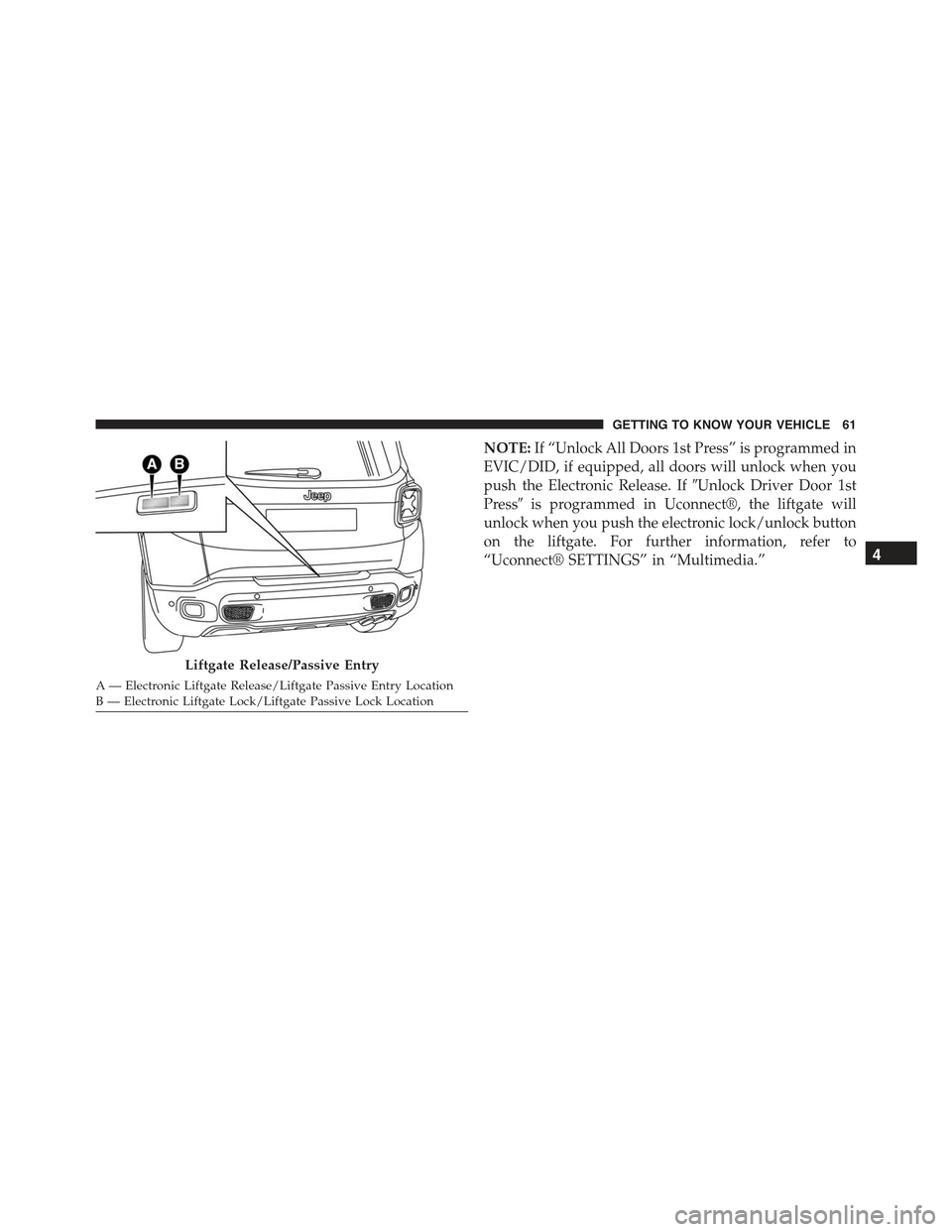
To Unlock/Enter The Liftgate
The liftgate Passive Entry unlock feature is built into the
electronic liftgate release. With a valid Passive Entry RKE
transmitter within 3 ft (1.0 m) of the liftgate, push the
Electronic Liftgate release to open with one fluid motion.
60 GETTING TO KNOW YOUR VEHICLE
Page 63 of 678
NOTE:If “Unlock All Doors 1st Press” is programmed in
EVIC/DID, if equipped, all doors will unlock when you
push the Electronic Release. If#Unlock Driver Door 1st
Press#is programmed in Uconnect®, the liftgate will
unlock when you push the electronic lock/unlock button
on the liftgate. For further information, refer to
“Uconnect® SETTINGS” in “Multimedia.”
Liftgate Release/Passive Entry
A — Electronic Liftgate Release/Liftgate Passive Entry LocationB — Electronic Liftgate Lock/Liftgate Passive Lock Location
4
GETTING TO KNOW YOUR VEHICLE 61
Page 64 of 678
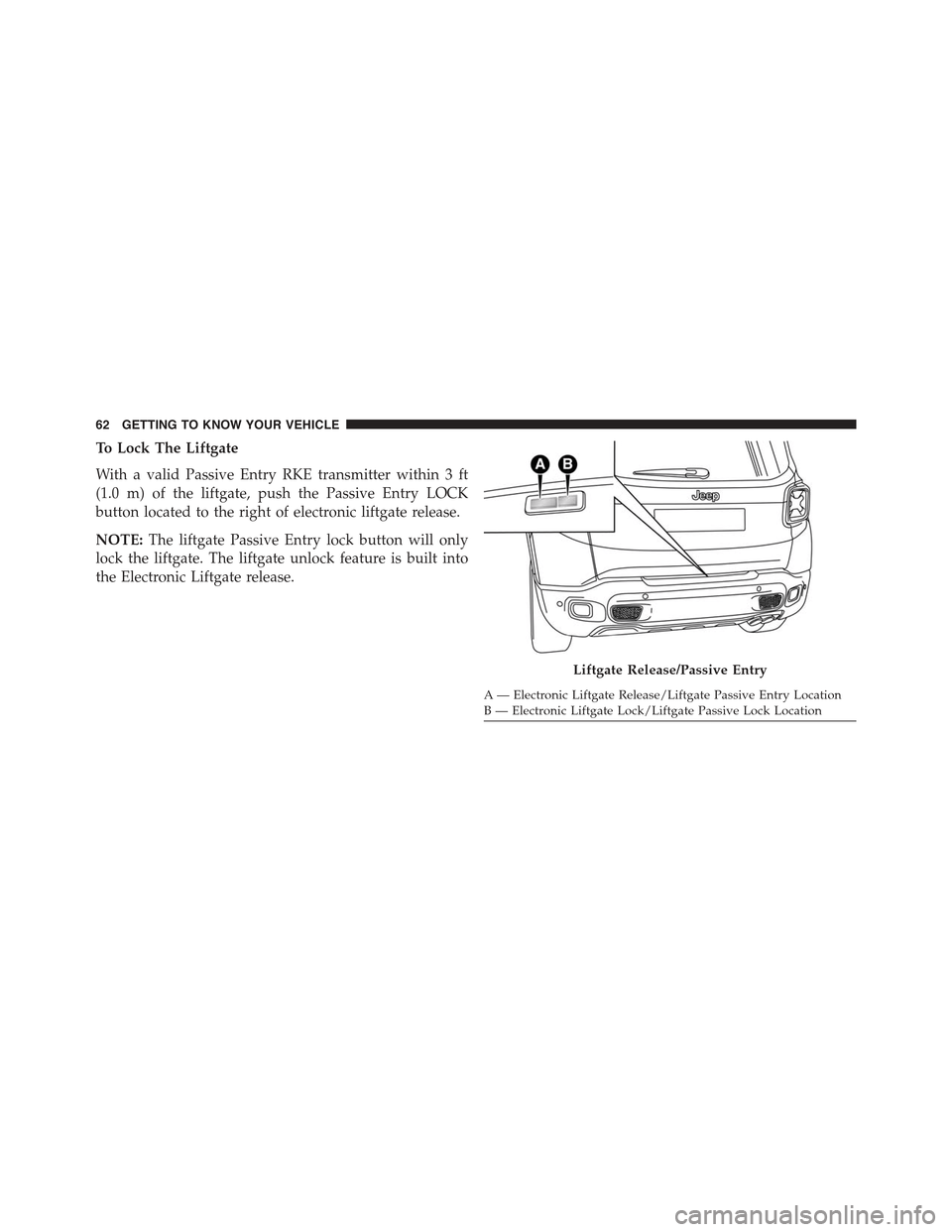
To Lock The Liftgate
With a valid Passive Entry RKE transmitter within 3 ft
(1.0 m) of the liftgate, push the Passive Entry LOCK
button located to the right of electronic liftgate release.
NOTE:The liftgate Passive Entry lock button will only
lock the liftgate. The liftgate unlock feature is built into
the Electronic Liftgate release.
Liftgate Release/Passive Entry
A — Electronic Liftgate Release/Liftgate Passive Entry LocationB — Electronic Liftgate Lock/Liftgate Passive Lock Location
62 GETTING TO KNOW YOUR VEHICLE
Page 65 of 678
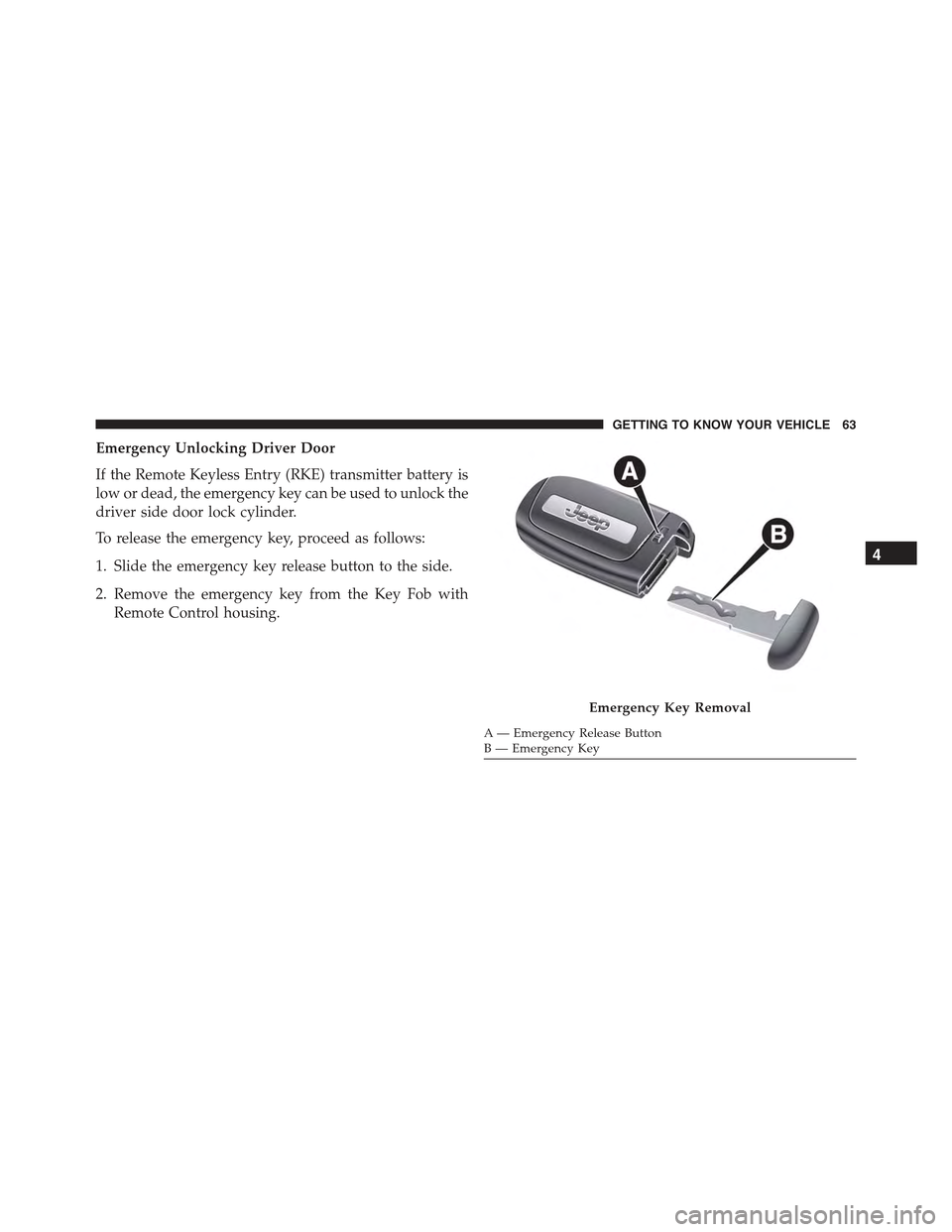
Emergency Unlocking Driver Door
If the Remote Keyless Entry (RKE) transmitter battery is
low or dead, the emergency key can be used to unlock the
driver side door lock cylinder.
To release the emergency key, proceed as follows:
1. Slide the emergency key release button to the side.
2. Remove the emergency key from the Key Fob with
Remote Control housing.
Emergency Key Removal
A — Emergency Release ButtonB — Emergency Key
4
GETTING TO KNOW YOUR VEHICLE 63
Page 66 of 678
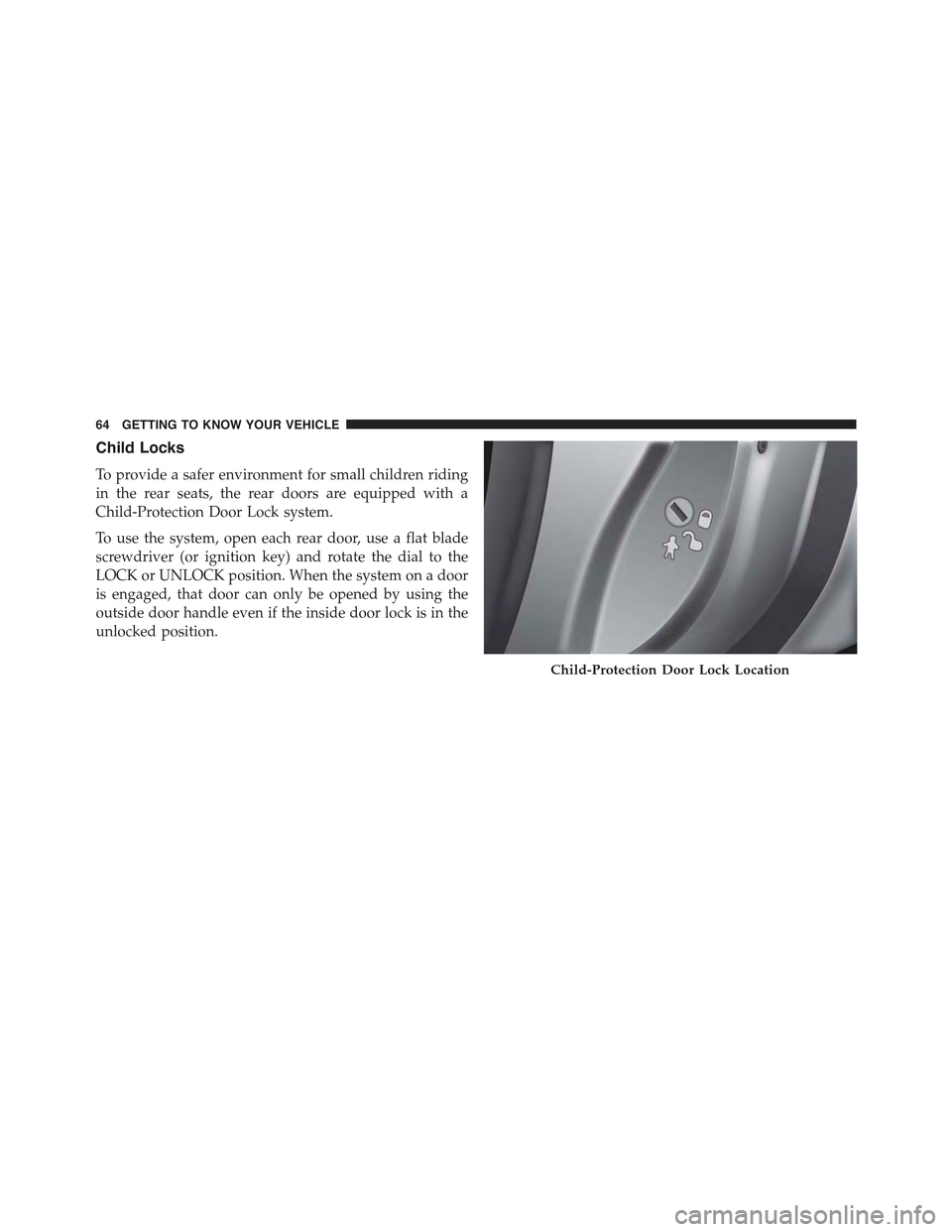
Child Locks
To provide a safer environment for small children riding
in the rear seats, the rear doors are equipped with a
Child-Protection Door Lock system.
To use the system, open each rear door, use a flat blade
screwdriver (or ignition key) and rotate the dial to the
LOCK or UNLOCK position. When the system on a door
is engaged, that door can only be opened by using the
outside door handle even if the inside door lock is in the
unlocked position.
Child-Protection Door Lock Location
64 GETTING TO KNOW YOUR VEHICLE
Page 67 of 678
NOTE:
•When the child lock system is engaged, the door can
only be opened by using the outside door handle even
though the inside door lock is in the unlocked position.
•After disengaging the Child-Protection Door Lock
system, always test the door from the inside to make
certain it is in the desired position.
•After engaging the Child-Protection Door Lock sys-
tem, always test the door from the inside to make
certain it is in the desired position.
•For emergency exit with the system engaged, rotate
the lock button to the unlocked position, roll down the
window, and open the door with the outside door
handle.
WARNING!
Avoid trapping anyone in a vehicle in a collision.
Remember that the rear doors can only be opened
from the outside when the Child-Protection locks are
engaged.
SEATS
Seats are a part of the Occupant Restraint System of the
vehicle.
4
GETTING TO KNOW YOUR VEHICLE 65
Page 77 of 678
Cargo Area Enlargement
Folding both sides of the rear seat provides additional
storage in the rear cargo area.
Proceed as follows:
1. Fully lower the rear seat head restraints.
2. Move the safety belts to the outboard side of the seat
and rest them on the seat belt guide.
3. Pull the seatback release lever to fold both sides of the
rear seatbacks completely forward.
Seatback Repositioning
NOTE:If interference from the cargo area prevents the
seatback from fully locking, you will have difficulty
returning the seat to its proper position.
1. Move the safety belts to the outboard side of the seat
and rest them on the seat belt guide to ensure they
properly latch.
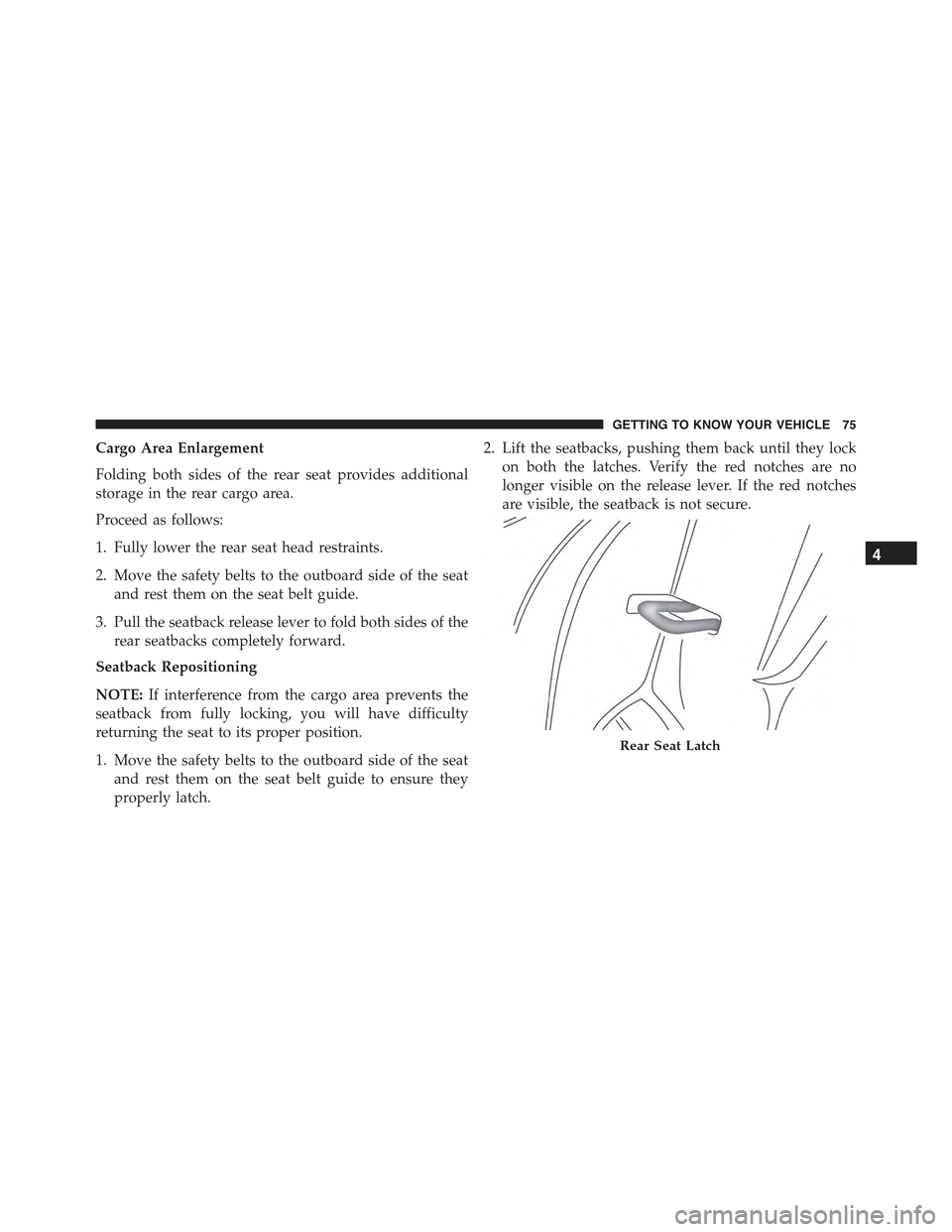
2. Lift the seatbacks, pushing them back until they lock
on both the latches. Verify the red notches are no
longer visible on the release lever. If the red notches
are visible, the seatback is not secure.
Rear Seat Latch
4
GETTING TO KNOW YOUR VEHICLE 75
Page 79 of 678
WARNING!
Be certain that the seatback is securely locked into
position. If the seatback is not securely locked into
position the seat will not provide the proper stability
for child seats and/or passengers. An improperly
latched seat could cause serious injury.
HEAD RESTRAINTS
Head restraints are designed to reduce the risk of injury
by restricting head movement in the event of a rear
impact. Head restraints should be adjusted so that the top
of the head restraint is located above the top of your ear.
WARNING!
The head restraints for all occupants must be prop-
erly adjusted prior to operating the vehicle or occu-
pying a seat. Head restraints should never be ad-
justed while the vehicle is in motion. Driving a
vehicle with the head restraints improperly adjusted
or removed could cause serious injury or death in the
event of a collision.
Front Head Restraints
To raise the head restraint, pull upward on the head
restraint. To lower the head restraint, push the adjust-
ment button, located at the base of the head restraint, and
push downward on the head restraint.
4
GETTING TO KNOW YOUR VEHICLE 77