wheel JEEP RENEGADE 2015 1.G Manual PDF
[x] Cancel search | Manufacturer: JEEP, Model Year: 2015, Model line: RENEGADE, Model: JEEP RENEGADE 2015 1.GPages: 678, PDF Size: 29.84 MB
Page 408 of 678
turning against engine compression drag. This will per-
mit you to control the vehicle speed and direction.
When descending mountains or hills, repeated braking
can cause brake fade with loss of braking control. Avoid
repeated heavy braking by downshifting the transmis-
sion whenever possible.
After Driving Off-Road
Off-road operation puts more stress on your vehicle than
does most on-road driving. After going off-road, it is
always a good idea to check for damage. That way you
can get any problems taken care of right away and have
your vehicle ready when you need it.
•Completely inspect the underbody of your vehicle.
Check tires, body structure, steering, suspension, and
exhaust system for damage.
•Inspect the radiator for mud and debris and clean as
required.
•Check threaded fasteners for looseness, particularly on
the chassis, drivetrain components, steering, and sus-
pension. Retighten them, if required, and torque to the
values specified in the Service Manual.
•Check for accumulations of plants or brush. These
things could be a fire hazard. They might hide damage
to fuel lines, brake hoses, axle pinion seals, and
propeller shafts.
•After extended operation in mud, sand, water, or
similar dirty conditions, have the radiator, fan, brake
rotors, wheels, brake linings, and axle yokes inspected
and cleaned as soon as possible.
WARNING!
Abrasive material in any part of the brakes may cause
excessive wear or unpredictable braking. You might
(Continued)
406 STARTING AND OPERATING
Page 409 of 678
WARNING!(Continued)
not have full braking power when you need it to
prevent a collision. If you have been operating your
vehicle in dirty conditions, get your brakes checked
and cleaned as necessary.
•If you experience unusual vibration after driving in
mud, slush or similar conditions, check the wheels for
impacted material. Impacted material can cause a
wheel imbalance and freeing the wheels of it will
correct the situation.
POWER STEERING
The electric power steering system will give you good
vehicle response and increased ease of maneuverability
in tight spaces. The system will vary its assist to provide
light efforts while parking and good feel while driving. If
the electric steering system experiences a fault that
reduces assist or prevents the vehicle from providing
assist, you will still have the ability to steer the vehicle
manually.
WARNING!
Continued operation with reduced assist could pose
a safety risk to yourself and others. Service should be
obtained as soon as possible.
7
STARTING AND OPERATING 407
Page 410 of 678
If the “SERVICE POWER STEERING#OR
#POWER STEERING ASSIST OFF - SERVICE
SYSTEM” message and a steering wheel icon
are displayed on the EVIC/DID screen, it indicates that
the vehicle needs to be taken to the dealer for service. It
is likely the vehicle has lost power steering assistance.
Refer to “Electronic Vehicle Information (EVIC) or
#Driver Information Display (DID)” in “Getting To Know
Your Instrument Panel” for further information.
If the “POWER STEERING SYSTEM HOT - PERFOR-
MANCE MAY BE LIMITED” message and an icon are
displayed on the EVIC/DID screen, it indicates that
extreme steering maneuvers may have occurred, which
caused an over temperature condition in the power
steering system. You will lose power steering assistance
momentarily until the over temperature condition no
longer exists. Once driving conditions are safe, then pull
over and let vehicle idle for a few moments until the light
turns off. Refer to “Electronic Vehicle Information
(EVIC)/Driver Information Display (DID)” in “Getting
To Know Your Instrument Panel” for further information.
NOTE:
•Even if the power steering assistance is no longer
operational, it is still possible to steer the vehicle.
Under these conditions there will be a substantial
increase in steering effort, especially at low speeds and
during parking maneuvers.
•If the condition persists, see your authorized dealer for
service.
TRAILER TOWING
In this section you will find safety tips and information
on limits to the type of towing you can reasonably do
with your vehicle. Before towing a trailer, carefully
review this information to tow your load as efficiently
and safely as possible.
408 STARTING AND OPERATING
Page 415 of 678
Trailer Towing Weights (Maximum Trailer Weight
Ratings)
The following chart provides the maximum trailer
weight ratings towable for your given drivetrain.
1.4L Turbo Engine
Trailer towing is not recommended.
EngineMax. GTW (Gross Trailer Wt.)Max. Tongue Wt. (See Note)
2.4L2,000 lbs (900 kg)200 lbs (90 kg)
Refer to local laws for maximum trailer towing speeds.
NOTE: The trailer tongue weight must be considered as part of the combined weight of occupants and cargo
and should never exceed the weight referenced on the Tire and Loading Information placard. Refer to “Tire
Safety Information” in “Starting And Operating” for further information.
Trailer And Tongue Weight
Always load a trailer with 60% to 65% of the weight in
the front of the trailer. This places 10% to 15% of the
Gross Trailer Weight (GTW) on the tow hitch of your
vehicle. Loads balanced over the wheels or heavier in the
rear can cause the trailer to swayseverelyside to side
which will cause loss of control of the vehicle and trailer.
Failure to load trailers heavier in front is the cause of
many trailer collisions.
7
STARTING AND OPERATING 413
Page 417 of 678
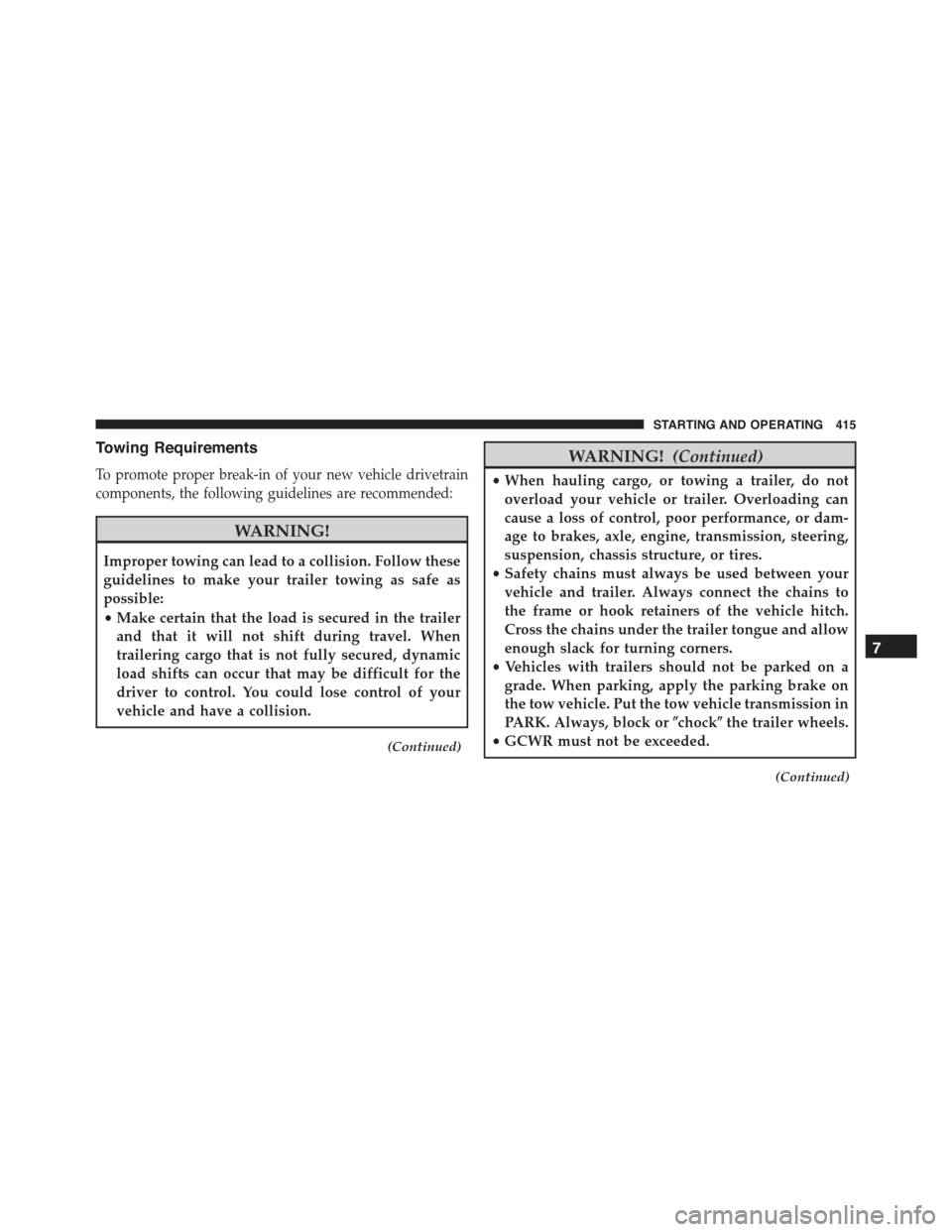
Towing Requirements
To promote proper break-in of your new vehicle drivetrain
components, the following guidelines are recommended:
WARNING!
Improper towing can lead to a collision. Follow these
guidelines to make your trailer towing as safe as
possible:
•Make certain that the load is secured in the trailer
and that it will not shift during travel. When
trailering cargo that is not fully secured, dynamic
load shifts can occur that may be difficult for the
driver to control. You could lose control of your
vehicle and have a collision.
(Continued)
WARNING!(Continued)
•When hauling cargo, or towing a trailer, do not
overload your vehicle or trailer. Overloading can
cause a loss of control, poor performance, or dam-
age to brakes, axle, engine, transmission, steering,
suspension, chassis structure, or tires.
•Safety chains must always be used between your
vehicle and trailer. Always connect the chains to
the frame or hook retainers of the vehicle hitch.
Cross the chains under the trailer tongue and allow
enough slack for turning corners.
•Vehicles with trailers should not be parked on a
grade. When parking, apply the parking brake on
the tow vehicle. Put the tow vehicle transmission in
PARK. Always, block or$chock$the trailer wheels.
•GCWR must not be exceeded.
(Continued)
7
STARTING AND OPERATING 415
Page 424 of 678
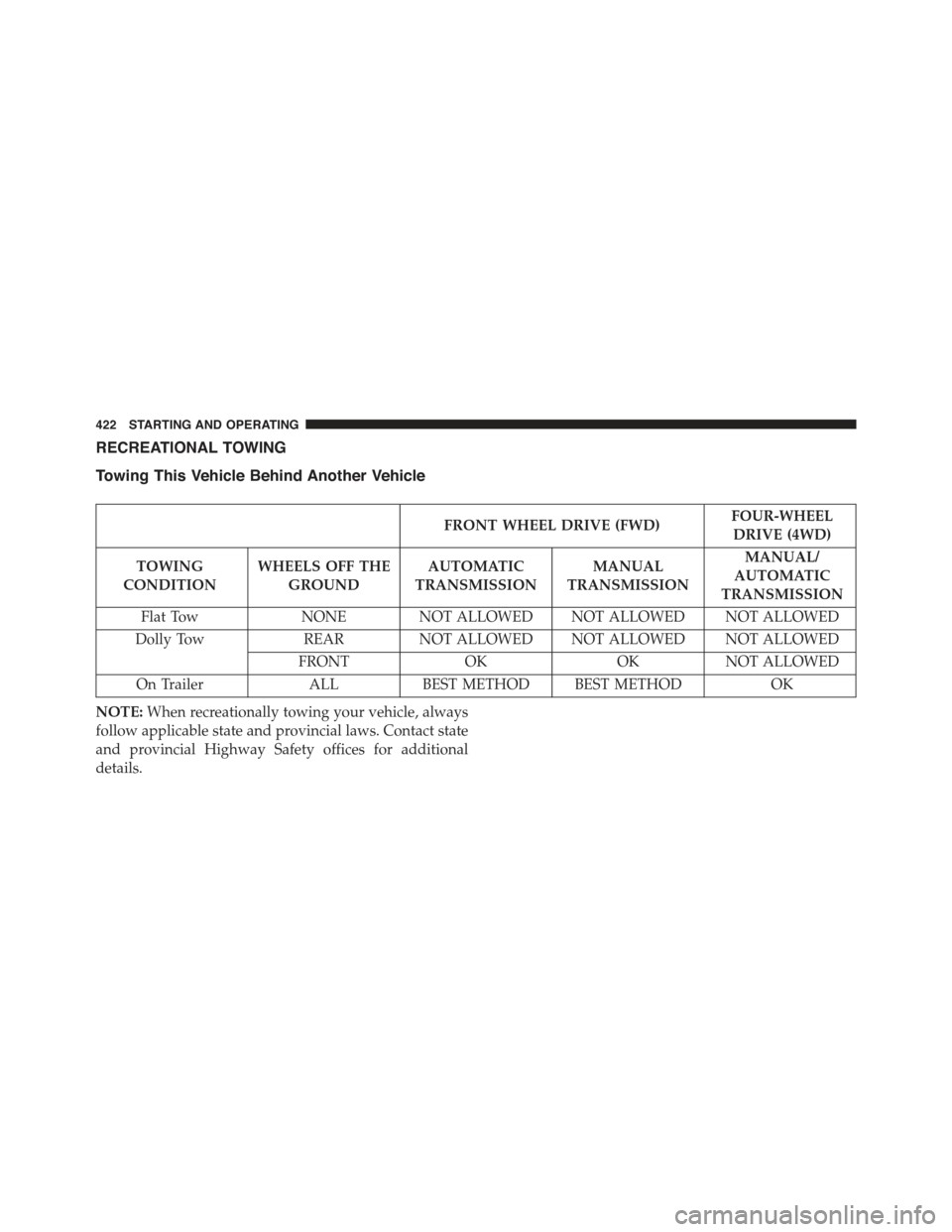
RECREATIONAL TOWING
Towing This Vehicle Behind Another Vehicle
FRONT WHEEL DRIVE (FWD)FOUR-WHEEL
DRIVE (4WD)
TOWING
CONDITION
WHEELS OFF THE
GROUND
AUTOMATIC
TRANSMISSION
MANUAL
TRANSMISSION
MANUAL/
AUTOMATIC
TRANSMISSION
Flat TowNONE NOT ALLOWED NOT ALLOWED NOT ALLOWED
Dolly TowREARNOT ALLOWED NOT ALLOWED NOT ALLOWED
FRONTOKOKNOT ALLOWED
On TrailerALLBEST METHOD BEST METHODOK
NOTE:When recreationally towing your vehicle, always
follow applicable state and provincial laws. Contact state
and provincial Highway Safety offices for additional
details.
422 STARTING AND OPERATING
Page 425 of 678
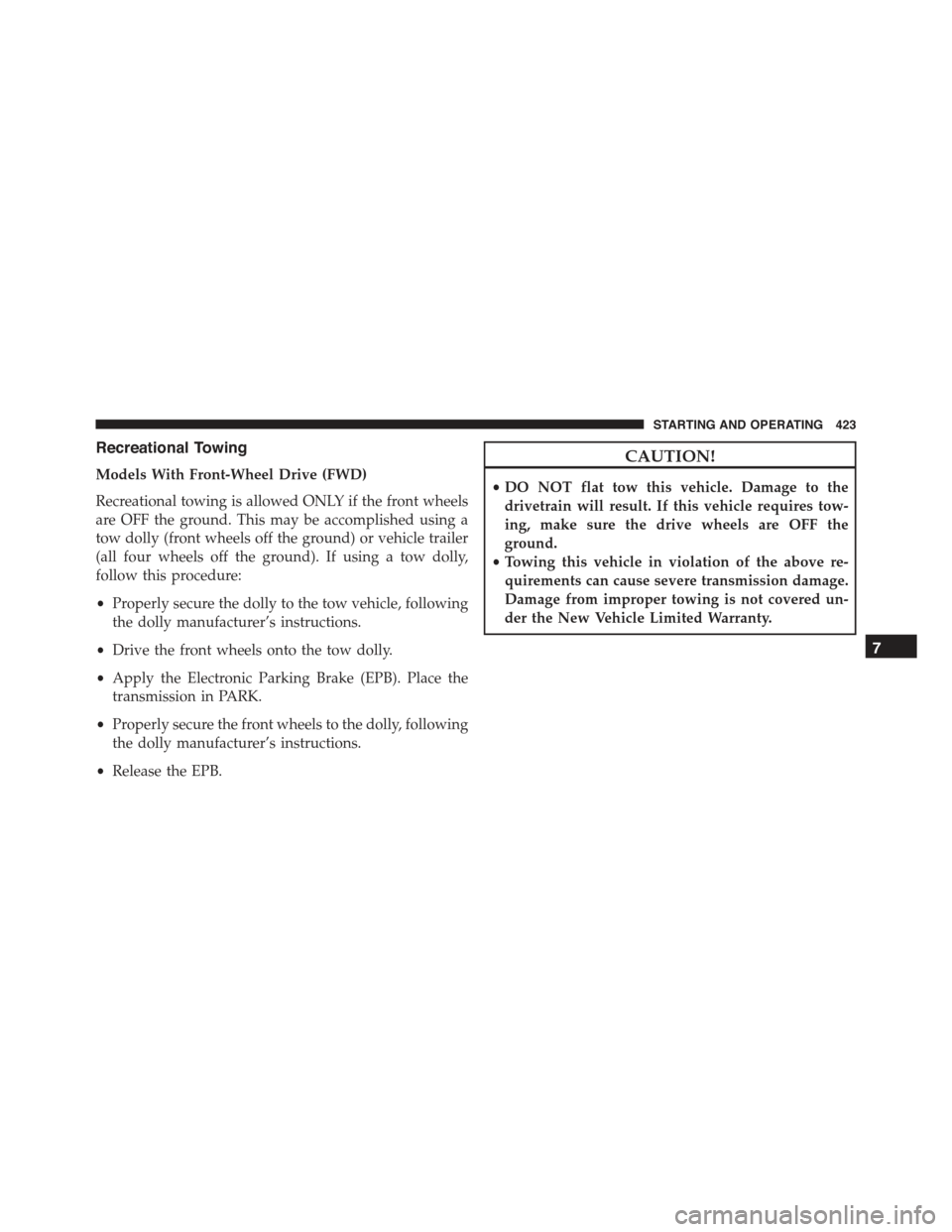
Recreational Towing
Models With Front-Wheel Drive (FWD)
Recreational towing is allowed ONLY if the front wheels
are OFF the ground. This may be accomplished using a
tow dolly (front wheels off the ground) or vehicle trailer
(all four wheels off the ground). If using a tow dolly,
follow this procedure:
•Properly secure the dolly to the tow vehicle, following
the dolly manufacturer’s instructions.
•Drive the front wheels onto the tow dolly.
•Apply the Electronic Parking Brake (EPB). Place the
transmission in PARK.
•Properly secure the front wheels to the dolly, following
the dolly manufacturer’s instructions.
•Release the EPB.
CAUTION!
•DO NOT flat tow this vehicle. Damage to the
drivetrain will result. If this vehicle requires tow-
ing, make sure the drive wheels are OFF the
ground.
•Towing this vehicle in violation of the above re-
quirements can cause severe transmission damage.
Damage from improper towing is not covered un-
der the New Vehicle Limited Warranty.
7
STARTING AND OPERATING 423
Page 426 of 678
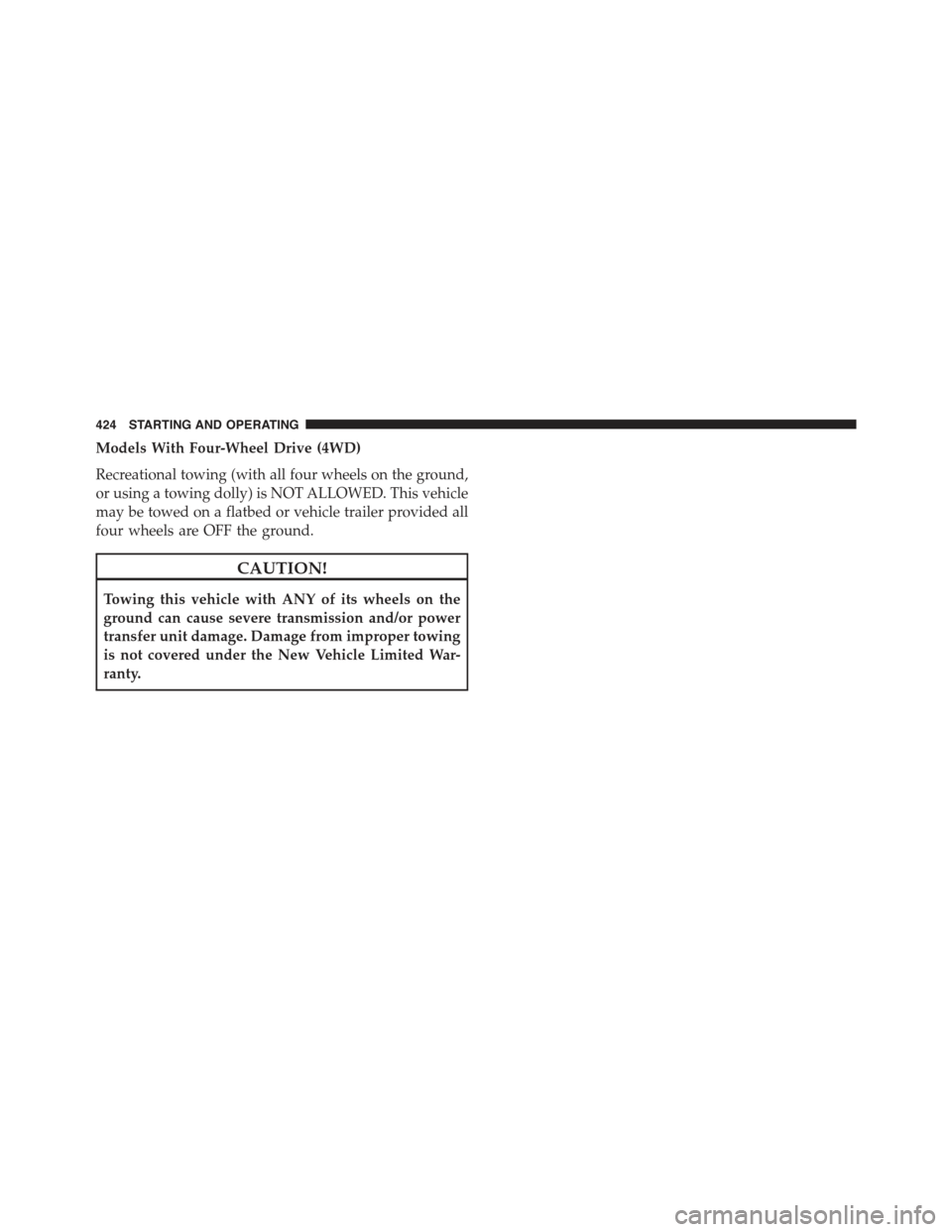
Models With Four-Wheel Drive (4WD)
Recreational towing (with all four wheels on the ground,
or using a towing dolly) is NOT ALLOWED. This vehicle
may be towed on a flatbed or vehicle trailer provided all
four wheels are OFF the ground.
CAUTION!
Towing this vehicle with ANY of its wheels on the
ground can cause severe transmission and/or power
transfer unit damage. Damage from improper towing
is not covered under the New Vehicle Limited War-
ranty.
424 STARTING AND OPERATING
Page 427 of 678
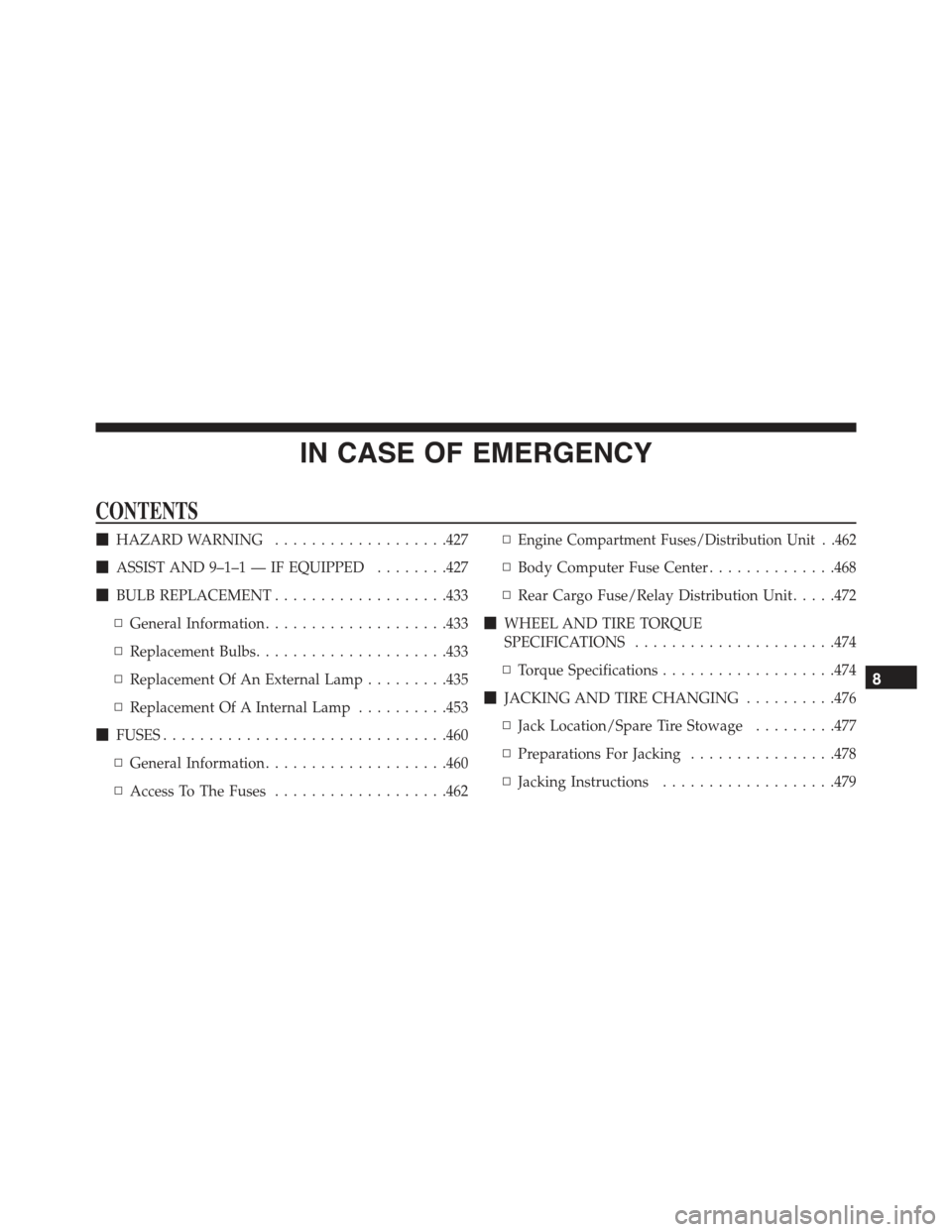
IN CASE OF EMERGENCY
CONTENTS
!HAZARD WARNING...................427
!ASSIST AND 9–1–1 — IF EQUIPPED........427
!BULB REPLACEMENT...................433
▫General Information....................433
▫Replacement Bulbs.....................433
▫Replacement Of An External Lamp.........435
▫Replacement Of A Internal Lamp..........453
!FUSES...............................460
▫General Information....................460
▫Access To The Fuses...................462
▫Engine Compartment Fuses/Distribution Unit . .462
▫Body Computer Fuse Center..............468
▫Rear Cargo Fuse/Relay Distribution Unit.....472
!WHEEL AND TIRE TORQUE
SPECIFICATIONS......................474
▫Torque Specifications...................474
!JACKING AND TIRE CHANGING..........476
▫Jack Location/Spare Tire Stowage.........477
▫Preparations For Jacking................478
▫Jacking Instructions...................479
8
Page 428 of 678
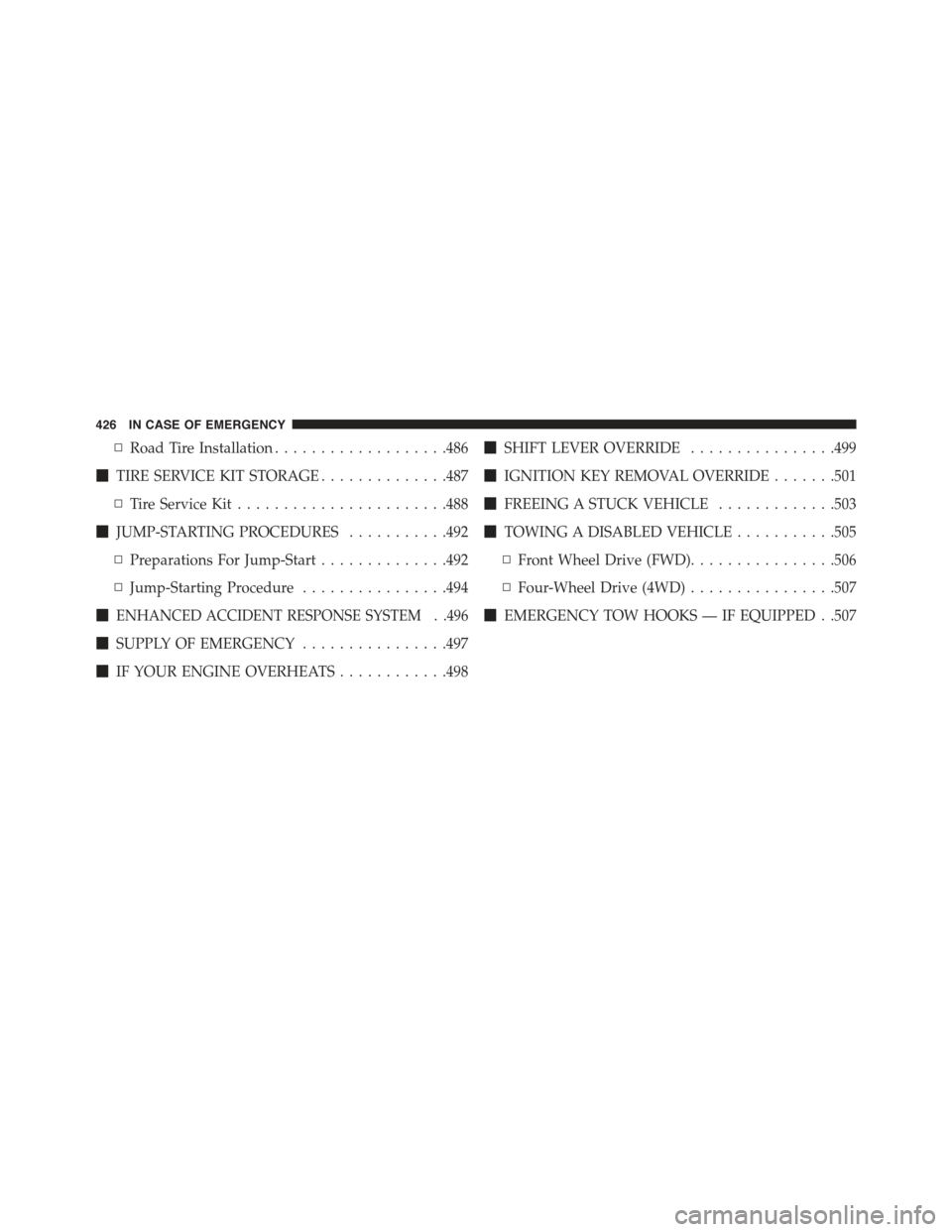
▫Road Tire Installation...................486
!TIRE SERVICE KIT STORAGE..............487
▫Tire Service Kit.......................488
!JUMP-STARTING PROCEDURES...........492
▫Preparations For Jump-Start..............492
▫Jump-Starting Procedure................494
!ENHANCED ACCIDENT RESPONSE SYSTEM . .496
!SUPPLY OF EMERGENCY................497
!IF YOUR ENGINE OVERHEATS............498
!SHIFT LEVER OVERRIDE................499
!IGNITION KEY REMOVAL OVERRIDE.......501
!FREEING A STUCK VEHICLE.............503
!TOWING A DISABLED VEHICLE...........505
▫Front Wheel Drive (FWD)................506
▫Four-Wheel Drive (4WD)................507
!EMERGENCY TOW HOOKS — IF EQUIPPED . .507
426 IN CASE OF EMERGENCY