automatic transmission JEEP RENEGADE 2018 Owner handbook (in English)
[x] Cancel search | Manufacturer: JEEP, Model Year: 2018, Model line: RENEGADE, Model: JEEP RENEGADE 2018Pages: 356, PDF Size: 6.11 MB
Page 222 of 356
FUEL CUT-OFF SYSTEM
173)
This intervenes in the case of an impact
causing:
the interruption of the fuel supply with
the engine consequently cutting out;
the automatic unlocking of the doors;turning on the lights inside the car;deactivation of climate control system
ventilation;
switching on the hazard warning lights
(to disable the lights, perform the “reset”
procedure as described below).
On some versions, the intervention of the
system is indicated by a message shown
on the display. In the same way, a
dedicated message on the display warns
the driver if system operation is
compromised.
IMPORTANT Carefully check the
vehicle for fuel leaks, for instance in
the engine compartment, under the
vehicle or near the tank area. After a
collision, bring the ignition device to
STOP to prevent the battery from
running down.
Reset procedure
To restore correct operation of the
vehicle, carry out the following procedure(this procedure must be started and
completed within less than one minute):
bring the ignition device to MAR;turn on the direction indicators on the
right, then on the left, then again on the
right and again on the left;
now deactivate the direction indicators
on the left;
bring the ignition device to STOP;move the ignition device to MAR.
LPG versions
In case of collision, the petrol feed is
immediately closed, the LPG safety
solenoid valves are closed and injection
is interrupted to stop the engine.
WARNING
173)If, after an impact, you smell fuel or
notice leaks from the fuel system, do not
reactivate the system to avoid the risk of
fire.
AUTOMATIC
TRANSMISSION GEAR
LEVER UNLOCKING
In the event of a fault, to move the gear
lever from P (Park), proceed as follows:
stop the engine and engage the
electric parking brake;
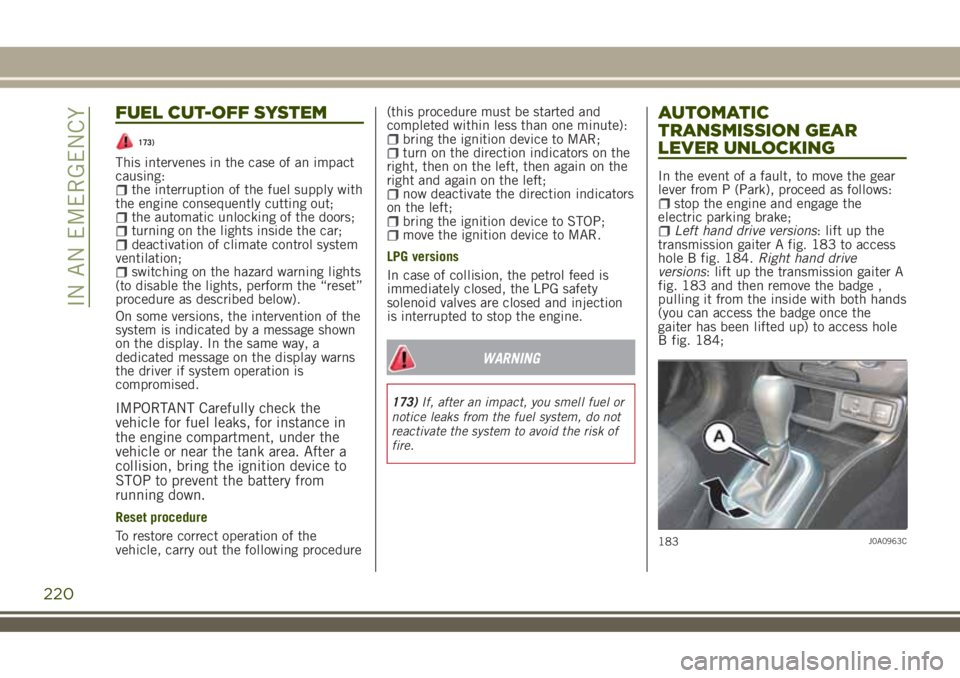
Left hand drive versions: lift up the
transmission gaiter A fig. 183 to access
hole B fig. 184.Right hand drive
versions: lift up the transmission gaiter A
fig. 183 and then remove the badge ,
pulling it from the inside with both hands
(you can access the badge once the
gaiter has been lifted up) to access hole
B fig. 184;
183J0A0963C
220
IN AN EMERGENCY
Page 224 of 356
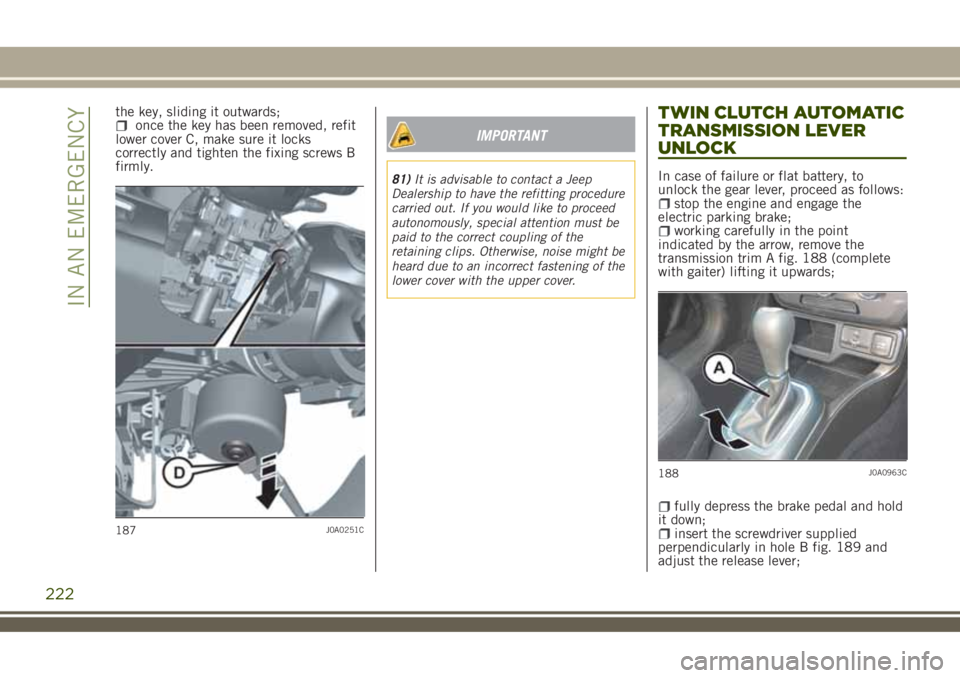
the key, sliding it outwards;once the key has been removed, refit
lower cover C, make sure it locks
correctly and tighten the fixing screws B
firmly.IMPORTANT
81)It is advisable to contact a Jeep
Dealership to have the refitting procedure
carried out. If you would like to proceed
autonomously, special attention must be
paid to the correct coupling of the
retaining clips. Otherwise, noise might be
heard due to an incorrect fastening of the
lower cover with the upper cover.
TWIN CLUTCH AUTOMATIC
TRANSMISSION LEVER
UNLOCK
In case of failure or flat battery, to
unlock the gear lever, proceed as follows:
stop the engine and engage the
electric parking brake;
working carefully in the point
indicated by the arrow, remove the
transmission trim A fig. 188 (complete
with gaiter) lifting it upwards;
fully depress the brake pedal and hold
it down;
insert the screwdriver supplied
perpendicularly in hole B fig. 189 and
adjust the release lever;187J0A0251C
188J0A0963C
222
IN AN EMERGENCY
Page 226 of 356

IMPORTANT
82)It is advisable to contact a Jeep
Dealership to have the refitting procedure
carried out. If you would like to proceed
autonomously, special attention must be
paid to the correct coupling of the
retaining clips. Otherwise, noise might be
heard due to an incorrect fastening of the
lower cover with the upper cover.
BROKEN-DOWN VEHICLE
TOWING
It is recommended to tow the vehicle
with all four wheels lifted from the
ground on the platform of a rescue
vehicle.
VERSIONS WITH FOUR-WHEEL DRIVE (4WD)
AND AUTOMATIC TRANSMISSION
IMPORTANT Avoid lifting the front (or
rear) wheels only. Lifting the front (or
rear) wheels only while towing might
damage the transmission or the
transfer unit.
IMPORTANT If a vehicle is towed
without complying with the above
requirements, the transmission and/or
the transfer unit might be seriously
damaged. Damage due to an incorrect
towing will not be covered by the
warranty.
192J0A0251C
224
IN AN EMERGENCY
Page 227 of 356
TOWING THE VEHICLE
ATTACHING THE TOW RING
174) 175) 176)
The tow ring provided with the car is
located in the tool box inside the boot.
Front
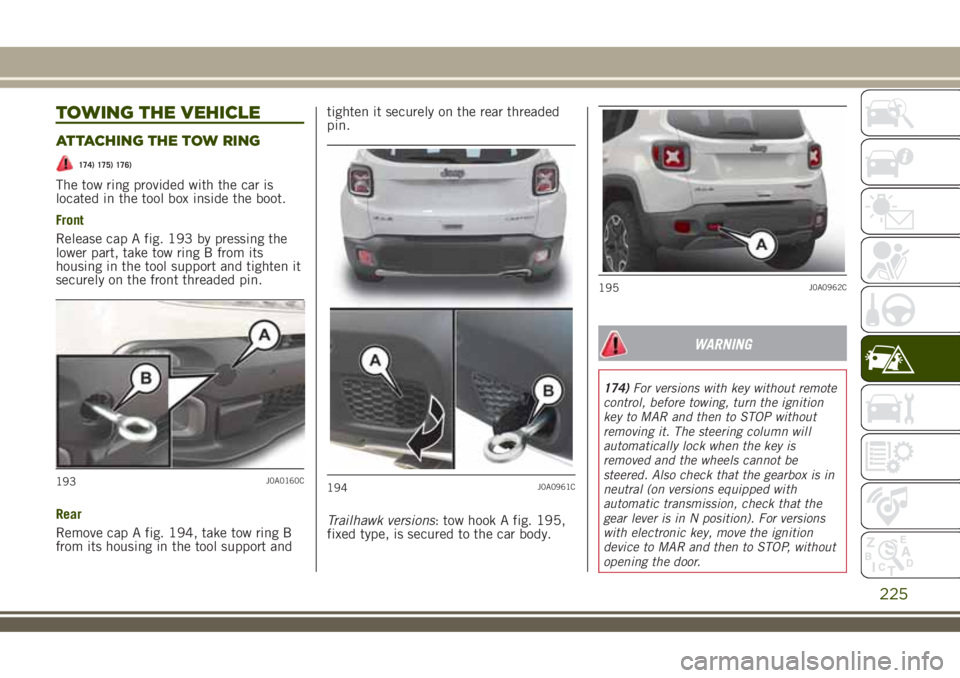
Release cap A fig. 193 by pressing the
lower part, take tow ring B from its
housing in the tool support and tighten it
securely on the front threaded pin.
Rear
Remove cap A fig. 194, take tow ring B
from its housing in the tool support andtighten it securely on the rear threaded
pin.
Trailhawk versions: tow hook A fig. 195,
fixed type, is secured to the car body.
WARNING
174)For versions with key without remote
control, before towing, turn the ignition
key to MAR and then to STOP without
removing it. The steering column will
automatically lock when the key is
removed and the wheels cannot be
steered. Also check that the gearbox is in
neutral (on versions equipped with
automatic transmission, check that the
gear lever is in N position). For versions
with electronic key, move the ignition
device to MAR and then to STOP, without
opening the door.
193J0A0160C194J0A0961C
195J0A0962C
225
Page 233 of 356
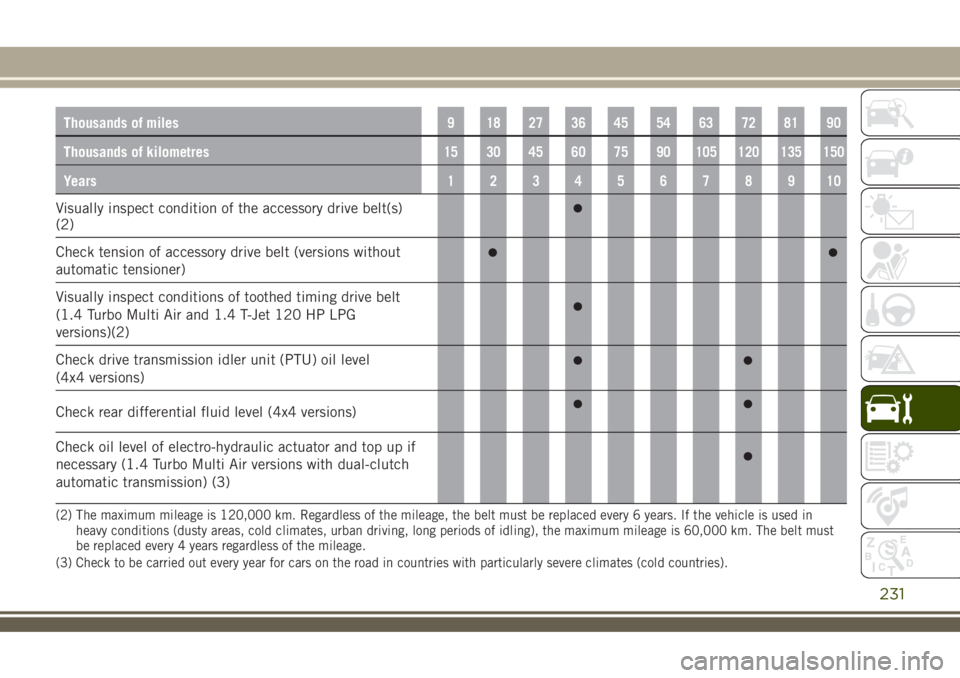
Thousands of miles9 182736455463728190
Thousands of kilometres15 30 45 60 75 90 105 120 135 150
Years12345678910
Visually inspect condition of the accessory drive belt(s)
(2)
Check tension of accessory drive belt (versions without
automatic tensioner)
Visually inspect conditions of toothed timing drive belt
(1.4 Turbo Multi Air and 1.4 T-Jet 120 HP LPG
versions)(2)
Check drive transmission idler unit (PTU) oil level
(4x4 versions)
Check rear differential fluid level (4x4 versions)
Check oil level of electro-hydraulic actuator and top up if
necessary (1.4 Turbo Multi Air versions with dual-clutch
automatic transmission) (3)
(2) The maximum mileage is 120,000 km. Regardless of the mileage, the belt must be replaced every 6 years. If the vehicle is used in
heavy conditions (dusty areas, cold climates, urban driving, long periods of idling), the maximum mileage is 60,000 km. The belt must
be replaced every 4 years regardless of the mileage.
(3) Check to be carried out every year for cars on the road in countries with particularly severe climates (cold countries).
231
Page 236 of 356

Thousands of miles9 182736455463728190
Thousands of kilometres15 30 45 60 75 90 105 120 135 150
Years12345678910
Change the brake fluid(8)
Replace the passenger compartment cleaner (7) (O) (•)
(8) Brake fluid is to be replaced every 2 years regardless of the distance travelled.
(7) If the vehicle is used in dusty areas, this cleaner must be replaced every 15,000 km.
(O) Recommended operations
(•) Obligatory operations
NOTE change automatic transmission oil and replace oil filter every 240,000 km.
234
SERVICING AND MAINTENANCE
Page 242 of 356

Thousands of miles12 24 36 48 60 72 84 96 108 120
Thousands of kilometres20 40 60 80 100 120 140 160 180 200
Years12345678910
Visually inspect condition of the accessory drive belt(s)
(2)
Check tension of accessory drive belt (versions without
automatic tensioner)
Visually inspect conditions of toothed timing drive belt
(2)
Check oil level of electro-hydraulic actuator and top up if
necessary (1.6 16V Multijet versions with dual-clutch
automatic transmission)(3)
Check drive transmission idler unit (PTU) oil level (except
1.6 16V Multijet versions)
Check rear differential fluid level (except 1.6 16V
Multijet versions)
(2) The maximum mileage is 120,000 km. Regardless of the mileage, the belt must be replaced every 6 years. If the vehicle is used in
heavy conditions (dusty areas, cold climates, urban driving, long periods of idling), the maximum mileage is 60,000 km. The belt must
be replaced every 4 years regardless of the mileage.
(3) Check to be carried out every year for cars on the road in countries with particularly severe climates (cold countries).
240
SERVICING AND MAINTENANCE
Page 244 of 356

Thousands of miles12 24 36 48 60 72 84 96 108 120
Thousands of kilometres20 40 60 80 100 120 140 160 180 200
Years12345678910
Replace the passenger compartment cleaner (6) (O) (•)
(6) If the vehicle is used in dusty areas, this cleaner must be replaced every 20,000 km.
(O) Recommended operations
(•) Obligatory operations
NOTE change automatic transmission oil and replace oil filter every 240,000 km.
242
SERVICING AND MAINTENANCE
Page 251 of 356
ENGINE OIL
179)84)
Check that the oil level is between the
MIN and MAX references on the dipstick
A. If the oil level is near or even under
the MIN line, add oil using the filler B to
reach the MAX line.
Take out the engine oil dipstick A, clean
it with a lint-free cloth and reinsert it.
Extract it again and check that the level
is between the MIN and MAX marks on
the dipstick.
Engine oil consumption
85)4)
The maximum engine oil consumption is
usually 400 grams every 1,000 km.
During the initial period of use the
engine oil consumption conditions
should be considered as having stabilised
after the first 5000 - 6000 km.
ENGINE COOLANT
180)86)
If the level is too low, unscrew the cap of
reservoir C and add the fluid described in
the "Technical Specifications" section.
WINDSCREEN/REAR WINDOW
WASHER FLUID
181) 182)
If the level is too low, lift reservoir cap D
and add the fluid described in the
chapter "Technical Specifications".
BRAKE FLUID
183) 184)87)
Check that the fluid is at the max. level.
If the fluid level in the reservoir is too
low, undo reservoir cap E and add the
fluid described in the chapter "Technical
Specifications".
AUTOMATIC TRANSMISSION /
TWIN CLUTCH AUTOMATIC
TRANSMISSION ACTUATION
SYSTEM OIL
5)
The transmission control oil level should
only be checked at a Jeep Dealership.
BATTERY
185) 186) 187) 188)6)
The battery does not require the
electrolyte to be topped up with distilled
water. A periodic check carried out at a
Jeep Dealership is, however, necessary to
check efficiency.
IMPORTANT After the battery is
disconnected, the steering must be
initialised. The
warning light on the
instrument panel switches on to
indicate this. To carry out this
procedure turn the steering wheel all
the way from one end to the other or
drive in a straight line for about a
hundred metres.
IMPORTANT If the charge level
remains under 50% for a long time,
the battery is damaged by sulphation,
reducing its capacity and efficiency at
start-up.
CLIMATE CONTROL SYSTEM
MAINTENANCE
In winter, the climate control system
must be turned on at least once a month
for about 10 minutes. Have the system
inspected at a Jeep Dealership before the
summer.
WARNING
177)Never smoke while working in the
engine compartment: gas and
inflammable vapours may be present, with
the risk of fire.
249
Page 266 of 356

Versions 2.0 16V Multijet 120 HP 2.0 16V Multijet 140 HP 2.0 16V Multijet 170 HP
Engine code 5526308755263087 / 55263088(*)55263088
Cycle Diesel Diesel Diesel
Number and position of cylinders 4 in line 4 in line 4 in line
Piston bore and stroke (mm) 83 × 90.4 83 × 90.4 83 × 90.4
Total displacement (cm³) 1956 1956 1956
Compression ratio 16.5 16.5 16.5
Maximum power (EC) (kW) 88 103 125
Maximum power (EEC) (HP) 120 140 170
corresponding engine speed (rpm) 4000
3750 / 4000
(*)3750
Maximum torque (EC) (Nm) 320 350 350
Maximum torque (EC) (kgm) 32.6 35.7 35.7
corresponding engine speed (rpm) 1250
1500 / 1750
(*)1750
FuelDiesel for motor vehicles
(EN590 Specification)Diesel for motor vehicles
(EN590 Specification)Diesel for motor vehicles
(EN590 Specification)
(*) Versions with automatic transmission
264
TECHNICAL DATA