wheel JEEP WAGONEER 2023 Owners Manual
[x] Cancel search | Manufacturer: JEEP, Model Year: 2023, Model line: WAGONEER, Model: JEEP WAGONEER 2023Pages: 396, PDF Size: 15.17 MB
Page 295 of 396
IN CASE OF EMERGENCY293
(Continued)
Automatic SOS — If Equipped
Automatic SOS is a hands-free safety service that can
immediately connect you with help in the event that your
vehicle’s airbags deploy. Please refer to your provided
radio supplement for complete information.
JACKING AND TIRE CHANGING
NOTE:
If your vehicle is equipped with an air suspension system,
there is a feature which allows the automatic leveling to be
disabled before changing a tire. This feature can be acti
-
vated through the Uconnect system
Úpage 215.
PREPARATIONS FOR JACKING
Before changing a tire or using the jack please disable the
hands free lift gate, This feature can be disabled through
the Uconnect system
Úpage 197.
1. Park the vehicle on a firm, level surface as far from the edge of the roadway as possible. Avoid icy or
slippery areas.
2. Turn on the Hazard Warning Flashers.
3. Apply the parking brake.
4. Place the gear selector into PARK (P).
5. Turn OFF the ignition.
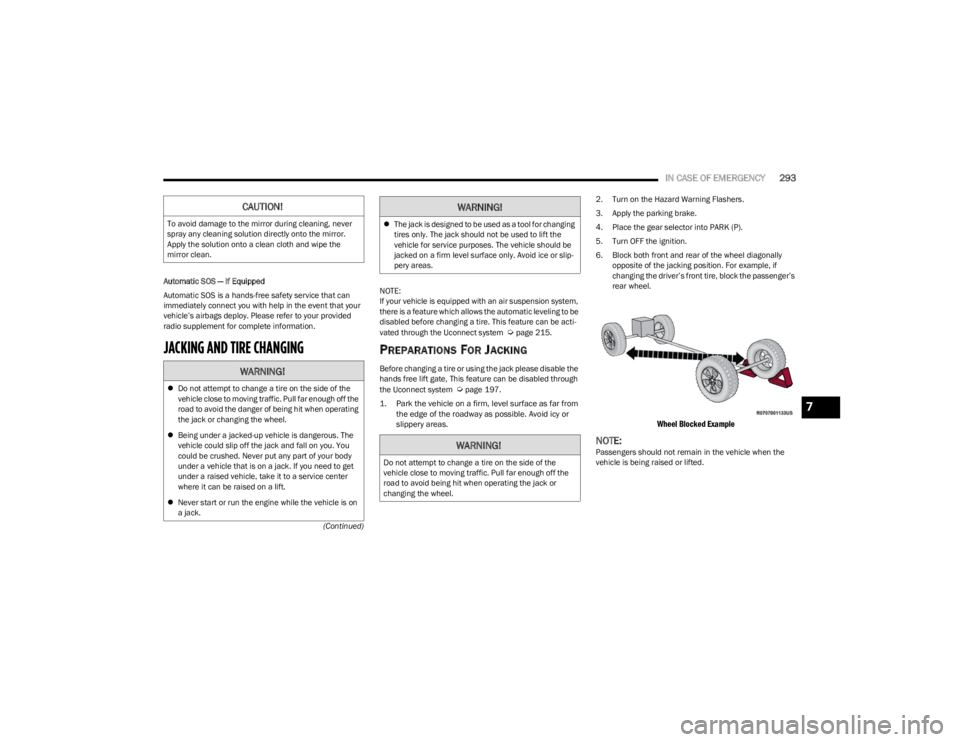
6. Block both front and rear of the wheel diagonally
opposite of the jacking position. For example, if
changing the driver’s front tire, block the passenger’s
rear wheel.
Wheel Blocked Example
NOTE:Passengers should not remain in the vehicle when the
vehicle is being raised or lifted.
CAUTION!
To avoid damage to the mirror during cleaning, never
spray any cleaning solution directly onto the mirror.
Apply the solution onto a clean cloth and wipe the
mirror clean.
WARNING!
Do not attempt to change a tire on the side of the
vehicle close to moving traffic. Pull far enough off the
road to avoid the danger of being hit when operating
the jack or changing the wheel.
Being under a jacked-up vehicle is dangerous. The
vehicle could slip off the jack and fall on you. You
could be crushed. Never put any part of your body
under a vehicle that is on a jack. If you need to get
under a raised vehicle, take it to a service center
where it can be raised on a lift.
Never start or run the engine while the vehicle is on
a jack.
The jack is designed to be used as a tool for changing
tires only. The jack should not be used to lift the
vehicle for service purposes. The vehicle should be
jacked on a firm level surface only. Avoid ice or slip -
pery areas.
WARNING!
Do not attempt to change a tire on the side of the
vehicle close to moving traffic. Pull far enough off the
road to avoid being hit when operating the jack or
changing the wheel.
WARNING!
7
23_WS_OM_EN_USC_t.book Page 293
Page 297 of 396
IN CASE OF EMERGENCY295
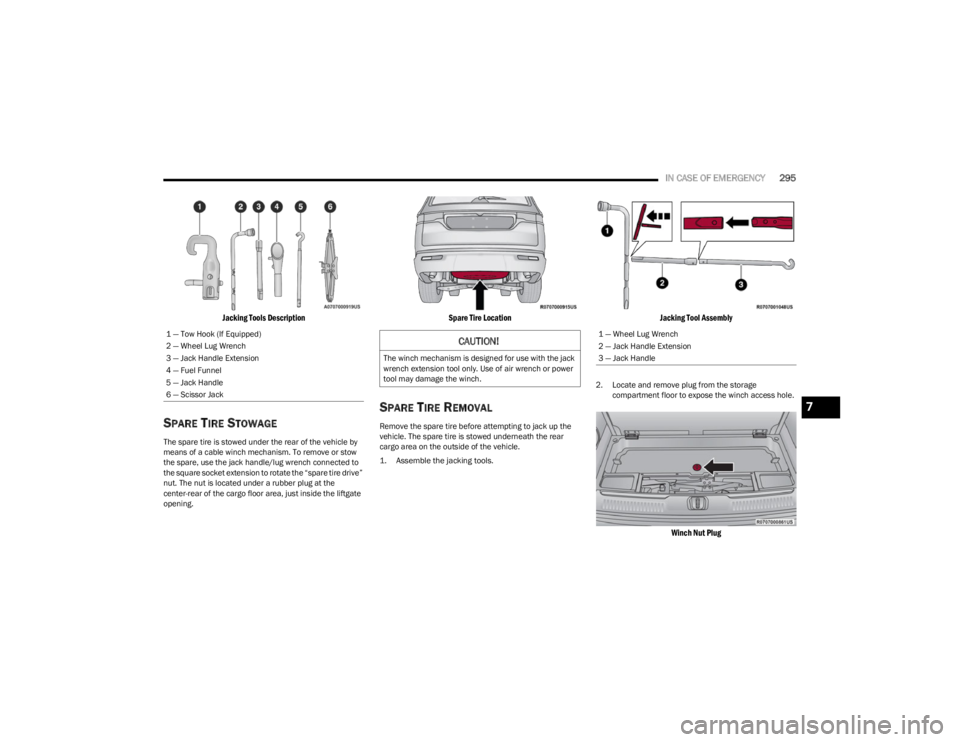
Jacking Tools Description
SPARE TIRE STOWAGE
The spare tire is stowed under the rear of the vehicle by
means of a cable winch mechanism. To remove or stow
the spare, use the jack handle/lug wrench connected to
the square socket extension to rotate the “spare tire drive”
nut. The nut is located under a rubber plug at the
center-rear of the cargo floor area, just inside the liftgate
opening.
Spare Tire Location
SPARE TIRE REMOVAL
Remove the spare tire before attempting to jack up the
vehicle. The spare tire is stowed underneath the rear
cargo area on the outside of the vehicle.
1. Assemble the jacking tools.
Jacking Tool Assembly
2. Locate and remove plug from the storage
compartment floor to expose the winch access hole.
Winch Nut Plug
1 — Tow Hook (If Equipped)
2 — Wheel Lug Wrench
3 — Jack Handle Extension
4 — Fuel Funnel
5 — Jack Handle
6 — Scissor JackCAUTION!
The winch mechanism is designed for use with the jack
wrench extension tool only. Use of air wrench or power
tool may damage the winch.
1 — Wheel Lug Wrench
2 — Jack Handle Extension
3 — Jack Handle
7
23_WS_OM_EN_USC_t.book Page 295
Page 298 of 396
296IN CASE OF EMERGENCY
(Continued)
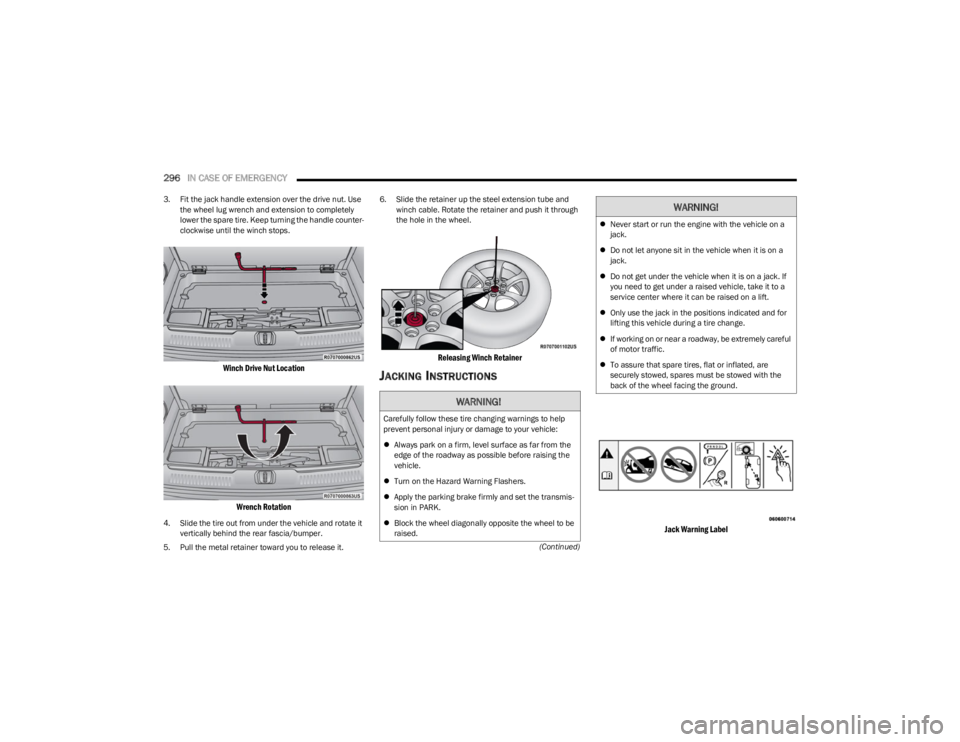
3. Fit the jack handle extension over the drive nut. Use
the wheel lug wrench and extension to completely
lower the spare tire. Keep turning the handle counter -
clockwise until the winch stops.
Winch Drive Nut Location
Wrench Rotation
4. Slide the tire out from under the vehicle and rotate it vertically behind the rear fascia/bumper.
5. Pull the metal retainer toward you to release it. 6. Slide the retainer up the steel extension tube and
winch cable. Rotate the retainer and push it through
the hole in the wheel.
Releasing Winch Retainer
JACKING INSTRUCTIONS
Jack Warning Label
WARNING!
Carefully follow these tire changing warnings to help
prevent personal injury or damage to your vehicle:
Always park on a firm, level surface as far from the
edge of the roadway as possible before raising the
vehicle.
Turn on the Hazard Warning Flashers.
Apply the parking brake firmly and set the transmis -
sion in PARK.
Block the wheel diagonally opposite the wheel to be
raised.
Never start or run the engine with the vehicle on a
jack.
Do not let anyone sit in the vehicle when it is on a
jack.
Do not get under the vehicle when it is on a jack. If
you need to get under a raised vehicle, take it to a
service center where it can be raised on a lift.
Only use the jack in the positions indicated and for
lifting this vehicle during a tire change.
If working on or near a roadway, be extremely careful
of motor traffic.
To assure that spare tires, flat or inflated, are
securely stowed, spares must be stowed with the
back of the wheel facing the ground.
WARNING!
23_WS_OM_EN_USC_t.book Page 296
Page 299 of 396
IN CASE OF EMERGENCY297
1. Loosen (but do not remove) the wheel lug nuts,
using the lug wrench by turning them counter -
clockwise, one turn, while the wheel is still on the
ground.
Loosen Lug Nuts
2. Assemble the jack and tools Úpage 295.
Jack And Tool Assembled
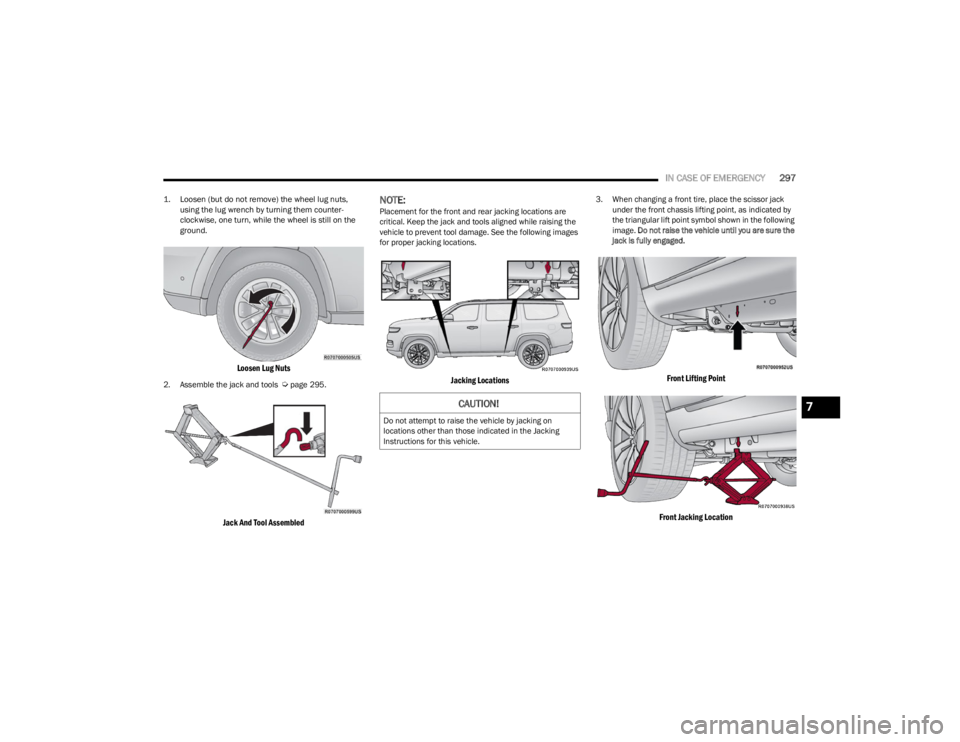
NOTE:Placement for the front and rear jacking locations are
critical. Keep the jack and tools aligned while raising the
vehicle to prevent tool damage. See the following images
for proper jacking locations.
Jacking Locations
3. When changing a front tire, place the scissor jack under the front chassis lifting point, as indicated by
the triangular lift point symbol shown in the following
image. Do not raise the vehicle until you are sure the
jack is fully engaged.
Front Lifting Point
Front Jacking Location
CAUTION!
Do not attempt to raise the vehicle by jacking on
locations other than those indicated in the Jacking
Instructions for this vehicle.
7
23_WS_OM_EN_USC_t.book Page 297
Page 300 of 396
298IN CASE OF EMERGENCY
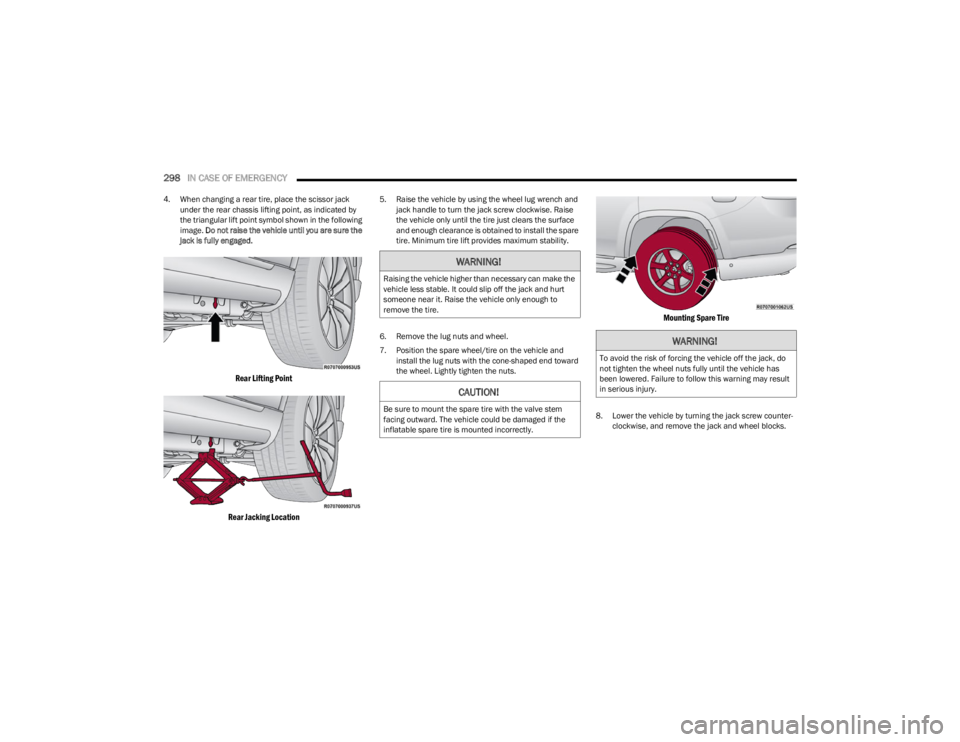
4. When changing a rear tire, place the scissor jack
under the rear chassis lifting point, as indicated by
the triangular lift point symbol shown in the following
image. Do not raise the vehicle until you are sure the
jack is fully engaged.
Rear Lifting Point
Rear Jacking Location
5. Raise the vehicle by using the wheel lug wrench and jack handle to turn the jack screw clockwise. Raise
the vehicle only until the tire just clears the surface
and enough clearance is obtained to install the spare
tire. Minimum tire lift provides maximum stability.
6. Remove the lug nuts and wheel.
7. Position the spare wheel/tire on the vehicle and install the lug nuts with the cone-shaped end toward
the wheel. Lightly tighten the nuts.
Mounting Spare Tire
8. Lower the vehicle by turning the jack screw counter -
clockwise, and remove the jack and wheel blocks.
WARNING!
Raising the vehicle higher than necessary can make the
vehicle less stable. It could slip off the jack and hurt
someone near it. Raise the vehicle only enough to
remove the tire.
CAUTION!
Be sure to mount the spare tire with the valve stem
facing outward. The vehicle could be damaged if the
inflatable spare tire is mounted incorrectly.
WARNING!
To avoid the risk of forcing the vehicle off the jack, do
not tighten the wheel nuts fully until the vehicle has
been lowered. Failure to follow this warning may result
in serious injury.
23_WS_OM_EN_USC_t.book Page 298
Page 301 of 396
IN CASE OF EMERGENCY299
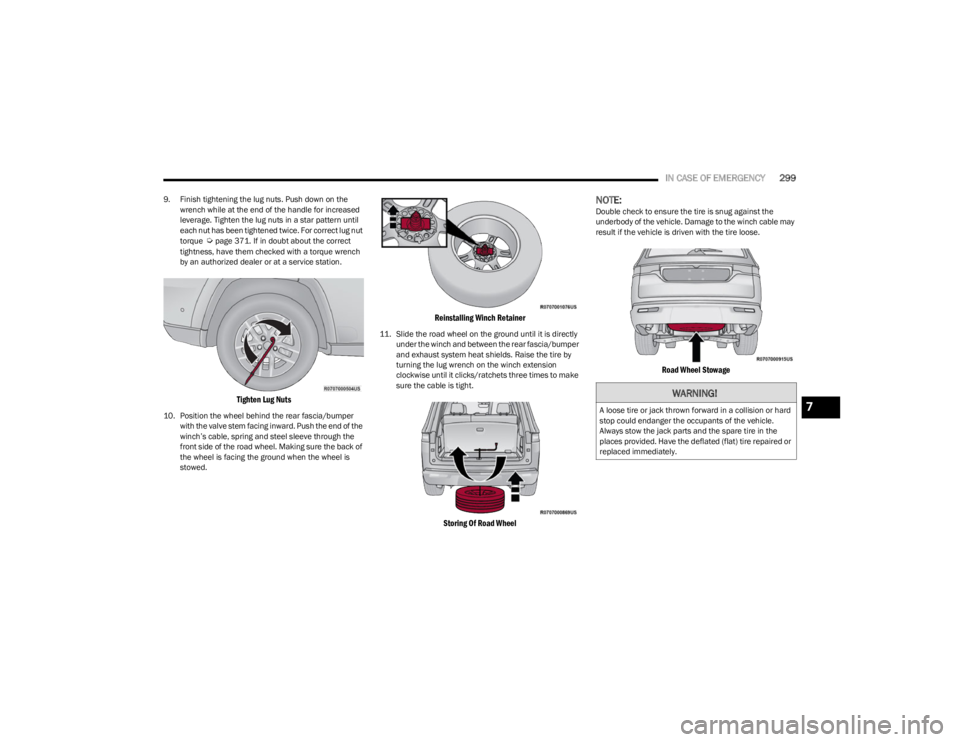
9. Finish tightening the lug nuts. Push down on the
wrench while at the end of the handle for increased
leverage. Tighten the lug nuts in a star pattern until
each nut has been tightened twice. For correct lug nut
torque
Úpage 371. If in doubt about the correct
tightness, have them checked with a torque wrench
by an authorized dealer or at a service station.
Tighten Lug Nuts
10. Position the wheel behind the rear fascia/bumper with the valve stem facing inward. Push the end of the
winch’s cable, spring and steel sleeve through the
front side of the road wheel. Making sure the back of
the wheel is facing the ground when the wheel is
stowed.
Reinstalling Winch Retainer
11. Slide the road wheel on the ground until it is directly under the winch and between the rear fascia/bumper
and exhaust system heat shields. Raise the tire by
turning the lug wrench on the winch extension
clockwise until it clicks/ratchets three times to make
sure the cable is tight.
Storing Of Road Wheel
NOTE:Double check to ensure the tire is snug against the
underbody of the vehicle. Damage to the winch cable may
result if the vehicle is driven with the tire loose.
Road Wheel Stowage
WARNING!
A loose tire or jack thrown forward in a collision or hard
stop could endanger the occupants of the vehicle.
Always stow the jack parts and the spare tire in the
places provided. Have the deflated (flat) tire repaired or
replaced immediately.7
23_WS_OM_EN_USC_t.book Page 299
Page 302 of 396
300IN CASE OF EMERGENCY
12. Lower the jack to the fully closed position.
13. Return the Jack and tools back into the jack storage
bin. Reinstall the jack storage cover by firmly pushing
down until the clips lock into position.
14. After 25 miles (40 km), check the lug nut torque with a torque wrench to ensure that all lug nuts are
properly seated against the wheel.
15. Have the road wheel and tire repaired as soon as possible and properly secure the spare tire, jack and
tool kit.
NOTE:Do not drive with the spare tire installed for more than
50 miles (80 km) at a max speed of 50 mph (80 km/h).
JUMP STARTING
If your vehicle has a discharged battery, it can be jump
started using a set of jumper cables and a battery in
another vehicle, or by using a portable battery booster
pack. Jump starting can be dangerous if done improperly,
so please follow the procedures in this section carefully.
NOTE:When using a portable battery booster pack, follow the
manufacturer's operating instructions and precautions.
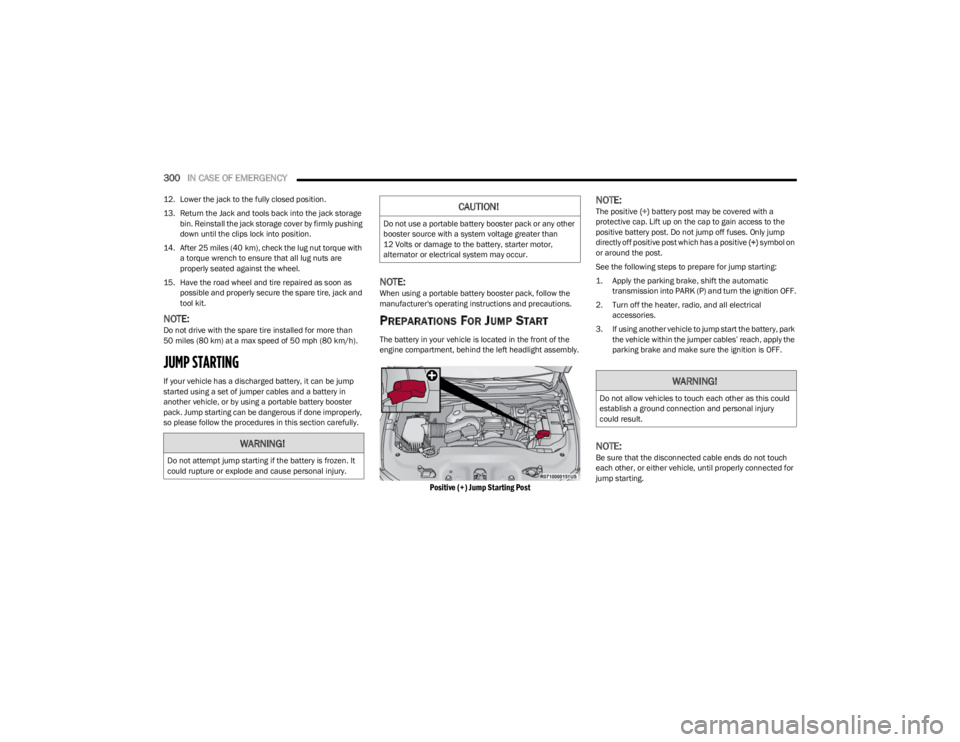
PREPARATIONS FOR JUMP START
The battery in your vehicle is located in the front of the
engine compartment, behind the left headlight assembly.
Positive (+) Jump Starting Post
NOTE:The positive (+) battery post may be covered with a
protective cap. Lift up on the cap to gain access to the
positive battery post. Do not jump off fuses. Only jump
directly off positive post which has a positive (+) symbol on
or around the post.
See the following steps to prepare for jump starting:
1. Apply the parking brake, shift the automatic transmission into PARK (P) and turn the ignition OFF.
2. Turn off the heater, radio, and all electrical accessories.
3. If using another vehicle to jump start the battery, park the vehicle within the jumper cables’ reach, apply the
parking brake and make sure the ignition is OFF.
NOTE:Be sure that the disconnected cable ends do not touch
each other, or either vehicle, until properly connected for
jump starting.
WARNING!
Do not attempt jump starting if the battery is frozen. It
could rupture or explode and cause personal injury.
CAUTION!
Do not use a portable battery booster pack or any other
booster source with a system voltage greater than
12 Volts or damage to the battery, starter motor,
alternator or electrical system may occur.
WARNING!
Do not allow vehicles to touch each other as this could
establish a ground connection and personal injury
could result.
23_WS_OM_EN_USC_t.book Page 300
Page 307 of 396
IN CASE OF EMERGENCY305
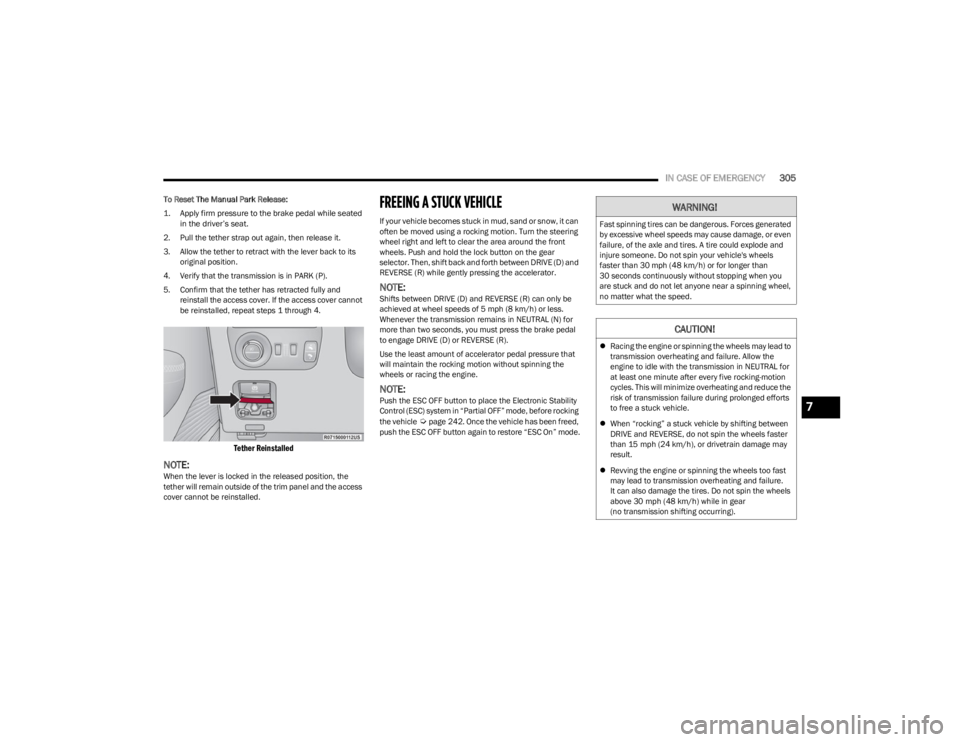
To Reset The Manual Park Release:
1. Apply firm pressure to the brake pedal while seated
in the driver’s seat.
2. Pull the tether strap out again, then release it.
3. Allow the tether to retract with the lever back to its original position.
4. Verify that the transmission is in PARK (P).
5. Confirm that the tether has retracted fully and reinstall the access cover. If the access cover cannot
be reinstalled, repeat steps 1 through 4.
Tether Reinstalled
NOTE:When the lever is locked in the released position, the
tether will remain outside of the trim panel and the access
cover cannot be reinstalled.
FREEING A STUCK VEHICLE
If your vehicle becomes stuck in mud, sand or snow, it can
often be moved using a rocking motion. Turn the steering
wheel right and left to clear the area around the front
wheels. Push and hold the lock button on the gear
selector. Then, shift back and forth between DRIVE (D) and
REVERSE (R) while gently pressing the accelerator.
NOTE:Shifts between DRIVE (D) and REVERSE (R) can only be
achieved at wheel speeds of 5 mph (8 km/h) or less.
Whenever the transmission remains in NEUTRAL (N) for
more than two seconds, you must press the brake pedal
to engage DRIVE (D) or REVERSE (R).
Use the least amount of accelerator pedal pressure that
will maintain the rocking motion without spinning the
wheels or racing the engine.
NOTE:Push the ESC OFF button to place the Electronic Stability
Control (ESC) system in “Partial OFF” mode, before rocking
the vehicle
Úpage 242. Once the vehicle has been freed,
push the ESC OFF button again to restore “ESC On” mode.
WARNING!
Fast spinning tires can be dangerous. Forces generated
by excessive wheel speeds may cause damage, or even
failure, of the axle and tires. A tire could explode and
injure someone. Do not spin your vehicle's wheels
faster than 30 mph (48 km/h) or for longer than
30 seconds continuously without stopping when you
are stuck and do not let anyone near a spinning wheel,
no matter what the speed.
CAUTION!
Racing the engine or spinning the wheels may lead to
transmission overheating and failure. Allow the
engine to idle with the transmission in NEUTRAL for
at least one minute after every five rocking-motion
cycles. This will minimize overheating and reduce the
risk of transmission failure during prolonged efforts
to free a stuck vehicle.
When “rocking” a stuck vehicle by shifting between
DRIVE and REVERSE, do not spin the wheels faster
than 15 mph (24 km/h), or drivetrain damage may
result.
Revving the engine or spinning the wheels too fast
may lead to transmission overheating and failure.
It can also damage the tires. Do not spin the wheels
above 30 mph (48 km/h) while in gear
(no transmission shifting occurring).
7
23_WS_OM_EN_USC_t.book Page 305
Page 308 of 396

306IN CASE OF EMERGENCY
TOWING A DISABLED VEHICLE
This section describes procedures for towing a disabled vehicle using a commercial towing service.
If the transmission and drivetrain are operable, disabled 4x4 vehicles may also be towed as described on
Úpage 190.
Proper towing or lifting equipment is required to prevent damage to your vehicle. Use only tow bars and other equipment designed for this purpose, following equipment manufacturer’s
instructions. Use of safety chains is mandatory. Attach a tow bar or other towing device to main structural members of the vehicle, not to fascia/bumpers or associated brackets. State
and local laws regarding vehicles under tow must be observed.
NOTE:Vehicle’s equipped with air suspension, must have Tire Jack Mode Úpage 215 enabled to prevent air suspension movement during towing.
If you must use the accessories (wipers, defrosters, etc.) while being towed, the ignition must be in the ON/RUN mode.
If the vehicle's battery is discharged, instructions on shifting the automatic transmission out of PARK (P) in order to move the vehicle
Úpage 303.
Towing Condition Wheels OFF The Ground Rear-Wheel Drive Models
Four-Wheel Drive Models
With Single-Speed Transfer
Case Four-Wheel Drive Models With Two-Speed
Transfer Case
Flat Tow NONE NOT ALLOWEDNOT ALLOWEDDetailed Instructions
Úpage 190
Transmission in PARK
Transfer case in N (Neutral)
Tow in forward direction
Wheel Lift Or Dolly Tow Front
NOT ALLOWEDNOT ALLOWEDNOT ALLOWED
Rear OKNOT ALLOWEDNOT ALLOWED
Flatbed ALL BEST METHODOKBEST METHOD
23_WS_OM_EN_USC_t.book Page 306
Page 309 of 396

IN CASE OF EMERGENCY307
REAR-WHEEL DRIVE MODELS
FCA US LLC recommends towing your vehicle with all
four wheels OFF the ground using a flatbed.
If flatbed equipment is not available, and the transmission
is operable, the vehicle may be towed (with rear wheels off
the ground) under the following conditions:
The transmission must be in NEUTRAL (N). For instruc -
tions on shifting the transmission to NEUTRAL (N) when
the engine is off
Úpage 303.
The towing speed must not exceed 30 mph (48 km/h).
The towing distance must not exceed 30 miles
(48 km). If the transmission is not operable, or the vehicle must be
towed faster than 30 mph (48 km/h) or farther than
30 miles (48 km), tow with the rear wheels OFF the
ground. Acceptable methods are to tow the vehicle on a
flatbed, or with the front wheels raised and the rear
wheels on a towing dolly, or (when using a suitable
steering wheel stabilizer to hold the front wheels in the
straight position) with the rear wheels raised and the front
wheels ON the ground.
FOUR-WHEEL DRIVE MODELS
FCA US LLC recommends towing with all wheels OFF the
ground. Acceptable methods are to tow the vehicle on a
flatbed or with one end of the vehicle raised and the
opposite end on a towing dolly.
If flatbed equipment is not available, and the transfer case
is operable, vehicles with a two-speed transfer case may
be towed (in the forward direction, with ALL wheels on the
ground), IF the transfer case is in NEUTRAL (N) and the
transmission is in PARK
Úpage 190.
Vehicles equipped with a single-speed transfer case have
no NEUTRAL (N) position, and therefore must be towed will
all four wheels OFF the ground.
CAUTION!
Do not use sling type equipment when towing.
Vehicle damage may occur.
When securing the vehicle to a flatbed truck, always
secure by tire/wheel straps. Do not attach to front or
rear suspension components, body or frame.
Damage to your vehicle will result from improper
towing.
CAUTION!
Towing faster than 30 mph (48 km/h) or farther than
30 miles (48 km) with rear wheels on the ground can
cause severe transmission damage. Damage from
improper towing is not covered under the New
Vehicle Limited Warranty.
CAUTION!
Front or rear wheel lifts must not be used (if the
remaining wheels are on the ground). Internal
damage to the transmission or transfer case will
occur if a front or rear wheel lift is used when towing.
Towing this vehicle in violation of the approved
requirements can cause severe transmission and/or
transfer case damage. Damage from improper
towing is not covered under the New Vehicle Limited
Warranty.
7
23_WS_OM_EN_USC_t.book Page 307