spare tire JEEP WAGONEER 2023 User Guide
[x] Cancel search | Manufacturer: JEEP, Model Year: 2023, Model line: WAGONEER, Model: JEEP WAGONEER 2023Pages: 396, PDF Size: 15.17 MB
Page 298 of 396
296IN CASE OF EMERGENCY
(Continued)
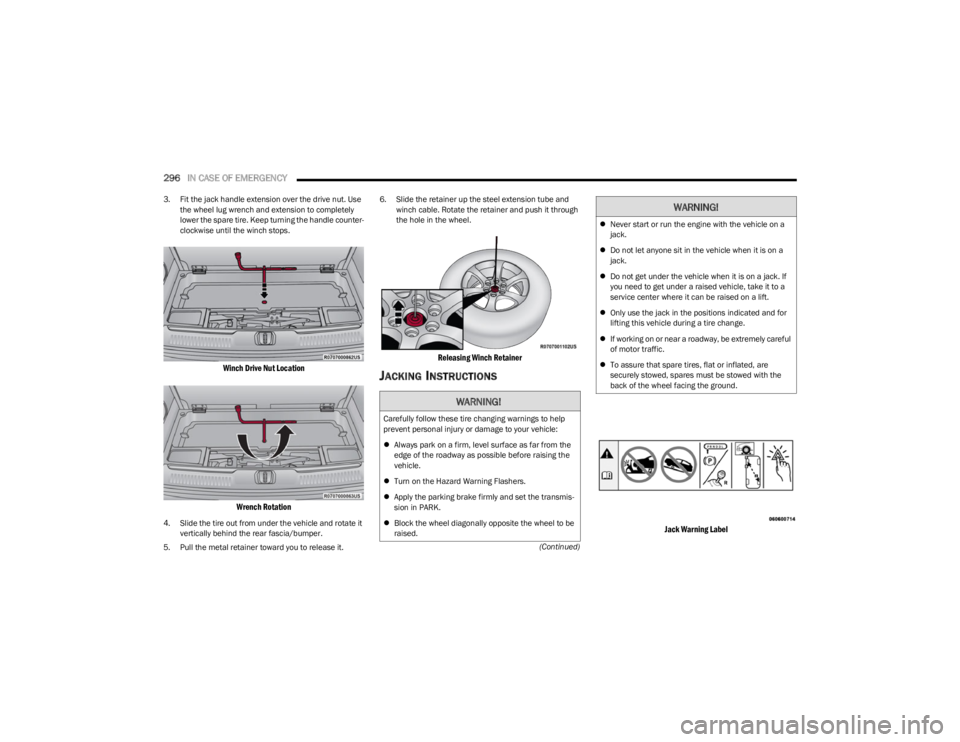
3. Fit the jack handle extension over the drive nut. Use
the wheel lug wrench and extension to completely
lower the spare tire. Keep turning the handle counter -
clockwise until the winch stops.
Winch Drive Nut Location
Wrench Rotation
4. Slide the tire out from under the vehicle and rotate it vertically behind the rear fascia/bumper.
5. Pull the metal retainer toward you to release it. 6. Slide the retainer up the steel extension tube and
winch cable. Rotate the retainer and push it through
the hole in the wheel.
Releasing Winch Retainer
JACKING INSTRUCTIONS
Jack Warning Label
WARNING!
Carefully follow these tire changing warnings to help
prevent personal injury or damage to your vehicle:
Always park on a firm, level surface as far from the
edge of the roadway as possible before raising the
vehicle.
Turn on the Hazard Warning Flashers.
Apply the parking brake firmly and set the transmis -
sion in PARK.
Block the wheel diagonally opposite the wheel to be
raised.
Never start or run the engine with the vehicle on a
jack.
Do not let anyone sit in the vehicle when it is on a
jack.
Do not get under the vehicle when it is on a jack. If
you need to get under a raised vehicle, take it to a
service center where it can be raised on a lift.
Only use the jack in the positions indicated and for
lifting this vehicle during a tire change.
If working on or near a roadway, be extremely careful
of motor traffic.
To assure that spare tires, flat or inflated, are
securely stowed, spares must be stowed with the
back of the wheel facing the ground.
WARNING!
23_WS_OM_EN_USC_t.book Page 296
Page 300 of 396
298IN CASE OF EMERGENCY
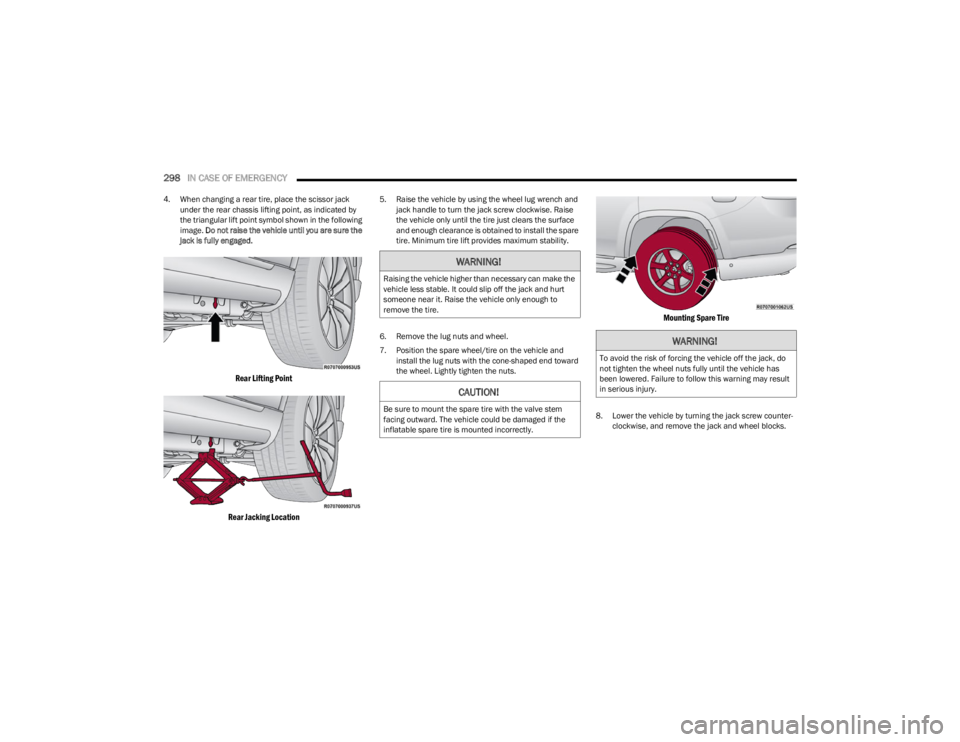
4. When changing a rear tire, place the scissor jack
under the rear chassis lifting point, as indicated by
the triangular lift point symbol shown in the following
image. Do not raise the vehicle until you are sure the
jack is fully engaged.
Rear Lifting Point
Rear Jacking Location
5. Raise the vehicle by using the wheel lug wrench and jack handle to turn the jack screw clockwise. Raise
the vehicle only until the tire just clears the surface
and enough clearance is obtained to install the spare
tire. Minimum tire lift provides maximum stability.
6. Remove the lug nuts and wheel.
7. Position the spare wheel/tire on the vehicle and install the lug nuts with the cone-shaped end toward
the wheel. Lightly tighten the nuts.
Mounting Spare Tire
8. Lower the vehicle by turning the jack screw counter -
clockwise, and remove the jack and wheel blocks.
WARNING!
Raising the vehicle higher than necessary can make the
vehicle less stable. It could slip off the jack and hurt
someone near it. Raise the vehicle only enough to
remove the tire.
CAUTION!
Be sure to mount the spare tire with the valve stem
facing outward. The vehicle could be damaged if the
inflatable spare tire is mounted incorrectly.
WARNING!
To avoid the risk of forcing the vehicle off the jack, do
not tighten the wheel nuts fully until the vehicle has
been lowered. Failure to follow this warning may result
in serious injury.
23_WS_OM_EN_USC_t.book Page 298
Page 301 of 396
IN CASE OF EMERGENCY299
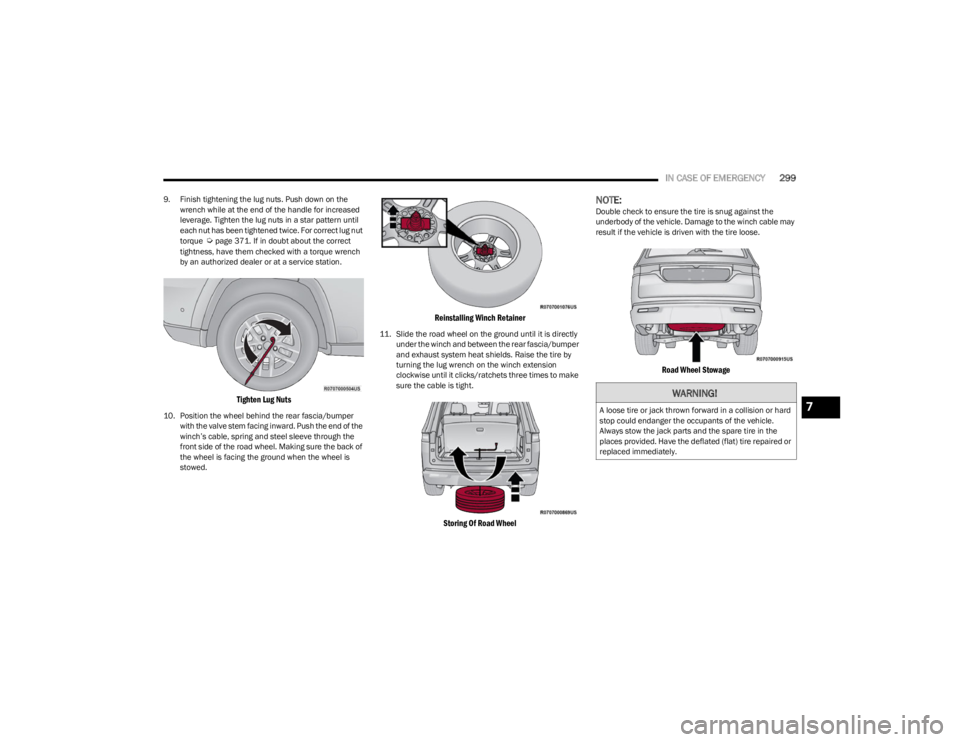
9. Finish tightening the lug nuts. Push down on the
wrench while at the end of the handle for increased
leverage. Tighten the lug nuts in a star pattern until
each nut has been tightened twice. For correct lug nut
torque
Úpage 371. If in doubt about the correct
tightness, have them checked with a torque wrench
by an authorized dealer or at a service station.
Tighten Lug Nuts
10. Position the wheel behind the rear fascia/bumper with the valve stem facing inward. Push the end of the
winch’s cable, spring and steel sleeve through the
front side of the road wheel. Making sure the back of
the wheel is facing the ground when the wheel is
stowed.
Reinstalling Winch Retainer
11. Slide the road wheel on the ground until it is directly under the winch and between the rear fascia/bumper
and exhaust system heat shields. Raise the tire by
turning the lug wrench on the winch extension
clockwise until it clicks/ratchets three times to make
sure the cable is tight.
Storing Of Road Wheel
NOTE:Double check to ensure the tire is snug against the
underbody of the vehicle. Damage to the winch cable may
result if the vehicle is driven with the tire loose.
Road Wheel Stowage
WARNING!
A loose tire or jack thrown forward in a collision or hard
stop could endanger the occupants of the vehicle.
Always stow the jack parts and the spare tire in the
places provided. Have the deflated (flat) tire repaired or
replaced immediately.7
23_WS_OM_EN_USC_t.book Page 299
Page 302 of 396
300IN CASE OF EMERGENCY
12. Lower the jack to the fully closed position.
13. Return the Jack and tools back into the jack storage
bin. Reinstall the jack storage cover by firmly pushing
down until the clips lock into position.
14. After 25 miles (40 km), check the lug nut torque with a torque wrench to ensure that all lug nuts are
properly seated against the wheel.
15. Have the road wheel and tire repaired as soon as possible and properly secure the spare tire, jack and
tool kit.
NOTE:Do not drive with the spare tire installed for more than
50 miles (80 km) at a max speed of 50 mph (80 km/h).
JUMP STARTING
If your vehicle has a discharged battery, it can be jump
started using a set of jumper cables and a battery in
another vehicle, or by using a portable battery booster
pack. Jump starting can be dangerous if done improperly,
so please follow the procedures in this section carefully.
NOTE:When using a portable battery booster pack, follow the
manufacturer's operating instructions and precautions.
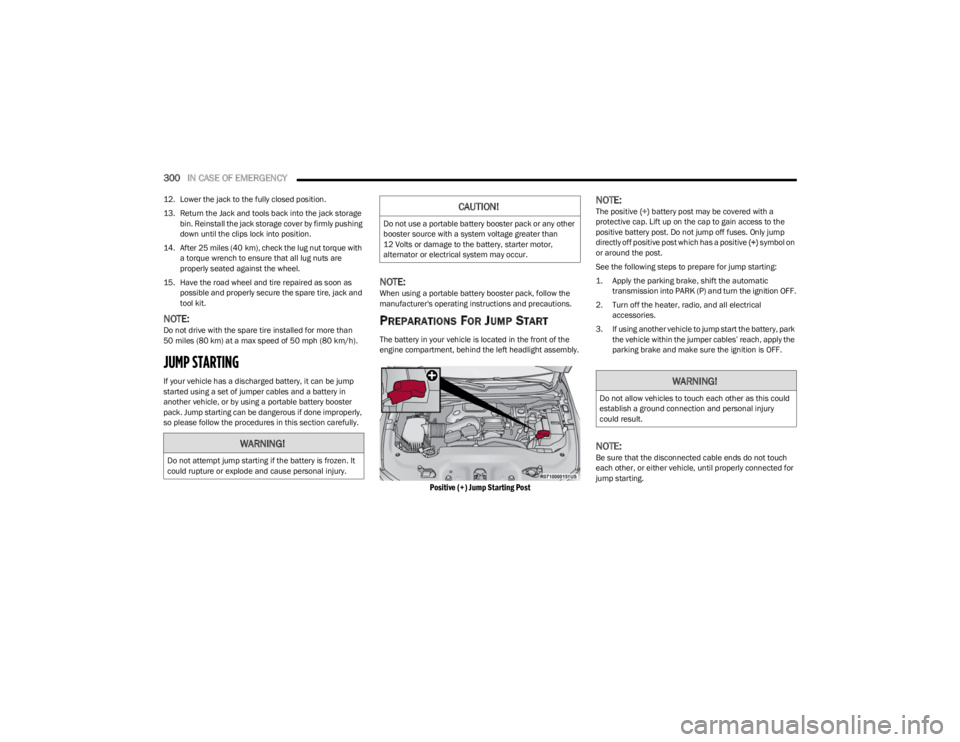
PREPARATIONS FOR JUMP START
The battery in your vehicle is located in the front of the
engine compartment, behind the left headlight assembly.
Positive (+) Jump Starting Post
NOTE:The positive (+) battery post may be covered with a
protective cap. Lift up on the cap to gain access to the
positive battery post. Do not jump off fuses. Only jump
directly off positive post which has a positive (+) symbol on
or around the post.
See the following steps to prepare for jump starting:
1. Apply the parking brake, shift the automatic transmission into PARK (P) and turn the ignition OFF.
2. Turn off the heater, radio, and all electrical accessories.
3. If using another vehicle to jump start the battery, park the vehicle within the jumper cables’ reach, apply the
parking brake and make sure the ignition is OFF.
NOTE:Be sure that the disconnected cable ends do not touch
each other, or either vehicle, until properly connected for
jump starting.
WARNING!
Do not attempt jump starting if the battery is frozen. It
could rupture or explode and cause personal injury.
CAUTION!
Do not use a portable battery booster pack or any other
booster source with a system voltage greater than
12 Volts or damage to the battery, starter motor,
alternator or electrical system may occur.
WARNING!
Do not allow vehicles to touch each other as this could
establish a ground connection and personal injury
could result.
23_WS_OM_EN_USC_t.book Page 300
Page 304 of 396
302IN CASE OF EMERGENCY
3. Disconnect the positive (+) end of the jumper cable
from the positive (+) post of the booster battery.
4. Disconnect the opposite end of the positive (+)
jumper cable from the positive (+) post of the
discharged vehicle.
5. Reinstall the protective cover over the positive (+)
post of the discharged vehicle.
If frequent jump starting is required to start your vehicle
have the battery and charging system tested at an
authorized dealer.
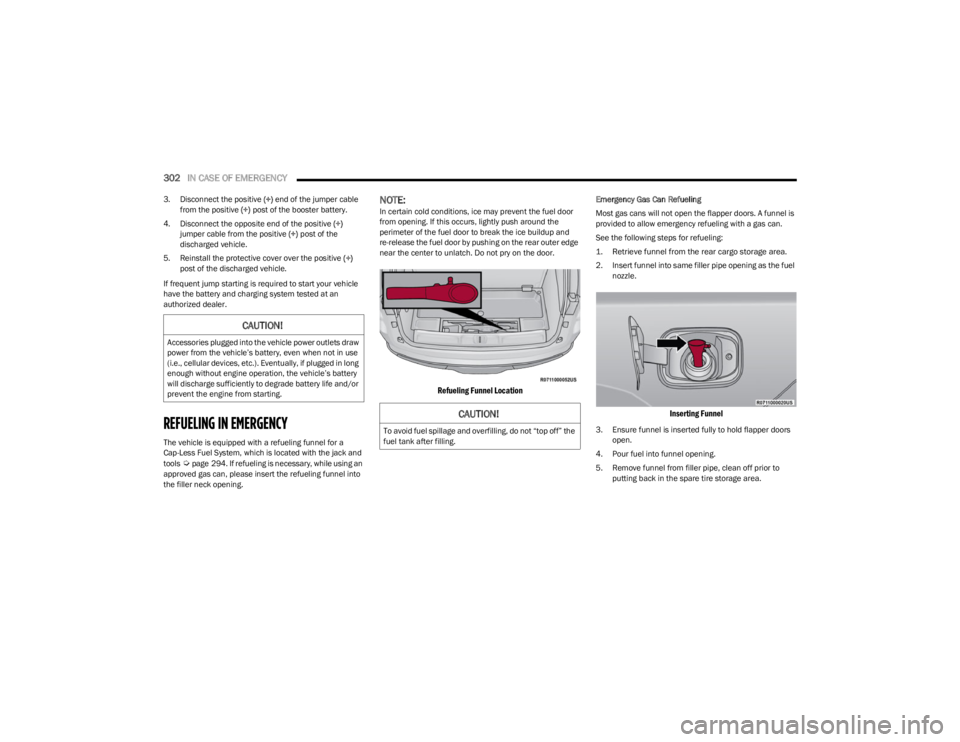
REFUELING IN EMERGENCY
The vehicle is equipped with a refueling funnel for a
Cap-Less Fuel System, which is located with the jack and
tools
Úpage 294. If refueling is necessary, while using an
approved gas can, please insert the refueling funnel into
the filler neck opening.
NOTE:In certain cold conditions, ice may prevent the fuel door
from opening. If this occurs, lightly push around the
perimeter of the fuel door to break the ice buildup and
re-release the fuel door by pushing on the rear outer edge
near the center to unlatch. Do not pry on the door.
Refueling Funnel Location
Emergency Gas Can Refueling
Most gas cans will not open the flapper doors. A funnel is
provided to allow emergency refueling with a gas can.
See the following steps for refueling:
1. Retrieve funnel from the rear cargo storage area.
2. Insert funnel into same filler pipe opening as the fuel nozzle.
Inserting Funnel
3. Ensure funnel is inserted fully to hold flapper doors open.
4. Pour fuel into funnel opening.
5. Remove funnel from filler pipe, clean off prior to putting back in the spare tire storage area.
CAUTION!
Accessories plugged into the vehicle power outlets draw
power from the vehicle’s battery, even when not in use
(i.e., cellular devices, etc.). Eventually, if plugged in long
enough without engine operation, the vehicle’s battery
will discharge sufficiently to degrade battery life and/or
prevent the engine from starting.
CAUTION!
To avoid fuel spillage and overfilling, do not “top off” the
fuel tank after filling.
23_WS_OM_EN_USC_t.book Page 302
Page 346 of 396

344SERVICING AND MAINTENANCE
The Rear Power Distribution Center is located behind a trim cover of the rear driver’s side quarter panel. This center contains cartridge fuses, micro fuses, relays, and circuit breakers.
The following chart corresponds to the fuses inside.
CavityCartridge Fuse Micro Fuse Description
* If Equipped
F05 150 Amp Gray –Underhood Power Distribution Center Battery Feed
F06 ––Spare
F07 ––Spare
F08 ––Spare
F09 ––Spare
F10 ––Spare
F11 ––Spare
F12 ––Spare
F13 30 Amp Pink –Air Compressor (Tire Inflator)
F14 25 Amp Clear –MTR Sunshade Sunroof
F15A ––Spare
F15B –10 Amp RedHands Free Liftgate / Rear Window Switches / MOD HVAC Cntrl Rr
F16 ––Spare
F17 ––Spare
F18 25 Amp Clear –Power Liftgate Module
F19A –10 Amp RedL2+ Driver Alert Lighting Module
F19B –10 Amp RedAnimation Lighting RR-LT
F20A –15 Amp BlueCentral ASAS Decision Module (CADM) - LO
F20B ––Spare
F21A ––Spare
23_WS_OM_EN_USC_t.book Page 344
Page 350 of 396

348SERVICING AND MAINTENANCE
F81 –20 Amp Yellow Module Seat Heater Frt (PASS) *
F82 –10 Amp RedAnimation Lighting RR / Air Compressor (Tire Inflator) / Animation
Lighting Liftgate Taillamp
F83 ––Spare
F84 ––Spare
F85 ––Spare
F86 –15 Amp BlueLumbar Support Driver & Passenger SW *
F87 ––Spare
F88 20 Amp Blue –MOD Door MUX Driver Rear - Smart Motor
CB1 –20 Amp BluePower Outlet RR
CavityCartridge Fuse Micro Fuse Description
* If Equipped
23_WS_OM_EN_USC_t.book Page 348
Page 351 of 396
SERVICING AND MAINTENANCE349
BULB REPLACEMENT
Replacement Bulbs, Names, And Part
Numbers
Your vehicle is equipped with LED lamps. In the event of a
light malfunction, please see an authorized dealer for LED
replacement.
TIRES
TIRE SAFETY INFORMATION
Tire safety information will cover aspects of the following
information: Tire Markings, Tire Identification Numbers,
Tire Terminology and Definitions, Tire Pressures, and Tire
Loading.
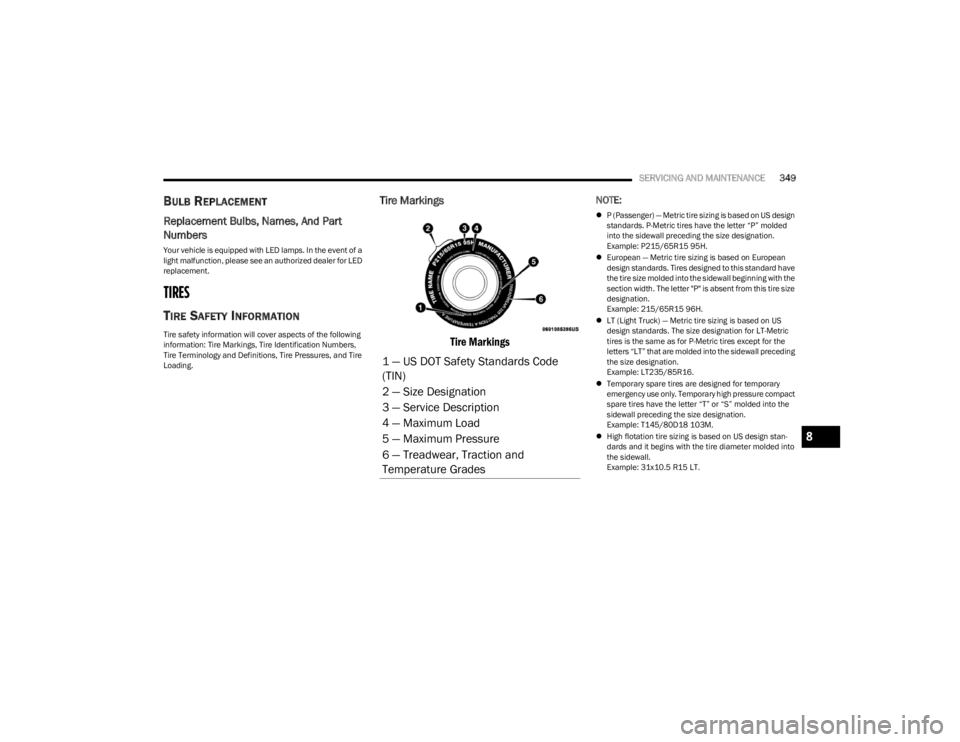
Tire Markings
Tire Markings
NOTE:
P (Passenger) — Metric tire sizing is based on US design
standards. P-Metric tires have the letter “P” molded
into the sidewall preceding the size designation.
Example: P215/65R15 95H.
European — Metric tire sizing is based on European
design standards. Tires designed to this standard have
the tire size molded into the sidewall beginning with the
section width. The letter "P" is absent from this tire size
designation.
Example: 215/65R15 96H.
LT (Light Truck) — Metric tire sizing is based on US
design standards. The size designation for LT-Metric
tires is the same as for P-Metric tires except for the
letters “LT” that are molded into the sidewall preceding
the size designation.
Example: LT235/85R16.
Temporary spare tires are designed for temporary
emergency use only. Temporary high pressure compact
spare tires have the letter “T” or “S” molded into the
sidewall preceding the size designation.
Example: T145/80D18 103M.
High flotation tire sizing is based on US design stan -
dards and it begins with the tire diameter molded into
the sidewall.
Example: 31x10.5 R15 LT.
1 — US DOT Safety Standards Code
(TIN)
2 — Size Designation
3 — Service Description
4 — Maximum Load
5 — Maximum Pressure
6 — Treadwear, Traction and
Temperature Grades
8
23_WS_OM_EN_USC_t.book Page 349
Page 352 of 396

350SERVICING AND MAINTENANCE
TIRE SIZING CHART
EXAMPLE:
Example Size Designation: P215/65R15XL 95H, 215/65R15 96H, LT235/85R16C, T145/80D18 103M, 31x10.5 R15 LT
P = Passenger car tire size based on US design standards, or
"....blank...." = Passenger car tire based on European design standards, or
LT = Light truck tire based on US design standards, or
T or S = Temporary spare tire or
31 = Overall diameter in inches (in)
215, 235, 145 = Section width in millimeters (mm)
65, 85, 80 = Aspect ratio in percent (%)
Ratio of section height to section width of tire, or
10.5 = Section width in inches (in)
R = Construction code
"R" means radial construction, or
"D" means diagonal or bias construction
15, 16, 18 = Rim diameter in inches (in)
23_WS_OM_EN_USC_t.book Page 350
Page 356 of 396
354SERVICING AND MAINTENANCE
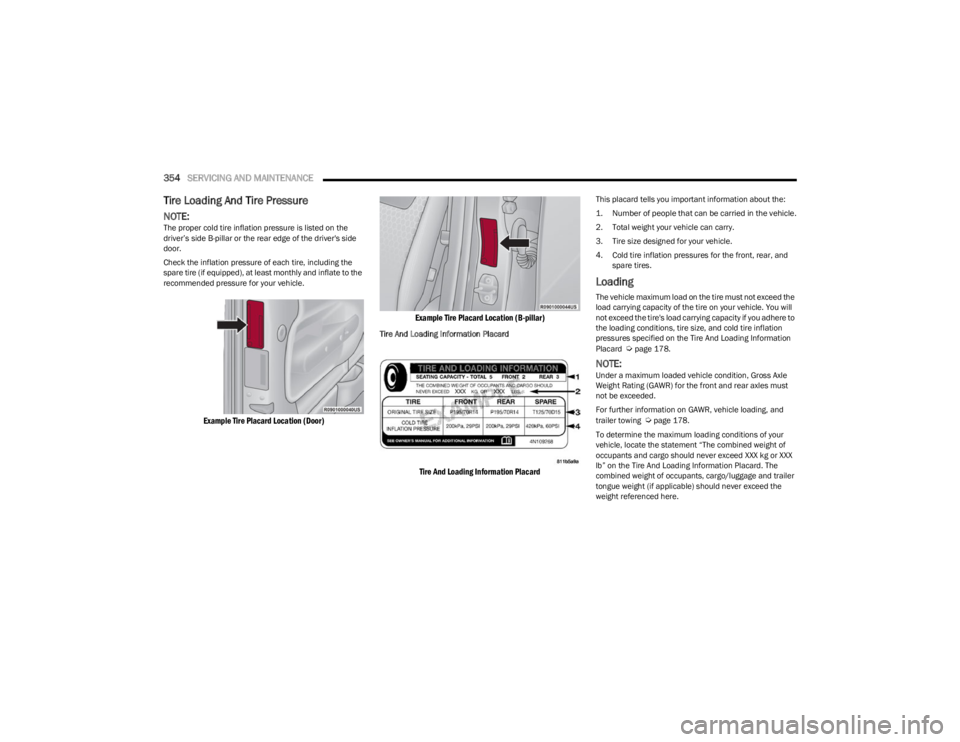
Tire Loading And Tire Pressure
NOTE:The proper cold tire inflation pressure is listed on the
driver’s side B-pillar or the rear edge of the driver's side
door.
Check the inflation pressure of each tire, including the
spare tire (if equipped), at least monthly and inflate to the
recommended pressure for your vehicle.
Example Tire Placard Location (Door) Example Tire Placard Location (B-pillar)
Tire And Loading Information Placard
Tire And Loading Information Placard
This placard tells you important information about the:
1. Number of people that can be carried in the vehicle.
2. Total weight your vehicle can carry.
3. Tire size designed for your vehicle.
4. Cold tire inflation pressures for the front, rear, and
spare tires.
Loading
The vehicle maximum load on the tire must not exceed the
load carrying capacity of the tire on your vehicle. You will
not exceed the tire's load carrying capacity if you adhere to
the loading conditions, tire size, and cold tire inflation
pressures specified on the Tire And Loading Information
Placard
Úpage 178.
NOTE:Under a maximum loaded vehicle condition, Gross Axle
Weight Rating (GAWR) for the front and rear axles must
not be exceeded.
For further information on GAWR, vehicle loading, and
trailer towing
Úpage 178.
To determine the maximum loading conditions of your
vehicle, locate the statement “The combined weight of
occupants and cargo should never exceed XXX kg or XXX
lb” on the Tire And Loading Information Placard. The
combined weight of occupants, cargo/luggage and trailer
tongue weight (if applicable) should never exceed the
weight referenced here.
23_WS_OM_EN_USC_t.book Page 354