change time JEEP WAGONEER 2023 Repair Manual
[x] Cancel search | Manufacturer: JEEP, Model Year: 2023, Model line: WAGONEER, Model: JEEP WAGONEER 2023Pages: 396, PDF Size: 15.17 MB
Page 294 of 396
292IN CASE OF EMERGENCY
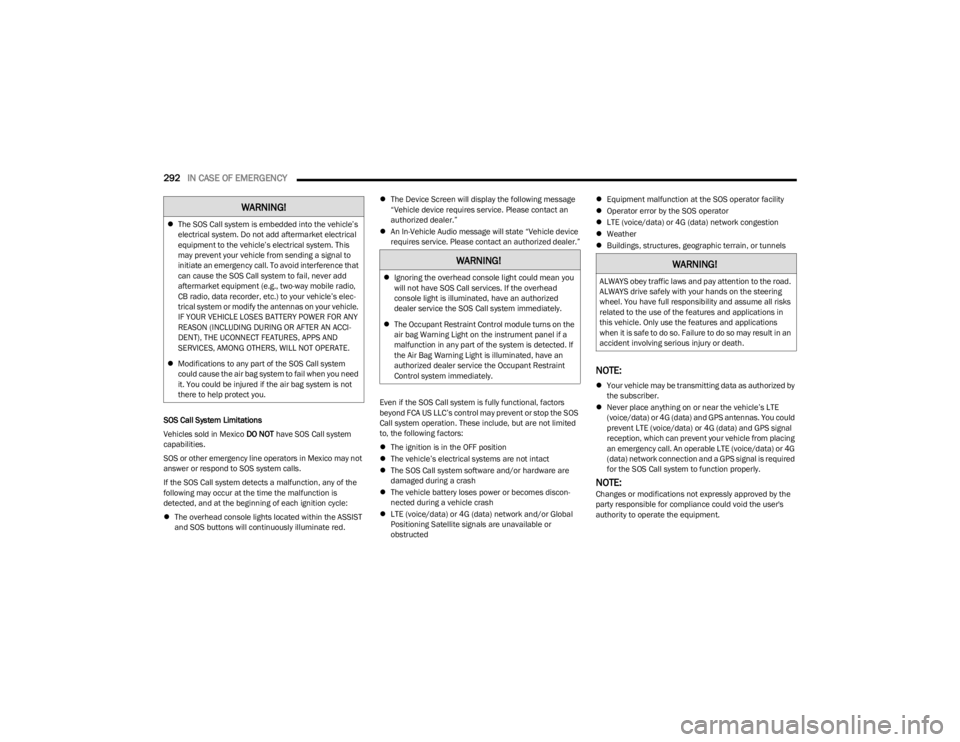
SOS Call System Limitations
Vehicles sold in Mexico DO NOT have SOS Call system
capabilities.
SOS or other emergency line operators in Mexico may not
answer or respond to SOS system calls.
If the SOS Call system detects a malfunction, any of the
following may occur at the time the malfunction is
detected, and at the beginning of each ignition cycle:
The overhead console lights located within the ASSIST
and SOS buttons will continuously illuminate red.
The Device Screen will display the following message
“Vehicle device requires service. Please contact an
authorized dealer.”
An In-Vehicle Audio message will state “Vehicle device
requires service. Please contact an authorized dealer.”
Even if the SOS Call system is fully functional, factors
beyond FCA US LLC’s control may prevent or stop the SOS
Call system operation. These include, but are not limited
to, the following factors:
The ignition is in the OFF position
The vehicle’s electrical systems are not intact
The SOS Call system software and/or hardware are
damaged during a crash
The vehicle battery loses power or becomes discon -
nected during a vehicle crash
LTE (voice/data) or 4G (data) network and/or Global
Positioning Satellite signals are unavailable or
obstructed
Equipment malfunction at the SOS operator facility
Operator error by the SOS operator
LTE (voice/data) or 4G (data) network congestion
Weather
Buildings, structures, geographic terrain, or tunnels
NOTE:
Your vehicle may be transmitting data as authorized by
the subscriber.
Never place anything on or near the vehicle’s LTE
(voice/data) or 4G (data) and GPS antennas. You could
prevent LTE (voice/data) or 4G (data) and GPS signal
reception, which can prevent your vehicle from placing
an emergency call. An operable LTE (voice/data) or 4G
(data) network connection and a GPS signal is required
for the SOS Call system to function properly.
NOTE:Changes or modifications not expressly approved by the
party responsible for compliance could void the user's
authority to operate the equipment.
The SOS Call system is embedded into the vehicle’s
electrical system. Do not add aftermarket electrical
equipment to the vehicle’s electrical system. This
may prevent your vehicle from sending a signal to
initiate an emergency call. To avoid interference that
can cause the SOS Call system to fail, never add
aftermarket equipment (e.g., two-way mobile radio,
CB radio, data recorder, etc.) to your vehicle’s elec -
trical system or modify the antennas on your vehicle.
IF YOUR VEHICLE LOSES BATTERY POWER FOR ANY
REASON (INCLUDING DURING OR AFTER AN ACCI -
DENT), THE UCONNECT FEATURES, APPS AND
SERVICES, AMONG OTHERS, WILL NOT OPERATE.
Modifications to any part of the SOS Call system
could cause the air bag system to fail when you need
it. You could be injured if the air bag system is not
there to help protect you.
WARNING!
WARNING!
Ignoring the overhead console light could mean you
will not have SOS Call services. If the overhead
console light is illuminated, have an authorized
dealer service the SOS Call system immediately.
The Occupant Restraint Control module turns on the
air bag Warning Light on the instrument panel if a
malfunction in any part of the system is detected. If
the Air Bag Warning Light is illuminated, have an
authorized dealer service the Occupant Restraint
Control system immediately.
WARNING!
ALWAYS obey traffic laws and pay attention to the road.
ALWAYS drive safely with your hands on the steering
wheel. You have full responsibility and assume all risks
related to the use of the features and applications in
this vehicle. Only use the features and applications
when it is safe to do so. Failure to do so may result in an
accident involving serious injury or death.
23_WS_OM_EN_USC_t.book Page 292
Page 311 of 396
309
SERVICING AND MAINTENANCE
SCHEDULED SERVICING
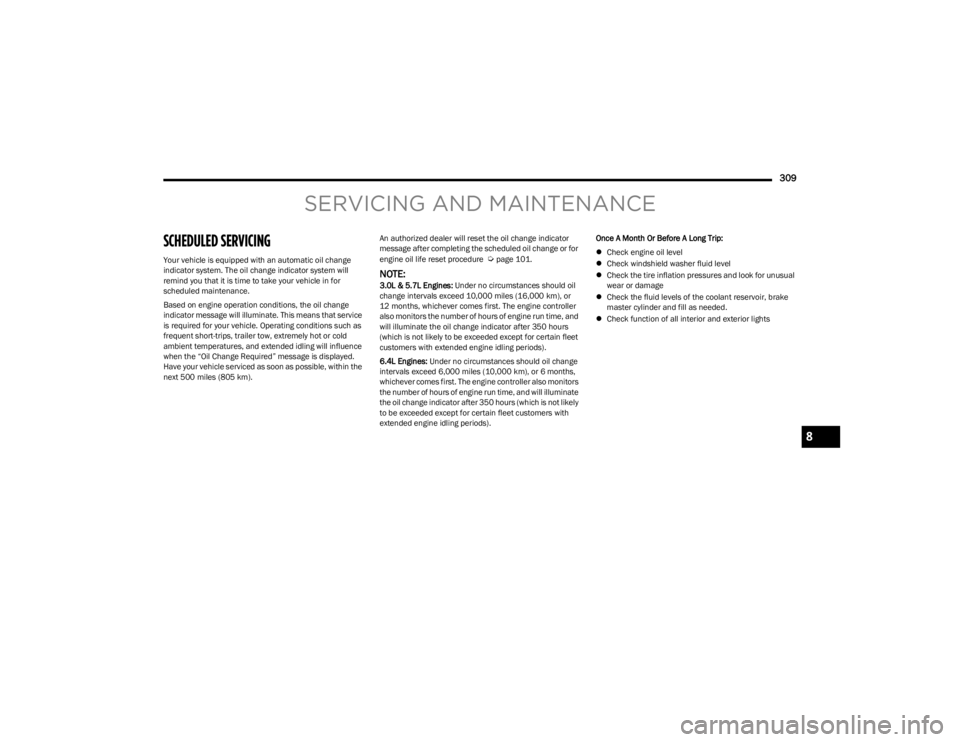
Your vehicle is equipped with an automatic oil change
indicator system. The oil change indicator system will
remind you that it is time to take your vehicle in for
scheduled maintenance.
Based on engine operation conditions, the oil change
indicator message will illuminate. This means that service
is required for your vehicle. Operating conditions such as
frequent short-trips, trailer tow, extremely hot or cold
ambient temperatures, and extended idling will influence
when the “Oil Change Required” message is displayed.
Have your vehicle serviced as soon as possible, within the
next 500 miles (805 km).An authorized dealer will reset the oil change indicator
message after completing the scheduled oil change or for
engine oil life reset procedure Úpage 101.
NOTE:3.0L & 5.7L Engines:
Under no circumstances should oil
change intervals exceed 10,000 miles (16,000 km), or
12 months, whichever comes first. The engine controller
also monitors the number of hours of engine run time, and
will illuminate the oil change indicator after 350 hours
(which is not likely to be exceeded except for certain fleet
customers with extended engine idling periods).
6.4L Engines: Under no circumstances should oil change
intervals exceed 6,000 miles (10,000 km), or 6 months,
whichever comes first. The engine controller also monitors
the number of hours of engine run time, and will illuminate
the oil change indicator after 350 hours (which is not likely
to be exceeded except for certain fleet customers with
extended engine idling periods). Once A Month Or Before A Long Trip:
Check engine oil level
Check windshield washer fluid level
Check the tire inflation pressures and look for unusual
wear or damage
Check the fluid levels of the coolant reservoir, brake
master cylinder and fill as needed.
Check function of all interior and exterior lights
8
23_WS_OM_EN_USC_t.book Page 309
Page 312 of 396

310SERVICING AND MAINTENANCE
MAINTENANCE PLAN
Refer to the Maintenance Plans for the required maintenance intervals.
At Every Oil Change Interval As Indicated By Oil Change Indicator System
Change oil and filter.
Rotate the tires at the first sign of irregular wear, even if it occurs before the oil indicator system turns on.
Inspect battery and clean and tighten terminals as required.
Inspect the CV/Universal joints.
Inspect brake pads, shoes, rotors, drums, hoses and parking brake.
Inspect engine cooling system protection and hoses.
Inspect exhaust system.
Inspect engine air cleaner filter if using in dusty or off-road conditions. Replace engine air cleaner filter, as necessary.
Mileage Or Time Passed (Whichever
Comes First)
20,000
30,000
40,000
50,000
60,000
70,000
80,000
90,000
100,000
110,000
120,000
130,000
140,000
150,000
Or Years: 2 3 4 5 6 7 8 9 10 11 12 13 14 15
Or Kilometers:
32,000
48,000
64,000
80,000
96,000
112,000
128,000
144,000
160,000
176,000
192,000
208,000
224,000
240,000
Additional Inspections
Inspect the CV/Universal joints. X X X X X X X X X X X X X X
Inspect front suspension, tie rod ends, and
replace if necessary. X
X X XX XX
23_WS_OM_EN_USC_t.book Page 310
Page 313 of 396

SERVICING AND MAINTENANCE311
Inspect the front and rear axle fluid, change if
using your vehicle for police, taxi, fleet, off-road
or frequent trailer towing. X
X X XX XX
Inspect the brake linings, parking brake
function. X
X X XX XX
Inspect transfer case fluid. XX XXX
Additional Maintenance
Replace engine air cleaner filter. XX XXX
Replace the cabin air filter. To be replaced every 12,000 miles (19,000 km).
Replace spark plugs (3.0L Engine).
1X X Replace spark plugs (5.7L Engine).
1
X Replace spark plugs (6.4L Engine).
1
X
Flush and replace the engine coolant at
10 years or 150,000 miles (240,000 km)
whichever comes first. X
X
Mileage Or Time Passed (Whichever
Comes First)
20,000
30,000
40,000
50,000
60,000
70,000
80,000
90,000
100,000
110,000
120,000
130,000
140,000
150,000
Or Years: 2 3 4 5 6 7 8 9 10 11 12 13 14 15
Or Kilometers:
32,000
48,000
64,000
80,000
96,000
112,000
128,000
144,000
160,000
176,000
192,000
208,000
224,000
240,000
8
23_WS_OM_EN_USC_t.book Page 311
Page 314 of 396
312SERVICING AND MAINTENANCE
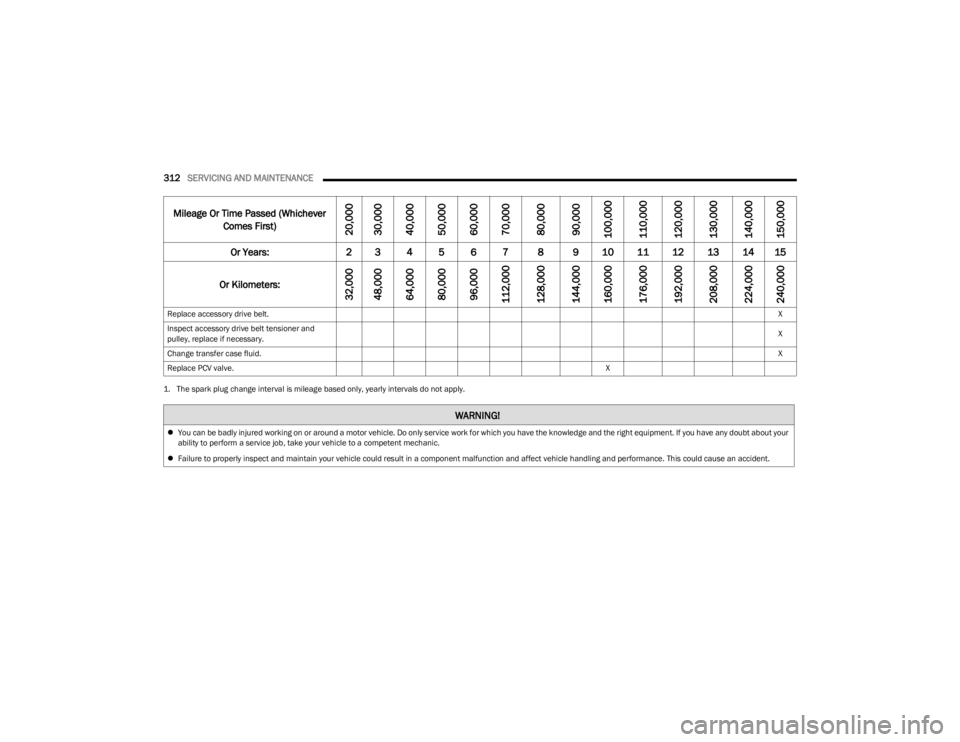
Replace accessory drive belt. X
Inspect accessory drive belt tensioner and
pulley, replace if necessary. X
Change transfer case fluid. X
Replace PCV valve. X 1.
The spark plug change interval is mileage based only, yearly intervals do not apply.
Mileage Or Time Passed (Whichever
Comes First)
20,000
30,000
40,000
50,000
60,000
70,000
80,000
90,000
100,000
110,000
120,000
130,000
140,000
150,000
Or Years: 2 3 4 5 6 7 8 9 10 11 12 13 14 15
Or Kilometers:
32,000
48,000
64,000
80,000
96,000
112,000
128,000
144,000
160,000
176,000
192,000
208,000
224,000
240,000
WARNING!
You can be badly injured working on or around a motor vehicle. Do only service work for which you have the knowledge and the right equipment. If you have any doubt about your
ability to perform a service job, take your vehicle to a competent mechanic.
Failure to properly inspect and maintain your vehicle could result in a component malfunction and affect vehicle handling and performance. This could cause an accident.
23_WS_OM_EN_USC_t.book Page 312
Page 319 of 396
SERVICING AND MAINTENANCE317
NOTE:
After adding oil to the engine, always reinstall the oil
cap securely by rotating clockwise until it stops. Never
run the engine without the oil fill cap as this could
cause an oil leak.
Because the oil level is automatically detected only
when the engine has been off and restarted (after four
minutes), the system cannot immediately detect a
sudden drop in oil level while driving (for example, if the
oil pan starts to leak due to damage during an off-road
event).
CHECKING OIL LEVEL — 5.7L & 6.4L
E
NGINES
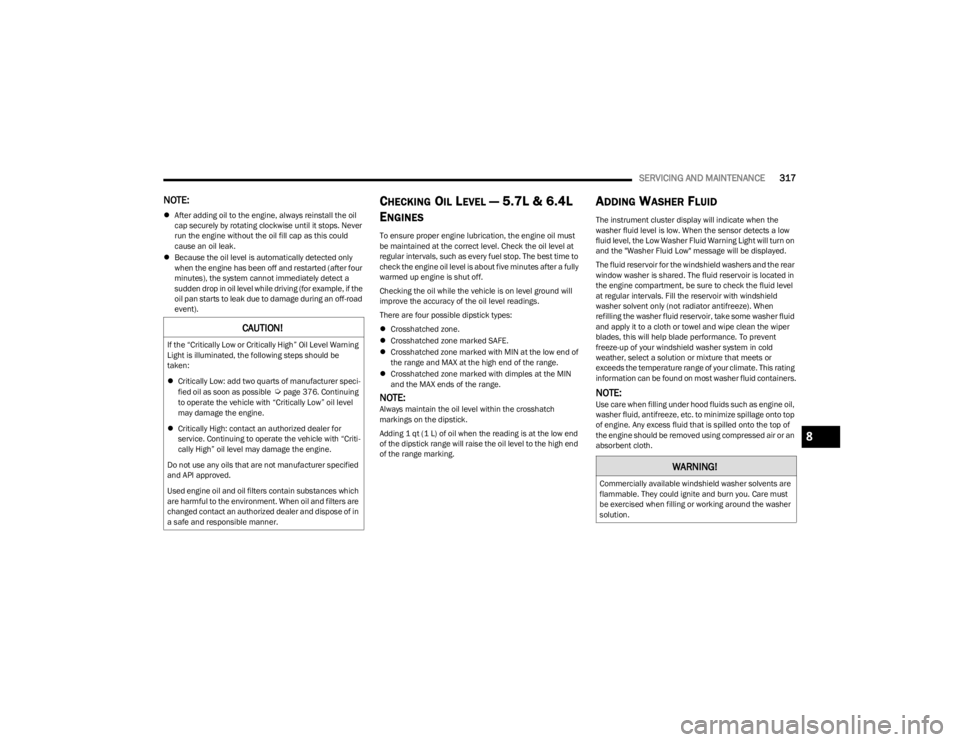
To ensure proper engine lubrication, the engine oil must
be maintained at the correct level. Check the oil level at
regular intervals, such as every fuel stop. The best time to
check the engine oil level is about five minutes after a fully
warmed up engine is shut off.
Checking the oil while the vehicle is on level ground will
improve the accuracy of the oil level readings.
There are four possible dipstick types:
Crosshatched zone.
Crosshatched zone marked SAFE.
Crosshatched zone marked with MIN at the low end of
the range and MAX at the high end of the range.
Crosshatched zone marked with dimples at the MIN
and the MAX ends of the range.
NOTE:Always maintain the oil level within the crosshatch
markings on the dipstick.
Adding 1 qt (1 L) of oil when the reading is at the low end
of the dipstick range will raise the oil level to the high end
of the range marking.
ADDING WASHER FLUID
The instrument cluster display will indicate when the
washer fluid level is low. When the sensor detects a low
fluid level, the Low Washer Fluid Warning Light will turn on
and the "Washer Fluid Low" message will be displayed.
The fluid reservoir for the windshield washers and the rear
window washer is shared. The fluid reservoir is located in
the engine compartment, be sure to check the fluid level
at regular intervals. Fill the reservoir with windshield
washer solvent only (not radiator antifreeze). When
refilling the washer fluid reservoir, take some washer fluid
and apply it to a cloth or towel and wipe clean the wiper
blades, this will help blade performance. To prevent
freeze-up of your windshield washer system in cold
weather, select a solution or mixture that meets or
exceeds the temperature range of your climate. This rating
information can be found on most washer fluid containers.
NOTE:Use care when filling under hood fluids such as engine oil,
washer fluid, antifreeze, etc. to minimize spillage onto top
of engine. Any excess fluid that is spilled onto the top of
the engine should be removed using compressed air or an
absorbent cloth.
CAUTION!
If the “Critically Low or Critically High” Oil Level Warning
Light is illuminated, the following steps should be
taken:
Critically Low: add two quarts of manufacturer speci -
fied oil as soon as possible
Úpage 376. Continuing
to operate the vehicle with “Critically Low” oil level
may damage the engine.
Critically High: contact an authorized dealer for
service. Continuing to operate the vehicle with “Criti -
cally High” oil level may damage the engine.
Do not use any oils that are not manufacturer specified
and API approved.
Used engine oil and oil filters contain substances which
are harmful to the environment. When oil and filters are
changed contact an authorized dealer and dispose of in
a safe and responsible manner.
WARNING!
Commercially available windshield washer solvents are
flammable. They could ignite and burn you. Care must
be exercised when filling or working around the washer
solution.
8
23_WS_OM_EN_USC_t.book Page 317
Page 321 of 396
SERVICING AND MAINTENANCE319
ENGINE OIL
Engine Oil Selection
Use only the manufacturer's recommended fluids Úpage 376.
NOTE:Hemi engines at times can tick right after startup and then
quiet down after approximately 30 seconds. This is normal
and will not harm the engine. This characteristic can be
caused by short drive cycles. For example, if the vehicle is
started then shut off after driving a short distance. Upon
restarting, you may experience a ticking sound. Other
causes could be if the vehicle is unused for an extended
period of time, incorrect oil, extended oil changes or
extended idling. If the engine continues to tick or if the
Malfunction Indicator Light (MIL) comes on, see the
nearest authorized dealer.
American Petroleum Institute (API)
Approved Engine Oil
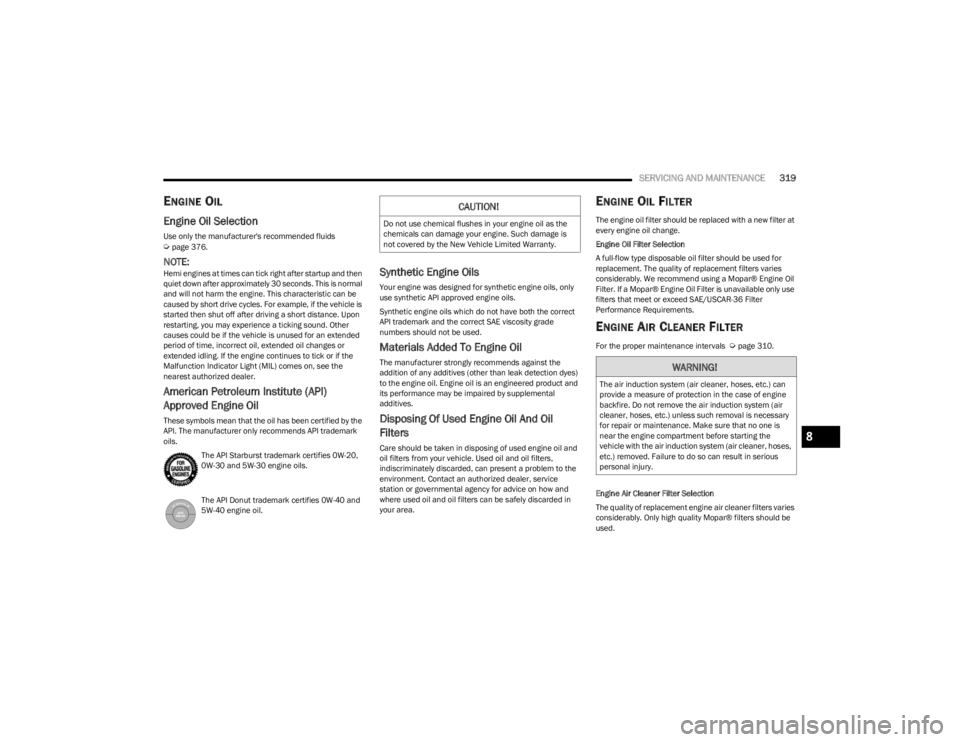
These symbols mean that the oil has been certified by the
API. The manufacturer only recommends API trademark
oils.
The API Starburst trademark certifies 0W-20,
0W-30 and 5W-30 engine oils.
The API Donut trademark certifies 0W-40 and
5W-40 engine oil.
Synthetic Engine Oils
Your engine was designed for synthetic engine oils, only
use synthetic API approved engine oils.
Synthetic engine oils which do not have both the correct
API trademark and the correct SAE viscosity grade
numbers should not be used.
Materials Added To Engine Oil
The manufacturer strongly recommends against the
addition of any additives (other than leak detection dyes)
to the engine oil. Engine oil is an engineered product and
its performance may be impaired by supplemental
additives.
Disposing Of Used Engine Oil And Oil
Filters
Care should be taken in disposing of used engine oil and
oil filters from your vehicle. Used oil and oil filters,
indiscriminately discarded, can present a problem to the
environment. Contact an authorized dealer, service
station or governmental agency for advice on how and
where used oil and oil filters can be safely discarded in
your area.
ENGINE OIL FILTER
The engine oil filter should be replaced with a new filter at
every engine oil change.
Engine Oil Filter Selection
A full-flow type disposable oil filter should be used for
replacement. The quality of replacement filters varies
considerably. We recommend using a Mopar® Engine Oil
Filter. If a Mopar® Engine Oil Filter is unavailable only use
filters that meet or exceed SAE/USCAR-36 Filter
Performance Requirements.
ENGINE AIR CLEANER FILTER
For the proper maintenance intervals Úpage 310.
Engine Air Cleaner Filter Selection
The quality of replacement engine air cleaner filters varies
considerably. Only high quality Mopar® filters should be
used.
CAUTION!
Do not use chemical flushes in your engine oil as the
chemicals can damage your engine. Such damage is
not covered by the New Vehicle Limited Warranty.
WARNING!
The air induction system (air cleaner, hoses, etc.) can
provide a measure of protection in the case of engine
backfire. Do not remove the air induction system (air
cleaner, hoses, etc.) unless such removal is necessary
for repair or maintenance. Make sure that no one is
near the engine compartment before starting the
vehicle with the air induction system (air cleaner, hoses,
etc.) removed. Failure to do so can result in serious
personal injury.
8
23_WS_OM_EN_USC_t.book Page 319
Page 327 of 396
SERVICING AND MAINTENANCE325
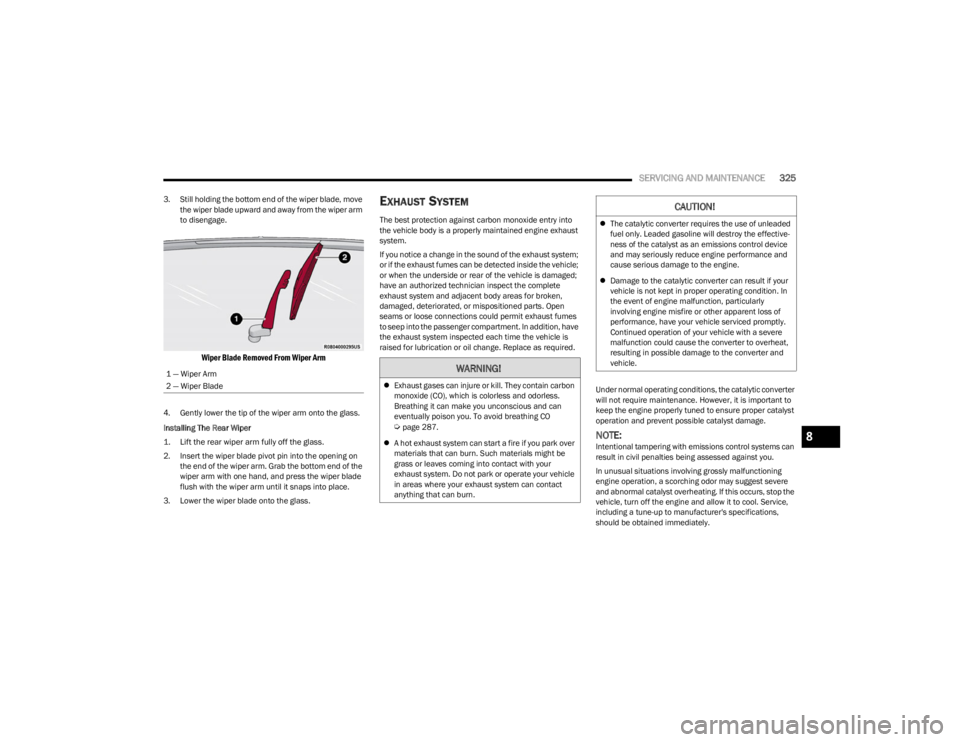
3. Still holding the bottom end of the wiper blade, move
the wiper blade upward and away from the wiper arm
to disengage.
Wiper Blade Removed From Wiper Arm
4. Gently lower the tip of the wiper arm onto the glass.
Installing The Rear Wiper
1. Lift the rear wiper arm fully off the glass.
2. Insert the wiper blade pivot pin into the opening on the end of the wiper arm. Grab the bottom end of the
wiper arm with one hand, and press the wiper blade
flush with the wiper arm until it snaps into place.
3. Lower the wiper blade onto the glass.
EXHAUST SYSTEM
The best protection against carbon monoxide entry into
the vehicle body is a properly maintained engine exhaust
system.
If you notice a change in the sound of the exhaust system;
or if the exhaust fumes can be detected inside the vehicle;
or when the underside or rear of the vehicle is damaged;
have an authorized technician inspect the complete
exhaust system and adjacent body areas for broken,
damaged, deteriorated, or mispositioned parts. Open
seams or loose connections could permit exhaust fumes
to seep into the passenger compartment. In addition, have
the exhaust system inspected each time the vehicle is
raised for lubrication or oil change. Replace as required.
Under normal operating conditions, the catalytic converter
will not require maintenance. However, it is important to
keep the engine properly tuned to ensure proper catalyst
operation and prevent possible catalyst damage.
NOTE:Intentional tampering with emissions control systems can
result in civil penalties being assessed against you.
In unusual situations involving grossly malfunctioning
engine operation, a scorching odor may suggest severe
and abnormal catalyst overheating. If this occurs, stop the
vehicle, turn off the engine and allow it to cool. Service,
including a tune-up to manufacturer's specifications,
should be obtained immediately.
1 — Wiper Arm
2 — Wiper Blade
WARNING!
Exhaust gases can injure or kill. They contain carbon
monoxide (CO), which is colorless and odorless.
Breathing it can make you unconscious and can
eventually poison you. To avoid breathing CO
Úpage 287.
A hot exhaust system can start a fire if you park over
materials that can burn. Such materials might be
grass or leaves coming into contact with your
exhaust system. Do not park or operate your vehicle
in areas where your exhaust system can contact
anything that can burn.
CAUTION!
The catalytic converter requires the use of unleaded
fuel only. Leaded gasoline will destroy the effective -
ness of the catalyst as an emissions control device
and may seriously reduce engine performance and
cause serious damage to the engine.
Damage to the catalytic converter can result if your
vehicle is not kept in proper operating condition. In
the event of engine malfunction, particularly
involving engine misfire or other apparent loss of
performance, have your vehicle serviced promptly.
Continued operation of your vehicle with a severe
malfunction could cause the converter to overheat,
resulting in possible damage to the converter and
vehicle.
8
23_WS_OM_EN_USC_t.book Page 325
Page 331 of 396

SERVICING AND MAINTENANCE329
AUTOMATIC TRANSMISSION
Special Additives
The manufacturer strongly recommends against using any
special additives in the transmission. Automatic
Transmission Fluid (ATF) is an engineered product and its
performance may be impaired by supplemental additives.
Therefore, do not add any fluid additives to the
transmission. Avoid using transmission sealers as they
may adversely affect seals.
Fluid Level Check
The fluid level is preset at the factory and does not require
adjustment under normal operating conditions. Routine
fluid level checks are not required; therefore the
transmission has no dipstick. An authorized dealer can
check your transmission fluid level using special service
tools. If you notice fluid leakage or transmission
malfunction, visit an authorized dealer immediately to
have the transmission fluid level checked. Operating the
vehicle with an improper fluid level can cause severe
transmission damage.
Fluid And Filter Changes
Under normal operating conditions, the fluid installed at
the factory will provide satisfactory lubrication for the life
of the vehicle.
Routine fluid and filter changes are not required. However,
change the fluid and filter if the fluid becomes
contaminated (with water, etc.), or if the transmission is
disassembled for any reason.
Selection Of Lubricant
It is important to use the proper transmission fluid to
ensure optimum transmission performance and life. Use
only the manufacturer's specified transmission fluid
Úpage 377. It is important to maintain the transmission
fluid at the correct level using the recommended fluid.
NOTE:No chemical flushes should be used in any transmission;
only the approved lubricant should be used.
To avoid contamination from foreign matter or mois -
ture, use only new brake fluid or fluid that has been
in a tightly closed container. Keep the master
cylinder reservoir cap secured at all times. Brake
fluid in an open container absorbs moisture from the
air resulting in a lower boiling point. This may cause
it to boil unexpectedly during hard or prolonged
braking, resulting in sudden brake failure. This could
result in a collision.
Overfilling the brake fluid reservoir can result in
spilling brake fluid on hot engine parts, causing the
brake fluid to catch fire. Brake fluid can also damage
painted and vinyl surfaces, care should be taken to
avoid its contact with these surfaces.
Do not allow petroleum-based fluid to contaminate
the brake fluid. Brake seal components could be
damaged, causing partial or complete brake failure.
This could result in a collision.
WARNING!CAUTION!
Do not use chemical flushes in your transmission as the
chemicals can damage your transmission components.
Such damage is not covered by the New Vehicle Limited
Warranty.
CAUTION!
If a transmission fluid leak occurs, visit an authorized
dealer immediately. Severe transmission damage may
occur. An authorized dealer has the proper tools to
adjust the fluid level accurately.
CAUTION!
Using a transmission fluid other than the
manufacturer’s recommended fluid may cause
deterioration in transmission shift quality and/or torque
converter shudder.8
23_WS_OM_EN_USC_t.book Page 329
Page 388 of 396

386H
Hazard Warning Flashers ............................................ 290
Head Restraints .............................................................. 44
Head Up Display ........................................................... 105 Head Up Display (HUD
) — If Equipped
b
................106
Headlights
Automatic ...................................................................58
Cleaning................................................................... 368
High Beam/Low Beam Select Switch .......................58
Lights On Reminder ...................................................59
On With Wipers ..........................................................59
Passing ....................................................................... 58
Heads Up Display ......................................................... 105
Heated Mirrors ................................................................53 Heated Seats...................................................................43
Heated Steering Wheel...................................................31Heater, Engine Block ................................................... 122
Hill Descent Control ..................................................... 243
Hill Descent Control Indicator ..................................... 243
Hill Start Assist ............................................................. 244
Hitches Trailer Towing .......................................................... 182
HomeLink (Garage Door Opener) ..................................53
Hood Prop ........................................................................85 Hood Release ..................................................................85
IIgnition .............................................................................20 Key Fob Battery Low Or Dead ...................................20
Key Fob Not Detected ...............................................20
Keyless Ignition..........................................................20
Keyless Push Button .................................................20
Push Button Ignition ..................................................20
Switch .........................................................................20 Immobilizer (Sentry Key) ................................................ 20
Inside Rearview Mirror ..........................................50
, 290
Instrument Cluster ............................................ 96, 98, 99
Display........................................................................ 99
Menu Items .............................................................. 104
Instrument Panel Lens Cleaning ................................. 370
Integrated Trailer Brake Control ..................................186
Interior And Instrument Lights ....................................... 60 Interior Appearance Care ............................................. 369
Interior Lights .................................................................. 60
Interior Monitoring Camera ..........................................171
Intermittent Wipers (Delay Wipers) ............................... 62Inverter Power ......................................................................... 80
JJack Location ................................................................ 294
Jack Operation .............................................................. 296
Jacking And Tire Changing Instructions ...................... 293
Jacking Instructions ...................................................... 296
Jump Starting ................................................................ 300
KKey FobArm The System......................................................... 24
Disarm The System ................................................... 24
Programming Additional Key Fobs ........................... 20
Key Fob Battery Service (Remote Keyless Entry) ......... 18
Key Fob Programming (Remote Keyless Entry) ............ 20
Keyless Enter 'n Go™ ...................................................119 Passive Entry ............................................................. 27
Passive Entry Programming ...................................... 27 Keys ................................................................................. 16
Replacement ............................................................. 20
Sentry (Immobilizer) .................................................. 20
Know & Go ¹ ......................................................................9
LLane Change Assist ........................................................ 60 Lap/Shoulder Belts ...................................................... 258
Latches ......................................................................... 289 Hood........................................................................... 85
Lead Free Gasoline ...................................................... 372
Leaks, Fluid................................................................... 289
Life Of Tires ................................................................... 359
Liftgate ............................................................................ 86 Closing ....................................................................... 86
Hands-Free ................................................................ 87
Opening............................................................... 86
, 87
Liftgate Window Wiper/Washer .................................... 64
Light Bulbs .................................................................... 289
Lights ............................................................................. 289 Air Bag............................................................. 265
, 287
Ambient...................................................................... 62
Automatic Headlights ............................................... 58
Brake Assist Warning.............................................. 243
Brake Warning......................................................... 109
Bulb Replacement .................................................. 349
Cargo.......................................................................... 89
Cruise ....................................................................... 116
Daytime Running....................................................... 58
Dimmer Switch, Headlight ................................. 57
, 61
Electronic Stability Program(ESP) Indicator .......... 110
Exterior.............................................................. 57
, 289
23_WS_OM_EN_USC_t.book Page 386