engine JEEP WRANGLER 2017 JK / 3.G Workshop Manual
[x] Cancel search | Manufacturer: JEEP, Model Year: 2017, Model line: WRANGLER, Model: JEEP WRANGLER 2017 JK / 3.GPages: 527, PDF Size: 5.34 MB
Page 307 of 527
Trac-Lok Rear Axle — If Equipped
The Trac-Lok rear axle provides a constant driving force to
both rear wheels and reduces wheel spin caused by the loss
of traction at one driving wheel. If traction differs between
the two rear wheels, the differential automatically propor-
tions the usable torque by providing more torque to the
wheel that has traction.
Trac-Lok is especially helpful during slippery driving
conditions. With both rear wheels on a slippery surface, a
slight application of the accelerator will supply maximum
traction.
WARNING!
On vehicles equipped with a limited-slip differential,
never run the engine with one rear wheel off the
ground. The vehicle may drive through the rear wheel
remaining on the ground and cause you to lose control
of your vehicle.
Axle Lock (Tru–Lok) — Rubicon Models
The AXLE LOCK switch is located on the instrument panel
(to the left of the steering column).This feature will only activate when the following condi-
tions are met:
•
Key in ignition, vehicle in 4L (Low) range.
• Vehicle speed should be 10 mph (16 km/h) or less.
To activate the system, push the bottom of the AXLE LOCK
switch once to lock the rear axle only (the “Rear Axle Lock
Indicator Light” will illuminate), push the bottom of the
switch again to lock the front axle (the “Front Axle Lock
Indicator Light” will illuminate). When the rear axle is
locked, pushing the bottom of switch again will lock or
unlock the front axle.
Axle Lock Switch
6
STARTING AND OPERATING 305
Page 311 of 527
WARNING!
Fluid level should be checked on a level surface and
with the engine off to prevent injury from moving
parts and to ensure accurate fluid level reading. Do not
overfill. Use only manufacturer’s recommended power
steering fluid.
If necessary, add fluid to restore to the proper indicated
level. With a clean cloth, wipe any spilled fluid from all
surfaces. Refer to “Fluids And Lubricants” in “Technical
Specifications” for further information.
SPEED CONTROL — IF EQUIPPED
When engaged, the Speed Control takes over accelerator
operations at speeds greater than 25 mph (40 km/h).
The Speed Control buttons are located on the right side of
the steering wheel. NOTE:
In order to ensure proper operation, the Speed
Control System has been designed to shut down if multiple
Speed Control functions are operated at the same time. If
this occurs, the Speed Control System can be reactivated by
pushing the Speed Control ON/OFF button and resetting
the desired vehicle set speed.
Speed Control Buttons
1 — ON/OFF 3 — SET -
2 — RES + 4 — CANCEL
6
STARTING AND OPERATING 309
Page 314 of 527
To Deactivate
A soft tap on the brake pedal, pushing the CANCEL
button, or normal brake pressure while slowing the vehicle
will deactivate the Speed Control without erasing the set
speed from memory.
Pushing the ON/OFF button or turning the ignition switch
OFF erases the set speed from memory.
REFUELING THE VEHICLE
Fuel Filler Cap
The fuel filler cap is located on the driver’s side of the
vehicle. If the fuel filler cap is lost or damaged, be sure the
replacement cap is the correct one for this vehicle.
WARNING!
•Never have any smoking materials lit in or near the
vehicle when the gas cap is removed or the tank is
being filled.
•Never add fuel when the engine is running. This is in
violation of most state and federal fire regulations and
may cause the MIL to turn on.
•A fire may result if gasoline is pumped into a portable
container that is inside of a vehicle. You could be
burned. Always place gas containers on the ground
while filling.
Fuel Filler Cap
312 STARTING AND OPERATING
Page 321 of 527
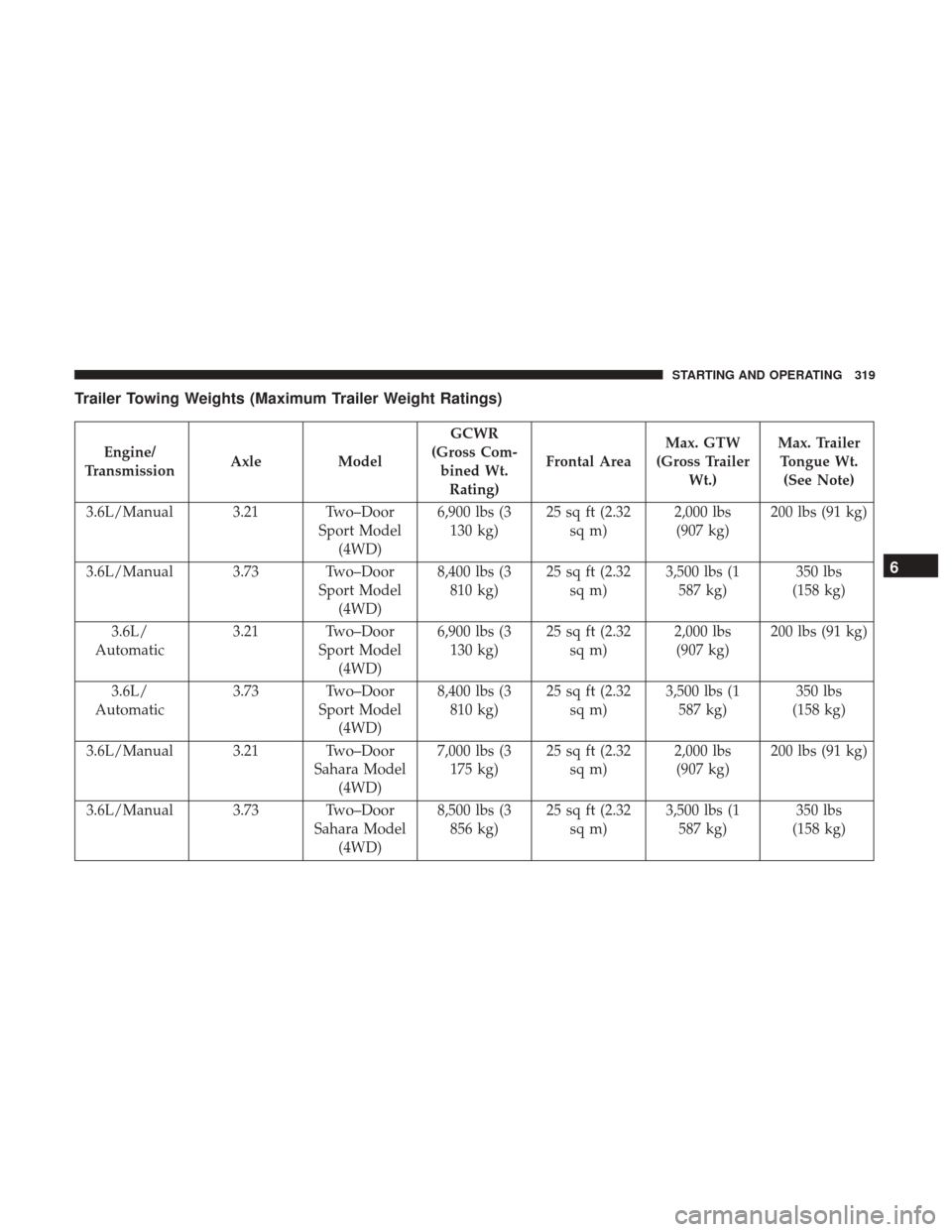
Trailer Towing Weights (Maximum Trailer Weight Ratings)
Engine/
Transmission Axle
Model GCWR
(Gross Com- bined Wt.Rating) Frontal Area
Max. GTW
(Gross Trailer Wt.) Max. Trailer
Tongue Wt. (See Note)
3.6L/Manual 3.21 Two–Door Sport Model(4WD) 6,900 lbs (3
130 kg) 25 sq ft (2.32
sq m) 2,000 lbs
(907 kg) 200 lbs (91 kg)
3.6L/Manual 3.73 Two–Door Sport Model(4WD) 8,400 lbs (3
810 kg) 25 sq ft (2.32
sq m) 3,500 lbs (1
587 kg) 350 lbs
(158 kg)
3.6L/
Automatic 3.21 Two–Door
Sport Model(4WD) 6,900 lbs (3
130 kg) 25 sq ft (2.32
sq m) 2,000 lbs
(907 kg) 200 lbs (91 kg)
3.6L/
Automatic 3.73 Two–Door
Sport Model(4WD) 8,400 lbs (3
810 kg) 25 sq ft (2.32
sq m) 3,500 lbs (1
587 kg) 350 lbs
(158 kg)
3.6L/Manual 3.21 Two–Door Sahara Model(4WD) 7,000 lbs (3
175 kg) 25 sq ft (2.32
sq m) 2,000 lbs
(907 kg) 200 lbs (91 kg)
3.6L/Manual 3.73 Two–Door Sahara Model(4WD) 8,500 lbs (3
856 kg) 25 sq ft (2.32
sq m) 3,500 lbs (1
587 kg) 350 lbs
(158 kg)
6
STARTING AND OPERATING 319
Page 322 of 527
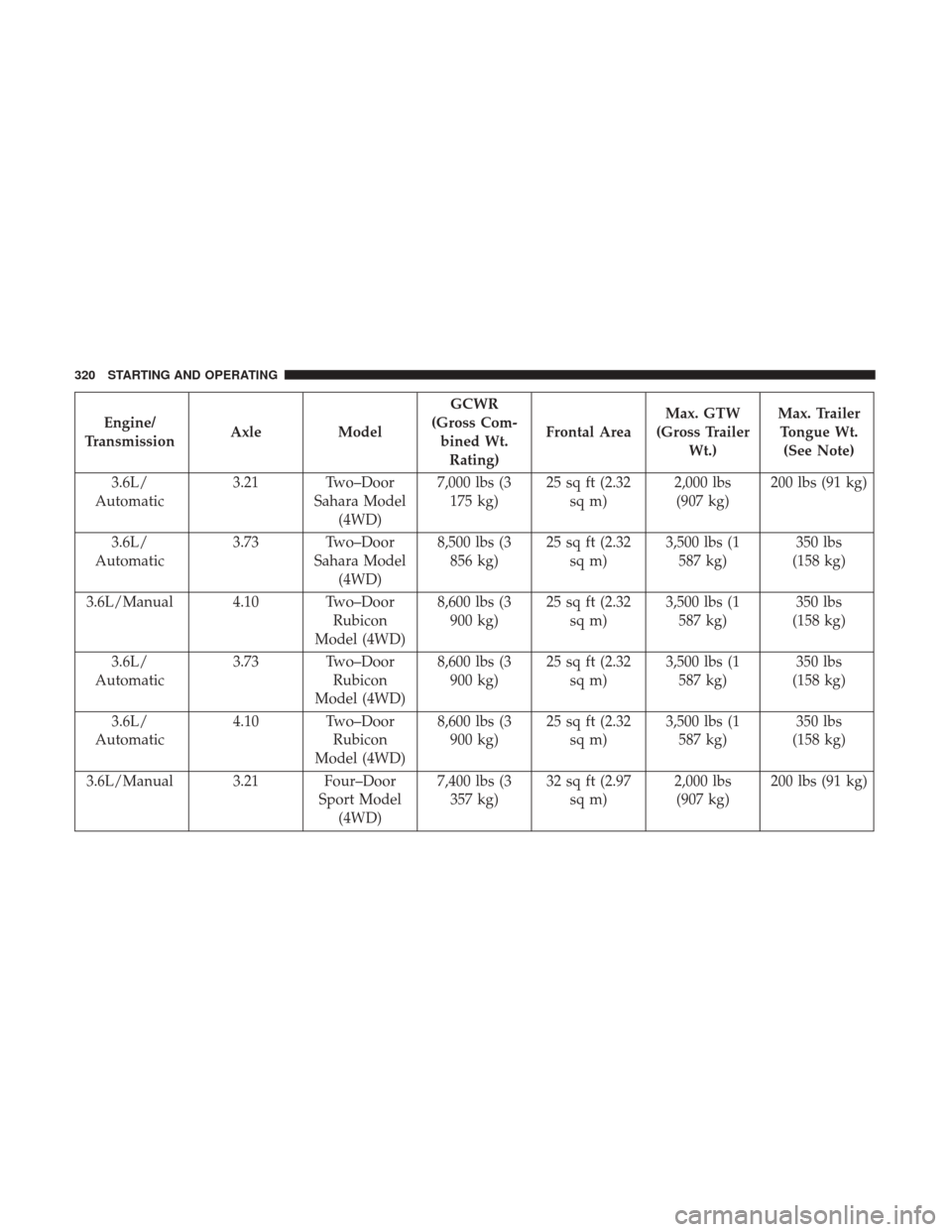
Engine/
Transmission Axle
Model GCWR
(Gross Com- bined Wt.Rating) Frontal Area
Max. GTW
(Gross Trailer Wt.) Max. Trailer
Tongue Wt. (See Note)
3.6L/
Automatic 3.21 Two–Door
Sahara Model(4WD) 7,000 lbs (3
175 kg) 25 sq ft (2.32
sq m) 2,000 lbs
(907 kg) 200 lbs (91 kg)
3.6L/
Automatic 3.73 Two–Door
Sahara Model(4WD) 8,500 lbs (3
856 kg) 25 sq ft (2.32
sq m) 3,500 lbs (1
587 kg) 350 lbs
(158 kg)
3.6L/Manual 4.10 Two–Door Rubicon
Model (4WD) 8,600 lbs (3
900 kg) 25 sq ft (2.32
sq m) 3,500 lbs (1
587 kg) 350 lbs
(158 kg)
3.6L/
Automatic 3.73 Two–Door
Rubicon
Model (4WD) 8,600 lbs (3
900 kg) 25 sq ft (2.32
sq m) 3,500 lbs (1
587 kg) 350 lbs
(158 kg)
3.6L/
Automatic 4.10 Two–Door
Rubicon
Model (4WD) 8,600 lbs (3
900 kg) 25 sq ft (2.32
sq m) 3,500 lbs (1
587 kg) 350 lbs
(158 kg)
3.6L/Manual 3.21 Four–Door Sport Model(4WD) 7,400 lbs (3
357 kg) 32 sq ft (2.97
sq m) 2,000 lbs
(907 kg) 200 lbs (91 kg)
320 STARTING AND OPERATING
Page 323 of 527
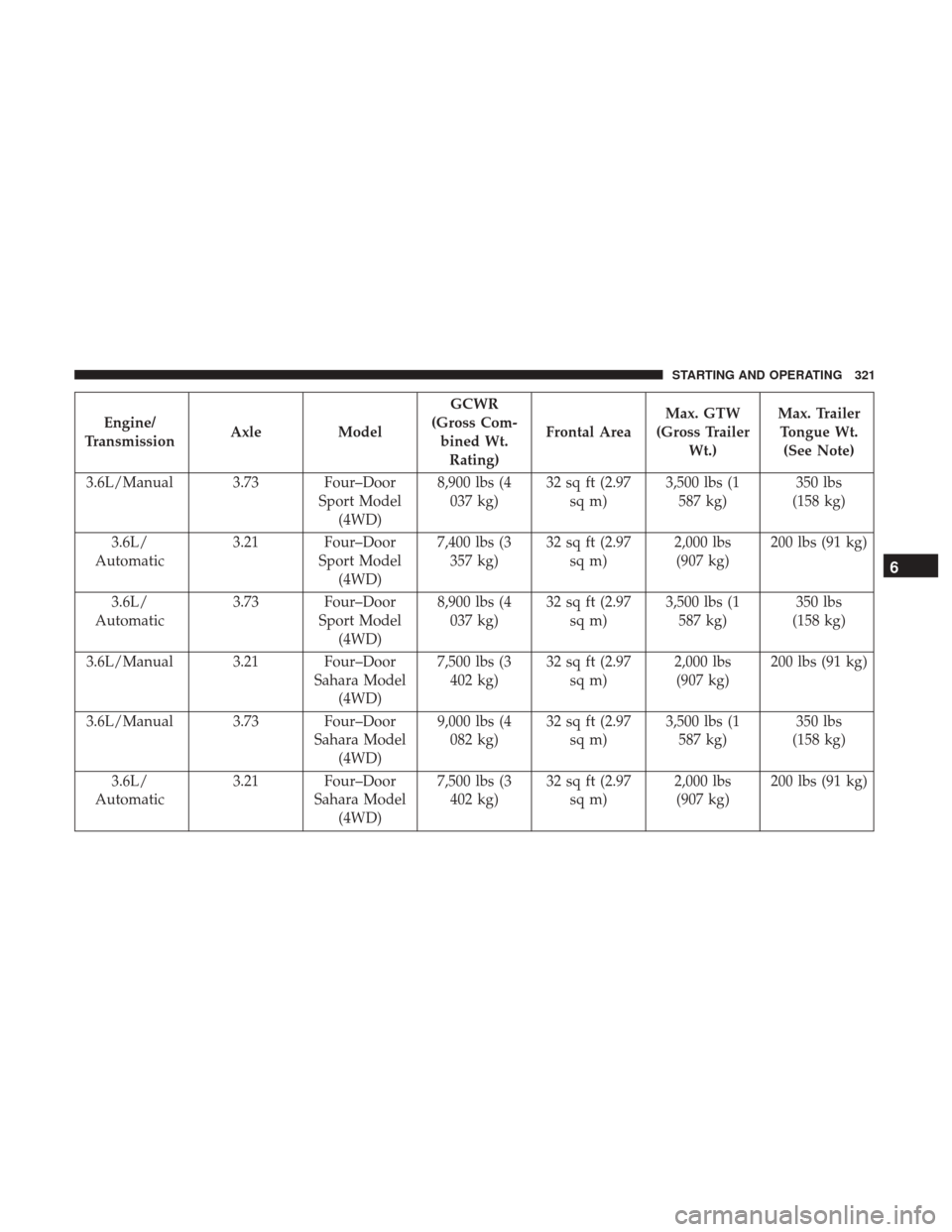
Engine/
Transmission Axle
Model GCWR
(Gross Com- bined Wt.Rating) Frontal Area
Max. GTW
(Gross Trailer Wt.) Max. Trailer
Tongue Wt. (See Note)
3.6L/Manual 3.73 Four–Door Sport Model(4WD) 8,900 lbs (4
037 kg) 32 sq ft (2.97
sq m) 3,500 lbs (1
587 kg) 350 lbs
(158 kg)
3.6L/
Automatic 3.21 Four–Door
Sport Model(4WD) 7,400 lbs (3
357 kg) 32 sq ft (2.97
sq m) 2,000 lbs
(907 kg) 200 lbs (91 kg)
3.6L/
Automatic 3.73 Four–Door
Sport Model(4WD) 8,900 lbs (4
037 kg) 32 sq ft (2.97
sq m) 3,500 lbs (1
587 kg) 350 lbs
(158 kg)
3.6L/Manual 3.21 Four–Door Sahara Model(4WD) 7,500 lbs (3
402 kg) 32 sq ft (2.97
sq m) 2,000 lbs
(907 kg) 200 lbs (91 kg)
3.6L/Manual 3.73 Four–Door Sahara Model(4WD) 9,000 lbs (4
082 kg) 32 sq ft (2.97
sq m) 3,500 lbs (1
587 kg) 350 lbs
(158 kg)
3.6L/
Automatic 3.21 Four–Door
Sahara Model(4WD) 7,500 lbs (3
402 kg) 32 sq ft (2.97
sq m) 2,000 lbs
(907 kg) 200 lbs (91 kg)
6
STARTING AND OPERATING 321
Page 324 of 527
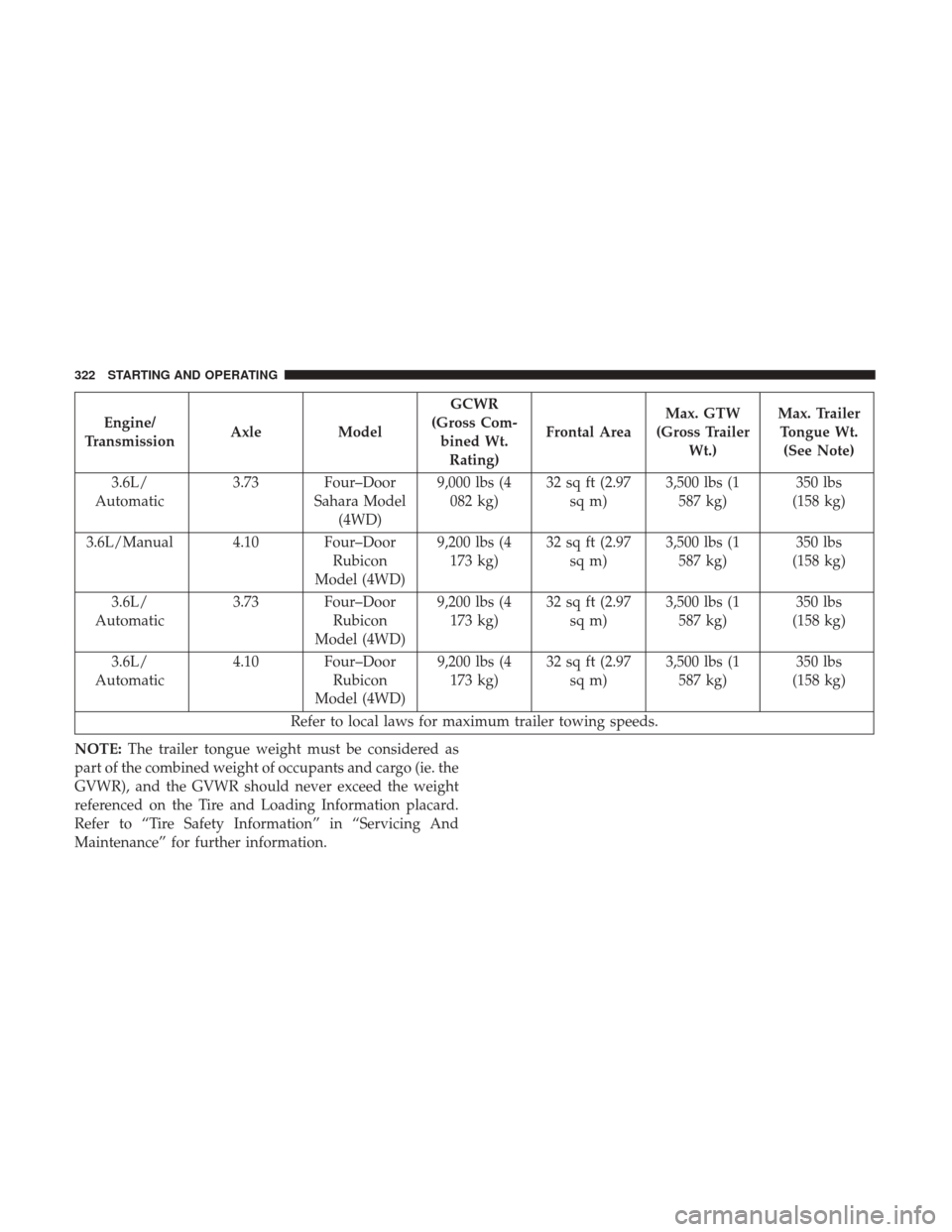
Engine/
Transmission Axle
Model GCWR
(Gross Com- bined Wt.Rating) Frontal Area
Max. GTW
(Gross Trailer Wt.) Max. Trailer
Tongue Wt. (See Note)
3.6L/
Automatic 3.73 Four–Door
Sahara Model(4WD) 9,000 lbs (4
082 kg) 32 sq ft (2.97
sq m) 3,500 lbs (1
587 kg) 350 lbs
(158 kg)
3.6L/Manual 4.10 Four–Door Rubicon
Model (4WD) 9,200 lbs (4
173 kg) 32 sq ft (2.97
sq m) 3,500 lbs (1
587 kg) 350 lbs
(158 kg)
3.6L/
Automatic 3.73 Four–Door
Rubicon
Model (4WD) 9,200 lbs (4
173 kg) 32 sq ft (2.97
sq m) 3,500 lbs (1
587 kg) 350 lbs
(158 kg)
3.6L/
Automatic 4.10 Four–Door
Rubicon
Model (4WD) 9,200 lbs (4
173 kg) 32 sq ft (2.97
sq m) 3,500 lbs (1
587 kg) 350 lbs
(158 kg)
Refer to local laws for maximum trailer towing speeds.
NOTE: The trailer tongue weight must be considered as
part of the combined weight of occupants and cargo (ie. the
GVWR), and the GVWR should never exceed the weight
referenced on the Tire and Loading Information placard.
Refer to “Tire Safety Information” in “Servicing And
Maintenance” for further information.
322 STARTING AND OPERATING
Page 327 of 527
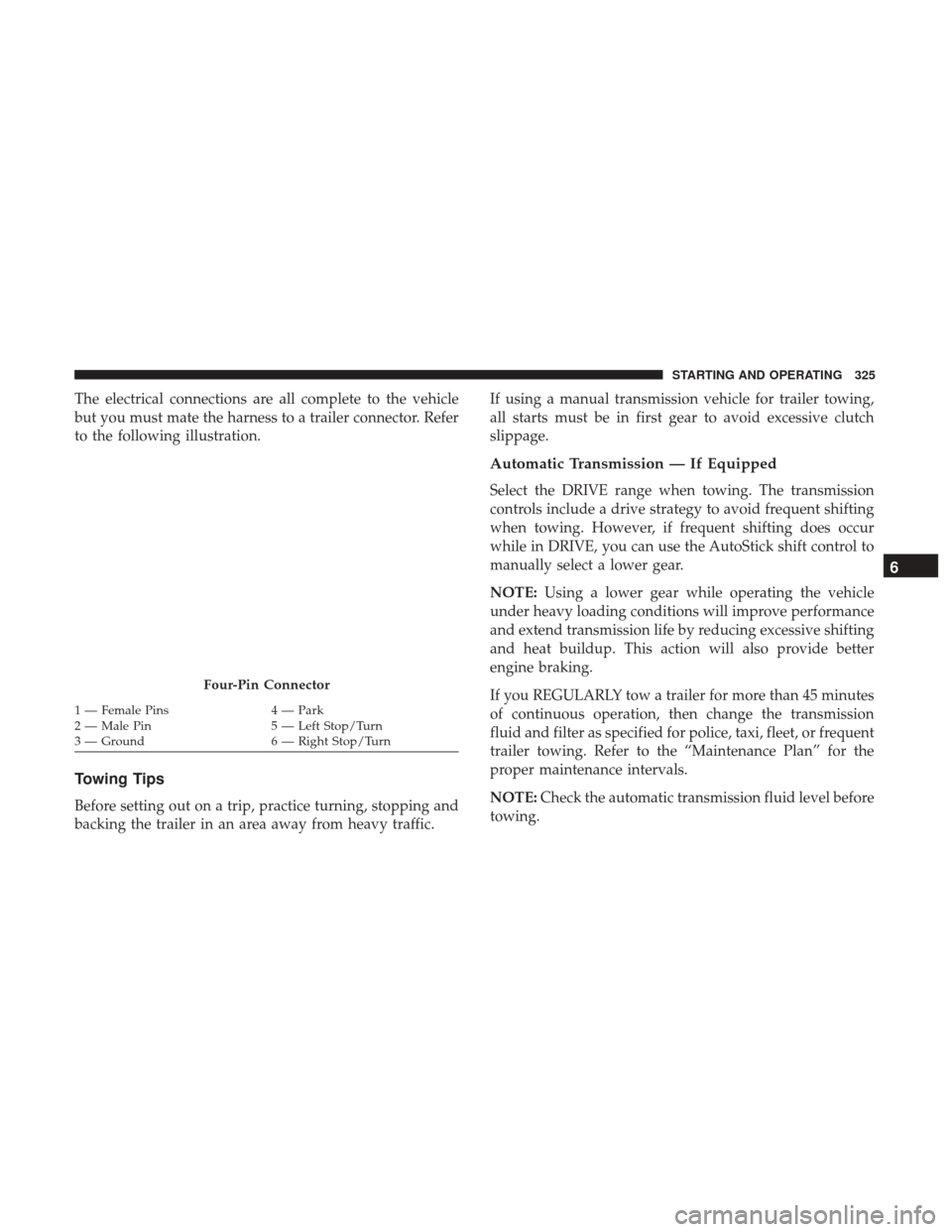
The electrical connections are all complete to the vehicle
but you must mate the harness to a trailer connector. Refer
to the following illustration.
Towing Tips
Before setting out on a trip, practice turning, stopping and
backing the trailer in an area away from heavy traffic.If using a manual transmission vehicle for trailer towing,
all starts must be in first gear to avoid excessive clutch
slippage.
Automatic Transmission — If Equipped
Select the DRIVE range when towing. The transmission
controls include a drive strategy to avoid frequent shifting
when towing. However, if frequent shifting does occur
while in DRIVE, you can use the AutoStick shift control to
manually select a lower gear.
NOTE:
Using a lower gear while operating the vehicle
under heavy loading conditions will improve performance
and extend transmission life by reducing excessive shifting
and heat buildup. This action will also provide better
engine braking.
If you REGULARLY tow a trailer for more than 45 minutes
of continuous operation, then change the transmission
fluid and filter as specified for police, taxi, fleet, or frequent
trailer towing. Refer to the “Maintenance Plan” for the
proper maintenance intervals.
NOTE: Check the automatic transmission fluid level before
towing.
Four-Pin Connector
1 — Female Pins 4 — Park
2 — Male Pin 5 — Left Stop/Turn
3 — Ground 6 — Right Stop/Turn
6
STARTING AND OPERATING 325
Page 328 of 527
AutoStick — If Equipped
•When using the AutoStick shift control, select the high-
est gear that allows for adequate performance and
avoids frequent downshifts. For example, choose “4” if
the desired speed can be maintained. Choose “3” or “2”
if needed to maintain the desired speed.
• To prevent excess heat generation, avoid continuous
driving at high RPM. Reduce vehicle speed as necessary
to avoid extended driving at high RPM. Return to a
higher gear or vehicle speed when grade and road
conditions allow.
Electronic Speed Control — If Equipped
• Do not use in hilly terrain or with heavy loads.
• When using the speed control, if you experience speed
drops greater than 10 mph (16 km/h), disengage until
you can get back to cruising speed.
• Use speed control in flat terrain and with light loads to
maximize fuel efficiency.
Cooling System
To reduce potential for engine and transmission overheat-
ing, take the following actions:
City Driving
When stopped for short periods of time, shift the transmis-
sion into NEUTRAL and increase engine idle speed.
Highway Driving
Reduce speed.
Air Conditioning
Turn off temporarily.
326 STARTING AND OPERATING
Page 331 of 527
CAUTION!
It is necessary to follow these steps to be certain that
the transfer case is fully in NEUTRAL (N) before
recreational towing to prevent damage to internal
parts.
1. Bring the vehicle to a complete stop.
2. Press and hold the brake pedal.
3. Shift the automatic transmission into NEUTRAL or depress the clutch pedal on a manual transmission.
4. Turn the engine OFF.
5. Shift the transfer case lever into NEUTRAL (N).
6. Start the engine.
7. Shift the transmission into REVERSE.
8. Release the brake pedal (and clutch pedal on manual transmissions) for five seconds and ensure that there is
no vehicle movement.
9. Repeat steps seven and eight with automatic transmis- sion in DRIVE or manual transmission in first gear.
10. Turn the engine OFF. 11. Firmly apply the parking brake.
12. Shift the transmission into PARK or place manual
transmission in gear (NOT in NEUTRAL).
CAUTION!
Damage to the transmission may occur if the transmis-
sion is shifted into PARK with the transfer case in
NEUTRAL (N) and the engine running. With the
transfer case in NEUTRAL (N) ensure that the engine
is OFF before shifting the transmission into PARK.
13. Attach the vehicle to the tow vehicle using a suitable tow bar.
14. Release the parking brake.
Shifting Out of NEUTRAL (N)
Use the following procedure to prepare your vehicle for
normal usage.
1. Bring the vehicle to a complete stop, leaving it con- nected to the tow vehicle.
2. Firmly apply the parking brake.
3. Turn the ignition to the LOCK position.
6
STARTING AND OPERATING 329