ECU KIA BORREGO 2017 Service Manual
[x] Cancel search | Manufacturer: KIA, Model Year: 2017, Model line: BORREGO, Model: KIA BORREGO 2017Pages: 548, PDF Size: 36.78 MB
Page 426 of 548
What to do in an emergency
22
7
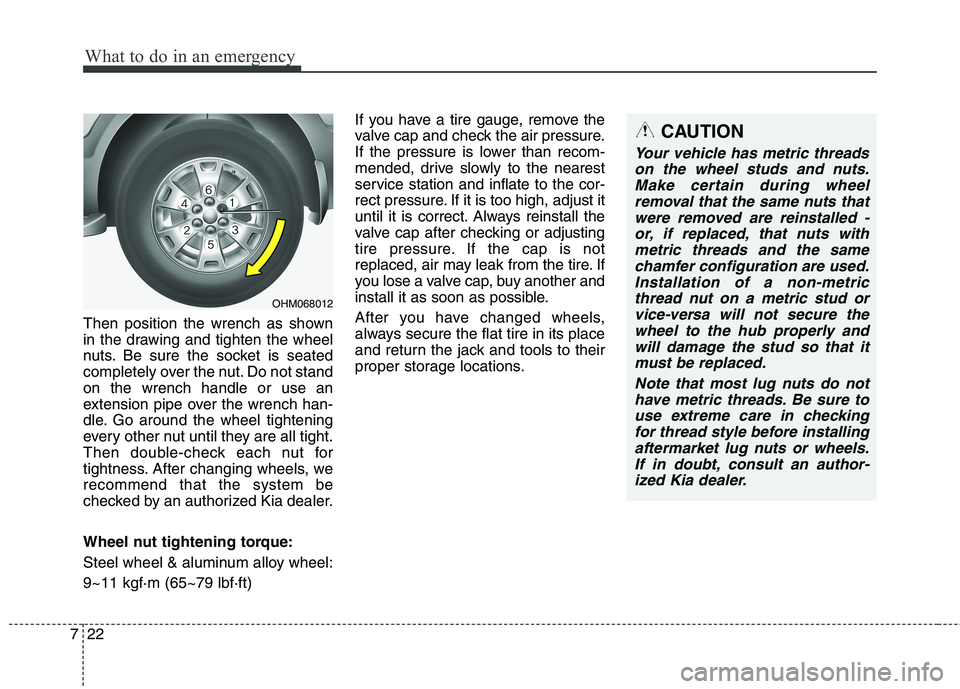
Then position the wrench as shown
in the drawing and tighten the wheel
nuts. Be sure the socket is seated
completely over the nut. Do not standon the wrench handle or use an
extension pipe over the wrench han-
dle. Go around the wheel tightening
every other nut until they are all tight.
Then double-check each nut for
tightness. After changing wheels, werecommend that the system be
checked by an authorized Kia dealer.
Wheel nut tightening torque:
Steel wheel & aluminum alloy wheel:9~11 kgf·m (65~79 lbf·ft) If you have a tire gauge, remove the
valve cap and check the air pressure.
If the pressure is lower than recom-
mended, drive slowly to the nearest
service station and inflate to the cor-
rect pressure. If it is too high, adjust it
until it is correct. Always reinstall the
valve cap after checking or adjusting
tire pressure. If the cap is not
replaced, air may leak from the tire. If
you lose a valve cap, buy another and
install it as soon as possible.
After you have changed wheels,
always secure the flat tire in its place
and return the jack and tools to their
proper storage locations.
OHM068012
CAUTION
Your vehicle has metric threads
on the wheel studs and nuts.Make certain during wheel removal that the same nuts thatwere removed are reinstalled -or, if replaced, that nuts withmetric threads and the same chamfer configuration are used.Installation of a non-metricthread nut on a metric stud or vice-versa will not secure thewheel to the hub properly andwill damage the stud so that it must be replaced.
Note that most lug nuts do nothave metric threads. Be sure touse extreme care in checkingfor thread style before installing aftermarket lug nuts or wheels.If in doubt, consult an author-ized Kia dealer.
Page 433 of 548
729
What to do in an emergency
If towing service is not available in an
emergency, your vehicle may be
temporarily towed using a cable or
chain secured to the emergency tow-ing hook under the front (or rear) of
the vehicle. Use extreme caution
when towing the vehicle. A driver
must be in the vehicle to steer it and
operate the brakes.
Towing in this manner may be done
only on hard-surfaced roads for a
short distance and at low speed.
Also, the wheels, axles, power train,
steering and brakes must all be ingood condition.
Do not use the tow hooks to pull avehicle out of mud, sand or other
conditions from which the vehicle
cannot be driven out under its own
power.
Avoid towing a vehicle heavier than the vehicle doing the towing.
The drivers of both vehicles should communicate with each other fre-
quently. Before emergency towing, check if
the hook is not broken or dam-aged.
Fasten the towing cable or chain securely to the hook.
Do not jerk the hook. Apply it steadily and with even force.
To avoid damaging the hook, do not pull from the side or at a verti-
cal angle. Always pull straightahead.CAUTION
Attach a towing strap to the
tow hook.
Using a portion of the vehicle other than the tow hooks fortowing may damage the bodyof your vehicle.
Use only a cable or chain specifically intended for usein towing vehicles. Securely fasten the cable or chain tothe towing hook provided.
WARNING
Use extreme caution when tow-
ing the vehicle.
Avoid sudden starts or erratic driving maneuvers which
would place excessive stress
on the emergency towing hook
and towing cable or chain. The
hook and towing cable or
chain may break and cause
serious injury or damage.
If the disabled vehicle is unable to be moved, do not
forcibly continue the towing.
We recommend that you con-
tact an authorized Kia dealer
or a commercial tow truck
service for assistance.
Tow the vehicle as straight ahead as possible.
Keep away from the vehicle during towing.
Page 442 of 548
Maintenance
6
8
Engine compartment precau- tions (Diesel engine)
• The piezo injector operates at high
voltage (maximum 200v). Therefore,
the following accidents may occur.
- Direct contact with the injector orinjector wiring may cause electric
shock or damage your muscle or
nerve system.
- The electromagnetic wave from the operating injector may cause
the artificial heart pacemaker tomalfunction.
Follow the safety tips provided below, when you are checking theengine room while the engine is
running.
- Do not touch the injector, injectorwirings, and the engine computer
while the engine is running.
- Do not remove the injector con- nector while the engine is running.
- People using pacemakers must not go near the engine while the
engine is starting or running.WARNING - Maintenance
work
Performing maintenance work on a vehicle can be danger-
ous. You can be seriously
injured while performing some
maintenance procedures. If
you lack sufficient knowledge
and experience or the propertools and equipment to do the
work, we recommend that the
system be servied by an
authorized Kia dealer.
Working under the hood with the engine running is danger-
ous. It becomes even more
dangerous when you wear jew-
elry or loose clothing. These
can become entangled in mov-
ing parts and result in injury.
Therefore, if you must run the
engine while working under the
hood, make certain that you
remove all jewelry (especially
rings, bracelets, watches, and
necklaces) and all neckties,
scarves, and similar loose
clothing before getting near theengine or cooling fans.WARNING - Diesel Engine
Never work on the injection sys- tem with the engine running orwithin 30 seconds after shutting
off the engine. High-pressure
pump, rail, injectors and high-pressure pipes are subject to
high pressure even after the
engine stopped. The fuel jet pro-
duced by fuel leaks may cause
serious injury, if it touches the
body. People using pacemakers
should not move more than
30cm closer to the ECU orwiring harness within the
engine room while the engine is
running, since the high currents
in the electronic engine control
system produce considerable
magnetic fields.
Page 454 of 548
Maintenance
18
8
EXPLANATION OF SCHEDULED MAINTENANCE ITEMS
Engine oil and filter The engine oil and filter should be
changed at the intervals specified in
the maintenance schedule. If the
vehicle is being driven in severe con-
ditions, more frequent oil and filterchanges are required. Drive belts
Inspect all drive belts for evidence of
cuts, cracks, excessive wear or oil
saturation and replace if necessary.
Drive belts should be checked peri-
odically for proper tension and
adjusted as necessary. Fuel filter cartridge (for diesel) A clogged filter can limit the speed at
which the vehicle may be driven,damage the emission system and
cause multiple issues such as hard
starting. If an excessive amount of
foreign matter accumulates in the
fuel tank, the filter may require
replacement more frequently.
After installing a new filter, run the
engine for several minutes, and
check for leaks at the connections.
We recommend that the fuel filter be
replaced by an authorized Kia dealer.
Fuel filter (for gasoline)
Kia gasoline vehicle is equipped a
lifetime fuel filter that integrated with
the fuel tank. Regular maintenance
or replacement is not needed but
depends on fuel quality. If there are
some important safety matters like
fuel flow restriction, surging, loss of
power, hard starting problem etc, fuelfilter inspection or replace is needed.
We recommend that the fuel filter be
Inspected or replaced by an author-
ized Kia dealer.Fuel lines, fuel hoses and con- nections
Check the fuel lines, fuel hoses and
connections for leakage and dam-
age. We recommend that the fuel
lines, fuel hoses and connections be
replaced by an authorized Kia dealer.
WARNING
- Diesel only
Never work on the injection sys- tem with the engine running orwithin 30 seconds after shutting
off the engine. High pressure
pump, rail, injectors and highpressure pipes are subject to
high pressure even after the
engine stops. The fuel jet pro-
duced by fuel leaks may cause
serious injury, if it touches the
body. People using pacemakers
should not more move than 30
cm closer to the ECU or wiring
harness within the engine roomwhile the engine is running,since the high currents in the
Common Rail system produce
considerable magnetic fields.
CAUTION
When you are inspecting the belt, place the ignition switch inthe LOCK/OFF or ACC position.
Page 455 of 548
819
Maintenance
Vapor hose and fuel filler cap
The vapor hose and fuel filler cap should be inspected at those inter-
vals specified in the maintenance
schedule. Make sure that a new
vapor hose or fuel filler cap is cor-rectly replaced.Vacuum crankcase ventilation hoses (if equipped)
Inspect the surface of hoses for evi- dence of heat and/or mechanical
damage. Hard and brittle rubber,
cracking, tears, cuts, abrasions, and
excessive swelling indicate deterio-
ration. Particular attention should be
paid to examine those hose surfaces
nearest to high heat sources, such
as the exhaust manifold.Inspect the hose routing to assurethat the hoses do not come in con-
tact with any heat source, sharp
edges or moving component whichmight cause heat damage or
mechanical wear. Inspect all hose
connections, such as clamps and
couplings, to make sure they are
secure, and that no leaks are pres-
ent. Hoses should be replaced
immediately if there is any evidence
of deterioration or damage.Air cleaner filter
We recommend that the air cleaner
filter be replaced by an authorized
Kia dealer. Spark plugs
(for gasoline engine)
Make sure to install new spark plugs
of the correct heat range.
WARNING
Do not disconnect and inspect spark plugs when the engine is
hot. You may burn yourself.
Page 465 of 548
829
Maintenance
WASHER FLUID
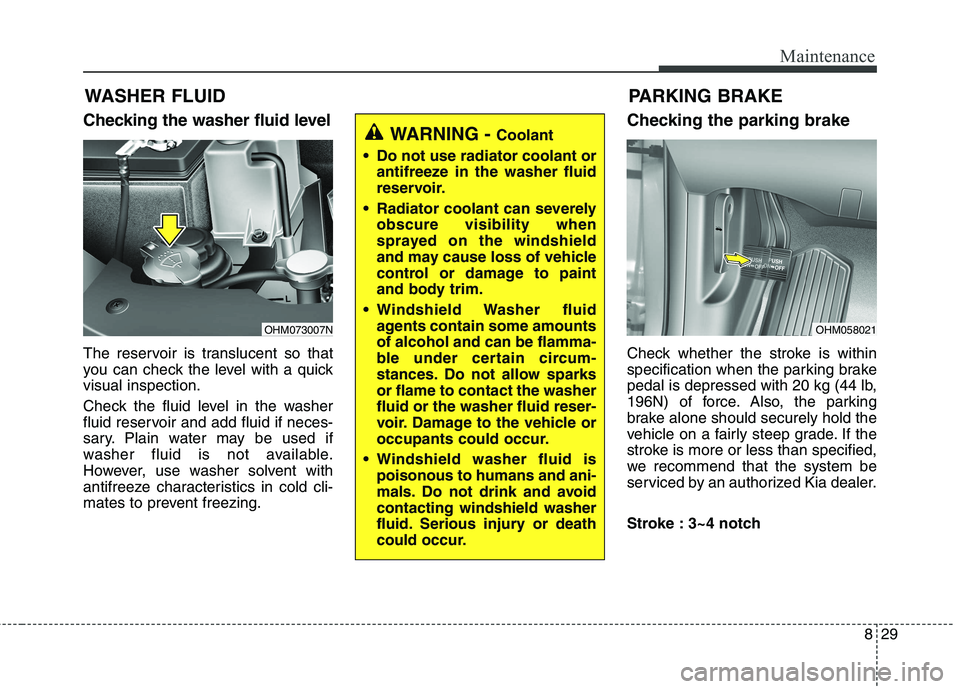
Checking the washer fluid level
The reservoir is translucent so that
you can check the level with a quickvisual inspection.
Check the fluid level in the washer
fluid reservoir and add fluid if neces-
sary. Plain water may be used if
washer fluid is not available.
However, use washer solvent with
antifreeze characteristics in cold cli-
mates to prevent freezing. Checking the parking brake
Check whether the stroke is within
specification when the parking brake
pedal is depressed with 20 kg (44 lb,
196N) of force. Also, the parking
brake alone should securely hold the
vehicle on a fairly steep grade. If the
stroke is more or less than specified,
we recommend that the system be
serviced by an authorized Kia dealer.
Stroke : 3~4 notch
WARNING -
Coolant
Do not use radiator coolant or antifreeze in the washer fluid
reservoir.
Radiator coolant can severely obscure visibility when
sprayed on the windshield
and may cause loss of vehicle
control or damage to paint
and body trim.
Windshield Washer fluid agents contain some amountsof alcohol and can be flamma-
ble under certain circum-
stances. Do not allow sparksor flame to contact the washerfluid or the washer fluid reser-
voir. Damage to the vehicle or
occupants could occur.
Windshield washer fluid is poisonous to humans and ani-
mals. Do not drink and avoidcontacting windshield washer
fluid. Serious injury or death
could occur.
OHM073007N PARKING BRAKE OHM058021
Page 466 of 548

Maintenance
30
8
FUEL FILTER (FOR DIESEL)
Draining water from the fuel filter
The fuel filter for diesel engine plays
an important role of separating water
from fuel and accumulating the waterin its bottom.
If water accumulates in the fuel filter,
the warning light comes on when the
ignition switch is in the ON position. Place a water trap under the fuel
filter.
Loosen the drain plug and drain water.
After water is drained, securely tighten the drain plug.
After starting the engine, check to make certain the fuel filter warning
light is off. Fuel filter cartridge replacement
✽✽
NOTICE
When replacing the fuel filter car-
tridge, we recommend that you use
parts for replacement from an
authorized Kia dealer.
CAUTION
If the water accumulated in the fuel filter is not drained at prop-er times, damages to the major parts such as the fuel systemcan be caused by water perme-ation in the fuel filter.OHM078008
Page 474 of 548
Maintenance
38
8
BATTERY
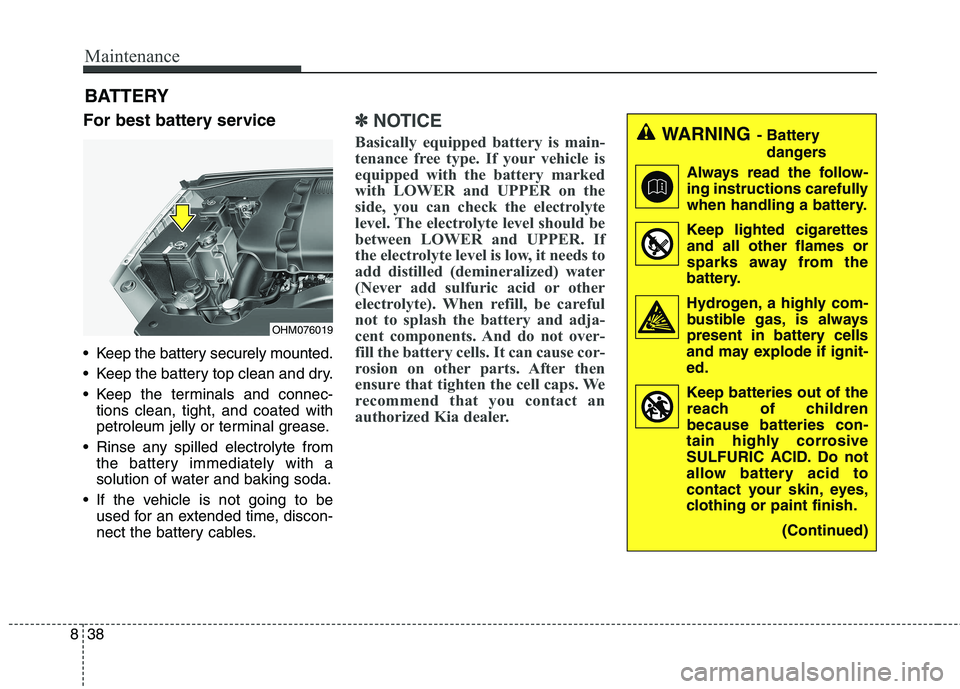
For best battery service
Keep the battery securely mounted.
Keep the battery top clean and dry.
Keep the terminals and connec- tions clean, tight, and coated with
petroleum jelly or terminal grease.
Rinse any spilled electrolyte from the battery immediately with a
solution of water and baking soda.
If the vehicle is not going to be used for an extended time, discon-
nect the battery cables.
✽✽ NOTICE
Basically equipped battery is main-
tenance free type. If your vehicle is
equipped with the battery marked
with LOWER and UPPER on the
side, you can check the electrolyte
level. The electrolyte level should be
between LOWER and UPPER. If
the electrolyte level is low, it needs to
add distilled (demineralized) water
(Never add sulfuric acid or other
electrolyte). When refill, be careful
not to splash the battery and adja-
cent components. And do not over-
fill the battery cells. It can cause cor-
rosion on other parts. After then
ensure that tighten the cell caps. We
recommend that you contact an
authorized Kia dealer.
OHM076019
WARNING - Battery
dangers
Always read the follow-
ing instructions carefully
when handling a battery.
Keep lighted cigarettes and all other flames or
sparks away from the
battery.
Hydrogen, a highly com- bustible gas, is always
present in battery cells
and may explode if ignit-ed.
Keep batteries out of the reach of children because batteries con-
tain highly corrosive
SULFURIC ACID. Do not
allow battery acid to
contact your skin, eyes,
clothing or paint finish.
(Continued)
Page 493 of 548
857
Maintenance
2. Remove the fuse panel cover bypressing the tab and pulling the
cover up. When the blade type
fuse is disconnected, remove it by
using the clip designed for chang-ing fuses located in the engine
room fuse box. Upon removal,
securely insert reserve fuse of
equal quantity.
3. Check the removed fuse; replace it if it is blown. To remove or insert
the fuse, use the fuse puller in the
engine compartment fuse panel.
4. Push in a new fuse of the same rating, and make sure it fits tightly
in the clips. If it fits loosely, we rec-
ommend that you consult an
authorized Kia dealer.Main fuse
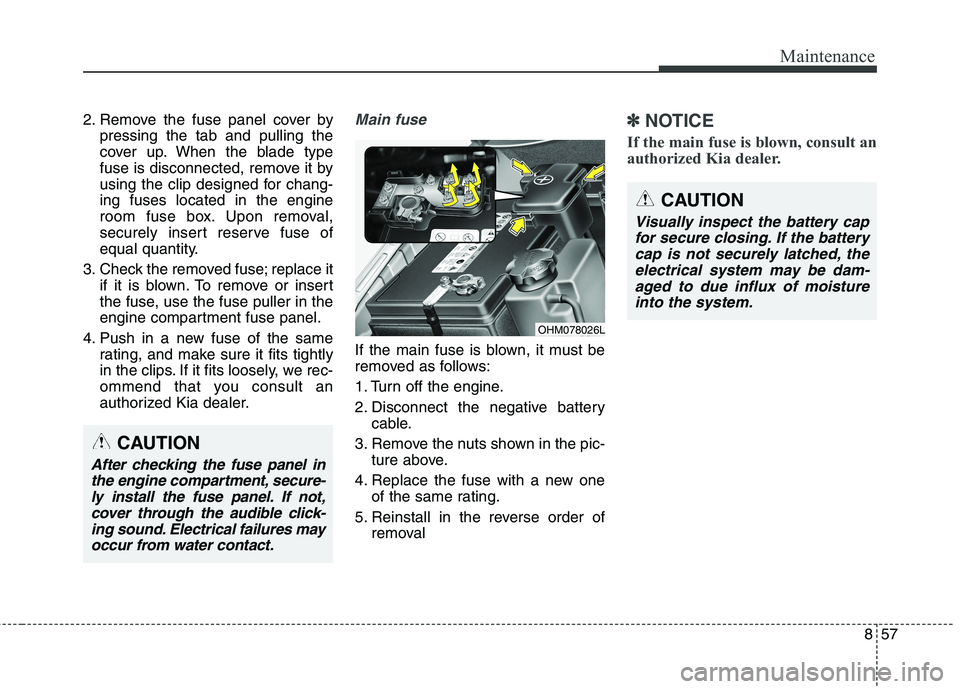
If the main fuse is blown, it must be
removed as follows:
1. Turn off the engine.
2. Disconnect the negative batterycable.
3. Remove the nuts shown in the pic- ture above.
4. Replace the fuse with a new one of the same rating.
5. Reinstall in the reverse order of removal
✽✽ NOTICE
If the main fuse is blown, consult an
authorized Kia dealer.
CAUTION
Visually inspect the battery cap for secure closing. If the batterycap is not securely latched, theelectrical system may be dam- aged to due influx of moistureinto the system.
OHM078026L
CAUTION
After checking the fuse panel inthe engine compartment, secure-ly install the fuse panel. If not, cover through the audible click-ing sound. Electrical failures mayoccur from water contact.
Page 500 of 548
Maintenance
64
8
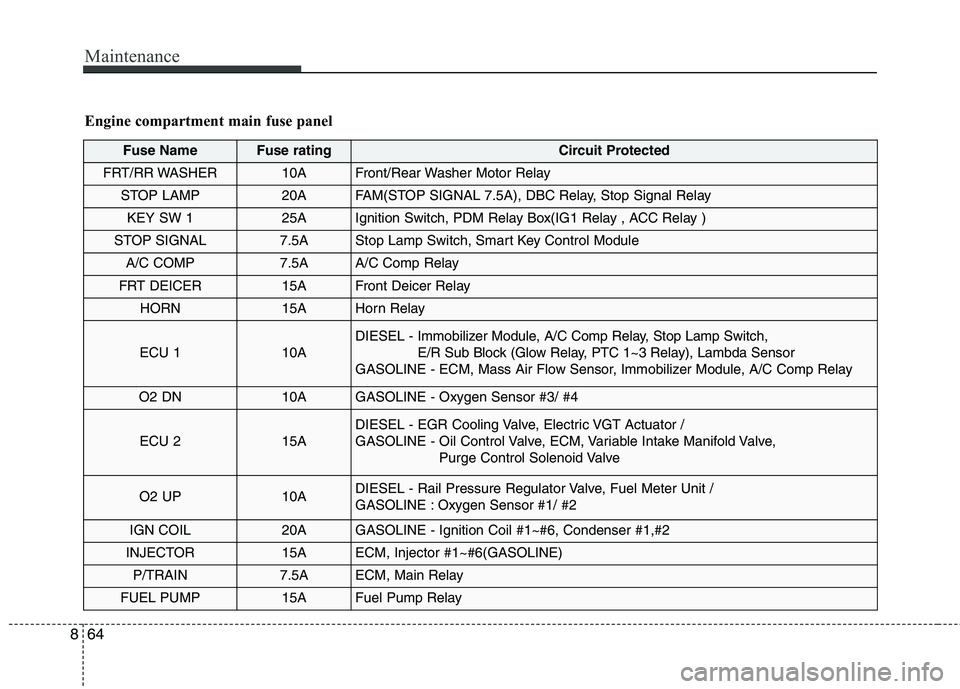
Engine compartment main fuse panel
Fuse NameFuse ratingCircuit Protected
FRT/RR WASHER10AFront/Rear Washer Motor Relay
STOP LAMP20AFAM(STOP SIGNAL 7.5A), DBC Relay, Stop Signal Relay
KEY SW 125AIgnition Switch, PDM Relay Box(IG1 Relay , ACC Relay )
STOP SIGNAL7.5AStop Lamp Switch, Smart Key Control Module
A/C COMP7.5AA/C Comp Relay
FRT DEICER15AFront Deicer Relay
HORN15AHorn Relay
ECU 110A
DIESEL - Immobilizer Module, A/C Comp Relay, Stop Lamp Switch,
E/R Sub Block (Glow Relay, PTC 1~3 Relay), Lambda Sensor
GASOLINE - ECM, Mass Air Flow Sensor, Immobilizer Module, A/C Comp Relay
O2 DN10AGASOLINE - Oxygen Sensor #3/ #4
ECU 215A
DIESEL - EGR Cooling Valve, Electric VGT Actuator /
GASOLINE - Oil Control Valve, ECM, Variable Intake Manifold Valve, Purge Control Solenoid Valve
O2 UP10ADIESEL - Rail Pressure Regulator Valve, Fuel Meter Unit /
GASOLINE : Oxygen Sensor #1/ #2
IGN COIL20AGASOLINE - Ignition Coil #1~#6, Condenser #1,#2
INJECTOR15AECM, Injector #1~#6(GASOLINE)
P/TRAIN7.5AECM, Main Relay
FUEL PUMP15AFuel Pump Relay