power steering KIA CADENZA 2020 User Guide
[x] Cancel search | Manufacturer: KIA, Model Year: 2020, Model line: CADENZA, Model: KIA CADENZA 2020Pages: 560, PDF Size: 11.37 MB
Page 302 of 560
549
Driving your vehicle
Brake operation
In an urgent situation, the braking
system enters into the ready status
for prompt reaction to assist the driv-
er in depressing the brake pedal.
FCA provides additional braking
power for optimum braking per-
formance, when the driver
depresses the brake pedal.
The braking control is automatical-
ly deactivated, when the driver
sharply depresses the accelerator
pedal, or when the driver abruptly
operates the steering wheel.
The braking control is automatical-
ly canceled, when risk factors dis-
appear.WARNING
FCA cannot avoid all collisions.
FCA might not completely stop
the vehicle before a collision,
due to ambient, weather and
road conditions. The driver has
the responsibility to drive safely
and control the vehicle.
WARNING
FCA operates in accordance
with the risk levels, such as the
distance from the vehicle in
front, the speed of the vehicle in
front, and the driver's vehicle
operation. For the system to
activate, do not attempt risky
driving.
CAUTION
The driver should always pay
great caution to vehicle opera-
tion, even though there is no
warning message or warning
alarm.
If any other warning sound
such as seat belt warning
chime is already generated,
Forward Collision-Avoidance
Assist warning may not
sound.
Excessive audio volume may
disturb the sound of the sys-
tem warning alarm.
Page 330 of 560
577
Driving your vehicle
Blind-Spot Collision-Avoidance
Assist
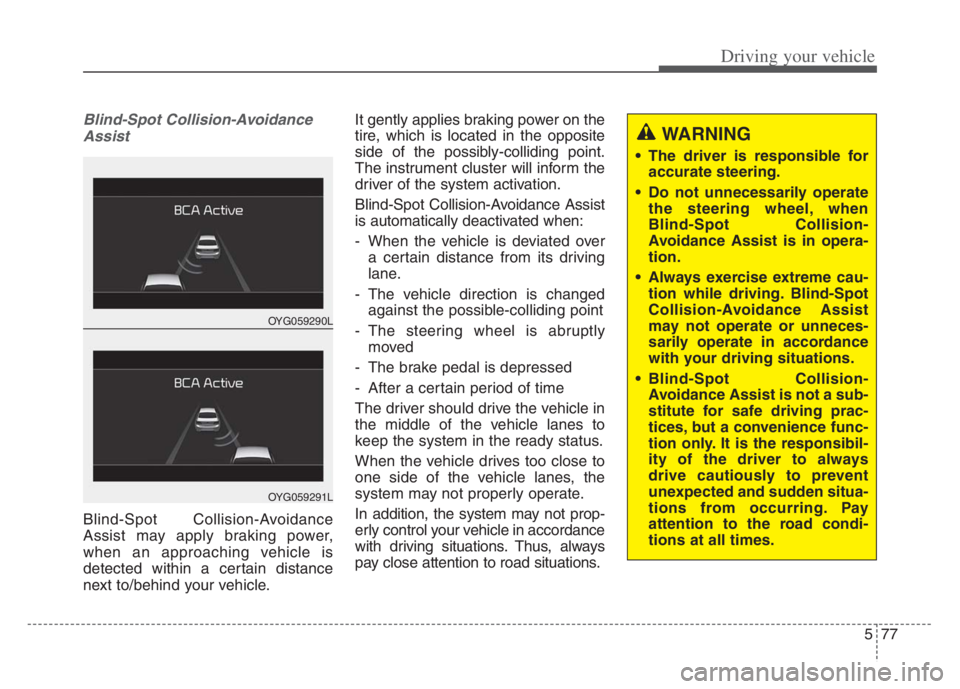
Blind-Spot Collision-Avoidance
Assist may apply braking power,
when an approaching vehicle is
detected within a certain distance
next to/behind your vehicle.It gently applies braking power on the
tire, which is located in the opposite
side of the possibly-colliding point.
The instrument cluster will inform the
driver of the system activation.
Blind-Spot Collision-Avoidance Assist
is automatically deactivated when:
- When the vehicle is deviated over
a certain distance from its driving
lane.
- The vehicle direction is changed
against the possible-colliding point
- The steering wheel is abruptly
moved
- The brake pedal is depressed
- After a certain period of time
The driver should drive the vehicle in
the middle of the vehicle lanes to
keep the system in the ready status.
When the vehicle drives too close to
one side of the vehicle lanes, the
system may not properly operate.
In addition, the system may not prop-
erly control your vehicle in accordance
with driving situations. Thus, always
pay close attention to road situations.
OYG059290L
OYG059291L
WARNING
The driver is responsible for
accurate steering.
Do not unnecessarily operate
the steering wheel, when
Blind-Spot Collision-
Avoidance Assist is in opera-
tion.
Always exercise extreme cau-
tion while driving. Blind-Spot
Collision-Avoidance Assist
may not operate or unneces-
sarily operate in accordance
with your driving situations.
Blind-Spot Collision-
Avoidance Assist is not a sub-
stitute for safe driving prac-
tices, but a convenience func-
tion only. It is the responsibil-
ity of the driver to always
drive cautiously to prevent
unexpected and sudden situa-
tions from occurring. Pay
attention to the road condi-
tions at all times.
Page 403 of 560

Driving your vehicle
150 5
Remember, your vehicle does not
require extended warm-up. After
the engine has started, allow the
engine to run for 10 to 20 seconds
prior to placing the vehicle in gear.
In very cold weather, however, give
your engine a slightly longer warm-
up period.
Don't "lug" or "over-rev" the engine.
Lugging is driving too slowly in a
very high gear resulting in engine
bucking. If this happens, shift to a
lower gear. Over-revving is racing
the engine beyond its safe limit.
This can be avoided by shifting at
the recommended speed. Use your air conditioning sparingly.
The air conditioning system is
operated by engine power so your
fuel economy is reduced when you
use it.
Open windows at high speeds can
reduce fuel economy.
Fuel economy is less in crosswinds
and headwinds. To help offset
some of this loss, slow down when
driving in these conditions.
Keeping a vehicle in good operating
condition is important both for econ-
omy and safety. Therefore, have an
authorized Kia dealer perform
scheduled inspections and mainte-
nance.
WARNING - Engine off
during motion
Never turn the engine off to
coast down hills or anytime the
vehicle is in motion. The power
steering and power brakes will
not function properly without the
engine running. In addition, turn-
ing off the ignition while driving
could lead to out of working
power driven steering wheel and
hard to control steering wheel.
Keep the engine on and down-
shift to an appropriate gear for
an engine braking effect.
Page 443 of 560
627
What to do in an emergency
3. Install the towing hook by turning it
clockwise into the hole until it is
fully secured.
4. Remove the towing hook and
install the cover after use.Emergency towing
If towing is necessary, we recom-
mend you to have it done by an
authorized Kia dealer or a com-
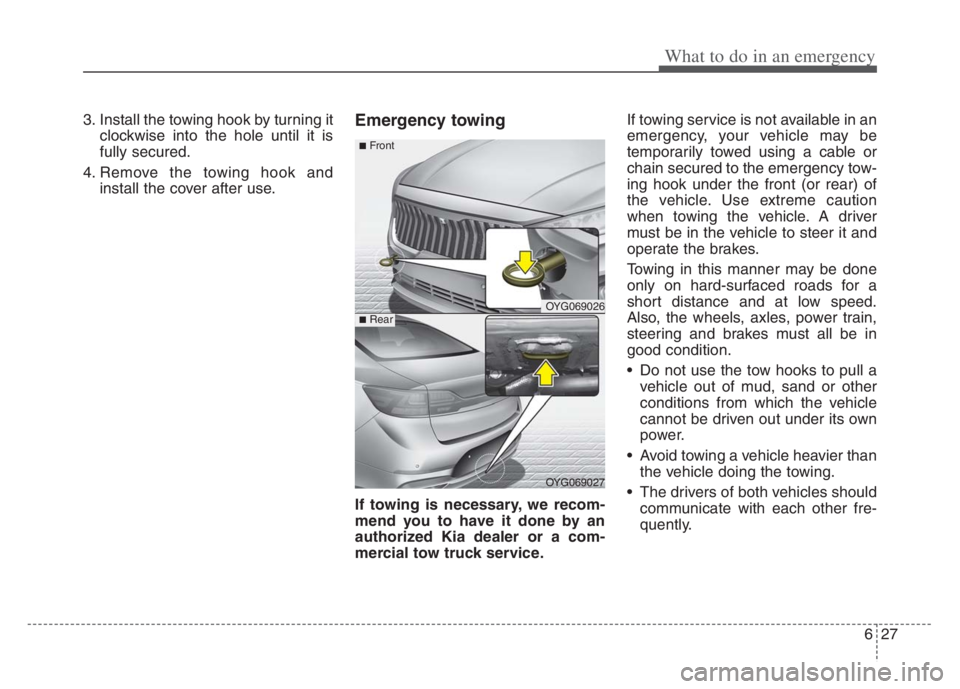
mercial tow truck service.If towing service is not available in an
emergency, your vehicle may be
temporarily towed using a cable or
chain secured to the emergency tow-
ing hook under the front (or rear) of
the vehicle. Use extreme caution
when towing the vehicle. A driver
must be in the vehicle to steer it and
operate the brakes.
Towing in this manner may be done
only on hard-surfaced roads for a
short distance and at low speed.
Also, the wheels, axles, power train,
steering and brakes must all be in
good condition.
Do not use the tow hooks to pull a
vehicle out of mud, sand or other
conditions from which the vehicle
cannot be driven out under its own
power.
Avoid towing a vehicle heavier than
the vehicle doing the towing.
The drivers of both vehicles should
communicate with each other fre-
quently.
OYG069026
OYG069027
■Front
■Rear
Page 445 of 560
629
What to do in an emergency
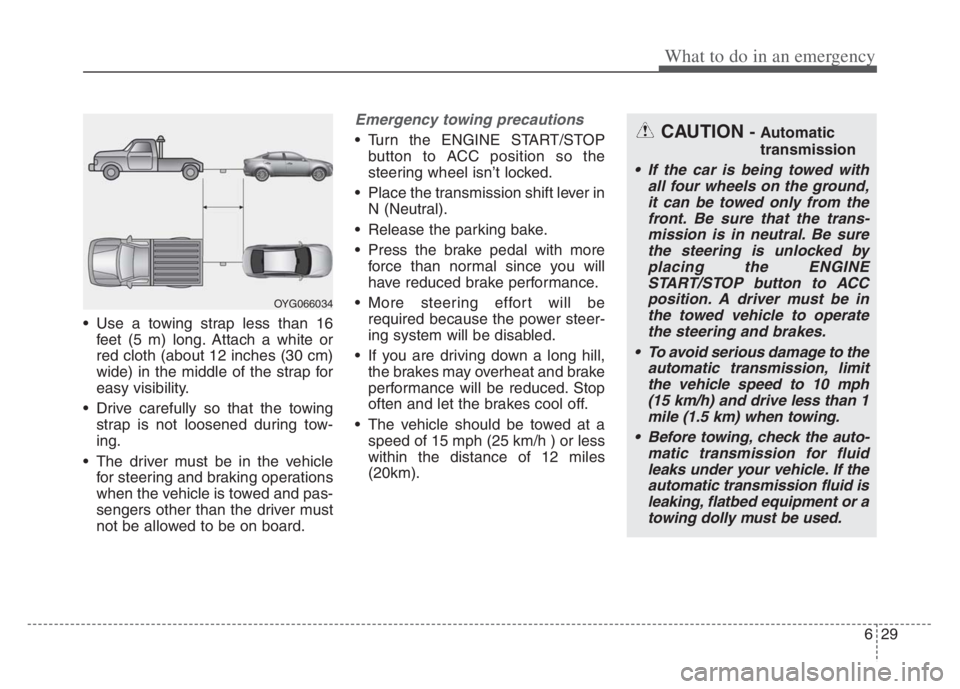
Use a towing strap less than 16
feet (5 m) long. Attach a white or
red cloth (about 12 inches (30 cm)
wide) in the middle of the strap for
easy visibility.
Drive carefully so that the towing
strap is not loosened during tow-
ing.
The driver must be in the vehicle
for steering and braking operations
when the vehicle is towed and pas-
sengers other than the driver must
not be allowed to be on board.
Emergency towing precautions
Turn the ENGINE START/STOP
button to ACC position so the
steering wheel isn’t locked.
Place the transmission shift lever in
N (Neutral).
Release the parking bake.
Press the brake pedal with more
force than normal since you will
have reduced brake performance.
More steering effort will be
required because the power steer-
ing system will be disabled.
If you are driving down a long hill,
the brakes may overheat and brake
performance will be reduced. Stop
often and let the brakes cool off.
The vehicle should be towed at a
speed of 15 mph (25 km/h ) or less
within the distance of 12 miles
(20km).CAUTION - Automatic
transmission
If the car is being towed with
all four wheels on the ground,
it can be towed only from the
front. Be sure that the trans-
mission is in neutral. Be sure
the steering is unlocked by
placing the ENGINE
START/STOP button to ACC
position. A driver must be in
the towed vehicle to operate
the steering and brakes.
To avoid serious damage to the
automatic transmission, limit
the vehicle speed to 10 mph
(15 km/h) and drive less than 1
mile (1.5 km) when towing.
Before towing, check the auto-
matic transmission for fluid
leaks under your vehicle. If the
automatic transmission fluid is
leaking, flatbed equipment or a
towing dolly must be used.
OYG066034
Page 502 of 560
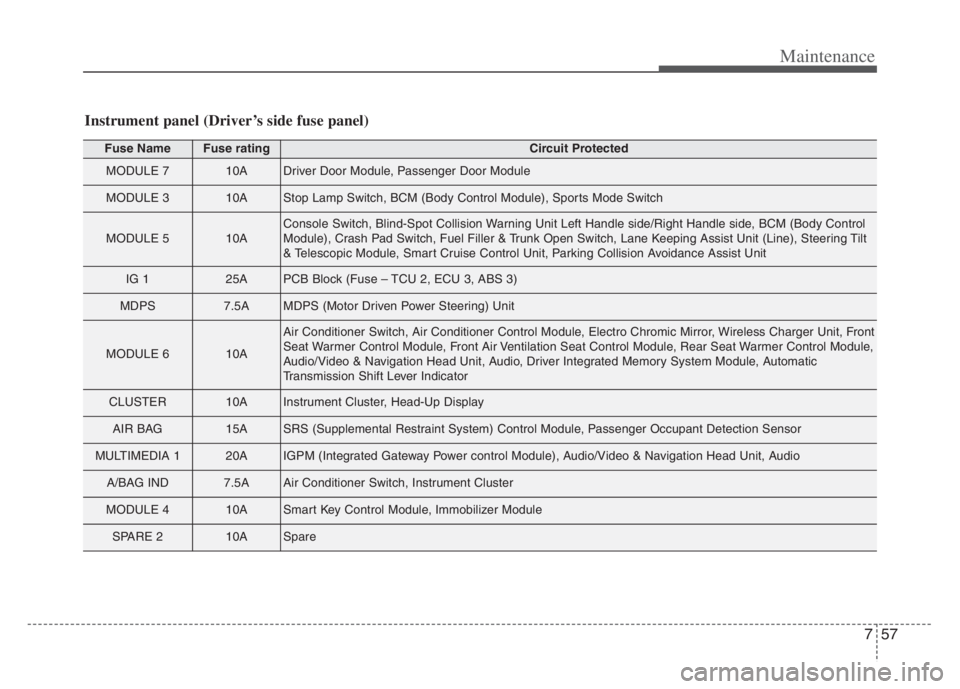
757
Maintenance
Fuse NameFuse ratingCircuit Protected
MODULE 710ADriver Door Module, Passenger Door Module
MODULE 310AStop Lamp Switch, BCM (Body Control Module), Sports Mode Switch
MODULE 510AConsole Switch, Blind-Spot Collision Warning Unit Left Handle side/Right Handle side, BCM (Body Control
Module), Crash Pad Switch, Fuel Filler & Trunk Open Switch, Lane Keeping Assist Unit (Line), Steering Tilt
& Telescopic Module, Smart Cruise Control Unit, Parking Collision Avoidance Assist Unit
IG 125APCB Block (Fuse – TCU 2, ECU 3, ABS 3)
MDPS7.5AMDPS (Motor Driven Power Steering) Unit
MODULE 610A
Air Conditioner Switch, Air Conditioner Control Module, Electro Chromic Mirror, Wireless Charger Unit, Front
Seat Warmer Control Module, Front Air Ventilation Seat Control Module, Rear Seat Warmer Control Module,
Audio/Video & Navigation Head Unit, Audio, Driver Integrated Memory System Module, Automatic
Transmission Shift Lever Indicator
CLUSTER10AInstrument Cluster, Head-Up Display
AIR BAG15ASRS (Supplemental Restraint System) Control Module, Passenger Occupant Detection Sensor
MULTIMEDIA 120AIGPM (Integrated Gateway Power control Module), Audio/Video & Navigation Head Unit, Audio
A/BAG IND7.5AAir Conditioner Switch, Instrument Cluster
MODULE 410ASmart Key Control Module, Immobilizer Module
SPARE 210ASpare
Instrument panel (Driver’s side fuse panel)
Page 503 of 560
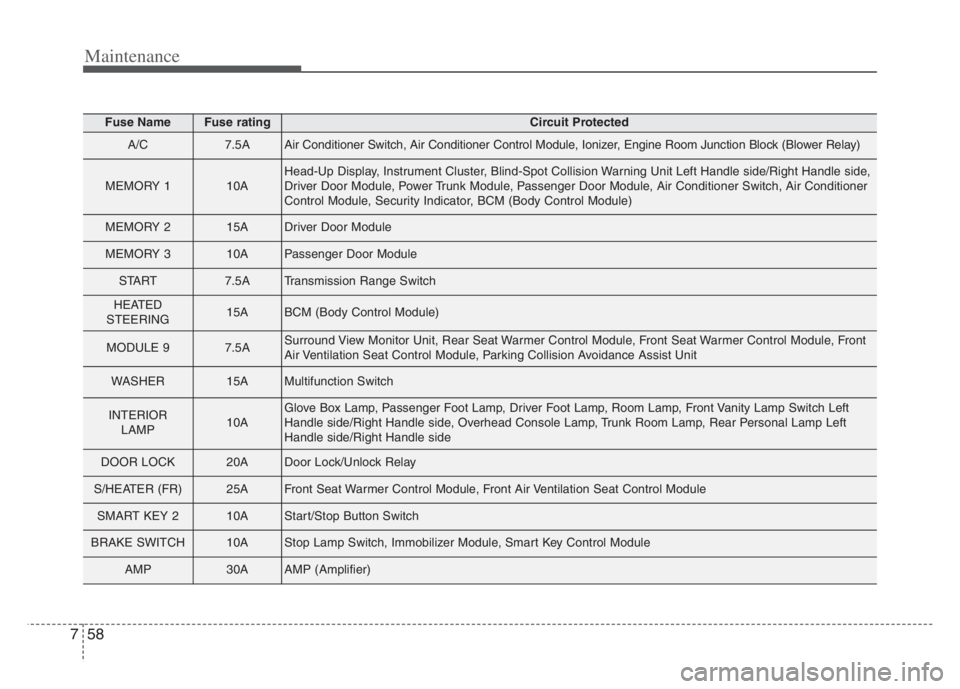
Maintenance
58 7
Fuse NameFuse ratingCircuit Protected
A/C7.5AAir Conditioner Switch, Air Conditioner Control Module, Ionizer, Engine Room Junction Block (Blower Relay)
MEMORY 110AHead-Up Display, Instrument Cluster, Blind-Spot Collision Warning Unit Left Handle side/Right Handle side,
Driver Door Module, Power Trunk Module, Passenger Door Module, Air Conditioner Switch, Air Conditioner
Control Module, Security Indicator, BCM (Body Control Module)
MEMORY 215ADriver Door Module
MEMORY 310APassenger Door Module
START7.5ATransmission Range Switch
HEATED
STEERING15ABCM (Body Control Module)
MODULE 97.5ASurround View Monitor Unit, Rear Seat Warmer Control Module, Front Seat Warmer Control Module, Front
Air Ventilation Seat Control Module, Parking Collision Avoidance Assist Unit
WASHER15AMultifunction Switch
INTERIOR
LAMP10AGlove Box Lamp, Passenger Foot Lamp, Driver Foot Lamp, Room Lamp, Front Vanity Lamp Switch Left
Handle side/Right Handle side, Overhead Console Lamp, Trunk Room Lamp, Rear Personal Lamp Left
Handle side/Right Handle side
DOOR LOCK20ADoor Lock/Unlock Relay
S/HEATER (FR)25AFront Seat Warmer Control Module, Front Air Ventilation Seat Control Module
SMART KEY 210AStart/Stop Button Switch
BRAKE SWITCH10AStop Lamp Switch, Immobilizer Module, Smart Key Control Module
AMP30AAMP (Amplifier)
Page 504 of 560
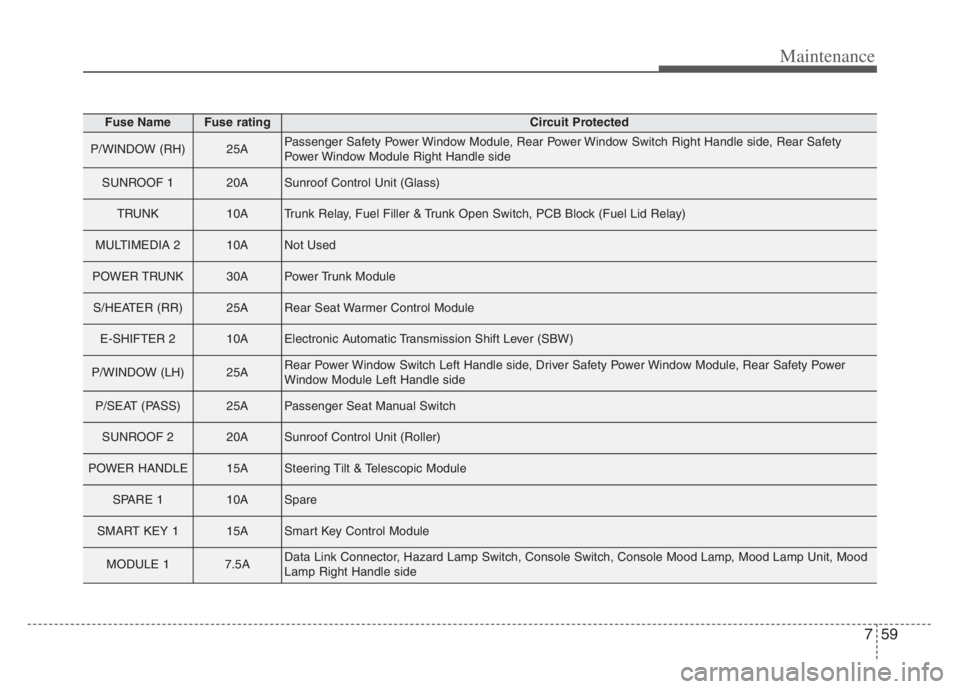
759
Maintenance
Fuse NameFuse ratingCircuit Protected
P/WINDOW (RH)25APassenger Safety Power Window Module, Rear Power Window Switch Right Handle side, Rear Safety
Power Window Module Right Handle side
SUNROOF 120ASunroof Control Unit (Glass)
TRUNK10ATrunk Relay, Fuel Filler & Trunk Open Switch, PCB Block (Fuel Lid Relay)
MULTIMEDIA 210ANot Used
POWER TRUNK30APower Trunk Module
S/HEATER (RR)25ARear Seat Warmer Control Module
E-SHIFTER 210AElectronic Automatic Transmission Shift Lever (SBW)
P/WINDOW (LH)25ARear Power Window Switch Left Handle side, Driver Safety Power Window Module, Rear Safety Power
Window Module Left Handle side
P/SEAT (PASS)25APassenger Seat Manual Switch
SUNROOF 220ASunroof Control Unit (Roller)
POWER HANDLE15ASteering Tilt & Telescopic Module
SPARE 110ASpare
SMART KEY 115ASmart Key Control Module
MODULE 17.5AData Link Connector, Hazard Lamp Switch, Console Switch, Console Mood Lamp, Mood Lamp Unit, Mood
Lamp Right Handle side
Page 507 of 560
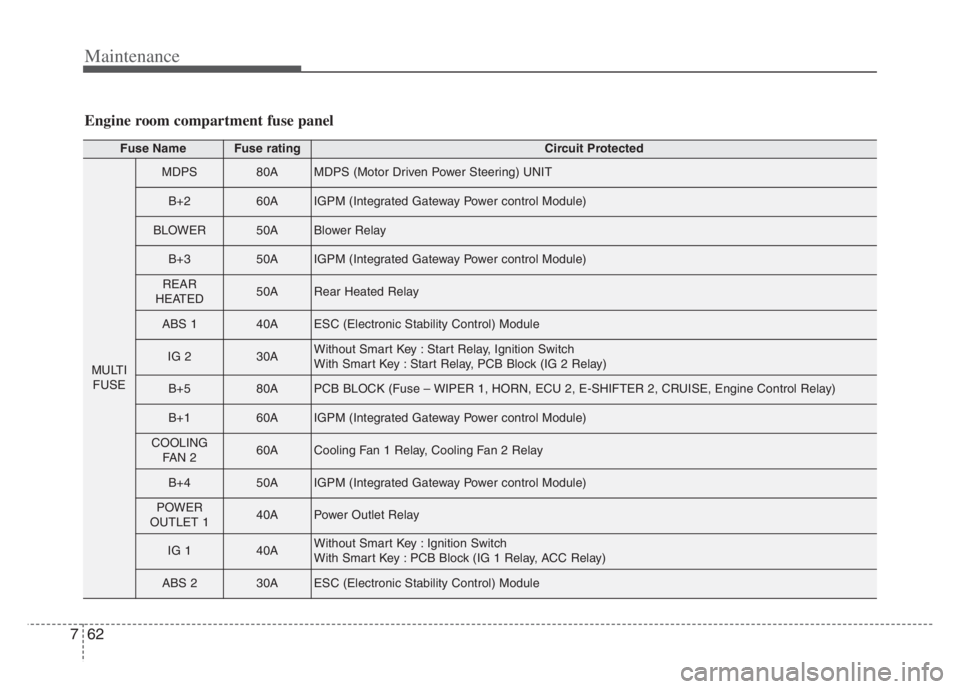
Maintenance
62 7
Fuse NameFuse ratingCircuit Protected
MULTI
FUSE
MDPS80AMDPS (Motor Driven Power Steering) UNIT
B+260AIGPM (Integrated Gateway Power control Module)
BLOWER50ABlower Relay
B+350AIGPM (Integrated Gateway Power control Module)
REAR
HEATED50ARear Heated Relay
ABS 140AESC (Electronic Stability Control) Module
IG 230AWithout Smart Key : Start Relay, Ignition Switch
With Smart Key : Start Relay, PCB Block (IG 2 Relay)
B+580APCB BLOCK (Fuse – WIPER 1, HORN, ECU 2, E-SHIFTER 2, CRUISE, Engine Control Relay)
B+160AIGPM (Integrated Gateway Power control Module)
COOLING
FAN 260ACooling Fan 1 Relay, Cooling Fan 2 Relay
B+450AIGPM (Integrated Gateway Power control Module)
POWER
OUTLET 140APower Outlet Relay
IG 140AWithout Smart Key : Ignition Switch
With Smart Key : PCB Block (IG 1 Relay, ACC Relay)
ABS 230AESC (Electronic Stability Control) Module
Engine room compartment fuse panel
Page 557 of 560
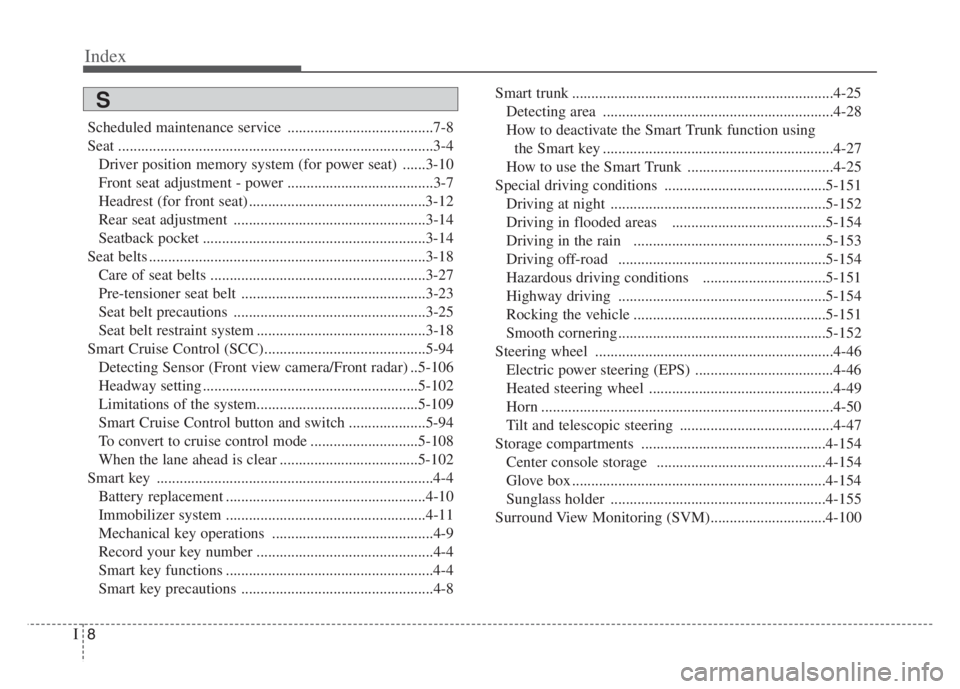
Index
8I
Scheduled maintenance service ......................................7-8
Seat ..................................................................................3-4
Driver position memory system (for power seat) ......3-10
Front seat adjustment - power ......................................3-7
Headrest (for front seat) ..............................................3-12
Rear seat adjustment ..................................................3-14
Seatback pocket ..........................................................3-14
Seat belts ........................................................................3-18
Care of seat belts ........................................................3-27
Pre-tensioner seat belt ................................................3-23
Seat belt precautions ..................................................3-25
Seat belt restraint system ............................................3-18
Smart Cruise Control (SCC)..........................................5-94
Detecting Sensor (Front view camera/Front radar) ..5-106
Headway setting ........................................................5-102
Limitations of the system..........................................5-109
Smart Cruise Control button and switch ....................5-94
To convert to cruise control mode ............................5-108
When the lane ahead is clear ....................................5-102
Smart key ........................................................................4-4
Battery replacement ....................................................4-10
Immobilizer system ....................................................4-11
Mechanical key operations ..........................................4-9
Record your key number ..............................................4-4
Smart key functions ......................................................4-4
Smart key precautions ..................................................4-8Smart trunk ....................................................................4-25
Detecting area ............................................................4-28
How to deactivate the Smart Trunk function using
the Smart key ............................................................4-27
How to use the Smart Trunk ......................................4-25
Special driving conditions ..........................................5-151
Driving at night ........................................................5-152
Driving in flooded areas ........................................5-154
Driving in the rain ..................................................5-153
Driving off-road ......................................................5-154
Hazardous driving conditions ................................5-151
Highway driving ......................................................5-154
Rocking the vehicle ..................................................5-151
Smooth cornering ......................................................5-152
Steering wheel ..............................................................4-46
Electric power steering (EPS) ....................................4-46
Heated steering wheel ................................................4-49
Horn ............................................................................4-50
Tilt and telescopic steering ........................................4-47
Storage compartments ................................................4-154
Center console storage ............................................4-154
Glove box ..................................................................4-154
Sunglass holder ........................................................4-155
Surround View Monitoring (SVM)..............................4-100
S