oil KIA CADENZA 2020 Owner's Guide
[x] Cancel search | Manufacturer: KIA, Model Year: 2020, Model line: CADENZA, Model: KIA CADENZA 2020Pages: 560, PDF Size: 11.37 MB
Page 525 of 560
Maintenance
80 7
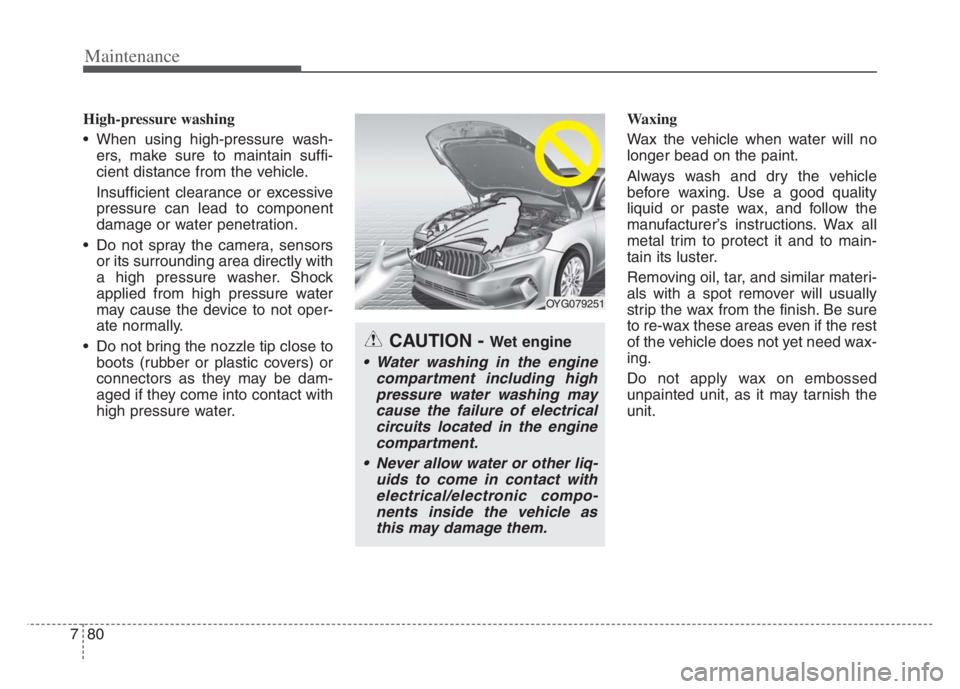
High-pressure washing
When using high-pressure wash-
ers, make sure to maintain suffi-
cient distance from the vehicle.
Insufficient clearance or excessive
pressure can lead to component
damage or water penetration.
Do not spray the camera, sensors
or its surrounding area directly with
a high pressure washer. Shock
applied from high pressure water
may cause the device to not oper-
ate normally.
Do not bring the nozzle tip close to
boots (rubber or plastic covers) or
connectors as they may be dam-
aged if they come into contact with
high pressure water.Waxing
Wax the vehicle when water will no
longer bead on the paint.
Always wash and dry the vehicle
before waxing. Use a good quality
liquid or paste wax, and follow the
manufacturer’s instructions. Wax all
metal trim to protect it and to main-
tain its luster.
Removing oil, tar, and similar materi-
als with a spot remover will usually
strip the wax from the finish. Be sure
to re-wax these areas even if the rest
of the vehicle does not yet need wax-
ing.
Do not apply wax on embossed
unpainted unit, as it may tarnish the
unit.
OYG079251
CAUTION - Wet engine
Water washing in the engine
compartment including high
pressure water washing may
cause the failure of electrical
circuits located in the engine
compartment.
Never allow water or other liq-
uids to come in contact with
electrical/electronic compo-
nents inside the vehicle as
this may damage them.
Page 529 of 560
Maintenance
84 7
When cleaning lower door panels,
rocker panels and frame members,
be sure that drain holes are kept
open so that moisture can escape
and not be trapped inside to accel-
erate corrosion.
Keep your garage dry
Don't park your vehicle in a damp,
poorly ventilated garage. This cre-
ates a favorable environment for cor-
rosion. This is particularly true if you
wash your vehicle in the garage or
drive it into the garage when it is still
wet or covered with snow, ice or
mud. Even a heated garage can con-
tribute to corrosion unless it is well
ventilated so moisture is dispersed.Keep paint and trim in good condi-
tion
Scratches or chips in the finish
should be covered with "touch-up"
paint as soon as possible to reduce
the possibility of corrosion. If bare
metal is showing through, the atten-
tion of a qualified body and paint
shop is recommended.
Bird droppings : Bird droppings are
highly corrosive and may damage
painted surfaces in just a few hours.
Always remove bird droppings as
soon as possible.
Don't neglect the interior
Moisture can collect under the floor
mats and carpeting and cause corro-
sion. Check under the mats periodi-
cally to be sure the carpeting is dry.
Use particular care if you carry fertil-
izers, cleaning materials or chemi-
cals in the vehicle.
These should be carried only in prop-
er containers and any spills or leaks
should be cleaned up, flushed with
clean water and thoroughly dried.Interior care
Interior general precautions
Prevent chemicals such as perfume,
cosmetic oil, sun cream, hand clean-
er, and air freshener from contacting
the interior parts because they may
cause damage or discoloration. If
they do contact the interior parts,
wipe them off immediately. If neces-
sary, use a vinyl cleaner, see product
instructions for correct usage.
Page 530 of 560
785
Maintenance
Taking care of leather seats
Vacuum the seat periodically to
remove dust and sand on the seat.
It will prevent abrasion or damage of
the leather and maintain its quality.
Wipe the natural leather seat cover
often with dry or soft cloth.
Sufficient use of a leather protec-
tive may prevent abrasion of the
cover and helps maintain the color.
Be sure to read the instructions
and consult a specialist when
using leather coating or protective
agents.
Leather with bright colors(beige,
cream beige) is easily contaminat-
ed and clear in appearance. Clean
the seats frequently.
Avoid wiping with wet cloth. It may
cause the surface to crack.
Cleaning the leather seats
Remove all contaminations instant-
ly. Refer to instructions below for
removal of each contaminant.
Cosmetic products(sunscreen,
foundation, etc.)
- Apply cleansing cream on a cloth
and wipe the contaminated point.
Wipe off the cream with a wet
cloth and remove water with a dry
cloth.
Beverages(coffee, soft drink, etc.)
- Apply a small amount of neutral
detergent and wipe until contami-
nations do not smear.
Oil
- Remove oil instantly with
absorbable cloth and wipe with
stain remover for natural leather
only.
Chewing gum
- Harden the gum with ice and
remove gradually.CAUTION - Electrical
components
Never allow water or other liq-
uids to come in contact with
electrical/electronic compo-
nents inside the vehicle as this
may damage them.
CAUTION - Leather
When cleaning leather products
(steering wheel, seats etc.), use
neutral detergents or low alco-
hol content solutions. If you use
high alcohol content solutions
or acid/alkaline detergents, the
color of the leather may fade or
the surface may get stripped off.
Page 531 of 560
Maintenance
86 7
Fabric seat cover using precau-
tions (If equipped)
Please clean the fabric seats regu-
larly with a vacuum cleaner in con-
sideration of fabric material charac-
teristics. If they are heavily soiled
with beverage stains, etc., use a suit-
able interior cleaner. To prevent dam-
age to seat covers, wipe off the seat
covers down to the seams with a
large wiping motion and moderate
pressure using a soft sponge or
microfiber cloth.
Velcro closures on clothing or sharp
objects may cause snagging or
scratches on the surface of the
seats. Make sure not to rub such
objects against the surface.
Cleaning the upholstery and inte-
rior trim
Vinyl
Remove dust and loose dirt from
vinyl with a whisk broom or vacuum
cleaner. Clean vinyl surfaces with a
vinyl cleaner.
Fabric
Remove dust and loose dirt from fab-
ric with a whisk broom or vacuum
cleaner. Clean with a mild soap solu-
tion recommended for upholstery or
carpets. Remove fresh spots imme-
diately with a fabric spot cleaner. If
fresh spots do not receive immediate
attention, the fabric can be stained
and its color can be affected. Also, its
fire-resistant properties can be
reduced if the material is not proper-
ly maintained.
Using anything but recommended
cleaners and procedures may affect
the fabric’s appearance and fire-
resistant properties.
Cleaning the lap/shoulder belt
webbing
Clean the belt webbing with any mild
soap solution recommended for
cleaning upholstery or carpet. Follow
the instructions provided with the
soap. Do not bleach or re-dye the
webbing because this may weaken it.
Cleaning the interior window
glass
If the interior glass surfaces of the
vehicle become fogged (that is, cov-
ered with an oily, greasy or waxy
film), they should be cleaned with a
glass cleaner. Follow the directions
on the glass cleaner container.
CAUTION- Rear window
Do not scrape or scratch the
inside of the rear window. This
may result in damage of the rear
window defroster grid.
Page 541 of 560
Specifications, Consumer information, Reporting safety defects
6 8
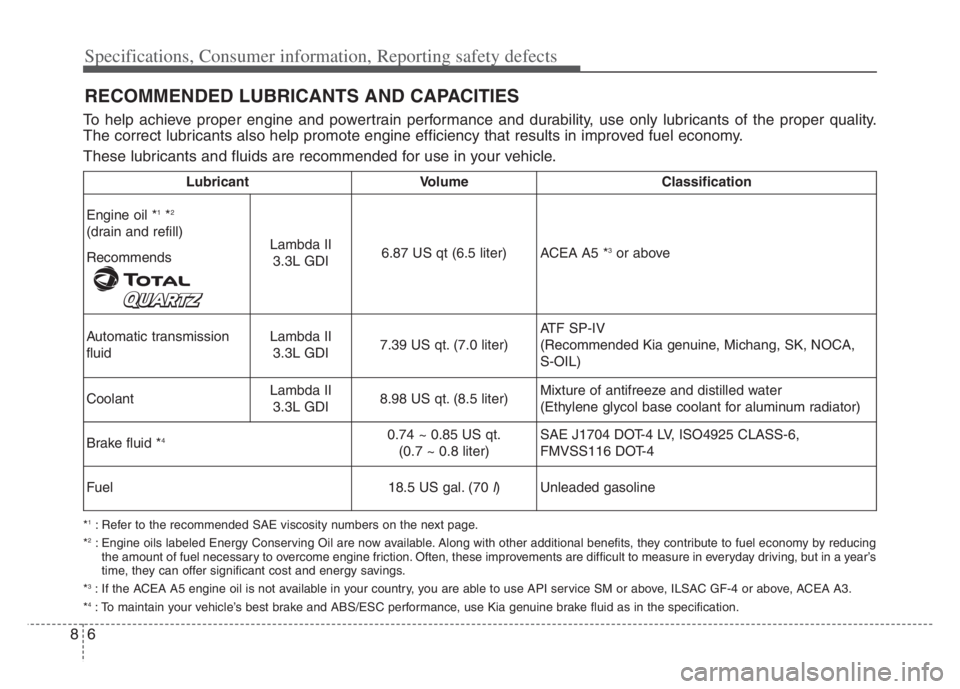
RECOMMENDED LUBRICANTS AND CAPACITIES
To help achieve proper engine and powertrain performance and durability, use only lubricants of the proper quality.
The correct lubricants also help promote engine efficiency that results in improved fuel economy.
These lubricants and fluids are recommended for use in your vehicle.
*1: Refer to the recommended SAE viscosity numbers on the next page.
*2: Engine oils labeled Energy Conserving Oil are now available. Along with other additional benefits, they contribute to fuel economy by reducing
the amount of fuel necessary to overcome engine friction. Often, these improvements are difficult to measure in everyday driving, but in a year’s
time, they can offer significant cost and energy savings.
*
3: If the ACEA A5 engine oil is not available in your country, you are able to use API service SM or above, ILSAC GF-4 or above, ACEA A3.
*4: To maintain your vehicle’s best brake and ABS/ESC performance, use Kia genuine brake fluid as in the specification.
LubricantVolume Classification
Engine oil *1*2
(drain and refill)
RecommendsLambda II
3.3L GDI6.87 US qt (6.5 liter)ACEA A5 *3or above
Automatic transmission
fluidLambda II
3.3L GDI
7.39 US qt. (7.0 liter)ATF SP-IV
(Recommended Kia genuine, Michang, SK, NOCA,
S-OIL)
CoolantLambda II
3.3L GDI
8.98 US qt. (8.5 liter)Mixture of antifreeze and distilled water
(Ethylene glycol base coolant for aluminum radiator)
Brake fluid *
40.74 ~ 0.85 US qt.
(0.7 ~ 0.8 liter)SAE J1704 DOT-4 LV, ISO4925 CLASS-6,
FMVSS116 DOT-4
Fuel
18.5 US gal. (70l) Unleaded gasoline
Page 542 of 560
87
Specifications, Consumer information, Reporting safety defects
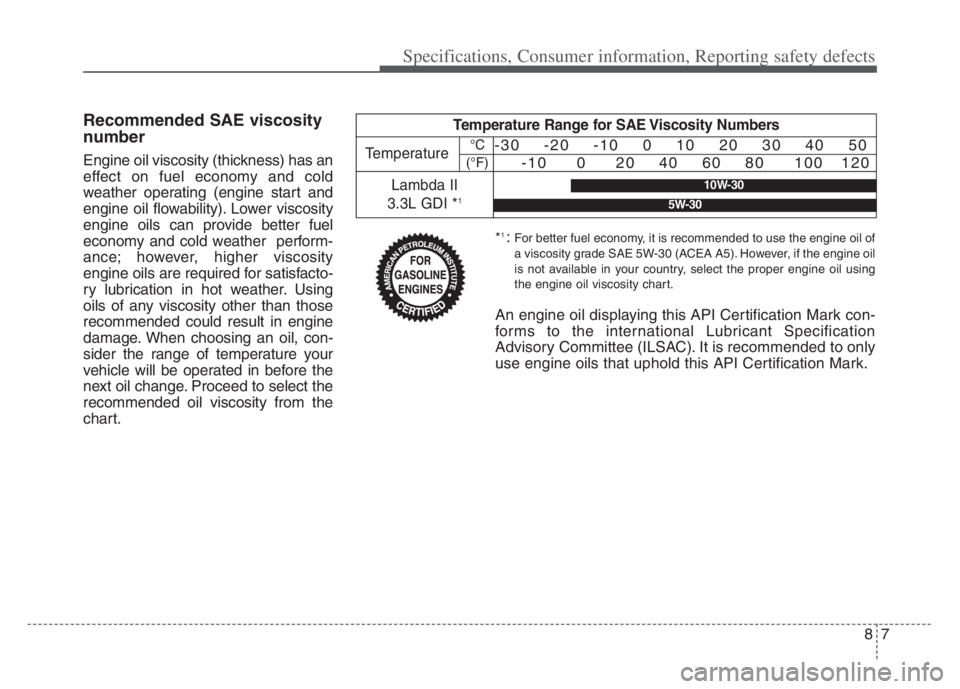
Recommended SAE viscosity
number
Engine oil viscosity (thickness) has an
effect on fuel economy and cold
weather operating (engine start and
engine oil flowability). Lower viscosity
engine oils can provide better fuel
economy and cold weather perform-
ance; however, higher viscosity
engine oils are required for satisfacto-
ry lubrication in hot weather. Using
oils of any viscosity other than those
recommended could result in engine
damage. When choosing an oil, con-
sider the range of temperature your
vehicle will be operated in before the
next oil change. Proceed to select the
recommended oil viscosity from the
chart.
Temperature Range for SAE Viscosity Numbers
Temperature
Lambda II
3.3L GDI *
1
°C
(°F)-30 -20 -10 0 10 20 30 40 50
-10 0 20 40 60 80 100 120
10W-30
5W-30
*1 :For better fuel economy, it is recommended to use the engine oil of
a viscosity grade SAE 5W-30 (ACEA A5). However, if the engine oil
is not available in your country, select the proper engine oil using
the engine oil viscosity chart.
An engine oil displaying this API Certification Mark con-
forms to the international Lubricant Specification
Advisory Committee (ILSAC). It is recommended to only
use engine oils that uphold this API Certification Mark.
Page 553 of 560
Index
4I
Emission control system ................................................7-87
Crankcase emission control system ............................7-87
Evaporative emission control (including ORVR:Onboard
Refueling Vapor Recovery) system ..........................7-87
Exhaust emission control system ................................7-88
Engine ............................................................................8-2
Engine compartment ................................................2-6, 7-3
Engine coolant ..............................................................7-20
Changing the coolant ..................................................7-22
Checking the coolant level..........................................7-20
Engine number ................................................................8-9
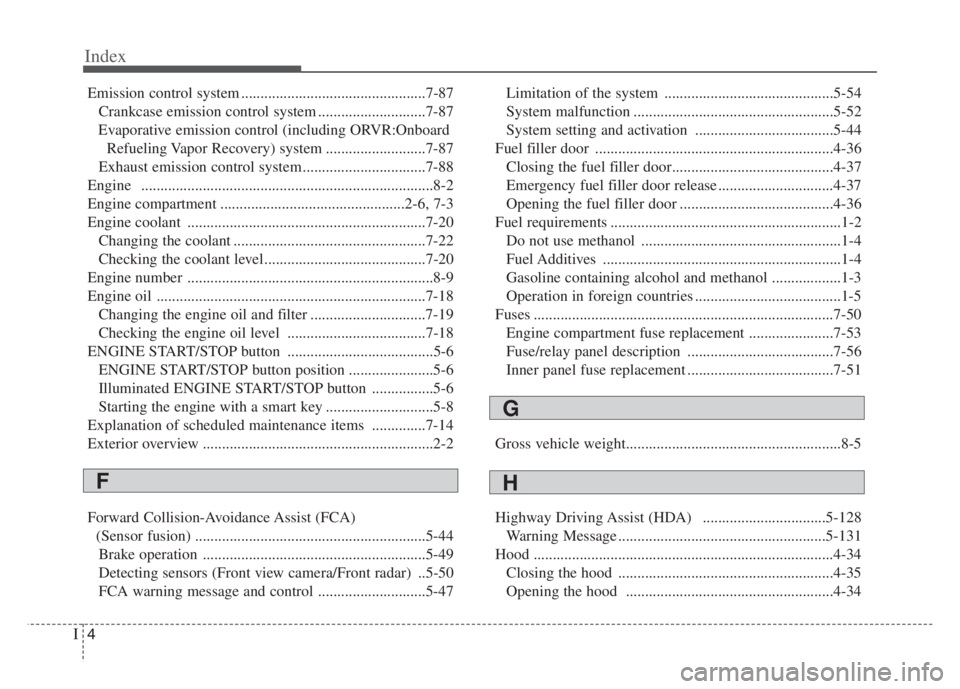
Engine oil ......................................................................7-18
Changing the engine oil and filter ..............................7-19
Checking the engine oil level ....................................7-18
ENGINE START/STOP button ......................................5-6
ENGINE START/STOP button position ......................5-6
Illuminated ENGINE START/STOP button ................5-6
Starting the engine with a smart key ............................5-8
Explanation of scheduled maintenance items ..............7-14
Exterior overview ............................................................2-2
Forward Collision-Avoidance Assist (FCA)
(Sensor fusion) ............................................................5-44
Brake operation ..........................................................5-49
Detecting sensors (Front view camera/Front radar) ..5-50
FCA warning message and control ............................5-47Limitation of the system ............................................5-54
System malfunction ....................................................5-52
System setting and activation ....................................5-44
Fuel filler door ..............................................................4-36
Closing the fuel filler door..........................................4-37
Emergency fuel filler door release ..............................4-37
Opening the fuel filler door ........................................4-36
Fuel requirements ............................................................1-2
Do not use methanol ....................................................1-4
Fuel Additives ..............................................................1-4
Gasoline containing alcohol and methanol ..................1-3
Operation in foreign countries ......................................1-5
Fuses ..............................................................................7-50
Engine compartment fuse replacement ......................7-53
Fuse/relay panel description ......................................7-56
Inner panel fuse replacement ......................................7-51
Gross vehicle weight........................................................8-5
Highway Driving Assist (HDA) ................................5-128
Warning Message ......................................................5-131
Hood ..............................................................................4-34
Closing the hood ........................................................4-35
Opening the hood ......................................................4-34
F
G
H
Page 559 of 560
Index
10I
Washer fluid ..................................................................7-24
Checking the washer fluid level..................................7-24
Welcome system ..........................................................4-130
Interior light ............................................................4-131
Windows ........................................................................4-29
Power windows ..........................................................4-30
Windshield defrosting and defogging..........................4-149
Auto defogging system ............................................4-151
Automatic climate control system ............................4-149
Defogging logic ........................................................4-150
Winter driving ..............................................................5-155
Carry emergency equipment ....................................5-158
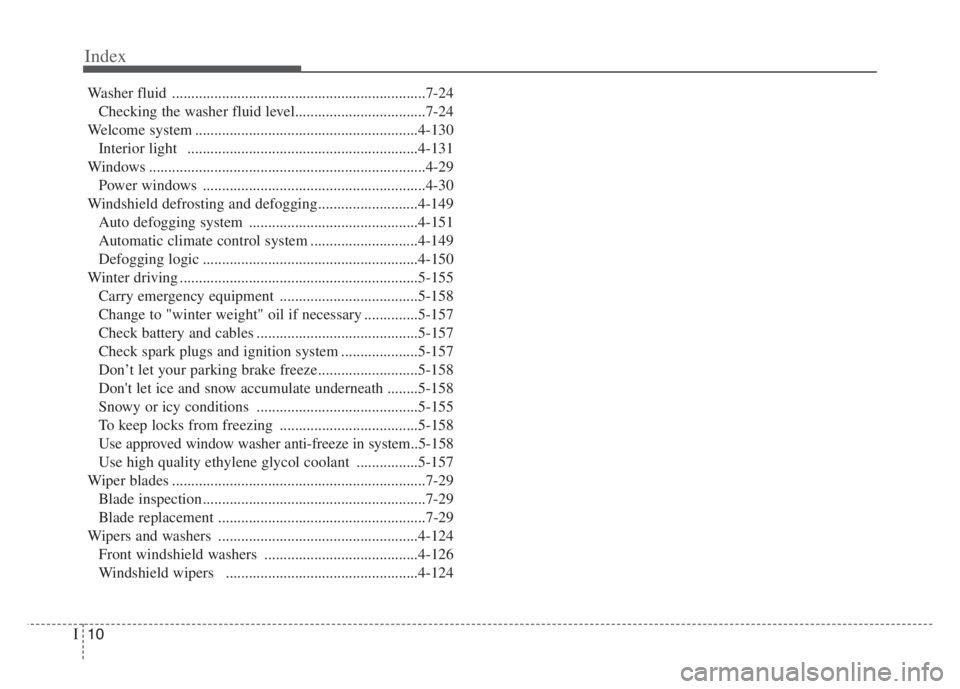
Change to "winter weight" oil if necessary ..............5-157
Check battery and cables ..........................................5-157
Check spark plugs and ignition system ....................5-157
Don’t let your parking brake freeze..........................5-158
Don't let ice and snow accumulate underneath ........5-158
Snowy or icy conditions ..........................................5-155
To keep locks from freezing ....................................5-158
Use approved window washer anti-freeze in system..5-158
Use high quality ethylene glycol coolant ................5-157
Wiper blades ..................................................................7-29
Blade inspection ..........................................................7-29
Blade replacement ......................................................7-29
Wipers and washers ....................................................4-124
Front windshield washers ........................................4-126
Windshield wipers ..................................................4-124