spare wheel KIA Carens 2017 3.G User Guide
[x] Cancel search | Manufacturer: KIA, Model Year: 2017, Model line: Carens, Model: KIA Carens 2017 3.GPages: 625, PDF Size: 19.69 MB
Page 548 of 625
Maintenance
48
8
TIRES AND WHEELS
Tire care
For proper maintenance, safety, and
maximum fuel economy, you must
always maintain recommended tire
inflation pressures and stay within
the load limits and weight distribution
recommended for your vehicle.
Recommended cold tire infla-
tion pressures
All tire pressures (including the
spare) should be checked when the
tires are cold. “Cold Tires” means the
vehicle has not been driven for at
least three hours or driven less than
1.6 km (one mile).
Recommended pressures must be
maintained for the best ride, top vehi-
cle handling, and minimum tire wear.
For recommended inflation pressure
refer to “Tire and wheels” in section
9.
WARNING
Tire failure may cause loss of
vehicle control resulting in an
accident. To reduce risk of
SERIOUS INJURY or DEATH,
take the following precautions:
Inspect your tires monthly for
proper inflation as well as
wear and damage.
The recommended cold tire pressure for your vehicle can
be found in this manual and
on the tire label located on the
driver’s side center pillar.
Always use a tire pressure
gauge to measure tire pres-
sure. Tires with too much or too
little pressure wear unevenly
causing poor handling.
Check the pressure of the spare every time you check
the pressure of the other tires
on your vehicle.
(Continued)
(Continued)
Replace tires that are worn,show uneven wear, or are
damaged. Worn tires can
cause loss of braking effec-
tiveness, steering) control, or
traction.
ALWAYS replace tires with the same size as each tire that
was originally supplied with
this vehicle. Using tires and
wheels other than the recom-
mended sizes could cause
unusual handling characteris-
tics, poor vehicle control, or
negatively affect your vehi-
cle's Anti-Lock Brake System
(ABS) resulting in a serious
accident.
Page 550 of 625
Maintenance
50
8
CAUTION
Underinflation also results in
excessive wear, poor handlingand reduced fuel economy.Wheel deformation also ispossible. Keep your tire pres-sures at the proper levels. If atire frequently needs refilling,have it checked by an author-ized Kia dealer.
Overinflation produces a harsh ride, excessive wear atthe center of the tire tread, anda greater possibility of dam-age from road hazards.
WARNING- Tire Inflation
Overinflation or underinflation
can reduce tire life, adversely
affect vehicle handling, and
lead to sudden tire failure. This
could result in loss of vehicle
control and potential injury.
CAUTION - Tire pressure
Always observe the following: Check tire pressure when the tires are cold. (After vehiclehas been parked for at leastthree hours or hasn't beendriven more than 1.6 km (onemile) since startup.)
Check the pressure of your spare tire each time you checkthe pressure of other tires.
Never overload your vehicle. Be careful not to overload avehicle luggage rack if yourvehicle is equipped with one.
Worn, old tires can cause acci- dents. If your tread is badlyworn, or if your tires havebeen damaged, replace them.
CAUTION
Warm tires normally exceed recommended cold tire pres-sures by 28 to 41 kPa (4 to 6psi ). Do not release air fromwarm tires to adjust the pres-sure or the tires will be under-inflated.
Be sure to reinstall the tire inflation valve caps. Withoutthe valve cap, dirt or moisturecould get into the valve coreand cause air leakage. If avalve cap is missing, install anew one as soon as possible.
Page 552 of 625
Maintenance
52
8
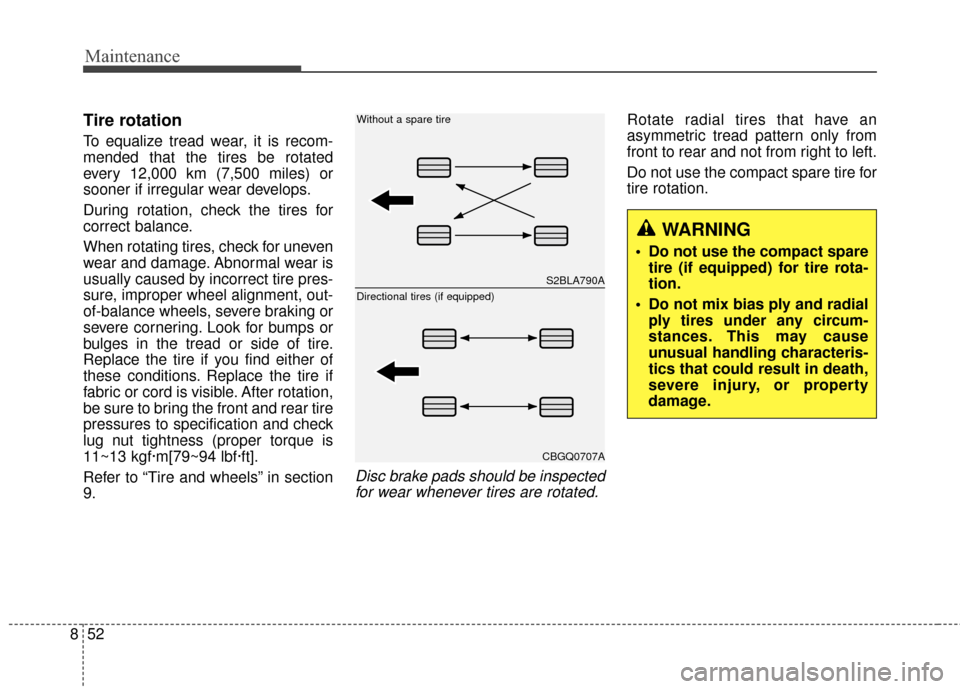
Tire rotation
To equalize tread wear, it is recom-
mended that the tires be rotated
every 12,000 km (7,500 miles) or
sooner if irregular wear develops.
During rotation, check the tires for
correct balance.
When rotating tires, check for uneven
wear and damage. Abnormal wear is
usually caused by incorrect tire pres-
sure, improper wheel alignment, out-
of-balance wheels, severe braking or
severe cornering. Look for bumps or
bulges in the tread or side of tire.
Replace the tire if you find either of
these conditions. Replace the tire if
fabric or cord is visible. After rotation,
be sure to bring the front and rear tire
pressures to specification and check
lug nut tightness (proper torque is
11~13 kgf·m[79~94 lbf·ft].
Refer to “Tire and wheels” in section
9.
Disc brake pads should be inspected
for wear whenever tires are rotated.
Rotate radial tires that have an
asymmetric tread pattern only from
front to rear and not from right to left.
Do not use the compact spare tire for
tire rotation.
S2BLA790A
CBGQ0707A
Without a spare tire
Directional tires (if equipped)
WARNING
Do not use the compact spare tire (if equipped) for tire rota-
tion.
Do not mix bias ply and radial ply tires under any circum-
stances. This may cause
unusual handling characteris-
tics that could result in death,
severe injury, or property
damage.
Page 555 of 625
855
Maintenance
Compact spare tire replacement
A compact spare tire has a shorter
tread life than a regular size tire.
Replace it when you can see the
tread wear indicator bars on the tire.
The replacement compact spare tire
should be the same size and design
tire as the one provided with your
new vehicle and should be mounted
on the same compact spare tire
wheel. The compact spare tire is not
designed to be mounted on a regular
size wheel, and the compact spare
tire wheel is not designed for mount-
ing a regular size tire.(Continued)
The use of any other tire size ortype may seriously affect ride,
handling, ground clearance,
stopping distance, body to tire
clearance, snow tire clearance,
and speedometer reliability.
It is best to replace all four tires at the same time. If that
is not possible, or necessary,
then replace the two front or
two rear tires as a pair.
Replacing just one tire can
seriously affect your vehicle’s
handling.
The ABS works by comparing the speed of the wheels. Tire
size can affect wheel speed.
When replacing tires, all 4 tires
must use the same size origi-
nally supplied with the vehicle.
Using tires of a different size
can cause the ABS (Anti-lock
Brake System) and ESC
(Electronic Stability Control) (if
equipped) to work irregularly.
(Continued)(Continued)
For replacement with anunsymmetrical tire, you
should check the outside/
inside of the unsymmetrical
tire. Make sure that the out-
side mark should locate in the
outward direction. If not, it
may adversely affect the vehi-
cle performance, riding com-
fort, and tire worn-out rates.
Page 556 of 625
Maintenance
56
8
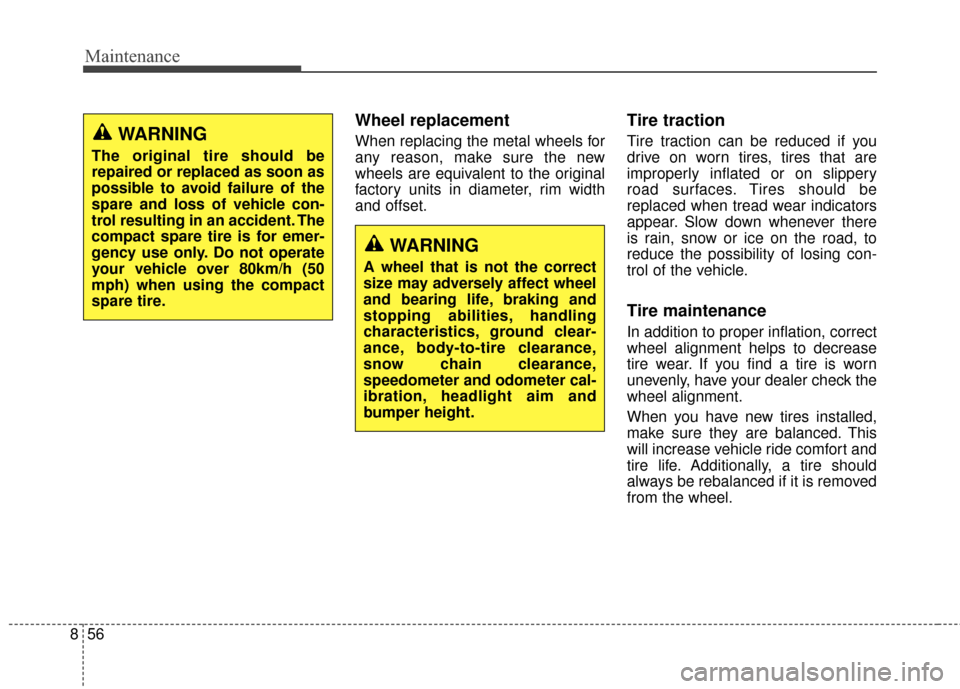
Wheel replacement
When replacing the metal wheels for
any reason, make sure the new
wheels are equivalent to the original
factory units in diameter, rim width
and offset.
Tire traction
Tire traction can be reduced if you
drive on worn tires, tires that are
improperly inflated or on slippery
road surfaces. Tires should be
replaced when tread wear indicators
appear. Slow down whenever there
is rain, snow or ice on the road, to
reduce the possibility of losing con-
trol of the vehicle.
Tire maintenance
In addition to proper inflation, correct
wheel alignment helps to decrease
tire wear. If you find a tire is worn
unevenly, have your dealer check the
wheel alignment.
When you have new tires installed,
make sure they are balanced. This
will increase vehicle ride comfort and
tire life. Additionally, a tire should
always be rebalanced if it is removed
from the wheel.
WARNING
A wheel that is not the correct
size may adversely affect wheel
and bearing life, braking and
stopping abilities, handling
characteristics, ground clear-
ance, body-to-tire clearance,
snow chain clearance,
speedometer and odometer cal-
ibration, headlight aim and
bumper height.
WARNING
The original tire should be
repaired or replaced as soon as
possible to avoid failure of the
spare and loss of vehicle con-
trol resulting in an accident. The
compact spare tire is for emer-
gency use only. Do not operate
your vehicle over 80km/h (50
mph) when using the compact
spare tire.
Page 558 of 625
Maintenance
58
8
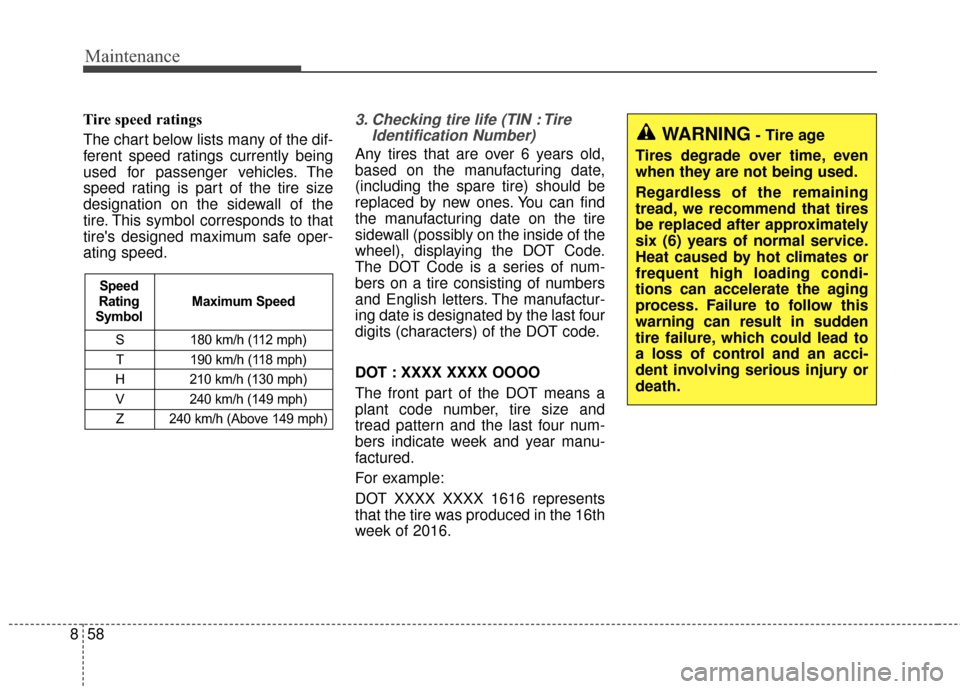
Tire speed ratings
The chart below lists many of the dif-
ferent speed ratings currently being
used for passenger vehicles. The
speed rating is part of the tire size
designation on the sidewall of the
tire. This symbol corresponds to that
tire's designed maximum safe oper-
ating speed.3. Checking tire life (TIN : Tire
Identification Number)
Any tires that are over 6 years old,
based on the manufacturing date,
(including the spare tire) should be
replaced by new ones. You can find
the manufacturing date on the tire
sidewall (possibly on the inside of the
wheel), displaying the DOT Code.
The DOT Code is a series of num-
bers on a tire consisting of numbers
and English letters. The manufactur-
ing date is designated by the last four
digits (characters) of the DOT code.
DOT : XXXX XXXX OOOO
The front part of the DOT means a
plant code number, tire size and
tread pattern and the last four num-
bers indicate week and year manu-
factured.
For example:
DOT XXXX XXXX 1616 represents
that the tire was produced in the 16th
week of 2016.
S 180 km/h (112 mph)
T 190 km/h (118 mph)
H 210 km/h (130 mph) V 240 km/h (149 mph)Z 240 km/h (Above 149 mph)
Maximum Speed
Speed
Rating
Symbol
WARNING- Tire age
Tires degrade over time, even
when they are not being used.
Regardless of the remaining
tread, we recommend that tires
be replaced after approximately
six (6) years of normal service.
Heat caused by hot climates or
frequent high loading condi-
tions can accelerate the aging
process. Failure to follow this
warning can result in sudden
tire failure, which could lead to
a loss of control and an acci-
dent involving serious injury or
death.
Page 607 of 625
Specifications & Consumer information
49
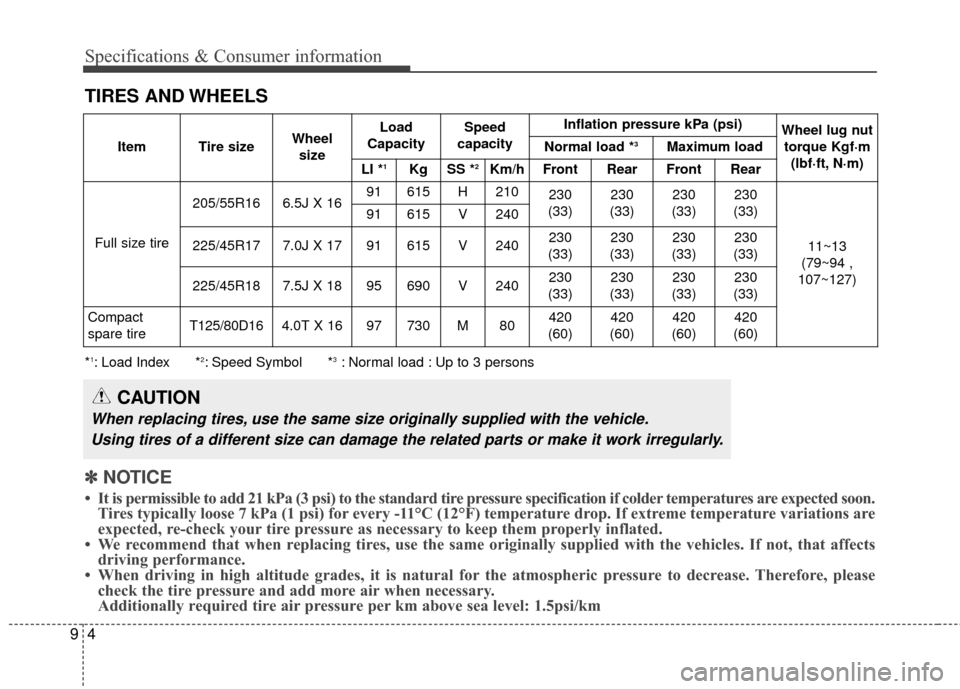
TIRES AND WHEELS
CAUTION
When replacing tires, use the same size originally supplied with the vehicle.Using tires of a different size can damage the related parts or make it work irregularly.
*1: Load Index *2: Speed Symbol *3: Normal load : Up to 3 persons
ItemTire sizeWheel sizeLoad
CapacitySpeed
capacityInflation pressure kPa (psi)Wheel lug nut torque Kgf·m (lbf·ft, N·m)
Normal load *3Maximum load
LI *1KgSS *2Km/hFront RearFront Rear
Full size tire
205/55R166.5J X 1691615H210230
(33)230
(33)230
(33)230
(33)
11~13
(79~94 ,
107~127)
91615V240
225/45R177.0J X 1791615V240230
(33)230
(33)230
(33)230
(33)
225/45R187.5J X 1895690V240230
(33)230
(33)230
(33)230
(33)
Compact
spare tireT125/80D164.0T X 1697730M80420
(60)420
(60)420
(60)420
(60)
✽ ✽ NOTICE
• It is permissible to add 21 kPa (3 psi) to the standard tire pressure specification if colder temperatures are expected soon.
Tires typically loose 7 kPa (1 psi) for every -11°C (12°F) temperature drop. If extreme temperature variations are
expected, re-check your tire pressure as necessary to keep them properly inflated.
• We recommend that when replacing tires, use the same originally supplied with the vehicles. If not, that aff\
ects driving performance.
• When driving in high altitude grades, it is natural for the atmospheric pressure to decrease. Therefore, please check the tire pressure and add more air when necessary.
Additionally required tire air pressure per km above sea level: 1.5psi/km
Page 623 of 625
I11
Index
Side curtain ..................................................................4-171
Side repeater light bulb replacement ............................8-86
Sliding the sunroof ........................................................4-44
Smart key ......................................................................4-\
11Smart key function ......................................................4-11
Using the button on the smart key ........................4-12,13
Loss of the smart key ..................................................4-14
Smart key precautions ................................................4-15
Smart key immobilizer system ..................................4-15
Smart key battery replacement ..................................4-17
Smart key battery replacement ......................................4-17
Smart key function ........................................................4-11
Smart key immobilizer system ......................................4-15
Smart key precautions ..................................................4-15
Smooth cornering ..........................................................6-60
Snow tires ......................................................................6-\
64
Spare tire Removing and storing the spare tire ..........................7-16
Changing tires ............................................................7-17
Special driving conditions ............................................6-59 Hazardous driving conditions ....................................6-59
Rocking the vehicle ....................................................6-59
Smooth cornering ........................................................6-60
Driving at night ..........................................................6-61
Driving in the rain ......................................................6-61
Driving in flooded areas ............................................6-62
Driving off-road ..........................................................6-62
Highway driving ........................................................6-62 Speedometer ..................................................................4-60
Sports mode - Automatic transaxle ..............................6-18
SRS Care........................................................................\
3-79
SRS components and functions ....................................3-54
Starting difficulties, see engine will not start ..................7-4
Starting the engine - With a smart key ..........................6-12
Starting the engine - With an ignition key ......................6-7
Steering wheel...........................................................\
.....4-48
Electric power steering ..............................................4-48
Tilt and telescopic steering ........................................4-49
Heated steering wheel ................................................4-50
Horn ........................................................................\
....4-50
Flex steer ....................................................................4-51\
Storage compartment ..................................................4-152 Center console storage ..............................................4-152
Glove box ..................................................................4-152
Cool box....................................................................4-15\
3
Sunglass holder ........................................................4-154
Luggage tray ............................................................4-154
Floor under tray ........................................................4-155
Sunglass holder ............................................................4-154
Sunroof ........................................................................\
..4-43 Sunroof open warning ................................................4-44
Sunshade ...............................................................\
.....4-46
Sliding the sunroof ......................................................4-44
Tilting the sunroof ....................................................4-45
Resetting the sunroof ..................................................4-47
Sunroof open warning ..................................................4-44