lock KIA CARENS RHD 2017 Owners Manual
[x] Cancel search | Manufacturer: KIA, Model Year: 2017, Model line: CARENS RHD, Model: KIA CARENS RHD 2017Pages: 723, PDF Size: 40.8 MB
Page 441 of 723
Driving your vehicle
6
6
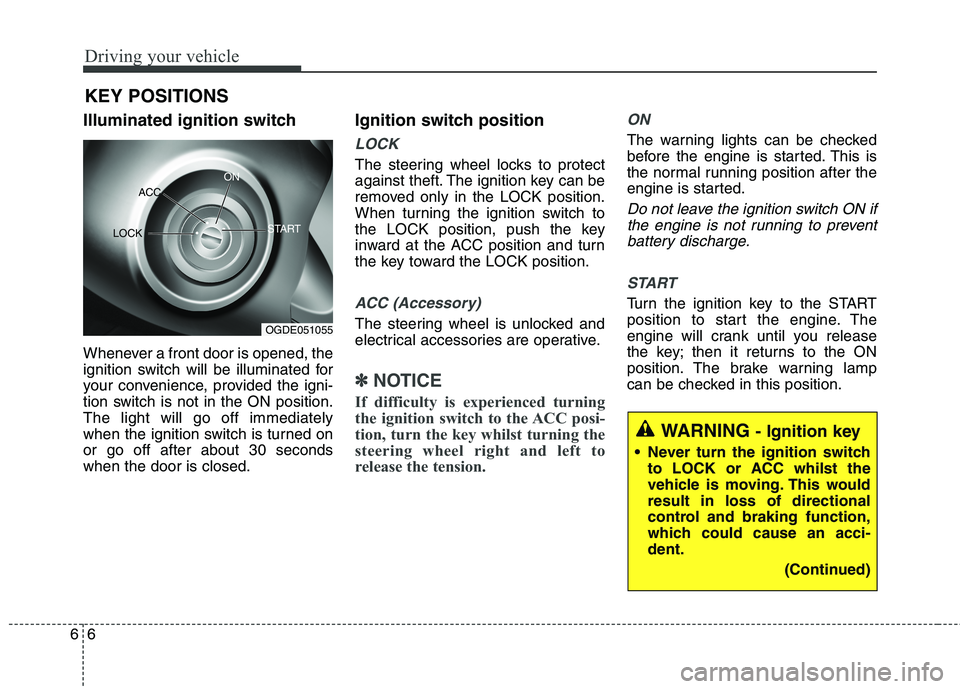
Illuminated ignition switch
Whenever a front door is opened, the
ignition switch will be illuminated for
your convenience, provided the igni-
tion switch is not in the ON position.The light will go off immediately
when the ignition switch is turned onor go off after about 30 secondswhen the door is closed. Ignition switch position
LOCK
The steering wheel locks to protect
against theft. The ignition key can be
removed only in the LOCK position.
When turning the ignition switch to
the LOCK position, push the key
inward at the ACC position and turn
the key toward the LOCK position.
ACC (Accessory)
The steering wheel is unlocked and
electrical accessories are operative.
✽✽
NOTICE
If difficulty is experienced turning
the ignition switch to the ACC posi-
tion, turn the key whilst turning the
steering wheel right and left to
release the tension.
ON
The warning lights can be checked
before the engine is started. This is
the normal running position after the
engine is started.
Do not leave the ignition switch ON if the engine is not running to preventbattery discharge.
START
Turn the ignition key to the START
position to start the engine. The
engine will crank until you release
the key; then it returns to the ON
position. The brake warning lamp
can be checked in this position.
KEY POSITIONS
WARNING
- Ignition key
Never turn the ignition switch to LOCK or ACC whilst the
vehicle is moving. This wouldresult in loss of directional
control and braking function,
which could cause an acci-dent.
(Continued)
OGDE051055
ACC
ON
START
LOCK
Page 442 of 723
67
Driving your vehicle
Starting the engine✽✽NOTICE - Kick down
mechanism (if equipped)
If your vehicle is equipped with a
kick down mechanism in the acceler-
ator pedal, it prevents you from driv-
ing at full throttle unintentionally by
making the driver require increased
effort to depress the accelerator
pedal. However, if you depress the
pedal more than approximately
82%, the vehicle can be at full throt-
tle and the accelerator pedal will be
easier to depress. This is not a mal-
function but a normal condition.(Continued)
The anti-theft steering column lock (if equipped) is not a sub-
stitute for the parking brake.
Before leaving the driver’s seat,
always make sure the shift lever
is engaged in 1st gear for the
manual transaxle or P (Park) forthe automatic transaxle / dual
clutch transmission, set the
parking brake fully and shut the
engine off. Unexpected and
sudden vehicle movement mayoccur if these precautions arenot taken.
Never reach for the ignition switch, or any other controls
through the steering wheel
whilst the vehicle is in motion.
The presence of your hand orarm in this area could cause a
loss of vehicle control, an
accident and serious bodily
injury or death.
Do not place any movable objects around the driver’s
seat as they may move whilst
driving, interfere with the driv-er and lead to an accident.
WARNING
Always wear appropriate shoes when operating your
vehicle. Unsuitable shoes (high
heels, ski boots,etc.) may inter-
fere with your ability to use the
brake, accelerator pedal and
clutch (if equipped) pedal.
Do not start the vehicle with the accelerator pedal
depressed. The vehicle can
move and lead to an accident.
Wait until the engine rpm is nor- mal. The vehicle may suddenly
move if the brake padel isreleased when the rpm is high.
Page 444 of 723
69
Driving your vehicle
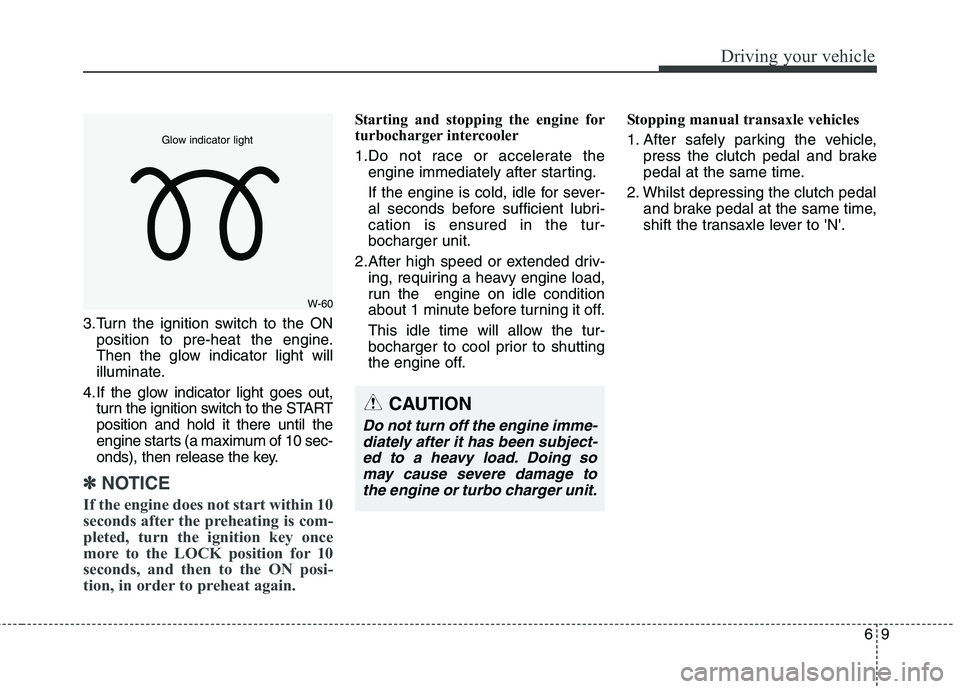
3.Turn the ignition switch to the ONposition to pre-heat the engine.
Then the glow indicator light will
illuminate.
4.If the glow indicator light goes out, turn the ignition switch to the STARTposition and hold it there until the
engine starts (a maximum of 10 sec-
onds), then release the key.
✽✽ NOTICE
If the engine does not start within 10
seconds after the preheating is com-
pleted, turn the ignition key once
more to the LOCK position for 10
seconds, and then to the ON posi-
tion, in order to preheat again.
Starting and stopping the engine for
turbocharger intercooler
1.Do not race or accelerate the engine immediately after starting.
If the engine is cold, idle for sever-
al seconds before sufficient lubri-cation is ensured in the tur-bocharger unit.
2.After high speed or extended driv- ing, requiring a heavy engine load,
run the engine on idle condition
about 1 minute before turning it off.
This idle time will allow the tur-
bocharger to cool prior to shutting
the engine off. Stopping manual transaxle vehicles
1. After safely parking the vehicle,
press the clutch pedal and brake
pedal at the same time.
2. Whilst depressing the clutch pedal and brake pedal at the same time,
shift the transaxle lever to 'N'.
W-60
Glow indicator light
CAUTION
Do not turn off the engine imme-
diately after it has been subject- ed to a heavy load. Doing somay cause severe damage tothe engine or turbo charger unit.
Page 445 of 723
Driving your vehicle
10
6
ENGINE START/STOP BUTTON (IF EQUIPPED)
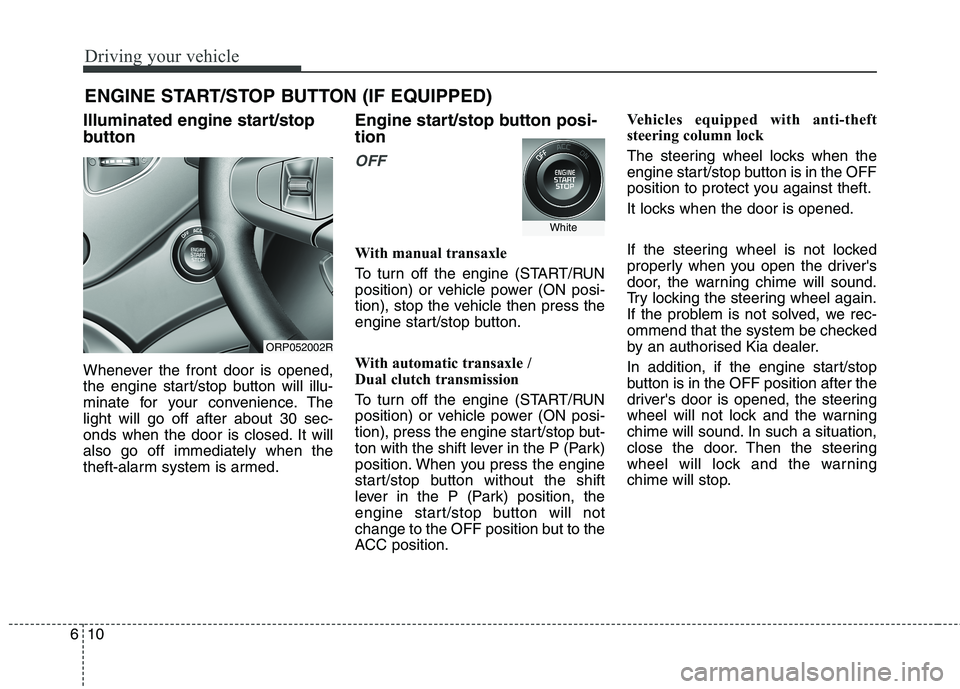
Illuminated engine start/stop
button
Whenever the front door is opened,
the engine start/stop button will illu-
minate for your convenience. Thelight will go off after about 30 sec-
onds when the door is closed. It willalso go off immediately when the
theft-alarm system is armed. Engine start/stop button posi- tion
OFF
With manual transaxle
To turn off the engine (START/RUN
position) or vehicle power (ON posi-
tion), stop the vehicle then press the
engine start/stop button.
With automatic transaxle /
Dual clutch transmission
To turn off the engine (START/RUN
position) or vehicle power (ON posi-
tion), press the engine start/stop but-
ton with the shift lever in the P (Park)
position. When you press the engine
start/stop button without the shift
lever in the P (Park) position, the
engine start/stop button will not
change to the OFF position but to the
ACC position.Vehicles equipped with anti-theft
steering column lock
The steering wheel locks when the
engine start/stop button is in the OFF
position to protect you against theft.
It locks when the door is opened.
If the steering wheel is not locked
properly when you open the driver's
door, the warning chime will sound.
Try locking the steering wheel again.
If the problem is not solved, we rec-
ommend that the system be checked
by an authorised Kia dealer.
In addition, if the engine start/stop
button is in the OFF position after the
driver's door is opened, the steering
wheel will not lock and the warning
chime will sound. In such a situation,
close the door. Then the steering
wheel will lock and the warning
chime will stop.
ORP052002R
White
Page 446 of 723
611
Driving your vehicle
✽✽
NOTICE
If the steering wheel doesn't unlock
properly, the engine start/stop but-
ton will not work. Press the engine
start/stop button whilst turning the
steering wheel right and left to
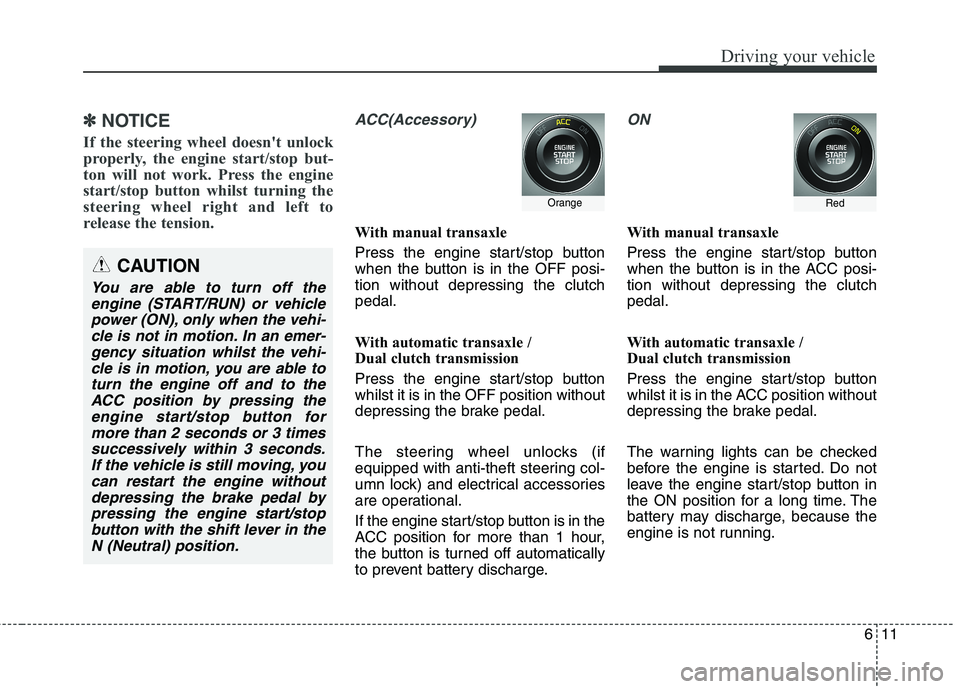
release the tension. ACC(Accessory)
With manual transaxle
Press the engine start/stop button
when the button is in the OFF posi-tion without depressing the clutchpedal.
With automatic transaxle /
Dual clutch transmission
Press the engine start/stop button whilst it is in the OFF position without
depressing the brake pedal.
The steering wheel unlocks (if
equipped with anti-theft steering col-
umn lock) and electrical accessories
are operational.
If the engine start/stop button is in the
ACC position for more than 1 hour,
the button is turned off automatically
to prevent battery discharge.
ON
With manual transaxle
Press the engine start/stop button
when the button is in the ACC posi-tion without depressing the clutchpedal.
With automatic transaxle /
Dual clutch transmission
Press the engine start/stop button
whilst it is in the ACC position without
depressing the brake pedal.
The warning lights can be checked
before the engine is started. Do not
leave the engine start/stop button in
the ON position for a long time. The
battery may discharge, because the
engine is not running.
CAUTION
You are able to turn off the engine (START/RUN) or vehiclepower (ON), only when the vehi- cle is not in motion. In an emer-gency situation whilst the vehi-cle is in motion, you are able to turn the engine off and to theACC position by pressing theengine start/stop button for more than 2 seconds or 3 timessuccessively within 3 seconds.If the vehicle is still moving, youcan restart the engine without depressing the brake pedal bypressing the engine start/stopbutton with the shift lever in the N (Neutral) position.
OrangeRed
Page 447 of 723
Driving your vehicle
12
6
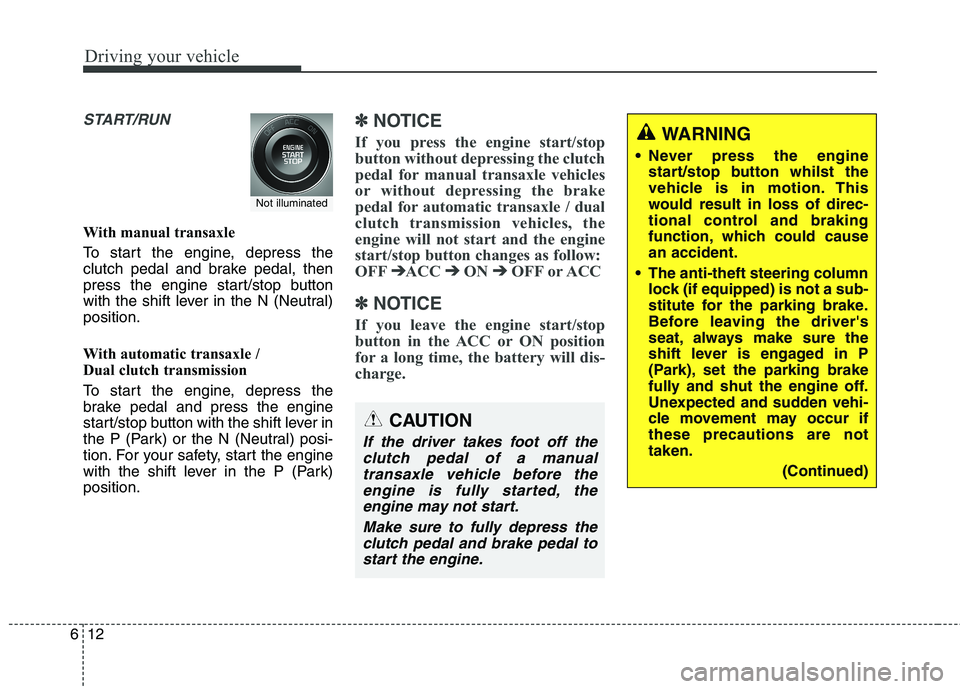
START/RUN
With manual transaxle
To start the engine, depress the
clutch pedal and brake pedal, then
press the engine start/stop button
with the shift lever in the N (Neutral)position.
With automatic transaxle /
Dual clutch transmission
To start the engine, depress the
brake pedal and press the engine
start/stop button with the shift lever in
the P (Park) or the N (Neutral) posi-
tion. For your safety, start the engine
with the shift lever in the P (Park)position.
✽✽
NOTICE
If you press the engine start/stop
button without depressing the clutch
pedal for manual transaxle vehicles
or without depressing the brake
pedal for automatic transaxle / dual
clutch transmission vehicles, the
engine will not start and the engine
start/stop button changes as follow:
OFF ➔
➔
ACC ➔➔
ON ➔➔
OFF or ACC
✽
✽
NOTICE
If you leave the engine start/stop
button in the ACC or ON position
for a long time, the battery will dis-
charge.
WARNING
Never press the engine start/stop button whilst the
vehicle is in motion. This
would result in loss of direc-
tional control and braking
function, which could causean accident.
The anti-theft steering column lock (if equipped) is not a sub-
stitute for the parking brake.
Before leaving the driver's
seat, always make sure the
shift lever is engaged in P
(Park), set the parking brake
fully and shut the engine off.
Unexpected and sudden vehi-
cle movement may occur ifthese precautions are nottaken.
(Continued)
Not illuminated
CAUTION
If the driver takes foot off theclutch pedal of a manualtransaxle vehicle before the engine is fully started, theengine may not start.
Make sure to fully depress theclutch pedal and brake pedal tostart the engine.
Page 449 of 723
Driving your vehicle
14
6
Starting the petrol engine
1.Carry the smart key or leave it
inside the vehicle.
2.Make sure the parking brake is firmly applied.
3. Manual Transaxle - Depress the
clutch pedal fully and shift the
transaxle into Neutral. Keep the
clutch pedal and brake pedal
depressed whilst starting the
engine.
Automatic transaxle / Dual clutch transmission - Place the
transaxle shift lever in P (Park).
Depress the brake pedal fully.
You can also start the engine when
the shift lever is in the N (Neutral)position.
4.Press the engine start/stop button.
It should be started without depress-
ing the accelerator. Manual Transaxle
To start the vehicle, keep the clutch
pedal and brake pedal depressed,
and make sure the engine RPM is
within normal range (under 1000
rpm). After checking, shift the
transaxle shift lever to the desiredposition.
Unlock the parking brake, and take
your foot off the clutch pedal. Then,
lightly depress the accelerator
pedal and slowly start the vehicle.
5. Do not wait for the engine to warm up whilst the vehicle remains sta-
tionary.
Start driving at moderate engine
speeds. (Steep accelerating and
decelerating should be avoided.)
Starting the diesel engine
To start the diesel engine when the engine is cold, it has to be pre-heat-
ed before starting the engine and
then have to be warmed up before
starting to drive.
1.Make sure the parking brake is applied.
2. Manual Transaxle - Depress the
clutch pedal fully and shift the
transaxle into Neutral. Keep the
clutch pedal and brake pedaldepressed whilst pressing the
engine start/stop button to the
START position.
Dual clutch transmission - Place
the transaxle shift lever in P (Park).
Depress the brake pedal fully.
You can also start the engine when
the shift lever is in the N (Neutral)position.
Page 451 of 723
Driving your vehicle
16
6
✽✽
NOTICE
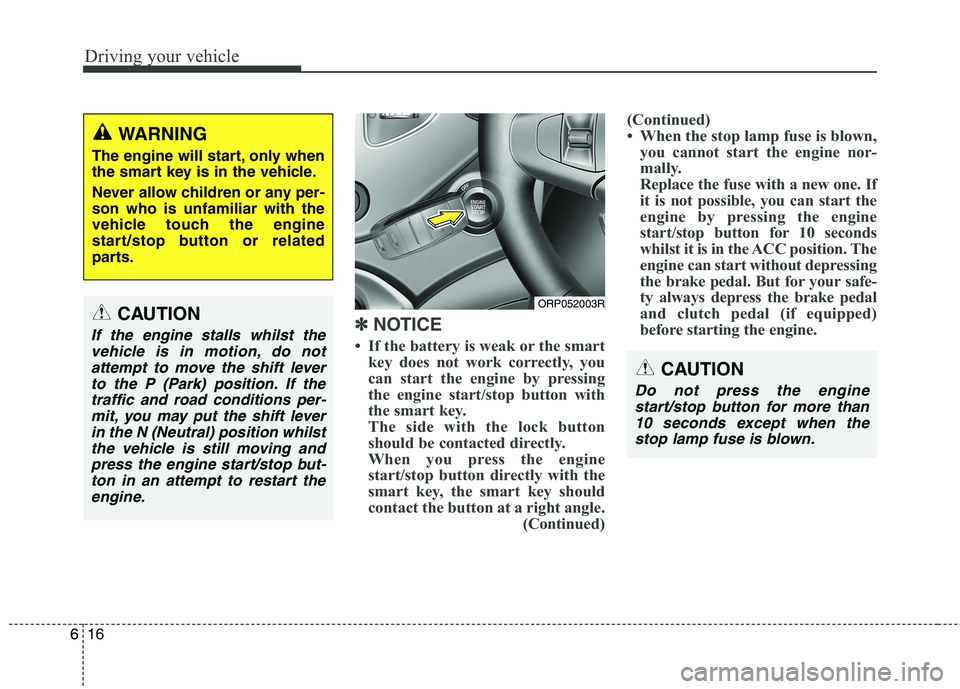
If the battery is weak or the smart key does not work correctly, you
can start the engine by pressing
the engine start/stop button with
the smart key.
The side with the lock button
should be contacted directly.
When you press the engine
start/stop button directly with the
smart key, the smart key should
contact the button at a right angle. (Continued) (Continued)
When the stop lamp fuse is blown,
you cannot start the engine nor-
mally.
Replace the fuse with a new one. If
it is not possible, you can start the
engine by pressing the engine
start/stop button for 10 seconds
whilst it is in the ACC position. The
engine can start without depressing
the brake pedal. But for your safe-
ty always depress the brake pedal
and clutch pedal (if equipped)
before starting the engine.
CAUTION
Do not press the engine
start/stop button for more than10 seconds except when thestop lamp fuse is blown.
ORP052003RCAUTION
If the engine stalls whilst thevehicle is in motion, do notattempt to move the shift lever to the P (Park) position. If thetraffic and road conditions per-mit, you may put the shift lever in the N (Neutral) position whilstthe vehicle is still moving andpress the engine start/stop but-ton in an attempt to restart the engine.
WARNING
The engine will start, only when
the smart key is in the vehicle.
Never allow children or any per- son who is unfamiliar with the
vehicle touch the engine
start/stop button or related
parts.
Page 455 of 723
Driving your vehicle
20
6
ISG system malfunction
The system may not operate
when:
The ISG related sensors or system
error occurs.
The following will happen:
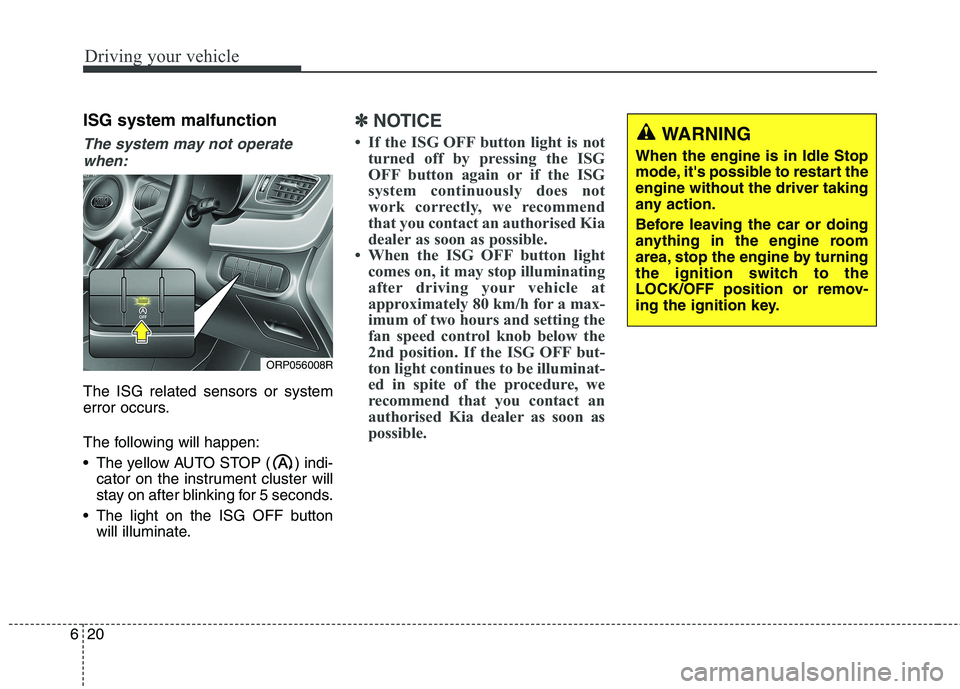
The yellow AUTO STOP ( ) indi- cator on the instrument cluster will
stay on after blinking for 5 seconds.
The light on the ISG OFF button will illuminate.
✽✽ NOTICE
If the ISG OFF button light is not turned off by pressing the ISG
OFF button again or if the ISG
system continuously does not
work correctly, we recommend
that you contact an authorised Kia
dealer as soon as possible.
When the ISG OFF button light comes on, it may stop illuminating
after driving your vehicle at
approximately 80 km/h for a max-
imum of two hours and setting the
fan speed control knob below the
2nd position. If the ISG OFF but-
ton light continues to be illuminat-
ed in spite of the procedure, we
recommend that you contact an
authorised Kia dealer as soon as
possible.
ORP056008R
WARNING
When the engine is in Idle Stop
mode, it's possible to restart theengine without the driver taking
any action.
Before leaving the car or doing
anything in the engine room
area, stop the engine by turning
the ignition switch to the
LOCK/OFF position or remov-
ing the ignition key.
Page 456 of 723
621
Driving your vehicle
Manual transaxle operation
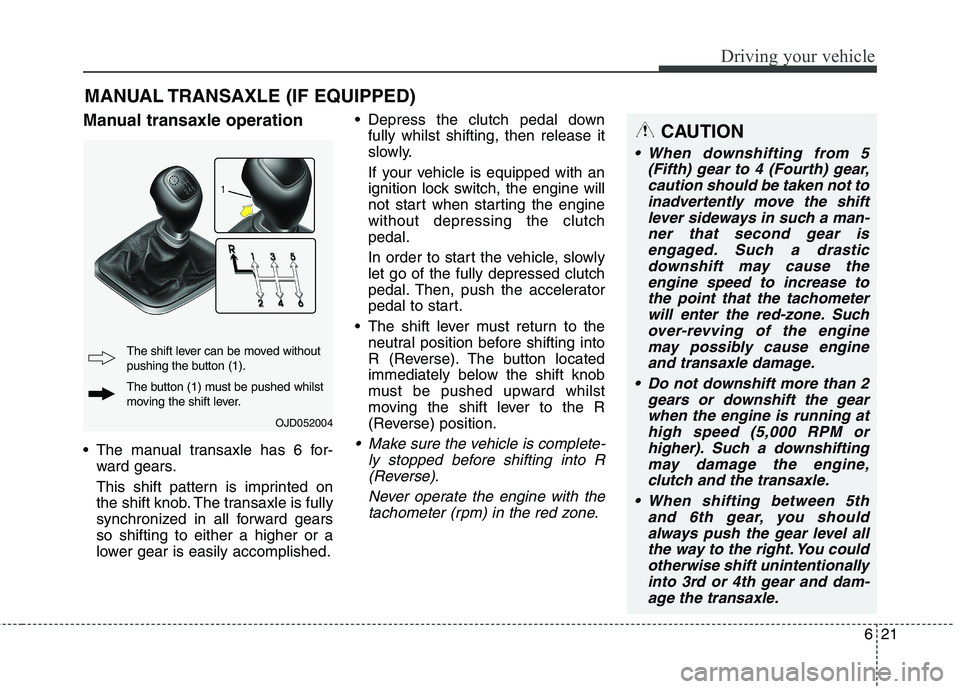
The manual transaxle has 6 for-ward gears.
This shift pattern is imprinted on
the shift knob. The transaxle is fully
synchronized in all forward gearsso shifting to either a higher or a
lower gear is easily accomplished. Depress the clutch pedal down
fully whilst shifting, then release it
slowly.
If your vehicle is equipped with an
ignition lock switch, the engine will
not start when starting the enginewithout depressing the clutchpedal.
In order to start the vehicle, slowly let go of the fully depressed clutch
pedal. Then, push the accelerator
pedal to start.
The shift lever must return to the neutral position before shifting into
R (Reverse). The button located
immediately below the shift knob
must be pushed upward whilst
moving the shift lever to the R
(Reverse) position.
Make sure the vehicle is complete-
ly stopped before shifting into R(Reverse).
Never operate the engine with thetachometer (rpm) in the red zone.
MANUAL TRANSAXLE (IF EQUIPPED)
OJD052004
The button (1) must be pushed whilst
moving the shift lever.
The shift lever can be moved without
pushing the button (1).
CAUTION
When downshifting from 5
(Fifth) gear to 4 (Fourth) gear,caution should be taken not to inadvertently move the shiftlever sideways in such a man-ner that second gear is engaged. Such a drasticdownshift may cause theengine speed to increase to the point that the tachometerwill enter the red-zone. Suchover-revving of the engine may possibly cause engineand transaxle damage.
Do not downshift more than 2 gears or downshift the gearwhen the engine is running at high speed (5,000 RPM orhigher). Such a downshiftingmay damage the engine, clutch and the transaxle.
When shifting between 5th and 6th gear, you shouldalways push the gear level allthe way to the right. You could otherwise shift unintentionallyinto 3rd or 4th gear and dam-age the transaxle.