engine KIA CARENS RHD 2017 Owners Manual
[x] Cancel search | Manufacturer: KIA, Model Year: 2017, Model line: CARENS RHD, Model: KIA CARENS RHD 2017Pages: 723, PDF Size: 40.8 MB
Page 547 of 723
Driving your vehicle
112
6
✽✽
NOTICE
With increasing altitude the engine
performance decreases. From 1,000
m above sea level and for every
1,000 m thereafter 10% of
vehicle/trailer weight (trailer
weighter + gross vehicle weight)
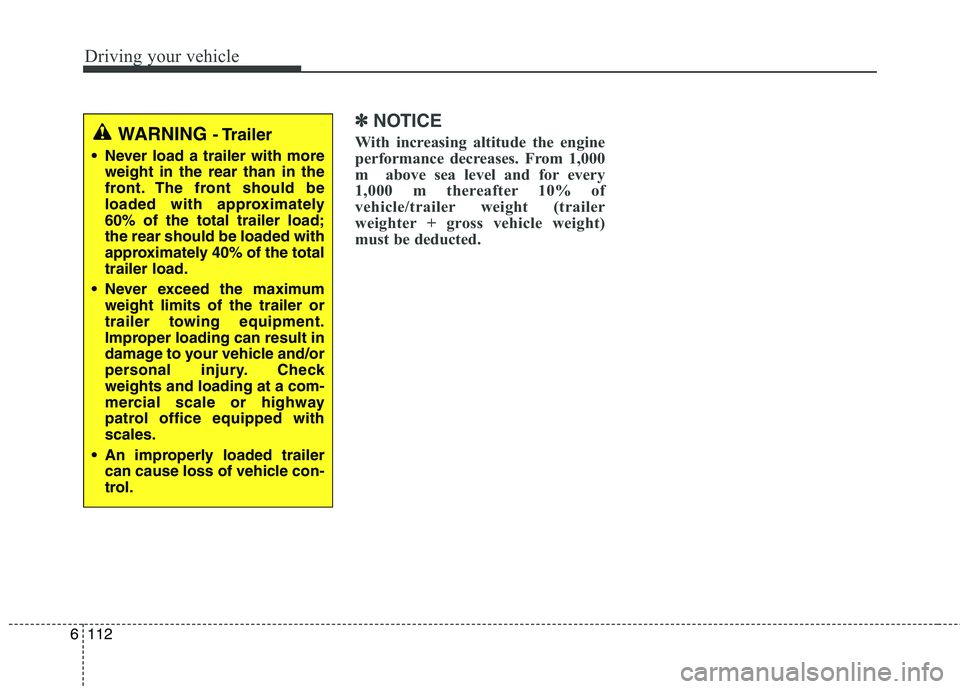
must be deducted.WARNING - Trailer
Never load a trailer with more weight in the rear than in the
front. The front should be
loaded with approximately60% of the total trailer load;the rear should be loaded with
approximately 40% of the totaltrailer load.
Never exceed the maximum weight limits of the trailer or
trailer towing equipment.
Improper loading can result in
damage to your vehicle and/or
personal injury. Checkweights and loading at a com-
mercial scale or highway
patrol office equipped withscales.
An improperly loaded trailer can cause loss of vehicle con-
trol.
Page 551 of 723
What to do in an emergency
Road warning . . . . . . . . . . . . . . . . . . . . . . . . . . . . . . 7-2• Hazard warning flasher . . . . . . . . . . . . . . . . . . . . . . . 7-2
In case of an emergency whilst driving . . . . . . . . . 7-3
. . . . . . . . . . . . . . 7-3
. . . . . . . . . . . . . . . . . . . . 7-3
If the engine does not start . . . . . . . . . . . . . . . . . . . 7-4 . . . . 7-4
. . . . 7-4
Emergency starting . . . . . . . . . . . . . . . . . . . . . . . . . 7-5
. . . . . . . . . . . . . . . . . . . . . . . . . . . . . . . . 7-7
If the engine overheats . . . . . . . . . . . . . . . . . . . . . . . 7-8
Tyre Pressure Monitoring System (TPMS) . . . . . . 7-9 . . . . . . . . . . . . . . . . . . . . . . 7-10
malfunction indicator . . . . . . . . . . . . . . . . . . . . . . . . 7-12
If you have a flat tyre (with spare tyre) . . . . . . . . 7-15 . . . . . . . . . . . . . . . . . . . . . . . . . . . . . . . 7-15
. . . . . . . . . . . 7-16
. . . . . . . . . . . . . . . . . . . . . . . . . . . . . . 7-17
. . . . . . . . . . . . . . . . . . . . . . . . . . . . . . . . . . . 7-24
. . . . . . . . . . 7-25 If you have a flat tyre (with tyre mobility kit). . . 7-26
. . . . . . . . . . . . . . . . . . . . . . . . . . . . . . . . . 7-26
. . . . . 7-27
. . . . . . . . . . . . . 7-28
. . . . . . . . . . . . . 7-30
. . . . . 7-31
. . . . . . . . . . . . . . . . . . . . . . . . . . . . . . . 7-31
Towing . . . . . . . . . . . . . . . . . . . . . . . . . . . . . . . . . . . 7-32 . . . . . . . . . . . . . . . . . . . . . . . . . . . . . . . 7-32
. . . . . . . . . . . . . . . . . . . . . . . 7-33
. . . . . . . . . . . . . . . . . . . . . . . . . . . . 7-34
Emergency Commodity . . . . . . . . . . . . . . . . . . . . . 7-37 . . . . . . . . . . . . . . . . . . . . . . . . . . . . . 7-37
. . . . . . . . . . . . . . . . . . . . . . . . . . . . 7-37
7
Page 553 of 723
73
What to do in an emergency
IN CASE OF AN EMERGENCY WHILST DRIVING
If the engine stalls at a cross-
road or crossing
If the engine stalls at a crossroad or crossing, set the shift lever in the
N (Neutral) position and then push
the vehicle to a safe place.
If your vehicle has a manual transaxle not equipped with a igni-
tion lock switch, the vehicle can
move forward by shifting to the2(Second) or 3(Third) gear and
then turning the starter withoutdepressing the clutch pedal. If you have a flat tyre whilst driving
If a tyre goes flat whilst you are driving:
1.Take your foot off the accelerator
pedal and let the vehicle slow down
whilst driving straight ahead. Do not
apply the brakes immediately orattempt to pull off the road as this
may cause a loss of control. When
the vehicle has slowed to such a
speed that it is safe to do so, brakecarefully and pull off the road.
Drive off the road as far as possible
and park on firm, level ground. If
you are on a divided highway, do
not park in the median area
between the two traffic lanes.
2.When the vehicle is stopped, turn on your emergency hazard flashers,
set the parking brake and put the
transaxle in P (automatic transaxle /
dual clutch transmission) or reverse
(manual transaxle). 3.Have all passengers get out of the
vehicle. Be sure they all get out on
the side of the vehicle that is away
from traffic.
4.When changing a flat tyre, follow the instruction provided later in this
chapter.
If engine stalls whilst driving
1.Reduce your speed gradually, keeping a straight line. Move cau-
tiously off the road to a safe place.
2.Turn on your emergency flashers.
3.Try to start the engine again. If your vehicle does not start, we recom-
mend that you consult an autho-
rised Kia dealer.
Page 554 of 723
What to do in an emergency
4
7
IF THE ENGINE DOES NOT START
If engine doesn't turn over or
turns over slowly
1.If your vehicle has an automatic transaxle / dual clutch transmis-
sion, be sure the shift lever is in N
(Neutral) or P (Park) and the emer-
gency brake is set.
2.Check the battery connections to be sure they are clean and tight.
3.Turn on the interior light. If the light dims or goes out when you operate
the starter, the battery is discharged.
4.Check the starter connections to be sure they are securely tightened.
5.Do not push or pull the vehicle to start it. See instructions for "Jump
starting". If engine turns over normally
but does not start
1.Check fuel level.
2.With the ignition switch in the
LOCK/ OFF position, check all connectors at ignition, coil and
spark plugs. Reconnect any that
may be disconnected or loose.
3.Check the fuel line in the engine compartment.
4.If the engine still does not start, we recommend that you call an autho-
rised Kia dealer.
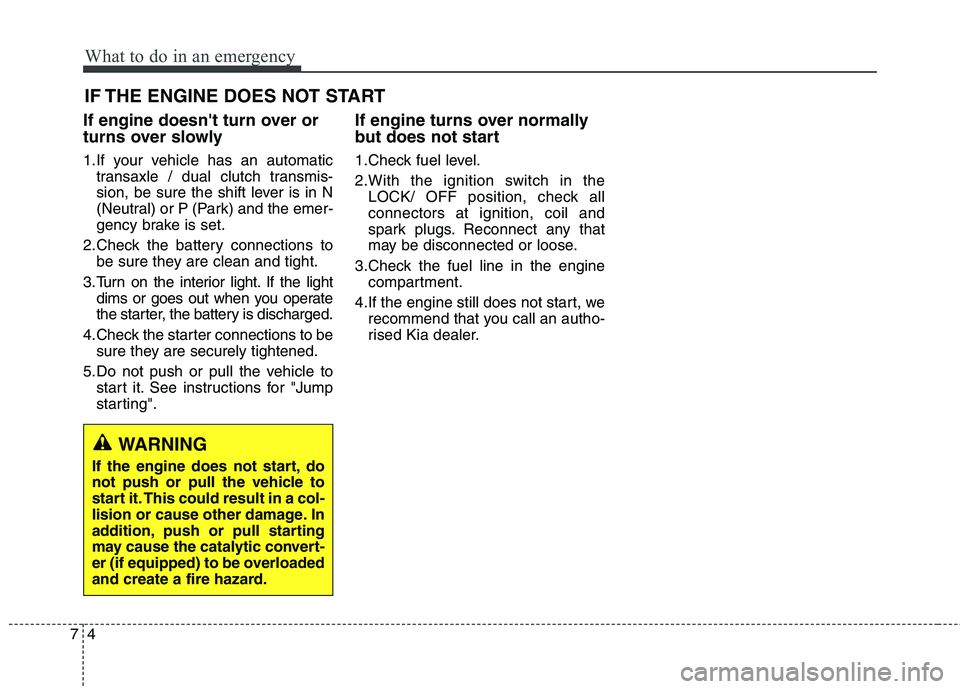
WARNING
If the engine does not start, do
not push or pull the vehicle to
start it. This could result in a col-
lision or cause other damage. In
addition, push or pull starting
may cause the catalytic convert-
er (if equipped) to be overloaded
and create a fire hazard.
Page 556 of 723
What to do in an emergency
6
7
Jump starting procedure
✽✽
NOTICE
If the battery is discharged, the
engine can be started using a battery
of another vehicle and two jumper
cables. Only use jumper cables with
fully insulated clamp handles.
To prevent personal injury or dam-
age to both vehicles, adhere strictly
to the following procedure.
(Continued)
Do not allow the (+) and (-) jumper cables to touch. It may cause sparks.
The battery may rupture or explode when you jump start
with a low or frozen battery.
CAUTION - AGM battery
(if equipped)
Absorbent Glass Matt (AGM) batteries are maintenance-freeand we recommend that theAGM batteries be serviced byan authorised Kia dealer. For charging your AGM battery,use only fully automatic bat-tery chargers that are speciallydeveloped for AGM batteries.
When replacing the AGM bat- tery, we recommend that youuse parts for replacementfrom an authorised Kia dealer.
Do not open or remove the cap on top of the battery. Thismay cause leaks of internalelectrolyte that could result insevere injury.
(Continued)
(Continued)
If the AGM battery is recon- nected or replaced, ISG func-tion will not operate immedi- ately.
If you want to use the ISGfunction, the battery sensorneeds to be calibrated forapproximately 4 hours with the ignition off.
Page 557 of 723
77
What to do in an emergency
1.Make sure the booster battery is12-volt and that its negative termi-
nal is grounded.
2.If the booster battery is in another vehicle, do not allow the vehicles totouch.
3.Turn off all unnecessary electrical loads.
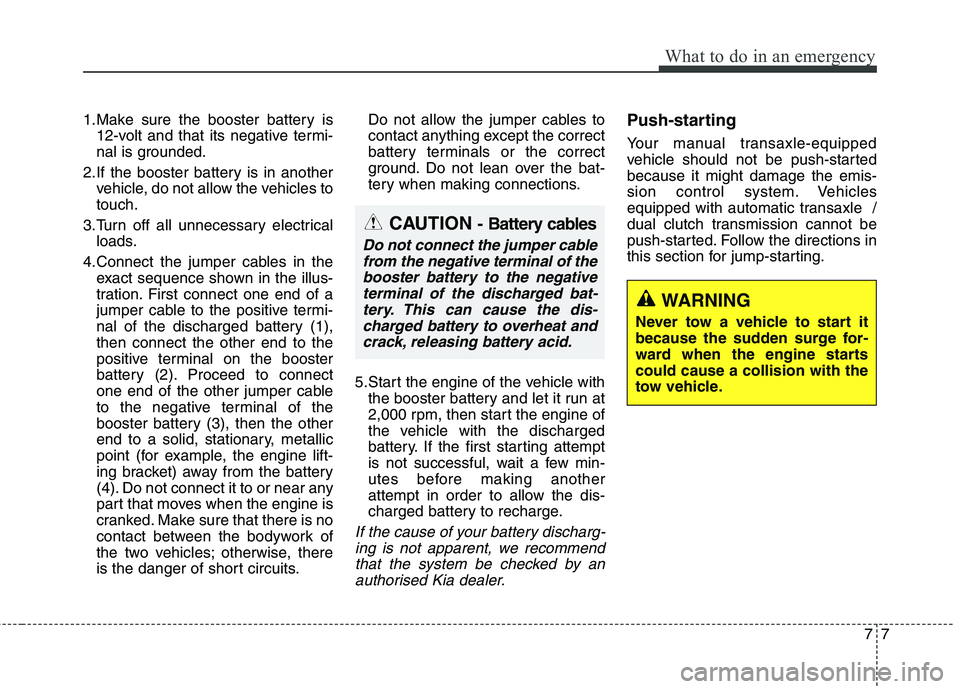
4.Connect the jumper cables in the exact sequence shown in the illus-
tration. First connect one end of a
jumper cable to the positive termi-
nal of the discharged battery (1),then connect the other end to the
positive terminal on the booster
battery (2). Proceed to connect
one end of the other jumper cable
to the negative terminal of the
booster battery (3), then the other
end to a solid, stationary, metallic
point (for example, the engine lift-
ing bracket) away from the battery
(4). Do not connect it to or near any
part that moves when the engine is
cranked. Make sure that there is no
contact between the bodywork of
the two vehicles; otherwise, there
is the danger of short circuits. Do not allow the jumper cables to
contact anything except the correct
battery terminals or the correct
ground. Do not lean over the bat-
tery when making connections.
5.Start the engine of the vehicle with the booster battery and let it run at
2,000 rpm, then start the engine of
the vehicle with the discharged
battery. If the first starting attempt
is not successful, wait a few min-
utes before making another
attempt in order to allow the dis-
charged battery to recharge.
If the cause of your battery discharg-
ing is not apparent, we recommendthat the system be checked by an authorised Kia dealer.
Push-starting
Your manual transaxle-equipped
vehicle should not be push-startedbecause it might damage the emis-
sion control system. Vehicles
equipped with automatic transaxle /
dual clutch transmission cannot be
push-started. Follow the directions in
this section for jump-starting.
CAUTION - Battery cables
Do not connect the jumper cable
from the negative terminal of thebooster battery to the negative terminal of the discharged bat-tery. This can cause the dis-charged battery to overheat and crack, releasing battery acid.
WARNING
Never tow a vehicle to start it
because the sudden surge for-
ward when the engine startscould cause a collision with the
tow vehicle.
Page 558 of 723
What to do in an emergency
8
7
IF THE ENGINE OVERHEATS
If your temperature gauge indicates
overheating, you will experience a
loss of power, or hear loud pinging or
knocking, the engine is probably too
hot. If this happens, you should:
1.Pull off the road and stop as soon as it is safe to do so.
2.Place the shift lever in P (automat- ic transaxle / dual clutch transmis-
sion) or neutral (manual transaxle)
and set the parking brake. If the air
conditioning is on, turn it off.
3.If engine coolant is running out under the vehicle or steam is com-ing out from the bonnet, stop the
engine. Do not open the bonnet until
the coolant has stopped running or
the steaming has stopped. If there is
no visible loss of engine coolant and
no steam, leave the engine running
and check to be sure the engine
cooling fan is operating. If the fan is
not running, turn the engine off.
4.Check to see if the water pump drive belt is missing. If it is not miss-
ing, check to see that it is tight. If the drive belt seems to be satis-
factory, check for coolant leaking
from the radiator, hoses or under
the vehicle. (If the air conditioning
had been in use, it is normal for
cold water to be draining from it
when you stop).
5.If the water pump drive belt is bro- ken or engine coolant is leakingout, stop the engine immediately
and we recommend that you call
an authorised Kia dealer. 6.If you cannot find the cause of the
overheating, wait until the engine
temperature has returned to nor-
mal. Then, if coolant has been lost,carefully add coolant to the reser-
voir to bring the fluid level in the
reservoir up to the halfway mark.
7.Proceed with caution, keeping alert for further signs of overheat-
ing. If overheating happens again,
we recommend that you call an
authorised Kia dealer.
CAUTION
Serious loss of coolant indi-
cates there is a leak in the cool-ing system and we recommend that the system be checked byan authorised Kia dealer.
When the engine overheats from low engine coolant, sud-denly adding engine coolant may cause cracks in theengine. To prevent damage,add engine coolant slowly in small quantities.
WARNING
Whilst the engine is running,
keep hair, hands and clothing
away from moving parts suchas the fan and drive belts to pre-
vent injury.
WARNING
Do not remove the radiator cap
when the engine is hot. This can
allow coolant to blow out of theopening and cause serious
burns.
Page 560 of 723
What to do in an emergency
10
7
Your vehicle has also been equipped
with a TPMS malfunction indicator toindicate when the system is not oper-
ating properly. The TPMS malfunction
indicator is combined with the low
tyre pressure telltale. When the sys-tem detects a malfunction, the telltale
will flash for approximately one
minute and then remain continuously
illuminated. This sequence will con-
tinue upon subsequent vehicle start-
ups as long as the malfunction exists.When the malfunction indicator is illu-
minated, the system may not be able
to detect or signal low tyre pressure
as intended. TPMS malfunctions may
occur for a variety of reasons, includ-ing the installation of replacement or
alternate tyres or wheels on the vehi-
cle that prevent the TPMS from func-
tioning properly. Always check theTPMS malfunction telltale afterreplacing one or more tyres or
wheels on your vehicle to ensure that
the replacement or alternate tyres
and wheels allow the TPMS to con-
tinue to function properly.✽✽
NOTICE
If the TPMS, Low Tyre Pressure
indicator do not illuminate for 3 sec-
onds when the ignition switch is
turned to the ON position or engine
is running, or if they remain illumi-
nated after coming on for approxi-
mately 3 seconds, we recommend
that the system be checked by an
authorised Kia dealer.Low tyre pressure telltale
When the tyre pressure monitoring
system warning indicators are illumi-
nated, one or more of your tyres issignificantly under-inflated.
If the telltale illuminates, immediately
reduce your speed, avoid hard cor-
nering and anticipate increased stop-
ping distances. You should stop and
check your tyres as soon as possi-
ble. Inflate the tyres to the proper
pressure as indicated on the vehi-
cle’s placard or tyre inflation pres-
sure label located on the driver’s side
centre pillar outer panel. If you can-
not reach a service station or if the
tyre cannot hold the newly added air,
replace the low pressure tyre with
the spare tyre.
Page 565 of 723
715
What to do in an emergency
IF YOU HAVE A FLAT TYRE (WITH SPARE TYRE, IF EQUIPPED)
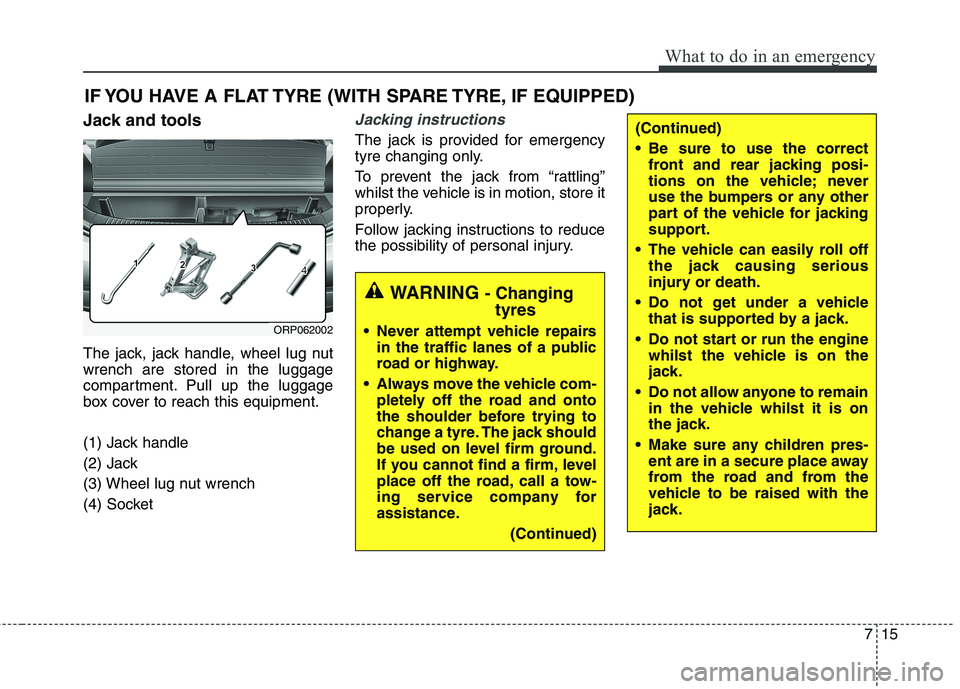
Jack and tools
The jack, jack handle, wheel lug nut wrench are stored in the luggage
compartment. Pull up the luggage
box cover to reach this equipment.
(1) Jack handle
(2) Jack
(3) Wheel lug nut wrench
(4) Socket
Jacking instructions
The jack is provided for emergency
tyre changing only.
To prevent the jack from “rattling”
whilst the vehicle is in motion, store it
properly.
Follow jacking instructions to reduce
the possibility of personal injury.
WARNING - Changing
tyres
Never attempt vehicle repairs in the traffic lanes of a public
road or highway.
Always move the vehicle com- pletely off the road and onto
the shoulder before trying to
change a tyre. The jack should
be used on level firm ground.
If you cannot find a firm, level
place off the road, call a tow-
ing service company for
assistance.
(Continued)
ORP062002
(Continued)
Be sure to use the correctfront and rear jacking posi-
tions on the vehicle; never
use the bumpers or any other
part of the vehicle for jacking
support.
The vehicle can easily roll off the jack causing serious
injury or death.
Do not get under a vehicle that is supported by a jack.
Do not start or run the engine whilst the vehicle is on the
jack.
Do not allow anyone to remain in the vehicle whilst it is on
the jack.
Make sure any children pres- ent are in a secure place away
from the road and from the
vehicle to be raised with the
jack.
Page 574 of 723
What to do in an emergency
24
7
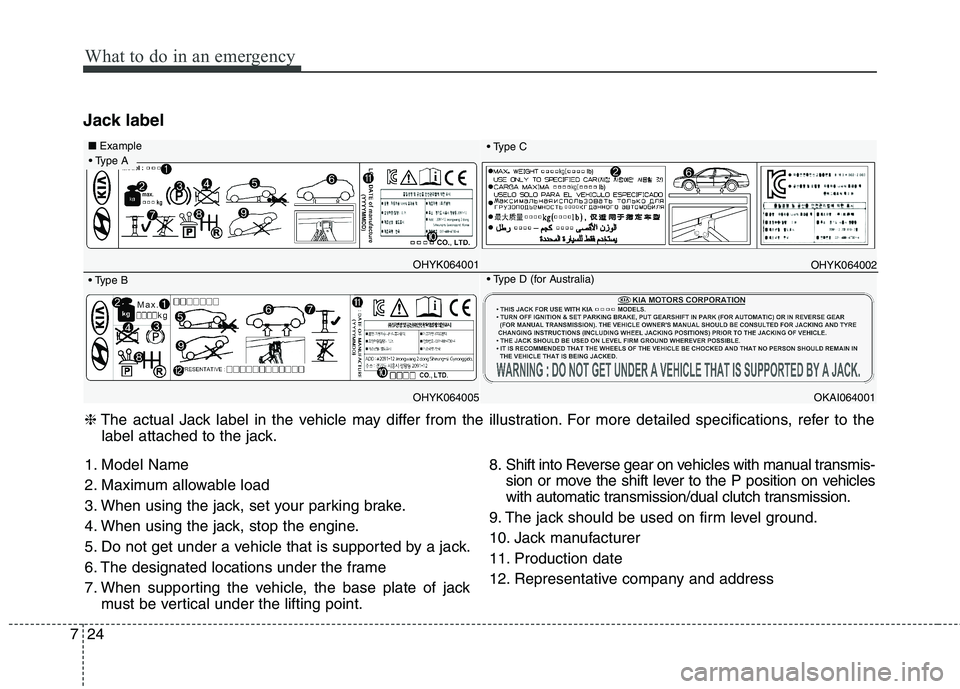
Jack label
❈ The actual Jack label in the vehicle may differ from the illustration. For more detailed specifications, refer to the
label attached to the jack.
OHYK064002
■ Example
OHYK064005
OHYK064001
OKAI064001
1. Model Name
2. Maximum allowable load
3. When using the jack, set your parking brake.
4. When using the jack, stop the engine.
5. Do not get under a vehicle that is supported by a jack.
6. The designated locations under the frame
7. When supporting the vehicle, the base plate of jack must be vertical under the lifting point. 8. Shift into Reverse gear on vehicles with manual transmis-
sion or move the shift lever to the P position on vehicles
with automatic transmission/dual clutch transmission.
9. The jack should be used on firm level ground.
10. Jack manufacturer
11. Production date
12. Representative company and address