engine KIA CARENS RHD 2017 Owners Manual
[x] Cancel search | Manufacturer: KIA, Model Year: 2017, Model line: CARENS RHD, Model: KIA CARENS RHD 2017Pages: 723, PDF Size: 40.8 MB
Page 531 of 723
Driving your vehicle
96
6
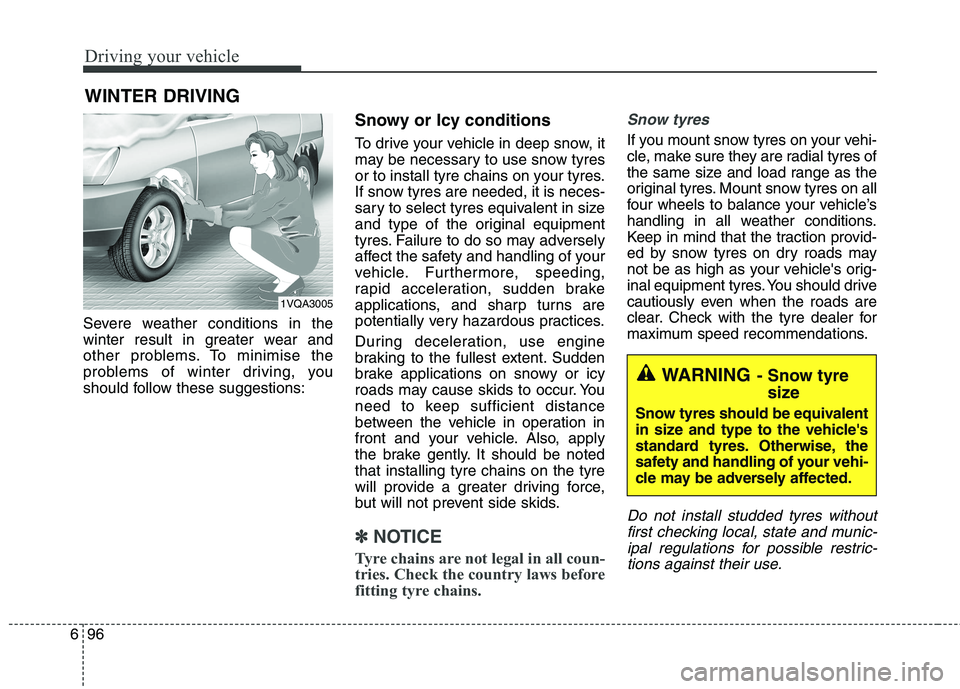
Severe weather conditions in the
winter result in greater wear and
other problems. To minimise the
problems of winter driving, you
should follow these suggestions: Snowy or Icy conditions
To drive your vehicle in deep snow, it
may be necessary to use snow tyres
or to install tyre chains on your tyres.
If snow tyres are needed, it is neces-
sary to select tyres equivalent in size
and type of the original equipment
tyres. Failure to do so may adversely
affect the safety and handling of your
vehicle. Furthermore, speeding,
rapid acceleration, sudden brake
applications, and sharp turns are
potentially very hazardous practices.
During deceleration, use engine
braking to the fullest extent. Sudden
brake applications on snowy or icy
roads may cause skids to occur. You
need to keep sufficient distance
between the vehicle in operation in
front and your vehicle. Also, apply
the brake gently. It should be notedthat installing tyre chains on the tyre
will provide a greater driving force,
but will not prevent side skids.
✽✽
NOTICE
Tyre chains are not legal in all coun-
tries. Check the country laws before
fitting tyre chains.
Snow tyres
If you mount snow tyres on your vehi-
cle, make sure they are radial tyres of
the same size and load range as the
original tyres. Mount snow tyres on all
four wheels to balance your vehicle’s
handling in all weather conditions.
Keep in mind that the traction provid-
ed by snow tyres on dry roads may
not be as high as your vehicle's orig-
inal equipment tyres. You should drive
cautiously even when the roads are
clear. Check with the tyre dealer for
maximum speed recommendations.
Do not install studded tyres without first checking local, state and munic-ipal regulations for possible restric-tions against their use.
WINTER DRIVING
WARNING - Snow tyre
size
Snow tyres should be equivalent
in size and type to the vehicle's
standard tyres. Otherwise, the
safety and handling of your vehi-
cle may be adversely affected.
1VQA3005
Page 532 of 723
697
Driving your vehicle
Tyre chains
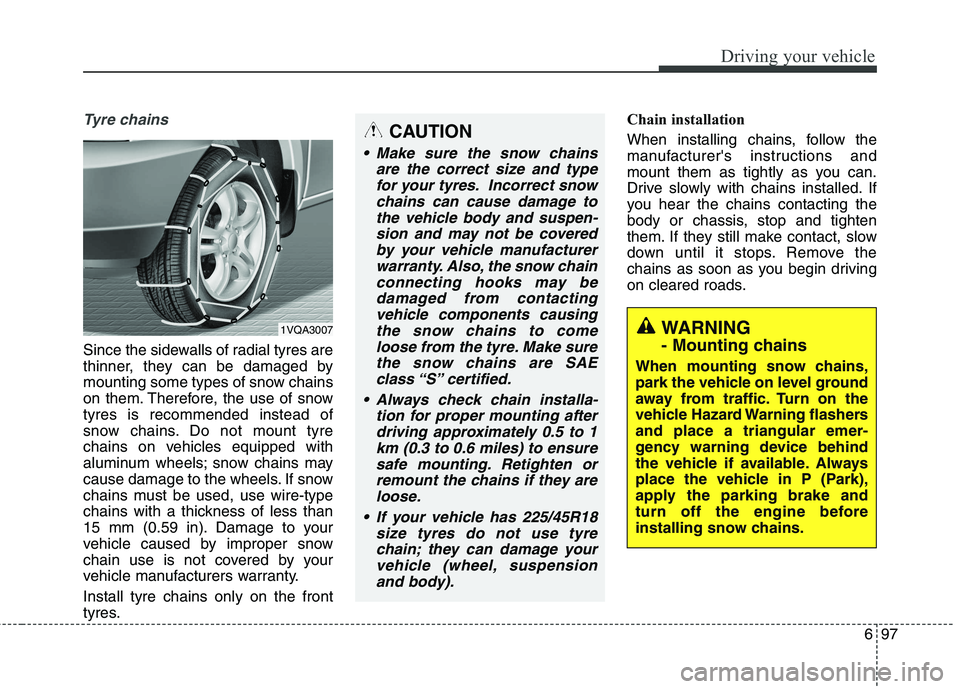
Since the sidewalls of radial tyres are
thinner, they can be damaged by
mounting some types of snow chains
on them. Therefore, the use of snowtyres is recommended instead of
snow chains. Do not mount tyre
chains on vehicles equipped with
aluminum wheels; snow chains may
cause damage to the wheels. If snow
chains must be used, use wire-type
chains with a thickness of less than
15 mm (0.59 in). Damage to your
vehicle caused by improper snow
chain use is not covered by your
vehicle manufacturers warranty. Install tyre chains only on the front
tyres.Chain installation
When installing chains, follow the
manufacturer's instructions and
mount them as tightly as you can.
Drive slowly with chains installed. If
you hear the chains contacting the
body or chassis, stop and tighten
them. If they still make contact, slow
down until it stops. Remove the
chains as soon as you begin driving
on cleared roads.
CAUTION
Make sure the snow chains
are the correct size and typefor your tyres. Incorrect snow chains can cause damage tothe vehicle body and suspen-sion and may not be covered by your vehicle manufacturerwarranty. Also, the snow chainconnecting hooks may be damaged from contactingvehicle components causingthe snow chains to come loose from the tyre. Make surethe snow chains are SAEclass “S” certified.
Always check chain installa- tion for proper mounting afterdriving approximately 0.5 to 1km (0.3 to 0.6 miles) to ensuresafe mounting. Retighten or remount the chains if they areloose.
If your vehicle has 225/45R18 size tyres do not use tyrechain; they can damage your vehicle (wheel, suspensionand body).
WARNING
- Mounting chains
When mounting snow chains,
park the vehicle on level ground
away from traffic. Turn on the
vehicle Hazard Warning flashersand place a triangular emer-
gency warning device behind
the vehicle if available. Always
place the vehicle in P (Park),
apply the parking brake and
turn off the engine before
installing snow chains.1VQA3007
Page 534 of 723
699
Driving your vehicle
To keep locks from freezing
To keep the locks from freezing,
squirt an approved de-icer fluid or
glycerine into the key opening. If a
lock is covered with ice, squirt it with
an approved de-icing fluid to remove
the ice. If the lock is frozen internally,
you may be able to thaw it out by
using a heated key. Handle the heat-
ed key with care to avoid injury.
Use approved window washer
anti-freeze in system
To keep the water in the window
washer system from freezing, add an
approved window washer anti-freeze
solution in accordance with instruc-
tions on the container. Window wash-
er anti-freeze is available from an
authorised Kia dealer and most auto
parts outlets. Do not use engine
coolant or other types of anti-freeze
as these may damage the paint finish.Don't let your parking brake
freeze
Under some conditions your parking
brake can freeze in the engaged
position. This is most likely to hap-
pen when there is an accumulation
of snow or ice around or near the
rear brakes or if the brakes are wet.
If there is a risk the parking brake
may freeze, apply it only temporarily
whilst you put the shift lever in P
(automatic transaxle / dual clutch
transmission) or in first or reverse
gear (manual transaxle) and block
the rear wheels so the vehicle cannot
roll. Then release the parking brake.
Don't let ice and snow accu-
mulate underneath
Under some conditions, snow and
ice can build up under the fenders
and interfere with the steering. When
driving in severe winter conditions
where this may happen, you should
periodically check underneath the
vehicle to be sure the movement of
the front wheels and the steering
components is not obstructed.Carry emergency equipment
Depending on the severity of the
weather, you should carry appropri-
ate emergency equipment. Some of
the items you may want to carry
include tyre chains, tow straps or
chains, flashlight, emergency flares,
sand, shovel, jumper cables, window
scraper, gloves, ground cloth, cover-
alls, blanket, etc.
Page 536 of 723
6101
Driving your vehicle
Your vehicle can tow a trailer. To
identify what the vehicle trailering
capacity is for your vehicle, you
should read the information in
“Weight of the trailer” that appearslater in this section.
Remember that trailering is different
than just driving your vehicle by itself.
Trailering means changes in han-
dling, durability, and fuel economy.
Successful, safe trailering requirescorrect equipment, and it has to be
used properly.This section contains many time-test-
ed, important trailering tips and safe-
ty rules. Many of these are important
for your safety and that of your pas-
sengers. Please read this section
carefully before you pull a trailer. Load-pulling components such as
the engine, transaxle, wheel assem-
blies, and tyres are forced to workharder against the load of the added
weight. The engine is required to
operate at relatively higher speeds
and under greater loads. This addi-
tional burden generates extra heat.
The trailer also considerably adds
wind resistance, increasing the
pulling requirements.
✽✽
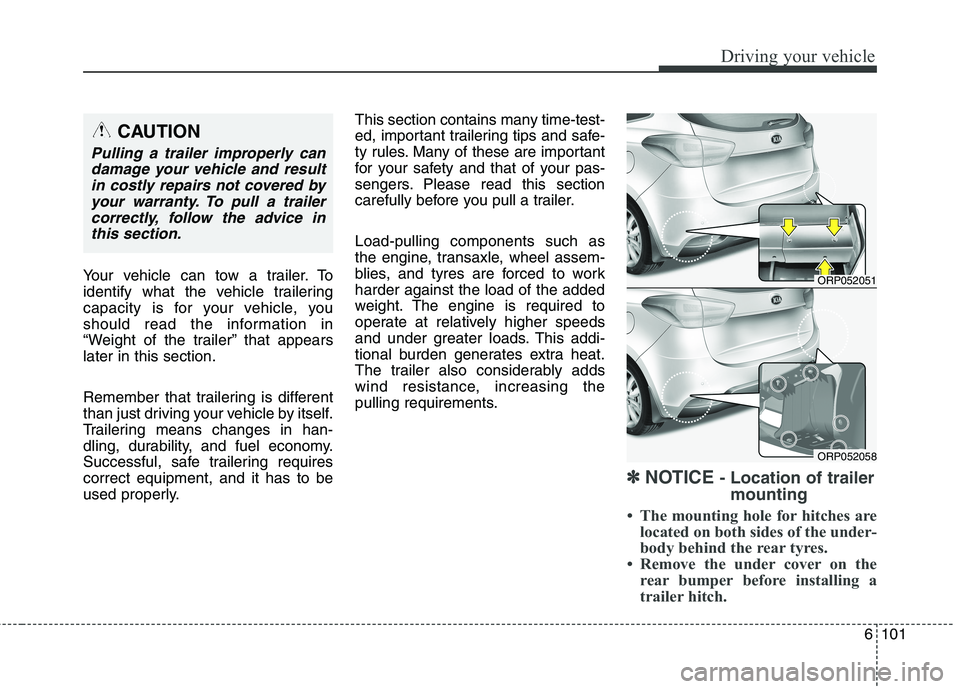
NOTICE - Location of trailer
mounting
The mounting hole for hitches are located on both sides of the under-
body behind the rear tyres.
Remove the under cover on the rear bumper before installing a
trailer hitch.
CAUTION
Pulling a trailer improperly can
damage your vehicle and resultin costly repairs not covered by your warranty. To pull a trailercorrectly, follow the advice inthis section.
ORP052051
ORP052058
Page 540 of 723
6105
Driving your vehicle
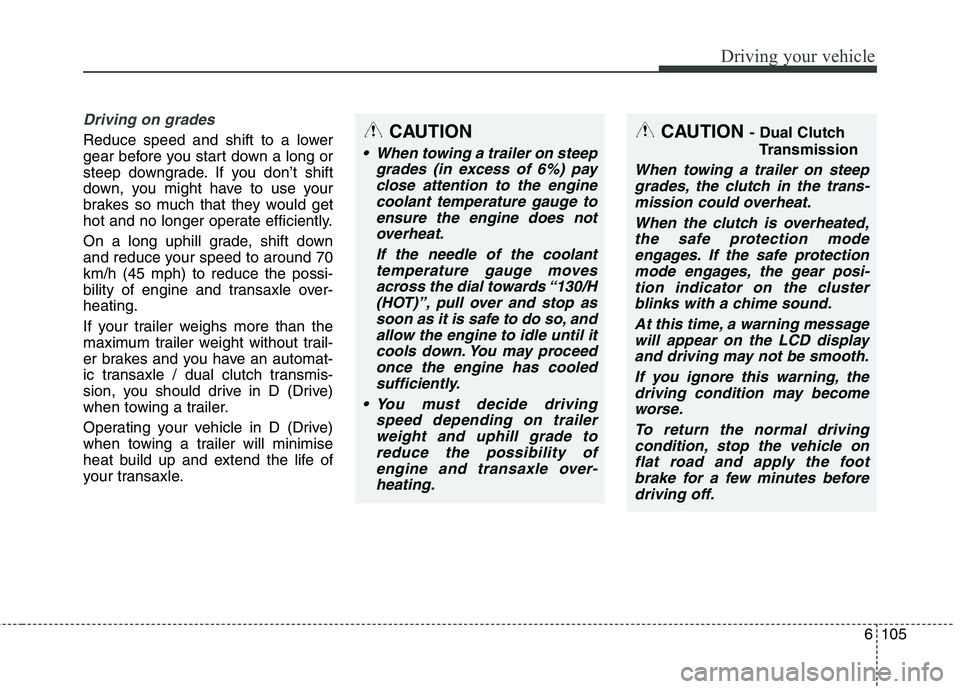
Driving on grades
Reduce speed and shift to a lower
gear before you start down a long or
steep downgrade. If you don’t shift
down, you might have to use your
brakes so much that they would get
hot and no longer operate efficiently.
On a long uphill grade, shift down
and reduce your speed to around 70km/h (45 mph) to reduce the possi-
bility of engine and transaxle over-heating.
If your trailer weighs more than the
maximum trailer weight without trail-
er brakes and you have an automat-
ic transaxle / dual clutch transmis-
sion, you should drive in D (Drive)
when towing a trailer.
Operating your vehicle in D (Drive)
when towing a trailer will minimise
heat build up and extend the life of
your transaxle.CAUTION
When towing a trailer on steepgrades (in excess of 6%) payclose attention to the enginecoolant temperature gauge toensure the engine does not overheat.
If the needle of the coolanttemperature gauge movesacross the dial towards “130/H(HOT)”, pull over and stop as soon as it is safe to do so, andallow the engine to idle until itcools down. You may proceedonce the engine has cooled sufficiently.
You must decide driving speed depending on trailerweight and uphill grade toreduce the possibility of engine and transaxle over-heating.
CAUTION - Dual Clutch
Transmission
When towing a trailer on steepgrades, the clutch in the trans-mission could overheat.
When the clutch is overheated,the safe protection mode engages. If the safe protectionmode engages, the gear posi-tion indicator on the cluster blinks with a chime sound.
At this time, a warning messagewill appear on the LCD displayand driving may not be smooth.
If you ignore this warning, thedriving condition may become worse.
To return the normal drivingcondition, stop the vehicle onflat road and apply the footbrake for a few minutes before driving off.
Page 541 of 723
Driving your vehicle
106
6
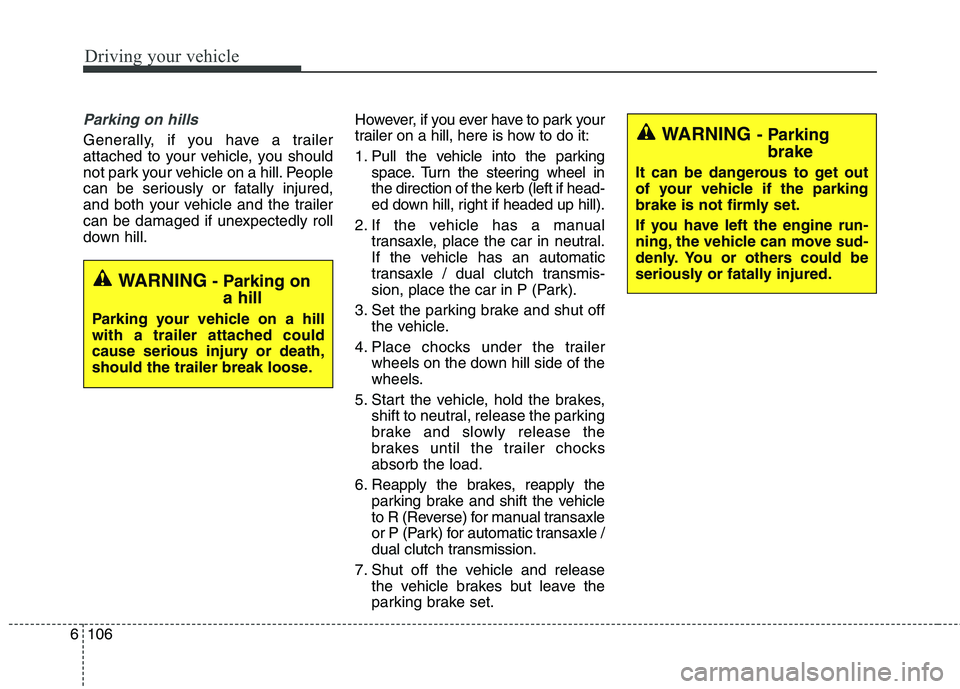
Parking on hills
Generally, if you have a trailer
attached to your vehicle, you should
not park your vehicle on a hill. People
can be seriously or fatally injured,
and both your vehicle and the trailer
can be damaged if unexpectedly roll
down hill. However, if you ever have to park your
trailer on a hill, here is how to do it:
1. Pull the vehicle into the parking
space. Turn the steering wheel in
the direction of the kerb (left if head-
ed down hill, right if headed up hill).
2. If the vehicle has a manual transaxle, place the car in neutral.
If the vehicle has an automatic
transaxle / dual clutch transmis-
sion, place the car in P (Park).
3. Set the parking brake and shut off the vehicle.
4. Place chocks under the trailer wheels on the down hill side of the
wheels.
5. Start the vehicle, hold the brakes, shift to neutral, release the parking
brake and slowly release the
brakes until the trailer chocksabsorb the load.
6. Reapply the brakes, reapply the parking brake and shift the vehicle
to R (Reverse) for manual transaxle
or P (Park) for automatic transaxle /
dual clutch transmission.
7. Shut off the vehicle and release the vehicle brakes but leave the
parking brake set.
WARNING - Parking on
a hill
Parking your vehicle on a hill
with a trailer attached could
cause serious injury or death,
should the trailer break loose.
WARNING - Parking
brake
It can be dangerous to get out
of your vehicle if the parking
brake is not firmly set.
If you have left the engine run-
ning, the vehicle can move sud-
denly. You or others could be
seriously or fatally injured.
Page 542 of 723
6107
Driving your vehicle
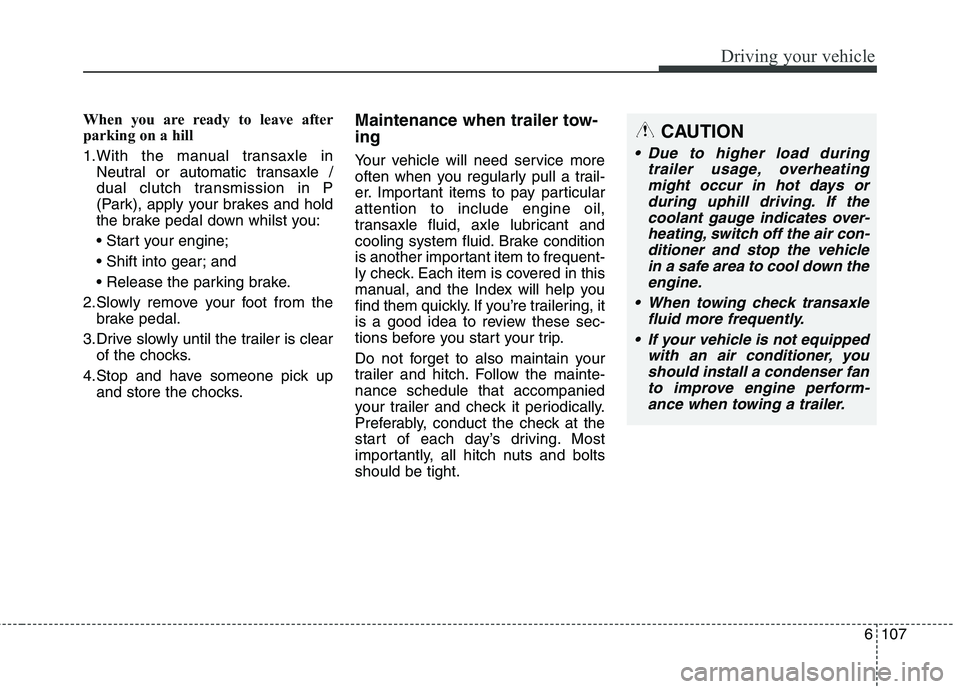
When you are ready to leave after
parking on a hill
1.With the manual transaxle inNeutral or automatic transaxle /
dual clutch transmission in P
(Park), apply your brakes and hold
the brake pedal down whilst you:
and
2.Slowly remove your foot from the brake pedal.
3.Drive slowly until the trailer is clear of the chocks.
4.Stop and have someone pick up and store the chocks. Maintenance when trailer tow- ing
Your vehicle will need service more
often when you regularly pull a trail-
er. Important items to pay particularattention to include engine oil,
transaxle fluid, axle lubricant and
cooling system fluid. Brake condition
is another important item to frequent-
ly check. Each item is covered in this
manual, and the Index will help you
find them quickly. If you’re trailering, it
is a good idea to review these sec-
tions before you start your trip.
Do not forget to also maintain your
trailer and hitch. Follow the mainte-nance schedule that accompanied
your trailer and check it periodically.
Preferably, conduct the check at the
start of each day’s driving. Most
importantly, all hitch nuts and boltsshould be tight.CAUTION
Due to higher load during
trailer usage, overheatingmight occur in hot days or during uphill driving. If thecoolant gauge indicates over-heating, switch off the air con- ditioner and stop the vehiclein a safe area to cool down theengine.
When towing check transaxle fluid more frequently.
If your vehicle is not equipped with an air conditioner, youshould install a condenser fanto improve engine perform-ance when towing a trailer.
Page 543 of 723
Driving your vehicle
108
6
If you do decide to pull a trailer
Here are some important points if
you decide to pull a trailer:
Consider using a sway control. You
can ask a hitch dealer about sway control.
Do not do any towing with your car during its first 2,000 km (1,200
miles) in order to allow the engine
to properly break in. Failure to heed
this caution may result in serious
engine or transaxle damage.
When towing a trailer, we recom- mend that you consult an authorisedKia dealer on additional require-
ments such as a towing kit, etc.
Always drive your vehicle at a mod- erate speed (less than 100 km/h(60 mph)).
On a long uphill grade, do not exceed 70 km/h (45 mph) or the
posted towing speed limit,
whichever is lower.
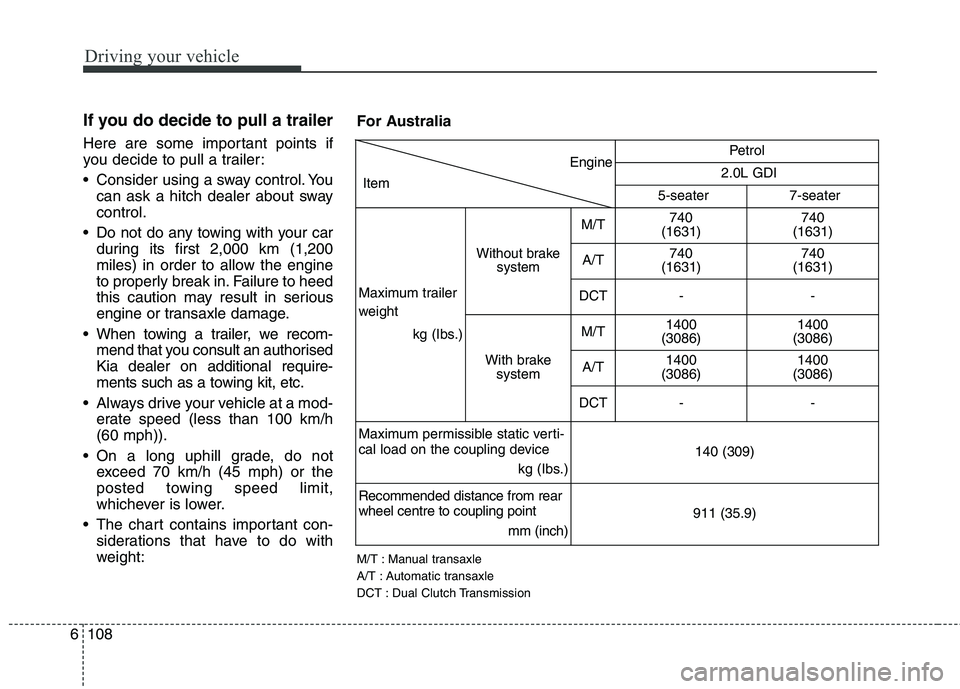
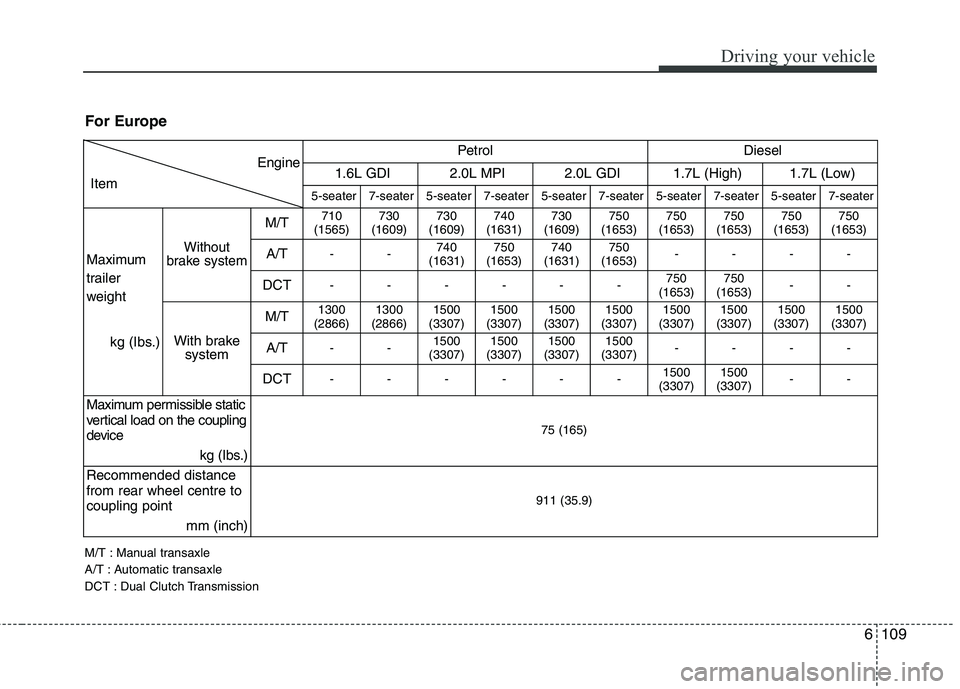
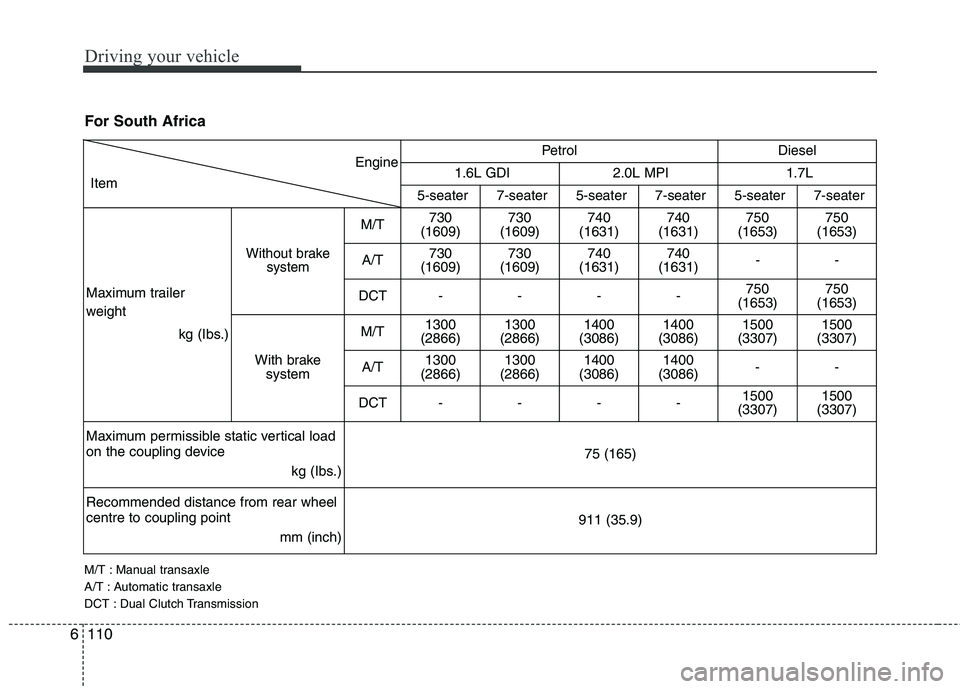
The chart contains important con- siderations that have to do with
weight:
Engine
ItemPetrol
2.0L GDI
5-seater 7-seater
Maximum trailer
weight kg (Ibs.)
Without brakesystem
M/T740
(1631) 740
(1631)
A/T740
(1631) 740
(1631)
DCT--
With brake system
M/T1400
(3086) 1400
(3086)
A/T1400
(3086) 1400
(3086)
DCT--
Maximum permissible static verti-
cal load on the coupling device kg (Ibs.)
140 (309)
Recommended distance from rear wheel centre to coupling point mm (inch)
911 (35.9)
For Australia
M/T : Manual transaxle
A/T : Automatic transaxle
DCT : Dual Clutch Transmission
Page 544 of 723
6109
Driving your vehicle
For Europe
M/T : Manual transaxle
A/T : Automatic transaxle
DCT : Dual Clutch Transmission
Engine
ItemPetrol Diesel
1.6L GDI2.0L MPI 2.0L GDI 1.7L (High) 1.7L (Low)
5-seater7-seater5-seater 7-seater 5-seater7-seater 5-seater 7-seater 5-seater 7-seater
Maximum
trailer
weight kg (Ibs.)
Without
brake system
M/T710
(1565)730
(1609)730
(1609) 740
(1631) 730
(1609)750
(1653) 750
(1653) 750
(1653) 750
(1653) 750
(1653)
A/T--740
(1631) 750
(1653) 740
(1631)750
(1653) ----
DCT------750
(1653) 750
(1653) --
With brake system
M/T1300
(2866)1300
(2866)1500
(3307) 1500
(3307) 1500
(3307)1500
(3307) 1500
(3307) 1500
(3307) 1500
(3307) 1500
(3307)
A/T--1500
(3307) 1500
(3307) 1500
(3307)1500
(3307) ----
DCT------1500
(3307) 1500
(3307) --
Maximum permissible static
vertical load on the coupling
device kg (Ibs.)
75 (165)
Recommended distance from rear wheel centre tocoupling point mm (inch)
911 (35.9)
Page 545 of 723
Driving your vehicle
110
6
Engine
ItemPetrol Diesel
1.6L GDI2.0L MPI 1.7L
5-seater7-seater5-seater 7-seater 5-seater 7-seater
Maximum trailer
weight kg (Ibs.)
Without brake system
M/T730
(1609)730
(1609)740
(1631) 740
(1631) 750
(1653) 750
(1653)
A/T730
(1609)730
(1609)740
(1631) 740
(1631) --
DCT---- 750
(1653) 750
(1653)
With brake system
M/T1300
(2866)1300
(2866)1400
(3086) 1400
(3086) 1500
(3307) 1500
(3307)
A/T1300
(2866)1300
(2866)1400
(3086) 1400
(3086) --
DCT---- 1500
(3307) 1500
(3307)
Maximum permissible static vertical load
on the coupling device kg (Ibs.)
75 (165)
Recommended distance from rear wheel centre to coupling point mm (inch)
911 (35.9)
For South Africa
M/T : Manual transaxle
A/T : Automatic transaxle
DCT : Dual Clutch Transmission