service KIA CARENS RHD 2017 Owner's Manual
[x] Cancel search | Manufacturer: KIA, Model Year: 2017, Model line: CARENS RHD, Model: KIA CARENS RHD 2017Pages: 723, PDF Size: 40.8 MB
Page 463 of 723
Driving your vehicle
28
6
R (Reverse)
Use this position to drive the vehicle
backward. N (Neutral)
The wheels and transaxle are not
engaged. The vehicle will roll freely
even on the slightest incline unless
the parking brake or service brakesare applied.
- Parking in N (Neutral) gear
Follow below steps when parking
and you want the vehicle to movewhen pushed.
1.After parking your vehicle, step on
the brake pedal and move the shift
lever to [P] with the ignition button in
[ON] or whilst the engine is running.
2.If the parking brake is applied unlock the parking brake.
- For EPB (Electronic ParkingBrake) equipped vehicles, push
the brake pedal with the ignition
button in [ON] or whilst the
engine is running to disengage
the parking brake. If [AUTOHOLD] function is used whilst
driving (If [AUTO HOLD] indicator
is on in the cluster), press [AUTO
HOLD] switch and [AUTO HOLD]
function should be turn off.
3.Whilst pressing the brake pedal, turn the ignition button [OFF].
- For smart key equipped vehicles,the ignition switch can be moved
to [OFF] only when the shift leveris in [P].
CAUTION
Always come to a complete stop
before shifting into or out of R(Reverse); you may damage the transaxle if you shift into R(Reverse) whilst the vehicle is inmotion, except as explained in “Rocking the vehicle”, in thismanual.
CAUTION
The transaxle may be damagedif you shift into P (Park) whilstthe vehicle is in motion.
WARNING
Do not drive with the shift lever in N (Neutral).
The engine brake will not work and lead to an accident.
Page 477 of 723
Driving your vehicle
42
6
Moving up a steep grade from a
standing start
To move up a steep grade from a
standing start, depress the brake
pedal, shift the shift lever to D
(Drive). Select the appropriate gear
depending on load weight and steep-
ness of the grade, and release the
parking brake. Depress the accelera-
tor gradually whilst releasing the
service brakes.
WARNING
If your vehicle becomes stuck in
snow, mud, sand, etc., then you
may attempt to rock the vehicle
free by moving it forward and
backward. Do not attempt this
procedure if people or objects
are anywhere near the vehicle.
During the rocking operation
the vehicle may suddenly move
forward of backward as it
becomes unstuck, causing
injury or damage to nearby peo-ple or objects.
(Continued)
In the event your vehicle leaves the roadway, do not
steer sharply. Instead, slow
down before pulling back into
the travel lanes.
Never exceed posted speed limits.WARNING
Always buckle-up! In a colli- sion, an unbelted occupant is
significantly more likely to be
seriously injured or killed
than a properly belted occu-pant.
Avoid high speeds when cor- nering or turning.
Do not make quick steering wheel movements, such as
sharp lane changes or fast,sharp turns.
The risk of rollover is greatly increased if you lose control
of your vehicle at highwayspeeds.
Loss of control often occurs if two or more wheels drop off
the roadway and the driver
oversteers to reenter the road-
way.
(Continued)
Page 480 of 723
645
Driving your vehicle
In the event of brake failure
If service brakes fail to operate whilst
the vehicle is in motion, you can
make an emergency stop with the
parking brake. The stopping dis-
tance, however, will be much greater
than normal.
Disc brakes wear indicator
When your brake pads are worn and
new pads are required, you will hear
a high-pitched warning sound from
your front brakes or rear brakes. You
may hear this sound come and go or
it may occur whenever you depress
the brake pedal.
Please remember that some driving
conditions or climates may cause a
brake squeal when you first apply (or
lightly apply) the brakes. This is nor-
mal and does not indicate a problem
with your brakes.
WARNING - Brake wear
This brake wear warning sound
means your vehicle needs serv-
ice. If you ignore this audible
warning, you will eventually
lose braking performance,
which could lead to a seriousaccident.
CAUTION
To avoid costly brake repairs, do not continue to drive withworn brake pads.
Always replace the front or rear brake pads as pairs.
WARNING - Parking
brake
Applying the parking brake
whilst the vehicle is moving atnormal speeds can cause a
sudden loss of control of the
vehicle. If you must use theparking brake to stop the vehi-
cle, use great caution in apply-
ing the brake.
Page 520 of 723
685
Driving your vehicle
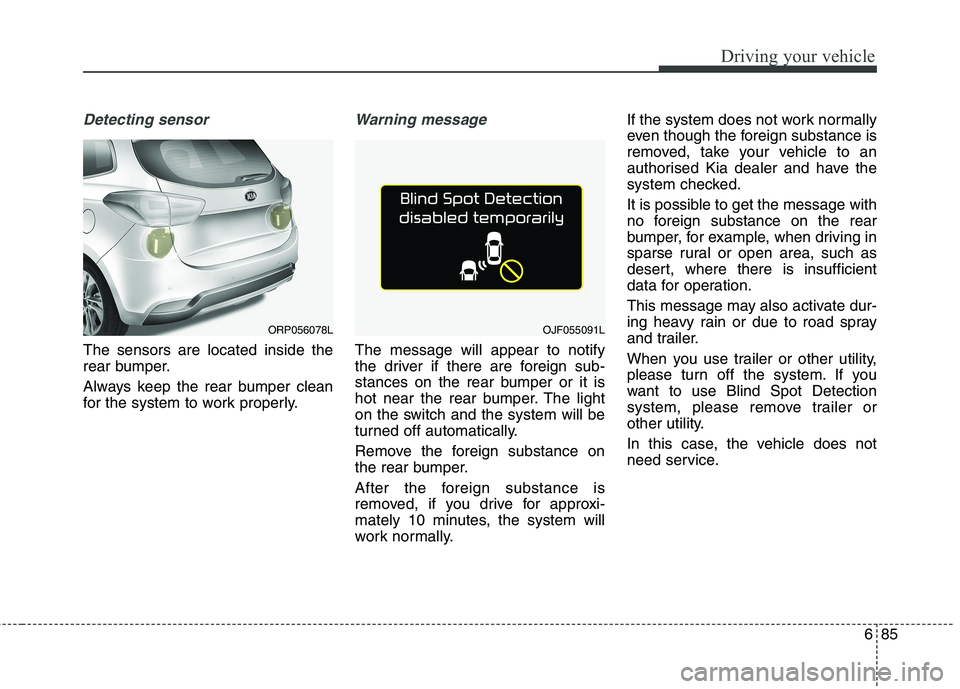
Detecting sensor
The sensors are located inside the
rear bumper.
Always keep the rear bumper clean
for the system to work properly.
Warning message
The message will appear to notify
the driver if there are foreign sub-
stances on the rear bumper or it is
hot near the rear bumper. The light
on the switch and the system will be
turned off automatically.
Remove the foreign substance on
the rear bumper.
After the foreign substance is
removed, if you drive for approxi-
mately 10 minutes, the system will
work normally.If the system does not work normally
even though the foreign substance is
removed, take your vehicle to an
authorised Kia dealer and have the
system checked.
It is possible to get the message with
no foreign substance on the rear
bumper, for example, when driving in
sparse rural or open area, such as
desert, where there is insufficient
data for operation.
This message may also activate dur-
ing heavy rain or due to road spray
and trailer.
When you use trailer or other utility,
please turn off the system. If you
want to use Blind Spot Detection
system, please remove trailer or
other utility.
In this case, the vehicle does not
need service.
OJF055091LORP056078L
Page 525 of 723
Driving your vehicle
90
6
ECONOMICAL OPERATION
Your vehicle's fuel economy depends
mainly on your style of driving, where
you drive and when you drive.
Each of these factors affects how
many kilometers (miles) you can get
from a litre (gallon) of fuel. To operate
your vehicle as economically as pos-
sible, use the following driving sug-
gestions to help save money in bothfuel and repairs:
Drive smoothly. Accelerate at a moderate rate. Do not make "jack-
rabbit" starts or full-throttle shifts
and maintain a steady cruising
speed. Do not race between stop-
lights. Try to adjust your speed to
the traffic so you do not have to
change speeds unnecessarily.
Avoid heavy traffic whenever pos-
sible. Always maintain a safe dis-
tance from other vehicles so you
can avoid unnecessary braking.
This also reduces brake wear.
Drive at a moderate speed. The faster you drive, the more fuel your
vehicle uses. Driving at a moderate
speed, especially on the highway,
is one of the most effective ways toreduce fuel consumption. Do not "ride" the brake or clutch
pedal. This can increase fuel con-
sumption and also increase wear
on these components. In addition,
driving with your foot resting on the
brake pedal may cause the brakes
to overheat, which reduces their
effectiveness and may lead to
more serious consequences.
Take care of your tyres. Keep them inflated to the recommended pres-
sure. Incorrect inflation, either too
much or too little, results in unnec-
essary tyre wear. Check the tyrepressures at least once a month.
Be sure that the wheels are aligned correctly. Improper align-
ment can result from hitting kerbs
or driving too fast over irregular
surfaces. Poor alignment causes
faster tyre wear and may also
result in other problems as well as
greater fuel consumption. Keep your vehicle in good condi-
tion. For better fuel economy and
reduced maintenance costs, main-
tain your vehicle in accordance
with the maintenance schedule. If
you drive your vehicle in severe
conditions, more frequent mainte-nance is required.
Keep your vehicle clean. For maxi- mum service, your vehicle should
be kept clean and free of corrosive
materials. It is especially important
that mud, dirt, ice, etc. not be
allowed to accumulate on the
underside of the vehicle. This extra
weight can result in increased fuel
consumption and also contribute tocorrosion.
Travel lightly. Do not carry unnec- essary weight in your vehicle.
Weight reduces fuel economy.
Do not let the engine idle longer than necessary. If you are waiting
(and not in traffic), turn off your
engine and restart only when
you're ready to go.
Page 526 of 723
691
Driving your vehicle
Remember, your vehicle does notrequire extended warm-up. After
the engine has started, allow the
engine to run for 10 to 20 seconds
prior to placing the vehicle in gear.
In very cold weather, however, give
your engine a slightly longer warm-
up period.
Do not "lug" or "over-rev" the engine. Lugging is driving too slow-ly in too high a gear resulting
engine bucking. If this happens,
shift to a lower gear. Over-revving
is racing the engine beyond its safe
limit. This can be avoided by shift-
ing at the recommended speeds.
Use your air conditioning sparingly. The air conditioning system is
operated by engine power so your
fuel economy is reduced when youuse it.
Open windows at high speeds can reduce fuel economy.
Fuel economy is less in crosswinds and headwinds. To help offset
some of this loss, slow down when
driving in these conditions. Keeping a vehicle in good operating
condition is important both for econ-
omy and safety. We recommend in
general that the vehicle be serviced
by an authorised Kia dealer.
WARNING
- Engine off
during motion
Never turn the engine off to
coast down hills or anytime the
vehicle is in motion. The power
steering and power brakes will
not function properly without
the engine running. Instead,
keep the engine on and down-
shift to an appropriate gear for
engine braking effect. In addi-
tion, turning off the ignition
whilst driving could engage the
steering wheel lock (ifequipped) resulting in loss of
vehicle steering which could
cause serious injury or death.
Page 542 of 723
6107
Driving your vehicle
When you are ready to leave after
parking on a hill
1.With the manual transaxle inNeutral or automatic transaxle /
dual clutch transmission in P
(Park), apply your brakes and hold
the brake pedal down whilst you:
and
2.Slowly remove your foot from the brake pedal.
3.Drive slowly until the trailer is clear of the chocks.
4.Stop and have someone pick up and store the chocks. Maintenance when trailer tow- ing
Your vehicle will need service more
often when you regularly pull a trail-
er. Important items to pay particularattention to include engine oil,
transaxle fluid, axle lubricant and
cooling system fluid. Brake condition
is another important item to frequent-
ly check. Each item is covered in this
manual, and the Index will help you
find them quickly. If you’re trailering, it
is a good idea to review these sec-
tions before you start your trip.
Do not forget to also maintain your
trailer and hitch. Follow the mainte-nance schedule that accompanied
your trailer and check it periodically.
Preferably, conduct the check at the
start of each day’s driving. Most
importantly, all hitch nuts and boltsshould be tight.CAUTION
Due to higher load during
trailer usage, overheatingmight occur in hot days or during uphill driving. If thecoolant gauge indicates over-heating, switch off the air con- ditioner and stop the vehiclein a safe area to cool down theengine.
When towing check transaxle fluid more frequently.
If your vehicle is not equipped with an air conditioner, youshould install a condenser fanto improve engine perform-ance when towing a trailer.
Page 556 of 723
What to do in an emergency
6
7
Jump starting procedure
✽✽
NOTICE
If the battery is discharged, the
engine can be started using a battery
of another vehicle and two jumper
cables. Only use jumper cables with
fully insulated clamp handles.
To prevent personal injury or dam-
age to both vehicles, adhere strictly
to the following procedure.
(Continued)
Do not allow the (+) and (-) jumper cables to touch. It may cause sparks.
The battery may rupture or explode when you jump start
with a low or frozen battery.
CAUTION - AGM battery
(if equipped)
Absorbent Glass Matt (AGM) batteries are maintenance-freeand we recommend that theAGM batteries be serviced byan authorised Kia dealer. For charging your AGM battery,use only fully automatic bat-tery chargers that are speciallydeveloped for AGM batteries.
When replacing the AGM bat- tery, we recommend that youuse parts for replacementfrom an authorised Kia dealer.
Do not open or remove the cap on top of the battery. Thismay cause leaks of internalelectrolyte that could result insevere injury.
(Continued)
(Continued)
If the AGM battery is recon- nected or replaced, ISG func-tion will not operate immedi- ately.
If you want to use the ISGfunction, the battery sensorneeds to be calibrated forapproximately 4 hours with the ignition off.
Page 560 of 723
What to do in an emergency
10
7
Your vehicle has also been equipped
with a TPMS malfunction indicator toindicate when the system is not oper-
ating properly. The TPMS malfunction
indicator is combined with the low
tyre pressure telltale. When the sys-tem detects a malfunction, the telltale
will flash for approximately one
minute and then remain continuously
illuminated. This sequence will con-
tinue upon subsequent vehicle start-
ups as long as the malfunction exists.When the malfunction indicator is illu-
minated, the system may not be able
to detect or signal low tyre pressure
as intended. TPMS malfunctions may
occur for a variety of reasons, includ-ing the installation of replacement or
alternate tyres or wheels on the vehi-
cle that prevent the TPMS from func-
tioning properly. Always check theTPMS malfunction telltale afterreplacing one or more tyres or
wheels on your vehicle to ensure that
the replacement or alternate tyres
and wheels allow the TPMS to con-
tinue to function properly.✽✽
NOTICE
If the TPMS, Low Tyre Pressure
indicator do not illuminate for 3 sec-
onds when the ignition switch is
turned to the ON position or engine
is running, or if they remain illumi-
nated after coming on for approxi-
mately 3 seconds, we recommend
that the system be checked by an
authorised Kia dealer.Low tyre pressure telltale
When the tyre pressure monitoring
system warning indicators are illumi-
nated, one or more of your tyres issignificantly under-inflated.
If the telltale illuminates, immediately
reduce your speed, avoid hard cor-
nering and anticipate increased stop-
ping distances. You should stop and
check your tyres as soon as possi-
ble. Inflate the tyres to the proper
pressure as indicated on the vehi-
cle’s placard or tyre inflation pres-
sure label located on the driver’s side
centre pillar outer panel. If you can-
not reach a service station or if the
tyre cannot hold the newly added air,
replace the low pressure tyre with
the spare tyre.
Page 562 of 723
What to do in an emergency
12
7
TPMS (Tyre Pressure Monitoring System)malfunction indicator
The low tyre pressure telltale will illu-
minate after it blinks for approximate-
ly one minute when there is a prob-
lem with the Tyre Pressure
Monitoring System. If the system is
able to correctly detect an underinfla-
tion warning at the same time as sys-
tem failure then it will illuminate both
the TPMS malfunction and low tyre
pressure telltales e.g. if Front Left
sensor fails, the TPMS malfunction
indicator illuminates, but if the FrontRight, Rear Left, or Rear Right tyre is
under-inflated, the low tyre pressure
telltales may illuminate together with
the TPMS malfunction indicator.
We recommend that the system be
checked by an authorised Kia dealer
to determine the cause of the prob-lem. Changing a tyre with TPMS
If you have a flat tyre, the Low Tyre
Pressure telltale will come on. Werecommend that the system be
checked by an authorised Kia dealer. Each wheel is equipped with a tyre pressure sensor mounted inside the
tyre behind the valve stem. You must
use TPMS specific wheels. It is rec-
ommended that you always have
your tyres serviced by an authorised
Kia dealer.CAUTION
The TPMS malfunction indica-
tor may be illuminated if thevehicle is moving around elec- tric power supply cables orradios transmitter such as atpolice stations, government and public offices, broadcast-ing stations, military installa-tions, airports, or transmitting towers, etc. This can interferewith normal operation of theTyre Pressure Monitoring System (TPMS).
The TPMS malfunction indica- tor may be illuminated if snowchains are used or some sep-arate electronic devices such as notebook computer, mobilecharger, remote starter ornavigation etc., are used in the vehicle. This can interfere withnormal operation of the TyrePressure Monitoring System(TPMS).
CAUTION
We recommend that you use the sealant approved by Kia.
The sealant on the tyre pressuresensor and wheel shall be elim-inated when you replace the tyre with a new one.