service KIA CARENS RHD 2017 Owner's Guide
[x] Cancel search | Manufacturer: KIA, Model Year: 2017, Model line: CARENS RHD, Model: KIA CARENS RHD 2017Pages: 723, PDF Size: 40.8 MB
Page 563 of 723
713
What to do in an emergency
Even if you replace the low pressure
tyre with the spare tyre, the Low TyrePressure telltale will remain on until
the low pressure tyre is repaired and
placed on the vehicle.
After you replace the low pressure
tyre with the spare tyre, the TPMS
malfunction indicator may illuminate
after a few minutes because theTPMS sensor mounted on the sparewheel is not initiated.
Once the low pressure tyre is rein- flated to the recommended pressure
and installed on the vehicle or theTPMS sensor mounted on the
replaced spare wheel is initiated by
an authorised Kia dealer, the TPMS
malfunction indicator and the low
tyre pressure telltale will extinguish
within a few minutes of driving.
If the indicator is not extinguished
after a few minutes of driving, werecommend that the system be
checked by an authorised Kia dealer.You may not be able identify a low
tyre by simply looking at it. Alwaysuse a good quality tyre pressuregauge to measure the tyre's inflation
pressure. Please note that a tyre that
is hot (from being driven) will have ahigher pressure measurement than atyre that is cold (from sitting station-
ary for at least 3 hours and driven
less than 1.6 km (1 mile) during that
3 hour period).
Allow the tyre to cool before measur-
ing the inflation pressure. Always be
sure the tyre is cold before inflating
to the recommended pressure.
A cold tyre means the vehicle has
been sitting for 3 hours and driven forless than 1.6 km (1 mile) in that 3
hour period.CAUTION
If a original mounted tyre is
replaced with the spare tyre, theTPMS sensor on the replaced spare wheel should be initiatedand the TPMS sensor on theoriginal mounted wheel shouldbe deactivated. If the TPMS sen- sor on the original mountedwheel located in the spare tyrecarrier still activates, the tyre pressure monitoring systemmay not operate properly. Werecommend that the system be serviced by an authorised Kiadealer.
CAUTION
We recommend that you use the sealant approved by Kia if yourvehicle is equipped with a TyrePressure Monitoring System. The liquid sealant can damagethe tyre pressure sensors.
Page 565 of 723
715
What to do in an emergency
IF YOU HAVE A FLAT TYRE (WITH SPARE TYRE, IF EQUIPPED)
Jack and tools
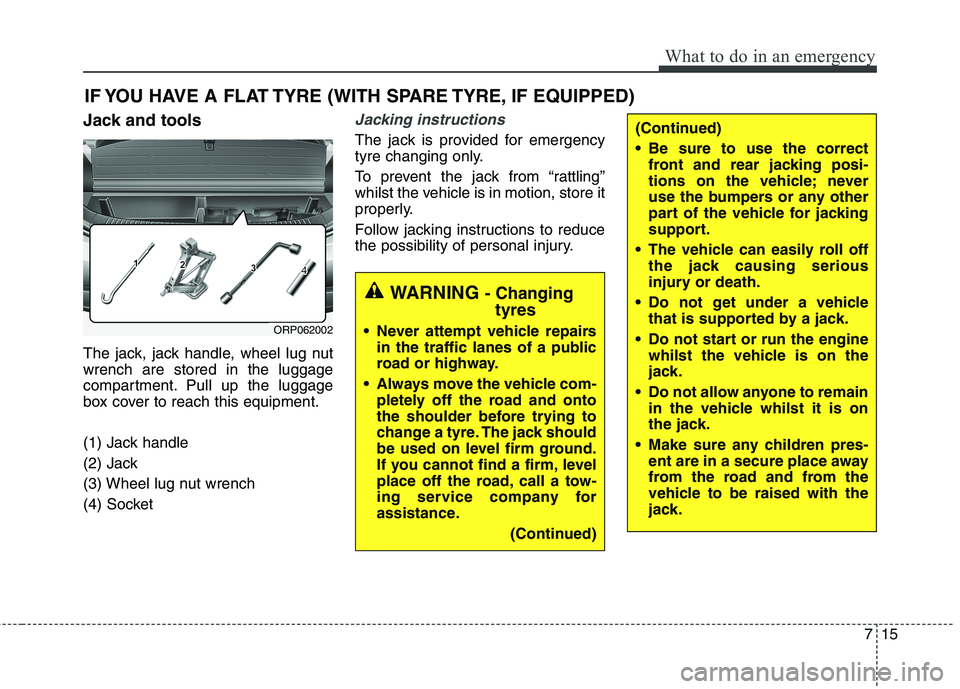
The jack, jack handle, wheel lug nut wrench are stored in the luggage
compartment. Pull up the luggage
box cover to reach this equipment.
(1) Jack handle
(2) Jack
(3) Wheel lug nut wrench
(4) Socket
Jacking instructions
The jack is provided for emergency
tyre changing only.
To prevent the jack from “rattling”
whilst the vehicle is in motion, store it
properly.
Follow jacking instructions to reduce
the possibility of personal injury.
WARNING - Changing
tyres
Never attempt vehicle repairs in the traffic lanes of a public
road or highway.
Always move the vehicle com- pletely off the road and onto
the shoulder before trying to
change a tyre. The jack should
be used on level firm ground.
If you cannot find a firm, level
place off the road, call a tow-
ing service company for
assistance.
(Continued)
ORP062002
(Continued)
Be sure to use the correctfront and rear jacking posi-
tions on the vehicle; never
use the bumpers or any other
part of the vehicle for jacking
support.
The vehicle can easily roll off the jack causing serious
injury or death.
Do not get under a vehicle that is supported by a jack.
Do not start or run the engine whilst the vehicle is on the
jack.
Do not allow anyone to remain in the vehicle whilst it is on
the jack.
Make sure any children pres- ent are in a secure place away
from the road and from the
vehicle to be raised with the
jack.
Page 571 of 723
721
What to do in an emergency
If you have a tyre gauge, remove the
valve cap and check the air pressure.
If the pressure is lower than recom-
mended, drive slowly to the nearest
service station and inflate to the cor-
rect pressure. If it is too high, adjust
it until it is correct. Always reinstall
the valve cap after checking or
adjusting tyre pressure. If the cap is
not replaced, air may leak from the
tyre. If you lose a valve cap, buyanother and install it as soon as pos-
sible.
After you have changed wheels,
always secure the flat tyre in its place
and return the jack and tools to their
proper storage locations.To prevent the jack, jack handle,
wheel lug nut wrench, socket and
spare tyre from rattling whilst the
vehicle is in motion, store them prop-
erly.CAUTION
Your vehicle has metric threads
on the wheel studs and nuts.Make certain during wheel removal that the same nuts thatwere removed are reinstalled -or, if replaced, that nuts with metric threads and the samechamfer configuration are used.Installation of a non-metricthread nut on a metric stud or vice-versa will not secure thewheel to the hub properly andwill damage the stud so that it must be replaced.
Note that most lug nuts do nothave metric threads. Be sure touse extreme care in checkingfor thread style before installing aftermarket lug nuts or wheels.If in doubt, we recommend thatyou consult an authorised Kia dealer.
WARNING - Wheel studs
If the studs are damaged, they
may lose their ability to retain
the wheel. This could lead to theloss of the wheel and a collisionresulting in serious injuries.
WARNING - Inadequate
spare tyre pressure
Check the inflation pressures
as soon as possible after
installing the spare tyre. Adjust
it to the specified pressure, if
necessary. Refer to “Tyres and
wheels” chapter 9.
Page 580 of 723
What to do in an emergency
30
7
Distributing the sealant
12. Immediately drive approximately
7~10km (4~6miles or, about
10min) to evenly distribute the
sealant in the tyre. Checking the tyre inflation pressure
1.After driving approximately 7~10
km (4~6 miles or about 10 min-
utes), stop at a suitable location.
2.Connect connection hose (9) of the compressor directly to the tyre
valve.
3.Connect between compressor and the vehicle power outlet using the
cable and connectors.
4.Adjust the tyre inflation pressure to 220 kPa (32 psi). With the ignition
switched on, proceed as follows.
- To increase the inflation pres-sure: Switch on the compressor,
position "I". To check the current
inflation pressure setting, briefly
switch off the compressor. - To reduce the inflation pres-
sure: Loosen the screw cap (8)
on the compressor hose.
CAUTION
Do not exceed a speed of 60
km/h (35 mph). If possible, donot fall below a speed of 20 km/h (12 mph).
Whilst driving, if you experienceany unusual vibration, ride dis-turbance or noise, reduce yourspeed and drive with caution until you can safely pull off ofthe side of the road. Call forroad side service or towing.
When you use the Tyre MobilityKit, the tyre pressure sensors and wheel may be stained bysealant. Therefore, remove thetyre pressure sensors and wheel stained by sealant and werecommend that inspect at anauthorised Kia dealer.
WARNING
Do not let the compressor run
for more than 10 minutes, other-
wise the device will overheat
and may be damaged.
CAUTION
If the inflation pressure is not maintained, drive the vehicle asecond time, refer toDistributing the sealant. Then repeat steps 1 to 4.
Use of the TMK may be ineffec-tual for tyre damage larger thanapproximately 4 mm (0.16 in).
We recommend that you contactan authorised Kia dealer if the tyre cannot be made roadworthywith the Tyre Mobility Kit.
WARNING
The tyre inflation pressure must
be at least 220 kPa (32 psi). If it
is not, do not continue driving.
Call for road side service or
towing.
Page 582 of 723
What to do in an emergency
32
7
TOWING
Towing service
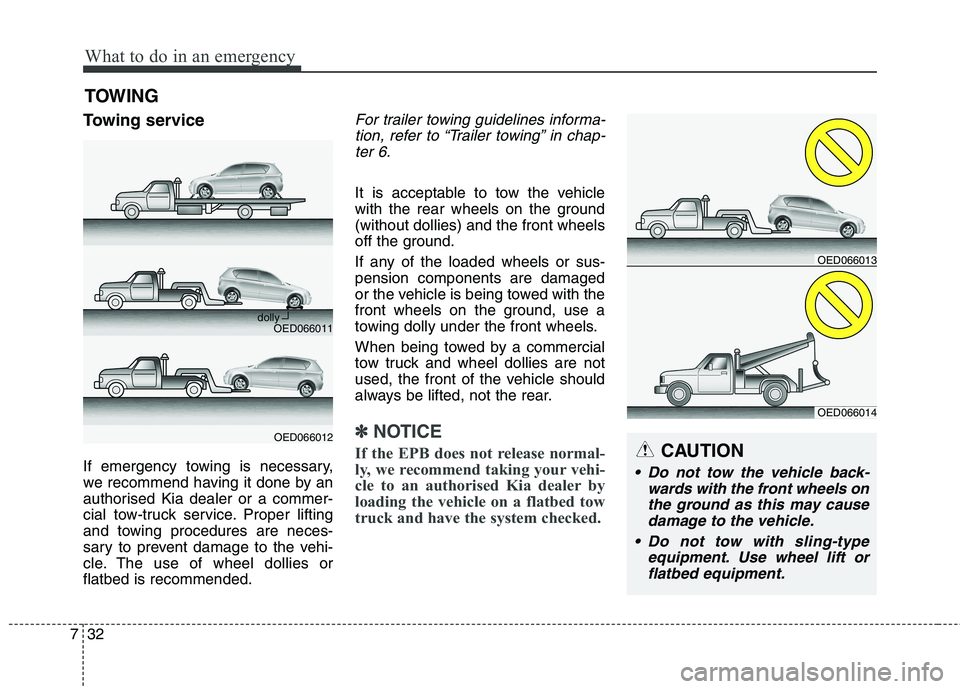
If emergency towing is necessary,
we recommend having it done by an
authorised Kia dealer or a commer-
cial tow-truck service. Proper lifting
and towing procedures are neces-
sary to prevent damage to the vehi-
cle. The use of wheel dollies orflatbed is recommended.
For trailer towing guidelines informa- tion, refer to “Trailer towing” in chap-ter 6.
It is acceptable to tow the vehicle
with the rear wheels on the ground(without dollies) and the front wheels
off the ground.
If any of the loaded wheels or sus- pension components are damaged
or the vehicle is being towed with the
front wheels on the ground, use a
towing dolly under the front wheels.
When being towed by a commercial
tow truck and wheel dollies are not
used, the front of the vehicle should
always be lifted, not the rear.
✽✽ NOTICE
If the EPB does not release normal-
ly, we recommend taking your vehi-
cle to an authorised Kia dealer by
loading the vehicle on a flatbed tow
truck and have the system checked.
CAUTION
Do not tow the vehicle back- wards with the front wheels onthe ground as this may causedamage to the vehicle.
Do not tow with sling-type equipment. Use wheel lift orflatbed equipment.
OED066011
OED066012
dolly
OED066014
OED066013
Page 584 of 723
What to do in an emergency
34
7
Emergency towing
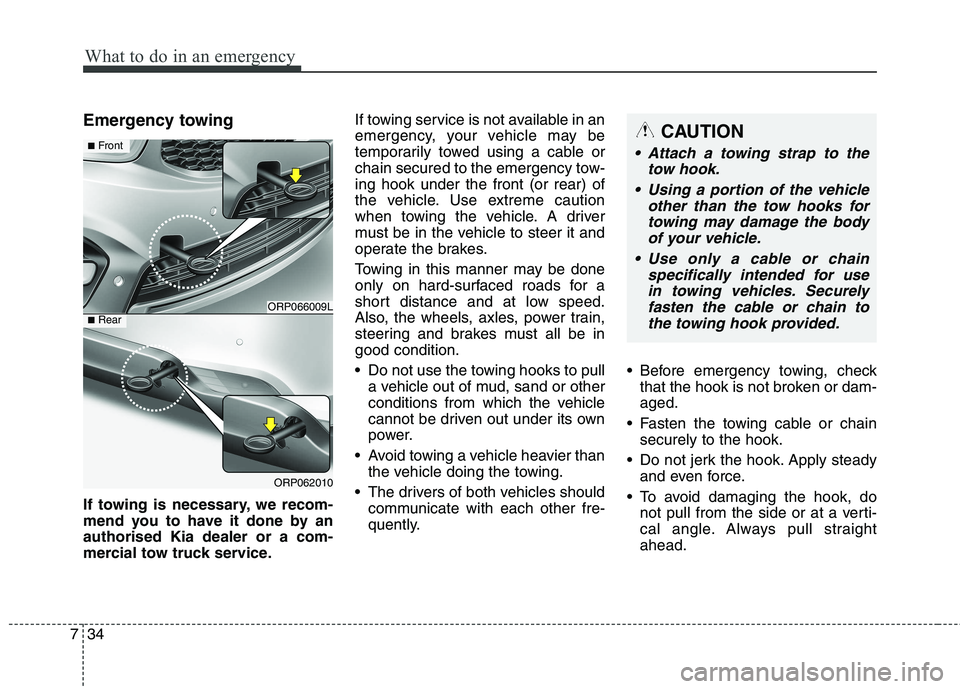
If towing is necessary, we recom-
mend you to have it done by anauthorised Kia dealer or a com-
mercial tow truck service. If towing service is not available in an
emergency, your vehicle may be
temporarily towed using a cable or
chain secured to the emergency tow-ing hook under the front (or rear) of
the vehicle. Use extreme caution
when towing the vehicle. A driver
must be in the vehicle to steer it and
operate the brakes.
Towing in this manner may be done
only on hard-surfaced roads for a
short distance and at low speed.
Also, the wheels, axles, power train,
steering and brakes must all be ingood condition.
Do not use the towing hooks to pull
a vehicle out of mud, sand or other
conditions from which the vehicle
cannot be driven out under its own
power.
Avoid towing a vehicle heavier than the vehicle doing the towing.
The drivers of both vehicles should communicate with each other fre-
quently. Before emergency towing, check
that the hook is not broken or dam-aged.
Fasten the towing cable or chain securely to the hook.
Do not jerk the hook. Apply steady and even force.
To avoid damaging the hook, do not pull from the side or at a verti-
cal angle. Always pull straightahead.CAUTION
Attach a towing strap to the
tow hook.
Using a portion of the vehicle other than the tow hooks fortowing may damage the bodyof your vehicle.
Use only a cable or chain specifically intended for usein towing vehicles. Securely fasten the cable or chain tothe towing hook provided.
ORP066009L
ORP062010
■ Front
■Rear
Page 585 of 723
735
What to do in an emergency
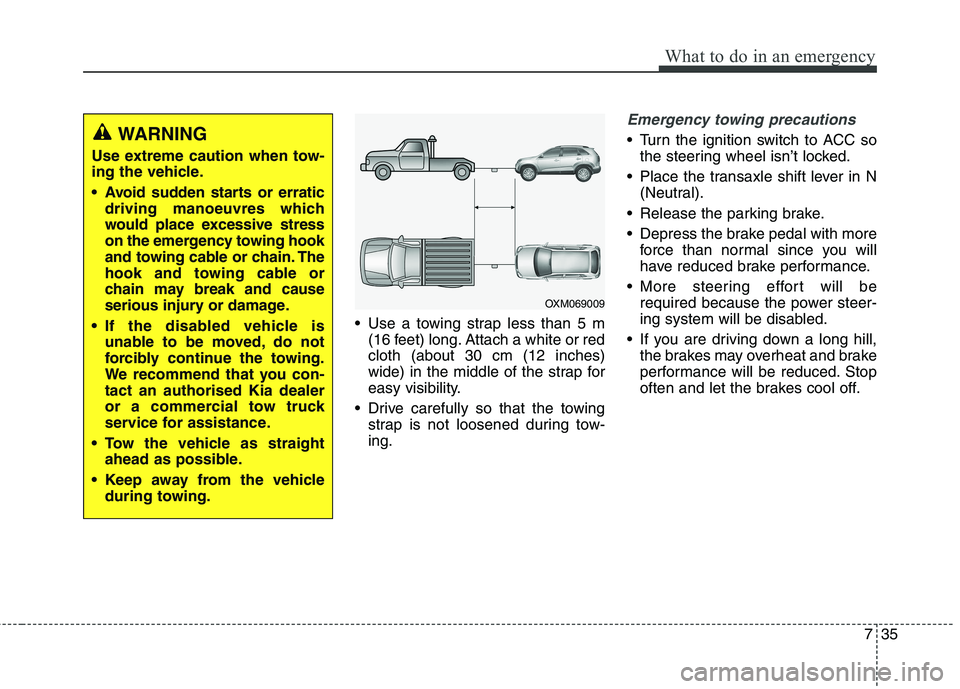
Use a towing strap less than 5 m(16 feet) long. Attach a white or red cloth (about 30 cm (12 inches)
wide) in the middle of the strap for
easy visibility.
Drive carefully so that the towing strap is not loosened during tow-ing.
Emergency towing precautions
Turn the ignition switch to ACC sothe steering wheel isn’t locked.
Place the transaxle shift lever in N (Neutral).
Release the parking brake.
Depress the brake pedal with more force than normal since you will
have reduced brake performance.
More steering effort will be required because the power steer-
ing system will be disabled.
If you are driving down a long hill, the brakes may overheat and brake
performance will be reduced. Stop
often and let the brakes cool off.
OXM069009
WARNING
Use extreme caution when tow-
ing the vehicle.
Avoid sudden starts or erratic driving manoeuvres which
would place excessive stress
on the emergency towing hook
and towing cable or chain. The
hook and towing cable or
chain may break and cause
serious injury or damage.
If the disabled vehicle is unable to be moved, do not
forcibly continue the towing.
We recommend that you con-tact an authorised Kia dealer
or a commercial tow truck
service for assistance.
Tow the vehicle as straight ahead as possible.
Keep away from the vehicle during towing.
Page 588 of 723
Maintenance
Engine compartment . . . . . . . . . . . . . . . . . . . . . . . . 8-3
Maintenance services . . . . . . . . . . . . . . . . . . . . . . . . 8-6• Owner’s responsibility . . . . . . . . . . . . . . . . . . . . . . . . 8-6
. . . . . . . . . . . . . . . . 8-6
. . . . . . . . . . . . . . . . 8-7
Owner maintenance . . . . . . . . . . . . . . . . . . . . . . . . . 8-9 . . . . . . . . . . . . . . . . . . . 8-9
Scheduled maintenance service . . . . . . . . . . . . . 8-11
Explanation of scheduled maintenance items . . . 8-28
Engine oil. . . . . . . . . . . . . . . . . . . . . . . . . . . . . . . . . 8-32 . . . . . . . . . . . . . . . . . . . 8-32
. . . . . . . . . . . . . . . 8-33
Engine coolant . . . . . . . . . . . . . . . . . . . . . . . . . . . . 8-34 . . . . . . . . . . . . . . . . . . 8-34
. . . . . . . . . . . . . . . . . . . . . . . . . 8-37
Brake/clutch fluid . . . . . . . . . . . . . . . . . . . . . . . . . . 8-38 . . . . . . . . . . . . 8-38
Washer fluid . . . . . . . . . . . . . . . . . . . . . . . . . . . . . . 8-39 . . . . . . . . . . . . . . . . 8-39
Parking brake - hand type . . . . . . . . . . . . . . . . . . 8-39 . . . . . . . . . . . . . . . . . . 8-39
Fuel Filter . . . . . . . . . . . . . . . . . . . . . . . . . . . . . . . . 8-40 . . . . . . . . . . . . . . . . . 8-40 Air cleaner air cleaner . . . . . . . . . . . . . . . . . . . . . . 8-40
. . . . . . . . . . . . . . . . . . . . . . . . . . . . 8-40
Climate control air filter . . . . . . . . . . . . . . . . . . . . 8-42 . . . . . . . . . . . . . . . . . . . . . . . . . . . . . . 8-42
. . . . . . . . . . . . . . . . . . . . . . . . . . . . 8-42
Wiper blades . . . . . . . . . . . . . . . . . . . . . . . . . . . . . . 8-44 . . . . . . . . . . . . . . . . . . . . . . . . . . . . . . 8-44
. . . . . . . . . . . . . . . . . . . . . . . . . . . 8-44
Battery . . . . . . . . . . . . . . . . . . . . . . . . . . . . . . . . . . . 8-48 . . . . . . . . . . . . . . . . . . . . . . . 8-48
. . . . . . . . . . . . . . . . . . . . . . . . . 8-50
. . . . . . . . . . . . . . . . . . . . . . . . . . 8-50
. . . . . . . . . . . . . . . . . . . . . . . . . . . . . . . . . . 8-51
Tyres and wheels . . . . . . . . . . . . . . . . . . . . . . . . . . 8-52 . . . . . . . . . . . . . . . . . . . . . . . . . . . . . . . . . . . . 8-52
. . . . . . . 8-52
. . . . . . . . . . . . . . . . 8-53
. . . . . . . . . . . . . . . . . . . . . . . . . . . . . . . . 8-54
. . . . . . . . . . . . . 8-55
. . . . . . . . . . . . . . . . . . . . . . . . . . . . . 8-56
. . . . . . . . . . . . . . . . . . . . . . . . . . . 8-57
. . . . . . . . . . . . . . . . . . . . . . . . . . . . . . . . 8-57
. . . . . . . . . . . . . . . . . . . . . . . . . . . . 8-57
. . . . . . . . . . . . . . . . . . . . . . . . . 8-58
. . . . . . . . . . . . . . . . . . . . . . . . . 8-62
8
Page 593 of 723
Maintenance
6
8
MAINTENANCE SERVICES
You should exercise the utmost care
to prevent damage to your vehicle
and injury to yourself whenever per-
forming any maintenance or inspec-
tion procedures.
Inadequate, incomplete or insuffi-
cient servicing may result in opera-
tional problems with your vehicle that
could lead to vehicle damage, an
accident, or personal injury. Owner’s responsibility
✽✽
NOTICE
Maintenance Service and Record
Retention are the owner's responsi-
bility.
We recommend in general that you
have your vehicle serviced by an
authorised Kia dealer. You should
retain documents that show proper
maintenance has been performed on
your vehicle in accordance with the
maintenance schedule. You need this
information to establish your compli-
ance with the servicing and mainte-
nance requirements of your vehicle
warranties. Detailed warranty infor-
mation is provided in your Warranty
& Maintenance book. Repairs andadjustments required as a result of
improper maintenance or a lack of
required maintenance are not cov-
ered when your vehicle is covered by
warranty. Owner maintenance precau- tions
Improper or incomplete service may
result in problems. This chapter gives
instructions only for the maintenance
items that are easy to perform.
✽✽
NOTICE
Improper owner maintenance dur-
ing the warranty period may affect
warranty coverage. For details, read
the separate Warranty &
Maintenance book provided with
the vehicle. If you're unsure about
any servicing or maintenance proce-
dure, we recommend that the system
be checked by an authorised Kia
dealer.
Page 594 of 723
87
Maintenance
Engine compartment precau- tions (Diesel engine)
• The injector operates at high volt-age (maximum 200v). Therefore,
the following accidents may occur.
- Direct contact with the injector orinjector wiring may cause electric
shock or damage your muscle or
nerve system.
- The electromagnetic wave from the operating injector may cause
the artificial heart pacemaker tomalfunction.
Follow the safety tips provided below, when you are checking theengine room whilst the engine is
running.
- Do not touch the injector, injectorwirings, and the engine computer
whilst the engine is running.
- Do not remove the injector con- nector whilst the engine is run-ning.
- People using pacemakers must not go near the engine whilst the
engine is starting or running.WARNING - Maintenance
work
Performing maintenance work on a vehicle can be danger-
ous. You can be seriously
injured whilst performing
some maintenance proce-
dures. If you lack sufficient
knowledge and experience or
the proper tools and equip-
ment to do the work, we rec-ommend that the system be
serviced by an authorised Kia
dealer.
Working under the bonnet with the engine running is
dangerous. It becomes even
more dangerous when you
wear jewelry or loose cloth-
ing. These can become entan-
gled in moving parts and
result in injury.
(Continued)(Continued)
Therefore, if you must run the
engine whilst working under
the bonnet, make certain that
you remove all jewelry (espe-
cially rings, bracelets, watch-
es, and necklaces) and all
neckties, scarves, and similar
loose clothing before gettingnear the engine or coolingfans.