service KIA CARENS RHD 2017 Workshop Manual
[x] Cancel search | Manufacturer: KIA, Model Year: 2017, Model line: CARENS RHD, Model: KIA CARENS RHD 2017Pages: 723, PDF Size: 40.8 MB
Page 635 of 723
Maintenance
48
8
BATTERY
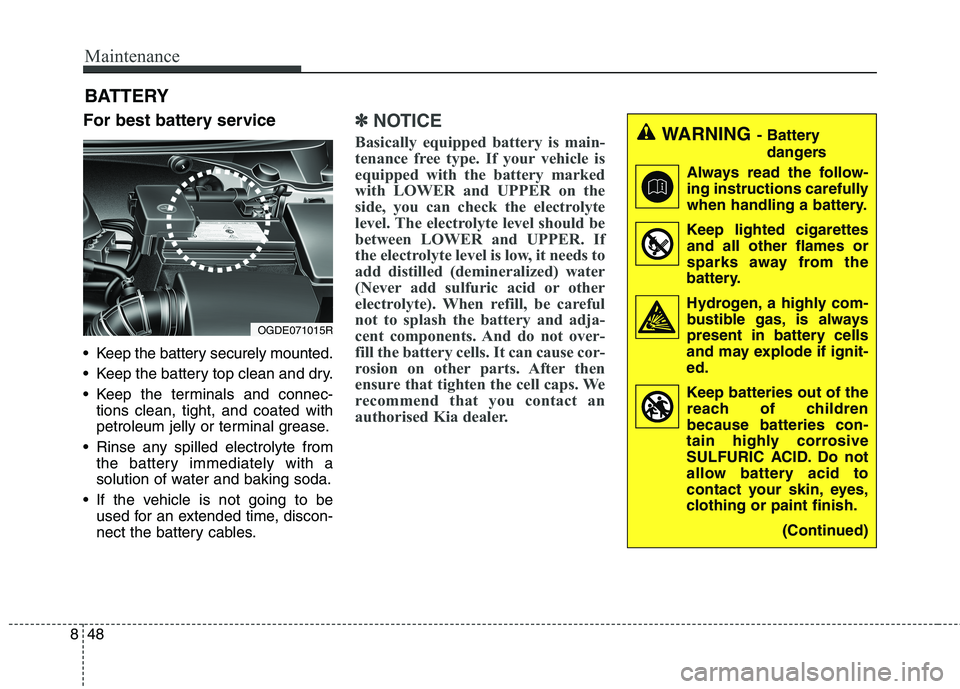
For best battery service
Keep the battery securely mounted.
Keep the battery top clean and dry.
Keep the terminals and connec- tions clean, tight, and coated with
petroleum jelly or terminal grease.
Rinse any spilled electrolyte from the battery immediately with a
solution of water and baking soda.
If the vehicle is not going to be used for an extended time, discon-
nect the battery cables.
✽✽ NOTICE
Basically equipped battery is main-
tenance free type. If your vehicle is
equipped with the battery marked
with LOWER and UPPER on the
side, you can check the electrolyte
level. The electrolyte level should be
between LOWER and UPPER. If
the electrolyte level is low, it needs to
add distilled (demineralized) water
(Never add sulfuric acid or other
electrolyte). When refill, be careful
not to splash the battery and adja-
cent components. And do not over-
fill the battery cells. It can cause cor-
rosion on other parts. After then
ensure that tighten the cell caps. We
recommend that you contact an
authorised Kia dealer.WARNING - Battery
dangers
Always read the follow-
ing instructions carefully
when handling a battery.
Keep lighted cigarettes and all other flames or
sparks away from the
battery.
Hydrogen, a highly com- bustible gas, is always
present in battery cells
and may explode if ignit-ed.
Keep batteries out of the reach of children because batteries con-
tain highly corrosive
SULFURIC ACID. Do not
allow battery acid to
contact your skin, eyes,
clothing or paint finish.
(Continued)
OGDE071015R
Page 637 of 723
Maintenance
50
8
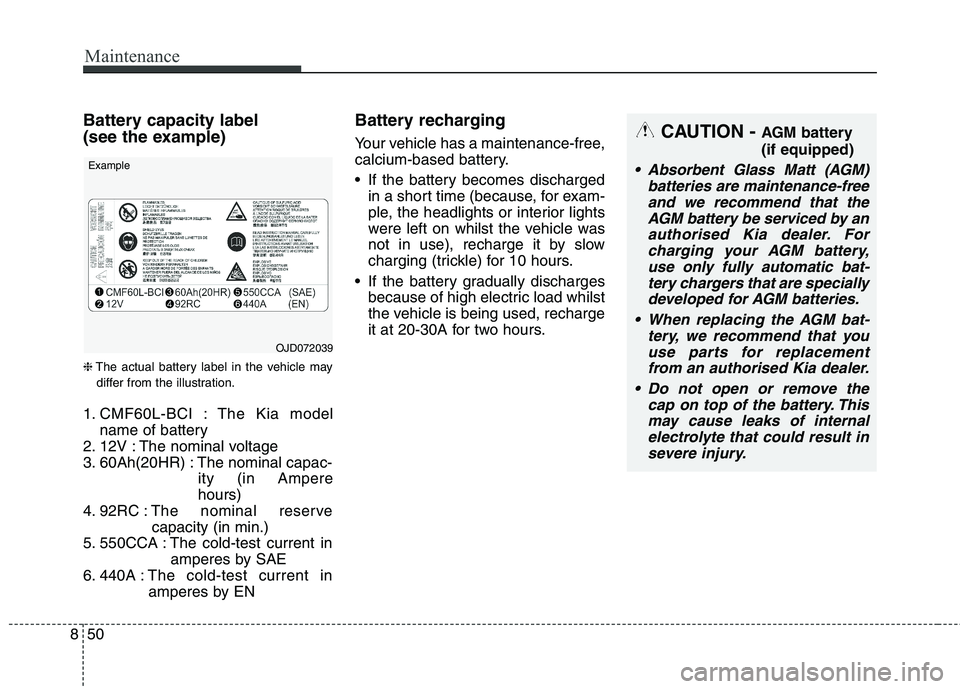
Battery capacity label
(see the example) ❈ The actual battery label in the vehicle may
differ from the illustration.
1. CMF60L-BCI : The Kia model name of battery
2. 12V : The nominal voltage
3. 60Ah(20HR) : The nominal capac- ity (in Amperehours)
4. 92RC : The nominal reserve
capacity (in min.)
5. 550CCA : The cold-test current in amperes by SAE
6. 440A : The cold-test current in
amperes by EN Battery recharging
Your vehicle has a maintenance-free,
calcium-based battery.
If the battery becomes discharged
in a short time (because, for exam-
ple, the headlights or interior lights
were left on whilst the vehicle was
not in use), recharge it by slow
charging (trickle) for 10 hours.
If the battery gradually discharges because of high electric load whilst
the vehicle is being used, recharge
it at 20-30A for two hours.
OJD072039
Example
CAUTION -
AGM battery (if equipped)
Absorbent Glass Matt (AGM)
batteries are maintenance-freeand we recommend that the AGM battery be serviced by anauthorised Kia dealer. Forcharging your AGM battery, use only fully automatic bat-tery chargers that are speciallydeveloped for AGM batteries.
When replacing the AGM bat- tery, we recommend that youuse parts for replacementfrom an authorised Kia dealer.
Do not open or remove the cap on top of the battery. Thismay cause leaks of internal electrolyte that could result insevere injury.
Page 646 of 723
859
Maintenance
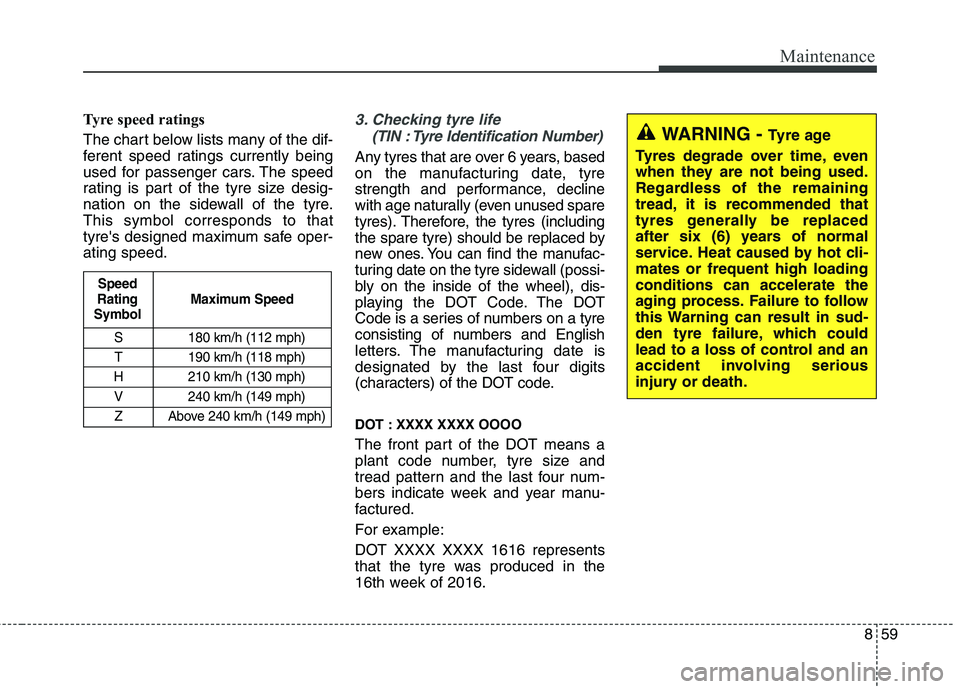
Tyre speed ratings
The chart below lists many of the dif-
ferent speed ratings currently being
used for passenger cars. The speed
rating is part of the tyre size desig-
nation on the sidewall of the tyre.This symbol corresponds to that
tyre's designed maximum safe oper-ating speed.3. Checking tyre life (TIN : Tyre Identification Number)
Any tyres that are over 6 years, based
on the manufacturing date, tyre
strength and performance, decline
with age naturally (even unused spare
tyres). Therefore, the tyres (including
the spare tyre) should be replaced by
new ones. You can find the manufac-
turing date on the tyre sidewall (possi-
bly on the inside of the wheel), dis-
playing the DOT Code. The DOT
Code is a series of numbers on a tyre
consisting of numbers and English
letters. The manufacturing date is
designated by the last four digits
(characters) of the DOT code.
DOT : XXXX XXXX OOOO
The front part of the DOT means a
plant code number, tyre size and
tread pattern and the last four num-
bers indicate week and year manu-
factured.
For example:
DOT XXXX XXXX 1616 represents
that the tyre was produced in the
16th week of 2016.
S 180 km/h (112 mph)
T 190 km/h (118 mph)
H 210 km/h (130 mph) V 240 km/h (149 mph) Z Above 240 km/h (149 mph)
Maximum Speed
Speed
Rating
Symbol
WARNING - Tyre age
Tyres degrade over time, even
when they are not being used.
Regardless of the remaining
tread, it is recommended that
tyres generally be replaced
after six (6) years of normal
service. Heat caused by hot cli-mates or frequent high loadingconditions can accelerate the
aging process. Failure to follow
this Warning can result in sud-
den tyre failure, which could
lead to a loss of control and an
accident involving serious
injury or death.
Page 647 of 723
Maintenance
60
8
4. Tyre ply composition and mate-
rial
The number of layers or plies of rub-
ber-coated fabric are in the tyre. Tyre
manufacturers also must indicate the
materials in the tyre, which include
steel, nylon, polyester, and others.
The letter "R" means radial ply con-
struction; the letter "D" means diago-
nal or bias ply construction; and theletter "B" means belted-bias ply con-
struction.
5. Maximum permissible inflationpressure
This number is the greatest amount of air pressure that should be put in
the tyre. Do not exceed the maximum
permissible inflation pressure. Refer
to the Tyre and Loading Information
label for recommended inflation
pressure.
6. Maximum load rating
This number indicates the maximum
load in kilograms and pounds that
can be carried by the tyre. When
replacing the tyres on the vehicle,
always use a tyre that has the same
load rating as the factory installed
tyre.
7. Uniform tyre quality grading
Quality grades can be found where
applicable on the tyre sidewall
between tread shoulder and maxi-
mum chapter width.
For example:
TREADWEAR 200
TRACTION AA
TEMPERATURE A Tread wear
The tread wear grade is a compara-
tive rating based on the wear rate ofthe tyre when tested under controlled
conditions on a specified government
test course. For example, a tyre grad-
ed 150 would wear one-and-a-half
times (1½) as well on the government
course as a tyre graded 100.
The relative performance of tyres depends upon the actual conditions
of their use, however, and may depart
significantly from the norm because
of variations in driving habits, service
practices and differences in road
characteristics and climate.
These grades are molded on the
side-walls of passenger vehicle tyres.
The tyres available as standard or
optional equipment on your vehicles
may vary with respect to grade.
Page 684 of 723
897
Maintenance
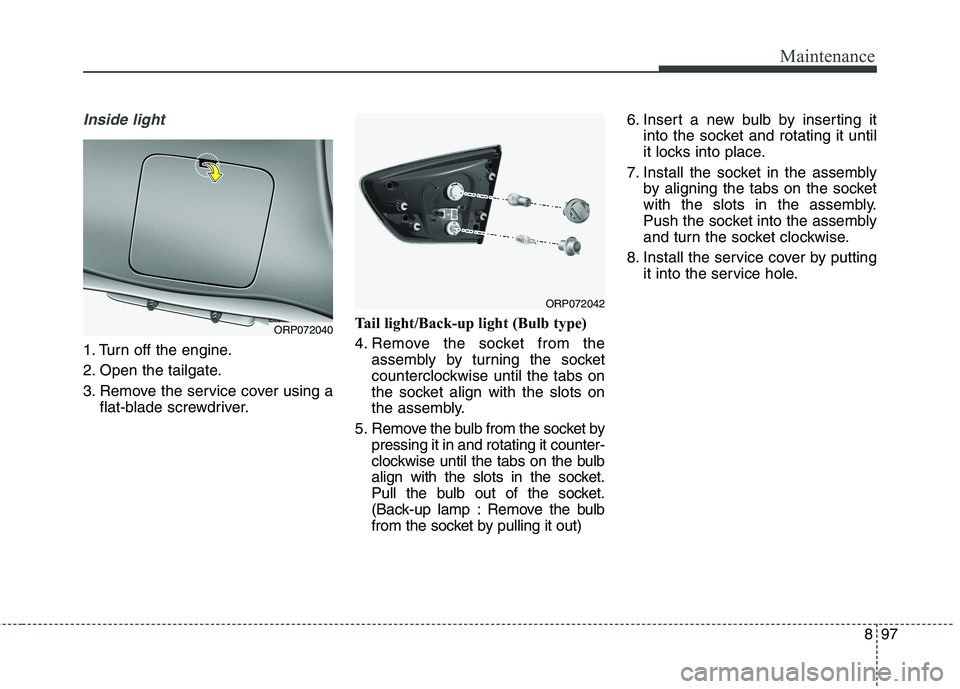
Inside light
1. Turn off the engine.
2. Open the tailgate.
3. Remove the service cover using aflat-blade screwdriver. Tail light/Back-up light (Bulb type)
4. Remove the socket from the
assembly by turning the socket
counterclockwise until the tabs on
the socket align with the slots on
the assembly.
5. Remove the bulb from the socket by pressing it in and rotating it counter-
clockwise until the tabs on the bulb
align with the slots in the socket.
Pull the bulb out of the socket.
(Back-up lamp : Remove the bulb
from the socket by pulling it out) 6. Insert a new bulb by inserting it
into the socket and rotating it until
it locks into place.
7. Install the socket in the assembly by aligning the tabs on the socket
with the slots in the assembly.
Push the socket into the assembly
and turn the socket clockwise.
8. Install the service cover by putting it into the service hole.
ORP072042
ORP072040
Page 696 of 723
8109
Maintenance
EMISSION CONTROL SYSTEM
The emission control system of your
vehicle is covered by a written limited
warranty. Please see the warranty
information contained in the Service
Passport in your vehicle.
Your vehicle is equipped with an emission control system to meet all
emission regulations. There are three emission control
systems which are as follows.
(1) Crankcase emission control sys- tem
(2) Evaporative emission control sys- tem
(3) Exhaust emission control systemIn order to assure the proper function
of the emission control systems, it is
recommended that you have your
car inspected and maintained by an
authorised Kia dealer in accordance
with the maintenance schedule. Caution for the Inspection and
Maintenance Test (With Electronic
Stability Control (ESC) system)
To prevent the vehicle from mis-
firing during dynamometer test-
ing, turn the Electronic Stability
Control (ESC) system off by
pressing the ESC switch.
After dynamometer testing is completed, turn the ESC system
back on by pressing the ESC
switch again.
1. Crankcase emission control system
The positive crankcase ventilation
system is employed to prevent air
pollution caused by blow-by gases
being emitted from the crankcase.This system supplies fresh filtered air
to the crankcase through the air
intake hose. Inside the crankcase,
the fresh air mixes with blow-by
gases, which then pass through the
PCV valve into the induction system. 2. Evaporative emission con-
trol System
The Evaporative Emission Control
System is designed to prevent fuel
vapours from escaping into the
atmosphere.
Canister
Fuel vapours generated inside the fuel tank are absorbed and stored in
the onboard canister. When the
engine is running, the fuel vapours
absorbed in the canister are drawninto the surge tank through the purge
control solenoid valve.
Purge Control Solenoid Valve (PCSV)
The purge control solenoid valve is
controlled by the Engine Control
Module (ECM); when the engine
coolant temperature is low during
idling, the PCSV closes so that evap-
orated fuel is not taken into the
engine. After the engine warms-up
during ordinary driving, the PCSV
opens to introduce evaporated fuel to
the engine.
Page 707 of 723
Specifications & Consumer information
8
9
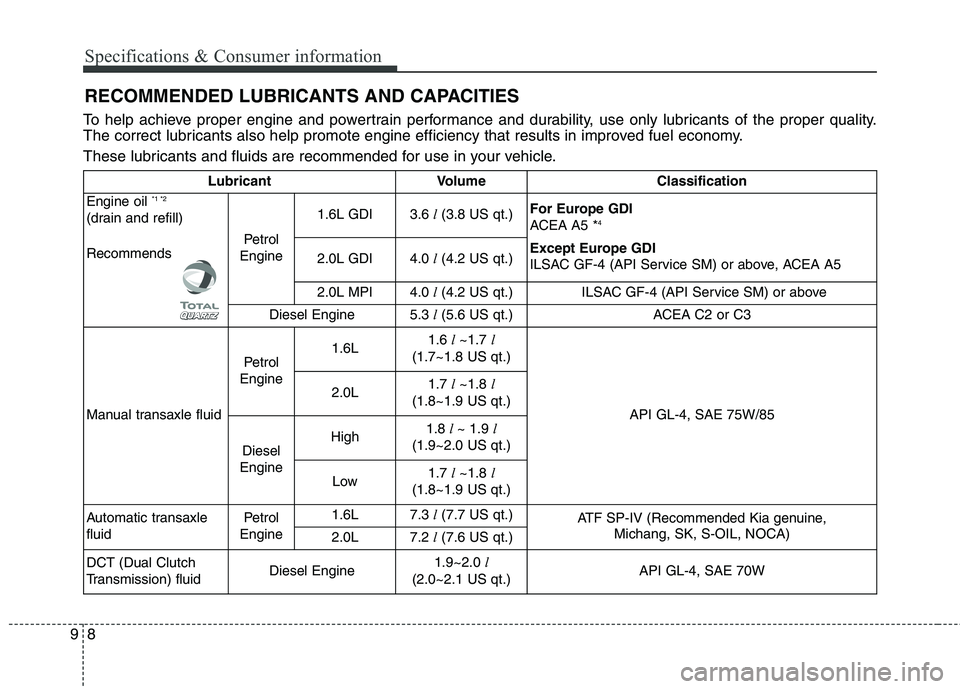
RECOMMENDED LUBRICANTS AND CAPACITIES
To help achieve proper engine and powertrain performance and durability, use only lubricants of the proper quality.
The correct lubricants also help promote engine efficiency that results in improved fuel economy.
These lubricants and fluids are recommended for use in your vehicle.
Lubricant Volume Classification
Engine oil *1 *2
(drain and refill) Recommends Petrol
Engine 1.6L GDI
3.6
l(3.8 US qt.) For Europe GDI
ACEA A5 *
4
Except Europe GDI
ILSAC GF-4 (API Service SM) or above, ACEA A5
2.0L GDI
4.0
l(4.2 US qt.)
2.0L MPI4.0 l(4.2 US qt.)ILSAC GF-4 (API Service SM) or above
Diesel Engine 5.3
l(5.6 US qt.)
ACEA C2 or C3
Manual transaxle fluid Petrol
Engine 1.6L
1.6
l~1.7 l
(1.7~1.8 US qt.)
API GL-4, SAE 75W/85
2.0L1.7 l~1.8 l
(1.8~1.9 US qt.)
Diesel
Engine High
1.8
l ~ 1.9 l
(1.9~2.0 US qt.)
Low 1.7
l~1.8 l
(1.8~1.9 US qt.)
Automatic transaxle fluid Petrol
Engine 1.6L
7.3
l(7.7 US qt.)
ATF SP-IV (Recommended Kia genuine,
Michang, SK, S-OIL, NOCA)
2.0L 7.2
l(7.6 US qt.)
DCT (Dual Clutch
Transmission) fluid Diesel Engine1.9~2.0
l
(2.0~2.1 US qt.) API GL-4, SAE 70W
Page 715 of 723
I3
Index
Checking the amount of air conditioner refrigerant and
compressor lubricant ..............................................4-162
Climate control air filter ..........................................4-161
Manual heating and air conditioning ........................4-153
System operation ......................................................4-159
Automatic transaxle ......................................................6-26 Automatic transaxle operation ....................................6-26
Good driving practices ................................................6-32
Battery............................................................................8-48 Battery capacity label..................................................8-50
Battery recharging ....................................................8-50
For best battery service ..............................................8-48
Reset items ..................................................................8-51
Before driving ..................................................................6-4 Before entering vehicle ................................................6-4Before starting ..............................................................6-4
Necessary inspections ..................................................6-4
Blind spot detection system (BSD) ..............................6-82 BSD (Blind Spot Detection) / LCA (Lane Change Assist) ......................................6-83
Driver's Attention ........................................................6-88
RCTA (Rear cross traffic alert) ..................................6-86
Bonnet ............................................................................4-38 Closing the bonnet ......................................................4-39
Opening the bonnet ....................................................4-38 Brake system..................................................................6-44
Anti-lock brake system (ABS) ..................................6-53
Electronic parking brake (EPB) ..................................6-48
Electronic stability control (ESC) ..............................6-56
Emergency Stop Signal (ESS) ....................................6-62
Good braking practices ..............................................6-62
Hill-start assist control (HAC) ....................................6-61
Parking brake - Hand type ..........................................6-46
Power brakes ............................................................6-44
Vehicle stability management (VSM) ........................6-60
Brake/clutch fluid ..........................................................8-38 Checking the brake/clutch fluid level ........................8-38
Bulb wattage ....................................................................9-5
Child restraint system ....................................................3-39 Child restraint system ................................................3-41
Installing a child restraint system with a lap/shoulder belt........................................................3-42
ISOFIX and Top Tether Anchorage system ................3-48
Top Tether Anchor system ..........................................3-46
Clean air ......................................................................4-167
Climate control air filter ................................................8-42 Filter inspection ..........................................................8-42
Filter replacement ......................................................8-42
Cruise Control system ..................................................6-64 Cruise control switch ..................................................6-65
B
C
Page 718 of 723
Index
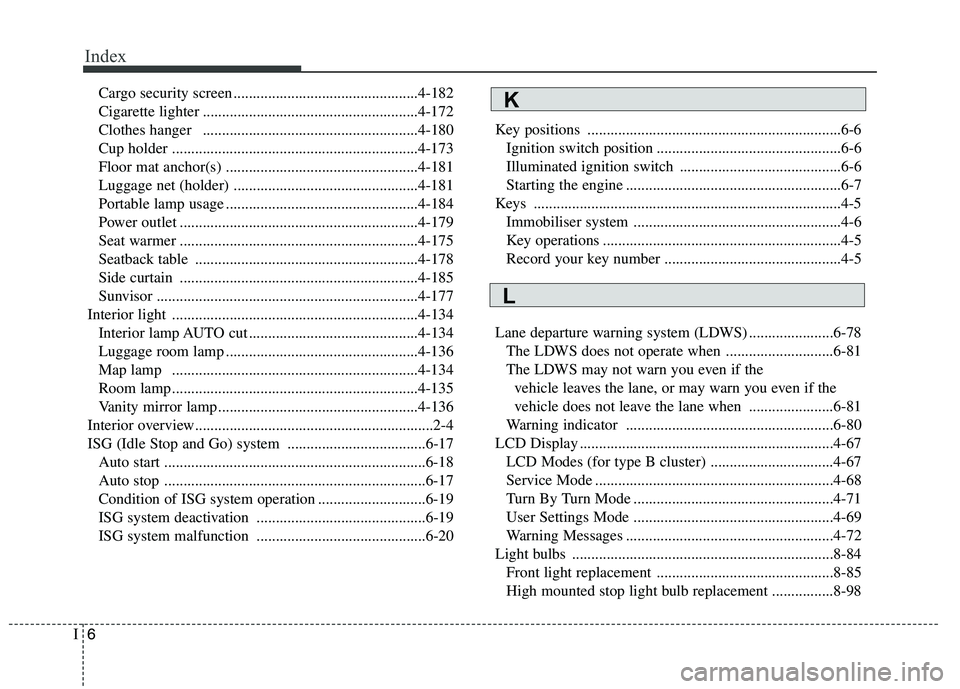
6
I
Cargo security screen ................................................4-182
Cigarette lighter ........................................................4-172
Clothes hanger ........................................................4-180
Cup holder ................................................................4-173
Floor mat anchor(s) ..................................................4-181
Luggage net (holder) ................................................4-181
Portable lamp usage ..................................................4-184
Power outlet ..............................................................4-179
Seat warmer ..............................................................4-175
Seatback table ..........................................................4-178
Side curtain ..............................................................4-185
Sunvisor ....................................................................4-177
Interior light ................................................................4-134 Interior lamp AUTO cut ............................................4-134
Luggage room lamp ..................................................4-136
Map lamp ................................................................4-134
Room lamp ................................................................4-135
Vanity mirror lamp ....................................................4-136
Interior overview..............................................................2-4
ISG (Idle Stop and Go) system ....................................6-17 Auto start ....................................................................6-18
Auto stop ....................................................................6-17
Condition of ISG system operation ............................6-19
ISG system deactivation ............................................6-19
ISG system malfunction ............................................6-20 Key positions ..................................................................6-6
Ignition switch position ................................................6-6
Illuminated ignition switch ..........................................6-6
Starting the engine ........................................................6-7
Keys ................................................................................4-5 Immobiliser system ......................................................4-6
Key operations ..............................................................4-5
Record your key number ..............................................4-5
Lane departure warning system (LDWS) ......................6-78 The LDWS does not operate when ............................6-81
The LDWS may not warn you even if the vehicle leaves the lane, or may warn you even if the
vehicle does not leave the lane when ......................6-81
Warning indicator ......................................................6-80
LCD Display ..................................................................4-67 LCD Modes (for type B cluster) ................................4-67
Service Mode ..............................................................4-68
Turn By Turn Mode ....................................................4-71
User Settings Mode ....................................................4-69
Warning Messages ......................................................4-72
Light bulbs ....................................................................8-84 Front light replacement ..............................................8-85
High mounted stop light bulb replacement ................8-98
L
K
Page 719 of 723
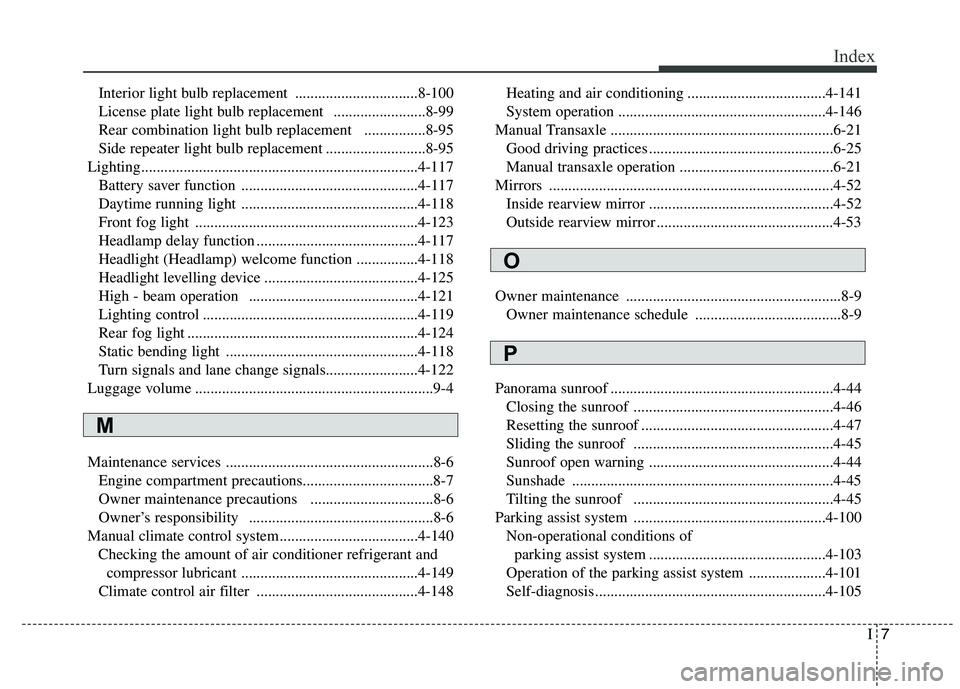
I7
Index
Interior light bulb replacement ................................8-100
License plate light bulb replacement ........................8-99
Rear combination light bulb replacement ................8-95
Side repeater light bulb replacement ..........................8-95
Lighting........................................................................4-117 Battery saver function ..............................................4-117
Daytime running light ..............................................4-118
Front fog light ..........................................................4-123
Headlamp delay function ..........................................4-117
Headlight (Headlamp) welcome function ................4-118
Headlight levelling device ........................................4-125
High - beam operation ............................................4-121
Lighting control ........................................................4-119
Rear fog light ............................................................4-124
Static bending light ..................................................4-118
Turn signals and lane change signals........................4-122
Luggage volume ..............................................................9-4
Maintenance services ......................................................8-6 Engine compartment precautions..................................8-7
Owner maintenance precautions ................................8-6
Owner’s responsibility ................................................8-6
Manual climate control system....................................4-140 Checking the amount of air conditioner refrigerant and compressor lubricant ..............................................4-149
Climate control air filter ..........................................4-148 Heating and air conditioning ....................................4-141
System operation ......................................................4-146
Manual Transaxle ..........................................................6-21 Good driving practices ................................................6-25
Manual transaxle operation ........................................6-21
Mirrors ..........................................................................4-52 Inside rearview mirror ................................................4-52
Outside rearview mirror ..............................................4-53
Owner maintenance ........................................................8-9 Owner maintenance schedule ......................................8-9
Panorama sunroof ..........................................................4-44 Closing the sunroof ....................................................4-46
Resetting the sunroof ..................................................4-47
Sliding the sunroof ....................................................4-45
Sunroof open warning ................................................4-44
Sunshade ....................................................................4-45
Tilting the sunroof ....................................................4-45
Parking assist system ..................................................4-100 Non-operational conditions of parking assist system ..............................................4-103
Operation of the parking assist system ....................4-101
Self-diagnosis............................................................4-105
P
M
O