service indicator KIA CARENS RHD 2018 User Guide
[x] Cancel search | Manufacturer: KIA, Model Year: 2018, Model line: CARENS RHD, Model: KIA CARENS RHD 2018Pages: 723, PDF Size: 40.94 MB
Page 190 of 723
Features of your vehicle
94
4
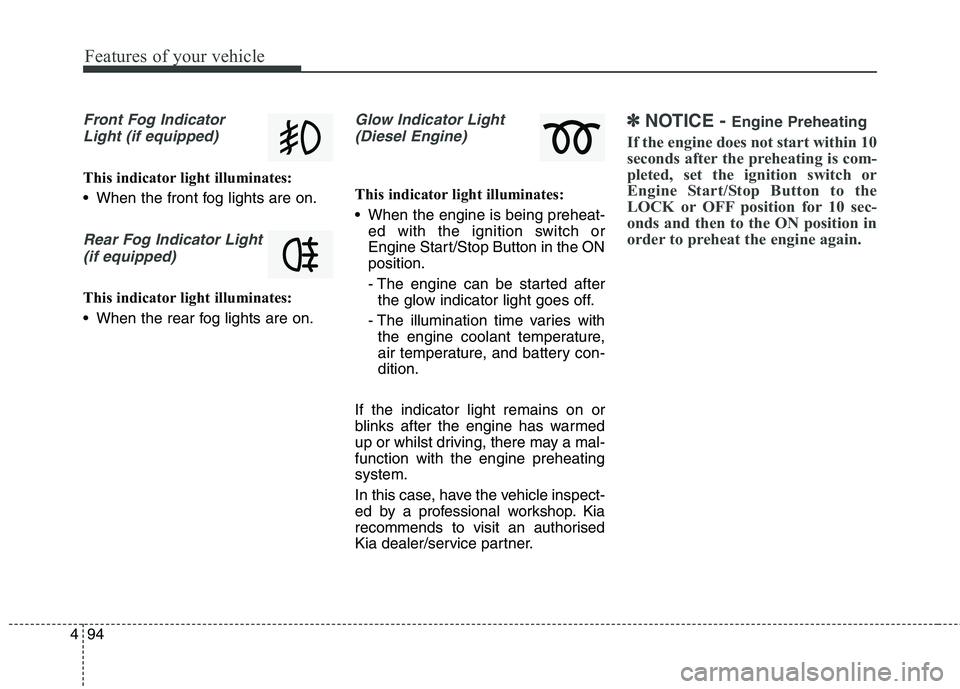
Front Fog Indicator
Light (if equipped)
This indicator light illuminates:
When the front fog lights are on.
Rear Fog Indicator Light (if equipped)
This indicator light illuminates:
When the rear fog lights are on.
Glow Indicator Light(Diesel Engine)
This indicator light illuminates:
When the engine is being preheat- ed with the ignition switch or
Engine Start/Stop Button in the ONposition.
- The engine can be started afterthe glow indicator light goes off.
- The illumination time varies with the engine coolant temperature,
air temperature, and battery con-dition.
If the indicator light remains on or
blinks after the engine has warmed
up or whilst driving, there may a mal-function with the engine preheatingsystem.
In this case, have the vehicle inspect-
ed by a professional workshop. Kia
recommends to visit an authorised
Kia dealer/service partner.
✽✽ NOTICE - Engine Preheating
If the engine does not start within 10
seconds after the preheating is com-
pleted, set the ignition switch or
Engine Start/Stop Button to the
LOCK or OFF position for 10 sec-
onds and then to the ON position in
order to preheat the engine again.
Page 211 of 723
4115
Features of your vehicle
Additional instructions
(messages)
When the Smart Parking Assist
System is operating, a message
("Manually control steering wheel",
"Reduce speed") may appear
regardless of the parking order. The messages will appear according
to the circumstances. Follow the
instructions provided whilst parking
your vehicle with the Smart ParkingAssist System.✽✽NOTICE
In the below conditions the system
will be cancelled. Park your vehicle
manually.
1. Search for parking space - When the ABS/ESC is activated
- When the vehicle speed is over40km/h (24.8mph)
- When you press the Smart Parking Assist System button
(the front and rear Parking
Assist System operates)
- When you shift the shift lever to R (Reverse)
2. Steering wheel control - When the ABS/ESC is activated
- When the vehicle speed is over7km/h (4.3 mph)
- When you press the Smart Parking Assist System button
(the front and rear Parking
Assist System operates)
- When you shift the shift lever to D (Drive) before entering the
parking space
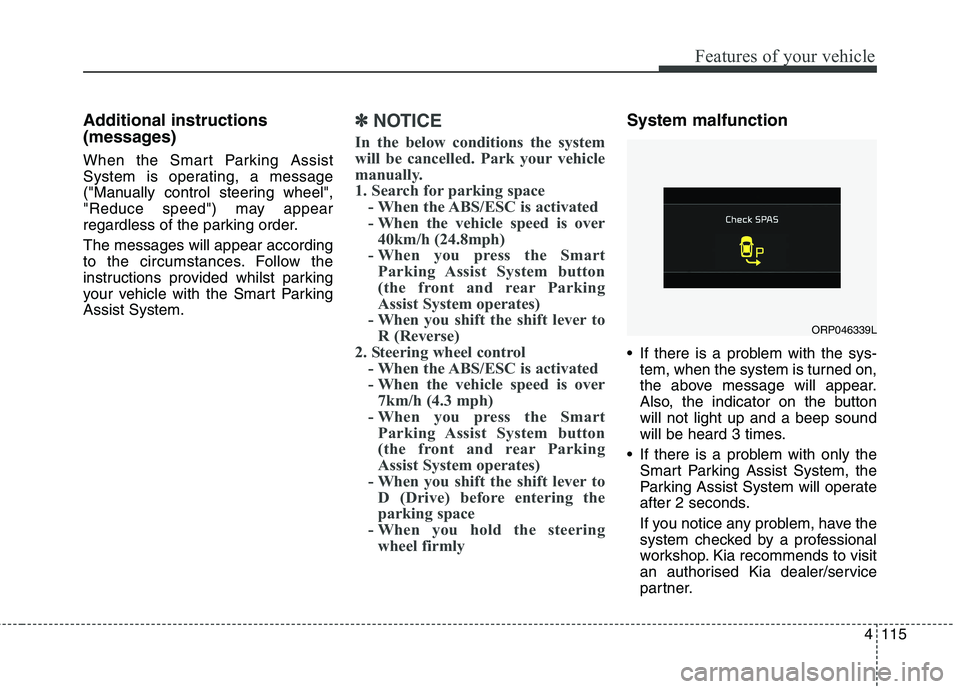
- When you hold the steering wheel firmlySystem malfunction
If there is a problem with the sys- tem, when the system is turned on,
the above message will appear.
Also, the indicator on the buttonwill not light up and a beep sound
will be heard 3 times.
If there is a problem with only the Smart Parking Assist System, the
Parking Assist System will operate
after 2 seconds.
If you notice any problem, have the
system checked by a professional
workshop. Kia recommends to visit
an authorised Kia dealer/service
partner.
ORP046339L
Page 462 of 723
627
Driving your vehicle
For smooth operation, depress thebrake pedal when shifting from N(Neutral) to a forward or reverse gear.Transaxle ranges
The indicator lights in the instrument
cluster displays the shift lever posi-
tion when the ignition switch is in theON position.
P (Park)
Always come to a complete stop
before shifting into P (Park). This
position locks the transaxle and pre-
vents the front wheels from rotating.
WARNING - Automatic
transaxle
Always check the surrounding areas near your vehicle for
people, especially children,
before shifting a vehicle into
D (Drive) or R (Reverse).
Before leaving the driver’s seat, always make sure the
shift lever is in the P (Park)
position; then set the parking
brake fully and shut the engine
off. Unexpected and sudden
vehicle movement can occur if
these precautions are not fol-
lowed in the order identified.
Do not use the engine brake (shifting from a high gear to
lower gear) rapidly on slip-
pery roads.
The vehicle may slip causing an accident.
CAUTION
To avoid damage to your
transaxle, do not acceleratethe engine in R (Reverse) orany forward gear position withthe brakes on.
When stopped on an upgrade, do not hold the vehicle sta-tionary with engine power.Use the service brake or theparking brake.
Do not shift from N (Neutral) or P (Park) into D (Drive), or R(Reverse) when the engine isabove idle speed.
WARNING
Shifting into P (Park) whilst the vehicle is in motion will
cause the drive wheels to lock
which will cause you to lose
control of the vehicle.
Do not use the P (Park) posi- tion in place of the parking
brake. Always make sure the
shift lever is latched in the P
(Park) position and set the
parking brake fully.
Never leave a child unattend- ed in a vehicle.
Page 463 of 723
Driving your vehicle
28
6
R (Reverse)
Use this position to drive the vehicle
backward. N (Neutral)
The wheels and transaxle are not
engaged. The vehicle will roll freely
even on the slightest incline unless
the parking brake or service brakesare applied.
- Parking in N (Neutral) gear
Follow below steps when parking
and you want the vehicle to movewhen pushed.
1.After parking your vehicle, step on
the brake pedal and move the shift
lever to [P] with the ignition button in
[ON] or whilst the engine is running.
2.If the parking brake is applied unlock the parking brake.
- For EPB (Electronic ParkingBrake) equipped vehicles, push
the brake pedal with the ignition
button in [ON] or whilst the
engine is running to disengage
the parking brake. If [AUTOHOLD] function is used whilst
driving (If [AUTO HOLD] indicator
is on in the cluster), press [AUTO
HOLD] switch and [AUTO HOLD]
function should be turn off.
3.Whilst pressing the brake pedal, turn the ignition button [OFF].
- For smart key equipped vehicles,the ignition switch can be moved
to [OFF] only when the shift leveris in [P].
CAUTION
Always come to a complete stop
before shifting into or out of R(Reverse); you may damage the transaxle if you shift into R(Reverse) whilst the vehicle is inmotion, except as explained in “Rocking the vehicle”, in thismanual.
CAUTION
The transaxle may be damagedif you shift into P (Park) whilstthe vehicle is in motion.
WARNING
Do not drive with the shift lever in N (Neutral).
The engine brake will not work and lead to an accident.
Page 470 of 723
635
Driving your vehicle
The Dual Clutch Transmission givesthe driving feel of a manual transmis-
sion, yet provides the ease of a fully
automatic transmission. Unlike a tra-
ditional automatic transmission, the
gear shifting can be felt (and heard)
on the dual clutch transmission
- Think of it as an automaticallyshifting manual transmission.
- Shift into Drive range and get fully automatic shifting, similar to a con-
ventional automatic transmission.
Dual clutch transmission adopts dry-type dual clutch, which is dif-
ferent from torque converter of
automatic transmission, and
shows better acceleration perform-
ance during driving. But, initial
launch might be little bit slower
than Automatic Transmission. The dry-type clutch transfers torque
and provides a direct driving feeling
which may feel different from a con-
ventional automatic transmission
with a torque converter. This may be
more noticeable when starting from
a stop or low vehicle speed.
When rapidly accelerating at low vehicle speed, engine could rev at
high rpm depending on vehicle
drive condition.
For smooth launch uphill, press down the accelerator pedalsmoothly depending on the current
conditions.
If you release your foot from the accelerator pedal at low vehicle
speed, you may feel strong engine
brake, which is similar to manual
transmission.
When driving downhill, you may use Sports Mode and press the
paddle shifters to downshift to a
lower gear in order to control your
speed without using the brake
pedal excessively. When you turn the engine on and
off, you may hear clicking soundsas the system goes through a self
test. This is a normal sound for the
Dual Clutch Transmission.
(Continued)
Do not use engine braking(shifting from a high gear to
lower gear) rapidly on slip-
pery roads. The vehicle mayslip causing an accident.
WARNING
Due to transmission failure, the
vehicle may not move and the
position indicator (D, R) will
blink on the cluster. In this case,
have the system checked by a
professional workshop. Kia rec-ommends to visit an authorised
Kia dealer/service partner.
Page 471 of 723
Driving your vehicle
36
6
CAUTION
To hold the vehicle on a hill
use the foot brake or the park-ing brake. If the vehicle is heldby applying the acceleratorpedal on a hill the clutch and transmission will be overheat-ed resulting in damage.
At this time, a warning mes-sage ("Steep grade! Pressbrake pedal") will appear on the LCD display and you mayfeel a vibration.
If the clutch becomes over- heated by excessive use of theclutch to hold on a hill, you may notice a shudder feelingand a blinking display on theinstrument cluster. When this occurs, the clutch is disableduntil the clutch cools to normaltemperatures. If this occurs, pull over to a safe location,shift into P (Park) and apply thefoot brake for a few minutes.
(Continued)
(Continued)
If the LCD warning is active, the foot brake must be applied.
Ignoring the warnings can lead to damage to the trans-mission.
If the display continues to blink, for your safety, contact a pro-fessional workshop. Kia recom-mends to visit an authorisedKia dealer/service partner.
Under certain conditions such as repeated launch on steepgrades, the clutch in the trans-mission could overheat. Whenthe clutch is overheated, the
safe protection modeengages. If the safe protectionmode engages, the gear posi-tion indicator on the cluster blinks with a chime sound.
At this time, a warning message("Transmission temp. is high!Stop safely", "Trans Cooling.Remain parked for 00 min.") willappear on the LCD display and driving may not be smooth.
(Continued)(Continued)If you ignore this warning, thedriving condition may becomeworse. To return the normal driving condition, stop thevehicle and apply the footbrake for a few minutes before driving off.
Repetitive kick downs may lead to overheating of thetransmission. This will lead tochange in the vehicle speed shift pattern, and illuminatesome warning message.
To return the normal drivingcondition, refrain from kickdown speed changes. Whenthe warning message illumi- nates, park the vehicle at asafe location.
Gear shifts may be more noticeable than a convention-al automatic transmission.This is a normal characteristic of this type of dual clutchtransmission.
(Continued)
Page 480 of 723
645
Driving your vehicle
In the event of brake failure
If service brakes fail to operate whilst
the vehicle is in motion, you can
make an emergency stop with the
parking brake. The stopping dis-
tance, however, will be much greater
than normal.
Disc brakes wear indicator
When your brake pads are worn and
new pads are required, you will hear
a high-pitched warning sound from
your front brakes or rear brakes. You
may hear this sound come and go or
it may occur whenever you depress
the brake pedal.
Please remember that some driving
conditions or climates may cause a
brake squeal when you first apply (or
lightly apply) the brakes. This is nor-
mal and does not indicate a problem
with your brakes.
WARNING - Brake wear
This brake wear warning sound
means your vehicle needs serv-
ice. If you ignore this audible
warning, you will eventually
lose braking performance,
which could lead to a seriousaccident.
CAUTION
To avoid costly brake repairs, do not continue to drive withworn brake pads.
Always replace the front or rear brake pads as pairs.
WARNING - Parking
brake
Applying the parking brake
whilst the vehicle is moving atnormal speeds can cause a
sudden loss of control of the
vehicle. If you must use theparking brake to stop the vehi-
cle, use great caution in apply-
ing the brake.
Page 486 of 723
651
Driving your vehicle
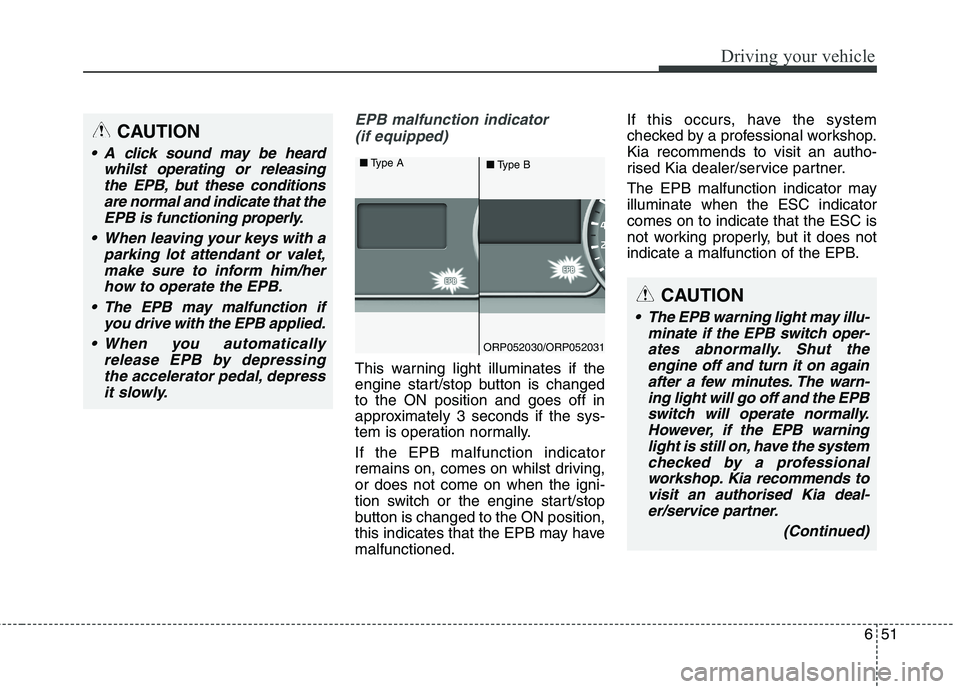
EPB malfunction indicator (if equipped)
This warning light illuminates if the
engine start/stop button is changedto the ON position and goes off in
approximately 3 seconds if the sys-
tem is operation normally. If the EPB malfunction indicator
remains on, comes on whilst driving,or does not come on when the igni-
tion switch or the engine start/stop
button is changed to the ON position,
this indicates that the EPB may havemalfunctioned. If this occurs, have the system
checked by a professional workshop.Kia recommends to visit an autho-
rised Kia dealer/service partner.
The EPB malfunction indicator may illuminate when the ESC indicatorcomes on to indicate that the ESC is
not working properly, but it does not
indicate a malfunction of the EPB.
CAUTION
A click sound may be heard
whilst operating or releasingthe EPB, but these conditionsare normal and indicate that theEPB is functioning properly.
When leaving your keys with a parking lot attendant or valet,make sure to inform him/herhow to operate the EPB.
The EPB may malfunction if you drive with the EPB applied.
When you automatically release EPB by depressingthe accelerator pedal, depress it slowly.
ORP052030/ORP052031
■
Type A
■Type B
CAUTION
The EPB warning light may illu-
minate if the EPB switch oper-ates abnormally. Shut the engine off and turn it on againafter a few minutes. The warn-ing light will go off and the EPB switch will operate normally.However, if the EPB warninglight is still on, have the system checked by a professionalworkshop. Kia recommends tovisit an authorised Kia deal-er/service partner.
(Continued)
Page 495 of 723
Driving your vehicle
60
6
Vehicle stability management (VSM) (if equipped)
This system provides further
enhancements to vehicle stability
and steering responses when a vehi-
cle is driving on a slippery road or a
vehicle detected changes in coeffi-
cient of friction between right wheels
and left wheels when braking.
VSM operation
When the VSM is operating:
ESC (Electronic Stability Control)
( ) light will blink.
The steering wheel may be con- trolled.
When the vehicle stability manage-
ment is operating properly, you can
feel a slight pulsation in the vehicle.
This is only the effect of brake control
and indicates nothing unusual. The VSM does not operate when:
Driving on bank road such as gra-
dient or incline
Driving rearward
ESC OFF indicator light ( ) remains on the instrument cluster
EPS (Electronic Power Steering) indicator light remains on the
instrument clusterVSM operation off
If you press the ESC OFF button to
turn off the ESC, the VSM will alsocancel and the ESC OFF indicator
light ( ) illuminates.
To turn on the VSM, press the button
again. The ESC OFF indicator lightgoes out.
Malfunction indicator
The VSM can be deactivated even if
you don’t cancel the VSM operation
by pressing the ESC OFF button. Itindicates that a malfunction has
been detected somewhere in the
EPS (Electronic Power Steering)
system or VSM system. If the ESC
indicator light ( ) or EPS warning
light remains on, have the system
checked by a professional workshop. Kia recommends to visit an autho-
rised Kia dealer/service partner.
✽✽ NOTICE
The VSM is designed to function above approximately 15 km/h (9
mph) on curves.
The VSM is designed to function above approximately 30 km/h (18
mph) when a vehicle is braking on
a split-mu road. The split-mu road
is made of surfaces which have dif-
ferent friction forces.
Page 498 of 723
663
Driving your vehicle
Check to be sure the parking brakeis not engaged and that the park-
ing brake indicator light is out
before driving away.
Driving through water may get the brakes wet. They can also get wet
when the vehicle is washed. Wet
brakes can be dangerous! Your
vehicle will not stop as quickly if the
brakes are wet. Wet brakes may
cause the vehicle to pull to one side.
To dry the brakes, apply the brakes
lightly until the braking action
returns to normal, taking care to
keep the vehicle under control at
all times. If the braking action does
not return to normal, stop as soon
as it is safe to do so and have your
vehicle inspected by a professional
workshop. Kia recommends to call an autho-
rised Kia dealer/service partner.
Do not coast down hills with the vehicle out of gear. This is extreme-
ly hazardous. Keep the vehicle in
gear at all times, use the brakes to
slow down, then shift to a lower
gear so that engine braking will
help you maintain a safe speed. Do not "ride" the brake pedal.
Resting your foot on the brake
pedal whilst driving can be danger-ous because it can result in the
brakes overheating and losing their
effectiveness. It also increases the
wear of the brake components.
If a tyre goes flat whilst you are driving, apply the brakes gently and
keep the vehicle pointed straight
ahead whilst you slow down. When
you are moving slowly enough for it
to be safe to do so, pull off the road
and stop in a safe place.
If your vehicle is equipped with an automatic transaxle / dual clutch
transmission, do not let your vehi-
cle creep forward. To avoid creep-
ing forward, keep your foot firmly
on the brake pedal when the vehi-cle is stopped.
Be cautious when parking on a hill. Firmly engage the parking brake
and place the shift lever in P (auto-
matic transaxle / dual clutch trans-
mission) or in first or reverse gear
(manual transaxle). If your vehicle
is facing downhill, turn the front
wheels into the kerb to help keep
the vehicle from rolling. If your vehicle is facing uphill, turn
the front wheels away from the
kerb to help keep the vehicle from
rolling. If there is no kerb or if it is
required by other conditions to
keep the vehicle from rolling, block
the wheels.
Under some conditions your park- ing brake can freeze in the
engaged position. This is most like-ly to happen when there is an accu-
mulation of snow or ice around or
near the rear brakes or if the brakes
are wet. If there is a risk that the
parking brake may freeze, apply it
only temporarily whilst you put the
shift lever in P (automatic transaxle
/ dual clutch transmission) or in first
or reverse gear (manual transaxle)
and block the rear wheels so the
vehicle cannot roll. Then release
the parking brake.
Do not hold the vehicle on the upgrade with the accelerator
pedal. This can cause the transaxle
to overheat. Always use the brake
pedal or parking brake.