ignition KIA CARNIVAL 2007 Owners Manual
[x] Cancel search | Manufacturer: KIA, Model Year: 2007, Model line: CARNIVAL, Model: KIA CARNIVAL 2007Pages: 1575, PDF Size: 44.86 MB
Page 830 of 1575

2007 > 2.7L V6 GASOLINE >
AIRBAG DISPOSAL
SPECIAL TOOL REQUIRED
Before scrapping any airbags or side airbags (including those in a whole vehicle to be scrapped), the airbags or side
airbags must be deployed. If the vehicle is still within the warranty period, before deploying the airbags or side airbags,
the Technical Manager must give approval and/or special instruction. Only after the airbags or side airbags have been
deployed (as the result of vehicle collision, for example), can they be scrapped.
If the airbags or side airbags appear intact (not deployed), treat them with extreme caution. Follow this procedure.
DEPLOYING AIRBAGS IN THE VEHICLE
If an SRS equipped vehicle is to be entirely scrapped, its airbags or side airbags should be deployed while still in the
vehicle. The airbags or side airbags should not be considered as salvageable parts and should never be installed in
another vehicle. 1. Turn the ignition switch OFF, and disconnect the battery negative cable and wait at least three minutes.
2. Confirm that each airbag or side airbag is securely mounted.
3. Confirm that the special tool is functioning properly by following the check procedure.
DRIVER'S AIRBAG :
1.Remove the driver's airbag and install the SST(0957A - 38500).
2. Install the driver's airbag on the steering wheel.
FRONT PASSENGER'S AIRBAG :
1.Remove the glove box, then disconnect the 2P connector between the front passenger's airbag and SRS main
harness.
2. Install the SST(0957A - 3F100).
SIDE AIRBAG :
1.Disconnect the 2P connector between the side airbag and side wire harness.
2. Install the SST (0957A- 3F100).
CURTAIN AIRBAG :
1.Disconnect the 2P connector between the curtain airbag and wire harness.
2. Install the SST(0957A - 38500).
SEAT BELT PRETENSIONER :
1.Disconnect the 2P connector from the seat belt pretensioner.
2. Install the SST(0957A - 38500).
3. Place the deployment tool at least thirty feet (10 meters) away from the airbag.
4. Connect a 12 volt battery to the tool.
5. Push the tool's deployment switch. The airbag should deploy (deployment is both highly audible and visible: a loud
noise and rapid inflation of the bag, followed by slow deflection)
6. Dispose of the complete airbag. No part of it can be reused. Place it in a sturdy plastic bag and seal it securely.
Page 836 of 1575

2.Remove ignition key from the vehicle.
3. Connect the clock spring harness connetor and horn harness connector to the clock spring.
4. Set the clock spring on neutral position and after turning the front wheels to the straight- ahead position, install the
clock spring.
5. Install the steering wheel column cover and the steering wheel. (Refer to ST group)
6. Connect the Driver Airbag (DAB) module connector and horn connector, then install the Driver Airbag (DAB)
module on the steering wheel.
7. Secure the Driver Airbag (DAB) with the new mounting bolts.
Tightening Torque (DAB Mounting Bolt)
: 0.8 ~ 1.1 kgf.m (7.9 ~ 10.8 Nm, 5.8 ~ 8.0 lb.ft)
8.Connect the battery negative cable.
9. After installing the airbag, confirm proper system operation:
a. Turn the ignition switch ON; the SRS indicator light should be turned on for about six seconds and then go off.
b. Make sure horn button works.
INSPECTION
Driver Airbag (DAB)
If any improper parts are found during the following inspection, replace the airbag module with a new one.
Never attempt to measure the circuit resistance of the airbag module (squib) even if you are using the specified
tester. If the circuit resistance is measured with a tester, accidental airbag deployment will result in serious
personal injury.
1. Check pad cover for dents, cracks or deformities.
2. Check the airbag module for denting, cracking or deformation.
3. Check hooks and connectors for damage, terminals for deformities, and harness for binds.
Page 842 of 1575

INSTALLATION
1.Disconnect the negative ( - ) cable from battery and wait for at least three minutes.
2. Remove ignition key from the vehicle.
3. Place a Passenger Airbag (PAB) on the crash pad and tighten the Passenger Airbag (PAB) mounting nuts.
Tightening Torque
: 0.7 ~ 0.8 kgf.m (7.0 ~ 8.0 N.m, 5.2 ~ 5.9 lb.ft)
4. Install the heater duct to the crash pad.
5. Install the crash pad. (Refer to BD group)
6. Tighten the PAB mounting bolts.
Tightening Torque
: 1.2 ~ 1.3 kgf.m (12.0 ~ 13.0 N.m, 8.9 ~ 9.6 lb.ft)
7. Connect the Passenger Airbag (PAB) harness connector to the SRS main harness connector.
8. Reinstall the bolve box. (Refer to BD group)
9. Reconnect the battery negative cable.
10. After installing the Passenger Airbag (PAB), confirm proper system operation:
a. Turn the ignition switch ON; the SRS indicator light should be turned on for about six seconds and then go off.
Page 846 of 1575

2007 > 2.7L V6 GASOLINE >
removal
1.Disconnect the battery negative cable and wait for at least 3 minutes before beginning work.
2. Remove the following parts. (Refer to BD group)
a. Interior trim
b. Headlining
3. Disconnect the Curtain Airbag harness connector (front & rear).
4.After loosening the mounting bolts (13EA), remove the curtain airbag.
INSTALLATION
a.Be sure to install the harness wires not to be pinched or interfered with other parts.
1. Disconnect the negative ( - ) cable from battery and wait for at least three minutes.
2. Remove ignition key from the vehicle.
3. Install a Curtain Airbag (CAB) on the mounting bracket.
4. Tighten the CAB mounting bolts (13EA).
Tightening Torque (CAB Mounting Bolt)
: 1.9 ~ 2.7 kgf.m(18.6 ~ 26.5 Nm, 13.7 ~ 19.5 lb.ft)
a.Never twist the airbag module when installing it. If the module is twisted, airbag module may operate
abnormally.
5. Connect the CAB connector (front & rear).
6. Reconnect the battery negative cable.
7. After installing the Curtain Airbag (CAB), confirm proper system operation:
a. Turn the ignition switch ON; the SRS indicator light should be turned on for about six seconds and then go off.
Page 850 of 1575
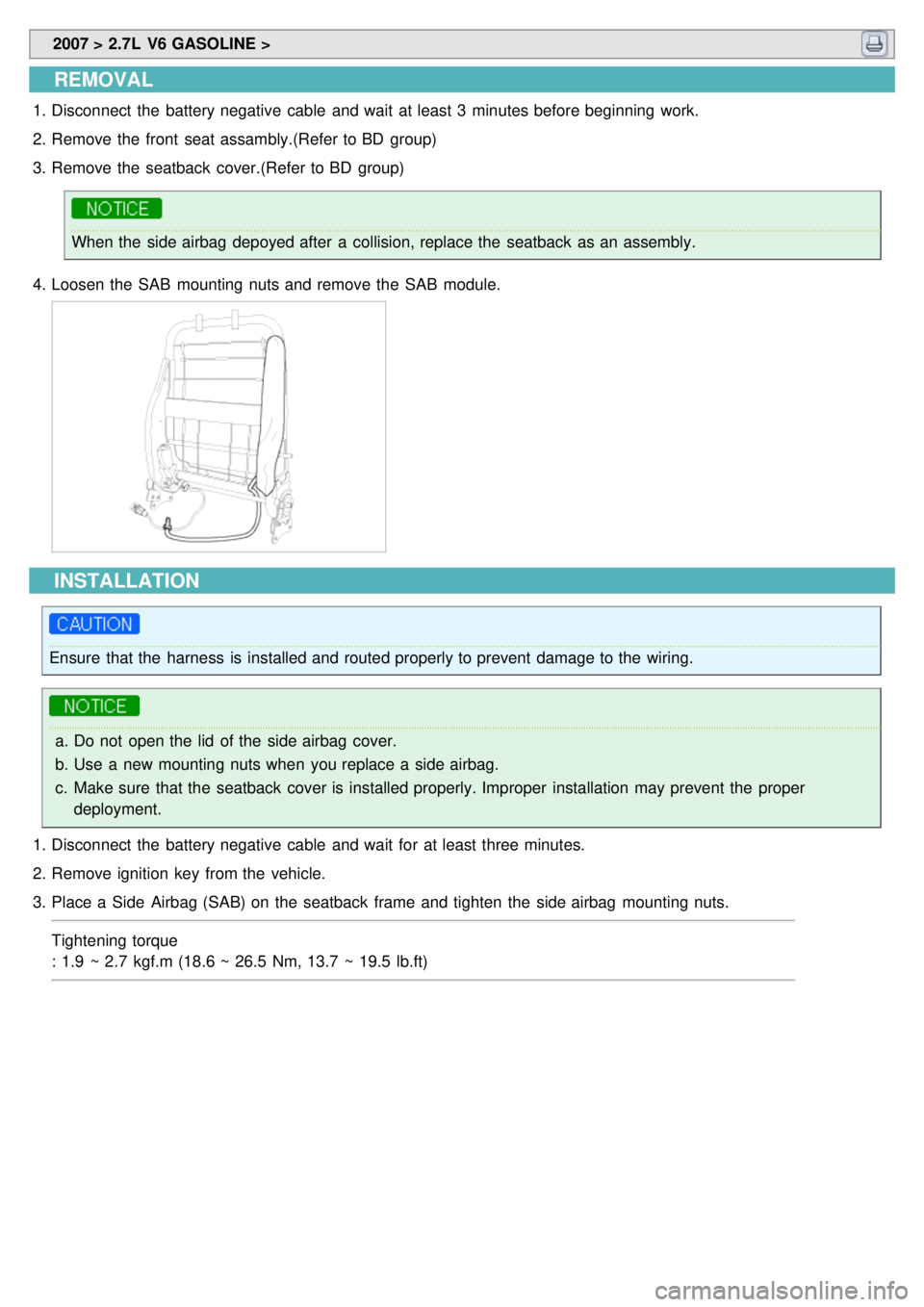
2007 > 2.7L V6 GASOLINE >
REMOVAL
1.Disconnect the battery negative cable and wait at least 3 minutes before beginning work.
2. Remove the front seat assambly.(Refer to BD group)
3. Remove the seatback cover.(Refer to BD group)
When the side airbag depoyed after a collision, replace the seatback as an assembly.
4. Loosen the SAB mounting nuts and remove the SAB module.
INSTALLATION
Ensure that the harness is installed and routed properly to prevent damage to the wiring.
a.Do not open the lid of the side airbag cover.
b. Use a new mounting nuts when you replace a side airbag.
c. Make sure that the seatback cover is installed properly. Improper installation may prevent the proper
deployment.
1. Disconnect the battery negative cable and wait for at least three minutes.
2. Remove ignition key from the vehicle.
3. Place a Side Airbag (SAB) on the seatback frame and tighten the side airbag mounting nuts.
Tightening torque
: 1.9 ~ 2.7 kgf.m (18.6 ~ 26.5 Nm, 13.7 ~ 19.5 lb.ft)
Page 851 of 1575

4.Install the new seatback cover.(Refer to BD group)
5. Install the seat assembly, then connect the Side Airbag (SAB) harness connector.
6. Recline and slide the front seat forward fully, make sure the harness wires are not pinched or interfering with other
parts.
7. Reconnect the battery negative cable.
8. After installing the Side Airbag (SAB), confirm proper system operation:
a. Turn the ignition switch ON; the SRS indicator light should be turned on for about six seconds and then go off.
Page 855 of 1575

2007 > 2.7L V6 GASOLINE >
REMOVAL
1.Disconnect the battery negative cable, and wait for at least three minutes before beginning work.
2. Remove the door scuff trim. (Refer to BD group)
3. Remove the center pillar trim. (Refer to BD group)
4. Remove the lower anchor bolt.
5. Remove the upper anchor bolt.
6. Loosen the Seat Belt Pretensioner mounting bolts and remove the Seat Belt Pretensioner.
7.Disconnect the Seat Belt Pretensioner connector.
INSTALLATION
1.Disconnect the negative ( - ) cable from battery and wait for at least three minutes.
2. Remove ignition key from the vehicle.
3. Connect the Seat Belt Pretensioner connector.
4. Install the Seat Belt Pretensioner (BPT) with bolts.
Tightening Torque (Seat Belt Anchor Bolt)
: 4.0 ~ 5.5 kgf.m (39.2 ~ 53.9 Nm, 28.9 ~ 39.8 lb.ft)
5. Install the upper and lower anchor bolts.
Tightening Torque (Seat Belt Anchor Bolt)
: 4.0 ~ 5.5 kgf.m (39.2 ~ 53.9 Nm, 28.9 ~ 39.8 lb.ft)
6. Install the center pillar trim and door scuff trim.
7. Reconnect the negative battery cable.
8. After installing the Seat Belt Pretensioner (BPT), confirm proper system operation:
a. Turn the ignition switch ON; the SRS indicator light should be turned on for about six seconds and then go off.
Page 859 of 1575

2007 > 2.7L V6 GASOLINE >
REMOVAL
1.Disconnect the battery negative cable, and wait for at least three minutes before beginning work.
2. Remove the front seat assembly. (Refer to BD group)
3. Loosen the Seat Belt Buckle Pretensioner mounting bolt and remove the Seat Belt Buckle Pretensioner.
INSTALLATION
1.Disconnect the battery negative cable and wait for at least three minutes.
2. Remove the ignition key from the vehicle.
3. Install the Seat Belt Buckle Pretensioner (BUPT) with the bolt.
Tightening torque
: 4.0 ~ 5.5 kgf.m (39.2 ~ 53.9 Nm, 28.9 ~ 39.8 lb.ft)
4. Install the front seat assembly.
a.Ensure that the harness is installed and routed properly to prevent damage to the wiring.
5. Reconnect the battery negative cable.
6. After installing the Seat Belt Buckle Pretensioner (BUPT), confirm proper system operation:
a. Turn the ignition switch ON; the SRS indicator light should be turned on for about six seconds and then go off.
Page 928 of 1575

2007 > 2.7L V6 GASOLINE >
DESCRIPTION
This specification applies to HCU(Hydraulic Control Unit) and ECU(Electronic Control Unit) of the HECU.(Hydraulic and
Electronic Control Unit)
This specification is for the wiring design and installation of ABS/TCS/ESC ECU.
This unit has the functions as follows.
a. Input of signal from Pressure sensor, Steering angle sensor, Yaw & Lateral G sensor, the wheel speed sensors
attached to each wheel.
b. Control of braking force / traction force/ yaw moment.
c. Failsafe function.
d. Self diagnosis function.
e. Interface with the external diagnosis tester.
Installation position : engine compartment a. Brake tube length from Master cylinder port to HECU inlet port should be max. 1m
b. The position should not be close to the engine block and not lower than the wheel.
OPERATION
The ECU shall be put into operation by switching on the operating voltage (IGN).
On completion of the initialization phase, the ECU shall be ready for operation.
In the operating condition, the ECU shall be ready, within the specified limits (voltage and temperature), to process the
signals offered by the various sensors and switches in accordance with the control algorithm defined by the software
and to control the hydraulic and electrical actuators.
Wheel Sensor signal processing
The ECU shall receive wheel speed signal from the four active wheel sensors.
The wheel signals are converted to voltage signal by the signal conditioning circuit after receiving current signal from
active wheel sensors and given as input to the MCU.
Solenoid Valve Control
When one side of the valve coil is connected to the positive voltage that is provided through the valve relay and the
other side is connected to the ground by the semiconductor circuit, the solenoid valve goes into operation.
The electrical function of the coils are always monitored by the valve test pulse under normal operation conditions.
Voltage limits
a.Overvoltage
When overvoltage is detected(above 16.8 V), the ECU switches off the valve relay and shuts down the system.
When voltage is returned to operating range, the system goes back to the normal condition after the initialization
phase.
b. Undervoltage
In the event of undervoltage(below 9.3 V), ABS control shall be inhibited and the warning lamp shall be turned on.
When voltage is returned to operating range, the warning lamp is switched off and ECU returns to normal operating
mode.
Pump Motor Checking
The ECU performs a pump motor test at a speed of 15km/h once after IGN is switched on.
Diagnostic Interface
Failures detected by the ECU are encoded on the ECU, stored in a EEPROM and read out by diagnostic equipment
when the ignition switch is turned on.
The diagnosis interface can also be used for testing the ECU during production of the ECU and for actuating the HCU
(Air - bleeding line or Roll and Brake Test line).
Warning Lamp module
Page 934 of 1575

2007 > 2.7L V6 GASOLINE >
STANDARD FLOW OF DIAGNOSTIC TROUBLESHOOTING
NOTES WITH REGARD TO DIAGNOSIS
The phenomena listed in the following table are not abnormal.
Phenomenon Explanation
System check sound When starting the engine, a thudding sound can sometimes be heard coming
from inside the engine compartment. This is because the system operation check
is being performed.
ABS operation sound a.Sound of the motor inside the ABS hydraulic unit operation (whine).
b. Sound is generated along with vibration of the brake pedal (scraping).
c. When ABS operates, sound is generated from the vehicle chassis due to
repeated brake application and release
(Thump : suspension; squeak: tires)
ABS operation (Long braking
distance) For road surfaces such as snow- covered and gravel roads, the braking distance
for vehicles with ABS can sometimes be longer than that for other vehicles.
Accordingly, advise the customer to drive safely on such roads by lowering the
vehicle speed.
Diagnosis detection conditions can vary depending on the diagnosis code. When checking the trouble symptom after
the diagnosis code has been erased, ensure that the requirements listed in "Comment" are met.
SCAN TOOL (PRO) CHECK
1. Turn the ignition switch OFF.
2. Connector the Scan tool to the 16P data link connector located the driver's side kick panel.