ignition KIA CARNIVAL 2007 Workshop Manual
[x] Cancel search | Manufacturer: KIA, Model Year: 2007, Model line: CARNIVAL, Model: KIA CARNIVAL 2007Pages: 1575, PDF Size: 44.86 MB
Page 935 of 1575
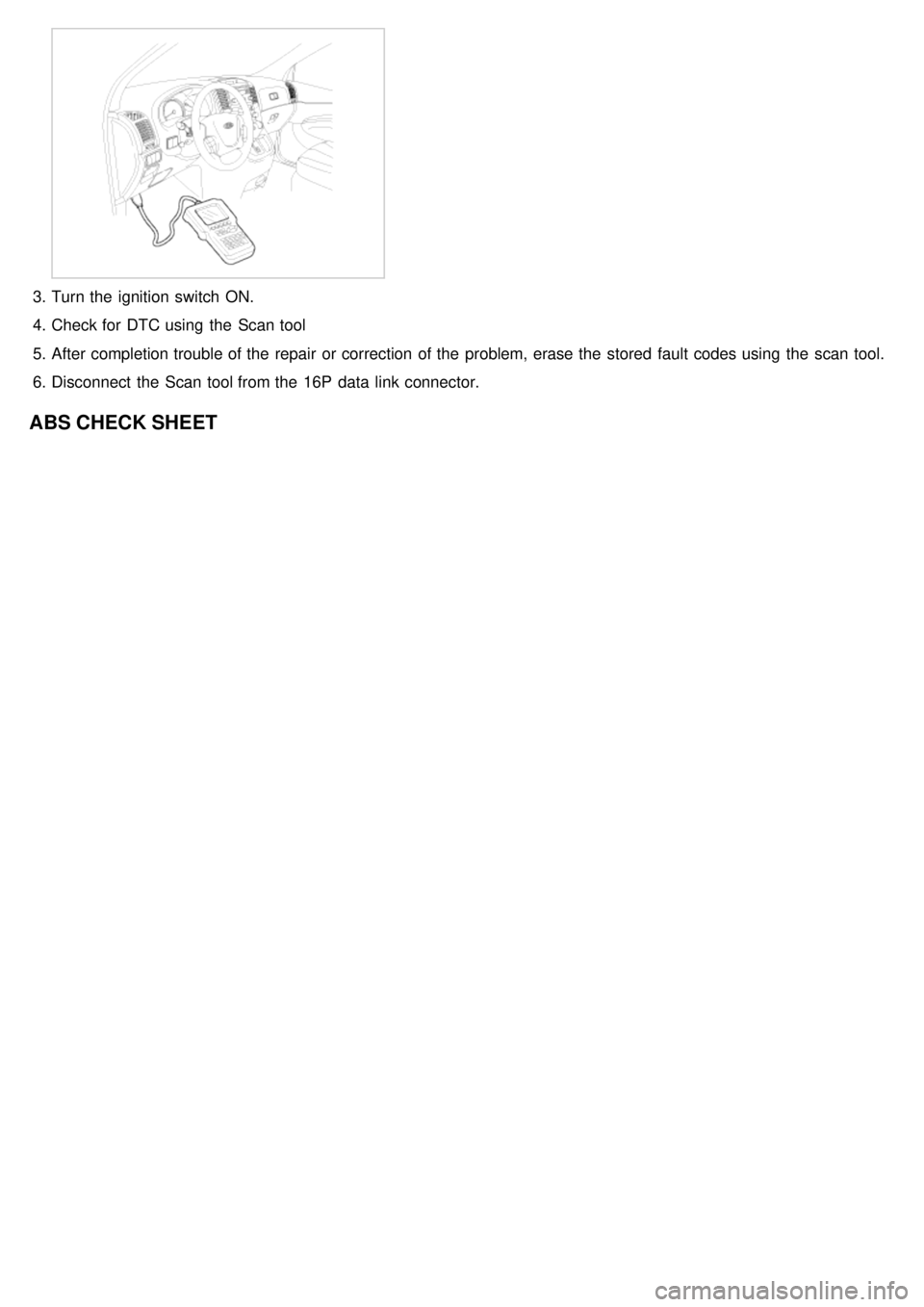
3.Turn the ignition switch ON.
4. Check for DTC using the Scan tool
5. After completion trouble of the repair or correction of the problem, erase the stored fault codes using the scan tool.
6. Disconnect the Scan tool from the 16P data link connector.
ABS CHECK SHEET
Page 937 of 1575

c.Stop lamp switch circuit.
d. Check the hydraulic circuit for leakage.
Communication with Scan tool is not possible.
(Communication with any system is not possible) a.
Power source circuit
b. Diagnosis line
Communication with Scan tool is not possible.
(Communication with ABS only is not possible) a.
Power source circuit
b. Diagnosis line
c. HECU
When ignition key is turned ON (engine OFF), the ABS
warning lamp does not light up. a.
ABS warning lamp circuit
b. HECU
Even after the engine is started, the ABS warning lamp
remains ON. a.
ABS warning lamp circuit
b. HECU
During ABS operation, the brake pedal may vibrate or may not be able to be depressed. Such phenomena are
due to intermittent changes in hydraulic pressure inside the brake line to prevent the wheels from locking and is
not an abnormality.
DETECTING CONDITION
Trouble Symptoms Possible Cause
Brake operation varies depending on driving conditions and road
surface conditions, so diagnosis can be difficult.However if a normal
DTC is displayed, check the following probable cause. When the
problem is still occurring, replace the ABS control module. a.
Inoperative power source circuit
b. Inoperative wheel speed sensor circuit
c. Inoperative hydraulic circuit for leakage
d. Inoperative HECU
INSPECTION PROCEDURES
DTC INSPECTION
1. Connect the Scan Tool with the data link connector and turn the ignition switch ON.
2. Verify that the system is operating to specifications.
Is the system operating to specifications ?
▶ Check the power source circuit.
▶ Erase the DTC and recheck using Scan Tool.
CHECK THE POWER SOURCE CIRCUIT.
1. Disconnect the connector from the ABS control module.
2. Turn the ignition switch ON, measure the voltage between terminal 18 of the ABS control module harness side
connector and body ground.
Specification: approximately B+
Is the voltage within specification?
▶ Check the ground circuit.
▶ Check the harness or connector between the fuse (10A) in the engine compartment junction block and the ABS
control module. Repair if necessary.
Page 939 of 1575

DTC is displayed, check the following probable cause. When the
problem is still occurring, replace the ABS control module.b.
Inoperative wheel speed sensor circuit
c. Inoperative hydraulic circuit for leakage
d. Inoperative HECU
INSPECTION PROCEDURES
DTC INSPECTION
1. Connect the Scan Tool with the data link connector and turn the ignition switch ON.
2. Verify that the system is operating to specifications.
Is the system operating to specifications ?
▶ Check the wheel speed sensor circuit.
▶ Erase the DTC and recheck using Scan Tool.
CHECK THE WHEEL SPEED SENSOR CIRCUIT.
Refer to the DTC troubleshooting procedures.
Is the system operating to specifications ?
▶ Check the stop lamp switch circuit.
▶ Repair or replace the wheel speed sensor.
CHECK THE STOP LAMP SWITCH CIRCUIT.
1. Check that stop lamp lights up when brake pedal is depressed and turns off when brake pedal is released.
2. Measure the voltage between terminal 20 of the ABS control module harness side connector and body ground
when brake pedal is depressed.
Specification: approximately B+
Is the voltage within specification?
▶ Check the hydraulic circuit for leakage.
▶ Repair the stop lamp switch. Repair an open in the wire between the ABS control module and the stop lamp
switch.
CHECK THE HYDRAULIC CIRCUIT FOR LEAKAGE.
Refer to the hydraulic lines.
Inspect leakage of the hydraulic lines.
Is the system operating to specifications ?
▶ The problem is still occurring, replace the ABS control module.
Page 941 of 1575

be probably an open in the HECU power circuit or an open in the
diagnosis output circuit.b.
Inoperative HECU
c. Inoperative power source circuit
INSPECTION PROCEDURES
CHECK FOR CONTINUITY IN THE DIAGNOSIS LINE
1. Disconnect the connector from the ABS control module.
2. Check for continuity between terminals 11 of the ABS control module connector and 1 of the data link connector.
Is there continuity?
▶ Check the power source of ABS control module.
▶ Repair an open in the wire.
CHECK THE POWER SOURCE OF ABS CONTROL MODULE
1. Disconnect the connector from the ABS control module.
2. Turn the ignition switch ON, measure the voltage between terminal 18 of the ABS control module harness side
connector and body ground.
Specification: approximately B+
Is voltage within specification?
▶ Check for poor ground.
▶ Check the harness or connector between the fuse (10A) in the engine compartment junction block and the ABS
control module.Repair if necessary.
CHECK FOR POOR GROUND
Check for continuity between terminal 5 of the data link connector and ground point.
▶ Replace the ABS control module and recheck.
▶ Repair an open in the wire or poor ground.
Page 942 of 1575

DETECTING CONDITIONTrouble Symptoms Possible Cause
When current flows in the HECU the ABS warning lamp turns from
ON to OFF as the initial check.Therefore if the lamp does not light up,
the cause may be an open in the lamp power supply circuit, a blown
bulb, an open in the both circuits between the ABS warning lamp and
the HECU, and the inoperative HECU. a.
Inoperative ABS warning lamp bulb
b. Blown No.2 fuse (10A) in the engine
compartment junction block
c. Inoperative ABS warning lamp module
d. Inoperative HECU
INSPECTION PROCEDURES
PROBLEM VERIFICATION
Disconnect the connector from the ABS control module and turn the ignition switch ON.
Does the ABS warning lamp light up?
▶ It is normal. Recheck the ABS control module.
▶ Check the power source for the ABS warning lamp.
CHECK THE POWER SOURCE FOR THE ABS WARNING LAMP
1. Disconnect the instrument cluster connector and turn the ignition switch ON.
2. Measure the voltage between terminal 8 of the cluster harness side connector and body ground.
Specification: approximately B+
Is voltage within specification?
▶ Repair bulb or instrument cluster assembly.
▶ Check for blown fuse.
Page 943 of 1575
CHECK FOR BLOWN FUSE
Check continuity of fuse (10A) from the engine compartment junction block.
Is there continuity?
▶ Repair an open in the wire between ABS fuse and 1 of cluster connector.
▶ Replace the blown fuse.
DETECTING CONDITION
Trouble Symptoms Possible Cause
If the HECU detects trouble, it lights the ABS warning lamp while at
the same time prohibiting ABS control. At this time, the HECU
records a DTC in memory.Even though the normal code is output, the
ABS warning lamp remains ON, then the cause may be probably an
open or short in the ABS warning lamp circuit. a.
An open in the wire
b. Inoperative instrument cluster assembly
c. Inoperative ABS warning lamp module
d. Inoperative HECU
INSPECTION PROCEDURES
CHECK DTC OUTPUT.
1. Connect the Scan Tool to the 16P data link connector located behind the driver's side kick panel.
2. Check the DTC output using Scan Tool.
Is DTC output ?
▶ Repair circuit indicated by code output.
▶ Check instrument cluster.
CHECK INSTRUMENT CLUSTER
Disconnect the cluster connector and turn the ignition switch ON.
Does the ABS warning lamp remains ON?
▶ Replace the instrument cluster.
▶ Check for open the wire.
CHECK FOR OPEN IN THE WIRE
Check for continuity in the wire between cluster and ABS control module.
Is there continuity?
▶ Replace the ABS control module and recheck.
▶ Repair an open in the wire between cluster and ABS control module.
BLEEDING OF BRAKE SYSTEM
1. Remove the reservoir cap and fill the brake reservoir with brake fluid.
If there is any brake fluid on any painted surface, wash it off immediately.
Page 966 of 1575
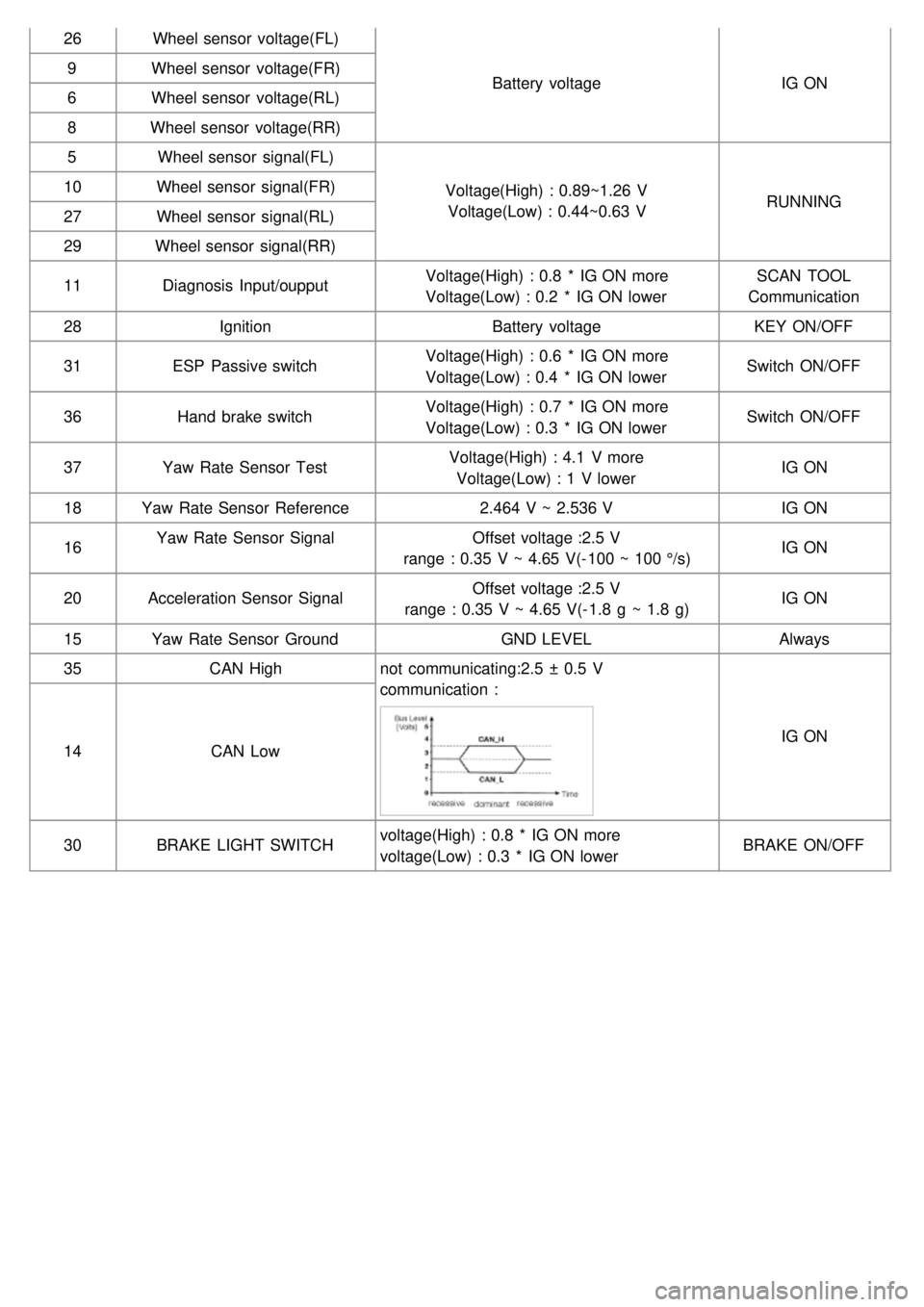
26Wheel sensor voltage(FL)
Battery voltageIG ON
9
Wheel sensor voltage(FR)
6 Wheel sensor voltage(RL)
8 Wheel sensor voltage(RR)
5 Wheel sensor signal(FL)
Voltage(High) : 0.89~1.26 VVoltage(Low) : 0.44~0.63 V RUNNING
10
Wheel sensor signal(FR)
27 Wheel sensor signal(RL)
29 Wheel sensor signal(RR)
11 Diagnosis Input/oupput Voltage(High) : 0.8 * IG ON more
Voltage(Low) : 0.2 * IG ON lower SCAN TOOL
Communication
28 Ignition Battery voltageKEY ON/OFF
31 ESP Passive switch Voltage(High) : 0.6 * IG ON more
Voltage(Low) : 0.4 * IG ON lower Switch ON/OFF
36 Hand brake switch Voltage(High) : 0.7 * IG ON more
Voltage(Low) : 0.3 * IG ON lower Switch ON/OFF
37 Yaw Rate Sensor Test Voltage(High) : 4.1 V more
Voltage(Low) : 1 V lower IG ON
18 Yaw Rate Sensor Reference 2.464 V ~ 2.536 VIG ON
16 Yaw Rate Sensor Signal
Offset voltage :2.5 V
range : 0.35 V ~ 4.65 V(- 100 ~ 100 °/s) IG ON
20 Acceleration Sensor Signal Offset voltage :2.5 V
range : 0.35 V ~ 4.65 V(- 1.8 g ~ 1.8 g) IG ON
15 Yaw Rate Sensor Ground GND LEVELAlways
35 CAN High not communicating:2.5 ± 0.5 V
communication :
IG ON
14 CAN Low
30 BRAKE LIGHT SWITCH voltage(High) : 0.8 * IG ON more
voltage(Low) : 0.3 * IG ON lower BRAKE ON/OFF
Page 1211 of 1575
2007 > 2.7L V6 GASOLINE >
DESCRIPTION
All modules are linked a low speed CAN network.
The input information for the modules is coming from both the CAN network and the hardware components
(actuatorsand sensors).
a. FAM (Front Area Module)
a. Headlamp low/high beam control (with DRL)
b. Park lamp control
c. Front fog lamp control
d. Front turn signal lamp control
e. Windshield wiper control
f. Windshield deicer
g. Diagnostics
b. IPM (In - Panel Module)
a. RKE (Remote Keyless Control)
b. VAS (Voice Alarm System)
c. Ignition key hole illumination
d. Switch indicators control
e. Panel light control
f. Seat belt warning
g. Auto light/DRL control (Logic)
h. Windshield/Rear wiper control (Logic)
i. Turn and Hazard lamp control (Logic)
j. Central door lock (Logic)
k. Windshield deicer timer
l. Rear glass defog timer
m. Gateway for ISO- 9141 (K- Line)
c. RAM (Rear Area Module)
a. Tail lamp control
b. Turn and Hazard lamp control
c. Back up lamp control
d. Rea fog lamp control
e. Stop lamp outage detection
f. Sliding door power window/Quarter glass control
g. Room lamp control
h. Rear wiper control
i. Rear glass defog
j. Fuel filler door open solenoid control
d. ADM (Assist Drive Module)
e. DDM (Driver Drive Module)
MODULE INTRODUCTION
FAM/IPM/RAM consists of a power board and an electronic board. The power board contains circuit protection devices
and switching devices. The electronic board uses Intelligent Power Switching (IPS) for HS/LS load control, logic
functions and CAN/K- Line communication. The power board and electronic board are connected with pin blocks for
the Front Area Module (FAM) and VCD (Variable Connection Displacement) for the In- Panel Module (IPM) and the
Rear Area Module (RAM).
Page 1214 of 1575

Turn Signal And Side Repeater Lamps Function
1.Necessary conditions to switch ON(if they are standard) :
a. By activation of Crash Unlock
b. During the opening / closing of the Tail gate by the PTG Flasher input
c. With the Remote Keyless Entry to lock / unlock the vehicle
d. By alarm activation
e. By panic activation with the Remote Keyless Entry
f. By activation of the Hazard Lamp by the hazard switch and ignition is position OFF, ACC or RUN
g. By using the turn lever switch with the ignition switch in the ON position.
2. Necessary conditions to switch OFF(if they are standard) :
a. Ignition switch in OFF position for deactivation of crash unlock flashing
b. Deactivation of the alarm or at the end of the alarm flashing sequence
c. Deactivation of panic sequence with pushing any button of the Remote Keyless Entry or at the end of the panic
flashing sequence
d. Turn lever switch command in OFF postion or ignition switch in OFF, ACC or START position to stop turn lever
flashing.
e. The hazard switch in OFF position or ignition switch in position START to stop the Hazard flashing.
f. At the end of the Lock, Unlock and PTG flashing sequence.
3. During the start up of the vehicle (ignition key in position START) :
a. The Turn signal lamps activated by the turn lever switch are temporarily turned OFF. If the time duration in Start
position is more than 10seconds and engine running, the Turn signal lamps are managed again as if the ignition
key was in ON position,
b. The flashing sequence of the hazard lamps is immediately stopped if they have been activated by the hazard
button. If the time duration in Start position is more than 10seconds and engine running, the flashing sequence
of the hazard lamps are managed again as if the ignition key was in RUN position,
c. The flashing sequence of the hazard lamps is not stopped if they have been activated by a crash unlock.
4. Functional diagram
Front Fog Lamps Function
Page 1216 of 1575

Stop Lamps Function
1.Necessary conditions to switch ON the stop lamps:
a. Pushing on the brake pedal.
2. Necessary conditions to switch OFF the stop lamps:
a. Releasing the brake pedal.
3. Functional diagram
Auto Light Function
1.The Auto light function is active when the Head lamp switch is positioned to 'Auto' and the Key is in RUN position.
The auto light sensor is powered on the status ACC, START and RUN of the key position. Based on the Auto light
sensor values corresponding to the exterior brightness level, it controls automatically the lighting of the Park and tail
lamps or / and the Head lamps Low Beam depending on the country.
2. Auto light Sensor detection table
Mode Tail Lamps
Head Lamps Low Beam
Lux (Lux) Voltage(V) Lux (Lux)Voltage(V)
ON < 24 ± 5.2 <1.77 ± 0.08V Same as Tail lamps
OFF > 48 ± 10.5 > 3.47 ± 0.1V Same as Tail lamps
Drl Function
1.The Auto DRL function operates the Head lamps High Beam at 50% of full illumination.
The park and tail are managed by the auto light sensor.
The Auto DRL function is active if:
a. The ignition switch is on RUN position
b. The engine is running.
c. The Park brake switch is OFF.
2. The DRL function is inactive when one of above conditions is released.
When the DRL function is active, the Head lamps High Beam can't be turned ON, except for the Flash To Pass
activation.