brake KIA CARNIVAL 2007 Workshop Manual
[x] Cancel search | Manufacturer: KIA, Model Year: 2007, Model line: CARNIVAL, Model: KIA CARNIVAL 2007Pages: 1575, PDF Size: 44.86 MB
Page 945 of 1575
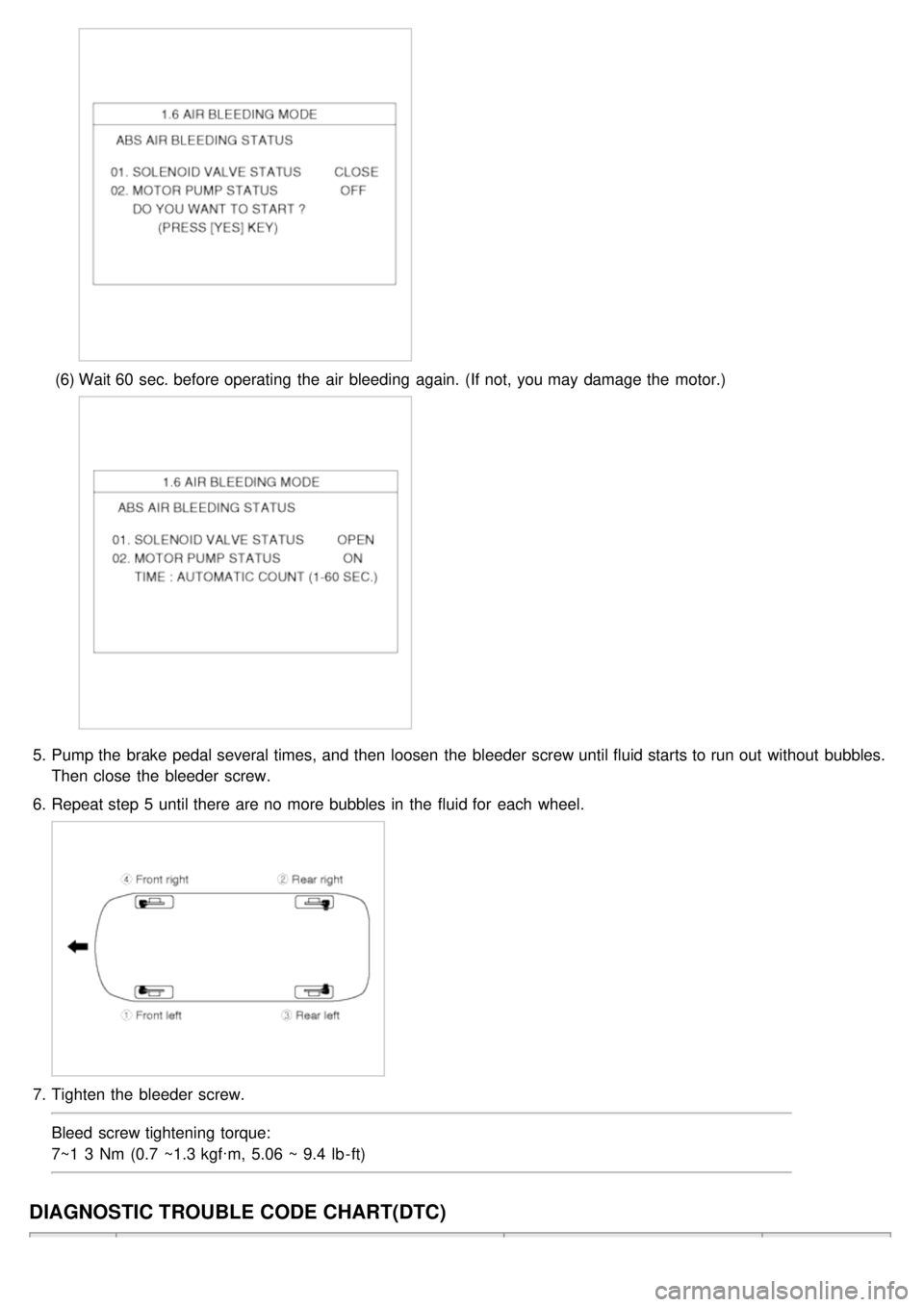
(6)Wait 60 sec. before operating the air bleeding again. (If not, you may damage the motor.)
5.Pump the brake pedal several times, and then loosen the bleeder screw until fluid starts to run out without bubbles.
Then close the bleeder screw.
6. Repeat step 5 until there are no more bubbles in the fluid for each wheel.
7.Tighten the bleeder screw.
Bleed screw tightening torque:
7~1 3 Nm (0.7 ~1.3 kgf·m, 5.06 ~ 9.4 lb - ft)
DIAGNOSTIC TROUBLE CODE CHART(DTC)
Page 946 of 1575

DTCDESCRIPTION WARNING LAMP
REMARK
ABS EBDESC
C1101 BATTERY VOLTAGE HIGH ООО
C1102 BATTERY VOLTAGE LOW ОО
C1200 FL WHEEL SPEED SENSOR- OPEN/SHORT ОО
C1201 FL WHEEL SENSOR- RANGE/ PERFORMANCE ОО
C1202 FL WHEEL WHEEL SPEED SENSOR- NO SIGNAL ОО
C1203 FR WHEEL SPEED SENSOR- OPEN/SHORT ОО
C1204 FR WHEEL SENSOR- RANGE/ PERFORMANCE ОО
C1205 FR WHEEL SPEED SENSOR- NO SIGNAL ОО
C1206 RL WHEEL SPEED SENSOR- OPEN/SHORT ОО
C1207 RL WHEEL SENSOR- RANGE/ PERFORMANCE ОО
C1208 RL WHEEL SPEED SENSOR- NO SIGNAL ОО
C1209 RR WHEEL SPEED SENSOR- OPEN/SHORT ОО
C1210 RR WHEEL SENSOR- RANGE/ PERFORMANCE ОО
C1211 RR WHEEL SPEED SENSOR- NO SIGNAL ОО
C1213 WHEEL SPEED FREQUENCY ERROR ОО
C1235 PRESSURE SENSOR- ELECTRICAL ОESP
C1237 PRESSURE SENSOR- SIGNAL FAULT ОESP
C1260 STEERING ANGLE SENSOR- SIGNAL ОESP
C1261 STEERING ANGLE SENSOR NOT CALIBRATED ОESP
C1282 YAW RATE & LATERAL G SENSOR- ELECTRICAL ОESP
C1283 YAW RATE & LATERAL G SENSOR- SIGNAL ОESP
C1503 ESP SWITCH ERROR ОESP
C1513 BRAKE LIGHT SWITCH MALFUNCTION О
C1604 ECU HARDWARE ERROR ООО
C1605 CAN CONTROL HARDWARE ERROR ОESP
C1611 CAN TIME OUT- PCM(ECM) ОESP
C1612 CAN TIME OUT- PCM(TCM) ОESP
C1616 CAN BUS OFF ОESP
C1623 CAN TIMEOUT STEERING ANGLE SENSOR ОESP
C1625 CAN TIME OUT- ESP ОESP
C1626 IMPLAUSIBLE CONTROL ООESP
C1702 VARIANT CODING ООО ESP
C2112 VALVE RELAY MALFUNCTION ООО
C2308 FL INLET VALVE MALFUNCTION ООО
C2312 FL OUTLET VALVE MALFUNCTION ООО
C2316 FR INLET VALVE MALFUNCTION ООО
C2320 FR OUTLET VALVE MALFUNCTION ООО
C2324 RL INLET VALVE MALFUNCTION ООО
C2328 RL OUTLET VALVE MALFUNCTION ООО
Page 950 of 1575
2007 > 2.7L V6 GASOLINE >
REMOVAL
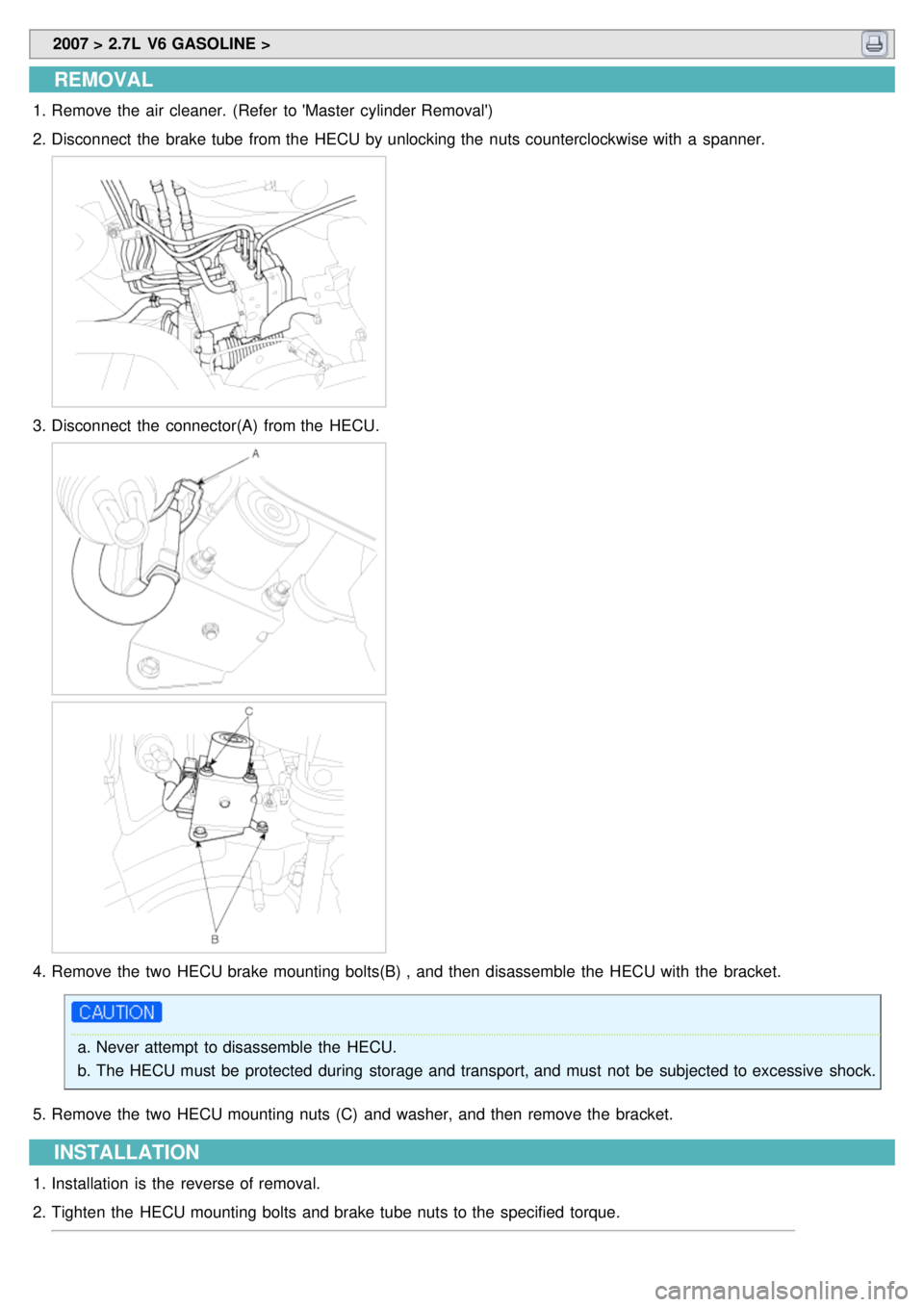
1.Remove the air cleaner. (Refer to 'Master cylinder Removal')
2. Disconnect the brake tube from the HECU by unlocking the nuts counterclockwise with a spanner.
3.Disconnect the connector(A) from the HECU.
4.Remove the two HECU brake mounting bolts(B) , and then disassemble the HECU with the bracket.
a.Never attempt to disassemble the HECU.
b. The HECU must be protected during storage and transport, and must not be subjected to excessive shock.
5. Remove the two HECU mounting nuts (C) and washer, and then remove the bracket.
INSTALLATION
1.Installation is the reverse of removal.
2. Tighten the HECU mounting bolts and brake tube nuts to the specified torque.
Page 960 of 1575
EBFD
(Electronic Brake Force Distribution)
Page 961 of 1575

2007 > 2.7L V6 GASOLINE >
DESCRIPTION
The EBD system (Electronic Brake force Distribution) as a sub- system of the ABS system is to control the effective
adhesion utilization by the rear wheels.
It further utilizes the efficiency of highly developed ABS equipment by controlling the slip of the rear wheels in the
partial braking range.
The brake force is moved even closer to the optimum and controlled electronically, thus dispensing with the need for
the proportioning valve.
The proportioning valve, because of a mechanical device, has limitations to achieve an ideal brake force distribution
tothe rear wheels as well as to carry out the flexible brake force distribution proportioning to the vehicle load or weight
increasing. And in the event of malfunctioning, driver cannot notice whether it fails or not.
EBD controlled by the ABS Control Module, calculates the slip ratio of each wheel at all times and controls the brake
pressure of the rear wheels not to exceed that of the front wheels.
If the EBD fails, the EBD warning lamp (Parking brake lamp) lights up.
ADVANTAGES
a.Function improvement of the base - brake system.
b. Compensation for the different friction coefficients.
c. Elimination of the proportioning valve.
d. Failure recognition by the warning lamp.
Comparison between Proportioning valve and EBD
Page 966 of 1575
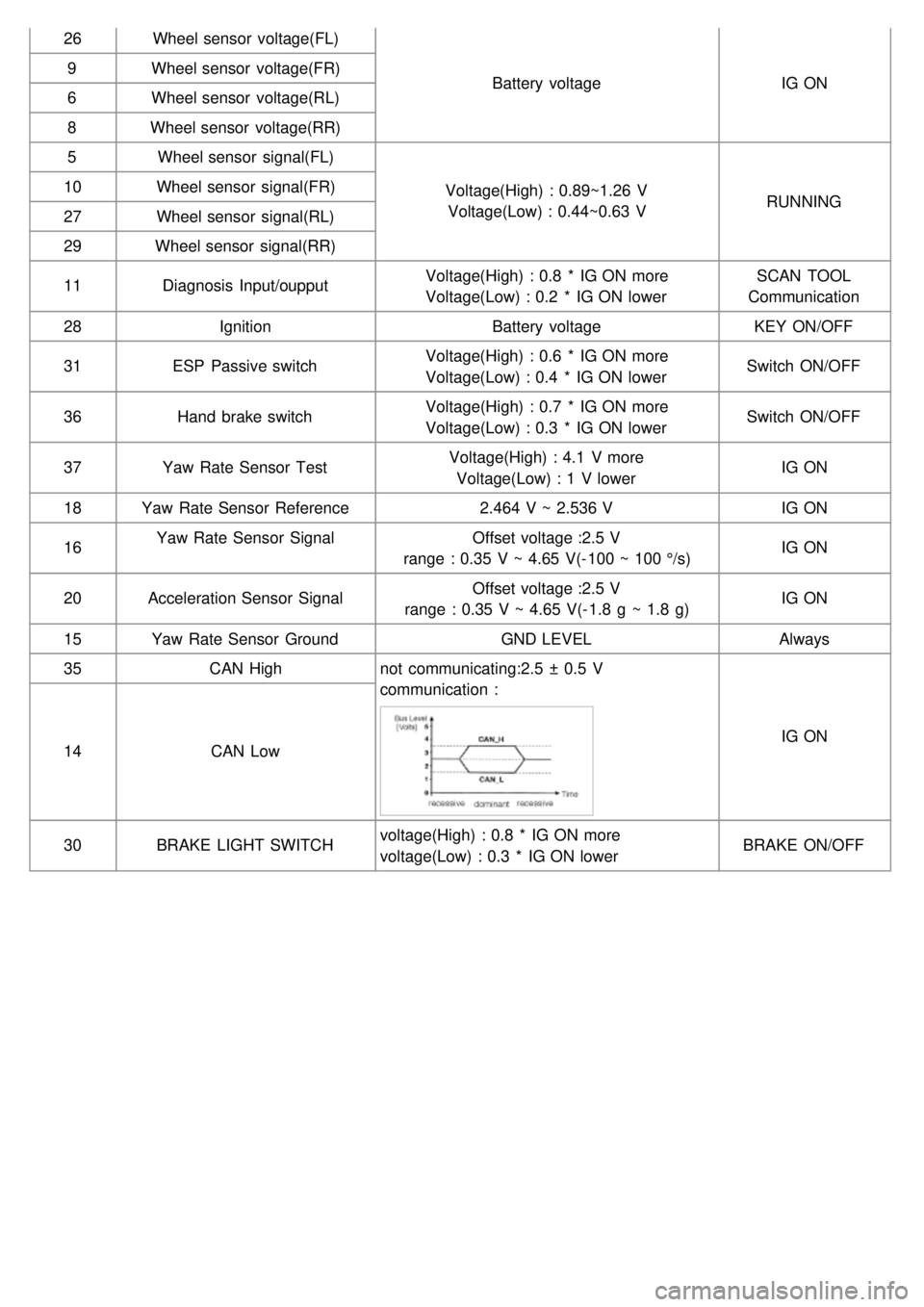
26Wheel sensor voltage(FL)
Battery voltageIG ON
9
Wheel sensor voltage(FR)
6 Wheel sensor voltage(RL)
8 Wheel sensor voltage(RR)
5 Wheel sensor signal(FL)
Voltage(High) : 0.89~1.26 VVoltage(Low) : 0.44~0.63 V RUNNING
10
Wheel sensor signal(FR)
27 Wheel sensor signal(RL)
29 Wheel sensor signal(RR)
11 Diagnosis Input/oupput Voltage(High) : 0.8 * IG ON more
Voltage(Low) : 0.2 * IG ON lower SCAN TOOL
Communication
28 Ignition Battery voltageKEY ON/OFF
31 ESP Passive switch Voltage(High) : 0.6 * IG ON more
Voltage(Low) : 0.4 * IG ON lower Switch ON/OFF
36 Hand brake switch Voltage(High) : 0.7 * IG ON more
Voltage(Low) : 0.3 * IG ON lower Switch ON/OFF
37 Yaw Rate Sensor Test Voltage(High) : 4.1 V more
Voltage(Low) : 1 V lower IG ON
18 Yaw Rate Sensor Reference 2.464 V ~ 2.536 VIG ON
16 Yaw Rate Sensor Signal
Offset voltage :2.5 V
range : 0.35 V ~ 4.65 V(- 100 ~ 100 °/s) IG ON
20 Acceleration Sensor Signal Offset voltage :2.5 V
range : 0.35 V ~ 4.65 V(- 1.8 g ~ 1.8 g) IG ON
15 Yaw Rate Sensor Ground GND LEVELAlways
35 CAN High not communicating:2.5 ± 0.5 V
communication :
IG ON
14 CAN Low
30 BRAKE LIGHT SWITCH voltage(High) : 0.8 * IG ON more
voltage(Low) : 0.3 * IG ON lower BRAKE ON/OFF
Page 967 of 1575

2007 > 2.7L V6 GASOLINE >
description of ESP
Optimum driving safety now has a name : ESP, the Electronic Stability Control.
ESP recognizes critical driving conditions, such as panic reactions in dangerous situations, and stabilizes the vehicle
by wheel- individual braking and engine control intervention with no needfor actuating the brake or the gas pedal.
ESP adds a further function known as Active Yaw Control (AYC) to the ABS, TCS, EBD and ESP functions. Whereas
the ABS/TCS function controls wheel slip during braking and acceleration and, thus, mainly intervenes in the
longitudinal dynamics of the vehicle, active yaw control stabilizes the vehicle about its vertical axis.
This is achieved by wheel individual brake intervention and adaptation of the momentary engine torque with no need
for any action to be taken by the driver.
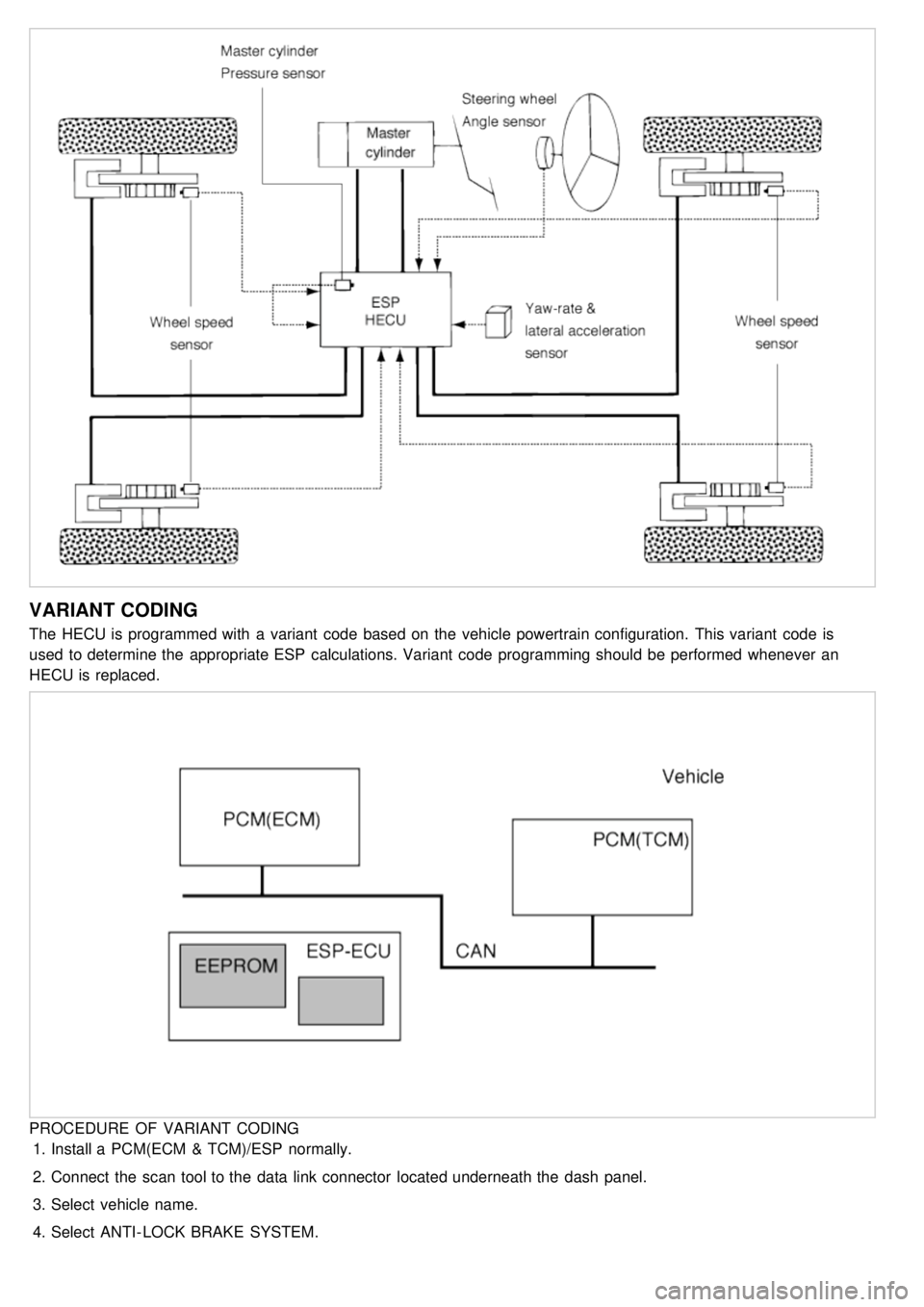
ESC essentially consists of three assemblies : the sensors, the electronic control unit and the actuators.
Of course, the stability control feature works under all driving and operating conditions. Under certain driving
conditions, the ABS/TCS function can be activated simultaneously with the ESP function in response to a command
by the driver.
In the event of a failure of the stability control function, the basic safety function, ABS, is still maintained.
DESCRIPTION OF ESP CONTROL
ESP system includes ABS/EBD, TCS and AYC (Active yaw control) function.
ABS/EBD function : The ECU changes the active sensor signal (current shift) coming from the four wheel sensors to
the square waveform.By using the input of above signals, the ECU calculates the vehicle speed and the acceleration
& deceleration of the four wheels.And, the ECU judges whether the ABS/EBD should be actuated or not.
TCS function prevents the wheel slip of drive direction by adding the brake pressure and engine torque reduction via
CAN communication.TCS function uses the wheel speed sensor signal to determine the wheel slip as far as ABS
function.
AYC function prevents unstable maneuver of the vehicle. To determine the vehicle maneuver, AYC function uses the
maneuver sensor signals(Yaw Rate Sensor, Lateral Acceleration Sensor, Steering Wheel Angle Sensor).If vehicle
maneuver is unstable (Over Steer or Under Steer), AYC function applies the brake pressure on certain wheel, and
send engine torque reduction signal by CAN.
After the key - on, the ECU continually diagnoses the system failure. (self- diagnosis)If the system failure is detected,
the ECU informs driver of the system failure through the BRAKE/ABS/ESP warning lamp. (fail- safe warning)
Page 968 of 1575
VARIANT CODING
The HECU is programmed with a variant code based on the vehicle powertrain configuration. This variant code is
used to determine the appropriate ESP calculations. Variant code programming should be performed whenever an
HECU is replaced.
PROCEDURE OF VARIANT CODING1. Install a PCM(ECM & TCM)/ESP normally.
2. Connect the scan tool to the data link connector located underneath the dash panel.
3. Select vehicle name.
4. Select ANTI- LOCK BRAKE SYSTEM.
Page 974 of 1575
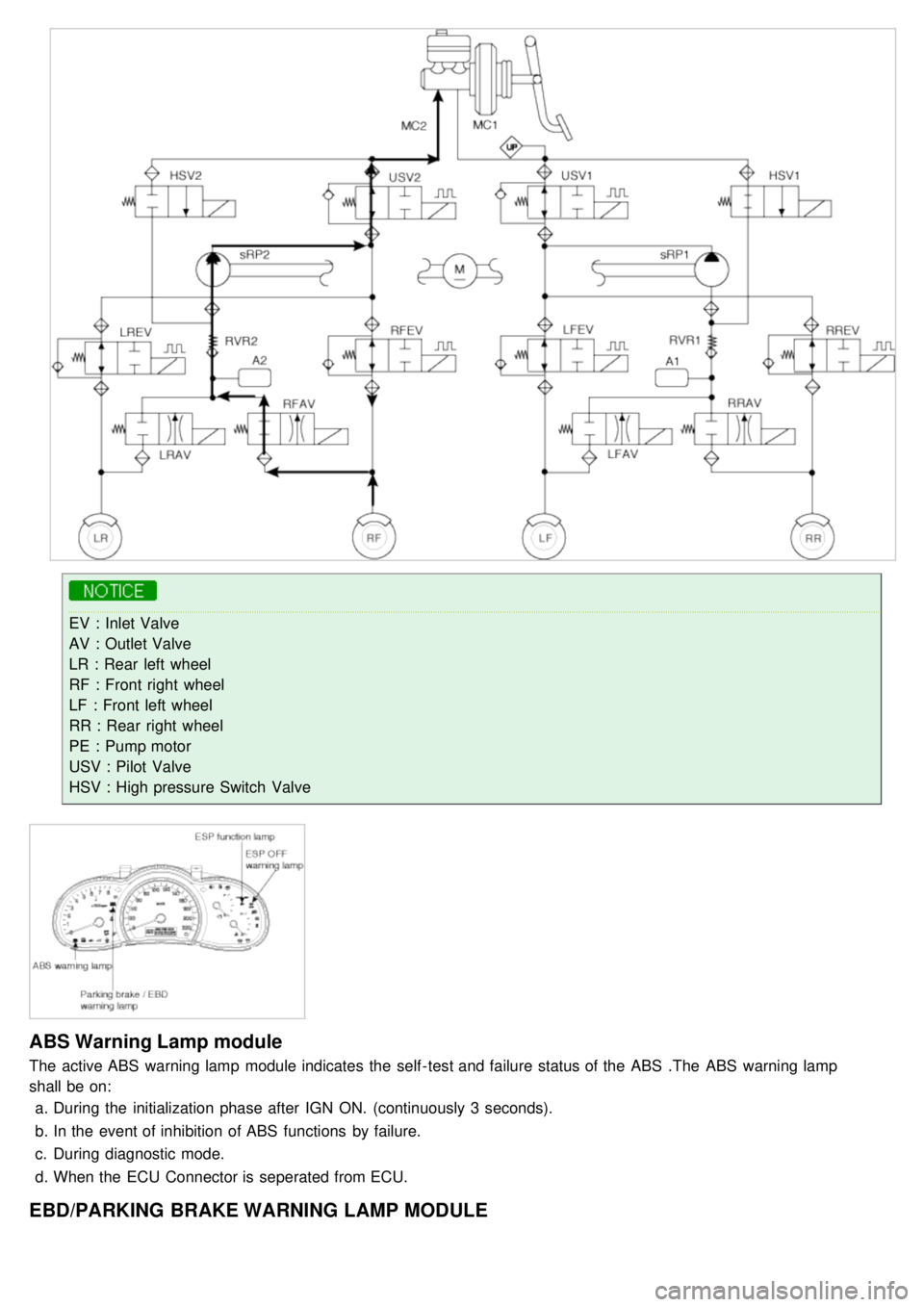
EV : Inlet Valve
AV : Outlet Valve
LR : Rear left wheel
RF : Front right wheel
LF : Front left wheel
RR : Rear right wheel
PE : Pump motor
USV : Pilot Valve
HSV : High pressure Switch Valve
ABS Warning Lamp module
The active ABS warning lamp module indicates the self - test and failure status of the ABS .The ABS warning lamp
shall be on:a. During the initialization phase after IGN ON. (continuously 3 seconds).
b. In the event of inhibition of ABS functions by failure.
c. During diagnostic mode.
d. When the ECU Connector is seperated from ECU.
EBD/PARKING BRAKE WARNING LAMP MODULE
Page 975 of 1575
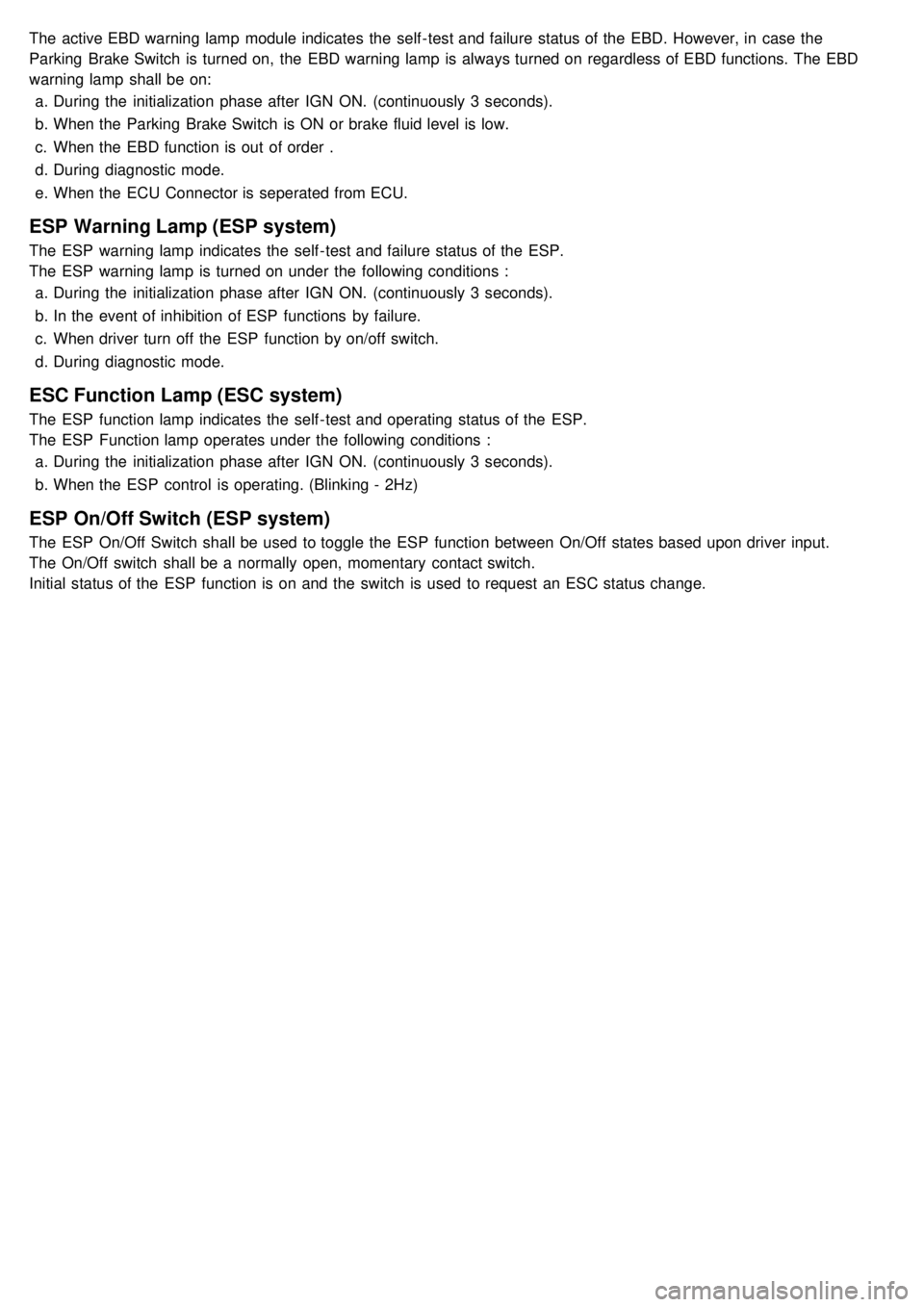
The active EBD warning lamp module indicates the self - test and failure status of the EBD. However, in case the
Parking Brake Switch is turned on, the EBD warning lamp is always turned on regardless of EBD functions. The EBD
warning lamp shall be on:a. During the initialization phase after IGN ON. (continuously 3 seconds).
b. When the Parking Brake Switch is ON or brake fluid level is low.
c. When the EBD function is out of order .
d. During diagnostic mode.
e. When the ECU Connector is seperated from ECU.
ESP Warning Lamp (ESP system)
The ESP warning lamp indicates the self - test and failure status of the ESP.
The ESP warning lamp is turned on under the following conditions :
a. During the initialization phase after IGN ON. (continuously 3 seconds).
b. In the event of inhibition of ESP functions by failure.
c. When driver turn off the ESP function by on/off switch.
d. During diagnostic mode.
ESC Function Lamp (ESC system)
The ESP function lamp indicates the self - test and operating status of the ESP.
The ESP Function lamp operates under the following conditions :
a. During the initialization phase after IGN ON. (continuously 3 seconds).
b. When the ESP control is operating. (Blinking - 2Hz)
ESP On/Off Switch (ESP system)
The ESP On/Off Switch shall be used to toggle the ESP function between On/Off states based upon driver input.
The On/Off switch shall be a normally open, momentary contact switch.
Initial status of the ESP function is on and the switch is used to request an ESC status change.