oil KIA CARNIVAL 2007 Workshop Manual
[x] Cancel search | Manufacturer: KIA, Model Year: 2007, Model line: CARNIVAL, Model: KIA CARNIVAL 2007Pages: 1575, PDF Size: 44.86 MB
Page 485 of 1575

2007 > 2.7L V6 GASOLINE >
SPECIAL SERVICE TOOLS
Tool (Number and Name) IllustrationUse
09568 - 4A000
Ball joint remover
Removal of Ball joint
(Front upper arm/lower arm, & Rear
upper arm)
09532 - 11600
Preload socket
Measurement of the front lower arm
ball joint starting torque.
(Use with torque wrench)
09546 - 26000
Strut spring compressor
Compression of the coil spring
09214 - 32000
Mount bushing remover and installer
Removal & installation of lower arm
bushing(G)
(Use with 09216 - 21100)
09216 - 21100
Mount bushing remover and installer
Removal & installation of lower arm
bushing(G)
(Use with 09216 - 32000)
09216 - 21600
Mount bushing remover and installer
arbor
Removal and installation of trailing
arm bushing
(Use with 09552 - 38100)
09552 - 38100 Removal and installation of the rear
Page 498 of 1575
→NO
Replace bent or damaged parts.
CHECK THE REAR SUSPENSION
a.Measure the vehicle wheel base for LH and RH.
b. Compare the measurements.
● Are the measurements the same ?
→ YES
If the ride is smooth, vehicle is OK.
If the ride is rough, Go to Detailed Test
→ NO
Inspect the rear suspension components for wear or damage.
Repair or Install new components as necessary.
DETAILED TEST H : ROUGH RIDE CONDITIONS DETAILS/RESULTS/ACTIONS
CHECK THE FRONT SHOCK ABSORBER
a.Raise support the vehicle.
b. Inspect the front shock absorber for oil leaks or damage.
● Are the tires excessively worn or damaged ?
→ YES
Install new front shock absorbers.
→ NO
Go to
CHECK THE REAR SHOCK ABSORBERS Inspect the rear shock absorbers for oil leaks or damage.
● Are the rear shock absorbers leaking ?
→ YES
Install new rear shock absorbers.
→ NO
The vehicle is OK. Go to TROUBLESHOOTING.
DETAILED TEST I : EXCESSIVE NOISE CONDITIONS DETAILS/RESULTS/ACTIONS
INSPECT THE SUSPENSION
a.Raise and support the vehicle.
b. Inspect the shock absorber mounting bolts.
● Are the mounting bolts loose or broken ?
→ YES
Tighten or Install new shock absorber mounting bolts.
→ NO
Go to
INSPECT THE SPRING AND TORSION BARS Inspect the springs and stabilizer bars for damage.
● Are the spring or stabilizer bars damaged ?
→ YES
Install new spring and/or stabilizer bars.
Page 512 of 1575
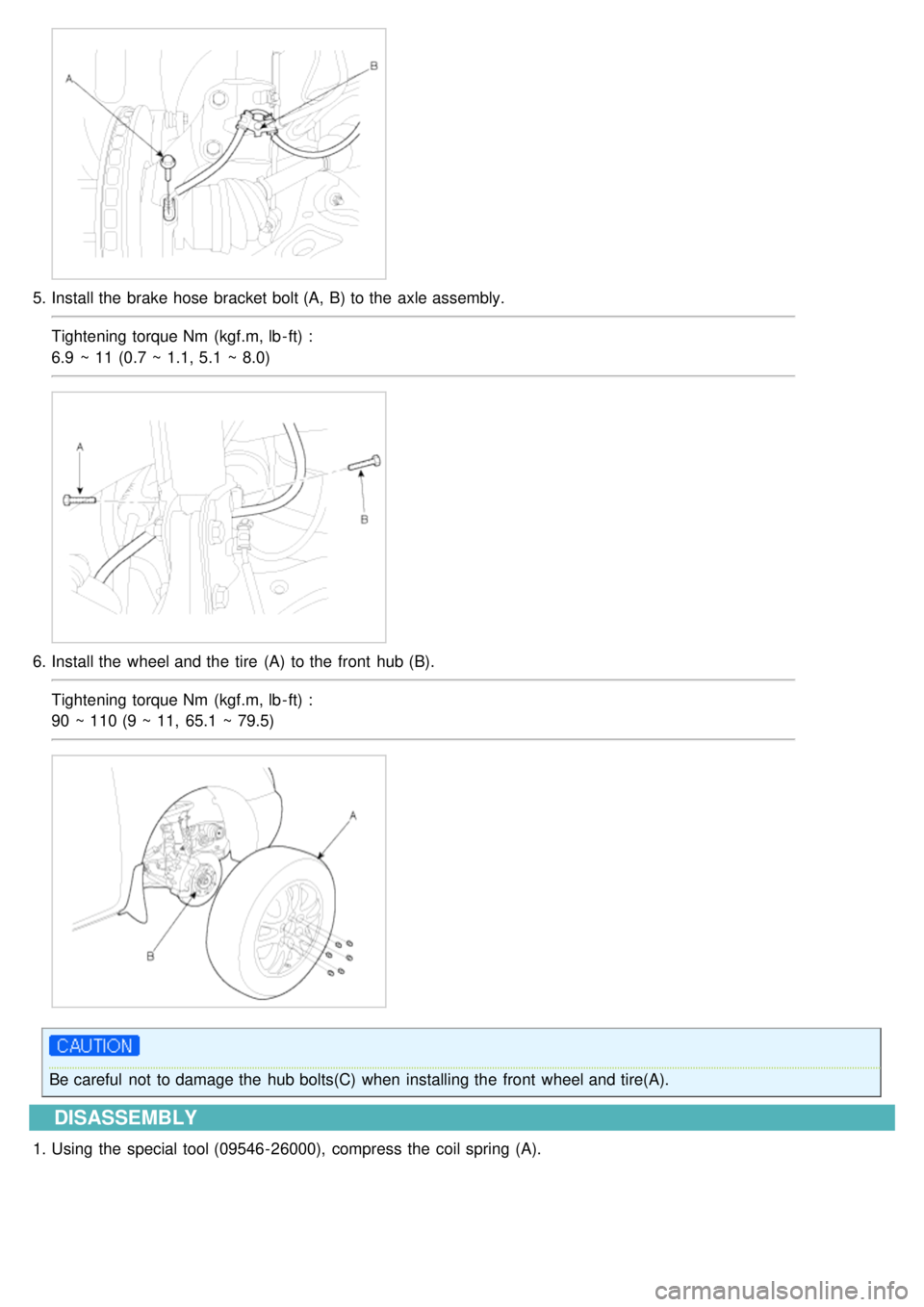
5.Install the brake hose bracket bolt (A, B) to the axle assembly.
Tightening torque Nm (kgf.m, lb - ft) :
6.9 ~ 11 (0.7 ~ 1.1, 5.1 ~ 8.0)
6.Install the wheel and the tire (A) to the front hub (B).
Tightening torque Nm (kgf.m, lb - ft) :
90 ~ 110 (9 ~ 11, 65.1 ~ 79.5)
Be careful not to damage the hub bolts(C) when installing the front wheel and tire(A).
DISASSEMBLY
1.Using the special tool (09546- 26000), compress the coil spring (A).
Page 513 of 1575
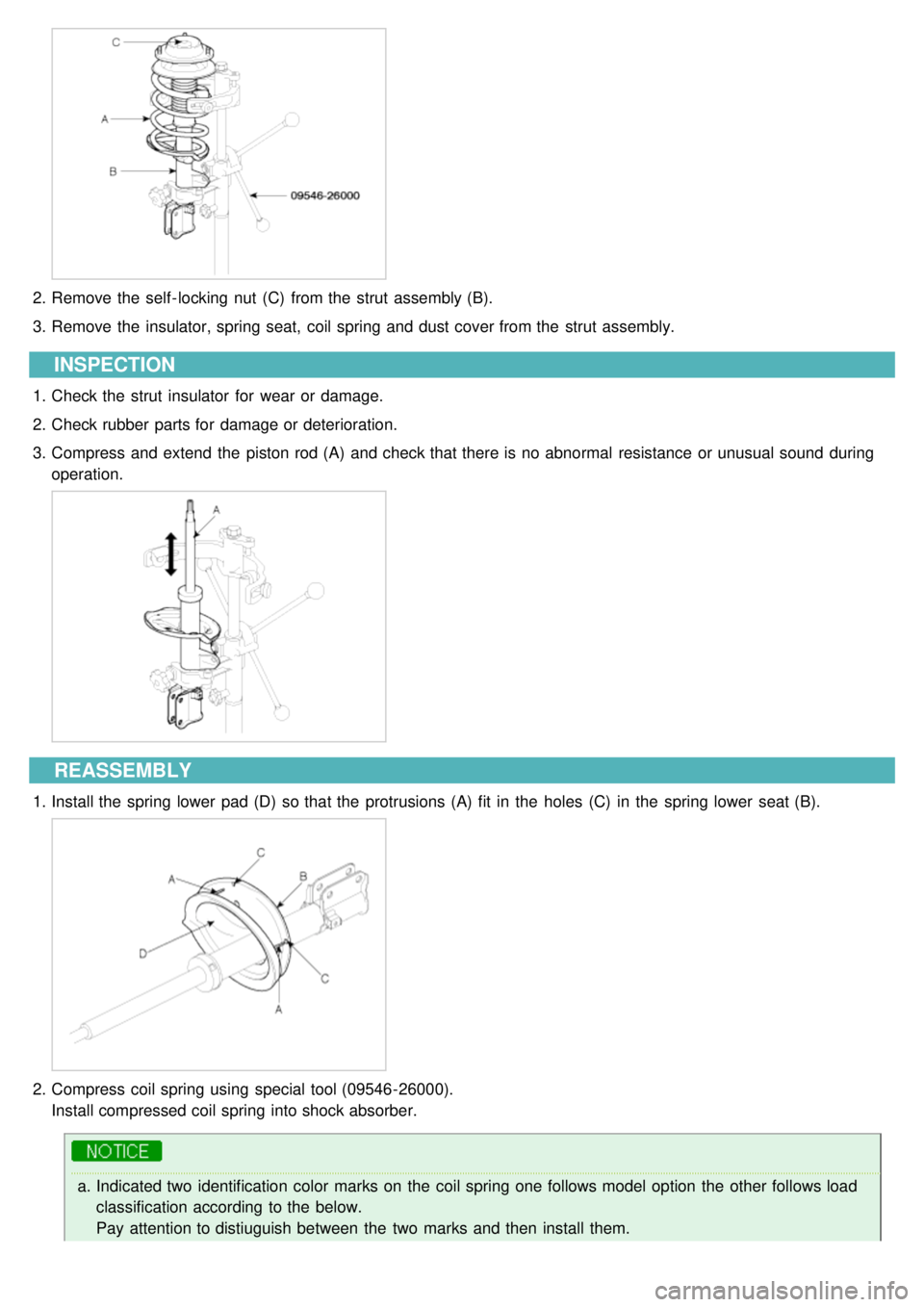
2.Remove the self - locking nut (C) from the strut assembly (B).
3. Remove the insulator, spring seat, coil spring and dust cover from the strut assembly.
INSPECTION
1.Check the strut insulator for wear or damage.
2. Check rubber parts for damage or deterioration.
3. Compress and extend the piston rod (A) and check that there is no abnormal resistance or unusual sound during
operation.
REASSEMBLY
1.Install the spring lower pad (D) so that the protrusions (A) fit in the holes (C) in the spring lower seat (B).
2.Compress coil spring using special tool (09546- 26000).
Install compressed coil spring into shock absorber.
a.Indicated two identification color marks on the coil spring one follows model option the other follows load
classification according to the below.
Pay attention to distiuguish between the two marks and then install them.
Page 514 of 1575
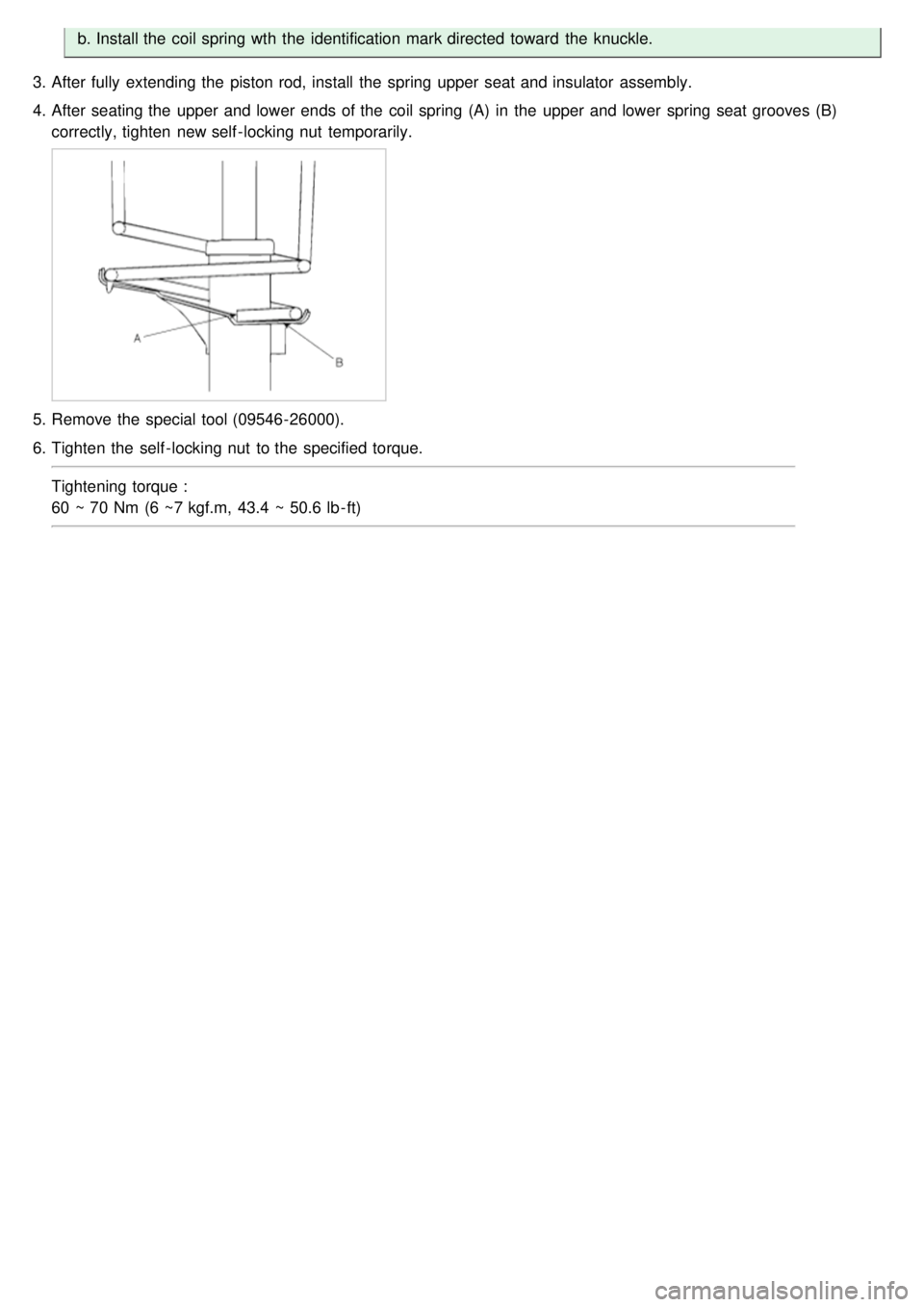
b.Install the coil spring wth the identification mark directed toward the knuckle.
3. After fully extending the piston rod, install the spring upper seat and insulator assembly.
4. After seating the upper and lower ends of the coil spring (A) in the upper and lower spring seat grooves (B)
correctly, tighten new self - locking nut temporarily.
5.Remove the special tool (09546- 26000).
6. Tighten the self - locking nut to the specified torque.
Tightening torque :
60 ~ 70 Nm (6 ~7 kgf.m, 43.4 ~ 50.6 lb - ft)
Page 579 of 1575

2007 > 2.7L V6 GASOLINE >
SPECIAL TOOLS
Tool (Number and Name) IllustrationUse
09222 - 32100
Valve stem oil seal installer
Installation of the oil pump oil seal
09555 - 21000
Bar
Removal and installation of the oil
seal
(Use with 09573 - 33100, 09573 -
33000,09573- 21000)
09561 - 11001
Steering wheel puller
Removal of steering wheel
09568 - 4A000
Tie rod end puller
Separation of the tie rod end bail
joint
09572 - 21000
Oil pressure gauge
Measurement of the oil pressure
(Use with 09572 - 22100, 09572 -
21200)
09572 - 21200
Oil pressure gauge adapter
Measurement of the oil pressure
(Use with 09572 - 21000, 09572 -
22100)
09572 - 22100 Measurement of the oil pressure
Page 580 of 1575
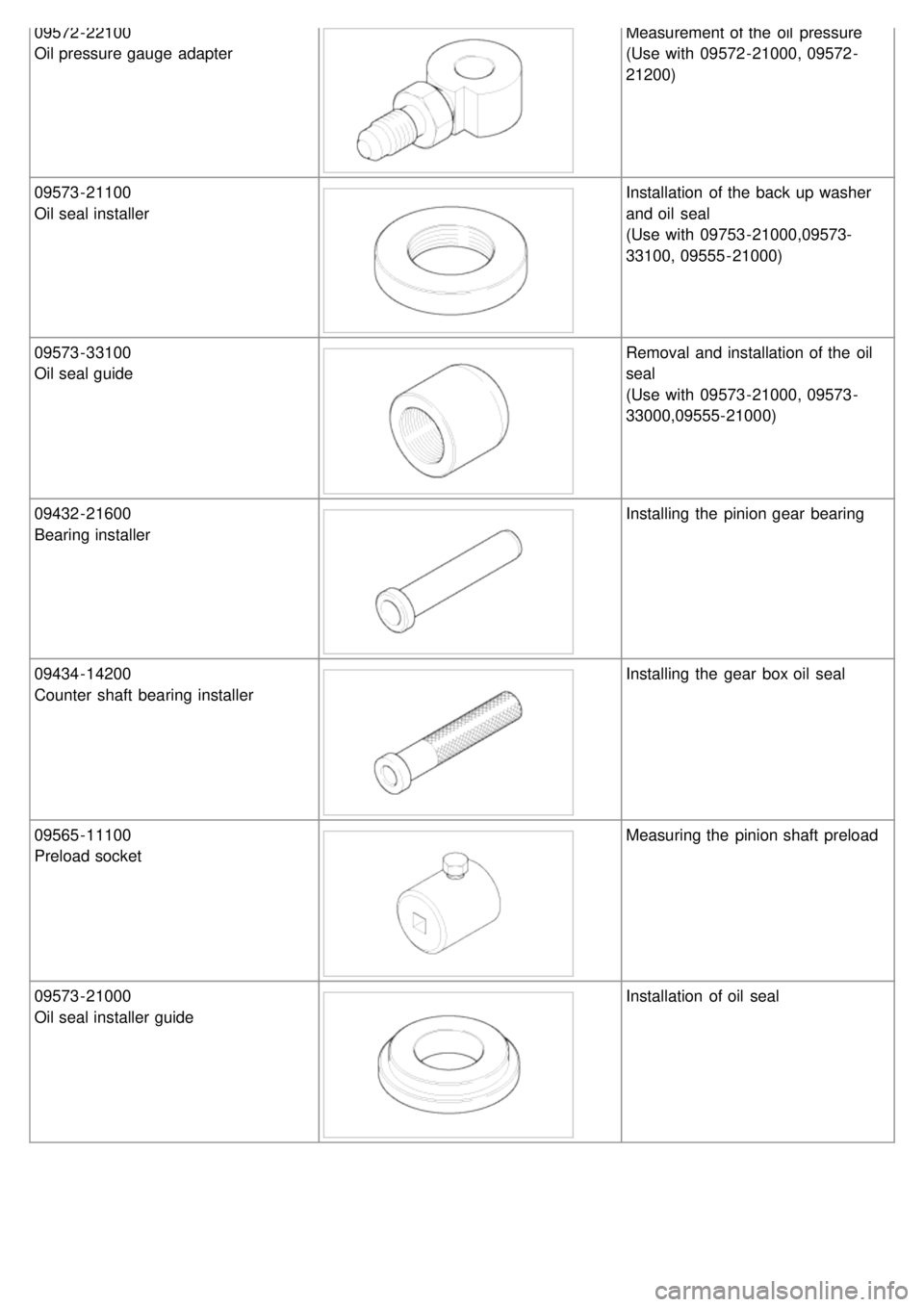
09572 - 22100
Oil pressure gauge adapterMeasurement of the oil pressure
(Use with 09572 - 21000, 09572 -
21200)
09573 - 21100
Oil seal installer
Installation of the back up washer
and oil seal
(Use with 09753 - 21000,09573-
33100, 09555 - 21000)
09573 - 33100
Oil seal guide
Removal and installation of the oil
seal
(Use with 09573 - 21000, 09573 -
33000,09555- 21000)
09432 - 21600
Bearing installer
Installing the pinion gear bearing
09434 - 14200
Counter shaft bearing installer
Installing the gear box oil seal
09565 - 11100
Preload socket
Measuring the pinion shaft preload
09573 - 21000
Oil seal installer guide
Installation of oil seal
Page 581 of 1575

2007 > 2.7L V6 GASOLINE >
TROUBLESHOOTING
Symptom Probable cause Remedy
Excessive play in
steering Loose yoke plug
Retighten
Loose steering gear mounting bolts Retighten
Loose or worn tie rod end Retighten or replace as necessary
Steering wheel
operation is not
smooth (Insufficient
power assist) V- belt slippage
Readjust
Damaged V- belt Replace
Low fluid level Replenish
Air in the fluid Bleed air
Twisted or damaged hoses Correct the routing or replace
Insufficient oil pump pressure Repair or replace the oil pump
Sticky flow control valve Replace
Excessive internal oil pump leakage Replace the damaged parts
Excessive oil leaks from rack and pinion in
gear box Replace the damaged parts
Distorted or damaged gear box or valve body
seals Replace
Steering wheel does
not return properly Excessive turning resistance of tierod end
Replace
Yoke plug excessively tight Adjust
Tie rod and/or ball joint cannot turn smoothly Replace
Loose mounting of gear box mounting bracket
Worn steering shaft joint and/or Retighten
Worn steering shaft joint and/or body
grommet Correct or replace
Distorted rack Replace
Damaged pinion bearing Replace
Twisted or damaged hoses Reposition or replace
Damaged oil pressure control valve Replace
Damaged oil pump input shaft bearing Replace
Noise Hissing Noise in Steering Gear
There is some noise with all power steering systems. One of the most common is a hissing
sound when the steering wheel is turned and the car is not moving. This noise will be most
evident when turning the wheel while the brakes are being applied. There is no relationship
between this noise and steering performance. Do not replace the valve unless the "hissing"
noise becomes extreme. A replaced valve will also make a slight noise, and is not always a
solution for the condition.
Rattling or chucking
noise in the rack and
pinion Interference with hoses from vehicle body
Reposition
Loose gear box bracket Retighten
Loose tie rod end and/or ball joint Retighten
Worn tie rod and/or ball joint Replace
Noise in the oil pump Low fluid level Replenish
Air in the fluid Bleed air
Loose pump mounting bolts Retighten
Page 583 of 1575

2.Shake the ball joint stud several times to check for looseness.
Tie rod end ball joint starting torque :
30 kg·cm or less
3.If the starting torque exceeds the upper limit of the standard value, replace the tie rod end.
4. Even if the starting torque is below the lower limit of the standard value, check the play of the ball joint and replace
if necessary.
CHECKING STEERING WHEEL RETURN
1.The force required to turn the steering wheel and the wheel return should be the same for both moderate and sharp
turns.
2. When the steering wheel is turned 90° and held for a couple of seconds while the vehicle is being driven at 20- 30
kph (12- 19 mph), the steering wheel should return at least 20° from its central position when it is released.
If the steering wheel is turned very quickly, steering may be momentarily difficult. This is not a malfunction
because the oil pump output will be somewhat decreased.
Page 584 of 1575

CHECKING POWER STEERING BELT TENSION
Refer to EM group(Timing system).
CHECKING POWER STEERING FLUID LEVEL
1.Position the vehicle on a level surface.
2. Start the engine. With the vehicle kept stationary, turn the steering wheel several times continuously to raise the
fluid temperature to 50- 60°C (122 - 140°F).
3. With the engine at idle, turn the steering wheel fully clockwise and counter- clockwise several times.
4. Make sure that there is no foaming or cloudiness in the reservoir fluid.
5. Stop the engine and check for any difference in fluid level between a stationary and a running engine.
a.If the fluid level varies 5 mm (0.2 in) or more, bleed the system again.
b. If the fluid level suddenly rises after stopping the engine, further bleeding is required.
c. Incomplete bleeding will produce a chattering sound in the pump and noise in the flow control valve, and
lead to decreased durability of the pump.
REPLACING POWER STEERING FLUID
1.Jack up the front wheels and support them with jackstands.
2. Disconnect the return hose from the oil reservoir and plug the oil reservoir.
3. Connect a vinyl hose to the disconnected return hose, and drain the oil into a container.
4. Remove the fuel pump fuse, then start the engine and wait for the engine to stall. Next, while operating the starting
motor intermittently, turn the steering wheel all the way to the left and then to the right several times to drain the
fluid.
5. Connect the return hoses, then fill the oil reservoir with the specified fluid.
6. Reinstall the fuel pump fuse.
7. Start the engine. Check for oil leakage.
8. Stop the engine.
9. Bleed the system.
Power steering fluid type : PSF - 3
Total quantity : Approx 1.1 liter
AIR BLEEDING
1.Remove the fuel pump fuse, then start the engine and wait for the engine to stall. Next, while operating the starting
motor intermittently (for 15 ~ 20 seconds), turn the steering wheel all the way to the left and then to the right five or
six times.