KIA CARNIVAL 2007 User Guide
CARNIVAL 2007
KIA
KIA
https://www.carmanualsonline.info/img/2/57045/w960_57045-0.png
KIA CARNIVAL 2007 User Guide
Page 290 of 1575
Page 292 of 1575
2007 > 2.7L V6 GASOLINE >
INSPECTION
FUNCTION AND OPERATION PRICIPLE
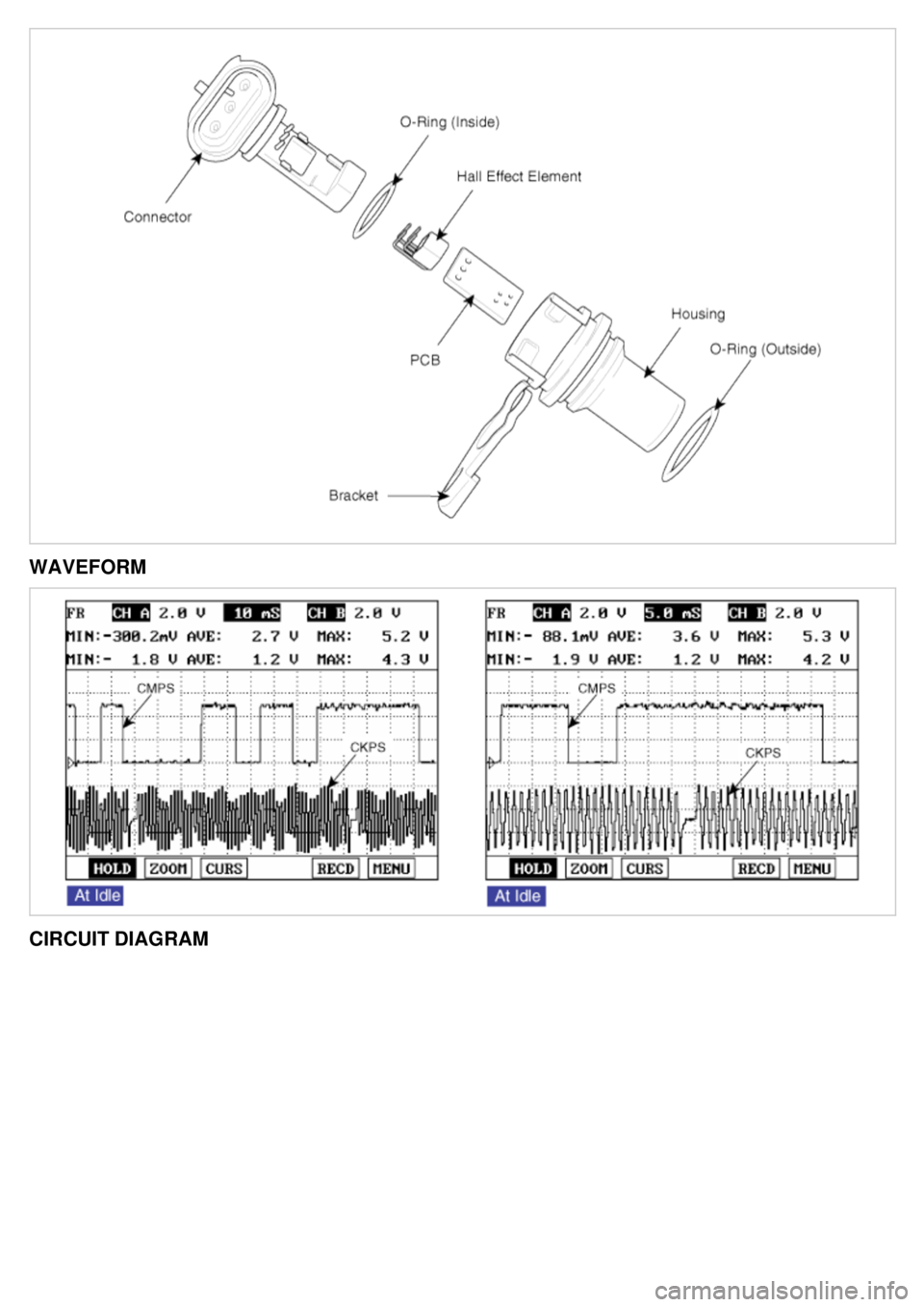
Crankshaft Position Sensor (CKPS) detects the crankshaft position and is one of the most important sensors of the
engine control system. If there is no CKPS signal input, fuel is not supplied and the main relay does not operate. That
is, vehicle can't run without CKPS signal. This sensor is installed on transaxle housing and generates alternating
current by magnetic flux field which is made by the sensor and the target wheel when engine runs. The target wheel
consists of 58 slots and 2 missing slots on 360 CA (Crank Angle).
WAVEFORM
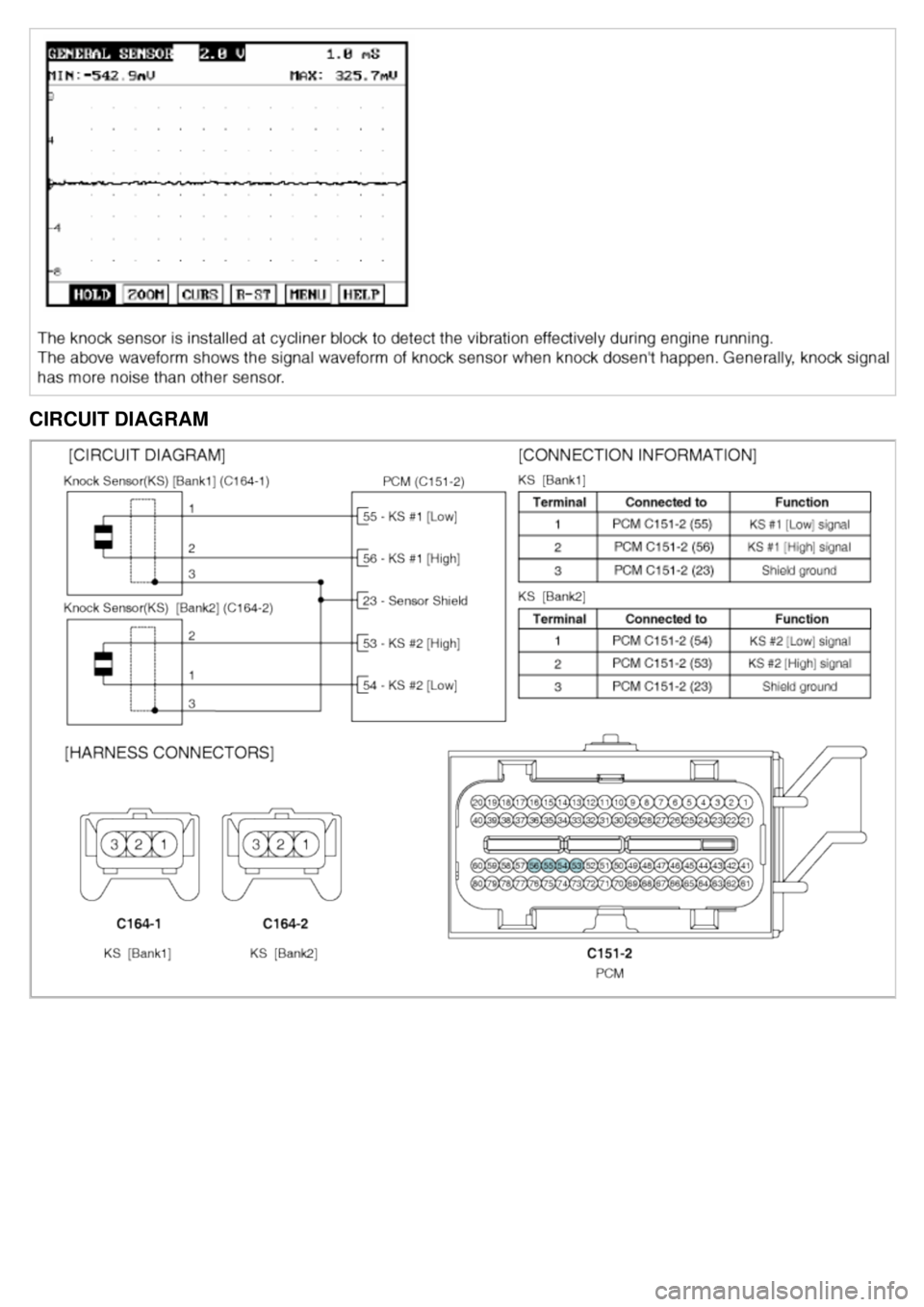
CIRCUIT DIAGRAM
Page 296 of 1575
Page 299 of 1575

2007 > 2.7L V6 GASOLINE >
INSPECTION
FUNCTION AND OPERATION PRICIPLE
Based on information from various sensors, the PCM measures the fuel injection amount. The fuel injector is a
solenoid- operated valve and the fuel injection amount is controlled by length of time that the fuel injector is held open.
The PCM controls each injector by grounding the control circuit. When the PCM energizes the injector by grounding
the control circuit, the circuit voltage should be low (theoretically 0V) and the fuel is injected. When the PCM de-
energizes the injector by opening control circuit, the fuel injector is closed and circuit voltage should momentarily peak.
If an injector connector is disconnected for more than 46 seconds while the engine runs, the PCM will determine
that the cylinder is misfiring and cut fuel supply. So be careful not to exceed 46 seconds. But the engine runs
normally in 10 seconds after turning the ignition key off.
SPECIFICATION
Item Specification
Coil Resistance (Ω) 13.8 ~ 15.2Ω at 20°C (68°F)
CIRCUIT DIAGRAM
Page 303 of 1575

2007 > 2.7L V6 GASOLINE >
INSTALLATION
If the OCVs are installed incorrectly, the vehicle may be damaged.
So when installing them, ensure the OCV and harness connector colors match(Components and harness side).
[Bank and its color] Bank Component side Harness side
Bank 1 (RH) GreyGrey
Bank 2 (LH) BlackBlack
INSPECTION
FUNCTION AND OPERATION PRICIPLE
The Continuously Variable Valve Timing (CVVT) system controls the amount of valve overlap by varying the amount of
oil flow into an assembly mounted on each intake camshaft through PCM control of an oil control valve. This system
uses two oil control valves, one on each bank. An Oil Temperature Sensor (OTS) is used to allow PCM monitoring of
engine oil temperature. As oil is directed into the chambers of the CVVT assembly, the cam phase is changed to suit
various performance and emissions requirements.. 1. When camshaft rotates engine rotation- wise: Intake- Advance / Exhaust- Retard
2. When camshaft rotates counter engine rotation- wise: Intake- Retard / Exhaust- Advance
SPECIFICATION
Item Specification
Coil Resistance (Ω) 6.7 ~ 7.7Ω at 20°C (68°F)
CIRCUIT DIAGRAM
Page 306 of 1575
2007 > 2.7L V6 GASOLINE >
INSPECTION
FUNCTION AND OPERATION PRICIPLE
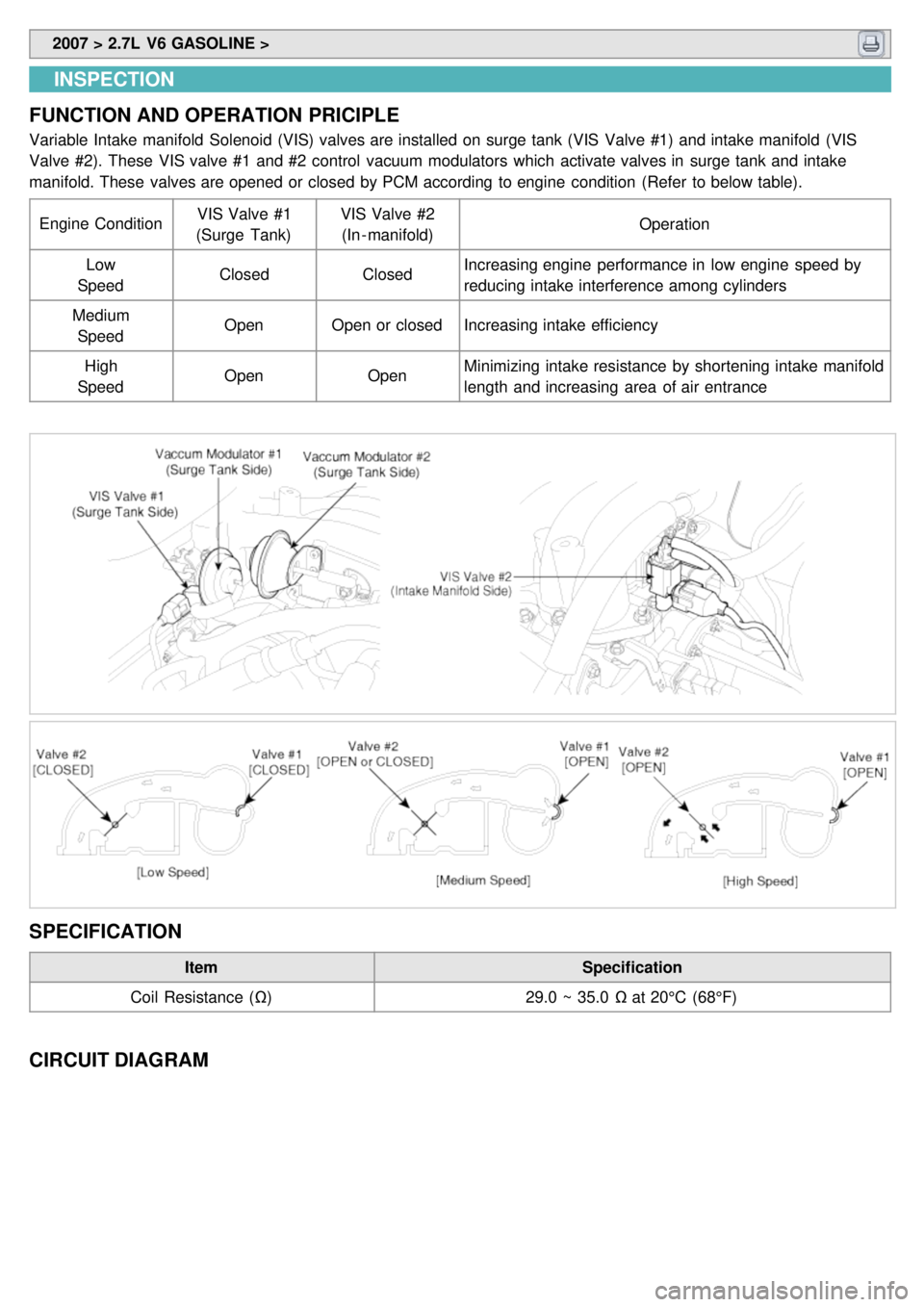
Variable Intake manifold Solenoid (VIS) valves are installed on surge tank (VIS Valve #1) and intake manifold (VIS
Valve #2). These VIS valve #1 and #2 control vacuum modulators which activate valves in surge tank and intake
manifold. These valves are opened or closed by PCM according to engine condition (Refer to below table).
Engine Condition VIS Valve #1
(Surge Tank) VIS Valve #2
(In - manifold) Operation
Low
Speed Closed
ClosedIncreasing engine performance in low engine speed by
reducing intake interference among cylinders
Medium Speed Open
Open or closed Increasing intake efficiency
High
Speed Open
OpenMinimizing intake resistance by shortening intake manifold
length and increasing area of air entrance
SPECIFICATION
Item
Specification
Coil Resistance (Ω) 29.0 ~ 35.0 Ω at 20°C (68°F)
CIRCUIT DIAGRAM
Page 309 of 1575
2007 > 2.7L V6 GASOLINE >
INSPECTION
FUNCTION AND OPERATION PRICIPLE
ETC (Electronic Throttle Control) system is electronically controlled throttle device which controls the throttle valve. It
consists of ETC motor, throttle body and throttle position sensor (TPS). A mechanical throttle control system receives a
driver's intention via a wire cable between the accelerator and the throttle valve, while this ETC system uses the signal
from the Accelerator Position Sensor (APS) installed on the accelerator pedal. After the PCM receives the APS signal
and calculates the throttle opening angle, it activates the throttle valve by using the ETC motor. Additionally, it can
handle cruise control function without any special devices.
SHEMATIC DIAGRAM
Page 311 of 1575
[ETC MOTOR]Item Sensor Resistance
Coil Resistance (Ω) 1.275 ~ 1.725Ω at 20°C (68°F)
CIRCUIT DIAGRAM
FAIL-SAFE MODE
ModeDescription Symptom Possible Cause
a. ETC system can't proceed reliable
algorithm procedure
Page 331 of 1575
2007 > 2.7L V6 GASOLINE >
Electronic Control System
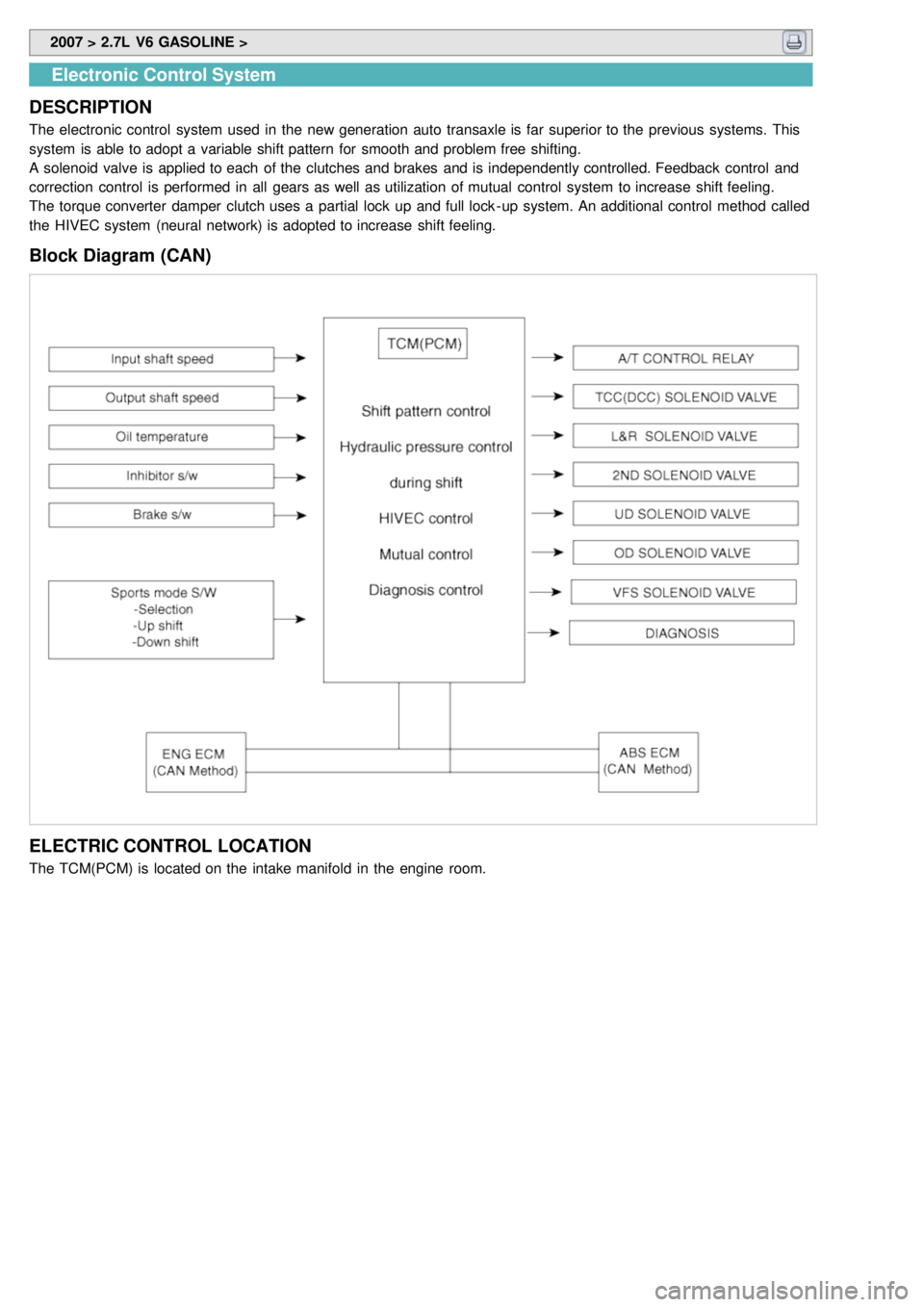
DESCRIPTION
The electronic control system used in the new generation auto transaxle is far superior to the previous systems. This
system is able to adopt a variable shift pattern for smooth and problem free shifting.
A solenoid valve is applied to each of the clutches and brakes and is independently controlled. Feedback control and
correction control is performed in all gears as well as utilization of mutual control system to increase shift feeling.
The torque converter damper clutch uses a partial lock up and full lock - up system. An additional control method called
the HIVEC system (neural network) is adopted to increase shift feeling.
Block Diagram (CAN)
ELECTRIC CONTROL LOCATION
The TCM(PCM) is located on the intake manifold in the engine room.
Page 807 of 1575
2007 > 2.7L V6 GASOLINE >
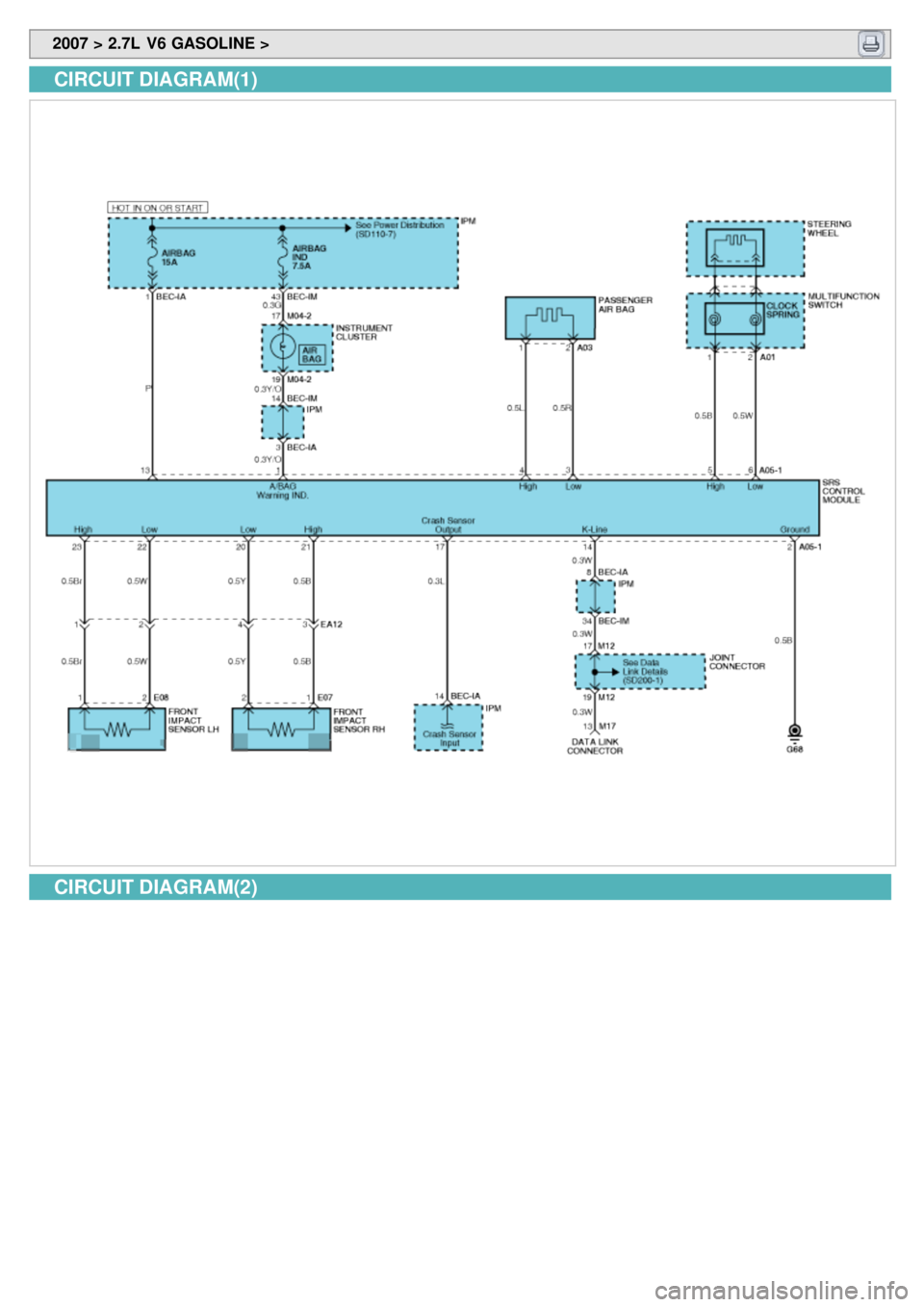
CIRCUIT DIAGRAM(1)
CIRCUIT DIAGRAM(2)


![KIA CARNIVAL 2007 User Guide [ETC MOTOR]Item Sensor Resistance
Coil Resistance (Ω) 1.275 ~ 1.725Ω at 20°C (68°F)
CIRCUIT DIAGRAM
FAIL-SAFE MODE
ModeDescription Symptom Possible Cause
a. ETC system cant proceed reliab](/img/2/57045/w960_57045-310.png "KIA CARNIVAL 2007 User Guide [ETC MOTOR]Item Sensor Resistance
Coil Resistance (Ω) 1.275 ~ 1.725Ω at 20°C (68°F)
CIRCUIT DIAGRAM
FAIL-SAFE MODE
ModeDescription Symptom Possible Cause
a. ETC system cant proceed reliab")