oil level KIA CARNIVAL 2007 User Guide
[x] Cancel search | Manufacturer: KIA, Model Year: 2007, Model line: CARNIVAL, Model: KIA CARNIVAL 2007Pages: 1575, PDF Size: 44.86 MB
Page 372 of 1575
REPLACEMENT
If you have a fluid changer, use this changer to replace the fluid. If you do not, replace it using the following
procedure.1. Disconnect the hose which connects the transmission and the oil cooler which is within the radiator only in 2.4L
engine(3.3L- the oil cooler is separated).
2. Start the engine and let the fluid drain out.
Running conditions : "N" range with engine idling.
The engine should be stopped within one minute after it is started. If the fluid has all drained out before then,
the engine should be stopped at that point.
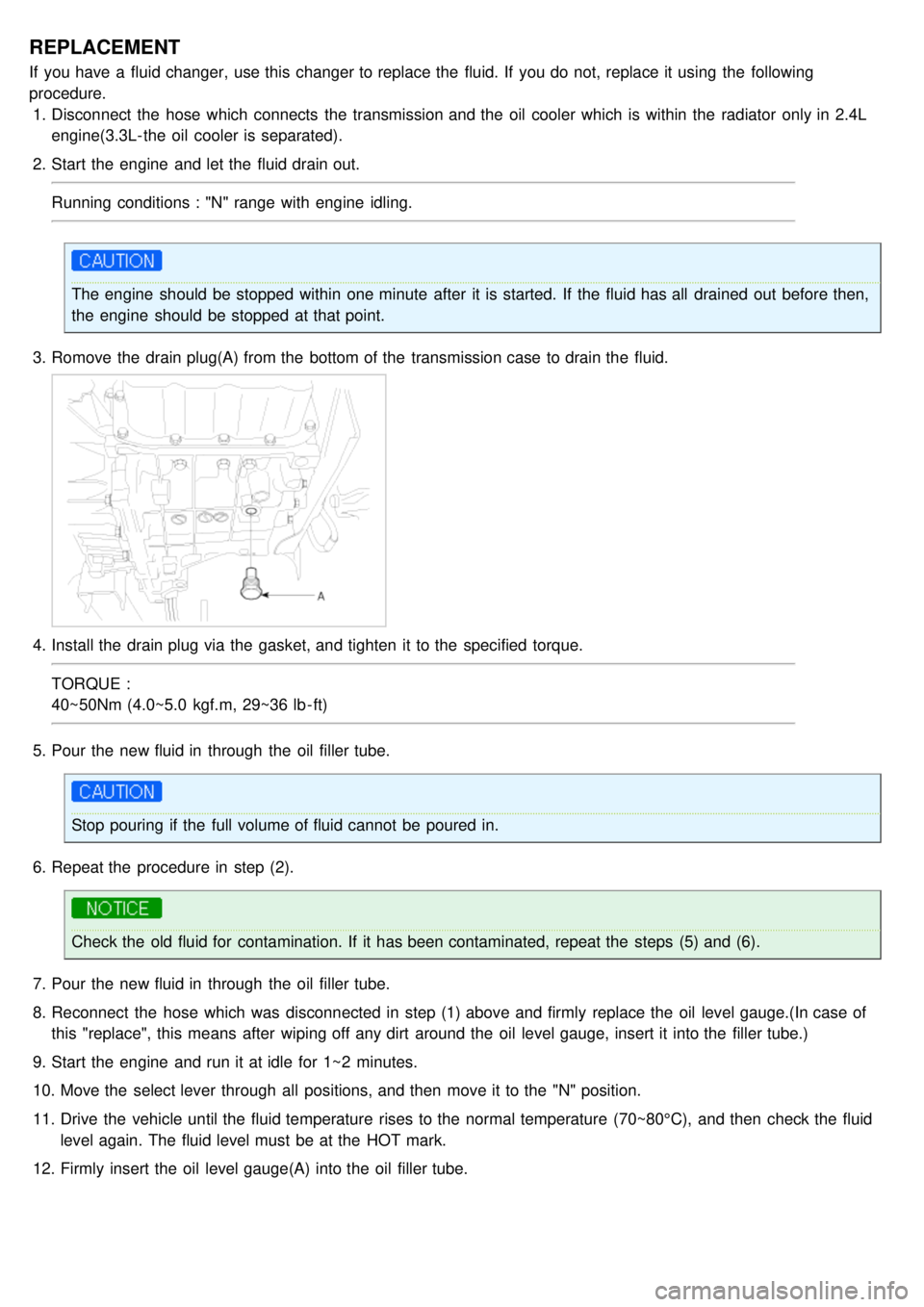
3. Romove the drain plug(A) from the bottom of the transmission case to drain the fluid.
4.Install the drain plug via the gasket, and tighten it to the specified torque.
TORQUE :
40~50Nm (4.0~5.0 kgf.m, 29~36 lb - ft)
5. Pour the new fluid in through the oil filler tube.
Stop pouring if the full volume of fluid cannot be poured in.
6. Repeat the procedure in step (2).
Check the old fluid for contamination. If it has been contaminated, repeat the steps (5) and (6).
7. Pour the new fluid in through the oil filler tube.
8. Reconnect the hose which was disconnected in step (1) above and firmly replace the oil level gauge.(In case of
this "replace", this means after wiping off any dirt around the oil level gauge, insert it into the filler tube.)
9. Start the engine and run it at idle for 1~2 minutes.
10. Move the select lever through all positions, and then move it to the "N" position.
11. Drive the vehicle until the fluid temperature rises to the normal temperature (70~80°C), and then check the fluid
level again. The fluid level must be at the HOT mark.
12. Firmly insert the oil level gauge(A) into the oil filler tube.
Page 424 of 1575

2007 > 2.7L V6 GASOLINE >
SERVICE ADJUSTMENT PROCEDURE
Transmission oil inspection and replacement
1. After parking the vehicle on a plain, stop the engine.
2. After removing the oil filler plug and washer, inspect the manual transaxle fluid condition and quantity.
3. If the manual transaxle fluid is contaminated, drain it out by removing the oil drain plug.
4. Tighten the new oil drain plug and feed manual transaxle fluid to a proper level.
TORQUE:
29.4~34.4 Nm(3.0~3.5kgf.m, 21.7~25.3lb - ft)
Oil type: SAE75W/85
Oil quantity:
1.9 liter(2.0077 US qt, 1.6718 lmp qt)
5. Retighten the oil filler plug with a new washer.
TORQUE:
29.4~34.4 Nm(3.0~3.5kgf.m, 21.7~25.3lb - ft)
Back up lamp switch inspection
1.Disconnect the back up lamp switch connector(B).
2.Inspect the continuity of the switch. When the shift lever is located in reverse range, it should be applied an electric
current.
3. Replace the back up lamp switch, if necessary.
TORQUE:
29.4~34.4 Nm(3.0~3.5kgf.m, 21.7~25.3lb - ft)
Page 581 of 1575

2007 > 2.7L V6 GASOLINE >
TROUBLESHOOTING
Symptom Probable cause Remedy
Excessive play in
steering Loose yoke plug
Retighten
Loose steering gear mounting bolts Retighten
Loose or worn tie rod end Retighten or replace as necessary
Steering wheel
operation is not
smooth (Insufficient
power assist) V- belt slippage
Readjust
Damaged V- belt Replace
Low fluid level Replenish
Air in the fluid Bleed air
Twisted or damaged hoses Correct the routing or replace
Insufficient oil pump pressure Repair or replace the oil pump
Sticky flow control valve Replace
Excessive internal oil pump leakage Replace the damaged parts
Excessive oil leaks from rack and pinion in
gear box Replace the damaged parts
Distorted or damaged gear box or valve body
seals Replace
Steering wheel does
not return properly Excessive turning resistance of tierod end
Replace
Yoke plug excessively tight Adjust
Tie rod and/or ball joint cannot turn smoothly Replace
Loose mounting of gear box mounting bracket
Worn steering shaft joint and/or Retighten
Worn steering shaft joint and/or body
grommet Correct or replace
Distorted rack Replace
Damaged pinion bearing Replace
Twisted or damaged hoses Reposition or replace
Damaged oil pressure control valve Replace
Damaged oil pump input shaft bearing Replace
Noise Hissing Noise in Steering Gear
There is some noise with all power steering systems. One of the most common is a hissing
sound when the steering wheel is turned and the car is not moving. This noise will be most
evident when turning the wheel while the brakes are being applied. There is no relationship
between this noise and steering performance. Do not replace the valve unless the "hissing"
noise becomes extreme. A replaced valve will also make a slight noise, and is not always a
solution for the condition.
Rattling or chucking
noise in the rack and
pinion Interference with hoses from vehicle body
Reposition
Loose gear box bracket Retighten
Loose tie rod end and/or ball joint Retighten
Worn tie rod and/or ball joint Replace
Noise in the oil pump Low fluid level Replenish
Air in the fluid Bleed air
Loose pump mounting bolts Retighten
Page 584 of 1575

CHECKING POWER STEERING BELT TENSION
Refer to EM group(Timing system).
CHECKING POWER STEERING FLUID LEVEL
1.Position the vehicle on a level surface.
2. Start the engine. With the vehicle kept stationary, turn the steering wheel several times continuously to raise the
fluid temperature to 50- 60°C (122 - 140°F).
3. With the engine at idle, turn the steering wheel fully clockwise and counter- clockwise several times.
4. Make sure that there is no foaming or cloudiness in the reservoir fluid.
5. Stop the engine and check for any difference in fluid level between a stationary and a running engine.
a.If the fluid level varies 5 mm (0.2 in) or more, bleed the system again.
b. If the fluid level suddenly rises after stopping the engine, further bleeding is required.
c. Incomplete bleeding will produce a chattering sound in the pump and noise in the flow control valve, and
lead to decreased durability of the pump.
REPLACING POWER STEERING FLUID
1.Jack up the front wheels and support them with jackstands.
2. Disconnect the return hose from the oil reservoir and plug the oil reservoir.
3. Connect a vinyl hose to the disconnected return hose, and drain the oil into a container.
4. Remove the fuel pump fuse, then start the engine and wait for the engine to stall. Next, while operating the starting
motor intermittently, turn the steering wheel all the way to the left and then to the right several times to drain the
fluid.
5. Connect the return hoses, then fill the oil reservoir with the specified fluid.
6. Reinstall the fuel pump fuse.
7. Start the engine. Check for oil leakage.
8. Stop the engine.
9. Bleed the system.
Power steering fluid type : PSF - 3
Total quantity : Approx 1.1 liter
AIR BLEEDING
1.Remove the fuel pump fuse, then start the engine and wait for the engine to stall. Next, while operating the starting
motor intermittently (for 15 ~ 20 seconds), turn the steering wheel all the way to the left and then to the right five or
six times.
Page 585 of 1575
a.During air bleeding, replenish the fluid supply so that the level never falls below the lower position of the
filter.
b. If air bleeding is done while the vehicle is idling, the air will be broken up and absorbed into the fluid. Be
sure to do the bleeding only while cranking.
c. Reinstall the fuel pump fuse, and start the engine(idling).
d. Turn the steering wheel to the left and the right until there are no air bubbles in the oil reservoir.
Do not hold the steering wheel turned all the way to either side for more than ten seconds.
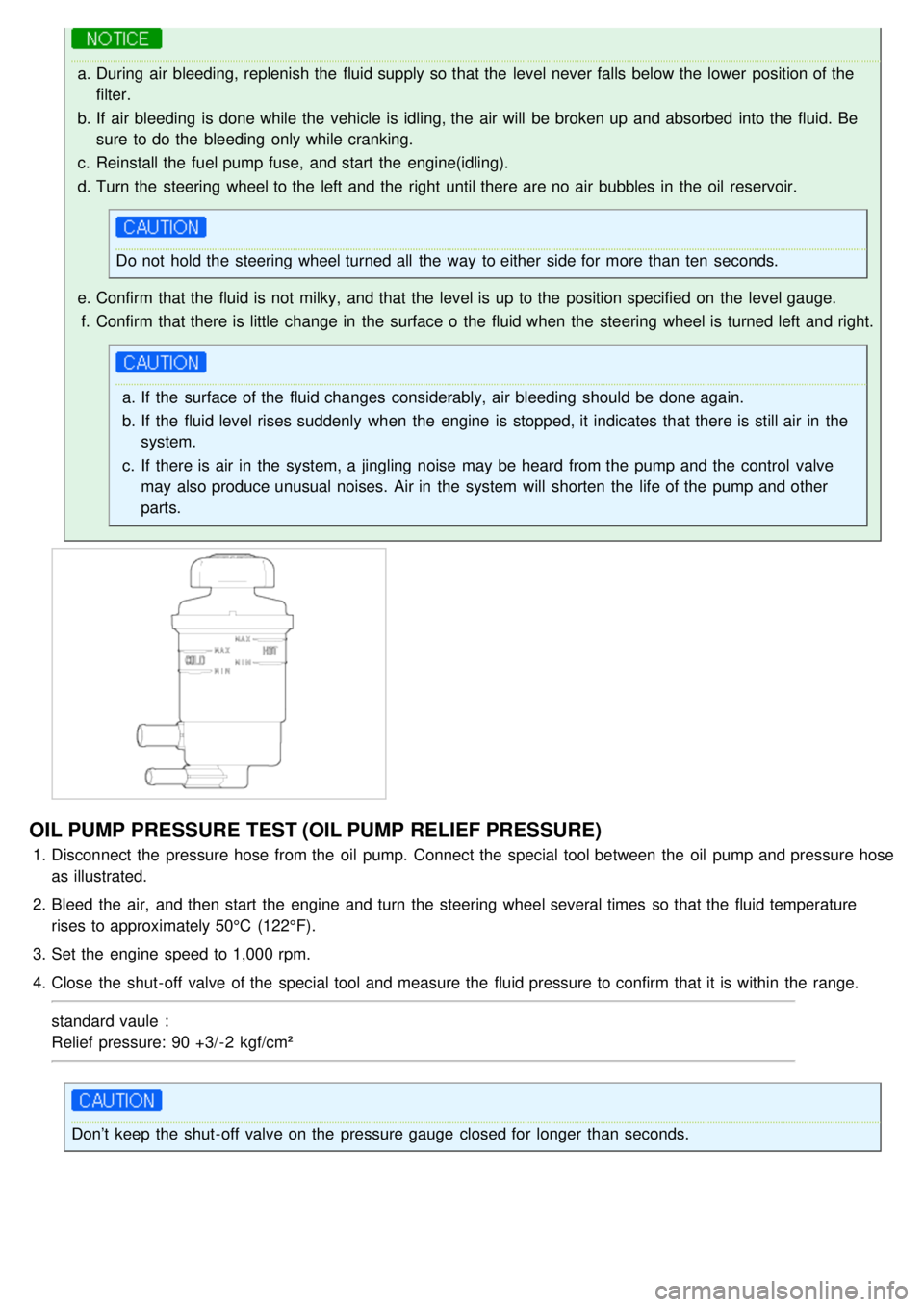
e. Confirm that the fluid is not milky, and that the level is up to the position specified on the level gauge.
f. Confirm that there is little change in the surface o the fluid when the steering wheel is turned left and right.
a. If the surface of the fluid changes considerably, air bleeding should be done again.
b. If the fluid level rises suddenly when the engine is stopped, it indicates that there is still air in the
system.
c. If there is air in the system, a jingling noise may be heard from the pump and the control valve
may also produce unusual noises. Air in the system will shorten the life of the pump and other
parts.
OIL PUMP PRESSURE TEST (OIL PUMP RELIEF PRESSURE)
1.Disconnect the pressure hose from the oil pump. Connect the special tool between the oil pump and pressure hose
as illustrated.
2. Bleed the air, and then start the engine and turn the steering wheel several times so that the fluid temperature
rises to approximately 50°C (122°F).
3. Set the engine speed to 1,000 rpm.
4. Close the shut- off valve of the special tool and measure the fluid pressure to confirm that it is within the range.
standard vaule :
Relief pressure: 90 +3/- 2 kgf/cm²
Don’t keep the shut- off valve on the pressure gauge closed for longer than seconds.
Page 1309 of 1575

Tolerance(rpm) 5,000
6,0007,0008,000Engine
Revolution (rpm) ±150
±180±210 -Gasoline
±150 ±150 --Diesel
FUEL GAUGE SENDER
1.Using an ohmmeter, measure the resistance between terminals 1 and 2 of sender connector (A) at each float level.
2.Also check that the resistance changes smoothly when the float is moved from "E" to "F".
Position Resistance(Ω)
Sender (E) 200
Warning lamp 160
1/2 54.5
Sender (F) 8
If the height resistance is not within specifications, replace the fuel sender as an assembly.
After completing this test, wipe the sender dry and reinstall it in the fuel tank.
ENGINE COOLANT TEMPERATURE SENDER
1.Using an ohmmeter, measure the resistance between the terminal 2 and ground.
Temperature[°F(°C)] 140
(60) 185
(85) 230
(110) 257
(127.4) E/G
Resistance (Ω) 12856.1 25.216.1Gasoline
Temperature [°F(°C)] 120
(49) 160
(71) 230
(110) 260
(127.4) E/G
Resistance (Ω) 209.688.724.315.9Diesel
OIL PRESSURE SWITCH
1.Check that there is continuity between the oil press switch terminal and ground with the engine off.
2. Check that there is no continuity between the terminal and ground with the engine running.
3. If operation is not as specified, replace the switch.
Page 1310 of 1575

4.Connect the oil pressure switch wire harness.
5. Turn the ignition switch ON. Check that the warning lamp lights up. If the warning lamp doesn't light, test the wire
harness.
BRAKE FLUID LEVEL WARNING SWITCH
1.Remove the connector (A) from the switch located at the brake fluid reservoir (B).
2. Verify that continuity exists between switch terminals 1 and 2 while pressing the switch (float) down with a rod.
BRAKE FLUID LEVEL WARNING LAMP
1.Ignition "ON"
2. Release the parking brake.
3. Remove the connector from the brake fluid level warning switch.
4. Ground the connector at the harness side.
5. Verify that the warning lamp lights.
PARKING BRAKE SWITCH
The parking brake switch is a push type. It is located at the side of the parking brake pedal.
1. Check that there is continuity between the terminal and switch body with the switch (A) ON.