sliding door KIA CARNIVAL 2007 Owner's Manual
[x] Cancel search | Manufacturer: KIA, Model Year: 2007, Model line: CARNIVAL, Model: KIA CARNIVAL 2007Pages: 1575, PDF Size: 44.86 MB
Page 1326 of 1575
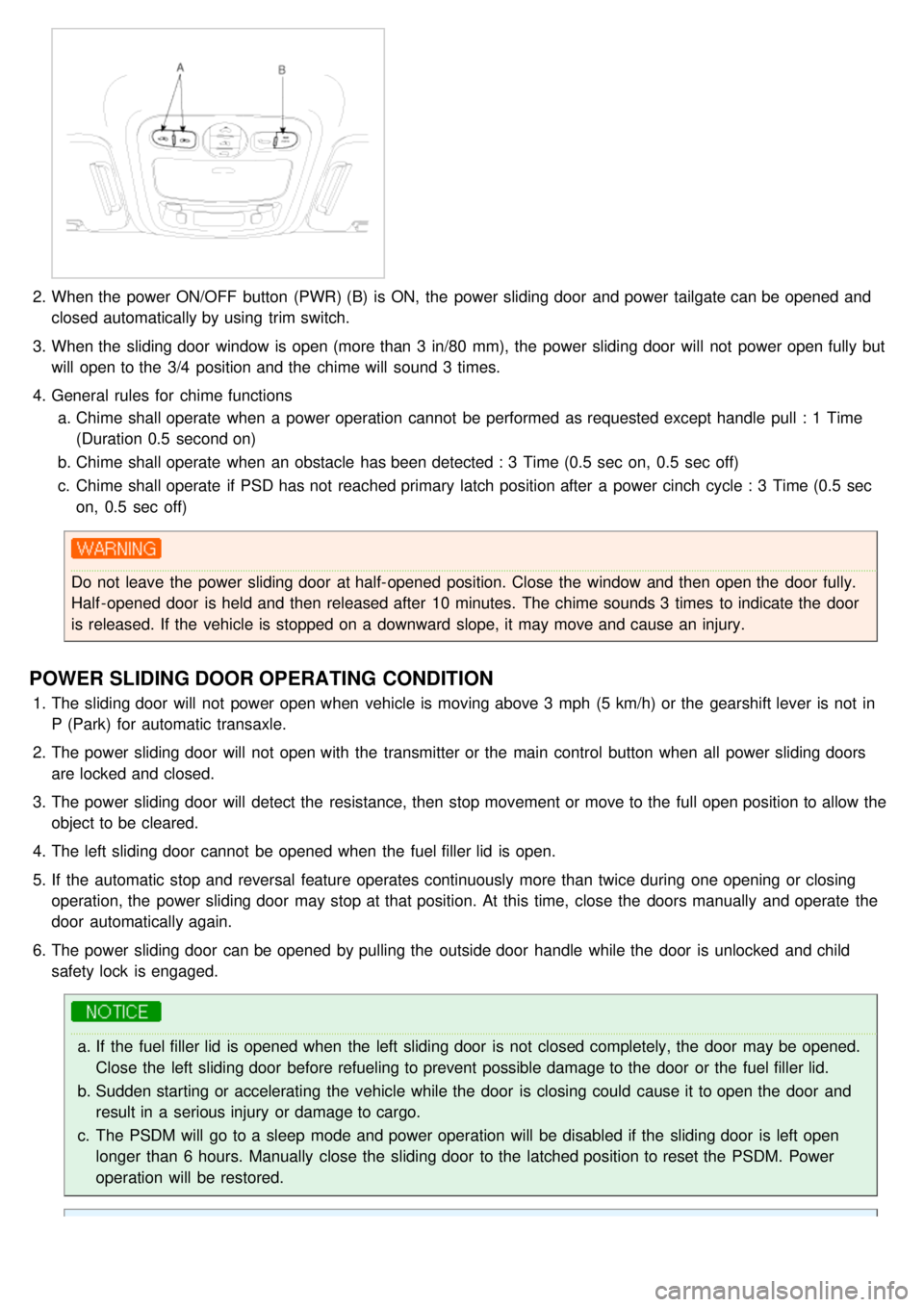
2.When the power ON/OFF button (PWR) (B) is ON, the power sliding door and power tailgate can be opened and
closed automatically by using trim switch.
3. When the sliding door window is open (more than 3 in/80 mm), the power sliding door will not power open fully but
will open to the 3/4 position and the chime will sound 3 times.
4. General rules for chime functions
a. Chime shall operate when a power operation cannot be performed as requested except handle pull : 1 Time
(Duration 0.5 second on)
b. Chime shall operate when an obstacle has been detected : 3 Time (0.5 sec on, 0.5 sec off)
c. Chime shall operate if PSD has not reached primary latch position after a power cinch cycle : 3 Time (0.5 sec
on, 0.5 sec off)
Do not leave the power sliding door at half- opened position. Close the window and then open the door fully.
Half - opened door is held and then released after 10 minutes. The chime sounds 3 times to indicate the door
is released. If the vehicle is stopped on a downward slope, it may move and cause an injury.
POWER SLIDING DOOR OPERATING CONDITION
1.The sliding door will not power open when vehicle is moving above 3 mph (5 km/h) or the gearshift lever is not in
P (Park) for automatic transaxle.
2. The power sliding door will not open with the transmitter or the main control button when all power sliding doors
are locked and closed.
3. The power sliding door will detect the resistance, then stop movement or move to the full open position to allow the
object to be cleared.
4. The left sliding door cannot be opened when the fuel filler lid is open.
5. If the automatic stop and reversal feature operates continuously more than twice during one opening or closing
operation, the power sliding door may stop at that position. At this time, close the doors manually and operate the
door automatically again.
6. The power sliding door can be opened by pulling the outside door handle while the door is unlocked and child
safety lock is engaged.
a.If the fuel filler lid is opened when the left sliding door is not closed completely, the door may be opened.
Close the left sliding door before refueling to prevent possible damage to the door or the fuel filler lid.
b. Sudden starting or accelerating the vehicle while the door is closing could cause it to open the door and
result in a serious injury or damage to cargo.
c. The PSDM will go to a sleep mode and power operation will be disabled if the sliding door is left open
longer than 6 hours. Manually close the sliding door to the latched position to reset the PSDM. Power
operation will be restored.
Page 1327 of 1575
a.The door could suddenly close by itself and cause a serious injury especially when stopping on a down - hill
grade.
b. To prevent the battery from being discharged, do not leave the power sliding door and power tailgate at
open position for a long time.
a.Let the rear passengers get on or off the vehicle after the door is open fully. Sudden closing could cause a
serious injury.
b. To prevent power sliding door system, don't use excessive force to open/close the door during operation.
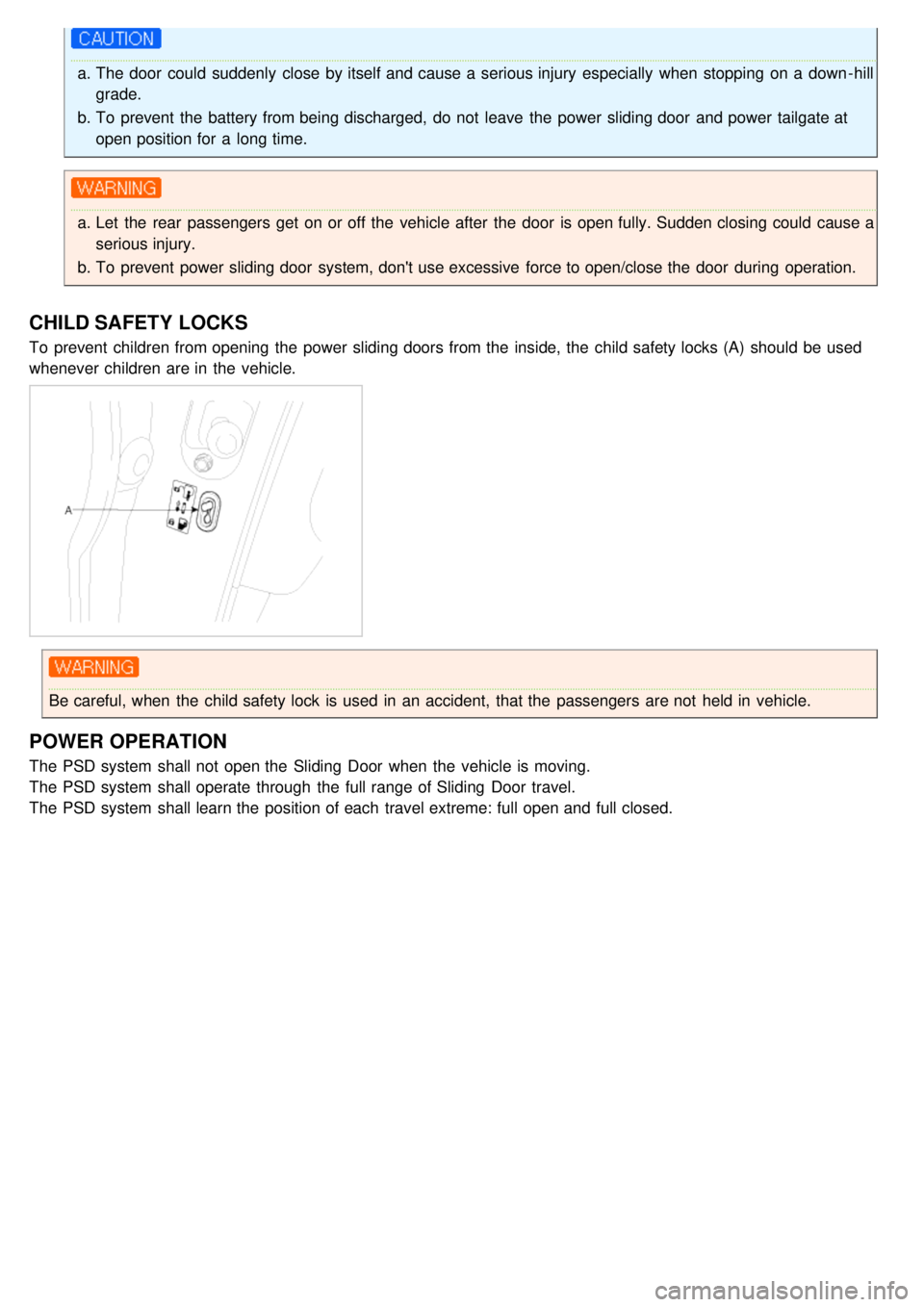
CHILD SAFETY LOCKS
To prevent children from opening the power sliding doors from the inside, the child safety locks (A) should be used
whenever children are in the vehicle.
Be careful, when the child safety lock is used in an accident, that the passengers are not held in vehicle.
POWER OPERATION
The PSD system shall not open the Sliding Door when the vehicle is moving.
The PSD system shall operate through the full range of Sliding Door travel.
The PSD system shall learn the position of each travel extreme: full open and full closed.
Page 1328 of 1575

1.Vehicle condition
Moving
a. (IGN=OFF and Vehicle Speed > 5 km/h) or (IGN= ON and (Vehicle Speed > 5 km/h or PIN - not P/N))
Not moving a. (IGN=OFF and Vehicle Speed < 5 km/h) or (IGN= ON and (Vehicle Speed < 5 km/h and TRANS - P/N))
2. DOOR TRAVEL - ZONES
The door travel is divided into four zones starting at the full closed and latched position.
Dimensions are at the rear edge of the door and are approximate.
Zone 1 - Latching - 0 to 10 mm (primary and secondary latch positions).
Zone 2 - Near latching position including curved track portion - 10 to 300 mm.
Zone 3 - Straight track - 300 mm to hold open latch.
Zone 4 - Hold Open - door in hold open latch.
POWER SLIDING DOOR OPERATION
1.Vehicle condition
Stopping condition
a. When the ignition switch is in the OFF or ACC position, vehicle is stopped or moving below 5 km/h.
b. When the ignition switch is in the ON position, vehicle is stopped or moving below 5 km/h (the gearshift lever is
in N(Neutral) for manual transaxle, P(Park) for automatic transaxle).
Driving condition a. When the ignition switch is in the OFF or ACC position, vehicle is moving above 5 km/h.
b. When the ignition switch is in the ON position, vehicle is moving above 5 km/h or the gearshift lever is not in
N(Neutral) for manual transaxle, P(Park) for automatic transaxle.
Page 1329 of 1575
N(Neutral) for manual transaxle, P(Park) for automatic transaxle.
2. Door position
If the power sliding door is operated while the door is in slightly- opened position (less than 300mm), the door is
automatically opened fully. If the power sliding door is operated while the door is in slightly- opened position (more
than 300mm), the door is automatically closed completely.
3. If the door handle is pulled from inside or outside while the door is locked or child safety lock is engaged, the
power sliding door is not opened.
Page 1331 of 1575

2007 > 2.7L V6 GASOLINE >
TROUBLESHOOTING
Check the following items prior to performing Power Sliding Door System service.
1. Manual movement
Make sure the sliding door moves manually. Place the ON/OFF switch on the overhead console in the OFF
position. Move the door manually and check for proper door fit and latch effort. Check for interference with other
body parts such as latch striker, trim, and weather seals.
2. Battery voltage
Make sure the battery is fully charged. The PSD system is an electronic device and requires a minimum battery
voltage to operate. The PSDM(Power sliding door module) monitors the battery voltage present at the PSDM input
battery input and will not permit operation if the battery voltage is out of range.
3. Fuses
Two fuses protect the battery supply to the PSDM(Power sliding door module), one for Power, and one for logic.
Check that the fuses are intact
4. Repeat Operations
Make sure the customer has not been operating the PSD repeatedly while the vehicle is turned off. The battery will
be discharged and the PSDM(Power sliding door module) will not permit operation.
5. Vehicle on Steep Grade
Make sure the customer has not been operating the PSD system when the vehicle is parked on a steep grade
(greater than 30%). The system will operate but the force of gravity and normal flex of the vehicle body may affect
proper operation.
6. Obstacle Detection
The obstacle detection force is not adjustable. Factors that may affect the force are vehicle grade, battery voltage,
or dirt in sliding door tracks.
7. Outside handle response time
When the vehicle has been parked and OFF, there may be a delay before power operation starts after the outside
handle is pulled. This is normal because the PSDM(Power sliding door module) must wake up and check for proper
conditions before starting a power open operation.
8. The sliding doors are not identical. Open and close times and obstacle detection efforts may vary when comparing
the two doors. This is normal and is caused by vehicle build conditions such as door fit and rolling resistance.
9. Scan tool Diagnostic tool
Connect Scan tool to the K- line and check status of system.
POWER SLIDING DOOR SYSTEM DIAGNOSIS
CONDITION POSSIBLE CAUSES CORRECTION
Sliding Door opens
unexpectedly Accidental activation or failure of
open/close command switch
Check for shorted or defective switch
Failure of latch assembly Check wiring connections
Check for diagnostic trouble codes
Failure of Power Sliding Door or Body
Control module Disconnect then reconnect battery or fuse to
reset module and function sliding door. If no
function exists check for loose wire
connections. See Body Diagnostic Manual for
detailed procedures
Sliding Door will not power
open or close Not in Park or false indication
Check switch status with SCAN tool
Battery voltage at PSDM is too low
<9.5V to start operation and
<8.0V to continue operation Check for proper voltage at the PSDM.
Charge battery
Blown fuse Check for blown fuse
BCM or sliding door control module
Page 1332 of 1575

BCM or sliding door control module
critical fault codesCheck for diagnostic trouble codes
Failure of latch assembly Check wire connections and for blown fuse
Check for foreign matter preventing the
operation of latch assembly
Failure of motor assembly Test motor assembly
Binding or sticking of components Establish location of binding and replace
necessary components
Wiring problems (system or vehicle) Troubleshoot using electrical schematics
Refer to wiring diagrams
Power loss during Sliding
Door operation Wiring problems (system or vehicle)
Troubleshoot using electrical schematics
Refer to wiring diagrams
Battery voltage at PSDM is too low
<9.5V to start operation and
<8.0V to continue operation Check for proper voltage at the PSDM.
Charge battery
Failure of Power Sliding Door or Body
Control Module Check for diagnostic trouble codes
Failure of motor assembly Test motor assembly
Sliding Door does not close
to primary latch position Door mis - alignment Check latch and striker alignment
Check rollers and track alignment
Binding or sticking of components Establish location of binding and adjust or
replace necessary components
Failure of Power Sliding Door or Body
Control Module Check for diagnostic trouble codes
Sliding Door seal force too high Inspect seals for damage, mis - assembly,
foreign matter or other possible obstruction
Failure of motor assembly Test motor assembly
Latch will not release from
primary position Not in Park or false indication
Check switch status with SCAN tool
Battery voltage at PSDM is too low Check for proper voltage at the PSDM
Charge battery
Blown fuse Check fuse and replace if required
Failure of latch assembly Check switch status with scan tool
Check for foreign matter or damaged
components preventing the operation of latch
assembly
Troubleshoot using body diagnostic manual.
Replace latch assembly, if necessary
Failure of outside or inside handle
connection Check handle connections on brainplate.
Failure of Power Sliding Door or Body
Control Module Check for diagnostic trouble codes.
Binding or sticking of components Establish location of binding and adjust or
replace necessary components
Key fob or overhead
console switch does not
power operate sliding door Blown Fuse
Check fuse and replace
Battery voltage at PSDM is too low Check for proper voltage at the PSDM.
Charge battery
Refer to wiring diagrams
Page 1333 of 1575

Wiring problems (system or vehicle)Refer to wiring diagrams
Check for diagnostic trouble codes.
Does Not Power Unlatch
Failure of latch assembly Check for foreign matter preventing the
operation of latch assembly
Check for diagnostic trouble codes.
Check Detent switch.
Troubleshoot using body diagnostic manual
Failure of Latch Release Actuator Check actuator and replace if necessary
Wiring problems (system or vehicle) Refer to wiring diagrams
Check for diagnostic trouble codes.
Failure of Body Control Module (BCM) Troubleshoot using body diagnostic manual
Replace BCM if necessary
Failure of key fob Reprogram key fob
Replace key fob if necessary
Failure of Power Sliding Door Module Check for diagnostic trouble codes.
See Body Diagnostic Manual for detailed
procedures
Failure of sliding door motor assembly Check for foreign matter preventing the
operation of motor assembly
Check wire connections
Drive Unit clutch does not engage.
Replace Drive Unit.
Troubleshoot using Body Diagnostic Manual
Replace motor if necessary
Sliding Door does not stay
open Hold Open Latch not working Check if sliding door powers open to hold
open latch
Check if H- O - L is working
High inside/outside opening
effort Bound cables Check for smooth manual operation
Check for broken attachments
Drive unit jammed or did not disengage Troubleshoot using Body Diagnostic Manual
Replace components, if necessary
Binding or sticking of components Establish location of binding and replace
necessary components
Sliding Door continues to
power close Failure of latch assembly Check wire connections and Detent switch
Check for foreign matter
Troubleshoot using Body Diagnostic Manual
Control Module Check for diagnostic trouble codes
Wiring problems (system or vehicle) Troubleshoot using electrical schematics
Refer to wiring diagrams
Sliding Door continues to
power open Failure of PSDM Check for diagnostic trouble codes
See Body Diagnostic Manual for detailed
procedures
Wiring problems (system or vehicle) Troubleshoot using electrical schematics
Refer to Wiring Diagrams
Sliding Door opens very
slowly Battery voltage at PSDM is too low
Check for proper voltage at the PSDM
Charge battery
Page 1334 of 1575

Bound cablesReplace drive unit if necessary
Binding or sticking of components Establish location of binding and replace
necessary components
Grade of vehicle too steep for power
operation Operate sliding door manually
Failure of sliding door motor assembly Replace motor assembly, if necessary
Squeaks, Noises and rattles Foreign material in Sliding Door Remove foreign material
Worn or Loose components Check and tighten loose components
DTC LIST DTC CODE DISPLAY
B1101 Battery Voltage High
B1102 Battery Voltage Low
B1105 Reference Voltage Fault
B1223 VSS Fault
B1270 Optical Sensor - 1 Output Stuck High
B1271 Optical Sensor - 1 Output Stuck Low
B1272 Optical Sensor - 2 Output Stuck High
B1273 Optical Sensor - 2 Output Stuck Low
B1274 Broken Cable(PSD Only)
B1580 Ignition Start Switch Short High
B1586 Chime Open Or Short High
B1621 ECU Fault
B1645 Drive Unit Fault
B2420 Drive Motor Open
B2421 Drive Motor Short High
B2422 Drive Motor Short Low
B2423 Clutch Open Or Short High
B2424 Clutch Short Low
B2425 Pinch strip(PSD) open or Stuck High
B2426 Pinch strip(PSD) Stuck Low
B2450 Unlatch Motor (PSD) Short High
B2451 Unlatch or Cinch Motor (PTG) / Unlatch Motor (PSD) Short Low
INPUT/OUTPUT MONITORING BCM DISPLAY UNIT
1 Battery Logic Voltage Voltages
2 Battery Power Voltage Voltages
3 Optical Sensor Power Voltages
4 Door/Gate Optical Sensor 2 - Logical State LOW/HIGH
5 Door/Gate Optical Sensor 1 - Logical State LOW/HIGH
Page 1336 of 1575

2007 > 2.7L V6 GASOLINE >
ADJUSTMENT
POWER SLIDING DOOR INITIALIZATION
A learn cycle must be performed whenever the power is removed, a Power Sliding Door component is removed or
replaced, or a sliding door adjustment is performed. The learn cycle enables the Power Sliding Door control module
(PSDM) to learn the range of full travel and effort required to power the Sliding Door which allows it to perform
properly and safely.
POWER SLIDING DOOR SYSTEM RESET
Certain conditions may require that the PSD system be reset 1. Remove the MEMORY fuse that provides power to the PSDM.
2. Wait 1 minute. Replace fuse. Initialize PSDM.
INITIALIZATION PROCEDURE
1.Manually close and latch the sliding door.
2. Power the sliding door open using the remote control, Open/Close switch, B- pillar switch, or handle.
3. Power the door close from full open to full closed position.
4. Power the door open again to full open position.
ALTERNATE METHOD
1.Remove the black connector (J2) from the PSDM.
2. Wait a short time. Replace connector. Initialize PSDM.
a.The PSD system initialization must start from the primary or secondary latched position.
b. Obstacle detection shall be active during Sliding Door initialization.
c. Work on level ground.
Page 1337 of 1575

Power Sliding Door Unit