engine oil KIA CARNIVAL 2007 Owner's Guide
[x] Cancel search | Manufacturer: KIA, Model Year: 2007, Model line: CARNIVAL, Model: KIA CARNIVAL 2007Pages: 1575, PDF Size: 44.86 MB
Page 131 of 1575

2007 > 2.7L V6 GASOLINE >
REMOVAL
INTAKE MANIFOLD ASSEMBLY
1. Remove the engine cover.
2. Remove the intake air hose and air cleaner assembly.
(1) Disconnect the MAF connector(A).
(2) Disconnect the breather hose(B) from air cleaner hose.
(3) Remove the intake air hose and air cleaner assembly(C).
3.Disconnect the engine wiring harness connectors.
(1) Disconnect the No.1/No.2 knock sensor connectors(A,B), the oil pressure switch connector(C), the ignition coil
harness(D) and the No.1 VIS(Variable Induction System) connector(E).
(2)Disconnect the bank 1 front/rear O2 sensor connectors(A).
(3)Disconnect the injection connectors(A,B,C), the ground lines(D), the condensor connector(E) and the Ignition
coil connectors(F).
Page 149 of 1575
2007 > 2.7L V6 GASOLINE >
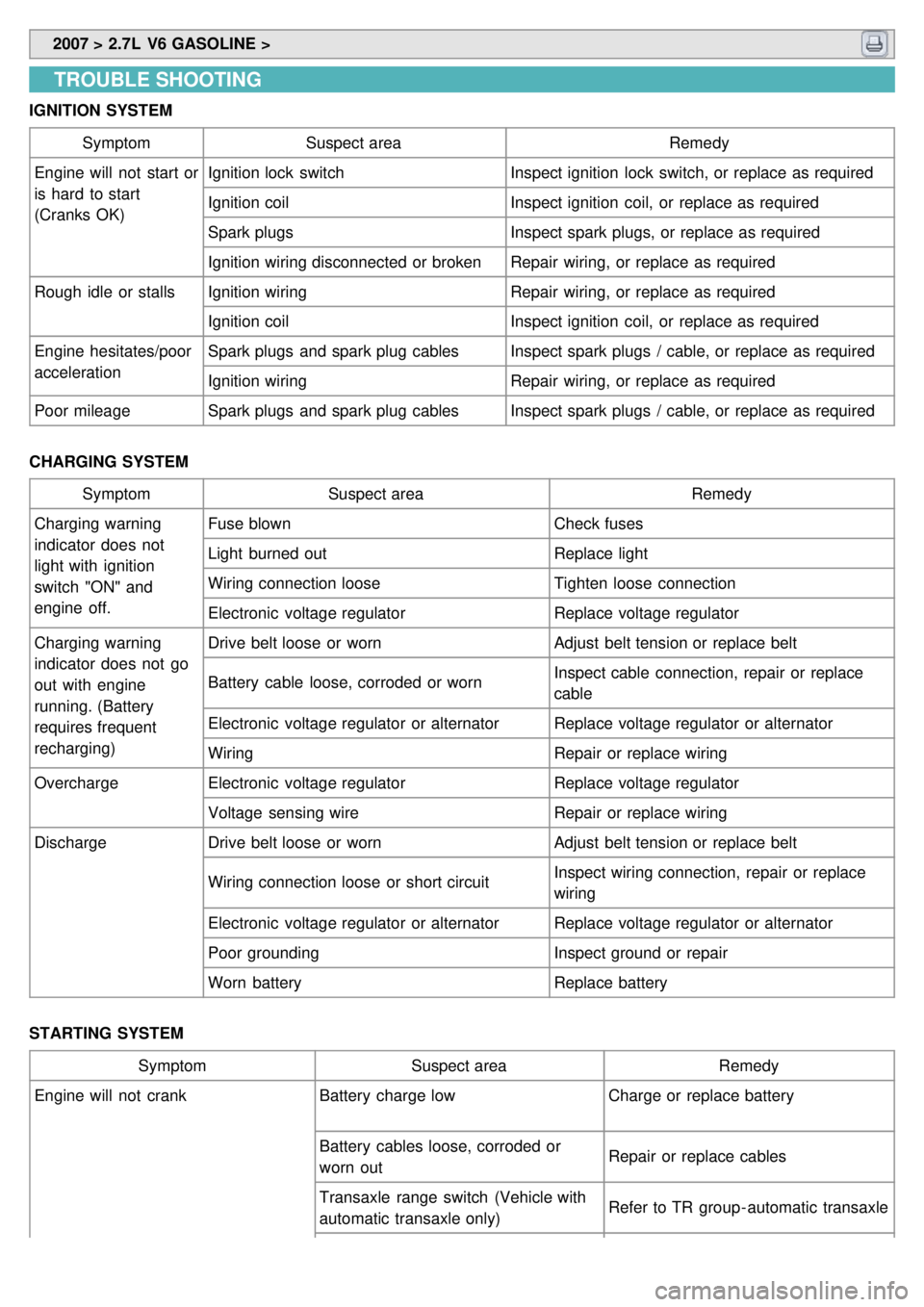
TROUBLE SHOOTING
IGNITION SYSTEM
Symptom Suspect area Remedy
Engine will not start or
is hard to start
(Cranks OK) Ignition lock switch
Inspect ignition lock switch, or replace as required
Ignition coil Inspect ignition coil, or replace as required
Spark plugs Inspect spark plugs, or replace as required
Ignition wiring disconnected or broken Repair wiring, or replace as required
Rough idle or stalls Ignition wiring Repair wiring, or replace as required
Ignition coil Inspect ignition coil, or replace as required
Engine hesitates/poor
acceleration Spark plugs and spark plug cables
Inspect spark plugs / cable, or replace as required
Ignition wiring Repair wiring, or replace as required
Poor mileage Spark plugs and spark plug cables Inspect spark plugs / cable, or replace as required
CHARGING SYSTEM Symptom Suspect area Remedy
Charging warning
indicator does not
light with ignition
switch "ON" and
engine off. Fuse blown
Check fuses
Light burned out Replace light
Wiring connection loose Tighten loose connection
Electronic voltage regulator Replace voltage regulator
Charging warning
indicator does not go
out with engine
running. (Battery
requires frequent
recharging) Drive belt loose or worn
Adjust belt tension or replace belt
Battery cable loose, corroded or worn Inspect cable connection, repair or replace
cable
Electronic voltage regulator or alternator Replace voltage regulator or alternator
Wiring Repair or replace wiring
Overcharge Electronic voltage regulator Replace voltage regulator
Voltage sensing wire Repair or replace wiring
Discharge Drive belt loose or worn Adjust belt tension or replace belt
Wiring connection loose or short circuit Inspect wiring connection, repair or replace
wiring
Electronic voltage regulator or alternator Replace voltage regulator or alternator
Poor grounding Inspect ground or repair
Worn battery Replace battery
STARTING SYSTEM Symptom Suspect area Remedy
Engine will not crank Battery charge low Charge or replace battery
Battery cables loose, corroded or
worn out Repair or replace cables
Transaxle range switch (Vehicle with
automatic transaxle only) Refer to TR group - automatic transaxle
Page 153 of 1575
2007 > 2.7L V6 GASOLINE >
DESCRITION
Ignition timing is controlled by the electronic control ignition timing system. The standard reference ignition timing data
for the engine operating conditions are preprogrammed in the memory of the ECM (Engine Control Module).
The engine operating conditions (speed, load, warm- up condition, etc.) are detected by the various sensors. Based on
these sensor signals and the ignition timing data, signals to interrupt the primary current are sent to the ECM. The
ignition coil is activated, and timing is controlled.
Page 154 of 1575
2007 > 2.7L V6 GASOLINE >
REMOVAL
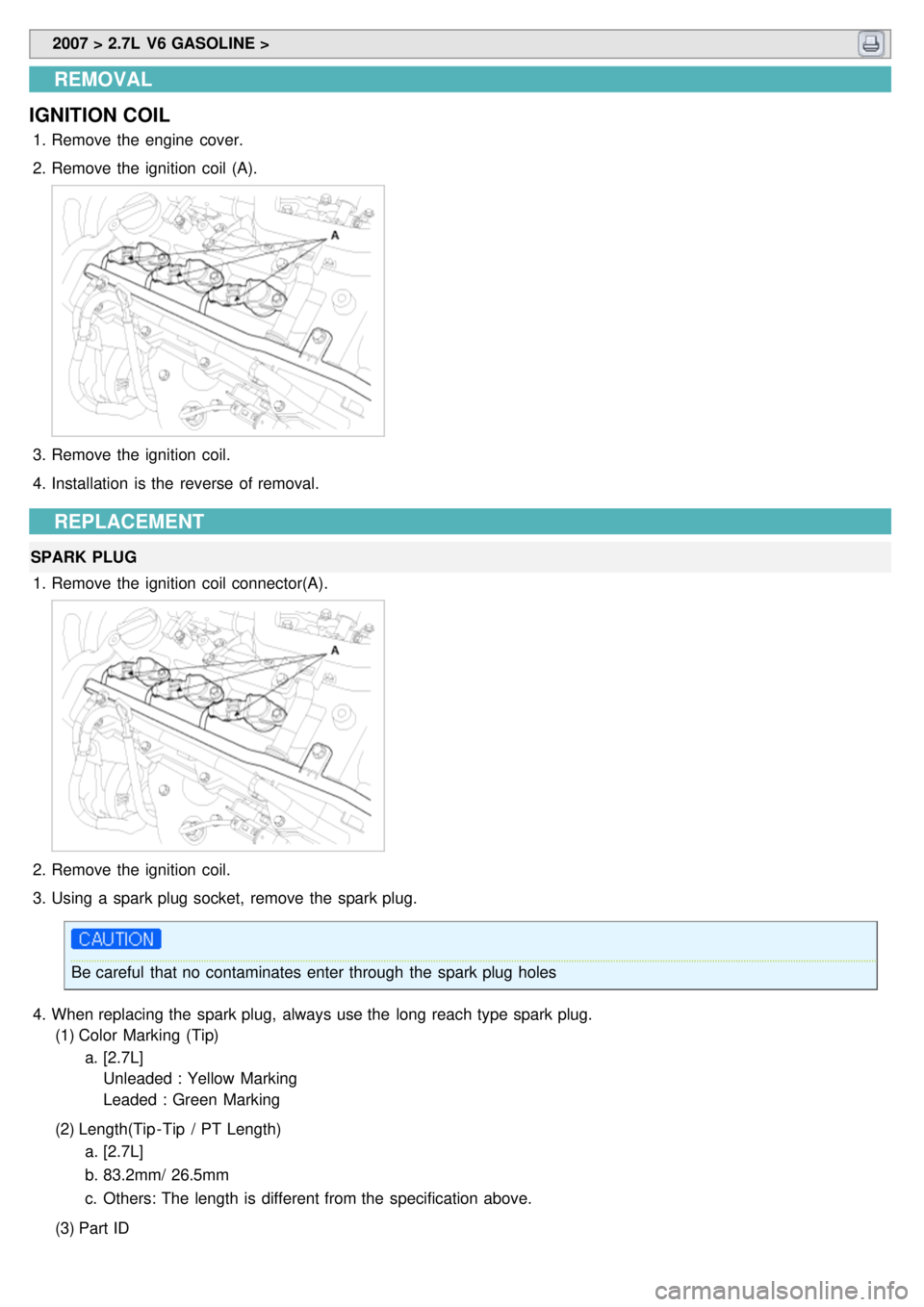
IGNITION COIL
1. Remove the engine cover.
2. Remove the ignition coil (A).
3.Remove the ignition coil.
4. Installation is the reverse of removal.
REPLACEMENT
SPARK PLUG
1. Remove the ignition coil connector(A).
2.Remove the ignition coil.
3. Using a spark plug socket, remove the spark plug.
Be careful that no contaminates enter through the spark plug holes
4. When replacing the spark plug, always use the long reach type spark plug.
(1) Color Marking (Tip)
a. [2.7L]
Unleaded : Yellow Marking
Leaded : Green Marking
(2) Length(Tip - Tip / PT Length)
a. [2.7L]
b. 83.2mm/ 26.5mm
c. Others: The length is different from the specification above.
(3) Part ID
Page 155 of 1575
![KIA CARNIVAL 2007 Owners Guide a.[U2.7]
L nleaded : ILFR5B11
Leaded : LFR5A
ON-VEHICLE INSPECTION
SPARK TEST
1. Remove the ignition coil connector(A).
Disconnect the iguition coil connector while pulling up tre connector](/img/2/57045/w960_57045-154.png "KIA CARNIVAL 2007 Owners Guide a.[U2.7]
L nleaded : ILFR5B11
Leaded : LFR5A
ON-VEHICLE INSPECTION
SPARK TEST
1. Remove the ignition coil connector(A).
Disconnect the iguition coil connector while pulling up tre connector")
a.[U2.7]
L nleaded : ILFR5B11
Leaded : LFR5A
ON-VEHICLE INSPECTION
SPARK TEST
1. Remove the ignition coil connector(A).
Disconnect the iguition coil connector while pulling up tre connector lock.
2. Remove the ignition coil.
3. Using a spark plug socket, remove the spark plug.
4. Install the spark plug to the ignition coil.
5. Ground the spark plug to the engine.
6.Check is spark occurs while engine is being cranked.
To prevent fuel being injected from injectors while the engine is being cranked, remove the fuel pump(A) relay
from the fuse box.
Crank the engine for no more than 5 ~ 10 seconds.
7. Inspect all the spark plugs.
8. Using a spark plug socket, install the spark plug.
9. Install the ignition coil.
10. Reconnect the ignition coil connector.
Page 175 of 1575
2007 > 2.7L V6 GASOLINE >
DESCRIPTION
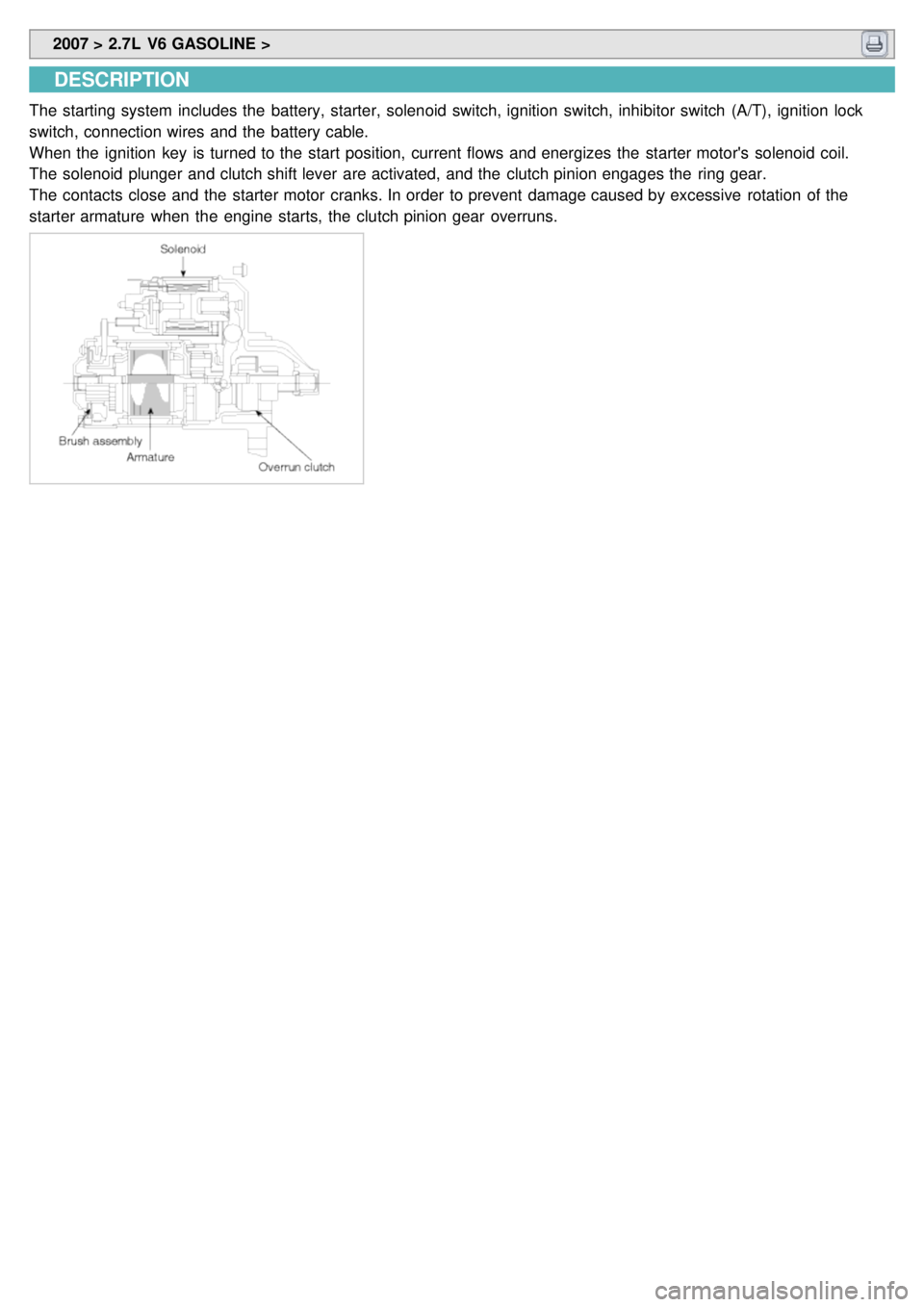
The starting system includes the battery, starter, solenoid switch, ignition switch, inhibitor switch (A/T), ignition lock
switch, connection wires and the battery cable.
When the ignition key is turned to the start position, current flows and energizes the starter motor's solenoid coil.
The solenoid plunger and clutch shift lever are activated, and the clutch pinion engages the ring gear.
The contacts close and the starter motor cranks. In order to prevent damage caused by excessive rotation of the
starter armature when the engine starts, the clutch pinion gear overruns.
Page 176 of 1575
2007 > 2.7L V6 GASOLINE >
STARTER CIRCUIT TROUBLESHOOTING
The battery must be in good condition and fully charged.
1. Remove the fuel pump relay(A) from the fuse box.
2. With the shift lever in N or P (A/T) or clutch pedal pressed (M/T), turn the ignition switch to "START"
If the starter normally cranks the engine, starting system is OK. If the starter will not crank the engine at all, go to
next step.
If it won't disengage from the ring gear when you release key, check for the following until you find the cause.
a. Solenoid plunger and switch malfunction.
b. Dirty pinion gear or damaged overrunning clutch.
3. Check the battery condition. Check electrical connections at the battery, battery negative cable connected to the
body, engine ground cables, and the starter for looseness and corrosion. Then try starting the engine again.
If the starter cranks normally the engine, repairing the loose connection repaired the problem. The starting system
is now OK.
If the starter still does not crank the engine, go to next step.
4. Disconnect the connector from the S- terminal of solenoid. Connect a jumper wire from the B- terminal of solenoid to
the S- terminal of solenoid.
If the starter cranks the engine, go to next step.
If the starter still does not crank the engine, remove the starter, and repair or replace as necessary.
5. Check the following items in the order listed until you find the open circuit.
a. Check the wire and connectors between the driver's under - dash fuse/relay box and the ignition switch, and
between the driver's under - dash fuse/relay box and the starter.
b. Check the ignition switch (Refer to BE group - ignition system)
c. Check the transaxle range switch connector or ignition lock switch connector.
d. Inspect the starter relay.
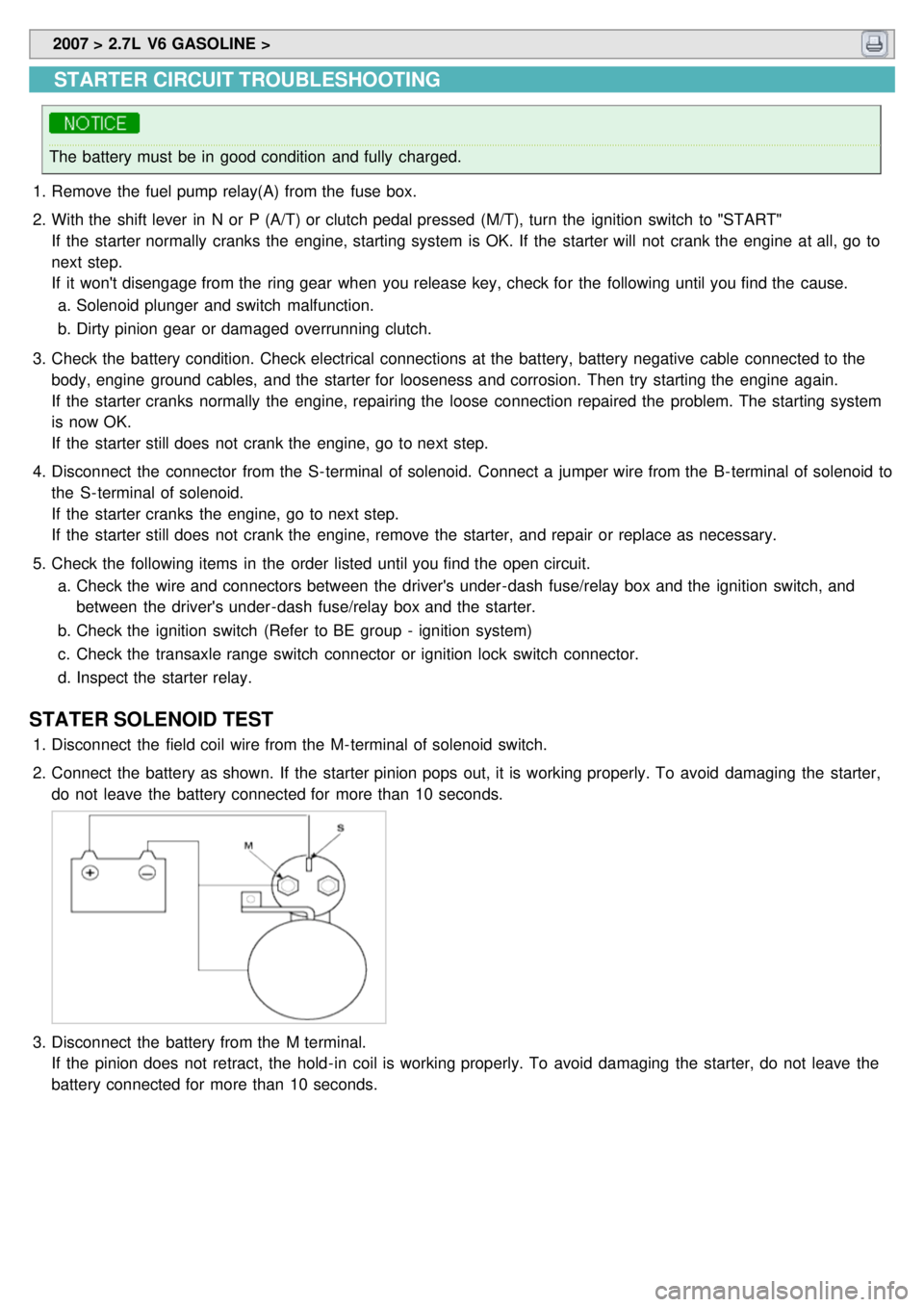
STATER SOLENOID TEST
1.Disconnect the field coil wire from the M- terminal of solenoid switch.
2. Connect the battery as shown. If the starter pinion pops out, it is working properly. To avoid damaging the starter,
do not leave the battery connected for more than 10 seconds.
3.Disconnect the battery from the M terminal.
If the pinion does not retract, the hold- in coil is working properly. To avoid damaging the starter, do not leave the
battery connected for more than 10 seconds.
Page 195 of 1575
2007 > 2.7L V6 GASOLINE >
TROUBLESHOOTING
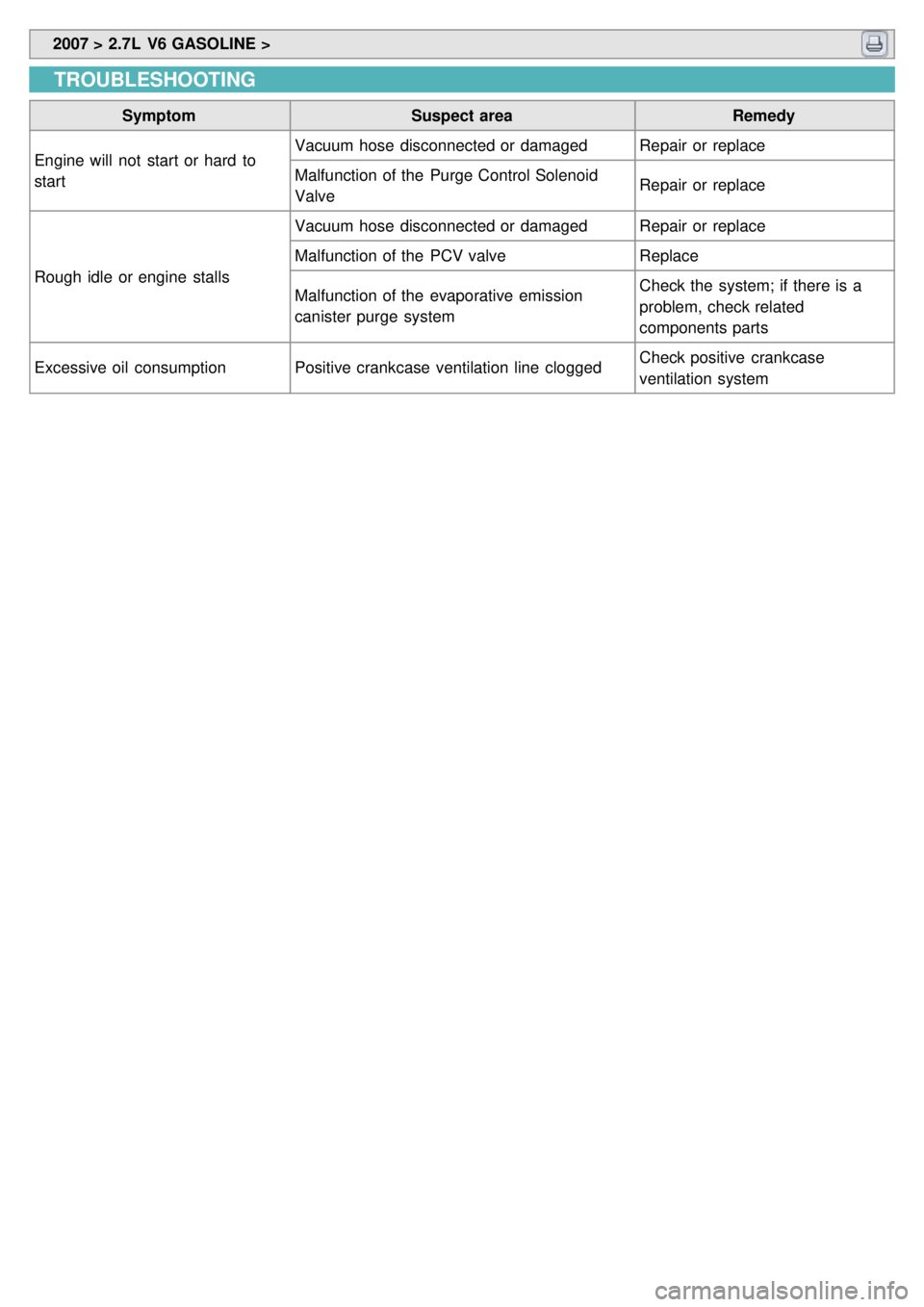
Symptom Suspect area Remedy
Engine will not start or hard to
start Vacuum hose disconnected or damaged
Repair or replace
Malfunction of the Purge Control Solenoid
Valve Repair or replace
Rough idle or engine stalls Vacuum hose disconnected or damaged
Repair or replace
Malfunction of the PCV valve Replace
Malfunction of the evaporative emission
canister purge system Check the system; if there is a
problem, check related
components parts
Excessive oil consumption Positive crankcase ventilation line clogged Check positive crankcase
ventilation system
Page 217 of 1575
2007 > 2.7L V6 GASOLINE >
DESCRIPTION
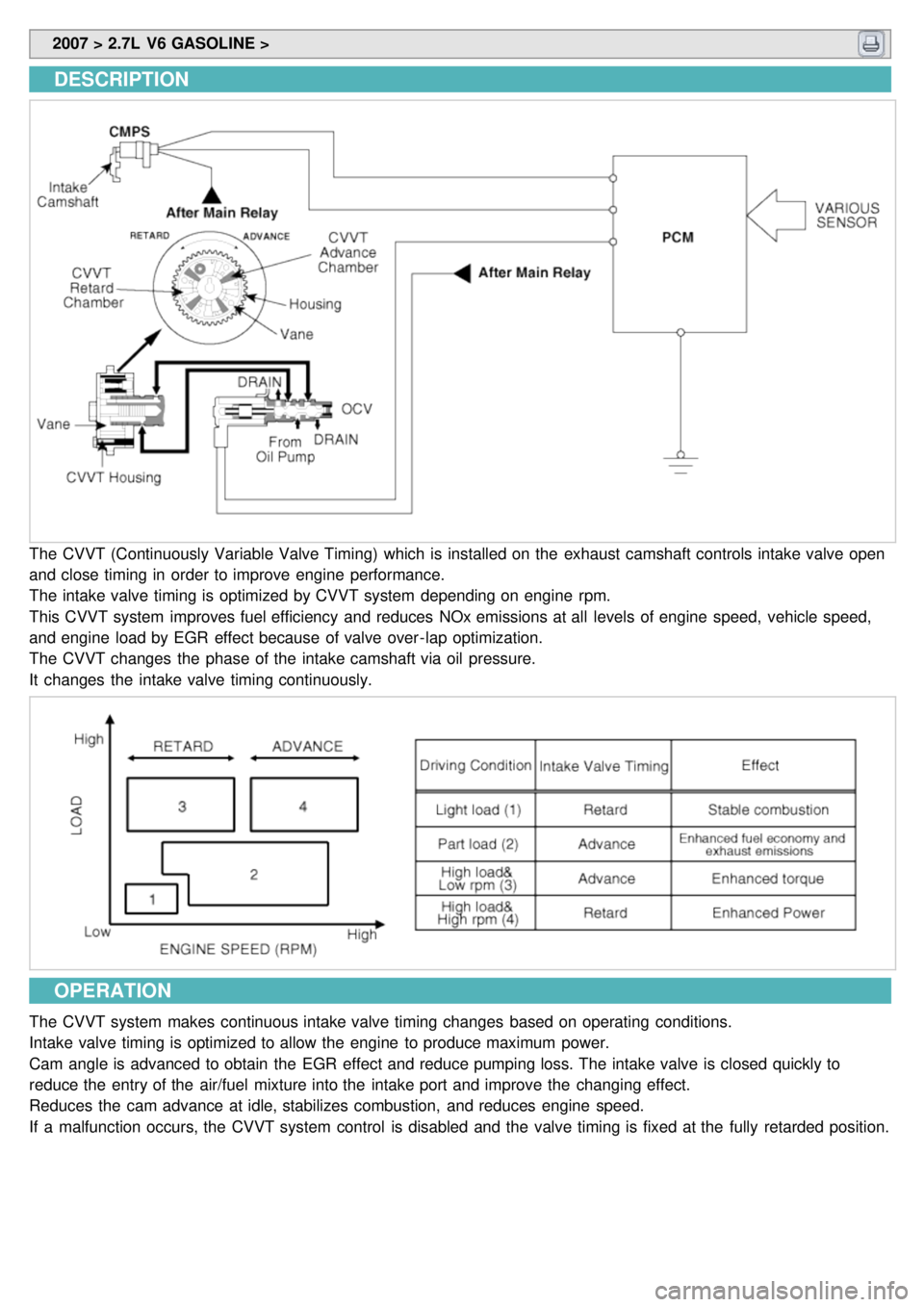
The CVVT (Continuously Variable Valve Timing) which is installed on the exhaust camshaft controls intake valve open
and close timing in order to improve engine performance.
The intake valve timing is optimized by CVVT system depending on engine rpm.
This CVVT system improves fuel efficiency and reduces NOx emissions at all levels of engine speed, vehicle speed,
and engine load by EGR effect because of valve over - lap optimization.
The CVVT changes the phase of the intake camshaft via oil pressure.
It changes the intake valve timing continuously.
OPERATION
The CVVT system makes continuous intake valve timing changes based on operating conditions.
Intake valve timing is optimized to allow the engine to produce maximum power.
Cam angle is advanced to obtain the EGR effect and reduce pumping loss. The intake valve is closed quickly to
reduce the entry of the air/fuel mixture into the intake port and improve the changing effect.
Reduces the cam advance at idle, stabilizes combustion, and reduces engine speed.
If a malfunction occurs, the CVVT system control is disabled and the valve timing is fixed at the fully retarded position.
Page 218 of 1575
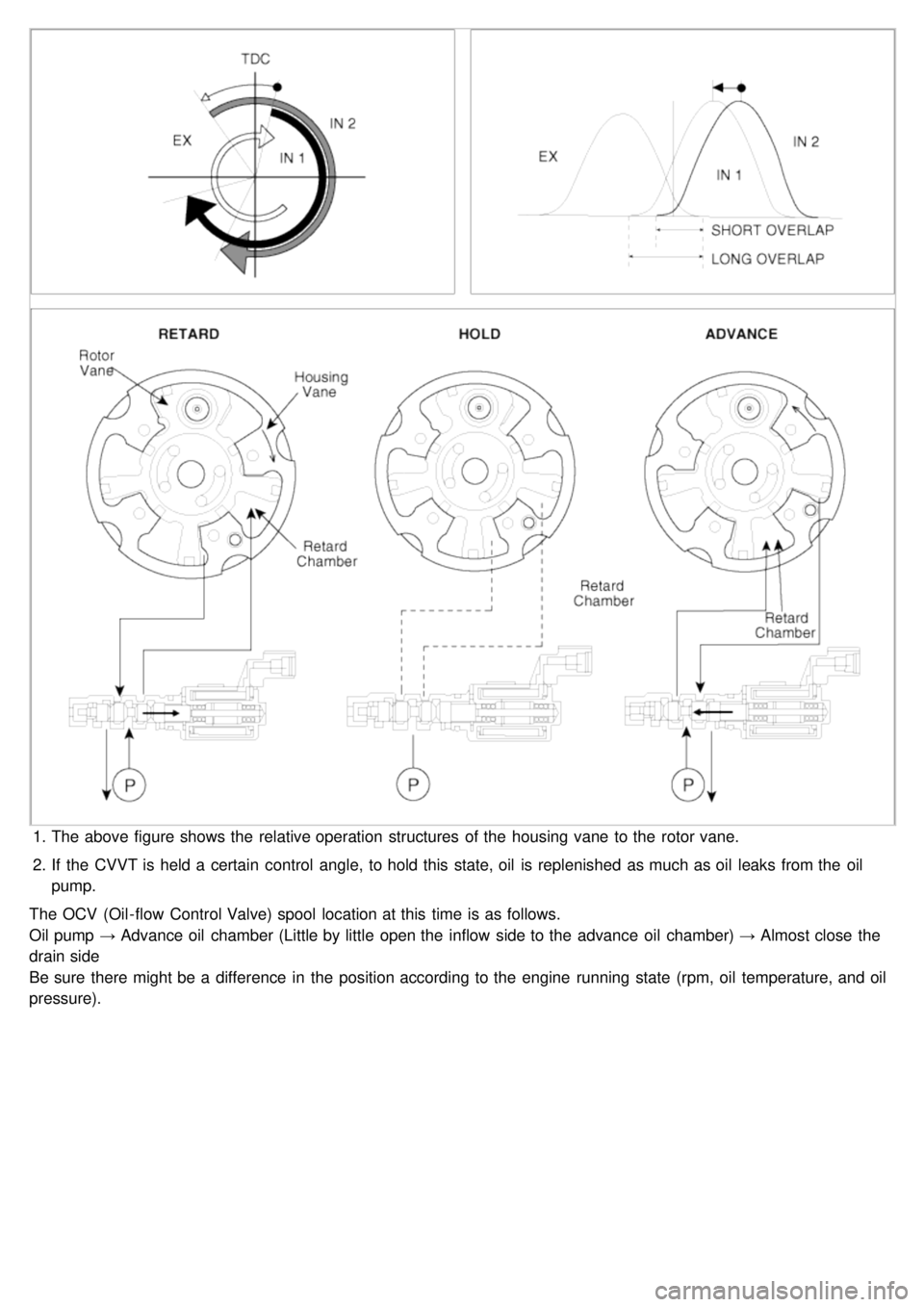
1.The above figure shows the relative operation structures of the housing vane to the rotor vane.
2. If the CVVT is held a certain control angle, to hold this state, oil is replenished as much as oil leaks from the oil
pump.
The OCV (Oil - flow Control Valve) spool location at this time is as follows.
Oil pump → Advance oil chamber (Little by little open the inflow side to the advance oil chamber) → Almost close the
drain side
Be sure there might be a difference in the position according to the engine running state (rpm, oil temperature, and oil
pressure).