oil pressure KIA CARNIVAL 2007 Service Manual
[x] Cancel search | Manufacturer: KIA, Model Year: 2007, Model line: CARNIVAL, Model: KIA CARNIVAL 2007Pages: 1575, PDF Size: 44.86 MB
Page 599 of 1575

2007 > 2.7L V6 GASOLINE >
REMOVAL
1.Remove the both front wheel & tire assemblies.
2. Drain the power steering fluid.
3. Remove the bolt (A) connecting steering column to universal joint.
Tightening torque Nm (kgf.m, lb - ft):
13 ~ 18 (1.3 ~ 1.8, 9.4 ~ 13.0)
4.Disconnect the pressure tube (A) from the power steering oil pump by loosening eye bolt.
Tightening torque Nm (kgf.m, lb - ft):
65 ~ 75 (6.5 ~ 7.5, 47 ~ 54)
[Diesel]
[Gasoline]
5.Disconnect the return hose (A)
Page 618 of 1575

2007 > 2.7L V6 GASOLINE >
REPLACEMENT
1.Drain the power steering fluid.
2. Disconnect the pressure tube (A) and suction tube (B) from the power steering oil pump.
Tightening torque Nm (kgf.m, lb - ft):
55 ~ 65 (4.5 ~ 5.5, 40 ~ 47)
[Diesel]
[Gasoline]
3.Disconnect the pressure tube (A) and return tube from the valve body housing.
Tightening torque Nm (kgf.m, lb - ft):
12 ~ 18 (1.2 ~ 1.8, 9 ~ 13)
4.Remove the brackets of the pressure tube and hose from the sub- frame.
Page 623 of 1575
2007 > 2.7L V6 GASOLINE >
REMOVAL
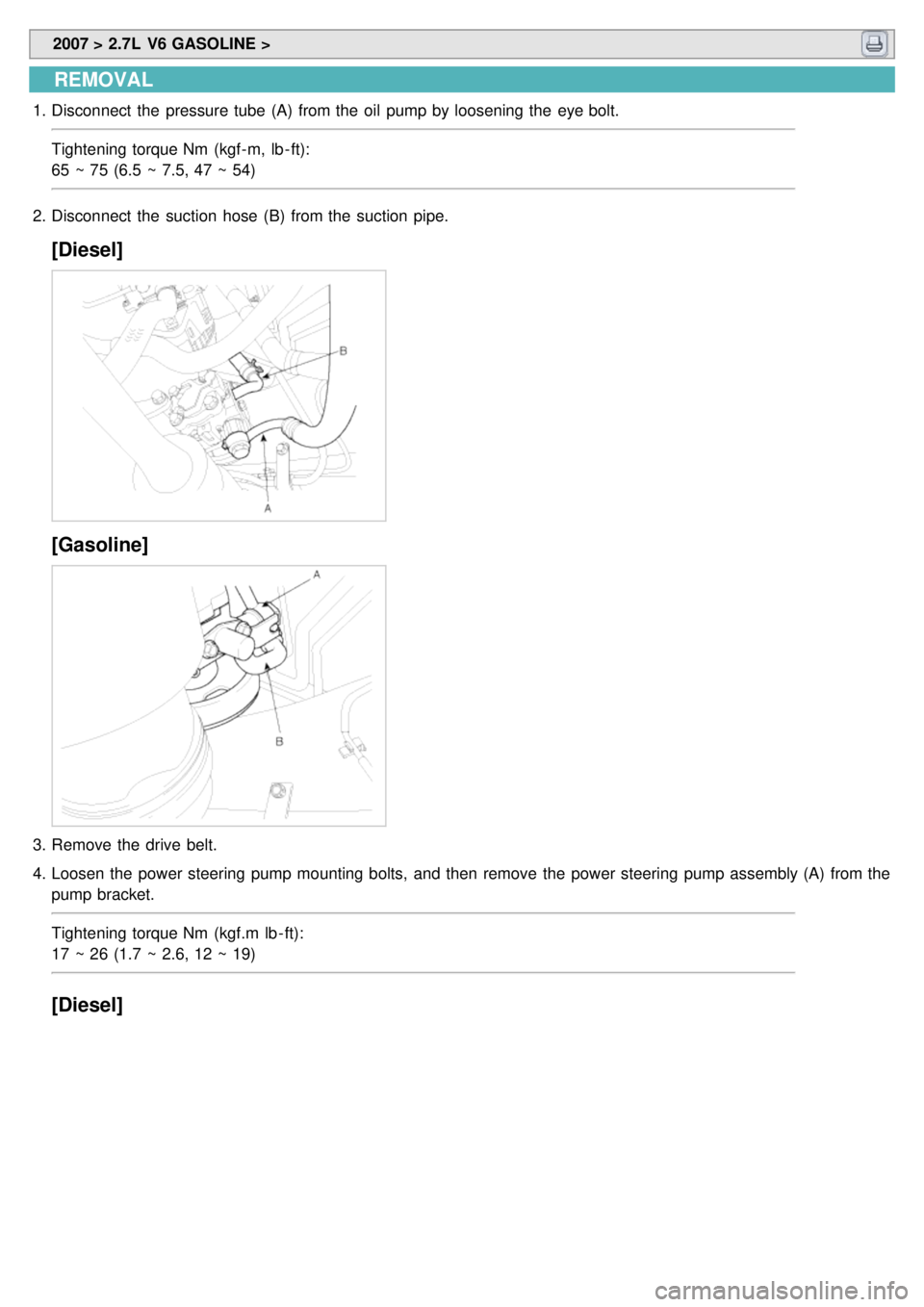
1.Disconnect the pressure tube (A) from the oil pump by loosening the eye bolt.
Tightening torque Nm (kgf- m, lb - ft):
65 ~ 75 (6.5 ~ 7.5, 47 ~ 54)
2. Disconnect the suction hose (B) from the suction pipe.
[Diesel]
[Gasoline]
3.Remove the drive belt.
4. Loosen the power steering pump mounting bolts, and then remove the power steering pump assembly (A) from the
pump bracket.
Tightening torque Nm (kgf.m lb - ft):
17 ~ 26 (1.7 ~ 2.6, 12 ~ 19)
[Diesel]
Page 625 of 1575
The pressure tube does not twist and come in contact with other components.
2. Add power steering fluid
3. Bleed the power steering system. (Refer to the air bleeding in ST group)
4. Check the oil pump pressure.
DISASSEMBLY
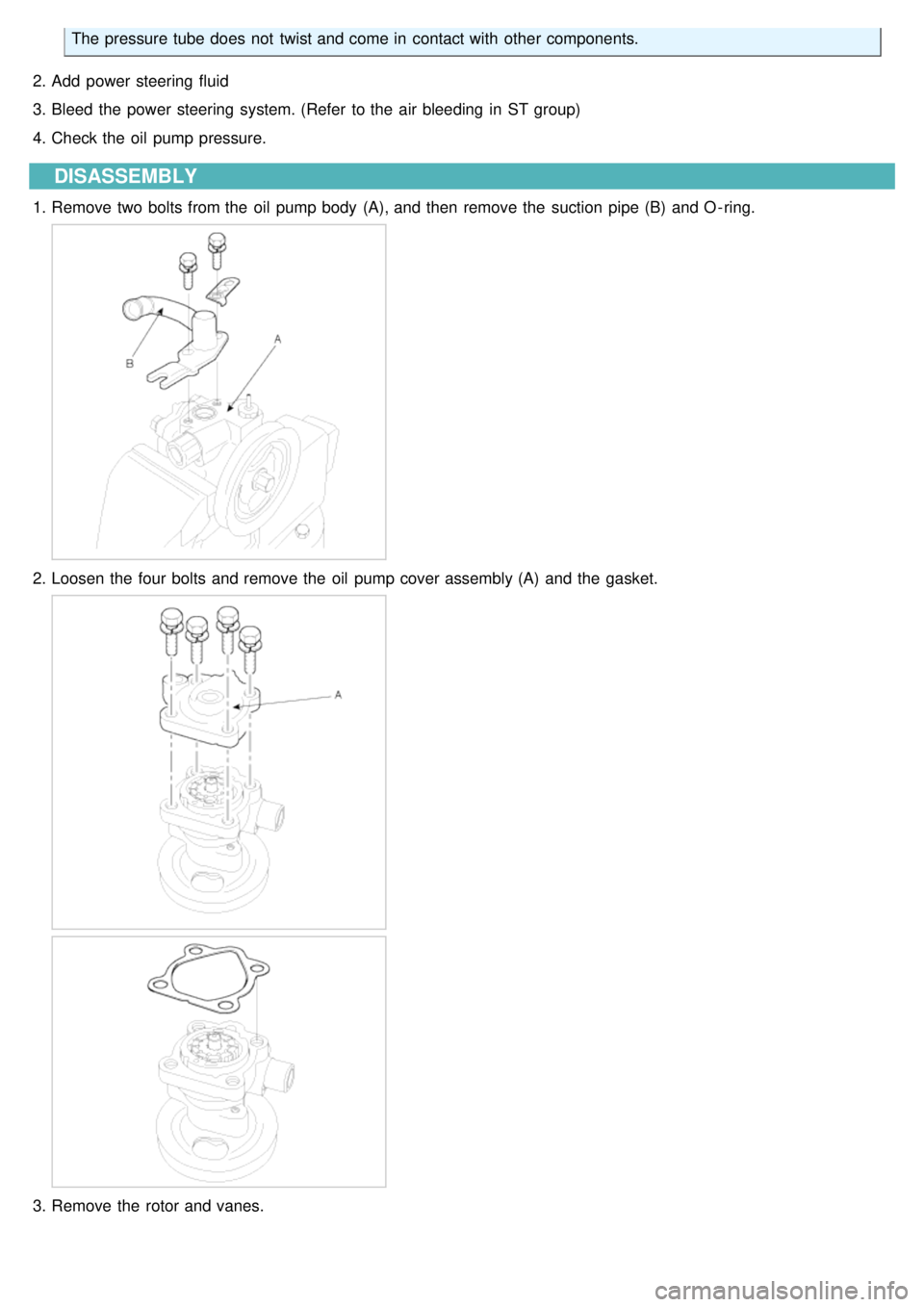
1.Remove two bolts from the oil pump body (A), and then remove the suction pipe (B) and O - ring.
2.Loosen the four bolts and remove the oil pump cover assembly (A) and the gasket.
3.Remove the rotor and vanes.
Page 647 of 1575
2007 > 2.7L V6 GASOLINE >
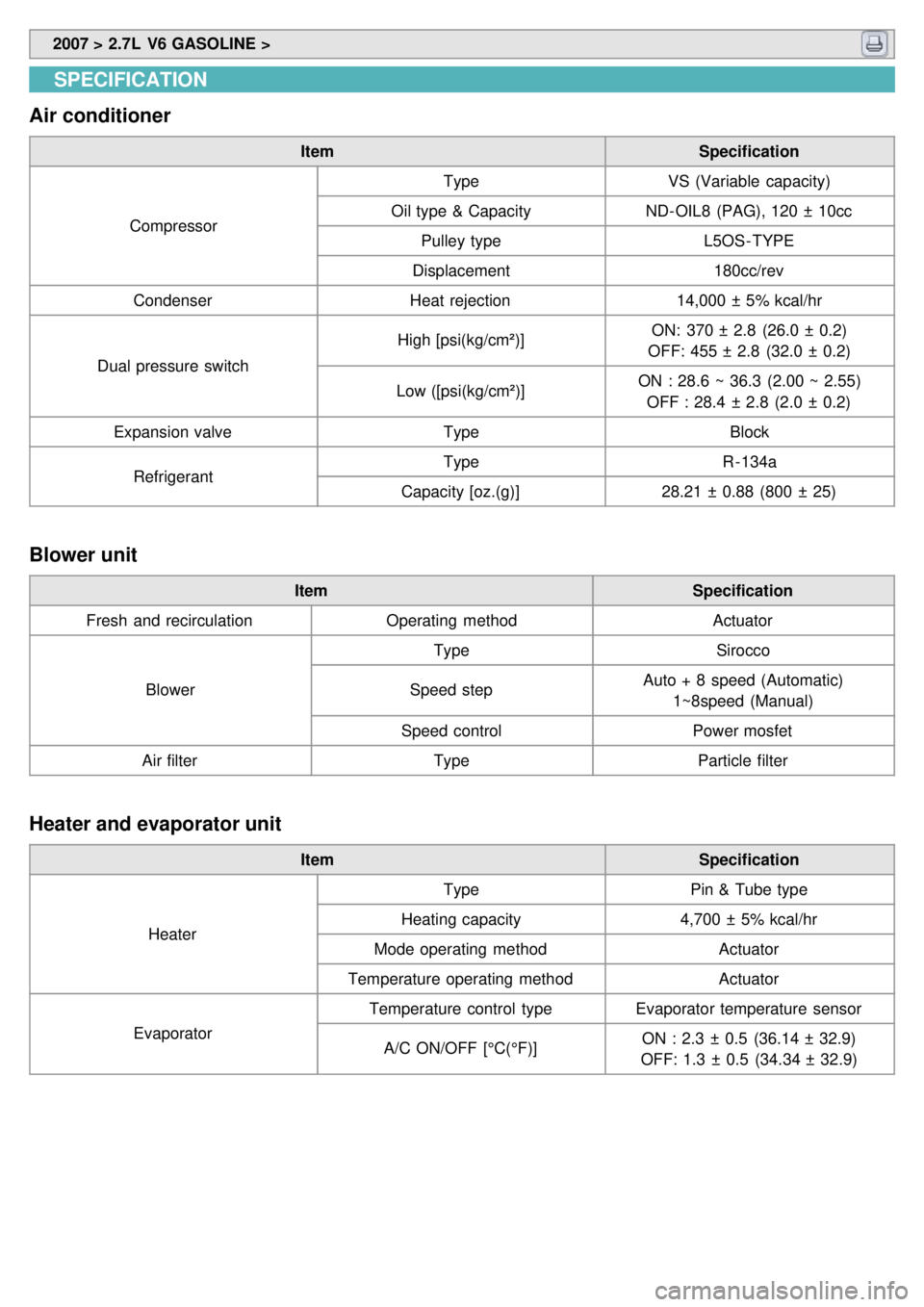
SPECIFICATION
Air conditioner
Item Specification
Compressor Type
VS (Variable capacity)
Oil type & Capacity ND- OIL8 (PAG), 120 ± 10cc
Pulley type L5OS - TYPE
Displacement 180cc/rev
Condenser Heat rejection14,000 ± 5% kcal/hr
Dual pressure switch High [psi(kg/cm²)]
ON: 370 ± 2.8 (26.0 ± 0.2)
OFF: 455 ± 2.8 (32.0 ± 0.2)
Low ([psi(kg/cm²)] ON : 28.6 ~ 36.3 (2.00 ~ 2.55)
OFF : 28.4 ± 2.8 (2.0 ± 0.2)
Expansion valve TypeBlock
Refrigerant Type
R- 134a
Capacity [oz.(g)] 28.21 ± 0.88 (800 ± 25)
Blower unit
Item Specification
Fresh and recirculation Operating method Actuator
Blower Type
Sirocco
Speed step Auto + 8 speed (Automatic)
1~8speed (Manual)
Speed control Power mosfet
Air filter TypeParticle filter
Heater and evaporator unit
Item Specification
Heater Type
Pin & Tube type
Heating capacity 4,700 ± 5% kcal/hr
Mode operating method Actuator
Temperature operating method Actuator
Evaporator Temperature control type
Evaporator temperature sensor
A/C ON/OFF [°C(°F)] ON : 2.3 ± 0.5 (36.14 ± 32.9)
OFF: 1.3 ± 0.5 (34.34 ± 32.9)
Page 654 of 1575
2007 > 2.7L V6 GASOLINE >
REFRIGERANT SYSTEM SERVICE BASICS
REFRIGERANT RECOVERY
Use only service equipment that is U.L - listed and is certified to meet the requirements of SAE J2210 to remove HFC-
134a(R- 134a) from the air conditioning system.
a. Air conditioning refrigerant or lubricant vapor can irritate your eyes, nose, or throat.
b. Be careful when connecting service equipment.
c. Do not breathe refrigerant or vapor.
If accidental system discharge occurs, ventilate work area before resuming service.
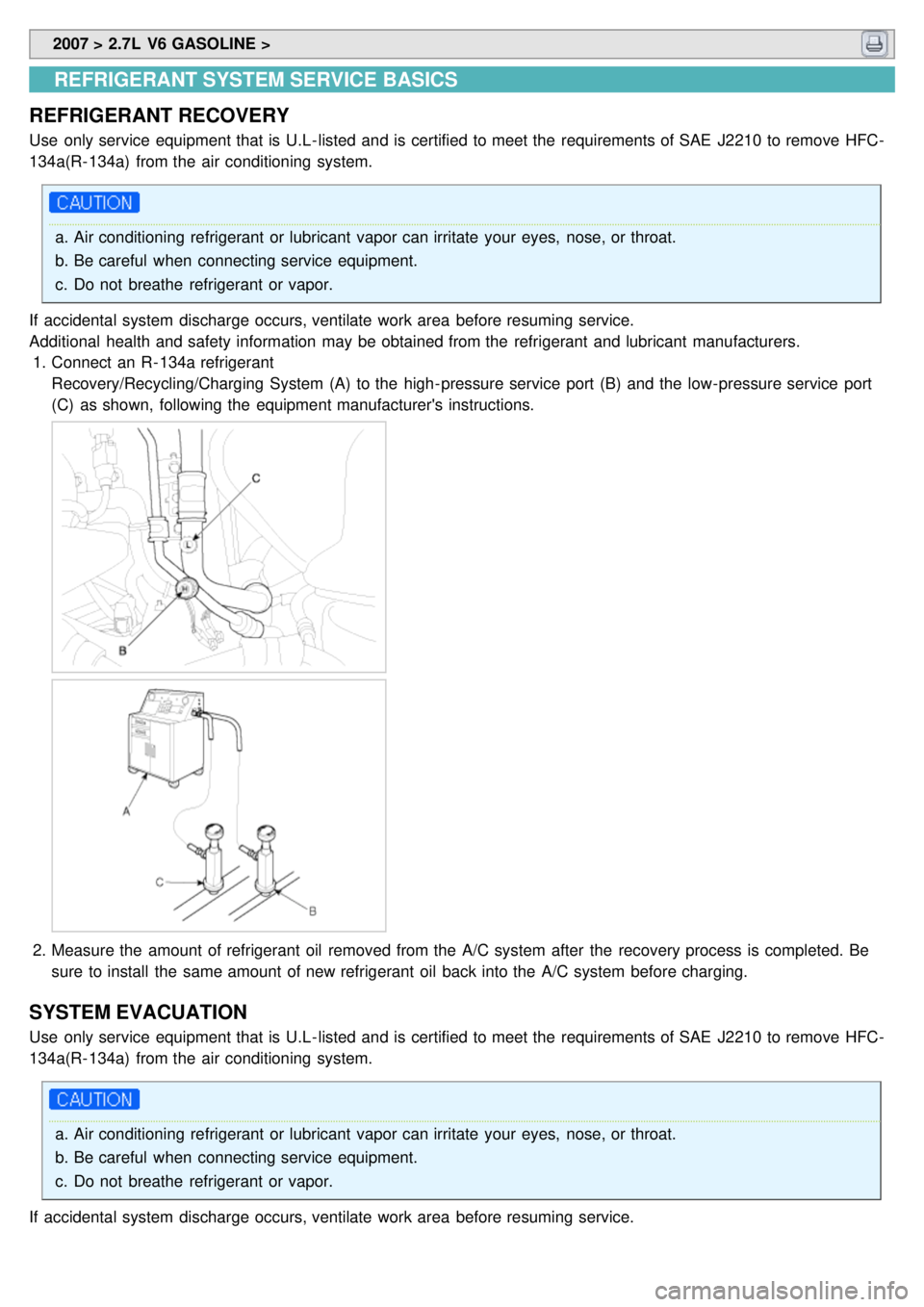
Additional health and safety information may be obtained from the refrigerant and lubricant manufacturers. 1. Connect an R- 134a refrigerant
Recovery/Recycling/Charging System (A) to the high- pressure service port (B) and the low- pressure service port
(C) as shown, following the equipment manufacturer's instructions.
2.Measure the amount of refrigerant oil removed from the A/C system after the recovery process is completed. Be
sure to install the same amount of new refrigerant oil back into the A/C system before charging.
SYSTEM EVACUATION
Use only service equipment that is U.L - listed and is certified to meet the requirements of SAE J2210 to remove HFC-
134a(R- 134a) from the air conditioning system.
a.Air conditioning refrigerant or lubricant vapor can irritate your eyes, nose, or throat.
b. Be careful when connecting service equipment.
c. Do not breathe refrigerant or vapor.
If accidental system discharge occurs, ventilate work area before resuming service.
Page 655 of 1575
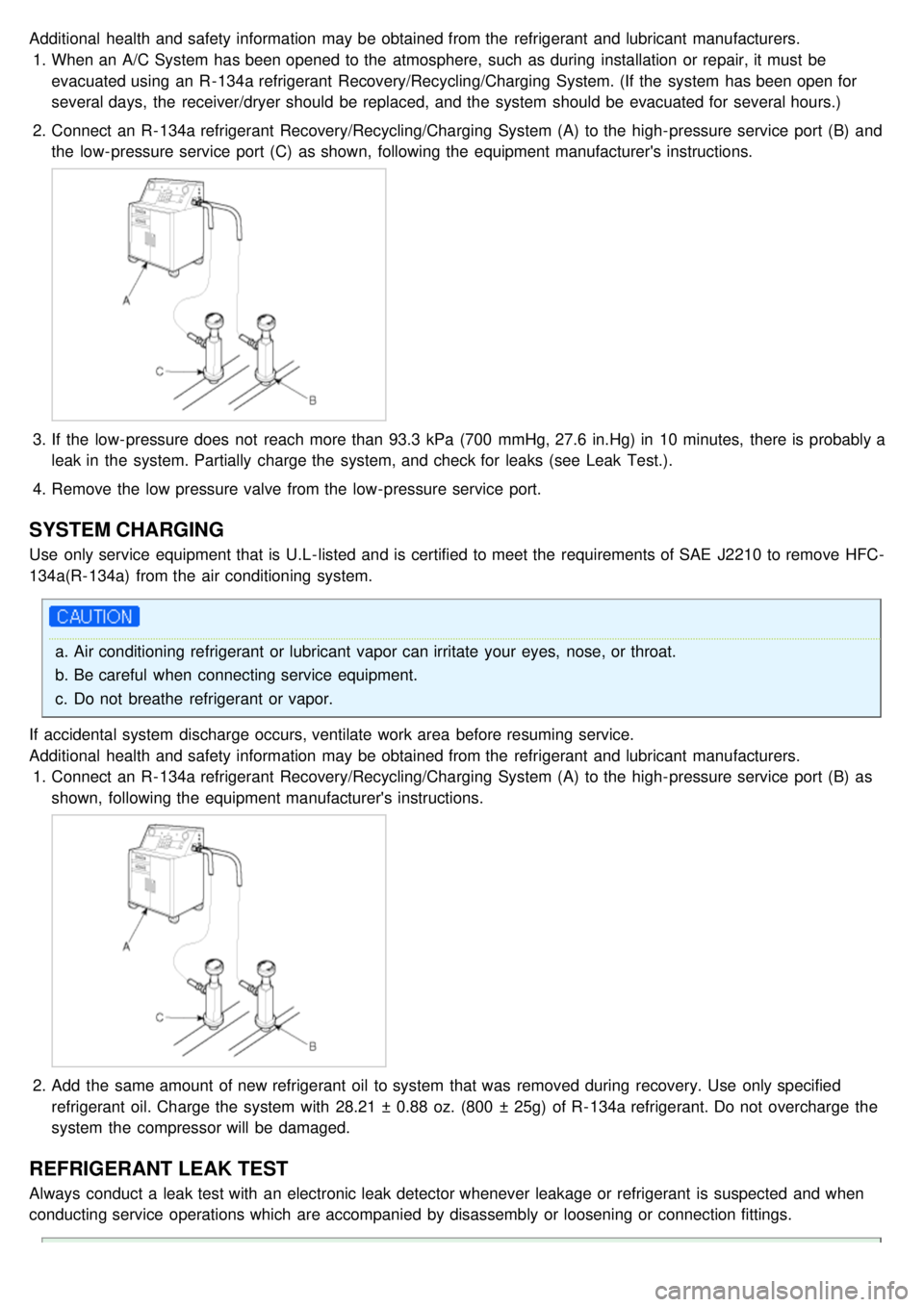
Additional health and safety information may be obtained from the refrigerant and lubricant manufacturers.1. When an A/C System has been opened to the atmosphere, such as during installation or repair, it must be
evacuated using an R- 134a refrigerant Recovery/Recycling/Charging System. (If the system has been open for
several days, the receiver/dryer should be replaced, and the system should be evacuated for several hours.)
2. Connect an R- 134a refrigerant Recovery/Recycling/Charging System (A) to the high- pressure service port (B) and
the low- pressure service port (C) as shown, following the equipment manufacturer's instructions.
3.If the low- pressure does not reach more than 93.3 kPa (700 mmHg, 27.6 in.Hg) in 10 minutes, there is probably a
leak in the system. Partially charge the system, and check for leaks (see Leak Test.).
4. Remove the low pressure valve from the low- pressure service port.
SYSTEM CHARGING
Use only service equipment that is U.L - listed and is certified to meet the requirements of SAE J2210 to remove HFC-
134a(R- 134a) from the air conditioning system.
a.Air conditioning refrigerant or lubricant vapor can irritate your eyes, nose, or throat.
b. Be careful when connecting service equipment.
c. Do not breathe refrigerant or vapor.
If accidental system discharge occurs, ventilate work area before resuming service.
Additional health and safety information may be obtained from the refrigerant and lubricant manufacturers. 1. Connect an R- 134a refrigerant Recovery/Recycling/Charging System (A) to the high- pressure service port (B) as
shown, following the equipment manufacturer's instructions.
2.Add the same amount of new refrigerant oil to system that was removed during recovery. Use only specified
refrigerant oil. Charge the system with 28.21 ± 0.88 oz. (800 ± 25g) of R- 134a refrigerant. Do not overcharge the
system the compressor will be damaged.
REFRIGERANT LEAK TEST
Always conduct a leak test with an electronic leak detector whenever leakage or refrigerant is suspected and when
conducting service operations which are accompanied by disassembly or loosening or connection fittings.
Page 928 of 1575

2007 > 2.7L V6 GASOLINE >
DESCRIPTION
This specification applies to HCU(Hydraulic Control Unit) and ECU(Electronic Control Unit) of the HECU.(Hydraulic and
Electronic Control Unit)
This specification is for the wiring design and installation of ABS/TCS/ESC ECU.
This unit has the functions as follows.
a. Input of signal from Pressure sensor, Steering angle sensor, Yaw & Lateral G sensor, the wheel speed sensors
attached to each wheel.
b. Control of braking force / traction force/ yaw moment.
c. Failsafe function.
d. Self diagnosis function.
e. Interface with the external diagnosis tester.
Installation position : engine compartment a. Brake tube length from Master cylinder port to HECU inlet port should be max. 1m
b. The position should not be close to the engine block and not lower than the wheel.
OPERATION
The ECU shall be put into operation by switching on the operating voltage (IGN).
On completion of the initialization phase, the ECU shall be ready for operation.
In the operating condition, the ECU shall be ready, within the specified limits (voltage and temperature), to process the
signals offered by the various sensors and switches in accordance with the control algorithm defined by the software
and to control the hydraulic and electrical actuators.
Wheel Sensor signal processing
The ECU shall receive wheel speed signal from the four active wheel sensors.
The wheel signals are converted to voltage signal by the signal conditioning circuit after receiving current signal from
active wheel sensors and given as input to the MCU.
Solenoid Valve Control
When one side of the valve coil is connected to the positive voltage that is provided through the valve relay and the
other side is connected to the ground by the semiconductor circuit, the solenoid valve goes into operation.
The electrical function of the coils are always monitored by the valve test pulse under normal operation conditions.
Voltage limits
a.Overvoltage
When overvoltage is detected(above 16.8 V), the ECU switches off the valve relay and shuts down the system.
When voltage is returned to operating range, the system goes back to the normal condition after the initialization
phase.
b. Undervoltage
In the event of undervoltage(below 9.3 V), ABS control shall be inhibited and the warning lamp shall be turned on.
When voltage is returned to operating range, the warning lamp is switched off and ECU returns to normal operating
mode.
Pump Motor Checking
The ECU performs a pump motor test at a speed of 15km/h once after IGN is switched on.
Diagnostic Interface
Failures detected by the ECU are encoded on the ECU, stored in a EEPROM and read out by diagnostic equipment
when the ignition switch is turned on.
The diagnosis interface can also be used for testing the ECU during production of the ECU and for actuating the HCU
(Air - bleeding line or Roll and Brake Test line).
Warning Lamp module
Page 1227 of 1575

Easy Access
1.Description
The easy access function permits automatic rearward movement of the driver seat when the key is removed from
the cylinder. Automatic forward movement of the driver seat will take place when the key is inserted into the
cylinder. This function will be enabled on IMS equipped vehicles when the AUTO button is pressed.
Inhibit Switch should be in P- Position for the Easy Access operation.
2. Functional Diagram
Driver Information
Cluster Indicators
1.The instument cluster indicators listed below are controlled by the In- Panel Module (IPM), Front Area Module
(FAM), or Rear Area Module (RAM) as applicable.
These indicators are:
a. Gearbox status
b. Oil pressure
c. Sediment fuel filter
d. Vacuum
e. Brake fluid
f. Washer fluid
g. Seat belt
h. Park brake
i. Charging voltage
j. Turn indicators
k. High beam
l. Front fog
m. Doors open
n. Tailgate open
o. Stop lamp failure front and rear
2. Functional Diagram
Page 1228 of 1575

Gearbox Status
The status of the gearbox is sent on the CAN network when the CAN network is available.
Oil Pressure Switch Status
The status of the oil pressure switch is sent on the CAN network when the CAN network is available.
Fuel Filter Status
The FAM receives on digital input the status of the fuel filter (Fuel Filter Input) and sends it (Fuel filter switch) on the
CAN network.
Washer Fluid Sensor Status
The FAM receives on digital input the status of the washer fluid sensor and sends it on the CAN network.
If Washer Fluid Low Input is LOW for more than 10 sec, FAM sends the warning message.
Seat Belt Warning Status
The IPM receives on digital input the status of the seat belt switch and sends the seat belt warning on the CAN
network.
If the Ignition switch status is in RUN or START when the Seat Belt Sw Input is FASTENED, the seat belt warning
indicator is blinking for 6 seconds.
When Seat Belt switch Input is NOT FASTENED, the seat belt warning indicator is blinking for 6 seconds.
If the Seat Belt switch Input is FASTENED during the 6 seconds, the seat belt warning indicator is blinking till the end
of the 6 seconds.
In North America:
the seat belt warning indicator is blinking when Ignition switch is on the status RUN or START and Seat Belt Sw Input
is NOT FASTENED.
Parking Brake Indicator
The indicator manages 3 functions: brake fluid sensor, parking brake warning and vacuum switch.
The vacuum function is available for diesel engine only
The FAM receives on digital input the status of the vacuum switch and the ABS EBD warning and sends them on the
CAN network.
The status of the vacuum switch and the ABS EBD warning are sent on the CAN network when the CAN network is
available.
The FAM receives on digital input the status of the brake fluid sensor and sends it on the CAN network.
The status of the brake fluid sensor is sent on the CAN network when the CAN network is available.
The IPM receives on digital input the status of the parking brake switch and by CAN network the status of the vacuum
switch, the status of the ABS EBD warning, the status of the brake fluid sensor and the speed of the vehicle.