battery KIA CERATO 2004 Owner's Manual
[x] Cancel search | Manufacturer: KIA, Model Year: 2004, Model line: CERATO, Model: KIA CERATO 2004Pages: 315, PDF Size: 68.16 MB
Page 229 of 315
69
In case of an emergency
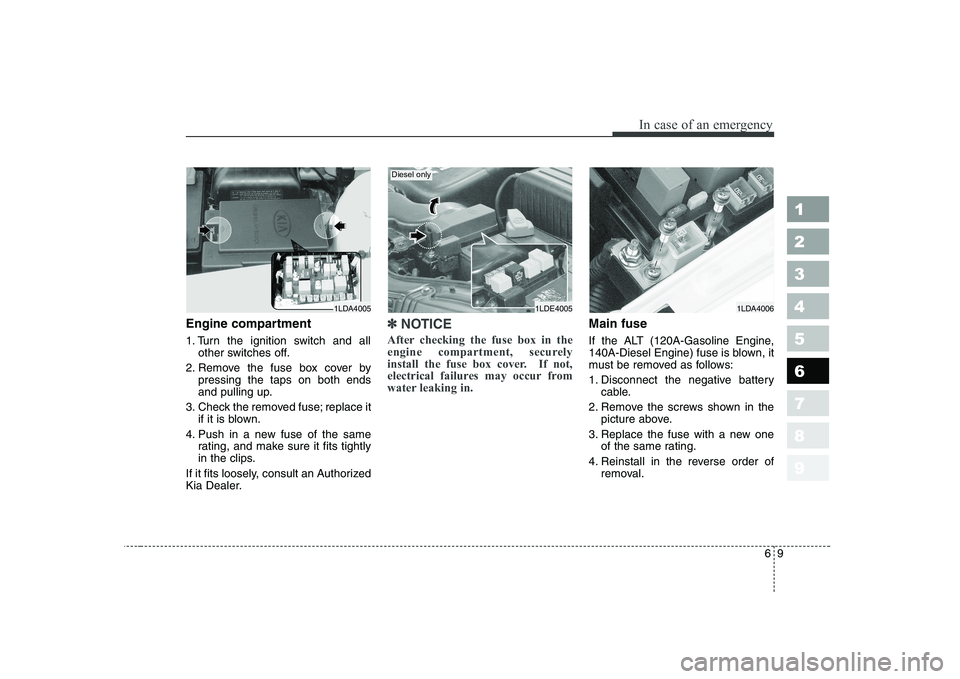
Engine compartment
1. Turn the ignition switch and allother switches off.
2. Remove the fuse box cover by pressing the taps on both ends
and pulling up.
3. Check the removed fuse; replace it if it is blown.
4. Push in a new fuse of the same rating, and make sure it fits tightly
in the clips.
If it fits loosely, consult an Authorized
Kia Dealer.✽✽ NOTICE
After checking the fuse box in the
engine compartment, securely
install the fuse box cover. If not,
electrical failures may occur from
water leaking in.Main fuse
If the ALT (120A-Gasoline Engine,
140A-Diesel Engine) fuse is blown, it
must be removed as follows:
1. Disconnect the negative battery cable.
2. Remove the screws shown in the picture above.
3. Replace the fuse with a new one of the same rating.
4. Reinstall in the reverse order of removal.
1 23456789
1LDA40051LDE40051LDA4006
Diesel only
Page 233 of 315
613
In case of an emergency
1 23456789
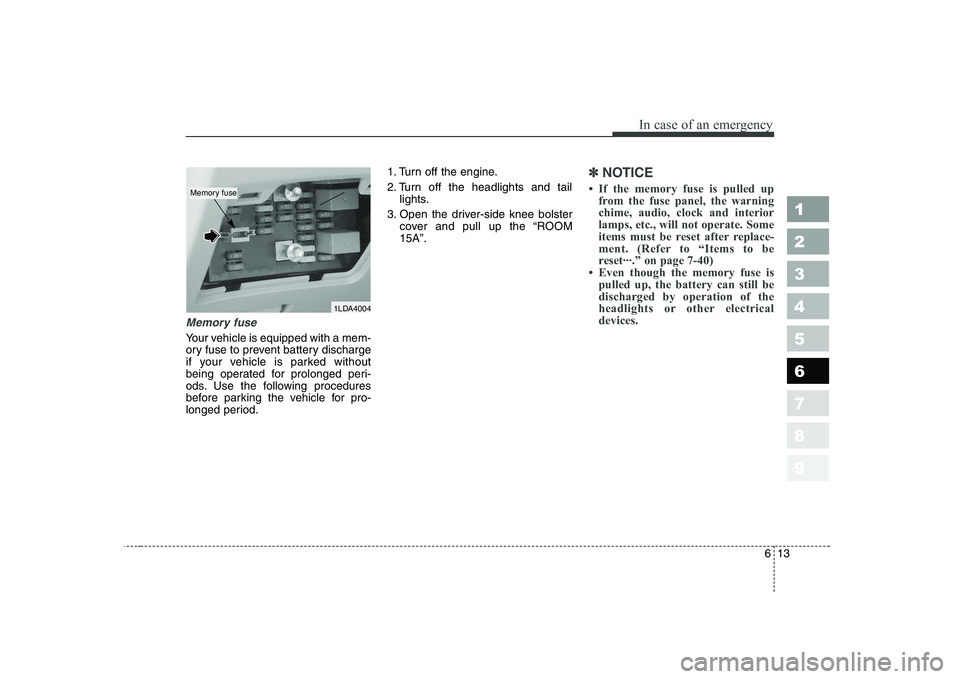
Memory fuse
Your vehicle is equipped with a mem-
ory fuse to prevent battery discharge
if your vehicle is parked without
being operated for prolonged peri-
ods. Use the following procedures
before parking the vehicle for pro-
longed period.1. Turn off the engine.
2. Turn off the headlights and tail
lights.
3. Open the driver-side knee bolster cover and pull up the “ROOM 15A”.
✽✽ NOTICE
Page 247 of 315
1 23456789Battery / 7-39
Tires and wheels / 7-42
Bulb replacement / 7-49
Lubricant specifications / 7-56 Exterior care / 7-58Interior care / 7-62
Maintenance
1 23456789
Page 251 of 315
1 23456789
Maintenance
6
7
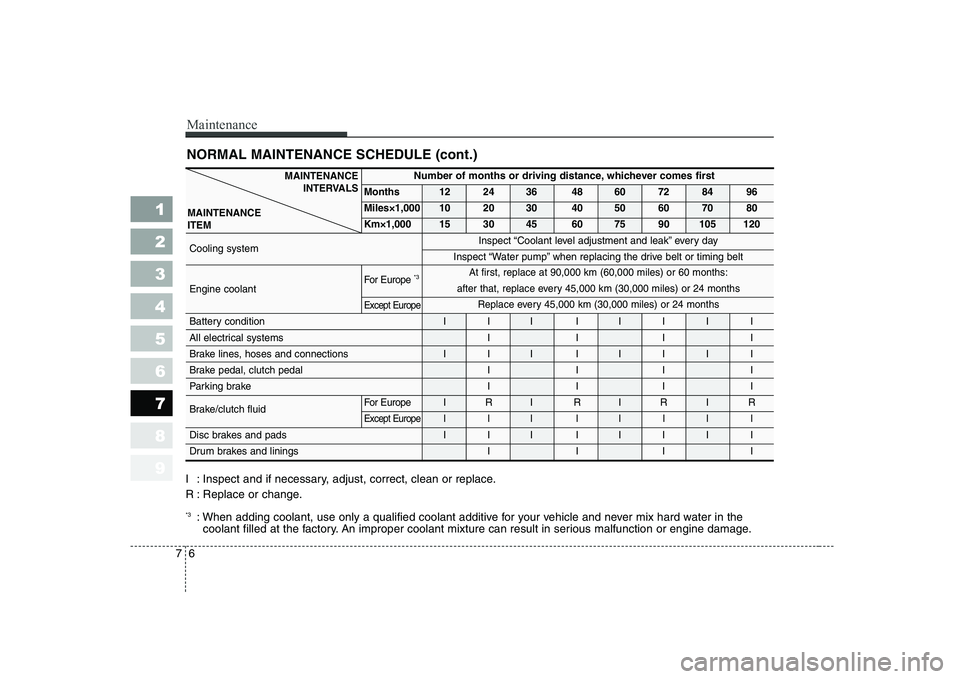
NORMAL MAINTENANCE SCHEDULE (cont.)
I : Inspect and if necessary, adjust, correct, clean or replace.
R : Replace or change. *3
: When adding coolant, use only a qualified coolant additive for your vehicle and never mix hard water in the
coolant filled at the factory. An improper coolant mixture can result in serious malfunction or engine damage.
MAINTENANCE
INTERVALS
MAINTENANCE ITEMNumber of months or driving distance, whichever comes first
Months 12 24 36 48 60 72 84 96
Miles×1,000 10 20 30 40 50 60 70 80
Km×1,000 15 30 45 60 75 90 105 120
Cooling system
For Europe *3
Engine coolant
Except Europe
Battery condition I I I I I I I I
All electrical systems I I I I
Brake lines, hoses and connections I I I I I I I I
Brake pedal, clutch pedal I I I I
Parking brake I I I I
Brake/clutch fluid
For EuropeIRI RIRIR
Except Europe I I I I I I I I
Disc brakes and pads I I I I I I I I
Drum brakes and linings I I I I
Inspect “Coolant level adjustment and leak” every day
Inspect “Water pump” when replacing the drive belt or timing belt
At first, replace at 90,000 km (60,000 miles) or 60 months:
after that, replace every 45,000 km (30,000 miles) or 24 months Replace every 45,000 km (30,000 miles) or 24 months
Page 256 of 315
711
Maintenance
1 23456789
At least monthly:
Check coolant level in the coolantrecovery reservoir.
Check the operation of all exterior lights, including the stoplights, turn
signals and hazard warning flash-
ers.
Check the inflation pressures of all tires including the spare.
At least twice a year
(i.e., every Spring and Fall) :
Check radiator, heater and air con- ditioning hoses for leaks or da-
mage.
Check windshield washer spray and wiper operation. Clean wiper
blades with clean cloth dampened
with washer fluid.
Check headlight alignment.
Check muffler, exhaust pipes, shields and clamps.
Check the lap/shoulder belts for wear and function.
Check for worn tires and loose wheel lug nuts.
At least once a year :
Clean body and door drain holes.
Lubricate door hinges and checks,and hood hinges.
Lubricate door and hood locks and latches.
Lubricate door rubber weather- strips.
Check the air conditioning system before the warm weather season.
Check the power steering fluid level.
Inspect and lubricate automatic transaxle linkage and controls.
Clean battery and terminals.
Check the brake fluid level.
Page 258 of 315
713
Maintenance
1 23456789
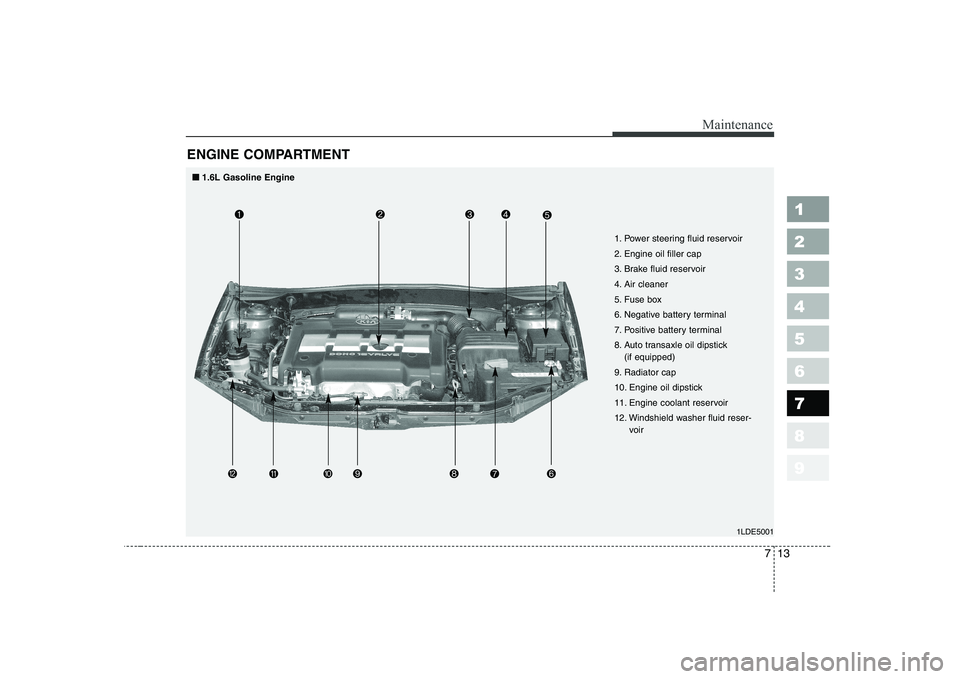
ENGINE COMPARTMENT
1LDE5001
1. Power steering fluid reservoir
2. Engine oil filler cap
3. Brake fluid reservoir
4. Air cleaner
5. Fuse box
6. Negative battery terminal
7. Positive battery terminal
8. Auto transaxle oil dipstick
(if equipped)
9. Radiator cap
10. Engine oil dipstick
11. Engine coolant reservoir
12. Windshield washer fluid reser- voir
■■1.6L Gasoline Engine
Page 259 of 315
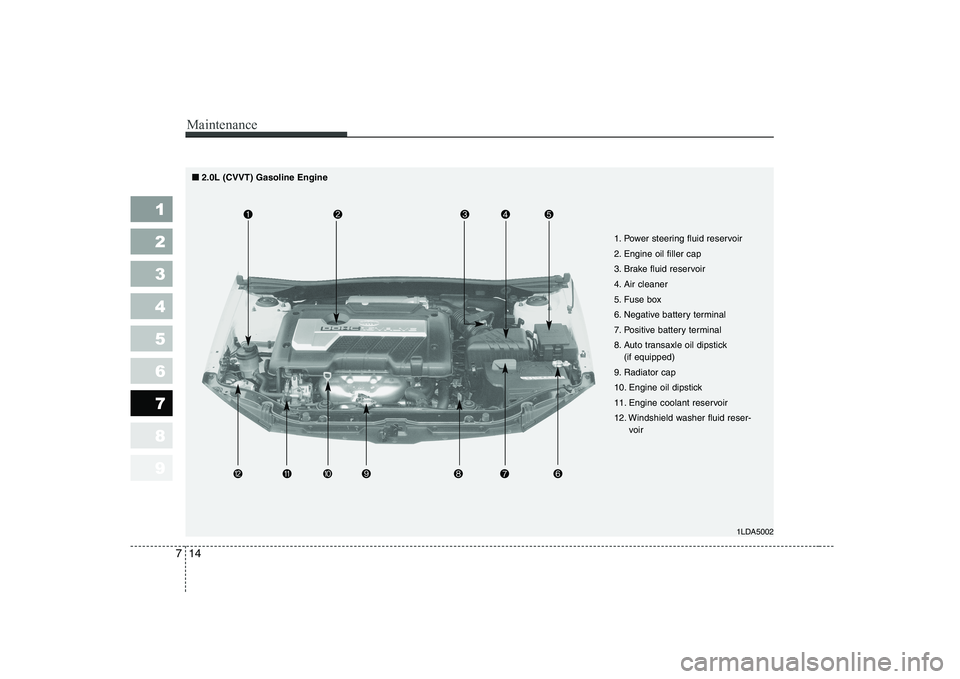
1LDA5002
Maintenance
14
7
1 23456789
1. Power steering fluid reservoir
2. Engine oil filler cap
3. Brake fluid reservoir
4. Air cleaner
5. Fuse box
6. Negative battery terminal
7. Positive battery terminal
8. Auto transaxle oil dipstick
(if equipped)
9. Radiator cap
10. Engine oil dipstick
11. Engine coolant reservoir
12. Windshield washer fluid reser- voir
■
■
2.0L (CVVT) Gasoline Engine
Page 260 of 315
715
Maintenance
1 23456789
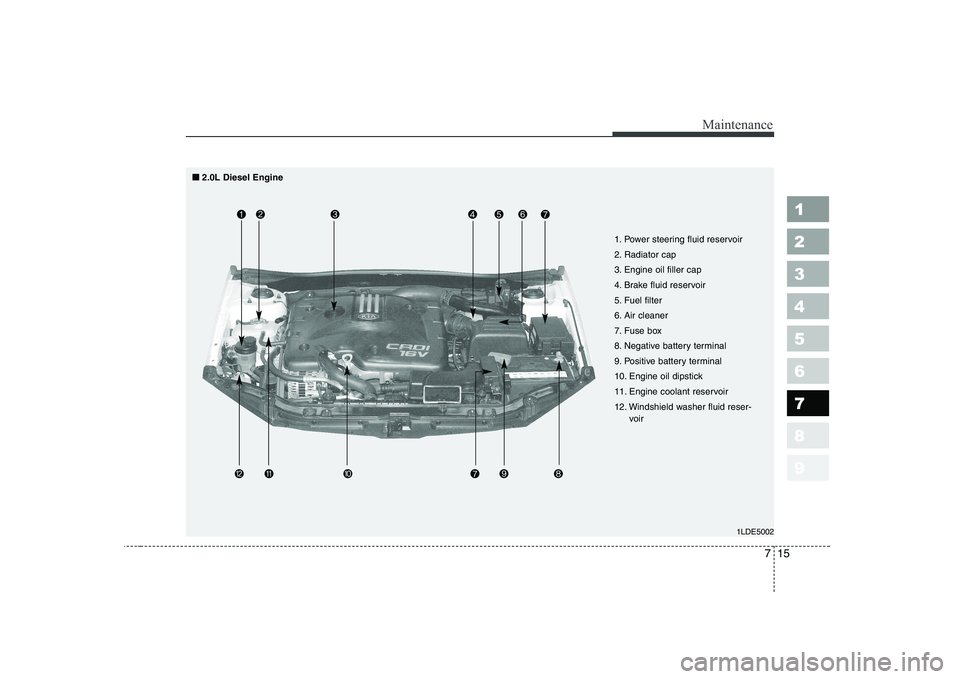
1LDE5002
1. Power steering fluid reservoir
2. Radiator cap
3. Engine oil filler cap
4. Brake fluid reservoir
5. Fuel filter
6. Air cleaner
7. Fuse box
8. Negative battery terminal
9. Positive battery terminal
10. Engine oil dipstick
11. Engine coolant reservoir
12. Windshield washer fluid reser-
voir
■
■
2.0L Diesel Engine
Page 284 of 315
739
Maintenance
1 23456789
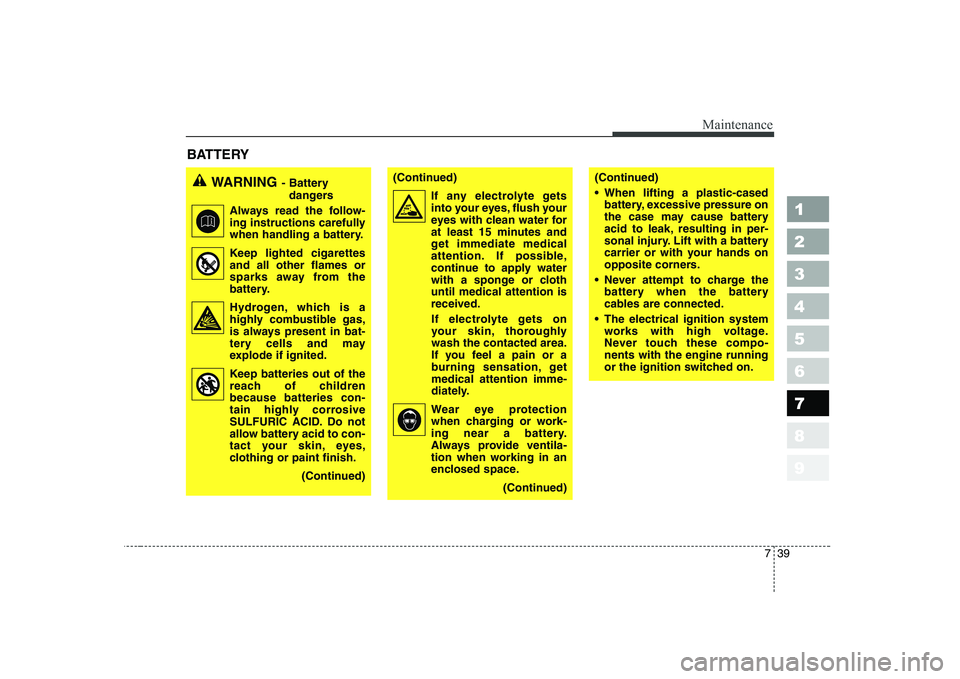
BATTERY
WARNING- Battery
dangers
Always read the follow-
ing instructions carefully
when handling a battery.
Keep lighted cigarettes and all other flames or
sparks away from the
battery.
Hydrogen, which is a highly combustible gas,
is always present in bat-
tery cells and may
explode if ignited.
Keep batteries out of the reach of children because batteries con-
tain highly corrosive
SULFURIC ACID. Do not
allow battery acid to con-
tact your skin, eyes,
clothing or paint finish.
(Continued)(Continued)If any electrolyte getsinto your eyes, flush your
eyes with clean water for
at least 15 minutes and
get immediate medical
attention. If possible,
continue to apply water
with a sponge or clothuntil medical attention isreceived.
If electrolyte gets on
your skin, thoroughlywash the contacted area.
If you feel a pain or a
burning sensation, getmedical attention imme-
diately.
Wear eye protection when charging or work-
ing near a battery.
Always provide ventila-
tion when working in an
enclosed space.
(Continued)(Continued)
When lifting a plastic-casedbattery, excessive pressure on
the case may cause battery
acid to leak, resulting in per-
sonal injury. Lift with a battery
carrier or with your hands on
opposite corners.
Never attempt to charge the battery when the battery
cables are connected.
The electrical ignition system works with high voltage.
Never touch these compo-nents with the engine running
or the ignition switched on.
Page 285 of 315
Maintenance
40
7
1 23456789
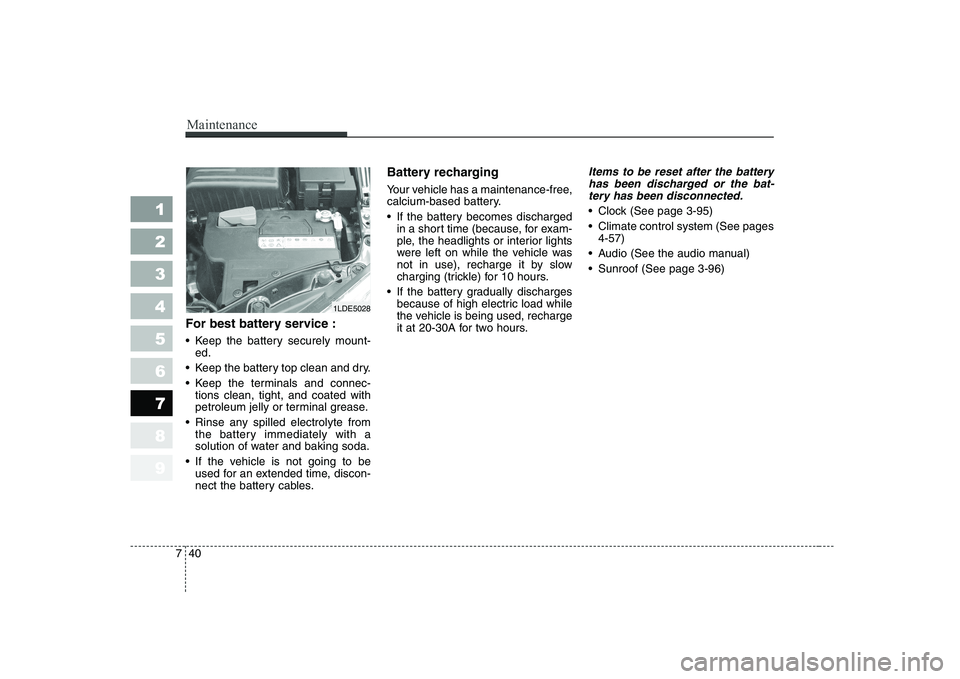
For best battery service :
Keep the battery securely mount-
ed.
Keep the battery top clean and dry.
Keep the terminals and connec- tions clean, tight, and coated with
petroleum jelly or terminal grease.
Rinse any spilled electrolyte from the battery immediately with a
solution of water and baking soda.
If the vehicle is not going to be used for an extended time, discon-
nect the battery cables. Battery recharging
Your vehicle has a maintenance-free,
calcium-based battery.
If the battery becomes discharged
in a short time (because, for exam-
ple, the headlights or interior lights
were left on while the vehicle was
not in use), recharge it by slow
charging (trickle) for 10 hours.
If the battery gradually discharges because of high electric load while
the vehicle is being used, recharge
it at 20-30A for two hours.
Items to be reset after the battery
has been discharged or the bat-tery has been disconnected.
Clock (See page 3-95)
Climate control system (See pages 4-57)
Audio (See the audio manual)
Sunroof (See page 3-96)
1LDE5028