ignition KIA CERATO 2007 User Guide
[x] Cancel search | Manufacturer: KIA, Model Year: 2007, Model line: CERATO, Model: KIA CERATO 2007Pages: 329, PDF Size: 34.09 MB
Page 30 of 329
Knowing your vehicle
20
3
1 23456789
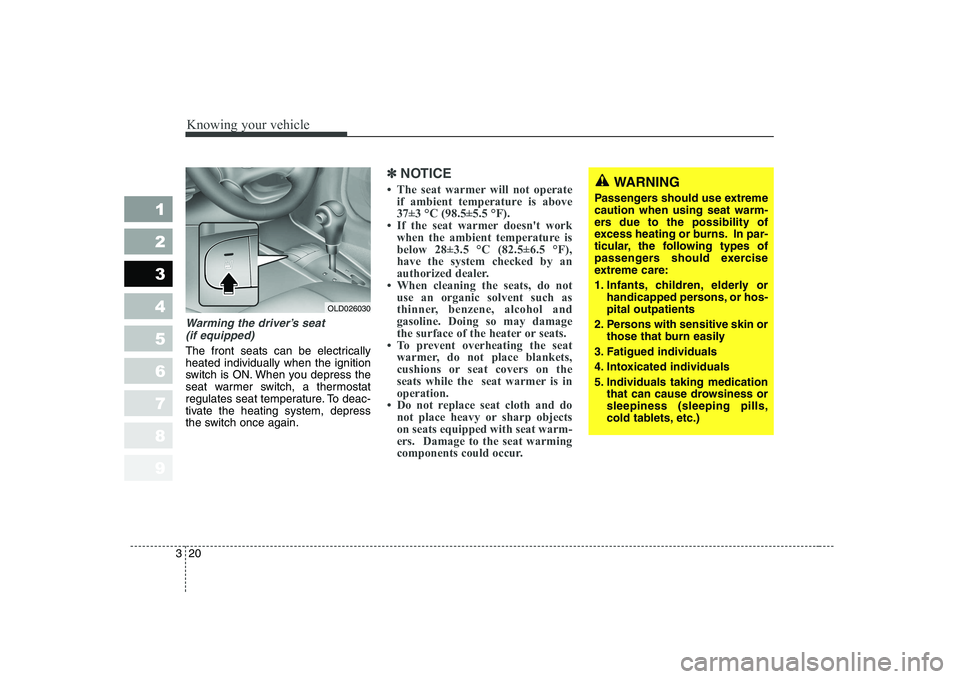
Warming the driver’s seat
(if equipped)
The front seats can be electrically heated individually when the ignition
switch is ON. When you depress the
seat warmer switch, a thermostat
regulates seat temperature. To deac-
tivate the heating system, depress
the switch once again.
✽✽ NOTICE
Page 34 of 329
Knowing your vehicle
24
3
1 23456789
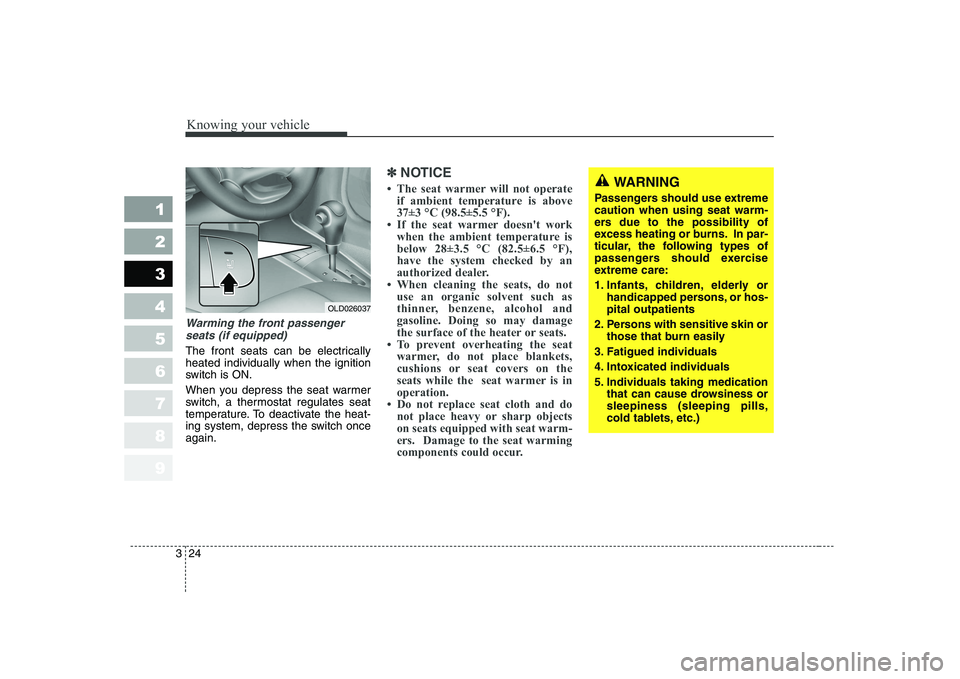
Warming the front passenger
seats (if equipped)
The front seats can be electrically heated individually when the ignition
switch is ON.
When you depress the seat warmer
switch, a thermostat regulates seat
temperature. To deactivate the heat-
ing system, depress the switch onceagain.
✽✽ NOTICE
Page 46 of 329

Knowing your vehicle
36
3
1 23456789
Safety belt warning light and
chime
Ty p e A
As a reminder to the driver and pas-
senger, safety belt warning light will
blink for approximately 6 seconds
each time you turn the ignition switchON.
If the driver’s lap/shoulder belt is not
fastened when the key is turned ON,
the safety belt warning chime sounds
and the safety belt warning light
blinks for approximately 6 seconds. Ty p e B
As a reminder to the driver, safety
belt warning light will blink or illumi-
nate for approximately 6 seconds
each time you turn the ignition switchON.
If the driver's lap/shoulder belt is not
fastened when the key is turned ON
or if it is disconnected after the key is
turn ON, the safety belt warning light
will blink or illuminate until the belt is
fastened.
If the driver's lap/shoulder belt is not
fastened when the key is turned ON
and you drive over 9km/h, the safety
belt warning chime will sound for
approximately 100 seconds after the
warning light blinks for approximately
one minute.
If the driver's lap/shoulder belt is dis-
connected after the key is turn ON
and you drive over 9km/h, the safety
belt warning chime will sound for
approximately 100 seconds.
But, if the driver's lap/shoulder belt is connected and disconnected twice
within 9 seconds after the belt is fas-
tened, the safety belt warning light
and chime will not operate.
1GQA2083
CAUTION
Never close the doors on any
part of the lap or shoulder belt. It can damage the safety belt orbuckle which could increase therisk of injury in case of an acci- dent.
Page 65 of 329

355
1 23456789
Knowing your vehicle
SRS components and func- tions
The SRS consists of the following components:
1. SRS "AIR BAG" warning light*
2. Passenger's Air bag Module*
3. Driver's Air Bag Module*
4. Side Impact Sensors*
5. SRS Control Module (SRSCM)*
6. Retractor Pre-tensionerAssemblies*
7. Side Air Bag Modules*
8. Curtain Air bag Modules*
9. Passenger’s front air bag OFF indicator*
10. Passenger’s front air bag ON/OFF switch*
* : If equipped The SRSCM continually monitors all SRS components while the ignition
switch is ON to determine if a crash
impact is severe enough to require
air bag deployment or pre-tensioner
seat belt deployment.
The SRS AIR BAG warning light on
the instrument panel will blink or illu-
minate for about 6 seconds after the
ignition switch is turned to the ON
position, after which the AIR BAG
warning light should go out.
If any of the following conditions
occurs, this indicates a malfunetion
of the SRS. Have an authorized Kiadealer inspect the air bag system as
soon as possible.
The light does not turn on briefly
when you turn the ignition ON.
The light stays on after illuminating for approximately 6 seconds.
The light comes on while the vehi- cle is in motion. What your airbag system does
Driver’s airbag and front passenger’s airbag are designed to supplement
the protection offered by the safety
belt in certain frontal collisions.
Likewise, side airbag and curtainairbags are designed to supplement
the protection offered by the safety
belt in side collisions. Safety belts
are designed to reduce the injury of
the driver or passengers in case of
light impact or collision. However, to
help reduce impact on driver or pas-
sengers in a serious collision, seat
belts must also be correctly worn.
What your airbag system does not do The air bag system is designed to
supplement the protection offered by
the safety belt system. IT IS NOT A
SUBSTITUTE FOR THE SAFETY
BELT.
Page 67 of 329
357
1 23456789
Knowing your vehicle
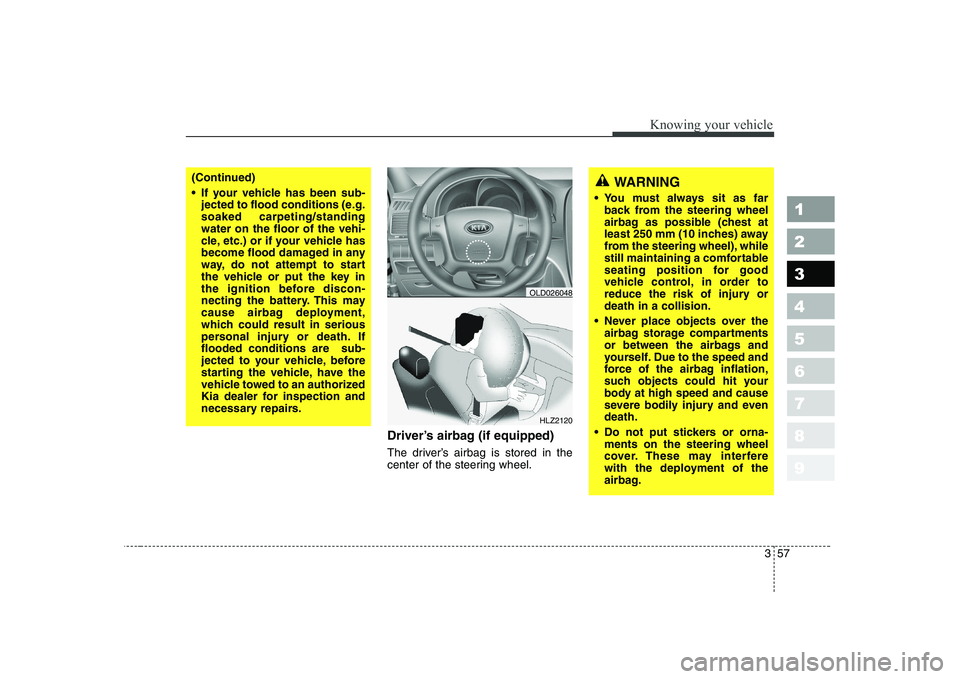
Driver’s airbag (if equipped)
The driver’s airbag is stored in the
center of the steering wheel.
HLZ2120
(Continued)
If your vehicle has been sub-jected to flood conditions (e.g. soaked carpeting/standingwater on the floor of the vehi-
cle, etc.) or if your vehicle has
become flood damaged in any
way, do not attempt to start
the vehicle or put the key in
the ignition before discon-
necting the battery. This may
cause airbag deployment,
which could result in serious
personal injury or death. Ifflooded conditions are sub-
jected to your vehicle, before
starting the vehicle, have the
vehicle towed to an authorized
Kia dealer for inspection and
necessary repairs.
OLD026048
WARNING
You must always sit as far back from the steering wheel
airbag as possible (chest at
least 250 mm (10 inches) away
from the steering wheel), while
still maintaining a comfortable
seating position for good
vehicle control, in order to
reduce the risk of injury ordeath in a collision.
Never place objects over the airbag storage compartments
or between the airbags and
yourself. Due to the speed and
force of the airbag inflation,
such objects could hit your
body at high speed and cause
severe bodily injury and evendeath.
Do not put stickers or orna- ments on the steering wheel
cover. These may interfere
with the deployment of the
airbag.
Page 70 of 329
Knowing your vehicle
60
3
1 23456789
WARNING
The front seat passenger’s airbag is much larger than the
steering wheel airbag and
inflates with considerably
more force. It can seriously
hurt or kill a passenger who is
not in the proper position and
wearing the safety belt proper-
ly. The front passengers
should always move their seat
as far back as practical and sit
back in their seat.
It is essential that the front passengers always wear their
safety belts, even when the
vehicle is moving in a parking
lot or up a driveway into
garage. (Continued)WARNING
The driver is responsible for the proper position of the pas-
senger’s front air bag ON/OFF
switch.
Deactivate the passenger's front air bag only when the
ignition switch is switched off,
or the malfunction may occur
in the SRS Control Module.
And there may be a danger
that the driver's and/or front
passenger’s and/or side and
curtain air bag may fail to trig-
ger, or not trigger correctlyduring a collision.
Never install a rearward facing child seat on the front passen-
ger's seat unless the passen-
ger's front air bag has been
deactivated. The infant or child
could be severely injured or
killed by an air bag deploy-ment in case of an accident.
(Continued)(Continued)
Even though your vehicle isequipped with the passen-
ger's front air bag ON/OFF
switch, do not install a child
restraint system in the front
passenger's seat. A child
restraint system must never
be placed in the front seat.
Children who are too large for
child restraint systems should
always occupy the rear seat
and use the available
lap/shoulder belts. Children
are afforded the most safety in
the event of an accident when
they are restrained by a prop-er restraint system in the rearseat.
As soon as the child seat is no longer needed on the front
passenger's seat, reactivate
the front passenger's air bag.
Page 79 of 329

369
1 23456789
Knowing your vehicle
Airbags may not inflate if the vehi-cle collides with objects such as
utility poles or trees, where the
point of impact is concentrated to
one area and the full force of the
impact is not delivered to the sen-
sors. How does the airbag system operate
Airbag only operates when the
ignition switch is turned to ON or
START position.
Airbags inflate instantly in the event of serious frontal or side col-lision (if equipped with side airbag
or curtain airbag) in order to help
protect the occupants from serious
physical injury.
There is no single speed at which the airbags will inflate.
Generally, airbags are designed to
inflate by the severity of a collision
and its direction. These two factors
determine whether the sensors
send out an electronic deploy-ment/inflation signal. Airbag deployment depends on a
number of factors including vehiclespeed, angles of impact and the
density and stiffness of the vehi-
cles or objects which your vehicle
hits in the collision. Though, factorsare not limited to those mentioned
above.
The front airbags will completely inflate and deflate in an instant.
It is virtually impossible for you to
see the airbags inflate during an
accident. It is much more likely that
you will simply see the deflatedairbags hanging out of their stor-
age compartments after the colli-sion.
1JBA3518
Page 80 of 329
Knowing your vehicle
70
3
1 23456789
In order to help provide protection
in a severe collision, the airbags
must inflate rapidly. The speed ofairbag inflation reduces the likeli-
hood of serious or life-threatening
injuries and is thus a mandatory
part of the airbag design.
However, airbag inflation can also
cause injuries which normally can
include facial abrasions, bruises
and broken bones, because thatspeed also causes the airbags to
expand with a great deal force.
There are even circumstances under which contact with the
steering wheel airbag can cause
fatal injuries, especially if the
occupant is positioned exces-
sively close to the steeringwheel. Noise and smoke
When the airbags inflate, they make
a loud noise and they leave smoke
and powder in the air inside of the
vehicle. This is normal and is a result
of the ignition of the airbag inflator.
After the airbag inflates, you may feel
substantial discomfort in breathing
due to the contact of your chest to
both the safety belt and the airbag,
as well as from breathing the smoke
and powder.
We strongly urge you
to open your doors and/or win-
dows as soon as possible after
impact in order to reduce discom-
fort and prevent prolonged expo-
sure to the smoke and powder.
Though smoke and powder are non-
toxic, it may cause irritation to the
skin (eyes, nose and throat etc). If
this is the case, wash and rinse with
the cold water immediately and con-sult the doctor if the symptom per-
sists.WARNING
Driver should sit as far back (at least 250 mm (10 inches)
away) from the steering wheel
airbag as possible to reduce
the risk of injury or death in a
collision. The front passenger
should always move their seat
as far back as possible and sit
back in their seat.
Airbag inflates instantly in an event of collision, passengers
may be injured by the airbag
expansion force if they are not
in proper position.
Airbag inflation may cause injuries which normally
include facial or bodily abra-
sions, injuries by the broken
glasses or burns by the explo-sives.
Page 82 of 329
Knowing your vehicle
72
3
1 23456789
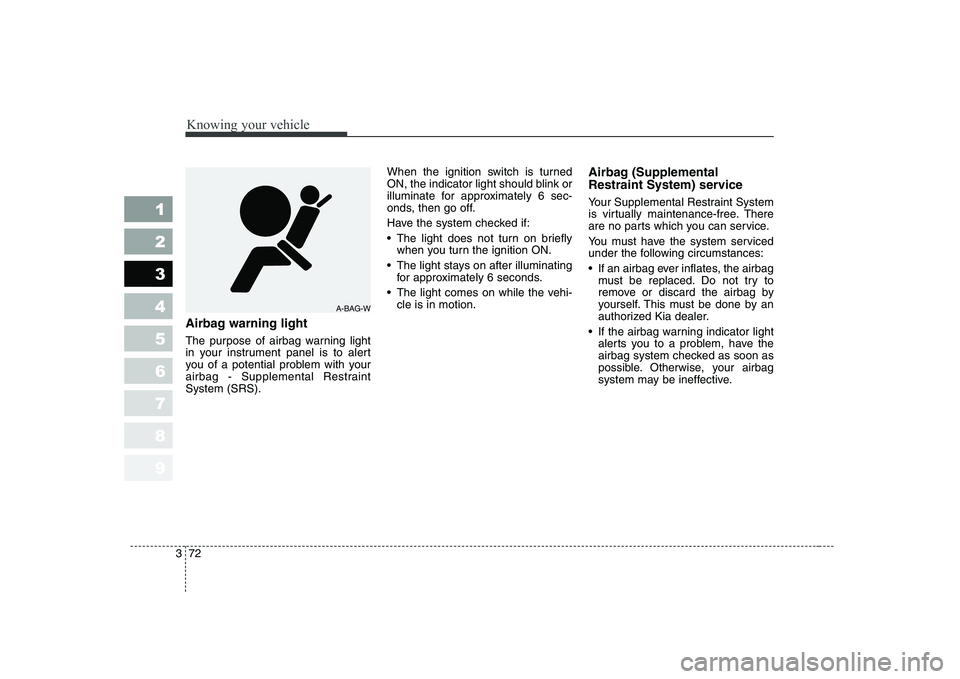
Airbag warning light
The purpose of airbag warning light
in your instrument panel is to alert
you of a potential problem with your
airbag - Supplemental RestraintSystem (SRS). When the ignition switch is turned
ON, the indicator light should blink or
illuminate for approximately 6 sec-
onds, then go off.
Have the system checked if:
The light does not turn on briefly
when you turn the ignition ON.
The light stays on after illuminating for approximately 6 seconds.
The light comes on while the vehi- cle is in motion. Airbag (Supplemental
Restraint System) service
Your Supplemental Restraint System
is virtually maintenance-free. There
are no parts which you can service.
You must have the system serviced
under the following circumstances:
If an airbag ever inflates, the airbag
must be replaced. Do not try to
remove or discard the airbag by
yourself. This must be done by an
authorized Kia dealer.
If the airbag warning indicator light alerts you to a problem, have the
airbag system checked as soon as
possible. Otherwise, your airbag
system may be ineffective.
A-BAG-W
Page 95 of 329
385
1 23456789
Knowing your vehicle
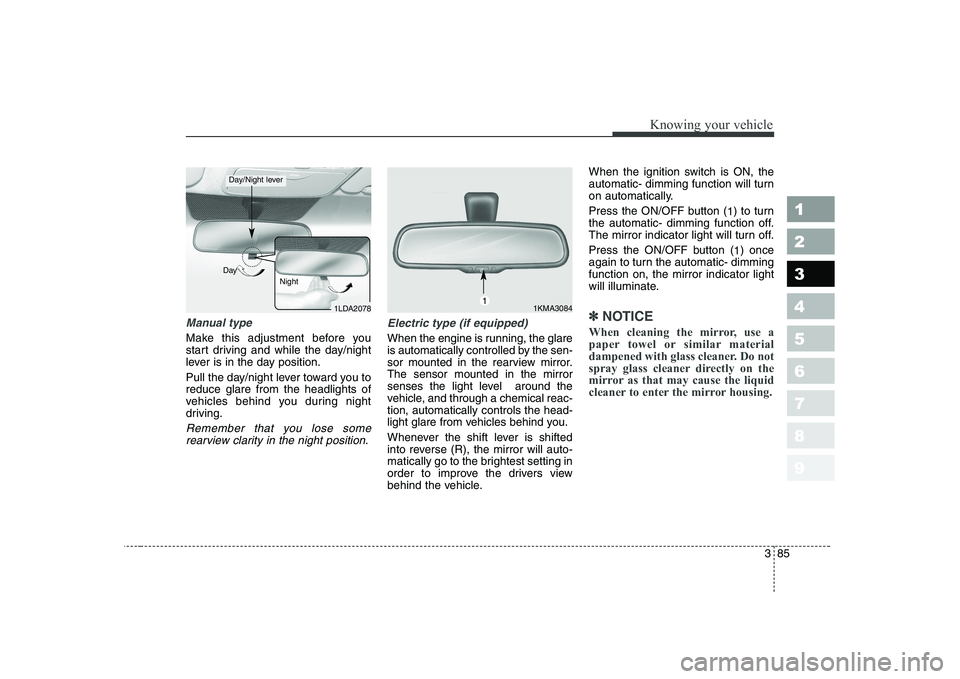
Manual type
Make this adjustment before you
start driving and while the day/night
lever is in the day position.
Pull the day/night lever toward you to reduce glare from the headlights of
vehicles behind you during night
driving.
Remember that you lose somerearview clarity in the night position.
Electric type (if equipped)
When the engine is running, the glare
is automatically controlled by the sen-
sor mounted in the rearview mirror.The sensor mounted in the mirror
senses the light level around the
vehicle, and through a chemical reac-tion, automatically controls the head-
light glare from vehicles behind you.
Whenever the shift lever is shifted
into reverse (R), the mirror will auto-
matically go to the brightest setting in
order to improve the drivers view
behind the vehicle. When the ignition switch is ON, the
automatic- dimming function will turn
on automatically.
Press the ON/OFF button (
1) to turn
the automatic- dimming function off.
The mirror indicator light will turn off.
Press the ON/OFF button ( 1) once
again to turn the automatic- dimming function on, the mirror indicator light
will illuminate.
✽✽ NOTICE
When cleaning the mirror, use a
paper towel or similar material
dampened with glass cleaner. Do not
spray glass cleaner directly on the
mirror as that may cause the liquid
cleaner to enter the mirror housing.1LDA2078
Day
Night
Day/Night lever
1KMA30841