air condition KIA MOHAVE 2014 Service Manual
[x] Cancel search | Manufacturer: KIA, Model Year: 2014, Model line: MOHAVE, Model: KIA MOHAVE 2014Pages: 417, PDF Size: 38.72 MB
Page 290 of 417
549
Driving your vehicle
Remember, your vehicle does notrequire extended warm-up. After the
engine has started, allow the engine to
run for 10 to 20 seconds prior to plac-
ing the vehicle in gear. In very cold
weather, however, give your engine a
slightly longer warm-up period.
Don't "lug" or "over-rev" the engine. Lugging is driving too slowly in a very
high gear resulting in engine bucking. If
this happens, shift to a lower gear.
Over-revving is racing the engine
beyond its safe limit. This can be avoid-
ed by shifting at the recommendedspeed. Use your air conditioning sparingly.
The air conditioning system is operat-
ed by engine power so your fuel econ-
omy is reduced when you use it.
Open windows at high speeds can reduce fuel economy.
Fuel economy is less in crosswinds and headwinds. To help offset some of
this loss, slow down when driving in
these conditions.
Keeping a vehicle in good operating con-
dition is important both for economy and
safety. Therefore, have an authorized Kia
dealer perform scheduled inspections
and maintenance.
WARNING - Engine off
during motion
Never turn the engine off to coast
down hills or anytime the vehicle is
in motion. The power steering and
power brakes will not function
properly without the engine run-
ning. Instead, keep the engine on
and downshift to an appropriate
gear for engine braking effect. In
addition, turning off the ignition
while driving could engage the
steering wheel lock resulting in
loss of vehicle steering which
could cause serious injury ordeath.
Page 304 of 417
563
Driving your vehicle
Maintenance when trailer towing
Your vehicle will need service more often
when you regularly pull a trailer.
Important items to pay particular atten-tion to include engine oil, automatic
transmission fluid, mission lubricant and
cooling system fluid. Brake condition is
another important item to frequently
check. Each item is covered in this man-
ual, and the Index will help you find them
quickly. If you’re trailering, it’s a good idea
to review these sections before you start
your trip.
Don’t forget to also maintain your trailer
and hitch. Follow the maintenance
schedule that accompanied your trailer
and check it periodically. Preferably, con-
duct the check at the start of each day’s
driving. Most importantly, all hitch nutsand bolts should be tight.If you do decide to pull a trailer
Here are some important points if you
decide to pull a trailer:
Consider using a sway control. You can
ask a hitch dealer about sway control.
Do not do any towing with your car dur- ing its first 2,000 km (1,200 miles) in
order to allow the engine to properly
break in. Failure to heed this caution
may result in serious engine or trans-
mission damage.
When towing a trailer, be sure to con- sult an authorized Kia dealer for further
information on additional requirements
such as a towing kit, etc.
Always drive your vehicle at a moder- ate speed (less than 100 km/h / 60mph).
On a long uphill grade, do not exceed 70 km/h (45 mph) or the posted towing
speed limit, whichever is lower.CAUTION
Due to higher load during trailer
usage, overheating might occurin hot days or during uphill driv-ing. If the coolant gauge indicatesover-heating, switch off the A/C
and stop the vehicle in a safe area to cool down the engine.
When towing, check the transmis- sion fluid more frequently.
If your vehicle is not equipped with an air conditioner, youshould install a condenser fan to improve engine performancewhen towing a trailer.
Page 313 of 417
What to do in an emergency
6
6
IF THE ENGINE OVERHEATS
F050000BHM
If your temperature gauge indicates over-
heating, you will experience a loss of
power, or hear loud pinging or knocking,
the engine will probably be too hot. If this
happens, you should:
1. Pull off the road and stop as soon as it is safe to do so.
2. Place the gear shift lever in P (Park) and set the parking brake. If the air
conditioning is on, turn it off.
3. If engine coolant is running out under the vehicle or steam is coming out
from the hood, stop the engine. Do notopen the hood until the coolant has
stopped running or the steaming has
stopped. If there is no visible loss of
engine coolant and no steam, leave
the engine running and check to be
sure the engine cooling fan is operat-
ing. If the fan is not running, turn the
engine off. 4. Check to see if the water pump drive
belt is missing. If it is not missing,
check to see that it is tight. If the drive
belt seems to be satisfactory, check for
coolant leaking from the radiator,
hoses or under the vehicle. (If the air
conditioning had been in use, it is nor-
mal for cold water to be draining from
it when you stop).
5. If the water pump drive belt is broken or engine coolant is leaking out, stop the engine immediately and call the
nearest authorized Kia dealer for
assistance. 6. If you cannot find the cause of the
overheating, wait until the engine tem-
perature has returned to normal. Then,if coolant has been lost, carefully add
coolant to the reservoir to bring the
fluid level in the reservoir up to the
halfway mark.
7. Proceed with caution, keeping alert for further signs of overheating. If over-heating happens again, call an author-
ized Kia dealer for assistance.
WARNING
While the engine is running, keep
hair, hands and clothing away from
moving parts such as the fan and
drive belts to prevent injury.
WARNING
Do not remove the radiator cap
when the engine is hot. This can
allow coolant to be blown out of the
opening and cause serious burns.
CAUTION
Serious loss of coolant indicates there is a leak in the cooling sys-
tem and this should be checked as soon as possible by an author-ized Kia dealer.
When the engine overheats from low engine coolant, suddenly
adding engine coolant may causecracks in the engine. To prevent damage, add engine coolantslowly in small quantities.
Page 321 of 417
What to do in an emergency
14
6
F070301AHM
Important - use of compact spare tire
(if equipped)
Your vehicle is equipped with a com-
pact spare tire. This compact spare
tire takes up less space than a regu-
lar-size tire. This tire is smaller than a
conventional tire and is designed for
temporary use only.
The compact spare should be inflat-
ed to 420 kPa (60 psi).
✽✽NOTICE
Check the inflation pressure after
installing the spare tire. Adjust it to
the specified pressure, as necessary.
When using a compact spare tire,
observe the following precautions:
Under no circumstances should you exceed 80 km/h (50 mph); a higher speed could damage the
tire.
Ensure that you drive slowly enough for the road conditions to
avoid all hazards. Any road hazard,
such as a pothole or debris, could
seriously damage the compact
spare.
Any continuous road use of this tire could result in tire failure, loss of
vehicle control, and possible per-
sonal injury.
Do not exceed the vehicle’s maxi- mum load rating or the load-carry-
ing capacity shown on the sidewall
of the compact spare tire.
Avoid driving over obstacles. The compact spare tire diameter issmaller than the diameter of a con-
ventional tire and reduces the
ground clearance approximately25 mm (1 inch), which could result
in damage to the vehicle.
CAUTION
You should drive carefully
when the compact spare is inuse. The compact spareshould be replaced by theproper conventional tire and rim at the first opportunity.
The operation of this vehicle is not recommended withmore than one compact sparetire in use at the same time.
WARNING
The compact spare tire is for
emergency use only. Do not
operate your vehicle on this
compact spare at speeds over
80 km/h (50 mph). The originaltire should be repaired or
replaced as soon as is possible
to avoid failure of the spare
possibly leading to personal
injury or death.
Page 334 of 417
77
Maintenance
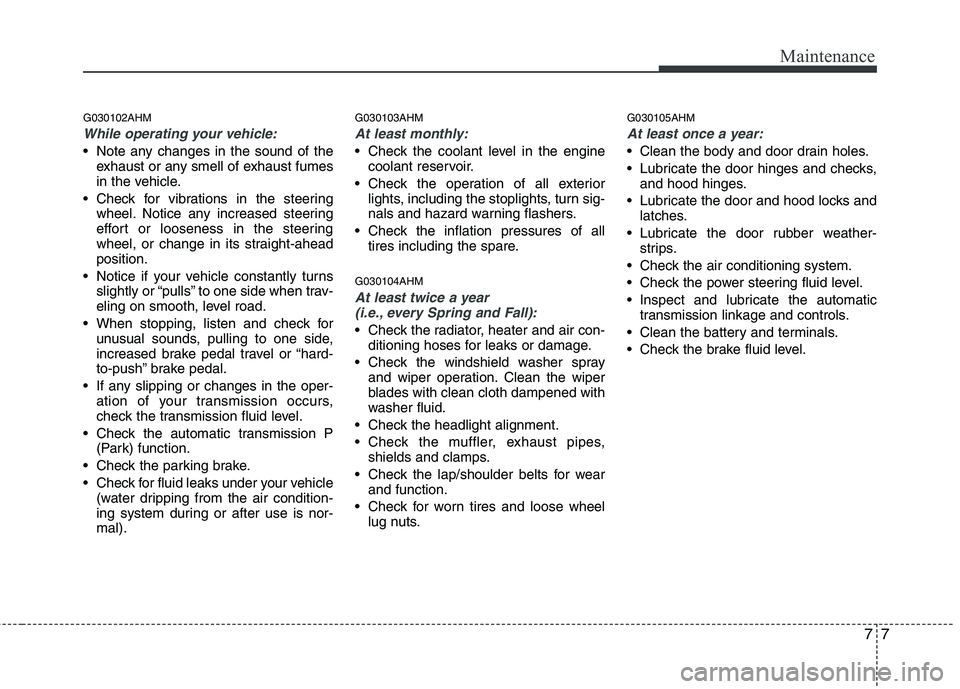
G030102AHM
While operating your vehicle:
Note any changes in the sound of theexhaust or any smell of exhaust fumes
in the vehicle.
Check for vibrations in the steering wheel. Notice any increased steering
effort or looseness in the steering
wheel, or change in its straight-aheadposition.
Notice if your vehicle constantly turns slightly or “pulls” to one side when trav-
eling on smooth, level road.
When stopping, listen and check for unusual sounds, pulling to one side,
increased brake pedal travel or “hard-
to-push” brake pedal.
If any slipping or changes in the oper- ation of your transmission occurs,
check the transmission fluid level.
Check the automatic transmission P (Park) function.
Check the parking brake.
Check for fluid leaks under your vehicle (water dripping from the air condition-
ing system during or after use is nor-mal). G030103AHM
At least monthly:
Check the coolant level in the engine
coolant reservoir.
Check the operation of all exterior lights, including the stoplights, turn sig-
nals and hazard warning flashers.
Check the inflation pressures of all tires including the spare.
G030104AHM
At least twice a year (i.e., every Spring and Fall):
Check the radiator, heater and air con- ditioning hoses for leaks or damage.
Check the windshield washer spray and wiper operation. Clean the wiper
blades with clean cloth dampened with
washer fluid.
Check the headlight alignment.
Check the muffler, exhaust pipes, shields and clamps.
Check the lap/shoulder belts for wear and function.
Check for worn tires and loose wheel lug nuts. G030105AHM
At least once a year:
Clean the body and door drain holes.
Lubricate the door hinges and checks,
and hood hinges.
Lubricate the door and hood locks and latches.
Lubricate the door rubber weather- strips.
Check the air conditioning system.
Check the power steering fluid level.
Inspect and lubricate the automatic transmission linkage and controls.
Clean the battery and terminals.
Check the brake fluid level.
Page 336 of 417
79
Maintenance
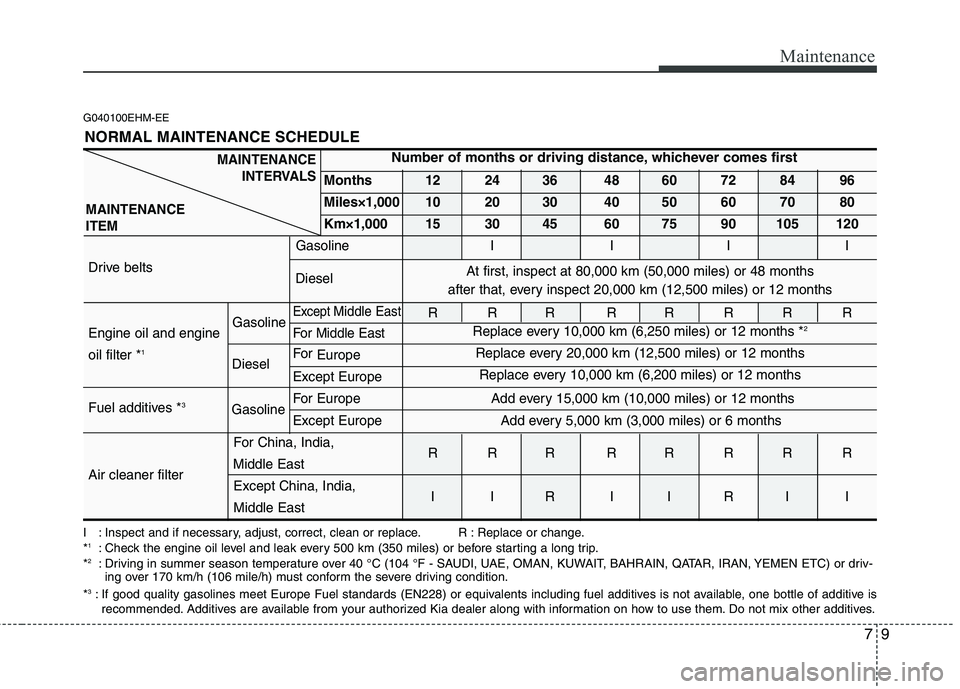
G040100EHM-EE
I : Inspect and if necessary, adjust, correct, clean or replace. R : Replace or change. *1
: Check the engine oil level and leak every 500 km (350 miles) or before starting a long trip.
* 2
: Driving in summer season temperature over 40 °C (104 °F - SAUDI, UAE, OMAN, KUWAIT, BAHRAIN, QATAR, IRAN, YEMEN ETC) or driv-
ing over 170 km/h (106 mile/h) must conform the severe driving condition.
* 3
: If good quality gasolines meet Europe Fuel standards (EN228) or equivalents including fuel additives is not available, one bottle of additive is
recommended. Additives are available from your authorized Kia dealer along with information on how to use them. Do not mix other additives.
MAINTENANCE
INTERVALS
MAINTENANCE ITEMNumber of months or driving distance, whichever comes first
Months 12 24 36 48 60 72 84 96
Miles×1,000 10 20 30 40 50 60 70 80
Km×1,000 15 30 45 60 75 90 105 120
Gasoline I I I I
Drive belts Diesel
Except Middle EastRRR RRRRR
Engine oil and engine Gasoline
For Middle East
oil filter *
1
DieselFor
Europe
Except Europe
Fuel additives * 3
For Europe Add every 15,000 km (10,000 miles) or 12 months
Gasoline Except Europe Add every 5,000 km (3,000 miles) or 6 months
For China, India, RRR RRRRR
Air cleaner filter Middle East
Except China, India, IIRIIRII
Middle East Replace every 20,000 km (12,500 miles) or 12 months
Replace every 10,000 km (6,200 miles) or 12 months
Replace every 10,000 km (6,250 miles) or 12 months *
2
At first, inspect at 80,000 km (50,000 miles) or 48 months
after that, every inspect 20,000 km (12,500 miles) or 12 months
NORMAL MAINTENANCE SCHEDULE
Page 339 of 417
Maintenance
12
7
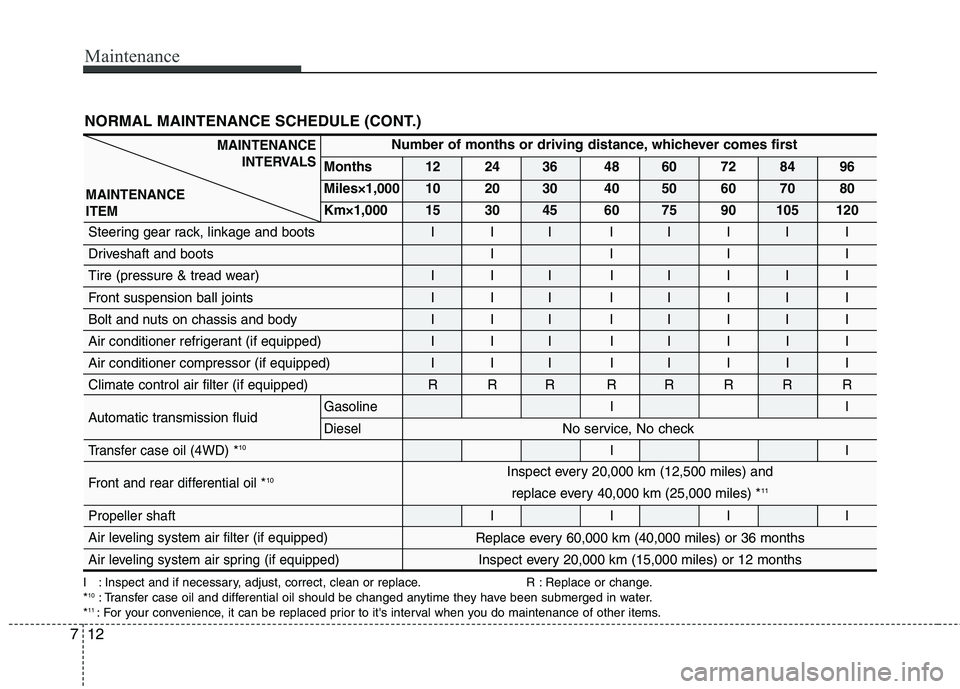
NORMAL MAINTENANCE SCHEDULE (CONT.)
I : Inspect and if necessary, adjust, correct, clean or replace. R : Replace or change. * 10
: Transfer case oil and differential oil should be changed anytime they have been submerged in water.
* 11
: For your convenience, it can be replaced prior to it's interval when you do maintenance of other items.
Number of months or driving distance, whichever comes first
Months 12 24 36 48 60 72 84 96
Miles×1,000 10 20 30 40 50 60 70 80
Km×1,000 15 30 45 60 75 90 105 120
Steering gear rack, linkage and boots I I I I I I I I
Driveshaft and boots I I I I
Tire (pressure & tread wear) I I I I I I I I
Front suspension ball joints I I I I I I I I
Bolt and nuts on chassis and body I I I I I I I I
Air conditioner refrigerant (if equipped) I I I I I I I I
Air conditioner compressor (if equipped) I I I I I I I I
Climate control air filter (if equipped) R R R R R R R R
Automatic transmission fluid Gasoline
II
Diesel
No service, No check
Transfer case oil (4WD) * 10
II
Front and rear differential oil * 10
Propeller shaft I I I I
Air leveling system air filter (if equipped)
Air leveling system air spring (if equipped)
MAINTENANCE INTERVALS
MAINTENANCE ITEM
Inspect every 20,000 km (12,500 miles) and replace every 40,000 km (25,000 miles) * 11
Replace every 60,000 km (40,000 miles) or 36 months Inspect every 20,000 km (15,000 miles) or 12 months
Page 340 of 417
713
Maintenance
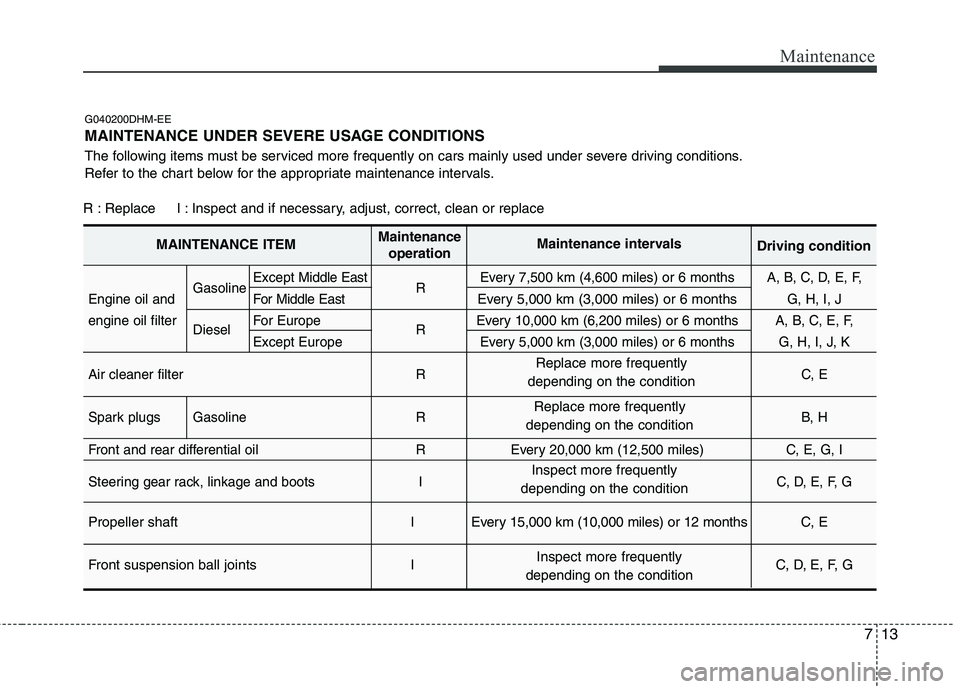
G040200DHM-EE
MAINTENANCE UNDER SEVERE USAGE CONDITIONS
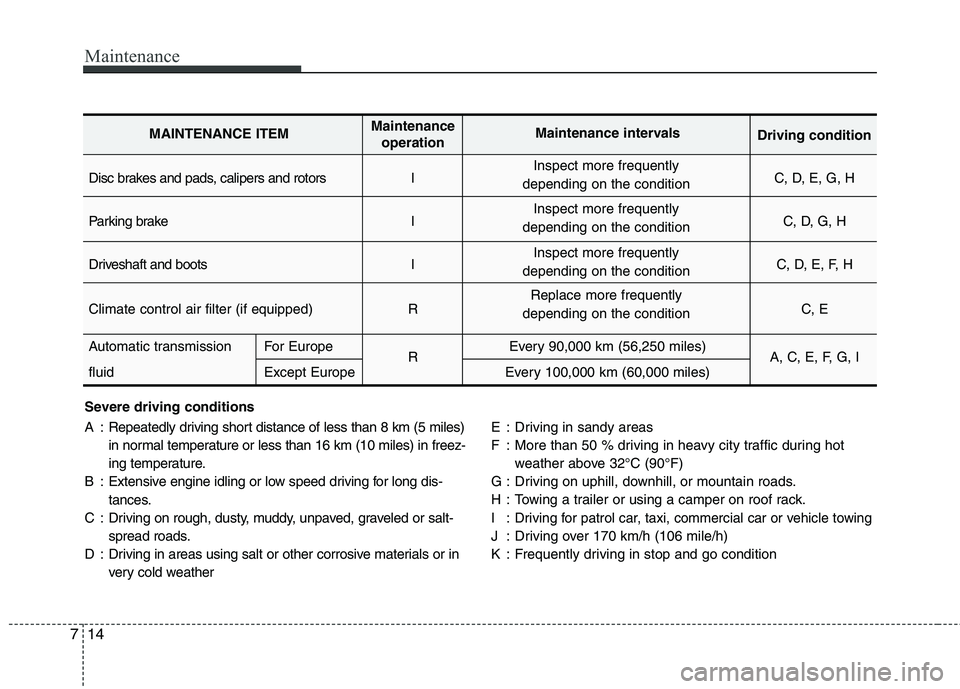
The following items must be serviced more frequently on cars mainly used under severe driving conditions.
Refer to the chart below for the appropriate maintenance intervals.
R : Replace I : Inspect and if necessary, adjust, correct, clean or replace
Except Middle East Every 7,500 km (4,600 miles) or 6 months A, B, C, D, E, F,
Engine oil and Gasoline
For Middle East R
Every 5,000 km (3,000 miles) or 6 monthsG, H, I, J
engine oil filter DieselFor Europe Every 10,000 km (6,200 miles) or 6 months A, B, C, E, F, Except Europe R
Every 5,000 km (3,000 miles) or 6 months G, H, I, J, K
Air cleaner filter R C, E
Spark plugs Gasoline R B, H
Front and rear differential oil R Every 20,000 km (12,500 miles) C, E, G, I
Steering gear rack, linkage and boots I C, D, E, F, G
Propeller shaftI Every 15,000 km (10,000 miles) or 12 months C, E
Front suspension ball joints I C, D, E, F, G
MAINTENANCE ITEMMaintenance
operation Maintenance intervals
Driving condition
Replace more frequently
depending on the condition
Inspect more frequently
depending on the condition Replace more frequently
depending on the condition
Inspect more frequently
depending on the condition
Page 341 of 417
Maintenance
14
7
Severe driving conditions
A : Repeatedly driving short distance of less than 8 km (5 miles)
in normal temperature or less than 16 km (10 miles) in freez-
ing temperature.
B : Extensive engine idling or low speed driving for long dis-
tances.
C : Driving on rough, dusty, muddy, unpaved, graveled or salt- spread roads.
D : Driving in areas using salt or other corrosive materials or in very cold weather E : Driving in sandy areas
F : More than 50 % driving in heavy city traffic during hot
weather above 32°C (90°F)
G : Driving on uphill, downhill, or mountain roads.
H : Towing a trailer or using a camper on roof rack.I:
Driving for patrol car, taxi, commercial car or vehicle towing
J : Driving over 170 km/h (106 mile/h)
K : Frequently driving in stop and go condition
Disc brakes and pads, calipers and rotors I C, D, E, G, H
Parking brake I C, D, G, H
Driveshaft and boots I C, D, E, F, H
Climate control air filter (if equipped) R C, E
Automatic transmission For Europe REvery 90,000 km (56,250 miles)
A, C, E, F, G, I
fluid Except Europe Every 100,000 km (60,000 miles)
MAINTENANCE ITEM Maintenance
operation Maintenance intervals
Driving condition
Inspect more frequently
depending on the condition
Inspect more frequently
depending on the condition
Inspect more frequently
depending on the condition
Replace more frequently
depending on the condition
Page 343 of 417
Maintenance
16
7
G050600AUN
Vapor hose and fuel filler cap
The vapor hose and fuel filler cap should
be inspected at those intervals specified
in the maintenance schedule. Make sure
that a new vapor hose or fuel filler cap iscorrectly replaced.
G050700AUN
Vacuum crankcase ventilation hoses (if equipped)
Inspect the surface of hoses for evidence
of heat and/or mechanical damage. Hard
and brittle rubber, cracking, tears, cuts,
abrasions, and excessive swelling indi-
cate deterioration. Particular attention
should be paid to examine those hose
surfaces nearest to high heat sources,
such as the exhaust manifold. Inspect the hose routing to assure that the hoses do not come in contact with
any heat source, sharp edges or movingcomponent which might cause heat dam-
age or mechanical wear. Inspect all hose
connections, such as clamps and cou-
plings, to make sure they are secure, and
that no leaks are present. Hoses should
be replaced immediately if there is any
evidence of deterioration or damage. G050800AUN
Air cleaner filter
A Genuine Kia air cleaner filter is recom- mended when the filter is replaced.
G050900BUN
Spark plugs (for gasoline engine)
Make sure to install new spark plugs of
the correct heat range. G051000AHM
Valve clearance
(for 3.8L gasoline engine)
Inspect for excessive valve noise and/or
engine vibration and adjust if necessary.
An authorized Kia dealer should perform
the operation. G051100AHM Cooling system
Check the cooling system components,
such as the radiator, coolant reservoir,
hoses and connections for leakage and
damage. Replace any damaged parts.G051200AUN Coolant The coolant should be changed at the
intervals specified in the maintenance
schedule.
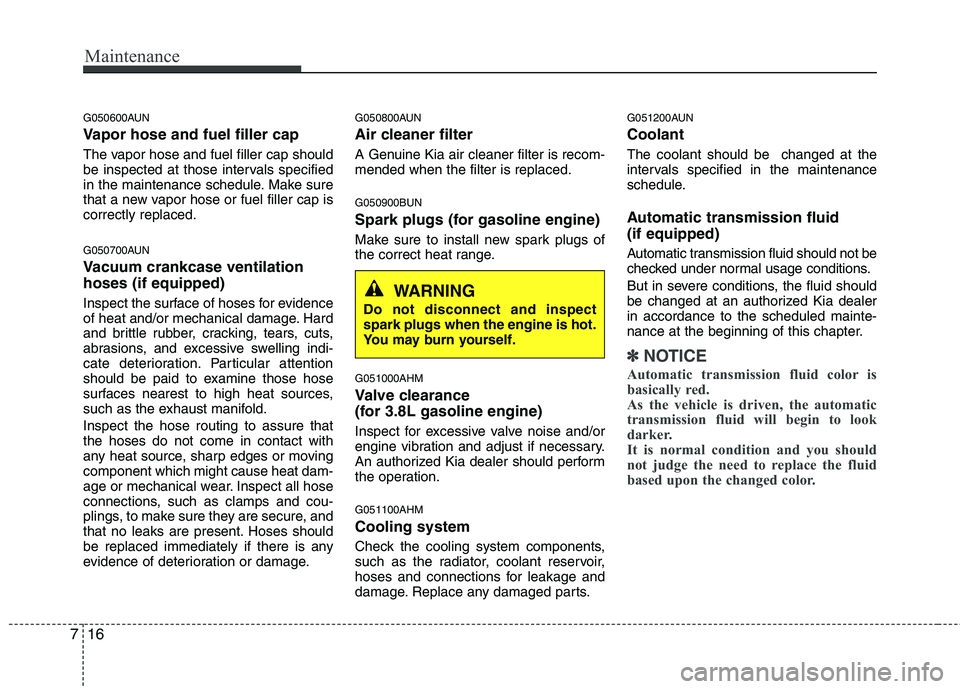
Automatic transmission fluid (if equipped)
Automatic transmission fluid should not be
checked under normal usage conditions.
But in severe conditions, the fluid should
be changed at an authorized Kia dealerin accordance to the scheduled mainte-
nance at the beginning of this chapter.
✽✽
NOTICE
Automatic transmission fluid color is
basically red.
As the vehicle is driven, the automatic
transmission fluid will begin to look
darker.
It is normal condition and you should
not judge the need to replace the fluid
based upon the changed color.
WARNING
Do not disconnect and inspect spark plugs when the engine is hot.
You may burn yourself.