lock KIA Optima 2006 2.G Workshop Manual
[x] Cancel search | Manufacturer: KIA, Model Year: 2006, Model line: Optima, Model: KIA Optima 2006 2.GPages: 225, PDF Size: 3.77 MB
Page 121 of 225

DRIVING YOUR VEHICLE
4-42CLIMATE CONTROL
SYSTEMCONTROLSA : Fan speed control knob
B : Mode selection
C : Temperature control knob
D : Air conditioning switch
E : Air intake control switch
F : Rear window defroster switch
G : MAX A/C mode switch
FAN SPEED CONTROL KNOBThe fan speed control knob (A) is the
knob closest to the driver. Four (4)
adjustable fan speeds are provided which
increase as the number increases. The
ignition switch must be in the ON
position for fan operation.
OFF - Fan off
1 - Low speed
2 - Medium speed
3 - High speed
4 - Maximum speed
MODE SELECTIONIt controls the direction of air flow
through the ventilation system.
The air from outlet port D flows at any
mode. Close the ventilation outlets using
the knob to block the air flow if you do
not want the air.
123
4
0
MAX
A/C
MMSA4044A
MMSA4050
E DF
ABC
G
B
B
C
C
D
D
A
A
A
A
MS-CNA-Eng 4(40~).QXD 7/25/2005 5:15 PM Page 42
Page 123 of 225

DRIVING YOUR VEHICLE
4-44TEMPERATURE CONTROL
KNOBThe temperature control knob (C) is the
round knob closest to the passenger side
of the ventilation control panel. To
change the air temperature in the
passenger compartment, turn the knob
either clockwise for warm to hot air or
counterclockwise for cooler air.
AIR INTAKE
CONTROL SWITCHThis is used to select fresh outside air or
recirculation inside air.
RECIRCULATED AIR
POSITION When the air intake control
switch is depressed (switch indicator
illuminates), almost all outside air flow
into the vehicle is shut off and air inside
the vehicle is recirculated.
This position can be used temporarily for
maximum heating or cooling (if
equipped with air conditioning ) and to
help prevent undesirable outside air flow
into the vehicle.
WARNING
• Continued climate control
system operation in the
recirculated air position may
allow humidity to increase
inside the vehicle which may
fog the glass and obscure
visibility.
Don’t sleep in a vehicle with
the air conditioning system
on. This could cause serious
harm or death to passengers
due to the depletion of
oxygen and lowering of body
temperature.
MS-CNA-Eng 4(40~).QXD 7/25/2005 5:15 PM Page 44
Page 140 of 225
DRIVING TIPS
5-4 Do not operate the vehicle when
there are signs of engine malfunction,
such as misfire or a noticeable loss of
performance.
Do not misuse or abuse the engine.
Examples of misuse are coasting
with the ignition off and descending
steep grades in gear with the ignition
off.
Do not operate the engine at high idle
speed for extended periods (5
minutes or more).
Do not modify or tamper with any
part of the engine or emission control
system. All inspections and
adjustments must be made by a
qualified technician.
Failure to observe the above precautions
could result in damage to the catalytic
converter and to your vehicle and could
void your warranties.
BEFORE DRIVINGBefore entering vehicle:
Be sure that all windows, outside
mirror(s), and outside lights are clean.
Check the condition of the tires.
Check under the vehicle for any sign
of leaks.
Be sure there are no obstacles behind
you if you intend to back up.NECESSARY
INSPECTIONSFluid levels, such as engine oil, engine
coolant, brake/clutch fluid, and washer
fluid should be checked on a regular
basis, with the exact interval depending
on the fluid. Further details are provided
in Maintenance, Section 7.
BEFORE STARTING Close and lock all doors.
Position the seat so that all controls
are easily reached.
Adjust the inside and outside
rearview mirrors.
Be sure that all lights work.
Check all gauges.
Check the operation of warning
lights when the ignition switch is
turned to the ON position.
Release the parking brake and make
sure the brake warning light goes out.
For safe operation, be sure you are
familiar with your vehicle and its
equipment.
MS-CNA-Eng 5 New.qxd 7/25/2005 5:21 PM Page 4
Page 143 of 225
SPECIAL DRIVING
CONDITIONSHAZARDOUS DRIVINGWhen hazardous driving is encountered
because of water, snow, ice, mud, sand, or
similar hazard, follow these suggestions:
Drive cautiously and allow extra
distance for braking.
Avoid sudden movements in braking
or steering.
When braking in vehicles without
anti-lock brakes, depress the brake
pedal with a controlled up-and- down
motion until the vehicle is stopped.
When starting from a stop in snow,
mud, or sand, use second gear and
accelerate slowly to avoid spinning
the front wheels. Low gear may be
used, if necessary.
Use sand, rock salt, tire chains, or
other non-slip material under the
front wheels to provide traction when
stalled on ice, snow, or mud.
ROCKING THE VEHICLEIf it is necessary to rock the vehicle to
free it from snow, sand, or mud, move
the shift lever of an automatic transaxle
from D (Drive) to R (Reverse) in a
repeat pattern while depressing the
accelerator gently. With a manual
transaxle, move the shift lever back and
forth from 1 (First) to R (Reverse).
Do not race the engine. If you are still
stuck after a couple minutes of rocking,
have the vehicle pulled out by a tow
vehicle to avoid engine overheating and
possible damage to the transaxle.
5-7
WARNING -
Downshifting
Downshifting into first gear with
a manual transaxle or into low
with an automatic transaxle
while driving on slippery
surfaces can cause an
accident. The sudden change in
tire speed could cause the tires
to skid. Be careful when
downshifting on slippery
surfaces.
✻
NOTICE
Prolonged rocking may cause
engine overheating, transaxle
damage or failure, and tire
damage.
MS-CNA-Eng 5 New.qxd 7/25/2005 5:21 PM Page 7
Page 145 of 225
5-9
If you believe you may have gottenyour brakes wet, apply them lightly
while driving until normal braking
operation returns.WINTER DRIVING We recommend that you carryemergency equipment. Some things
you might include are tire chains, a
window scraper, windshield de-icer,
a bag of sand or salt, flares, a small
shovel and jumper cables.
Make sure you have sufficient ethylene glycol coolant in the
radiator.
Check the battery condition and cables. Cold temperatures reduce the
capacity of any battery, so it must be
in top shape to provide enough
winter starting power.
Make sure the engine oil viscosity is suitable for cold weather.
Check the ignition system for loose connections and damage. Use antifreeze-formulated windshield
washer fluid and make sure you have
sufficient fluid for your trip. (Do not
use engine coolant antifreeze.)
Do not use the parking brake if it might freeze. This is most likely to
happen after driving in slushy or wet
conditions and temperatures drop into
the freezing range. When parking,
shift to P (Park) with automatic
transaxle, or to 1 (First) or R
(Reverse) with a manual transaxle
and block the rear wheels.
SNOW TIRESWhen snow tires are used, select the size
and construction specified on the Tire
Pressure Label. It is strongly
recommended that snow tires be used on
all four wheels, or poor handling may
result. Snow tires should not be operated
at speeds exceeding 120 km/h (75 mph).
These tires should be inflated 4 psi (28
kPa, 0.3 kg/cm
2) above the recommended pressures shown on the Tire
Specification/Pressure Label, but inflation
should never exceed the maximum cold-
tire pressure shown on the tire sidewalls.
Do not install studded tires without first
checking local, provincial and municipal
regulations for possible restrictions
against their use.
WARNING - Snow Tire
Size
Snow tires should be
equivalent in size and type to
the vehicle’s standard tires.
Otherwise, the safety and
handling of your vehicle may be
adversely affected.
MS-CNA-Eng 5 New.qxd 7/25/2005 5:21 PM Page 9
Page 146 of 225

DRIVING TIPS
5-10TIRE CHAINSTire Chain SelectionRegulations regarding the use of tire
chains vary according to location or type
of road, so always check them before
installing chains.
Use only SAE Class “S” tire chains.
Chains must be the proper size for the
vehicle, as recommended by the chain
manufacturer.CHAIN INSTALLATIONWhen installing chains on your tires,
carefully follow the instructions of the
chain manufacturer.
The chain bands will scratch the wheel
covers. Remove the covers before
installing the chains.Install the chains on the front tires as
tightly as possible. The use of chains on
the rear tires is not recommended.
Retighten the chains after driving 0.5-1.0
km (1/4-1/2 mile).
Driving in Flooded AreasAvoid driving through flooded areas
unless you are sure the water is no higher
than the bottom of the wheel rims. Drive
through any water slowly. Allow
adequate stopping distance because
brake performance may be affected.
After driving through water, dry the
brakes by gently applying them several
times while the vehicle is moving slowly.
WARNING - Tire Chains
The use of chains may
adversely affect vehicle
handling.
Do not exceed 30 mph (50 km/
h) or the chain manufacturer’s
recommended speed limit,
whichever is lower.
Drive carefully and avoid
bumps, holes, sharp turns
and other road hazards,
which may cause the vehicle
to bounce.
Avoid sharp turns or locked
wheel braking.
Do not attempt to use a tire
chain on the temporary spare
tire because it may impair
vehicle handling and result in
damage to the vehicle and the
tire.
MS-CNA-Eng 5 New.qxd 7/25/2005 5:21 PM Page 10
Page 150 of 225
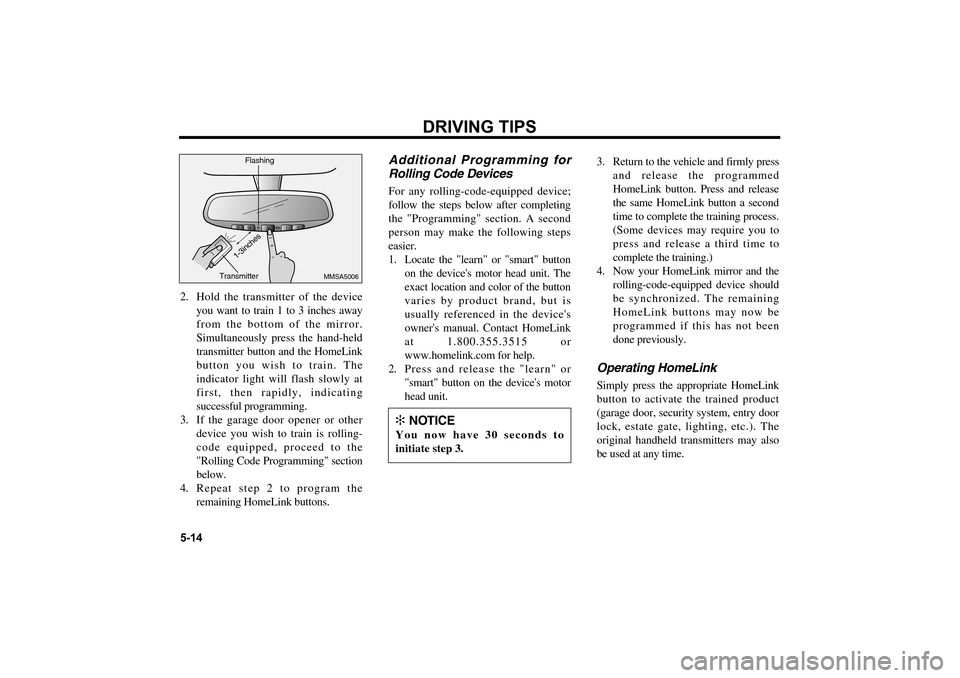
2. Hold the transmitter of the device
you want to train 1 to 3 inches away
from the bottom of the mirror.
Simultaneously press the hand-held
transmitter button and the HomeLink
button you wish to train. The
indicator light will flash slowly at
first, then rapidly, indicating
successful programming.
3. If the garage door opener or other
device you wish to train is rolling-
code equipped, proceed to the
"Rolling Code Programming" section
below.
4. Repeat step 2 to program the
remaining HomeLink buttons.
Additional Programming for
Rolling Code DevicesFor any rolling-code-equipped device;
follow the steps below after completing
the "Programming" section. A second
person may make the following steps
easier.
1. Locate the "learn" or "smart" button
on the device's motor head unit. The
exact location and color of the button
varies by product brand, but is
usually referenced in the device's
owner's manual. Contact HomeLink
at 1.800.355.3515 or
www.homelink.com for help.
2. Press and release the "learn" or
"smart" button on the device's motor
head unit.3. Return to the vehicle and firmly press
and release the programmed
HomeLink button. Press and release
the same HomeLink button a second
time to complete the training process.
(Some devices may require you to
press and release a third time to
complete the training.)
4. Now your HomeLink mirror and the
rolling-code-equipped device should
be synchronized. The remaining
HomeLink buttons may now be
programmed if this has not been
done previously.
Operating HomeLinkSimply press the appropriate HomeLink
button to activate the trained product
(garage door, security system, entry door
lock, estate gate, lighting, etc.). The
original handheld transmitters may also
be used at any time.
DRIVING TIPS
5-14
MMSA5006
✻
NOTICE
You now have 30 seconds to
initiate step 3.
Flashing
Transmitter
1-3inches
MS-CNA-Eng 5 New.qxd 7/25/2005 5:21 PM Page 14
Page 159 of 225
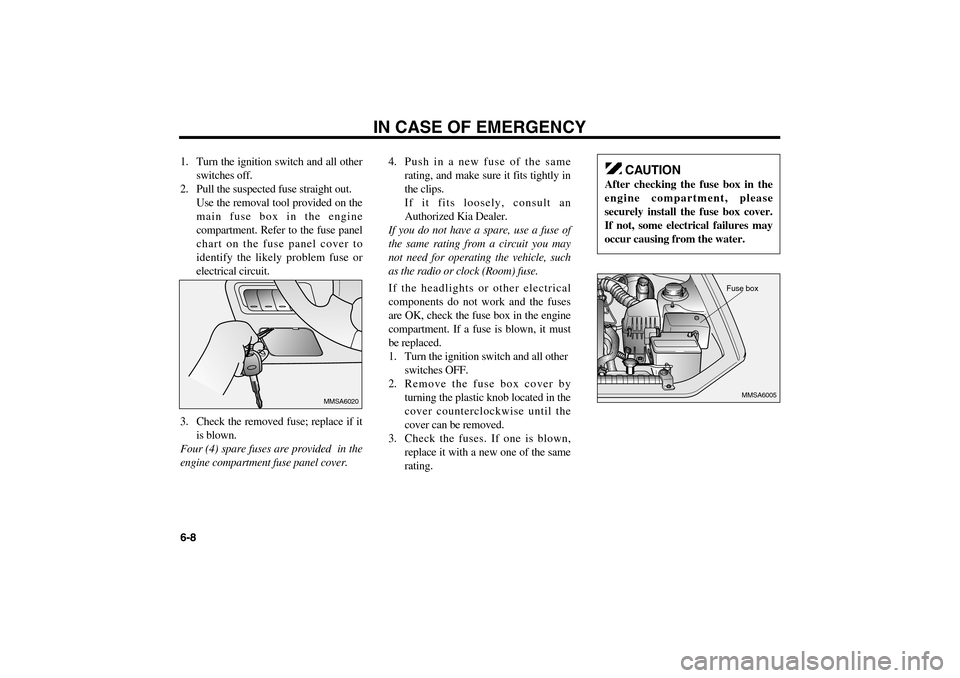
1. Turn the ignition switch and all other
switches off.
2. Pull the suspected fuse straight out.
Use the removal tool provided on the
main fuse box in the engine
compartment. Refer to the fuse panel
chart on the fuse panel cover to
identify the likely problem fuse or
electrical circuit.
3. Check the removed fuse; replace if it
is blown.
Four (4) spare fuses are provided in the
engine compartment fuse panel cover.4. Push in a new fuse of the same
rating, and make sure it fits tightly in
the clips.
If it fits loosely, consult an
Authorized Kia Dealer.
If you do not have a spare, use a fuse of
the same rating from a circuit you may
not need for operating the vehicle, such
as the radio or clock (Room) fuse.
If the headlights or other electrical
components do not work and the fuses
are OK, check the fuse box in the engine
compartment. If a fuse is blown, it must
be replaced.
1. Turn the ignition switch and all other
switches OFF.
2. Remove the fuse box cover by
turning the plastic knob located in the
cover counterclockwise until the
cover can be removed.
3. Check the fuses. If one is blown,
replace it with a new one of the same
rating.
IN CASE OF EMERGENCY
6-8
MMSA6020
MMSA6005
Fuse box
CAUTION
After checking the fuse box in the
engine compartment, please
securely install the fuse box cover.
If not, some electrical failures may
occur causing from the water.
MS-CNA-Eng 6.QXD 7/25/2005 5:13 PM Page 8
Page 160 of 225
6-9
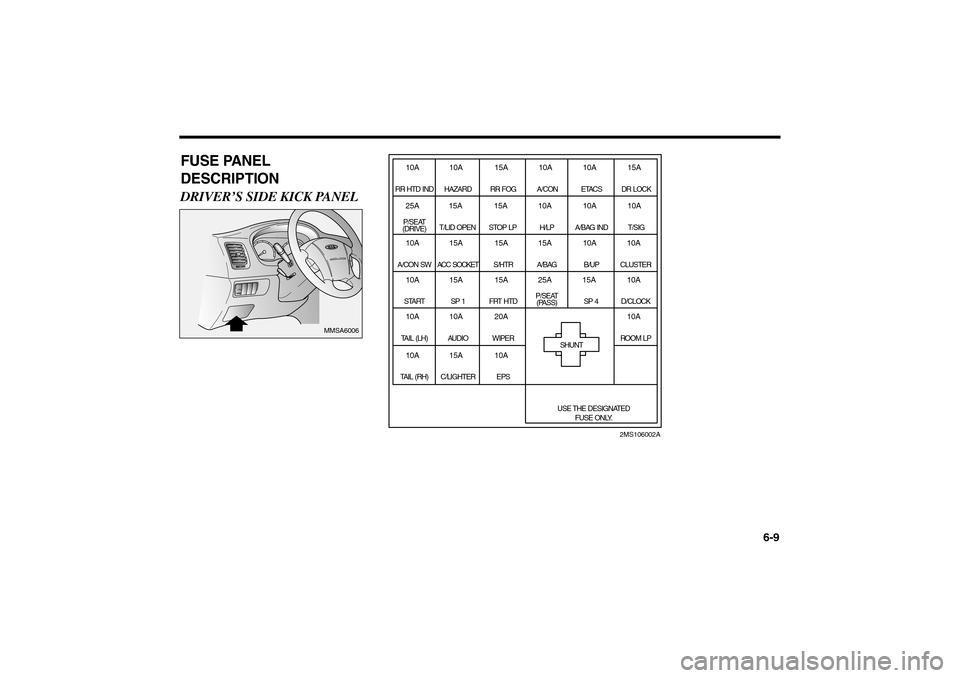
FUSE PANEL
DESCRIPTIONDRIVER’S SIDE KICK PANEL
L
P
G
MMSA6006
10ARR HTD IND
10AHAZARD
15ARR FOG
10AA/CON
10AETACS
15ADR LOCK10AT/SIG
10AA/BAG IND
10AH/LP
15ASTOP LP
15AT/LID OPEN
25AP/SEAT
(DRIVE)10AA/CON SW
15A
ACC SOCKET
15AS/HTR
15AA/BAG
10ASTART
15ASP 1
15AFRT HTD
10ATAIL (LH)
10AAUDIO
20AWIPER
10ATAIL (RH)
15AC/LIGHTER
10AEPS
10AROOM LP
SHUNT
USE THE DESIGNATED
FUSE ONLY.
25AP/SEAT
(PASS)
10AB/UP
10ACLUSTER10AD/CLOCK
15ASP 4
2MS106002A
MS-CNA-Eng 6.QXD 7/25/2005 5:13 PM Page 9
Page 161 of 225
IN CASE OF EMERGENCY
6-10
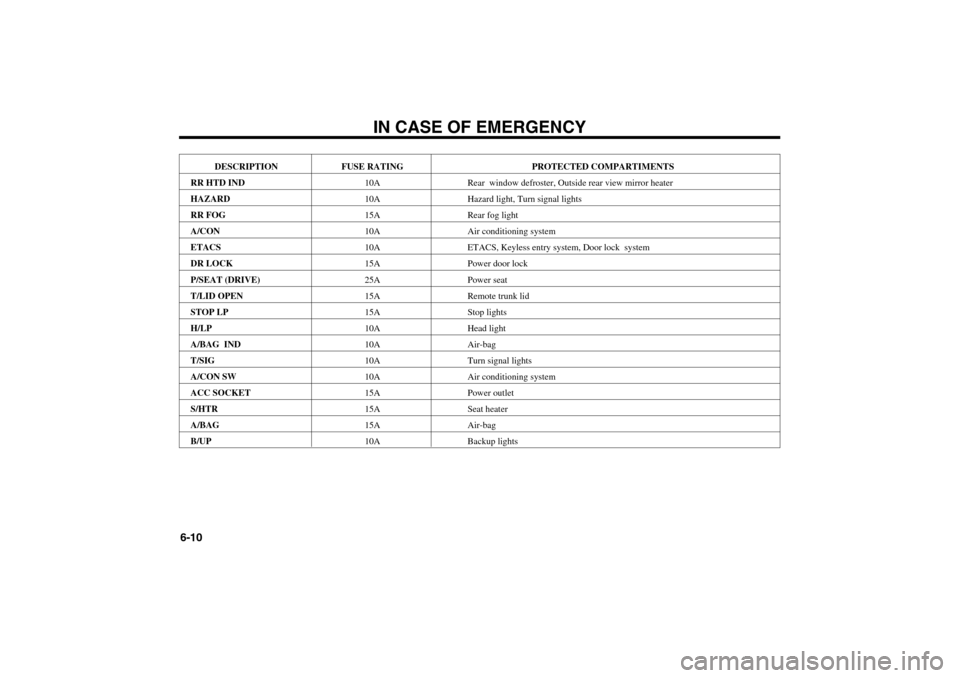
DESCRIPTION FUSE RATING PROTECTED COMPARTIMENTS
RR HTD IND10A Rear window defroster, Outside rear view mirror heater
HAZARD10A Hazard light, Turn signal lights
RR FOG15A Rear fog light
A/CON10A Air conditioning system
ETACS10A ETACS, Keyless entry system, Door lock system
DR LOCK15A Power door lock
P/SEAT (DRIVE)25A Power seat
T/LID OPEN15A Remote trunk lid
STOP LP15A Stop lights
H/LP10A Head light
A/BAG IND10A Air-bag
T/SIG10A Turn signal lights
A/CON SW10A Air conditioning system
ACC SOCKET15A Power outlet
S/HTR15A Seat heater
A/BAG15A Air-bag
B/UP10A Backup lights
MS-CNA-Eng 6.QXD 7/25/2005 5:13 PM Page 10