parking brake KIA OPTIMA 2020 Service Manual
[x] Cancel search | Manufacturer: KIA, Model Year: 2020, Model line: OPTIMA, Model: KIA OPTIMA 2020Pages: 589, PDF Size: 11.37 MB
Page 444 of 589
67
What to do in an emergency
IF THE ENGINE OVERHEATS
If your temperature gauge indicates
overheating, you will experience a
loss of power, or hear loud pinging or
knocking, the engine is probably too
hot. If this happens, you should:
1. Turn on the emergency warningflasher and stop in a safe place.
Move the shift lever to P (Park)
and engage the parking brake.
2. If hot steam does not come out from the engine room, carefully
open the engine room and check
whether the water pump connec-
tor is properly engaged. If the con-
nector is not properly engaged,
stop the engine immediately and
properly engage the connector.
Then, turn the engine on.
3. Turn on the air conditioner. 4. If the “HEV Warning” light turns on
in the driver instrument cluster, or
engine coolant or hot steam emits
from the engine coolant filler, stop
the engine immediately. Then, call
the nearest authorized Kia dealer
for assistance. If the “Engine
Warning” light remains illuminated
or the engine coolant is not flowing
out, keep the engine running.
Open the engine hood for ventila-
tion to help cool down the engine. 5. Check the coolant temperature
gauge on the instrument cluster to
make sure the coolant tempera-
ture is sufficiently cooled down. If
the engine coolant level is low,
please check the connecting parts
between the radiator hose, heater
hose, and water pump for any
signs of leakage. When there is no
sign of leakage, please refill the
engine coolant. If causes and
signs of engine overheating such
as warning light illumination,
engine coolant leakage, or cooling
fan malfunction are found, stop the
vehicle the earliest. Then, call the
nearest authorized Kia dealer for
assistance.
WARNING
While the engine is running,
keep hair, hands and clothing
away from moving parts such
as the fan and drive belts to pre-
vent injury.
Page 462 of 589
625
What to do in an emergency
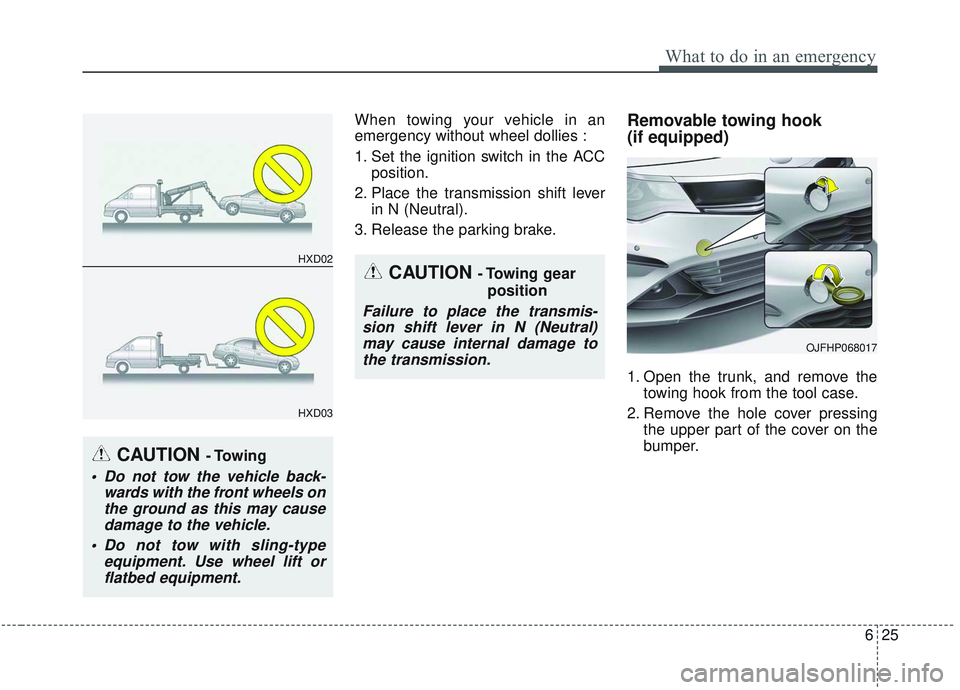
When towing your vehicle in an
emergency without wheel dollies :
1. Set the ignition switch in the ACCposition.
2. Place the transmission shift lever in N (Neutral).
3. Release the parking brake.Removable towing hook
(if equipped)
1. Open the trunk, and remove the towing hook from the tool case.
2. Remove the hole cover pressing the upper part of the cover on the
bumper.
CAUTION - Towing gear
position
Failure to place the transmis-sion shift lever in N (Neutral)may cause internal damage tothe transmission.
CAUTION - Towing
Do not tow the vehicle back- wards with the front wheels onthe ground as this may causedamage to the vehicle.
Do not tow with sling-type equipment. Use wheel lift orflatbed equipment.
HXD02
HXD03
OJFHP068017
Page 465 of 589
What to do in an emergency
28
6
Emergency towing precautions
Turn the ignition switch to ACC so
the steering wheel isn’t locked.
Place the transmission shift lever in N (Neutral).
Release the parking brake.
Press the brake pedal with more force than normal since you will
have reduced brake performance.
More steering effort will be required because the power steer-
ing system will be disabled.
If you are driving down a long hill, the brakes may overheat and brake
performance will be reduced. Stop
often and let the brakes cool off.
The vehicle should be towed at a speed of 25 km/h (15 mph) or less
within the distance of 20 km (12
miles). If the car is being towed with all
four wheels on the ground, it can
be towed only from the front. Be
sure that the transmission is in
neutral. Be sure the steering is
unlocked by placing the ignition
switch in the ACC position. A driver
must be in the towed vehicle to
operate the steering and brakes.
CAUTION - Automatic
transmission
To avoid serious damage to the automatic transmission,limit the vehicle speed to 15km/h (10 mph) and drive lessthan 1.5 km (1 mile) when tow-ing.
Before towing, check the auto- matic transmission for fluidleaks under your vehicle. If theautomatic transmission fluidis leaking, flatbed equipmentor a towing dolly must beused.
Page 467 of 589
Maintenance
7
Engine compartment . . . . . . . . . . . . . . . . . . . . . . . . 7-3
Maintenance services . . . . . . . . . . . . . . . . . . . . . . . . 7-4
• Owner’s responsibility . . . . . . . . . . . . . . . . . . . . . . . . . 7-4
• Owner maintenance precautions . . . . . . . . . . . . . . . . . 7-5
Owner maintenance . . . . . . . . . . . . . . . . . . . . . . . . . 7-6
• Owner maintenance schedule . . . . . . . . . . . . . . . . . . . 7-6
Scheduled maintenance service. . . . . . . . . . . . . . . . 7-8
Explanation of scheduled maintenance items . . . 7-14
Checking fluid levels . . . . . . . . . . . . . . . . . . . . . . . 7-17
Engine oil. . . . . . . . . . . . . . . . . . . . . . . . . . . . . . . . . 7-18
• Checking the engine oil level . . . . . . . . . . . . . . . . . . . 7-18
• Changing the engine oil and filter . . . . . . . . . . . . . . . 7-19
Engine maintenance mode (for plug-in Hybrid). . 7-20
• Starting Engine Maintenance Mode . . . . . . . . . . . . . 7-20
• Stopping Engine Maintenance Mode. . . . . . . . . . . . . 7-20
Coolant . . . . . . . . . . . . . . . . . . . . . . . . . . . . . . . . . . 7-21\
• Checking the coolant level . . . . . . . . . . . . . . . . . . . . . 7-21
• Engine coolant . . . . . . . . . . . . . . . . . . . . . . . . . . . . . . . 7-22
• Inverter coolant . . . . . . . . . . . . . . . . . . . . . . . . . . . . . . 7-22
• Recommended coolant . . . . . . . . . . . . . . . . . . . . . . . . 7-23
• Changing the coolant . . . . . . . . . . . . . . . . . . . . . . . . . 7-24
Brake fluid . . . . . . . . . . . . . . . . . . . . . . . . . . . . . . . 7-25
• Checking the brake fluid level . . . . . . . . . . . . . . . . . . 7-25
Washer fluid . . . . . . . . . . . . . . . . . . . . . . . . . . . . . . 7-26
• Checking the washer fluid level . . . . . . . . . . . . . . . . . 7-26
Parking brake . . . . . . . . . . . . . . . . . . . . . . . . . . . . . 7-27
• Checking the parking brake. . . . . . . . . . . . . . . . . . . . 7-27
Air cleaner. . . . . . . . . . . . . . . . . . . . . . . . . . . . . . . . 7-28
• Filter replacement . . . . . . . . . . . . . . . . . . . . . . . . . . . 7-28
Climate control air filter . . . . . . . . . . . . . . . . . . . . 7-30
• Filter inspection . . . . . . . . . . . . . . . . . . . . . . . . . . . . . . 7-30
Wiper blades . . . . . . . . . . . . . . . . . . . . . . . . . . . . . . 7-32
• Blade inspection . . . . . . . . . . . . . . . . . . . . . . . . . . . . . . 7-32
• Blade replacement . . . . . . . . . . . . . . . . . . . . . . . . . . . . 7-32
Battery . . . . . . . . . . . . . . . . . . . . . . . . . . . . . . . . . . . 7-\
36
• For best battery service . . . . . . . . . . . . . . . . . . . . . . . 7-36
• Recharging the battery . . . . . . . . . . . . . . . . . . . . . . . . 7-37
• Reset items . . . . . . . . . . . . . . . . . . . . . . . . . . . . . . . . . . 7-38\
Tires and wheels . . . . . . . . . . . . . . . . . . . . . . . . . . . 7-39
• Tire care . . . . . . . . . . . . . . . . . . . . . . . . . . . . . . . . . . . . \
7-39
• Recommended cold tire inflation pressures . . . . . . . 7-39
• Tire pressure . . . . . . . . . . . . . . . . . . . . . . . . . . . . . . . . 7-40
• Checking tire inflation pressure. . . . . . . . . . . . . . . . . 7-40
• Tire rotation . . . . . . . . . . . . . . . . . . . . . . . . . . . . . . . . 7-41
• Wheel alignment and tire balance . . . . . . . . . . . . . . . 7-42
• Tire replacement . . . . . . . . . . . . . . . . . . . . . . . . . . . . . 7-43
• Wheel replacement . . . . . . . . . . . . . . . . . . . . . . . . . . . 7-43
• Tire traction . . . . . . . . . . . . . . . . . . . . . . . . . . . . . . . . . 7-44
• Tire maintenance . . . . . . . . . . . . . . . . . . . . . . . . . . . . 7-44
• Tire sidewall labeling . . . . . . . . . . . . . . . . . . . . . . . . . 7-44
Page 472 of 589
Maintenance
67
OWNER MAINTENANCE
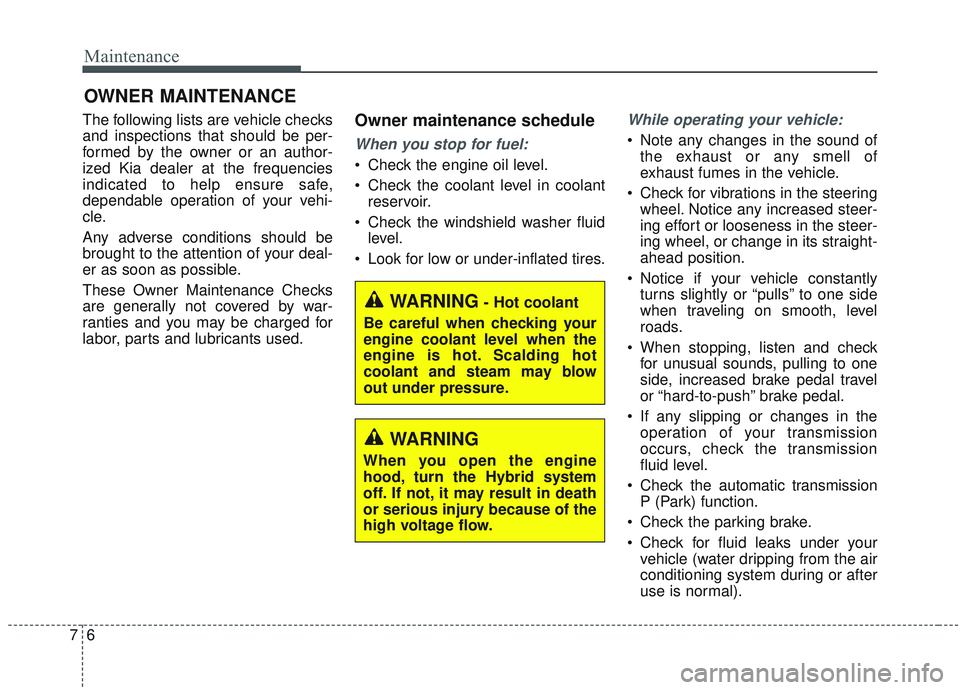
The following lists are vehicle checks
and inspections that should be per-
formed by the owner or an author-
ized Kia dealer at the frequencies
indicated to help ensure safe,
dependable operation of your vehi-
cle.
Any adverse conditions should be
brought to the attention of your deal-
er as soon as possible.
These Owner Maintenance Checks
are generally not covered by war-
ranties and you may be charged for
labor, parts and lubricants used.Owner maintenance schedule
When you stop for fuel:
Check the engine oil level.
Check the coolant level in coolantreservoir.
Check the windshield washer fluid level.
Look for low or under-inflated tires.
While operating your vehicle:
Note any changes in the sound of the exhaust or any smell of
exhaust fumes in the vehicle.
Check for vibrations in the steering wheel. Notice any increased steer-
ing effort or looseness in the steer-
ing wheel, or change in its straight-
ahead position.
Notice if your vehicle constantly turns slightly or “pulls” to one side
when traveling on smooth, level
roads.
When stopping, listen and check for unusual sounds, pulling to one
side, increased brake pedal travel
or “hard-to-push” brake pedal.
If any slipping or changes in the operation of your transmission
occurs, check the transmission
fluid level.
Check the automatic transmission P (Park) function.
Check the parking brake.
Check for fluid leaks under your vehicle (water dripping from the air
conditioning system during or after
use is normal).
WARNING- Hot coolant
Be careful when checking your
engine coolant level when the
engine is hot. Scalding hot
coolant and steam may blow
out under pressure.
WARNING
When you open the engine
hood, turn the Hybrid system
off. If not, it may result in death
or serious injury because of the
high voltage flow.
Page 477 of 589
711
Maintenance
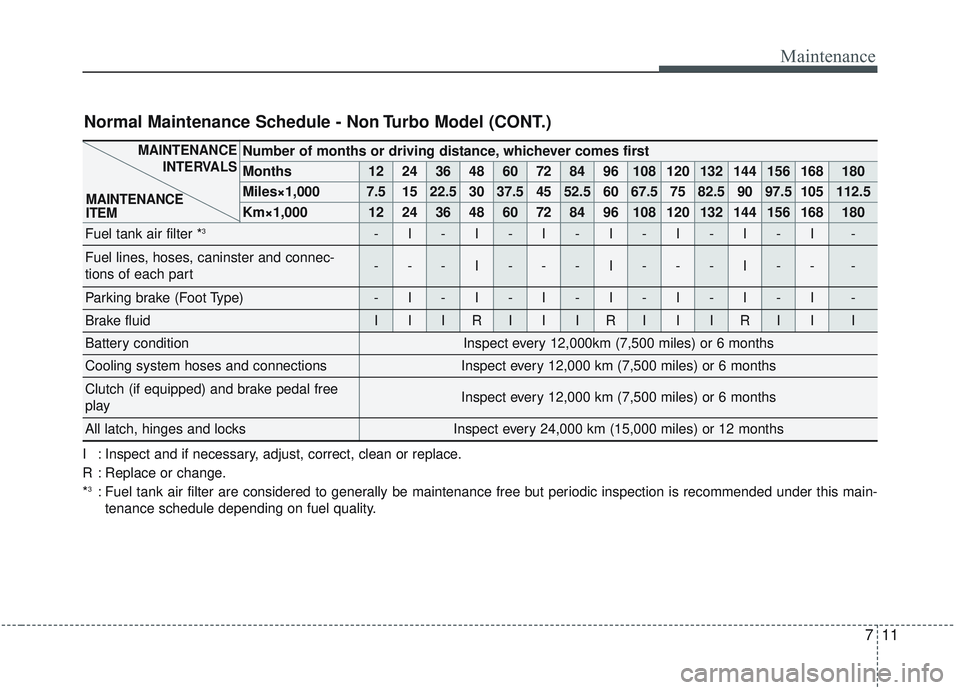
Number of months or driving distance, whichever comes first
Months1224364860728496108120132144156168180
Miles×1,0007.51522.530 37.5 45 52.5 60 67.5 75 82.5 90 97.5 105 112.5
Km×1,00012 24 36 48 60 72 84 96 108 120 132 144 156 168 180
Fuel tank air filter *3-I-I-I-I-I-I-I-
Fuel lines, hoses, caninster and connec-
tions of each part---I---I---I---
Parking brake (Foot Type)-I-I-I-I-I-I-I-
Brake fluidIIIRIIIRIIIRIII
Battery conditionInspect every 12,000km (7,500 miles) or 6 months
Cooling system hoses and connectionsInspect every 12,000 km (7,500 miles) or 6 months
Clutch (if equipped) and brake pedal free
playInspect every 12,000 km (7,500 miles) or 6 months
All latch, hinges and locksInspect every 24,000 km (15,000 miles) or 12 months
MAINTENANCEINTERVALS
MAINTENANCE
ITEM
Normal Maintenance Schedule - Non Turbo Model (CONT.)
I : Inspect and if necessary, adjust, correct, clean or replace.
R : Replace or change.
*
3: Fuel tank air filter are considered to generally be maintenance free but periodic inspection is recommended under this main- tenance schedule depending on fuel quality.
Page 478 of 589
Maintenance
12
7
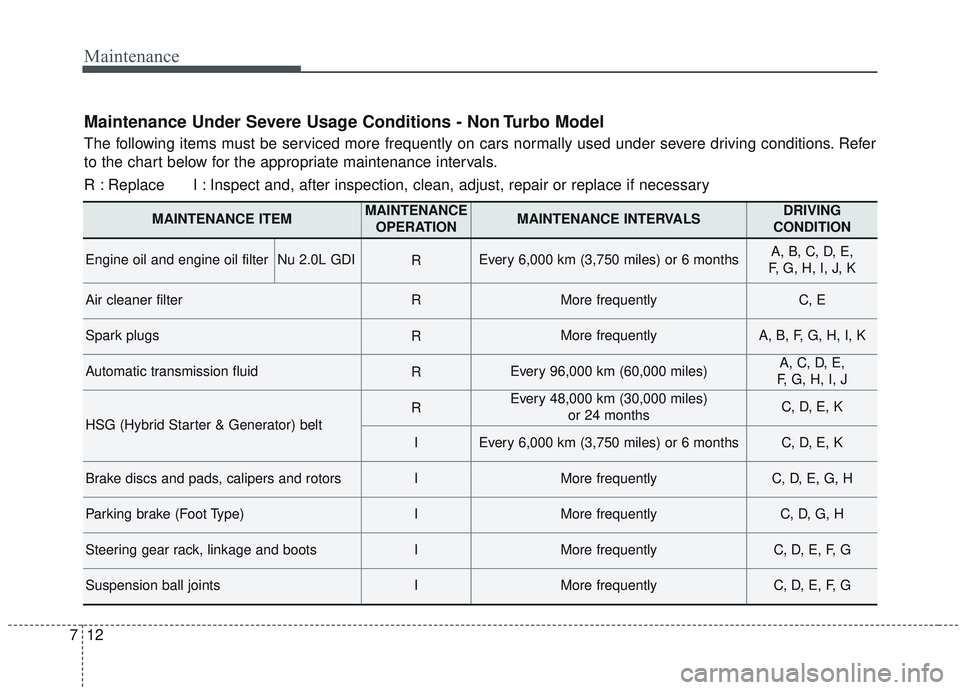
Maintenance Under Severe Usage Conditions - Non Turbo Model
The following items must be serviced more frequently on cars normally used under severe driving conditions. Refer
to the chart below for the appropriate maintenance intervals.
R : Replace I : Inspect and, after inspection, clean, adjust, repair or replace if neces\
sary
MAINTENANCE ITEMMAINTENANCE
OPERATIONMAINTENANCE INTERVALSDRIVING
CONDITION
Engine oil and engine oil filterNu 2.0L GDIREvery 6,000 km (3,750 miles) or 6 monthsA, B, C, D, E,
F, G, H, I, J, K
Air cleaner filterRMore frequentlyC, E
Spark plugs RMore frequentlyA, B, F, G, H, I, K
Automatic transmission fluidREvery 96,000 km (60,000 miles)A, C, D, E,
F, G, H, I, J
HSG (Hybrid Starter & Generator) belt
REvery 48,000 km (30,000 miles) or 24 monthsC, D, E, K
IEvery 6,000 km (3,750 miles) or 6 monthsC, D, E, K
Brake discs and pads, calipers and rotorsIMore frequentlyC, D, E, G, H
Parking brake (Foot Type)IMore frequentlyC, D, G, H
Steering gear rack, linkage and bootsIMore frequentlyC, D, E, F, G
Suspension ball jointsIMore frequentlyC, D, E, F, G
Page 482 of 589
Maintenance
16
7
Automatic transmission fluid
Automatic transmission fluid should
not be checked under normal usage
conditions.
But in severe conditions, the fluid
should be changed at an authorized
Kia dealer in accordance to the
scheduled maintenance at the begin-
ning of this chapter.
✽ ✽
NOTICE
Automatic transmission fluid color
is reddish.
As the vehicle is driven, the auto-
matic transmission fluid will begin
to look darker.
It is normal condition and you should
not judge the need to replace the fluid
based upon the changed color.
Brake hoses and lines
Visually check for proper installation,
chafing, cracks, deterioration and
any leakage. Replace any deteriorat-
ed or damaged parts immediately.
Brake fluid
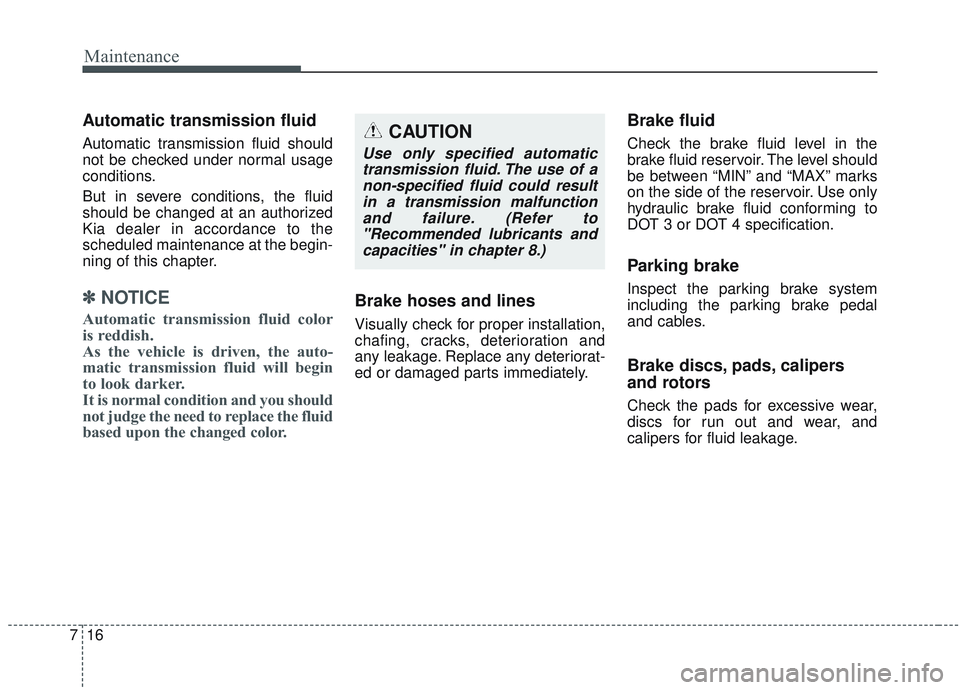
Check the brake fluid level in the
brake fluid reservoir. The level should
be between “MIN” and “MAX” marks
on the side of the reservoir. Use only
hydraulic brake fluid conforming to
DOT 3 or DOT 4 specification.
Parking brake
Inspect the parking brake system
including the parking brake pedal
and cables.
Brake discs, pads, calipers
and rotors
Check the pads for excessive wear,
discs for run out and wear, and
calipers for fluid leakage.
CAUTION
Use only specified automatic
transmission fluid. The use of anon-specified fluid could resultin a transmission malfunctionand failure. (Refer to"Recommended lubricants andcapacities" in chapter 8.)
Page 493 of 589
727
Maintenance
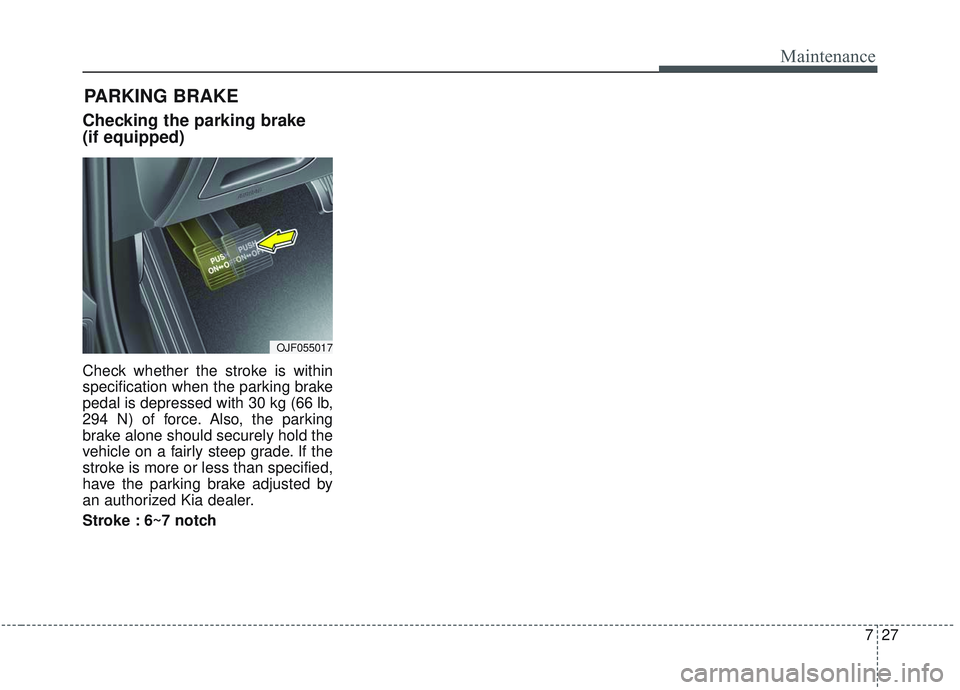
Checking the parking brake
(if equipped)
Check whether the stroke is within
specification when the parking brake
pedal is depressed with 30 kg (66 lb,
294 N) of force. Also, the parking
brake alone should securely hold the
vehicle on a fairly steep grade. If the
stroke is more or less than specified,
have the parking brake adjusted by
an authorized Kia dealer.
Stroke : 6~7 notch
PARKING BRAKE
OJF055017
Page 526 of 589
Maintenance
60
7
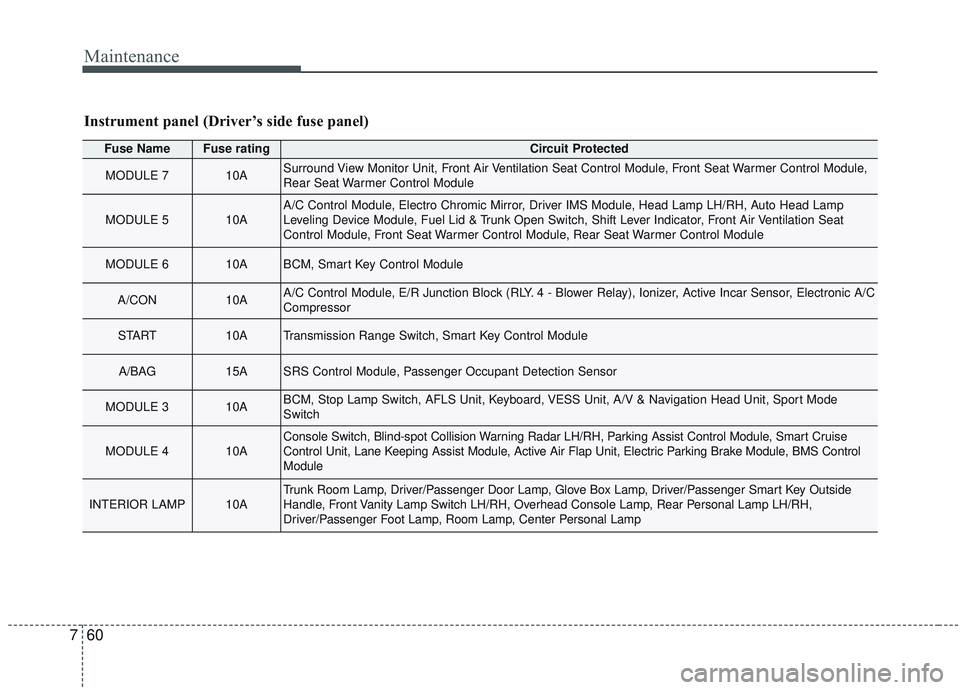
Instrument panel (Driver’s side fuse panel)
Fuse NameFuse ratingCircuit Protected
MODULE 710ASurround View Monitor Unit, Front Air Ventilation Seat Control Module, Front Seat Warmer Control Module,
Rear Seat Warmer Control Module
MODULE 510AA/C Control Module, Electro Chromic Mirror, Driver IMS Module, Head Lamp LH/RH, Auto Head Lamp
Leveling Device Module, Fuel Lid & Trunk Open Switch, Shift Lever Indicator, Front Air Ventilation Seat
Control Module, Front Seat Warmer Control Module, Rear Seat Warmer Control Module
MODULE 610ABCM, Smart Key Control Module
A/CON10AA/C Control Module, E/R Junction Block (RLY. 4 - Blower Relay), Ionizer, Active Incar Sensor, Electronic A/C
Compressor
START10ATransmission Range Switch, Smart Key Control Module
A/BAG15ASRS Control Module, Passenger Occupant Detection Sensor
MODULE 310ABCM, Stop Lamp Switch, AFLS Unit, Keyboard, VESS Unit, A/V & Navigation Head Unit, Sport Mode
Switch
MODULE 410AConsole Switch, Blind-spot Collision Warning Radar LH/RH, Parking Assist Control Module, Smart Cruise
Control Unit, Lane Keeping Assist Module, Active Air Flap Unit, Electric Parking Brake Module, BMS Control
Module
INTERIOR LAMP10ATrunk Room Lamp, Driver/Passenger Door Lamp, Glove Box Lamp, Driver/Passenger Smart Key Outside
Handle, Front Vanity Lamp Switch LH/RH, Overhead Console Lamp, Rear Personal Lamp LH/RH,
Driver/Passenger Foot Lamp, Room Lamp, Center Personal Lamp