ignition KIA Rio 2005 2.G User Guide
[x] Cancel search | Manufacturer: KIA, Model Year: 2005, Model line: Rio, Model: KIA Rio 2005 2.GPages: 238, PDF Size: 2.6 MB
Page 60 of 238
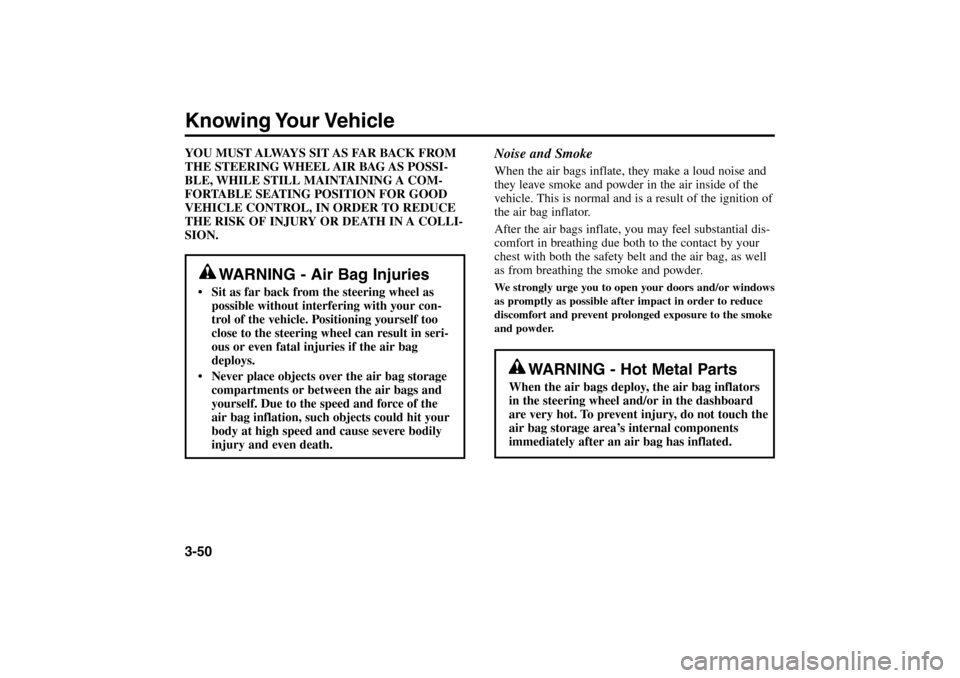
Knowing Your Vehicle3-50YOU MUST ALWAYS SIT AS FAR BACK FROM
THE STEERING WHEEL AIR BAG AS POSSI-
BLE, WHILE STILL MAINTAINING A COM-
FORTABLE SEATING POSITION FOR GOOD
VEHICLE CONTROL, IN ORDER TO REDUCE
THE RISK OF INJURY OR DEATH IN A COLLI-
SION.
WARNING - Air Bag Injuries
Sit as far back from the steering wheel as
possible without interfering with your con-
trol of the vehicle. Positioning yourself too
close to the steering wheel can result in seri-
ous or even fatal injuries if the air bag
deploys.
Never place objects over the air bag storage
compartments or between the air bags and
yourself. Due to the speed and force of the
air bag inflation, such objects could hit your
body at high speed and cause severe bodily
injury and even death.
Noise and SmokeWhen the air bags inflate, they make a loud noise and
they leave smoke and powder in the air inside of the
vehicle. This is normal and is a result of the ignition of
the air bag inflator.
After the air bags inflate, you may feel substantial dis-
comfort in breathing due both to the contact by your
chest with both the safety belt and the air bag, as well
as from breathing the smoke and powder. We strongly urge you to open your doors and/or windows
as promptly as possible after impact in order to reduce
discomfort and prevent prolonged exposure to the smoke
and powder.
WARNING - Hot Metal Parts
When the air bags deploy, the air bag inflators
in the steering wheel and/or in the dashboard
are very hot. To prevent injury, do not touch the
air bag storage area’s internal components
immediately after an air bag has inflated.
RIO ENG CNA 3.qxd 7/29/05 5:13 PM Page 50
Page 62 of 238
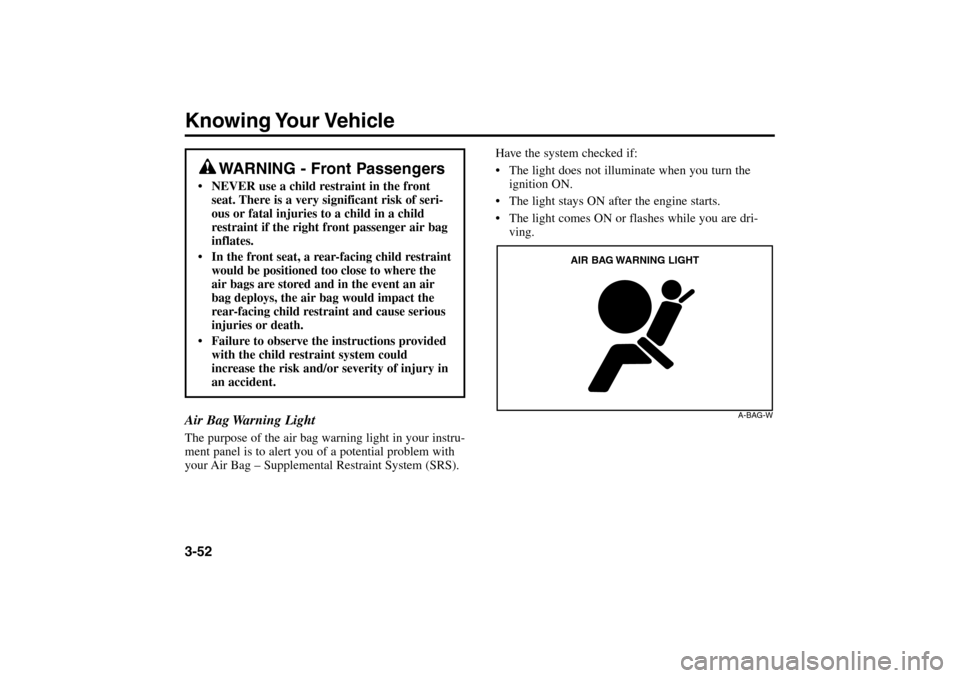
Knowing Your Vehicle3-52 Air Bag Warning LightThe purpose of the air bag warning light in your instru-
ment panel is to alert you of a potential problem with
your Air Bag – Supplemental Restraint System (SRS).
WARNING - Front Passengers
NEVER use a child restraint in the front
seat. There is a very significant risk of seri-
ous or fatal injuries to a child in a child
restraint if the right front passenger air bag
inflates.
In the front seat, a rear-facing child restraint
would be positioned too close to where the
air bags are stored and in the event an air
bag deploys, the air bag would impact the
rear-facing child restraint and cause serious
injuries or death.
Failure to observe the instructions provided
with the child restraint system could
increase the risk and/or severity of injury in
an accident.
Have the system checked if:
The light does not illuminate when you turn the
ignition ON.
The light stays ON after the engine starts.
The light comes ON or flashes while you are dri-
ving.
A-BAG-W
AIR BAG WARNING LIGHT
RIO ENG CNA 3.qxd 7/29/05 5:13 PM Page 52
Page 82 of 238
4-1
DRIVING YOUR VEHICLEIgnition Switch . . . . . . . . . . . . . . . . . . . . . . . . . . . . . . .4-2
Starting the Engine . . . . . . . . . . . . . . . . . . . . . . . . . . . .4-4
Manual Transaxle . . . . . . . . . . . . . . . . . . . . . . . . . . . . .4-7
Automatic Transaxle . . . . . . . . . . . . . . . . . . . . . . . . . . .4-9
Brake System . . . . . . . . . . . . . . . . . . . . . . . . . . . . . . .4-15
Power Steering . . . . . . . . . . . . . . . . . . . . . . . . . . . . . .4-22
Tilt Steering . . . . . . . . . . . . . . . . . . . . . . . . . . . . . . . . .4-22
Instrument Cluster . . . . . . . . . . . . . . . . . . . . . . . . . . .4-23
Gauges . . . . . . . . . . . . . . . . . . . . . . . . . . . . . . . . . . . .4-25
Warnings and Indicators . . . . . . . . . . . . . . . . . . . . . .4-27
Lighting . . . . . . . . . . . . . . . . . . . . . . . . . . . . . . . . . . . .4-33
Daytime Running Lights(DRL) . . . . . . . . . . . . . . . . . .4-35
Wipers and Washers . . . . . . . . . . . . . . . . . . . . . . . . . .4-36
Rear Window Defroster . . . . . . . . . . . . . . . . . . . . . . . .4-38
Interior Features . . . . . . . . . . . . . . . . . . . . . . . . . . . . .4-40
Climate Control System . . . . . . . . . . . . . . . . . . . . . . .4-44
Windshield Defrosting and Defogging . . . . . . . . . . . .4-50
4
RIO ENG CNA 4.qxd 7/29/05 5:06 PM Page 1
Page 83 of 238
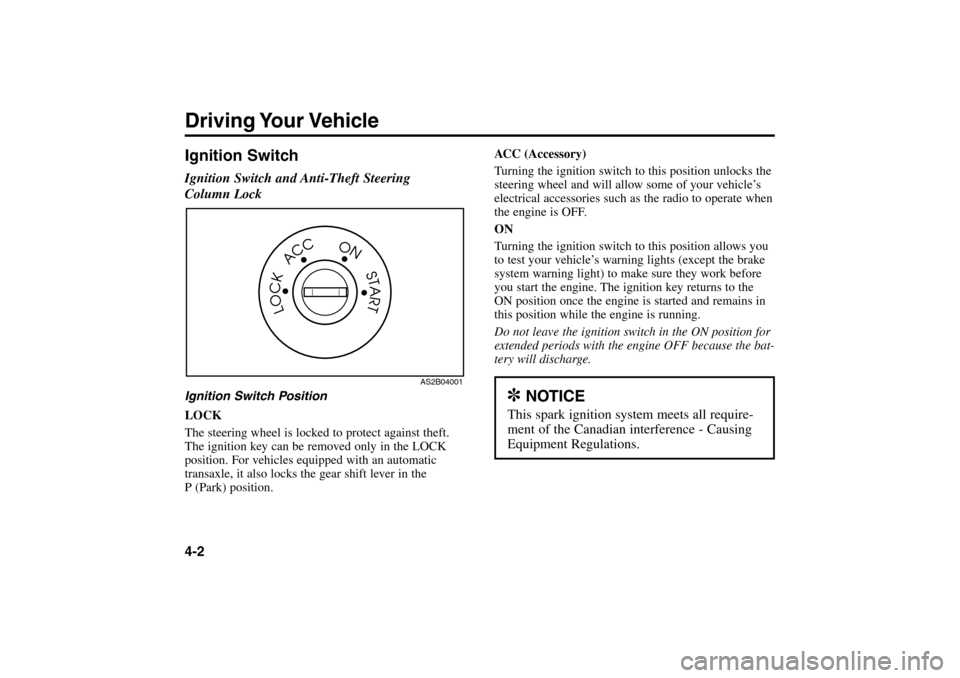
Ignition SwitchIgnition Switch and Anti-Theft Steering
Column LockIgnition Switch Position
LOCK
The steering wheel is locked to protect against theft.
The ignition key can be removed only in the LOCK
position. For vehicles equipped with an automatic
transaxle, it also locks the gear shift lever in the
P (Park) position.
ACC (Accessory)
Turning the ignition switch to this position unlocks the
steering wheel and will allow some of your vehicle’s
electrical accessories such as the radio to operate when
the engine is OFF.
ON
Turning the ignition switch to this position allows you
to test your vehicle’s warning lights (except the brake
system warning light) to make sure they work before
you start the engine. The ignition key returns to the
ON position once the engine is started and remains in
this position while the engine is running.
Do not leave the ignition switch in the ON position for
extended periods with the engine OFF because the bat-
tery will discharge.
Driving Your Vehicle4-2
AS2B04001
✽
NOTICE
This spark ignition system meets all require-
ment of the Canadian interference - Causing
Equipment Regulations.
RIO ENG CNA 4.qxd 7/29/05 5:06 PM Page 2
Page 84 of 238
START
Turn the ignition key to the START position to start the
engine. The engine will crank until you release the key,
then it returns to the ON position. Also, the brake
warning indicator illuminates to check the bulb in this
position.
Difficulty in turning the ignition key to the START posi-
tion can be caused by pressure on the switch from the
steering column. To allow the ignition key to turn,
move the steering wheel right or left to release the ten-
sion and then turn the key.
Automatic Transaxle
When turning the ignition switch to the LOCK posi-
tion, the shift lever must be in the P (Park) position.
Manual Transaxle
When turning the ignition switch to the LOCK posi-
tion, push the key inward at the ACC position and turn
the key toward the LOCK position.
4-3
WARNING
• Never turn the ignition switch to LOCK or
ACC while the vehicle is moving. This could
result in loss of directional control and
braking function, which could cause an
immediate accident.
Never reach for the ignition switch, or any
other controls, through the steering wheel
while the vehicle is in motion. Failure to
observe this warning can result in loss of
vehicle steering and braking control, which
may result in an accident.
✽
NOTICE
For safety, the engine will not start if the
clutch pedal is not depressed fully on manual
transaxle equipped models.
RIO ENG CNA 4.qxd 7/29/05 5:06 PM Page 3
Page 85 of 238
Starting the Engine1. Make sure the parking brake is applied.
2.Manual Transaxle- Depress the clutch pedal fully
and shift the transaxle into NEUTRAL. Keep the
clutch pedal depressed while cranking the engine.
The starter will not operate if the clutch pedal is not
fully depressed.
Automatic Transaxle- Place the transaxle shift
lever in P (Park). Depress the brake pedal fully.
You can also start the engine if the shift lever is in
the N (Neutral) position.
3. Turn the ignition switch to START and hold it there
until the engine starts (a maximum of 10 seconds),
then release the key.
In extremely cold weather, below minus 18°C (0°F), or
after the vehicle has not been operated for several
days, let it warm up without depressing the accelerator.
Whether the engine is cold or warm, it should be start-
ed without depressing the accelerator.If the engine fails to start using this procedure, attempt
the following.
The engine fails to start when the engine is cold
(engine coolant temperature is below 32°F/0°C):
A no start condition may be caused by an engine that
has become flooded (has excessive fuel in the cylin-
ders). If this is the case, follow the starting procedure
below.
1. Make sure the parking brake is applied.Driving Your Vehicle4-4
✽
NOTICE
If the engine stalls while you are in motion,
do not attempt to move the shift lever to P
(Park).
If it is safe to do so considering traffic and
road conditions, you may put the shift lever
in the N (Neutral) position while still moving
and turn the ignition switch to the START
position in an attempt to restart the engine.
RIO ENG CNA 4.qxd 7/29/05 5:06 PM Page 4
Page 86 of 238
2.Manual Transaxle - Depress the clutch pedal fully
and shift the transaxle into N (Neutral). Keep the
clutch pedal depressed while cranking the engine.
The starter will not operate if the clutch pedal is not
fully depressed.
Automatic Transaxle- Place the transaxle shift
lever in P (Park) or N (Neutral). Depress the brake
pedal fully.
3. Depress the accelerator fully and hold it.
4. While holding the accelerator fully depressed, turn
the ignition switch to the START position and hold
it (a maximum of 10 seconds) to discharge the
excess fuel.
If the engine starts, the engine speed will increase
suddenly; immediately release the ignition key and
the accelerator.
If the engine has not yet started, release the acceler-
ator after cranking the engine.
5. Without depressing the accelerator, crank the
engine until it starts (a maximum of 10 seconds).If the engine fails to start when the engine is warm:
If the engine is unusually difficult to restart when it is
warm (fails to start after repeated attempts without
depressing the accelerator):
1. Make sure the parking brake is applied.
2.Manual Transaxle- Depress the clutch pedal fully
and shift the transaxle into N (Neutral). Keep the
clutch pedal depressed while cranking the engine.
The starter will not operate if the clutch pedal is not
fully depressed.
Automatic Transaxle- Place the transaxle shift
lever in P (Park) or N (Neutral). Depress the brake
pedal fully.
3. While depressing the accelerator pedal about
halfway down, turn the ignition switch to the
START position and hold it (a maximum of
10 seconds).
4. After the engine has started, let it idle for about
10 seconds before driving.
4-5
RIO ENG CNA 4.qxd 7/29/05 5:06 PM Page 5
Page 87 of 238
The starter will not operate if:
Automatic transaxle - the shift lever is NOT in P
(Park) or N (Neutral).
Manual transaxle- the clutch pedal is not fully
depressed.
Excessive engine noise (from valve tappets) may occur
if the engine has not been operated for an extended
period.
The noise should stop after the engine has reached
normal operating temperature.
If the noise does not stop, have the vehicle inspected
by an Authorized Kia Dealer.Driving Your Vehicle4-6
✽
NOTICE
Do not engage the starter for more than
10 seconds. If the engine stalls or fails to start,
wait 5 to 10 seconds before re-engaging the
starter. Excessive or improper use of the starter
may damage it.
✽
NOTICE
This spark ignition system complies with
Canadian ICES-002.
RIO ENG CNA 4.qxd 7/29/05 5:06 PM Page 6
Page 90 of 238
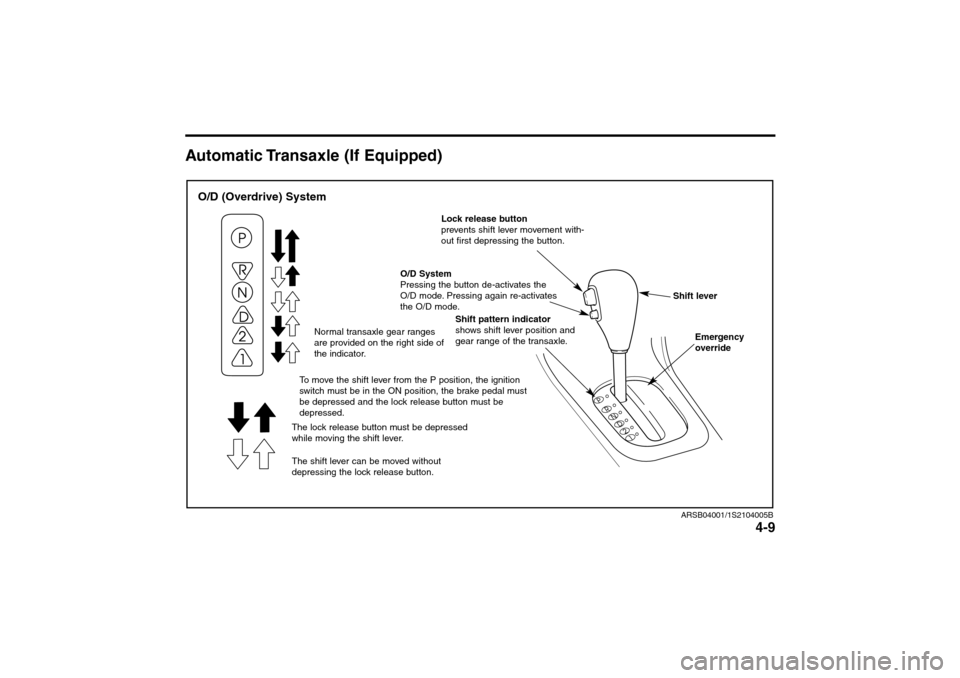
4-9
Automatic Transaxle (If Equipped)
ARSB04001/1S2104005B
Normal transaxle gear ranges
are provided on the right side of
the indicator.
To move the shift lever from the P position, the ignition
switch must be in the ON position, the brake pedal must
be depressed and the lock release button must be
depressed.
The lock release button must be depressed
while moving the shift lever.
The shift lever can be moved without
depressing the lock release button.Lock release button
prevents shift lever movement with-
out first depressing the button.
O/D System
Pressing the button de-activates the
O/D mode. Pressing again re-activates
the O/D mode.
Emergency
override
O/D (Overdrive) System
Shift lever
Shift pattern indicator
shows shift lever position and
gear range of the transaxle.
RIO ENG CNA 4.qxd 7/29/05 5:06 PM Page 9
Page 91 of 238
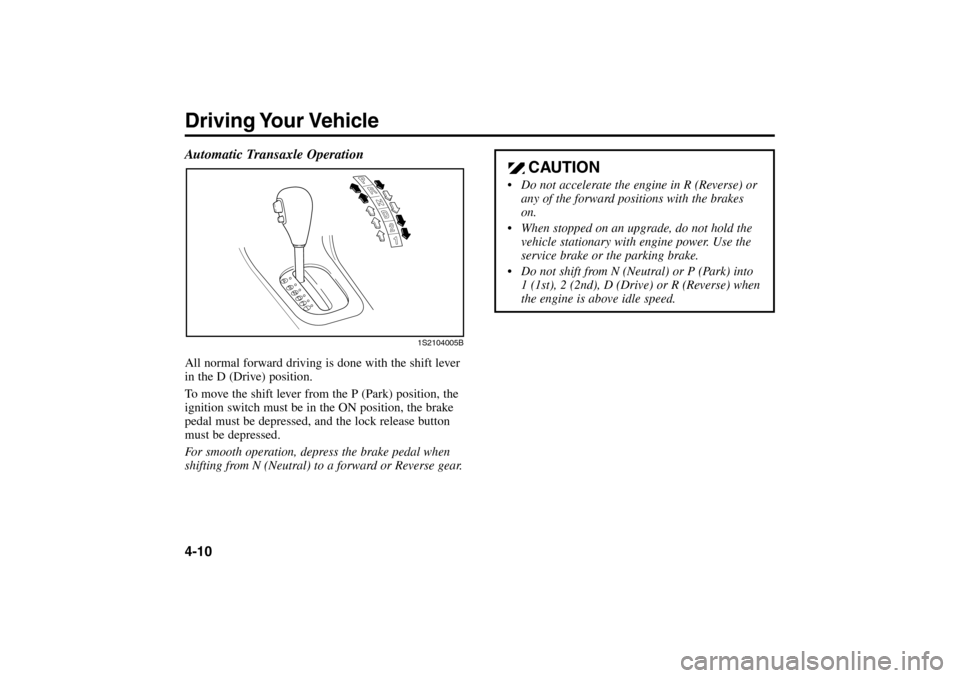
Automatic Transaxle OperationAll normal forward driving is done with the shift lever
in the D (Drive) position.
To move the shift lever from the P (Park) position, the
ignition switch must be in the ON position, the brake
pedal must be depressed, and the lock release button
must be depressed.
For smooth operation, depress the brake pedal when
shifting from N (Neutral) to a forward or Reverse gear.Driving Your Vehicle4-10
CAUTION
• Do not accelerate the engine in R (Reverse) or
any of the forward positions with the brakes
on.
When stopped on an upgrade, do not hold the
vehicle stationary with engine power. Use the
service brake or the parking brake.
Do not shift from N (Neutral) or P (Park) into
1 (1st), 2 (2nd), D (Drive) or R (Reverse) when
the engine is above idle speed.
1S2104005B
RIO ENG CNA 4.qxd 7/29/05 5:06 PM Page 10