ess KIA RIO 2022 Owner's Manual
[x] Cancel search | Manufacturer: KIA, Model Year: 2022, Model line: RIO, Model: KIA RIO 2022Pages: 528, PDF Size: 11.8 MB
Page 48 of 528
331
Safety features of your vehicle
The lap/shoulder belt automatically
returns to the “emergency lock
mode” whenever the belt is allowed
to retract fully.
Therefore, the preceding seven
steps must be followed each time a
child restraint is installed.
To remove the child restraint, press
the release button on the buckle and
then pull the lap/shoulder belt out of
the restraint and allow the seat belt
to retract fully.Securing a child restraint seatwith tether anchorage system
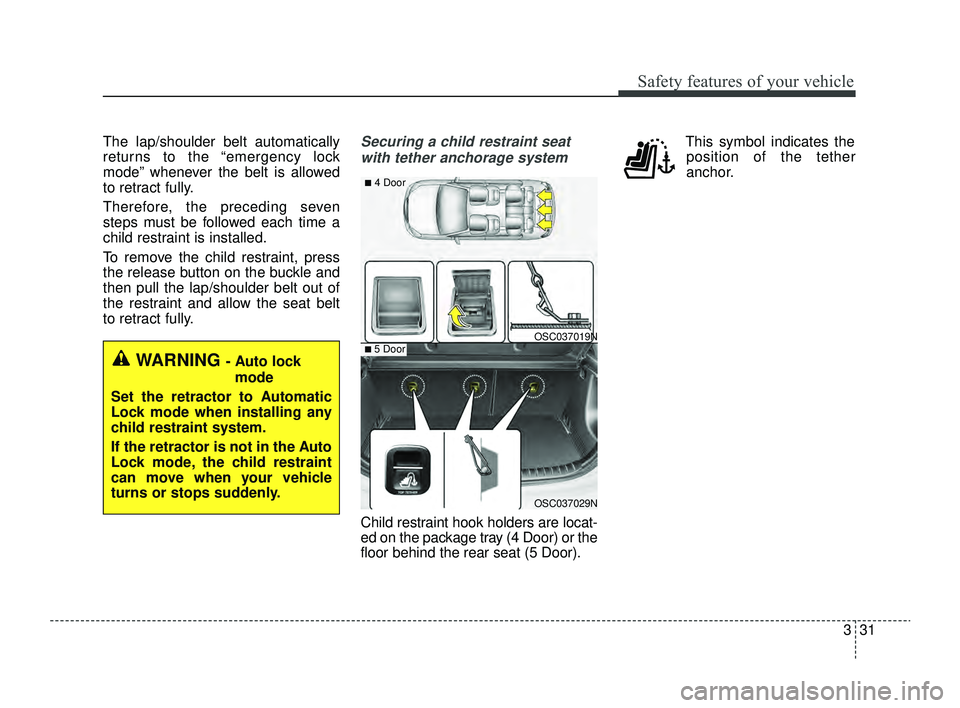
Child restraint hook holders are locat-
ed on the package tray (4 Door) or the
floor behind the rear seat (5 Door). This symbol indicates the
position of the tether
anchor.
WARNING - Auto lock
mode
Set the retractor to Automatic
Lock mode when installing any
child restraint system.
If the retractor is not in the Auto
Lock mode, the child restraint
can move when your vehicle
turns or stops suddenly.
OSC037019N
OSC037029N
■4 Door
■5 Door
SC PE USA 3.QXP 8/23/2021 5:38 PM Page 31
Page 52 of 528
335
Safety features of your vehicle
How does the air bag system
operate
Air bags are activated (able toinflate if necessary) only when the
ignition switch is turned to the ON
or START position.
Air bags inflate instantly in the event of serious frontal or side col-
lision (if equipped with side air bag
or curtain air bag) in order to help
protect the occupants from serious
physical injury.
Generally, air bags are designed to
inflate based upon the severity of a
collision and its direction. These
two factors determine whether the
sensors produce an electronic
deployment/ inflation signal. Air bag deployment depends on a
number of complex factors includ-
ing vehicle speed, angles of impact
and the density and stiffness of the
vehicles or objects which your
vehicle hits in the collision. Though,
factors are not limited to those
mentioned above. Airbags deploy
depending on the severity and
angle of the impact.
Airbags do not deploy in every
impact situation.
The front air bags will completely inflate and deflate in an instant.
It is virtually impossible for you to
see the air bags inflate during an
accident. It is much more likely that
you will simply see the deflated air
bags hanging out of their storage
compartments after the collision. In addition to inflating in certain
side collisions, vehicles equipped
with a rollover sensor, side and
curtain air bags will inflate if the
sensing system detects a rollover.
When a rollover is detected, side and
curtain air bags will remain inflated
longer to help provide protection
from ejection, especially when used
in conjunction with the seat belts.
In order to help provide protection in a severe collision, the air bags
must inflate rapidly. The speed of
air bag inflation is a consequence
of the extremely short time in
which a collision occurs and the
need to get the air bag between
the occupant and the vehicle struc-
tures before the occupant impacts
those structures. This speed of
inflation reduces the risk of serious
or life-threatening injuries in a
severe collision and is thus a nec-
essary part of air bag design.
SC PE USA 3.QXP 8/23/2021 5:38 PM Page 35
Page 53 of 528
Safety features of your vehicle
36
3
However, air bag inflation can also
cause injuries which can include
facial abrasions, bruises and bro-
ken bones because the inflation
speed also causes the air bags to
expand with a great deal of force.
There are even circumstances under which contact with the
steering wheel or passenger air
bag can cause fatal injuries,
especially if the occupant is
positioned excessively close to
the steering wheel or passenger
air bag.Noise and smoke
When the air bags inflate, they make
a loud noise and they leave smoke
and powder in the air inside of the
vehicle. This is normal and is a result
of the ignition of the air bag inflator.
After the air bag inflates, you may
feel substantial discomfort in breath-
ing due to the contact of your chest
to both the seat belt and the air bag,
as well as from breathing the smoke
and powder. Open your doors
and/or windows as soon as possi-
ble after the impact in order to
reduce discomfort and prevent
prolonged exposure to smoke and
powder.
Though the smoke and powder are
non-toxic, they may cause irritation
to the skin, eyes, nose and throat,
etc. If this is the case, wash and rinse
with cold water immediately and con-
sult a doctor if the symptom persists.WARNING - Airbag
Inflation
Sit as far back as possible from
the steering wheel while still
maintaining comfortable con-
trol of the your vehicle. A dis-
tance of at least 10" (25cm)
from your chest to the steering
wheel is recommended. Failure
to do so can result in airbag
inflation injuries to the driver.
SC PE USA 3.QXP 8/23/2021 5:38 PM Page 36
Page 54 of 528
337
Safety features of your vehicle
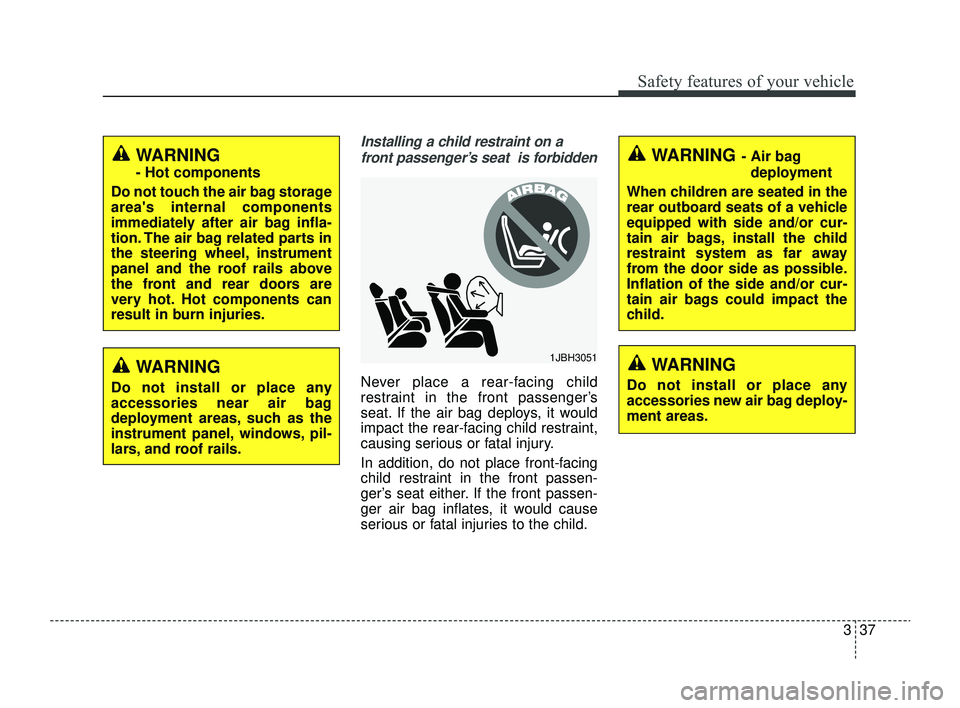
Installing a child restraint on afront passenger’s seat is forbidden
Never place a rear-facing child
restraint in the front passenger’s
seat. If the air bag deploys, it would
impact the rear-facing child restraint,
causing serious or fatal injury.
In addition, do not place front-facing
child restraint in the front passen-
ger’s seat either. If the front passen-
ger air bag inflates, it would cause
serious or fatal injuries to the child.
WARNING
- Hot components
Do not touch the air bag storage
area's internal components
immediately after air bag infla-
tion. The air bag related parts in
the steering wheel, instrument
panel and the roof rails above
the front and rear doors are
very hot. Hot components can
result in burn injuries.
1JBH3051
WARNING - Air bag deployment
When children are seated in the
rear outboard seats of a vehicle
equipped with side and/or cur-
tain air bags, install the child
restraint system as far away
from the door side as possible.
Inflation of the side and/or cur-
tain air bags could impact the
child.
WARNING
Do not install or place any
accessories near air bag
deployment areas, such as the
instrument panel, windows, pil-
lars, and roof rails.
WARNING
Do not install or place any
accessories new air bag deploy-
ment areas.
SC PE USA 3.QXP 8/23/2021 5:38 PM Page 37
Page 57 of 528
Safety features of your vehicle
40
3
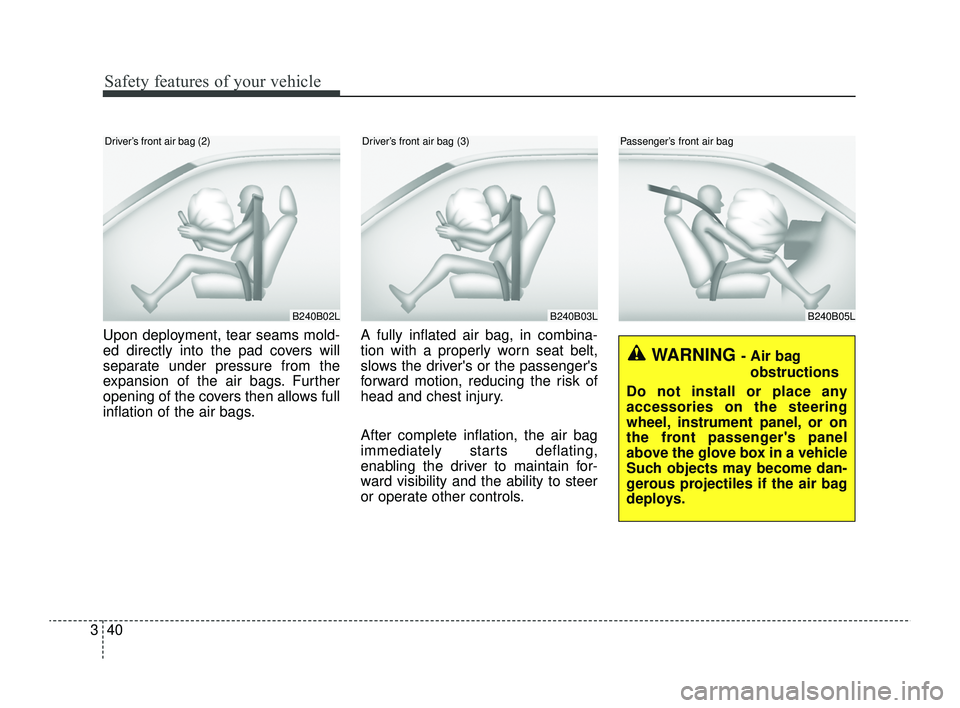
Upon deployment, tear seams mold-
ed directly into the pad covers will
separate under pressure from the
expansion of the air bags. Further
opening of the covers then allows full
inflation of the air bags. A fully inflated air bag, in combina-
tion with a properly worn seat belt,
slows the driver's or the passenger's
forward motion, reducing the risk of
head and chest injury.
After complete inflation, the air bag
immediately starts deflating,
enabling the driver to maintain for-
ward visibility and the ability to steer
or operate other controls.
B240B03L
Driver’s front air bag (3)
B240B02L
Driver’s front air bag (2)
B240B05L
Passenger’s front air bag
WARNING - Air bag
obstructions
Do not install or place any
accessories on the steering
wheel, instrument panel, or on
the front passenger's panel
above the glove box in a vehicle
Such objects may become dan-
gerous projectiles if the air bag
deploys.
SC PE USA 3.QXP 8/23/2021 5:38 PM Page 40
Page 59 of 528
Safety features of your vehicle
42
3
Main components of occupant
detection system
A detection device located within the front passenger seat cushion.
An electronic system which deter- mines whether the passenger air
bag systems should be activated
or deactivated.
An indicator light located on the instrument panel which illuminates
the words PASSENGER AIR BAG
“OFF” indicating the front passen-
ger air bag system is deactivated.
The instrument panel air bag warn- ing light is interconnected with the
occupant detection system. If the front passenger seat is occupied
by a person that the system deter-
mines to be of adult size, and he/she
sits properly (sitting upright with the
seatback in an upright position, cen-
tered on the seat cushion with their
seat belt on, legs comfortably extend-
ed and their feet on the floor), the
PASSENGER AIR BAG “OFF” indica-
tor will turn off and the front passen-
ger's air bag will be able to inflate, if
necessary, in frontal crashes.
You will find the PASSENGER AIR
BAG “OFF” indicator on the center facia
panel. This system detects the condi-
tions 1~4 in the following table and acti-
vates or deactivates the front passen-
ger air bag based on these conditions.
Always be sure that you and all vehicle
occupants are seated and restrained
properly (sitting upright with the seat in
an upright position, centered on the
seat cushion, with the person’s legs
comfortably extended, feet on the
floor, and wearing the safety belt prop-
erly) for the most effective protection
by the air bag and the safety belt. The ODS (Occupant Detection
System) may not function properly if
the passenger takes actions which
can defeat the detection system.
These include:
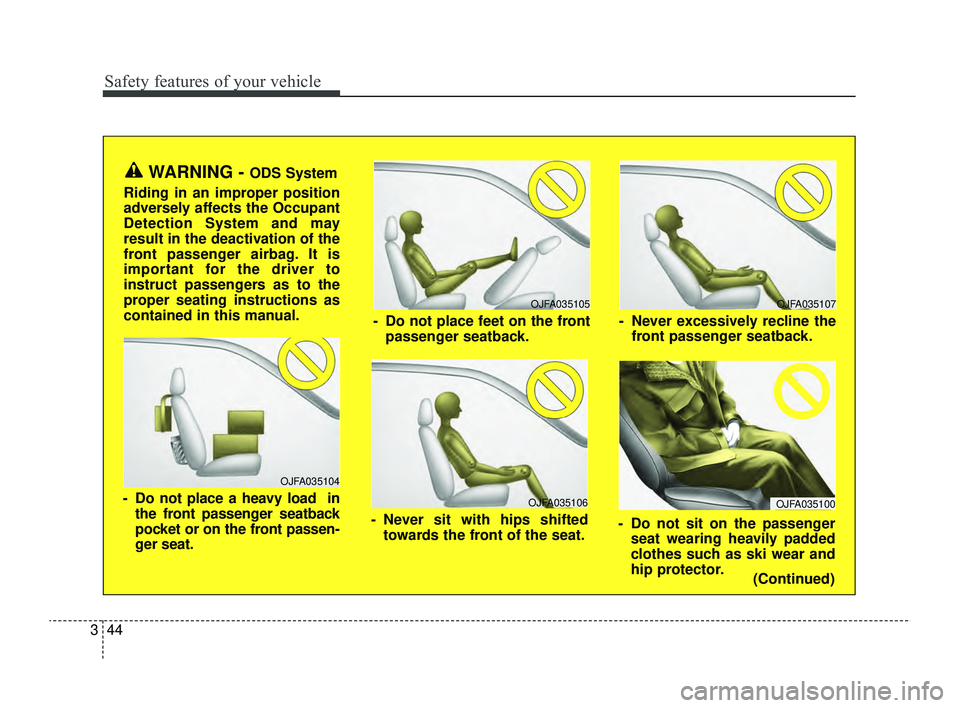
(1) Failing to sit in an upright position.
(2) Leaning against the door or cen- ter console.
(3) Sitting towards the sides or the front of the seat.
(4) Putting legs on the dashboard or resting them on other locations
which reduce the passenger
weight on the front seat.
(5) Improperly wearing the safety belt.
(6) Reclining the seat back.
SC PE USA 3.QXP 8/23/2021 5:38 PM Page 42
Page 61 of 528
Safety features of your vehicle
44
3
OJFA035106
- Never sit with hips shifted
towards the front of the seat.
OJFA035104
- Do not place a heavy load inthe front passenger seatback
pocket or on the front passen-
ger seat.
OJFA035105
- Do not place feet on the frontpassenger seatback.
WARNING - ODS System
Riding in an improper position
adversely affects the Occupant
Detection System and may
result in the deactivation of the
front passenger airbag. It is
important for the driver to
instruct passengers as to the
proper seating instructions as
contained in this manual.
(Continued)
OJFA035107
- Never excessively recline the front passenger seatback.
OJFA035100
- Do not sit on the passengerseat wearing heavily padded
clothes such as ski wear and
hip protector.
SC PE USA 3.QXP 8/23/2021 5:38 PM Page 44
Page 64 of 528
347
Safety features of your vehicle
✽ ✽NOTICE
• Do not use car seat cushions that
cover up the surface of the seat
and aftermarket manufactured
passenger seat heaters.
• After cleaning the car interior using steam or detergents, the seat should
be dried properly. Afterward, check
for normal operation of the PAS-
SENGER AIR BAG “OFF” and air
bag warning lights.
• Any service related to the passen- ger seat and the ODS must be
done at a Kia service center.
• After the passenger seat has been removed or installed for repair
purposes, check for normal opera-
tion of the PASSENGER AIR
BAG “OFF” and air bag warning
lights with a person seated or not
seated in the passenger seat.
✽ ✽ NOTICE
When the PASSENGER AIR BAG
“OFF” symbol is illuminated, the
passenger air bag system will not
operate. The passenger air bag sys-
tem will operate when necessary if
the symbol is not illuminated.
✽ ✽NOTICE
Do not modify or replace the front
passenger seat. Don't place anything
on or attach anything such as a blan-
ket, front seat cover or after market
seat heater to the front passenger
seat. This can adversely affect the
occupant detection system.
WARNING - ODS System
Riding in an improper position
adversely affects the Occupant
Detection System and may result
in the deactivation of the front
passenger airbag. It is important
for the driver to instruct the front
passenger as to the proper seat-
ing instructions as contained in
this manual.
SC PE USA 3.QXP 8/23/2021 5:39 PM Page 47
Page 70 of 528
353
Safety features of your vehicle
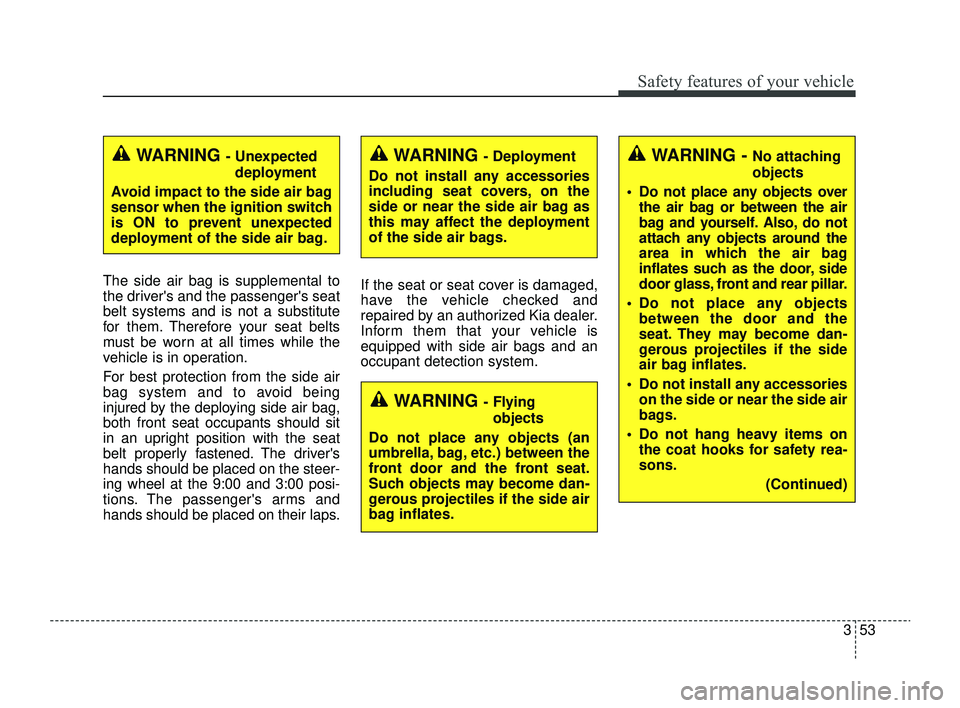
The side air bag is supplemental to
the driver's and the passenger's seat
belt systems and is not a substitute
for them. Therefore your seat belts
must be worn at all times while the
vehicle is in operation.
For best protection from the side air
bag system and to avoid being
injured by the deploying side air bag,
both front seat occupants should sit
in an upright position with the seat
belt properly fastened. The driver's
hands should be placed on the steer-
ing wheel at the 9:00 and 3:00 posi-
tions. The passenger's arms and
hands should be placed on their laps.If the seat or seat cover is damaged,
have the vehicle checked and
repaired by an authorized Kia dealer.
Inform them that your vehicle is
equipped with side air bags and an
occupant detection system.
WARNING - Unexpected
deployment
Avoid impact to the side air bag
sensor when the ignition switch
is ON to prevent unexpected
deployment of the side air bag.WARNING - Deployment
Do not install any accessories
including seat covers, on the
side or near the side air bag as
this may affect the deployment
of the side air bags.
WARNING - Flying objects
Do not place any objects (an
umbrella, bag, etc.) between the
front door and the front seat.
Such objects may become dan-
gerous projectiles if the side air
bag inflates.
WARNING - No attaching
objects
Do not place any objects over the air bag or between the air
bag and yourself. Also, do not
attach any objects around the
area in which the air bag
inflates such as the door, side
door glass, front and rear pillar.
Do not place any objects between the door and the
seat. They may become dan-
gerous projectiles if the side
air bag inflates.
Do not install any accessories on the side or near the side air
bags.
Do not hang heavy items on the coat hooks for safety rea-
sons.
(Continued)
SC PE USA 3.QXP 8/23/2021 5:39 PM Page 53
Page 73 of 528
Safety features of your vehicle
56
3
Why didn’t my air bag go off in
a collision? (Inflation and non-
inflation conditions of the air
bag)
There are many types of accidents in
which the air bag would not be
expected to provide additional pro-
tection.
These include rear impacts, second
or third collisions in multiple impact
accidents, as well as low speed
impacts.
In these situations, the air bags may
not deploy.
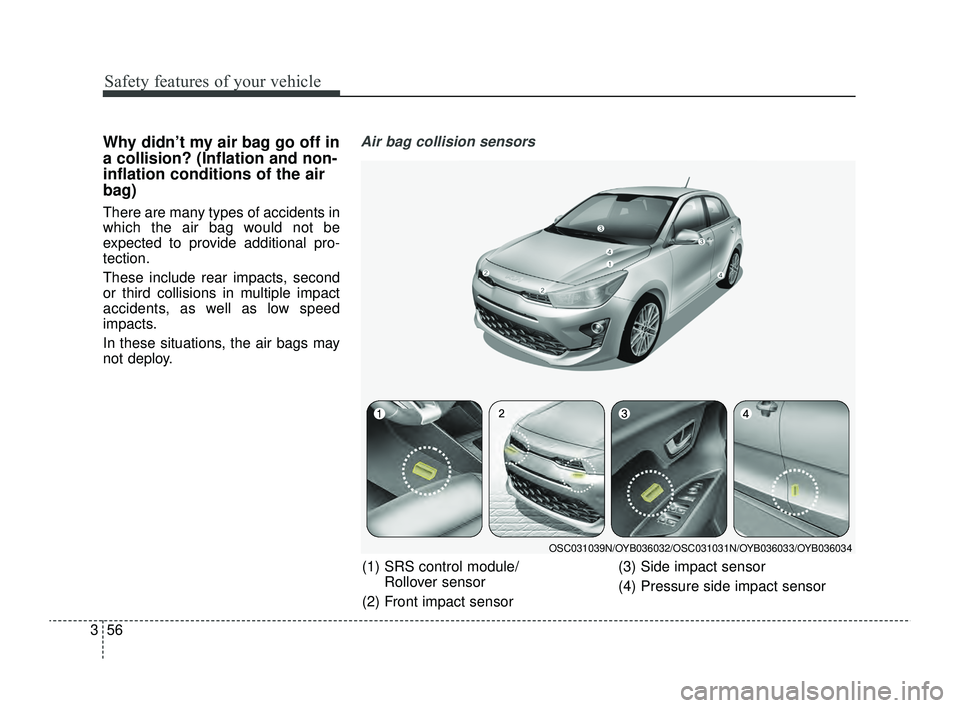
Air bag collision sensors
(1) SRS control module/
Rollover sensor
(2) Front impact sensor (3) Side impact sensor
(4) Pressure side impact sensor
OSC031039N/OYB036032/OSC031031N/OYB036033/OYB036034
SC PE USA 3.QXP 8/23/2021 5:39 PM Page 56