steering wheel KIA RIO 2022 Service Manual
[x] Cancel search | Manufacturer: KIA, Model Year: 2022, Model line: RIO, Model: KIA RIO 2022Pages: 528, PDF Size: 11.8 MB
Page 339 of 528
5105
Driving your vehicle
Hazardous driving conditions
When hazardous driving conditions
are encountered such as water,
snow, ice, mud, sand, or similar haz-
ards, follow these suggestions:
Drive cautiously and allow extradistance for braking.
Avoid sudden braking or steering.
When braking with non-ABS brakes, pump the brake pedal with
a light up-and-down motion until
the vehicle is stopped. Do not pump the brake pedal on a
vehicle equipped with ABS.
If stalled in snow, mud, or sand,
use second gear. Accelerate slow-
ly to avoid spinning the drive
wheels.
Use sand, rock salt, tire chains, or other non-slip material under the
drive wheels to provide traction
when stalled in ice, snow, or mud.
Rocking the vehicle
If it is necessary to rock the vehicle
to free it from snow, sand, or mud,
first turn the steering wheel right and
left to clear the area around your
front wheels. Then, shift back and
forth between R (Reverse) and any
forward gear in vehicles equipped
with an Intelligent Variable
Transmission. Do not race the
engine, and spin the wheels as little
as possible. If you are still stuck after
a few tries, have the vehicle pulled
out by a tow vehicle to avoid engine
overheating and possible damage to
the transmission.
The ESC system should be turned
OFF prior to rocking the vehicle.
SPECIAL DRIVING CONDITIONS
CAUTION- Vehicle
rocking
Prolonged rocking may causeengine overheating, transmis-sion damage or failure, and tiredamage.
WARNING- Downshifting
Do not downshift with an intelli-
gent variable transmission
while driving on slippery sur-
faces. The sudden change in
tire speed could cause the tires
to skid and result in an acci-
dent.
SC PE USA 5.QXP 9/9/2021 6:22 PM Page 105
Page 345 of 528
5111
Driving your vehicle
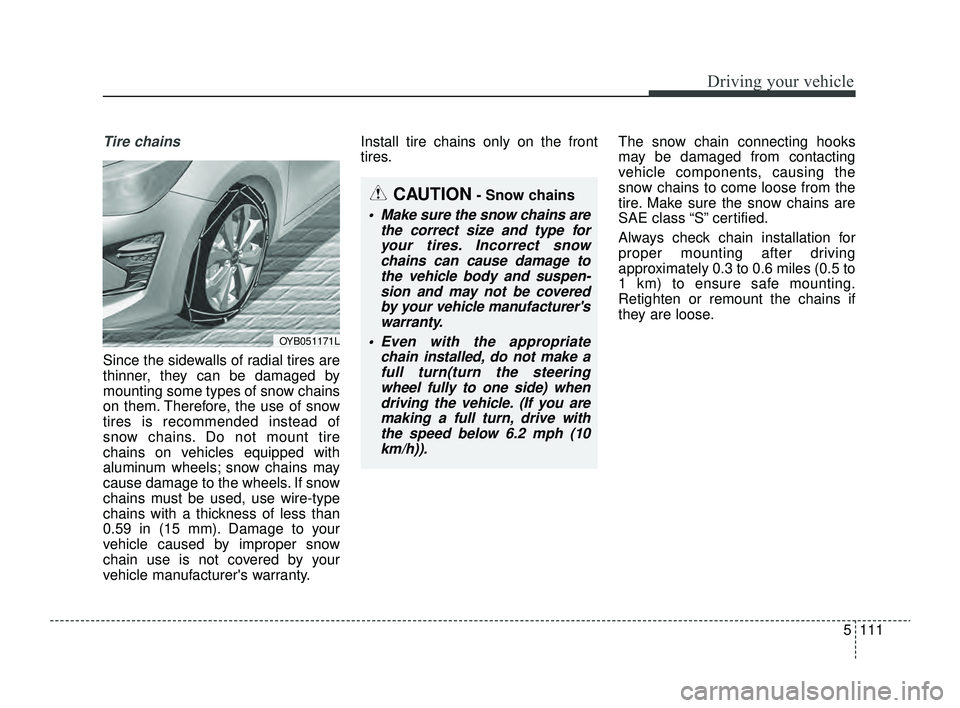
Tire chains
Since the sidewalls of radial tires are
thinner, they can be damaged by
mounting some types of snow chains
on them. Therefore, the use of snow
tires is recommended instead of
snow chains. Do not mount tire
chains on vehicles equipped with
aluminum wheels; snow chains may
cause damage to the wheels. If snow
chains must be used, use wire-type
chains with a thickness of less than
0.59 in (15 mm). Damage to your
vehicle caused by improper snow
chain use is not covered by your
vehicle manufacturer's warranty.Install tire chains only on the front
tires.
The snow chain connecting hooks
may be damaged from contacting
vehicle components, causing the
snow chains to come loose from the
tire. Make sure the snow chains are
SAE class “S” certified.
Always check chain installation for
proper mounting after driving
approximately 0.3 to 0.6 miles (0.5 to
1 km) to ensure safe mounting.
Retighten or remount the chains if
they are loose.
CAUTION- Snow chains
Make sure the snow chains are
the correct size and type foryour tires. Incorrect snowchains can cause damage tothe vehicle body and suspen-sion and may not be coveredby your vehicle manufacturer'swarranty.
Even with the appropriate chain installed, do not make afull turn(turn the steeringwheel fully to one side) whendriving the vehicle. (If you aremaking a full turn, drive withthe speed below 6.2 mph (10km/h)).
OYB051171L
SC PE USA 5.QXP 9/9/2021 6:22 PM Page 111
Page 347 of 528
5113
Driving your vehicle
Change to "winter weight" oil
if necessary
In some climates, it is recommended
that a lower viscosity "winter weight"
oil be used during cold weather. See
section 8 for recommendations. If
you aren't sure what weight oil you
should use, consult an authorized
Kia dealer.
Check spark plugs and igni-
tion system
Inspect your spark plugs as
described in section 7 and replace
them if necessary. Also check all
ignition wiring and components to be
sure they are not cracked, worn or
damaged in any way.
To keep locks from freezing
To keep the locks from freezing,
squirt an approved de-icer fluid or
glycerine into the key opening. If a
lock is covered with ice, squirt it with
an approved de-icing fluid to remove
the ice. If the lock is frozen internally,
you may be able to thaw it out by
using a heated key. Handle the heat-
ed key with care to avoid injury.
Use approved window washer
anti-freeze in system
To keep the water in the window
washer system from freezing, add an
approved window washer anti-freeze
solution in accordance with instruc-
tions on the container. Window wash-
er anti-freeze is available from an
authorized Kia dealer and most auto
parts outlets. Do not use engine
coolant or other types of anti-freeze
as these may damage the paint finish.
Don't let your parking brake
freeze
Under some conditions, your parking
brake can freeze in the engaged
position. This is most likely to hap-
pen when there is an accumulation
of snow or ice around or near the
rear brakes or if the brakes are wet.
If there is a risk the parking brake
may freeze, apply it only temporarily
while you put the shift lever in P
(Intelligent Variable Transmission)
and chock the rear wheels so the
vehicle cannot roll. Then release the
parking brake.
Don't let ice and snow accu-
mulate underneath
Under some conditions, snow and
ice can build up under the fenders
and interfere with the steering. When
driving in severe winter conditions
where this may happen, you should
periodically check underneath the
car to be sure the movement of the
front wheels and the steering com-
ponents is not obstructed.
SC PE USA 5.QXP 9/9/2021 6:22 PM Page 113
Page 385 of 528
631
What to do in an emergency
Emergency towingIf towing is necessary, we recom-
mend you have it done by an
authorized Kia dealer or a com-
mercial tow truck service.
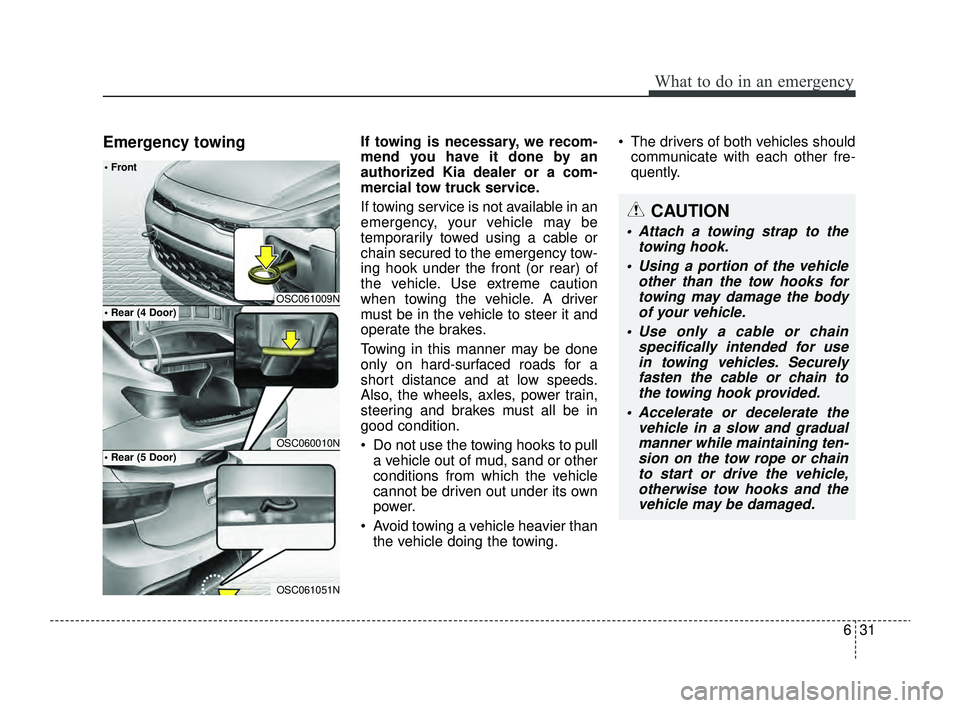
If towing service is not available in an
emergency, your vehicle may be
temporarily towed using a cable or
chain secured to the emergency tow-
ing hook under the front (or rear) of
the vehicle. Use extreme caution
when towing the vehicle. A driver
must be in the vehicle to steer it and
operate the brakes.
Towing in this manner may be done
only on hard-surfaced roads for a
short distance and at low speeds.
Also, the wheels, axles, power train,
steering and brakes must all be in
good condition.
Do not use the towing hooks to pulla vehicle out of mud, sand or other
conditions from which the vehicle
cannot be driven out under its own
power.
Avoid towing a vehicle heavier than the vehicle doing the towing. The drivers of both vehicles should
communicate with each other fre-
quently.
OSC061009N
OSC060010N
Front
Rear (4 Door)
OSC061051N
Rear (5 Door)
CAUTION
Attach a towing strap to the
towing hook.
Using a portion of the vehicle other than the tow hooks fortowing may damage the bodyof your vehicle.
Use only a cable or chain specifically intended for usein towing vehicles. Securelyfasten the cable or chain tothe towing hook provided.
Accelerate or decelerate the vehicle in a slow and gradualmanner while maintaining ten-sion on the tow rope or chainto start or drive the vehicle,otherwise tow hooks and thevehicle may be damaged.
SC PE USA 6.qxp 8/23/2021 6:02 PM Page 31
Page 387 of 528
633
What to do in an emergency
Emergency towing precautions
Turn the ignition switch to ACC sothe steering wheel isn’t locked.
Place the transmission shift lever in N (Neutral).
Release the parking brake.
Press the brake pedal with more force than normal since you will
have reduced brake performance.
More steering effort will be required because the power steer-
ing system will be disabled.
If you are driving down a long hill, the brakes may overheat and brake
performance will be reduced. Stop
often and let the brakes cool off.
To avoid serious damage to the Intelligent Variable Transmission,
limit the vehicle speed to 10 mph
(15 km/h) and drive less than 1
mile (1.5 km) when towing. (for
Intelligent Variable Transmission
vehicle) If the car is being towed with all four
wheels on the ground, it can be
towed only from the front. Be sure
that the transmission is in neutral. Be
sure the steering is unlocked by plac-
ing the ignition switch in the ACC
position. A driver must be in the
towed vehicle to operate the steering
and brakes.CAUTION- Intelligent
Variable Transmission
Before towing, check for an Intelligent Variable Transmissionfluid leak under your vehicle. If theIntelligent Variable Transmissionfluid is leaking, a flatbed equip-ment or towing dolly must beused.
SC PE USA 6.qxp 8/23/2021 6:02 PM Page 33
Page 394 of 528
77
Maintenance
OWNER MAINTENANCE
The following lists are vehicle checks
and inspections that should be per-
formed by the owner or an author-
ized Kia dealer at the frequencies
indicated to help ensure safe,
dependable operation of your vehi-
cle.
Any adverse conditions should be
brought to the attention of your deal-
er as soon as possible.
These Owner Maintenance Checks
are generally not covered by war-
ranties and you may be charged for
labor, parts and lubricants used.Owner maintenance schedule
When you stop for fuel:
Check the coolant level in coolantreservoir.
Check the windshield washer fluid level.
Look for low or under-inflated tires.
While operating your vehicle:
Note any changes in the sound of the exhaust or any smell of
exhaust fumes in the vehicle.
Check for vibrations in the steering wheel. Notice any increased steer-
ing effort or looseness in the steer-
ing wheel, or change in its straight-
ahead position.
Notice if your vehicle constantly turns slightly or “pulls” to one side
when traveling on smooth, level
road.
When stopping, listen and check for unusual sounds, pulling to one
side, increased brake pedal travel
or “hard-to-push” brake pedal.
If any slipping or changes in the operation of your transmission
occurs, take your vehicle to an
authorized Kia dealer.
Check the intelligent variable trans- mission P (Park) function.
WARNING- Hot coolant
Be careful when checking your
engine coolant level when the
engine is hot. Scalding hot
coolant and steam may blow
out under pressure.
SC PE USA 7.qxp 9/9/2021 6:26 PM Page 7
Page 406 of 528
719
Maintenance
Brake discs, pads and calipers
Check the pads for excessive wear,
discs for run out and wear, and
calipers for fluid leakage.
Exhaust pipe and muffler
Visually inspect the exhaust pipes,
muffler and hangers for cracks, dete-
rioration, or damage. Start the
engine and listen carefully for any
exhaust gas leakage. Tighten con-
nections or replace parts as neces-
sary.
Suspension mounting bolts
Check the suspension connections
for looseness or damage. Retighten
to the specified torque.
Steering gear box, linkage &
boots/lower arm ball joint
With the vehicle stopped and engine
off, check for excessive free-play in
the steering wheel.
Check the linkage for bends or dam-
age. Check the dust boots and ball
joints for deterioration, cracks, or
damage. Replace any damaged
parts.
Drive shafts and boots
Check the drive shafts, boots and
clamps for cracks, deterioration, or
damage. Replace any damaged
parts and, if necessary, repack the
grease.
Air conditioning refrigerant
Check the air conditioning lines and
connections for leakage and damage.
SC PE USA 7.qxp 9/9/2021 6:26 PM Page 19
Page 452 of 528
765
Maintenance
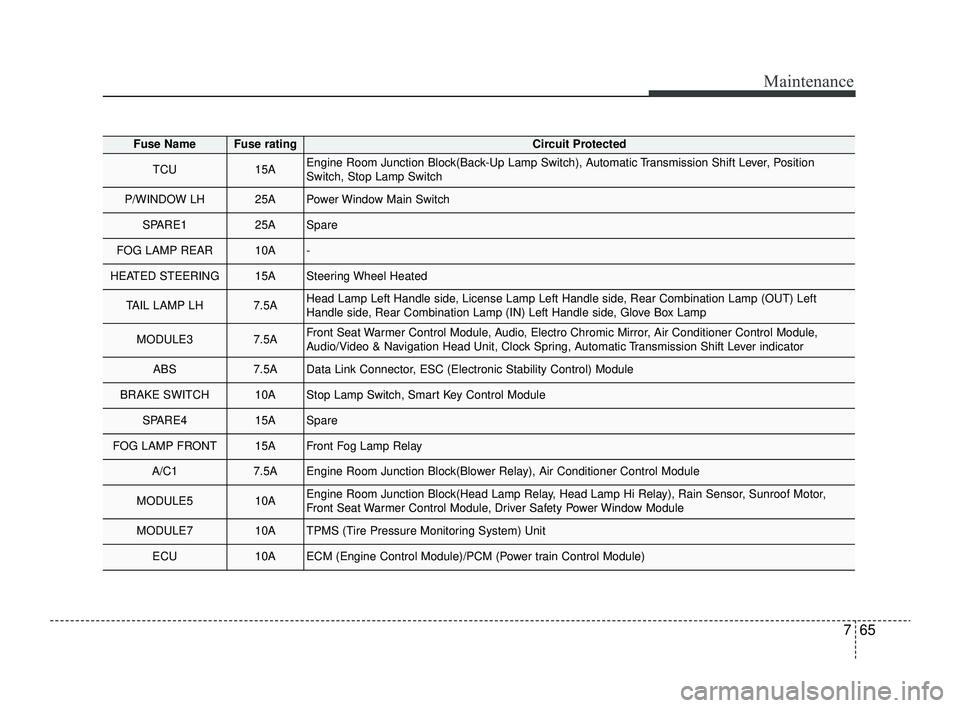
Fuse NameFuse ratingCircuit Protected
TCU15AEngine Room Junction Block(Back-Up Lamp Switch), Automatic Transmission Shift Lever, Position
Switch, Stop Lamp Switch
P/WINDOW LH25APower Window Main Switch
SPARE125ASpare
FOG LAMP REAR10A-
HEATED STEERING15ASteering Wheel Heated
TAIL LAMP LH7.5AHead Lamp Left Handle side, License Lamp Left Handle side, Rear Combination Lamp (OUT) Left
Handle side, Rear Combination Lamp (IN) Left Handle side, Glove Box Lamp
MODULE37.5AFront Seat Warmer Control Module, Audio, Electro Chromic Mirror, Air Conditioner Control Module,
Audio/Video & Navigation Head Unit, Clock Spring, Automatic Transmission Shift Lever indicator
ABS7.5AData Link Connector, ESC (Electronic Stability Control) Module
BRAKE SWITCH10AStop Lamp Switch, Smart Key Control Module
SPARE415ASpare
FOG LAMP FRONT15AFront Fog Lamp Relay
A/C17.5AEngine Room Junction Block(Blower Relay), Air Conditioner Control Module
MODULE510AEngine Room Junction Block(Head Lamp Relay, Head Lamp Hi Relay), Rain Sensor, Sunroof Motor,
Front Seat Warmer Control Module, Driver Safety Power Window Module
MODULE710ATPMS (Tire Pressure Monitoring System) Unit
ECU10AECM (Engine Control Module)/PCM (Power train Control Module)
SC PE USA 7.qxp 9/9/2021 6:28 PM Page 65
Page 496 of 528
7109
Maintenance
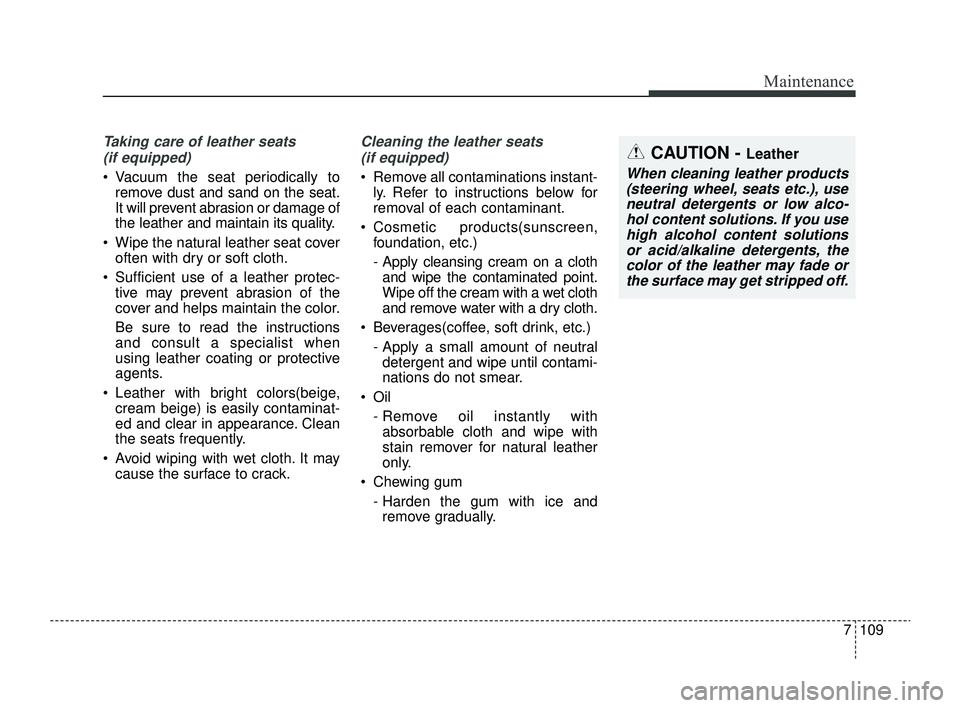
Taking care of leather seats (if equipped)
Vacuum the seat periodically to remove dust and sand on the seat.
It will prevent abrasion or damage of
the leather and maintain its quality.
Wipe the natural leather seat cover often with dry or soft cloth.
Sufficient use of a leather protec- tive may prevent abrasion of the
cover and helps maintain the color.
Be sure to read the instructions
and consult a specialist when
using leather coating or protective
agents.
Leather with bright colors(beige, cream beige) is easily contaminat-
ed and clear in appearance. Clean
the seats frequently.
Avoid wiping with wet cloth. It may cause the surface to crack.
Cleaning the leather seats
(if equipped)
Remove all contaminations instant- ly. Refer to instructions below for
removal of each contaminant.
Cosmetic products(sunscreen, foundation, etc.)
- Apply cleansing cream on a clothand wipe the contaminated point.
Wipe off the cream with a wet cloth
and remove water with a dry cloth.
Beverages(coffee, soft drink, etc.) - Apply a small amount of neutraldetergent and wipe until contami-
nations do not smear.
Oil - Remove oil instantly withabsorbable cloth and wipe with
stain remover for natural leather
only.
Chewing gum - Harden the gum with ice andremove gradually.
CAUTION - Leather
When cleaning leather products(steering wheel, seats etc.), useneutral detergents or low alco-hol content solutions. If you usehigh alcohol content solutionsor acid/alkaline detergents, thecolor of the leather may fade orthe surface may get stripped off.
SC PE USA 7.qxp 9/9/2021 6:31 PM Page 109
Page 525 of 528
I9
Index
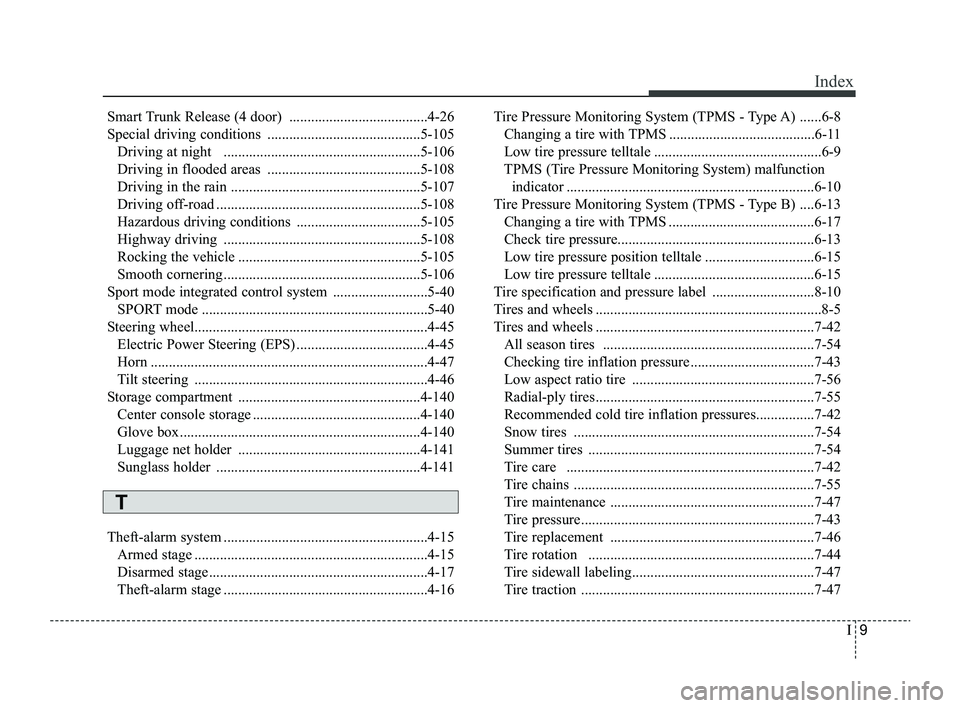
Smart Trunk Release (4 door) ......................................4-26
Special driving conditions ..........................................5-105Driving at night ......................................................5-106
Driving in flooded areas ..........................................5-108
Driving in the rain ....................................................5-107
Driving off-road ........................................................5-108
Hazardous driving conditions ..................................5-105
Highway driving ......................................................5-108
Rocking the vehicle ..................................................5-105
Smooth cornering ......................................................5-106
Sport mode integrated control system ..........................5-40 SPORT mode ..............................................................5-40
Steering wheel...........................................................\
.....4-45 Electric Power Steering (EPS) ....................................4-45
Horn ........................................................................\
....4-47
Tilt steering ................................................................4-46
Storage compartment ..................................................4-140 Center console storage ..............................................4-140
Glove box ..................................................................4-140
Luggage net holder ..................................................4-141
Sunglass holder ........................................................4-141
Theft-alarm system ........................................................4-15 Armed stage ................................................................4-15
Disarmed stage ............................................................4-17
Theft-alarm stage ........................................................4-16 Tire Pressure Monitoring System (TPMS - Type A) ......6-8
Changing a tire with TPMS ........................................6-11
Low tire pressure telltale ..............................................6-9
TPMS (Tire Pressure Monitoring System) malfunction indicator ....................................................................6-10\
Tire Pressure Monitoring System (TPMS - Type B) ....6-13 Changing a tire with TPMS ........................................6-17
Check tire pressure.....................................................\
.6-13
Low tire pressure position telltale ..............................6-15
Low tire pressure telltale ............................................6-15
Tire specification and pressure label ............................8-10
Tires and wheels ..............................................................8-5
Tires and wheels ............................................................7-42 All season tires ..........................................................7-54
Checking tire inflation pressure ..................................7-43
Low aspect ratio tire ..................................................7-56
Radial-ply tires ............................................................7-55
Recommended cold tire inflation pressures................7-42
Snow tires ..................................................................7-54
Summer tires ..............................................................7-54
Tire care ....................................................................7-42\
Tire chains ..................................................................7-55
Tire maintenance ........................................................7-47
Tire pressure................................................................7-43
Tire replacement ........................................................7-46
Tire rotation ..............................................................7-44
Tire sidewall labeling..................................................7-47
Tire traction ................................................................7-47
T
SC PE USA Index.qxp 8/23/2021 5:25 PM Page 9