belt KIA Sorento 2006 1.G Owner's Manual
[x] Cancel search | Manufacturer: KIA, Model Year: 2006, Model line: Sorento, Model: KIA Sorento 2006 1.GPages: 312, PDF Size: 5.21 MB
Page 10 of 312
3-1
KNOWING YOUR VEHICLEKeys. . . . . . . . . . . . . . . . . . . . . . . . . . . . . . . . . . . . . . . . . . . . . 3-2
Immobilizer System . . . . . . . . . . . . . . . . . . . . . . . . . . . . . . . . 3-3
Door Locks . . . . . . . . . . . . . . . . . . . . . . . . . . . . . . . . . . . . . . . 3-5
Windows . . . . . . . . . . . . . . . . . . . . . . . . . . . . . . . . . . . . . . . . 3-10
Front Seat . . . . . . . . . . . . . . . . . . . . . . . . . . . . . . . . . . . . . . . 3-13
Rear Seat . . . . . . . . . . . . . . . . . . . . . . . . . . . . . . . . . . . . . . . . 3-21
Safety Belts . . . . . . . . . . . . . . . . . . . . . . . . . . . . . . . . . . . . . . 3-25
Air Bag - Supplemental Restraint System . . . . . . . . . . . . . . 3-44
Rear Hatch. . . . . . . . . . . . . . . . . . . . . . . . . . . . . . . . . . . . . . . 3-67
Hood . . . . . . . . . . . . . . . . . . . . . . . . . . . . . . . . . . . . . . . . . . . 3-69
Fuel Filler Lid . . . . . . . . . . . . . . . . . . . . . . . . . . . . . . . . . . . . 3-70
Auto Fuel Cutoff Switch . . . . . . . . . . . . . . . . . . . . . . . . . . . . 3-72
Steering Wheel . . . . . . . . . . . . . . . . . . . . . . . . . . . . . . . . . . . 3-73
Mirrors . . . . . . . . . . . . . . . . . . . . . . . . . . . . . . . . . . . . . . . . . . 3-74
Interior Lights . . . . . . . . . . . . . . . . . . . . . . . . . . . . . . . . . . . . 3-76
Cup Holder . . . . . . . . . . . . . . . . . . . . . . . . . . . . . . . . . . . . . . 3-78
Sunglass Holder . . . . . . . . . . . . . . . . . . . . . . . . . . . . . . . . . . 3-79
Storage Compartment. . . . . . . . . . . . . . . . . . . . . . . . . . . . . . 3-80
Electrical Power Outlet . . . . . . . . . . . . . . . . . . . . . . . . . . . . . 3-82
Sunroof . . . . . . . . . . . . . . . . . . . . . . . . . . . . . . . . . . . . . . . . . 3-83
Antenna . . . . . . . . . . . . . . . . . . . . . . . . . . . . . . . . . . . . . . . . . 3-86
Luggage Net . . . . . . . . . . . . . . . . . . . . . . . . . . . . . . . . . . . . . 3-86
Tonneau cover . . . . . . . . . . . . . . . . . . . . . . . . . . . . . . . . . . . 3-87
Luggage center box . . . . . . . . . . . . . . . . . . . . . . . . . . . . . . . 3-88
Roof Rack . . . . . . . . . . . . . . . . . . . . . . . . . . . . . . . . . . . . . . . 3-89
3
BL-ENG (CAN)-3.qxd 7/28/05 5:52 PM Page 1
Page 22 of 312
FRONT SEAT
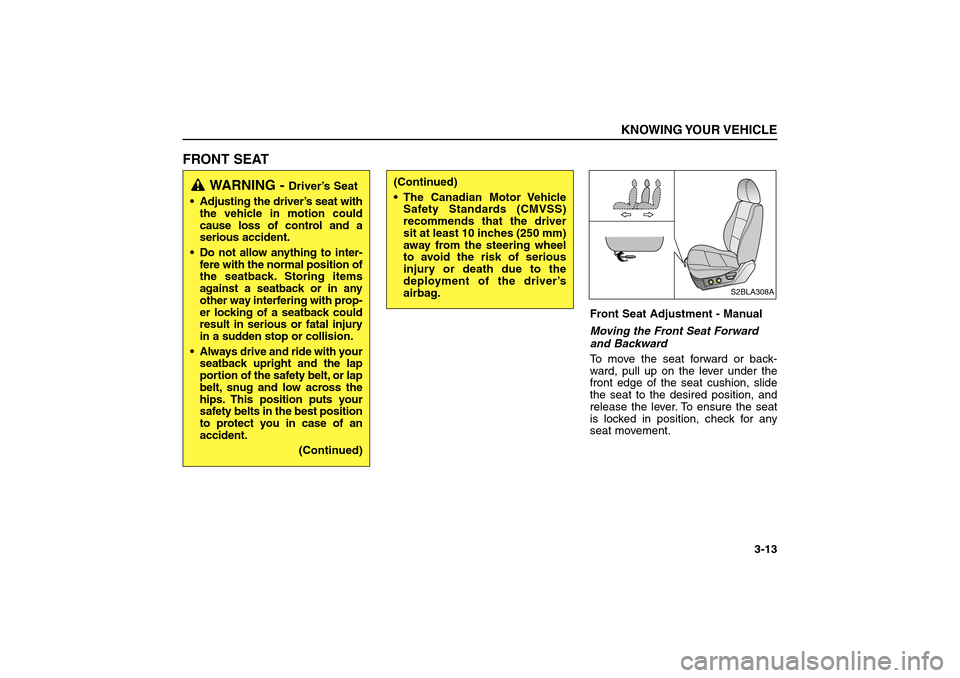
Front Seat Adjustment - Manual
Moving the Front Seat Forward
and Backward
To move the seat forward or back-
ward, pull up on the lever under the
front edge of the seat cushion, slide
the seat to the desired position, and
release the lever. To ensure the seat
is locked in position, check for any
seat movement.
KNOWING YOUR VEHICLE
3-13
S2BLA308A
WARNING -
Driver’s Seat
Adjusting the driver’s seat with
the vehicle in motion could
cause loss of control and a
serious accident.
Do not allow anything to inter-
fere with the normal position of
the seatback. Storing items
against a seatback or in any
other way interfering with prop-
er locking of a seatback could
result in serious or fatal injury
in a sudden stop or collision.
Always drive and ride with your
seatback upright and the lap
portion of the safety belt, or lap
belt, snug and low across the
hips. This position puts your
safety belts in the best position
to protect you in case of an
accident.
(Continued)
(Continued)
The Canadian Motor Vehicle
Safety Standards (CMVSS)
recommends that the driver
sit at least 10 inches (250 mm)
away from the steering wheel
to avoid the risk of serious
injury or death due to the
deployment of the driver’s
airbag.
BL-ENG (CAN)-3.qxd 7/28/05 5:52 PM Page 13
Page 23 of 312
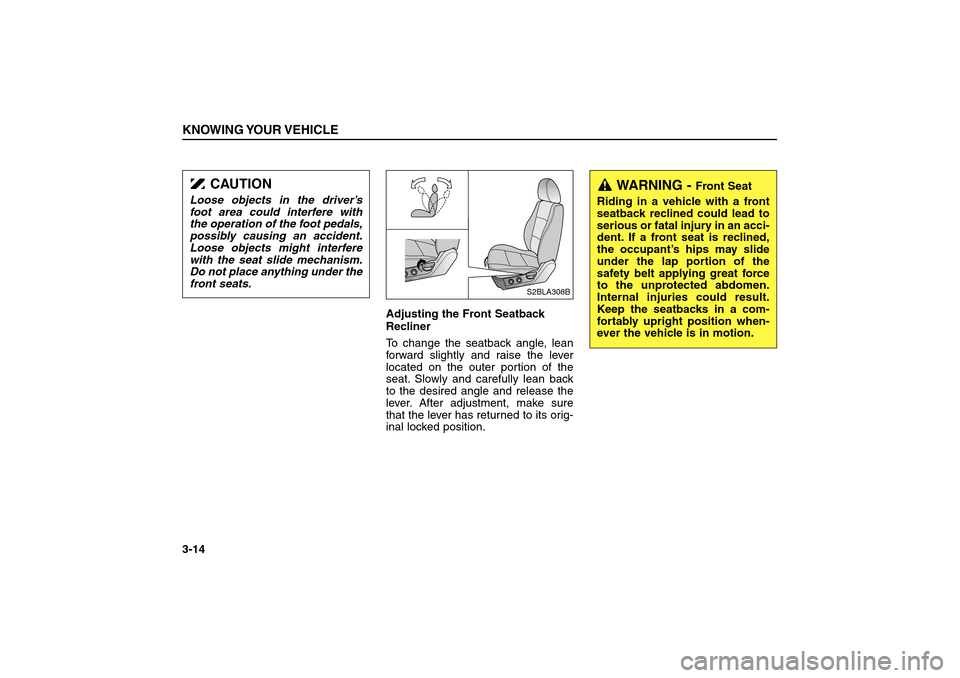
Adjusting the Front Seatback
Recliner
To change the seatback angle, lean
forward slightly and raise the lever
located on the outer portion of the
seat. Slowly and carefully lean back
to the desired angle and release the
lever. After adjustment, make sure
that the lever has returned to its orig-
inal locked position.
KNOWING YOUR VEHICLE3-14
S2BLA308B
CAUTION
Loose objects in the driver’s
foot area could interfere with
the operation of the foot pedals,
possibly causing an accident.
Loose objects might interfere
with the seat slide mechanism.
Do not place anything under the
front seats.
WARNING -
Front Seat
Riding in a vehicle with a front
seatback reclined could lead to
serious or fatal injury in an acci-
dent. If a front seat is reclined,
the occupant’s hips may slide
under the lap portion of the
safety belt applying great force
to the unprotected abdomen.
Internal injuries could result.
Keep the seatbacks in a com-
fortably upright position when-
ever the vehicle is in motion.
BL-ENG (CAN)-3.qxd 7/28/05 5:52 PM Page 14
Page 27 of 312
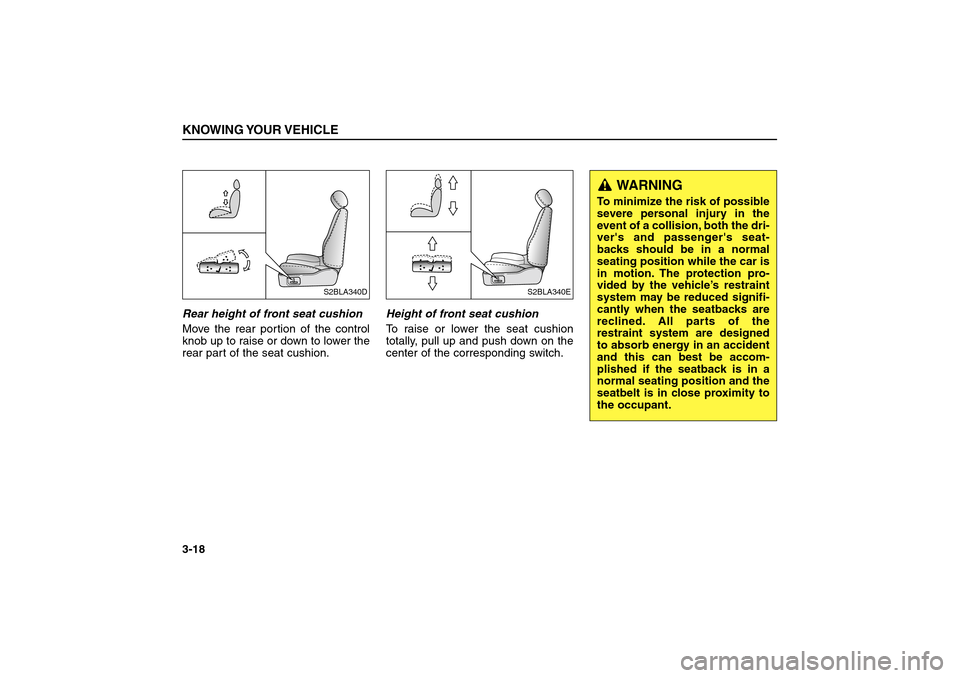
Rear height of front seat cushion
Move the rear portion of the control
knob up to raise or down to lower the
rear part of the seat cushion.Height of front seat cushion
To raise or lower the seat cushion
totally, pull up and push down on the
center of the corresponding switch.KNOWING YOUR VEHICLE3-18
S2BLA340E
S2BLA340D
WARNING
To minimize the risk of possible
severe personal injury in the
event of a collision, both the dri-
ver's and passenger's seat-
backs should be in a normal
seating position while the car is
in motion. The protection pro-
vided by the vehicle’s restraint
system may be reduced signifi-
cantly when the seatbacks are
reclined. All parts of the
restraint system are designed
to absorb energy in an accident
and this can best be accom-
plished if the seatback is in a
normal seating position and the
seatbelt is in close proximity to
the occupant.
BL-ENG (CAN)-3.qxd 7/28/05 5:52 PM Page 18
Page 30 of 312
REAR SEAT
Split Folding Rear Seat
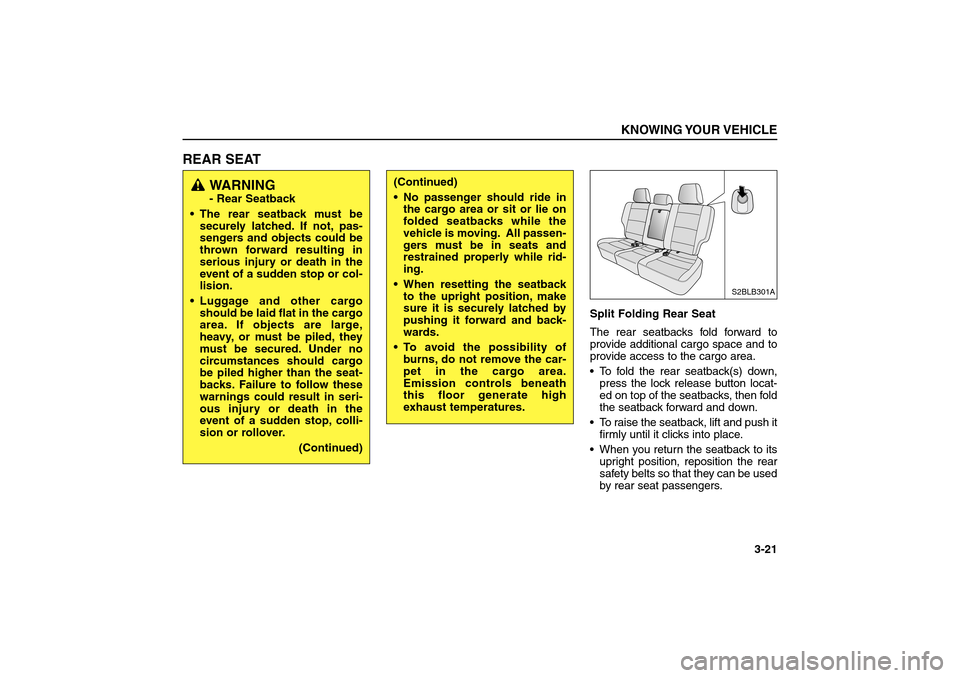
The rear seatbacks fold forward to
provide additional cargo space and to
provide access to the cargo area.
To fold the rear seatback(s) down,
press the lock release button locat-
ed on top of the seatbacks, then fold
the seatback forward and down.
To raise the seatback, lift and push it
firmly until it clicks into place.
When you return the seatback to its
upright position, reposition the rear
safety belts so that they can be used
by rear seat passengers.
KNOWING YOUR VEHICLE
3-21
S2BLB301A
WARNING- Rear Seatback
The rear seatback must be
securely latched. If not, pas-
sengers and objects could be
thrown forward resulting in
serious injury or death in the
event of a sudden stop or col-
lision.
Luggage and other cargo
should be laid flat in the cargo
area. If objects are large,
heavy, or must be piled, they
must be secured. Under no
circumstances should cargo
be piled higher than the seat-
backs. Failure to follow these
warnings could result in seri-
ous injury or death in the
event of a sudden stop, colli-
sion or rollover.
(Continued)
(Continued)
No passenger should ride in
the cargo area or sit or lie on
folded seatbacks while the
vehicle is moving. All passen-
gers must be in seats and
restrained properly while rid-
ing.
When resetting the seatback
to the upright position, make
sure it is securely latched by
pushing it forward and back-
wards.
To avoid the possibility of
burns, do not remove the car-
pet in the cargo area.
Emission controls beneath
this floor generate high
exhaust temperatures.
BL-ENG (CAN)-3.qxd 7/28/05 5:52 PM Page 21
Page 32 of 312
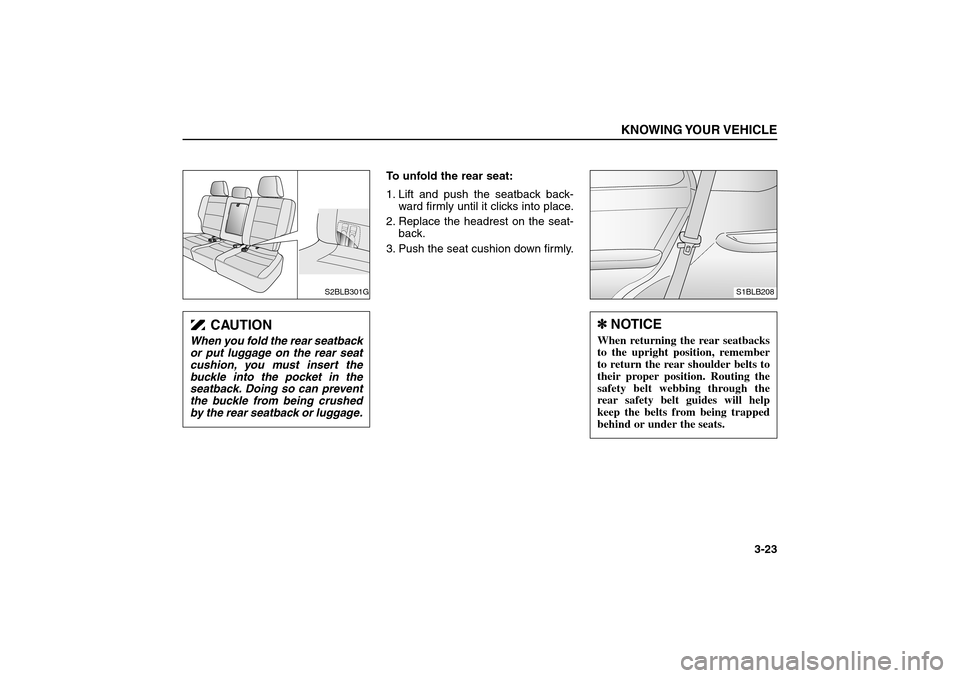
To unfold the rear seat:
1. Lift and push the seatback back-
ward firmly until it clicks into place.
2. Replace the headrest on the seat-
back.
3. Push the seat cushion down firmly.
KNOWING YOUR VEHICLE
3-23
S2BLB301G
S1BLB208
CAUTION
When you fold the rear seatback
or put luggage on the rear seat
cushion, you must insert the
buckle into the pocket in the
seatback. Doing so can prevent
the buckle from being crushed
by the rear seatback or luggage.
✽ ✽
NOTICEWhen returning the rear seatbacks
to the upright position, remember
to return the rear shoulder belts to
their proper position. Routing the
safety belt webbing through the
rear safety belt guides will help
keep the belts from being trapped
behind or under the seats.
BL-ENG (CAN)-3.qxd 7/28/05 5:52 PM Page 23
Page 34 of 312
SAFETY BELTSPre-tensioner Seat Belt
Your vehicle is equipped with driver’s
and front passenger’s pre-tensioner
safety belts. The purpose of the pre-
tensioner is to pull the safety belt
snugly against the occupant’s body in
certain frontal collisions.
The pre-tensioner safety belts will
activate, along with the airbags, when
a frontal collision is severe enough.When the vehicle stops suddenly, or
if the occupant tries to lean forward
too quickly, the seat belt retractor will
lock into position. However, in certain
frontal collisions, the pre-tensioner
will also activate and pull the seat belt
into tighter contact against the occu-
pant’s body.The safety belt pre-tensioner system
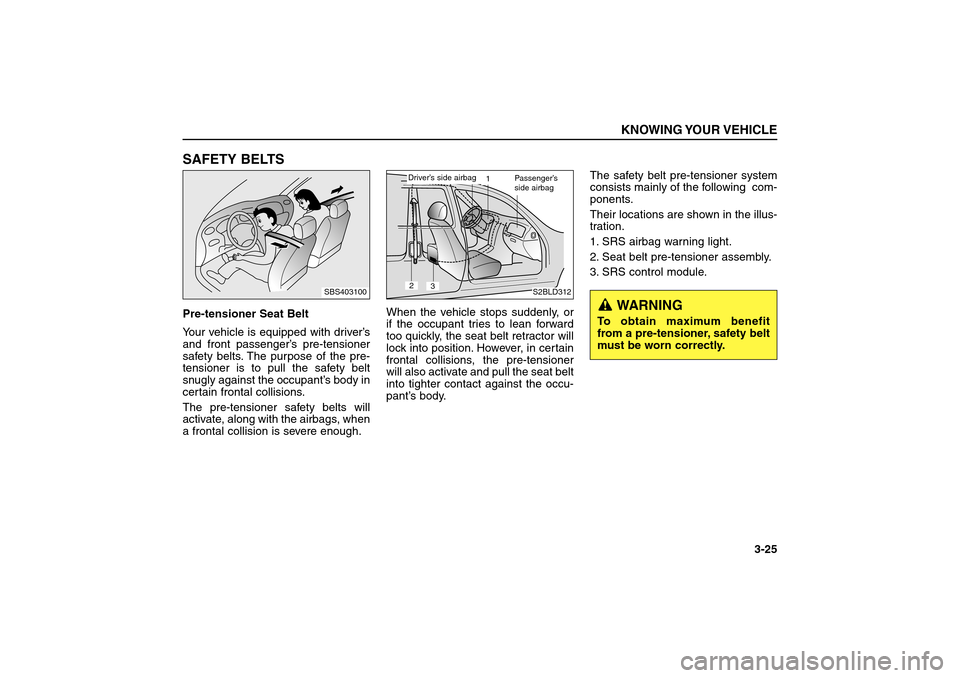
consists mainly of the following com-
ponents.
Their locations are shown in the illus-
tration.
1. SRS airbag warning light.
2. Seat belt pre-tensioner assembly.
3. SRS control module.
KNOWING YOUR VEHICLE
3-25
SBS403100
S2BLD312
2
3
1
Passenger’s
side airbag
Driver’s side airbag
WARNING
To obtain maximum benefit
from a pre-tensioner, safety belt
must be worn correctly.
BL-ENG (CAN)-3.qxd 7/28/05 5:52 PM Page 25
Page 35 of 312
Safety Belt Restraint System
KNOWING YOUR VEHICLE3-26
CAUTION
When the pre-tensioner safety
belts are activated, a loud
noise may be heard and fine
powder, which may appear to
be smoke, may be visible in the
passenger compartment. The
powder is not toxic.
The powder may cause skin
irritation and should not be
breathed for prolonged peri-
ods. Wash your hands and face
thoroughly after an accident in
which such powder has been
released.
If the pre-tensioner seat belt is
not working properly, the airbag
warning light will illuminate,
since both devices are on the
same electrical circuit. If the
SRS airbag warning light does
not blink when the ignition key
is turned to “ON” or “ACC”, or if
it remains illuminated for more
than 6 seconds, or if it illumi-
nates while the vehicle is being
driven, please have an author-
ized Kia dealer inspect the sys-
tem as soon as possible.
WARNING- Pretentioner Repair or
Replacement
Pre-tensioners are designed
to operate once. After activa-
tion, pre-tensioner safety
belts must be replaced.
Do not attempt to inspect,
repair or replace the pre-ten-
sioner safety belts yourself.
You can permanently damage
the system.
WARNING
- Safety Belts
To minimize the risk of serious
or fatal injury in an accident, the
driver and all passengers
should use the appropriate
safety restraints for their age
and size. The presence of
airbags does not change the
need to be properly restrained
by a safety belt or size-appro-
priate child restraint. In fact,
airbags can work properly when
passengers are correctly
restrained in the vehicle. Be
sure you are familiar with the
information in this section,
including the information on
infant and child restraints.
Read the safety warnings on the
sun visors.
BL-ENG (CAN)-3.qxd 7/28/05 5:52 PM Page 26
Page 36 of 312
We strongly recommend that the
driver and all passengers be properly
restrained at all times by using the
safety belts provided with the vehicle.
Proper use of the safety belts
decreases the risk of severe injury or
death in accidents or sudden stops.
In most states, and in Canada, the
law requires their use.
Inertial locks in the safety belt retrac-
tors allow all of the lap/shoulder safe-
ty belts to remain unlocked during
normal vehicle operation.
This allows the occupants some free-
dom of movement and increased
comfort while using the safety belts. If
a force is applied to the vehicle, such
as a strong stop, a sharp turn, or a
collision, the safety belt retractors will
automatically lock the safety belts.Since the inertial locks do not require
a collision to lock up, you may
become aware of the safety belts
locking while braking or going around
sharp corners.
Whenever possible, use the center
rear seat position to install your child
restraint. The center rear seat is the
safest position for a child to sit in. If
the center seat is unavailable, a child
restraint system may be installed in
an outboard rear seat position. Never
install a rear-facing infant seat in the
front passenger position, as an inflat-
ing airbag could cause serious or
fatal injury to a child in that position.The rear safety belts use a special
auto-lock feature designed to allow a
child restraint to be used in these
positions without an added locking
clip. They normally lock only under
extreme or emergency conditions
(emergency lock mode). However
they can be adjusted so that they
remain in fixed and locked when a
child restraint system is placed in
these positions. (Use this auto-lock
mode only to secure a child restraint,
never for passengers restrained by
the safety belts.) Page 3-38 gives
instructions on placing the safety belt
in the auto lock mode.
The drivers safety belt can only oper-
ate in the emergency lock mode.
KNOWING YOUR VEHICLE
3-27
BL-ENG (CAN)-3.qxd 7/28/05 5:52 PM Page 27
Page 37 of 312
Safety belts provide the best restraint
when:
The seatback is upright
The occupant is sitting upright (not
slouched)
The lap belt is snug across the hips
The shoulder belt is snug across
the chest
The knees are straight forward
To help you remember to fasten your
safety belt, a warning light will come
on and a chime will sound. See
Safety Belt Warning Light and Chime
on page 3-29.KNOWING YOUR VEHICLE3-28
WARNING - After a Collision
Lap/shoulder belt assemblies
may be stretched or damaged
when subjected to the stress
and forces of a collision.
The entire restraint system
should be inspected following
any collision. All belts, retrac-
tors, anchors and hardware
damaged by a collision
should be replaced before the
vehicle is operated again.
WARNING
- Cargo Area
Passengers should never be
allowed to ride in the cargo area
of a vehicle. No safety belts are
provided for the cargo area.
Persons riding in the vehicle
without a fastened safety belt
are much more likely to suffer
serious bodily injury or death
during an accident.
WARNING
- Twisted Belts
A twisted or jammed safety belt
cannot restrain you properly. If
you cannot untwist or unjam
the safety belt, see your Kia
dealer immediately. Never drive
or ride with a twisted or jammed
safety belt.
WARNING
- Belt Use
Safety belts must be used cor-
rectly to work properly in an
accident. Each seating position
in your vehicle has a specific
safety belt assembly that
includes a buckle and tongue
designed to be used together.
For greatest effectiveness, fol-
low these guidelines in using
safety belts:
Use the shoulder portion of
the safety belt on the outside
shoulder only. Never wear the
shoulder portion under the
arm.
Never swing the safety belt
around your neck to fit over
the inside shoulder.
Never wear the shoulder por-
tion of the safety belt across
the neck or face.
(Continued)
BL-ENG (CAN)-3.qxd 7/28/05 5:52 PM Page 28