trailer KIA SOUL 2019 User Guide
[x] Cancel search | Manufacturer: KIA, Model Year: 2019, Model line: SOUL, Model: KIA SOUL 2019Pages: 564, PDF Size: 14.2 MB
Page 408 of 564
This section will guide you in the
proper loading of your vehicle and/or
trailer, to keep your loaded vehicle
weight within its design rating capa-
bility, with or without a trailer.
Properly loading your vehicle will
provide maximum return of the vehi-
cle design performance. Before load-
ing your vehicle, familiarize yourself
with the following terms for determin-
ing your vehicle's weight ratings, with
or without a trailer, from the vehicle's
specifications and the certification
label:
Base curb weight
This is the weight of the vehicle
including a full tank of fuel and all
standard equipment. It does not
include passengers, cargo, or option-
al equipment.
Vehicle curb weight
This is the weight of your new vehicle
when you picked it up from your deal-
er plus any aftermarket equipment.
Cargo weight
This figure includes all weight added
to the Base Curb Weight, including
cargo and optional equipment.
GAW (Gross axle weight)
This is the total weight placed on
each axle (front and rear) - including
vehicle curb weight and all payload.
GAWR
(Gross axle weight rating)
This is the maximum allowable
weight that can be carried by a single
axle (front or rear). These numbers
are shown on the certification label.
The total load on each axle must
never exceed its GAWR.
GVW (Gross vehicle weight)
This is the Base Curb Weight plus
actual Cargo Weight plus passen-
gers.
GVWR
(Gross vehicle weight rating)
This is the maximum allowable
weight of the fully loaded vehicle
(including all options, equipment,
passengers and cargo). The GVWR
is shown on the certification label
located on the driver’s door sill.
VEHICLE WEIGHT GLOSSARY
6 118
Driving your vehicle
Page 424 of 564
What to do in an emergency
16
7
Avoid driving over obstacles. The
compact spare tire diameter is
smaller than the diameter of a con-
ventional tire and reduces the
ground clearance approximately
25 mm (1 inch), which could result
in damage to the vehicle.
Do not take this vehicle through an automatic vehicle wash while the
compact spare tire is installed.
Do not use the compact spare tire on any other vehicle because this
tire has been designed especially
for your vehicle.
The compact spare tire’s tread life is shorter than a regular tire.
Inspect your compact spare tire
regularly and replace worn com-
pact spare tires with the same size
and design, mounted on the same
wheel. The compact spare tire should not
be used on any other wheels, nor
should standard tires, snow tires,
wheel covers or trim rings be used
with the compact spare wheel. If
such use is attempted, damage to
these items or other vehicle com-
ponents may occur.
Do not use more than one compact spare tire at a time.
Do not tow a trailer while the com- pact spare tire is installed.
Page 427 of 564
719
What to do in an emergency
It is possible that some tires, espe-
cially with larger punctures or dam-
age to the sidewall, cannot be sealed
completely.
Air pressure loss in the tire may
adversely affect tire performance.
For this reason, you should avoid
abrupt steering or other driving
maneuvers, especially if the vehicle
is heavily loaded or if a trailer is in
use.
The Tire Mobility Kit is not designed
or intended as a permanent tire
repair method and is to be used for
one tire only.
This instruction shows you step by
step how to temporarily seal the
puncture simply and reliably.
Read the section "Notes on the safe
use of the Tire Mobility Kit".Notes on the suggested use of
the Tire Mobility Kit
Park your car at the side of the roadso that you can work with the Tire
Mobility Kit away from moving traf-
fic.
To be sure your vehicle will not move, even when you're on fairly
level ground, always set your park-
ing brake.
Only use the Tire Mobility Kit for sealing/inflation passenger car tires.
Only punctured areas located with-
in the tread region of the tire can be
sealed using the tire mobility kit.
Do not use on motorcycles, bicycles or any other type of tires.
When the tire and wheel are dam- aged, do not use Tire Mobility Kit for
your safety.
Use of the Tire Mobility Kit may not be effective for tire damage larger
than approximately 6 mm (0.24 in).
Please contact the nearest Kia
dealership if the tire cannot be
made roadworthy with the Tire
Mobility Kit. Do not use the Tire Mobility Kit if a
tire is severely damaged by driving
run flat or with insufficient air pres-
sure.
Do not remove any foreign objects such as nails or screws that have
penetrated the tire.
Provided the car is outdoors, leave the engine running. Otherwise
operating the compressor may
eventually drain the car battery.
Never leave the Tire Mobility Kit unattended while it is being used.
Do not leave the compressor run- ning for more than 10 min. at a time
or it may overheat.
Do not use the Tire Mobility Kit if the ambient temperature is below
-30°C (-22°F).
Page 434 of 564
What to do in an emergency
26
7
TOWING
Towing service
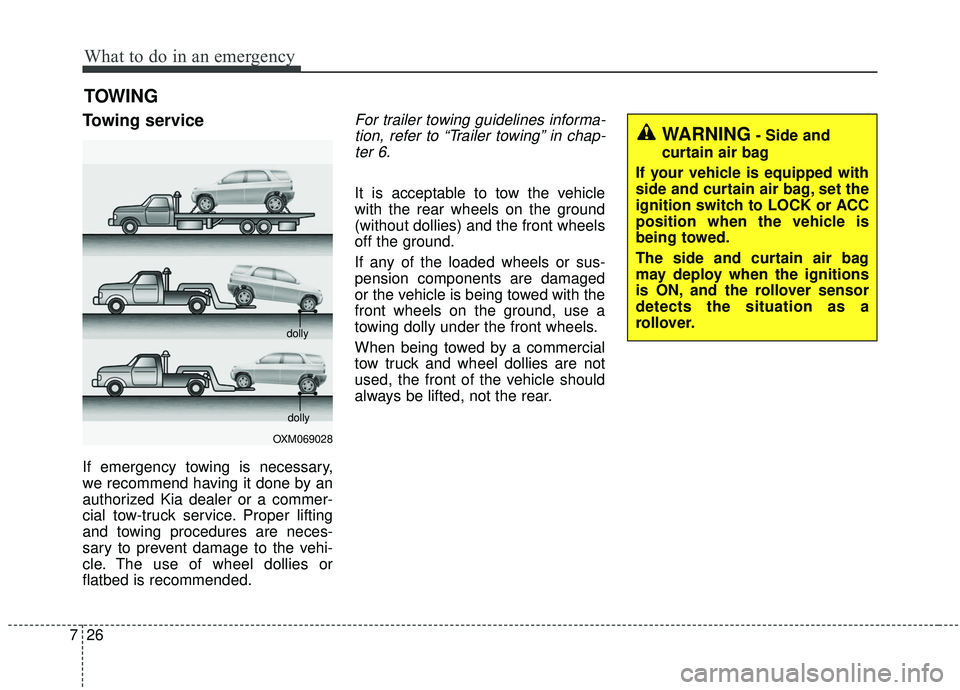
If emergency towing is necessary,
we recommend having it done by an
authorized Kia dealer or a commer-
cial tow-truck service. Proper lifting
and towing procedures are neces-
sary to prevent damage to the vehi-
cle. The use of wheel dollies or
flatbed is recommended.
For trailer towing guidelines informa-
tion, refer to “Trailer towing” in chap-ter 6.
It is acceptable to tow the vehicle
with the rear wheels on the ground
(without dollies) and the front wheels
off the ground.
If any of the loaded wheels or sus-
pension components are damaged
or the vehicle is being towed with the
front wheels on the ground, use a
towing dolly under the front wheels.
When being towed by a commercial
tow truck and wheel dollies are not
used, the front of the vehicle should
always be lifted, not the rear.
OXM069028 dolly
dolly
WARNING- Side and
curtain air bag
If your vehicle is equipped with
side and curtain air bag, set the
ignition switch to LOCK or ACC
position when the vehicle is
being towed.
The side and curtain air bag
may deploy when the ignitions
is ON, and the rollover sensor
detects the situation as a
rollover.
Page 454 of 564
Maintenance
16
8
SEVERE DRIVING CONDITIONS
A - Repeatedly driving shorts distance of less than 8 km (5
miles) in normal temperature or less than 16 km (10 miles)
in freezing temperature
B - Extensive engine idling or low speed driving for long dis- tances
C - Driving on rough, dusty, muddy, unpaved, graveled or salt- spread roads
D - Driving in areas using salt or other corrosive materials or in very cold weather E - Driving in heavy dust condition
F - Driving in heavy traffic area
G - Driving on uphill, downhill, or mountain road
H - Towing a Trailer, or using a camper, or roof rack
I - Driving as a patrol car, taxi, other commercial use or vehicle
towing
J - Driving over 170 km/h (106 MPH)
K - Frequently driving in stop-and-go conditions
Page 459 of 564
821
Maintenance
SEVERE DRIVING CONDITIONS
A - Repeatedly driving shorts distance of less than 8km (5miles) in normal temperature or less than 16 km (10 miles)
in freezing temperature
B - Extensive engine idling or low speed driving for long dis- tances
C - Driving on rough, dusty, muddy, unpaved, graveled or salt- spread roads
D - Driving in areas using salt or other corrosive materials or in very cold weather E - Driving in heavy dust condition
F - Driving in heavy traffic area
G - Driving on uphill, downhill, or mountain road
H - Towing a Trailer, or using a camper, or roof rack
I - Driving as a patrol car, taxi, other commercial use or vehicle
towing
J - Driving over 170 km/h (106 MPH)
K - Frequently driving in stop-and-go conditions
Page 563 of 564
I9
Index
Steering wheel . . . . . . . . . . . . . . . . . . . . . . . . . . . . . . . 4-41Electric power steering (EPS) . . . . . . . . . . . . . . . . . 4-41
Flex steer . . . . . . . . . . . . . . . . . . . . . . . . . . . . . . . . . 4-44
Heated steering wheel . . . . . . . . . . . . . . . . . . . . . . . 4-43
Horn . . . . . . . . . . . . . . . . . . . . . . . . . . . . . . . . . . . . \
. 4-44
Tilt and telescopic steering. . . . . . . . . . . . . . . . . . . . 4-42
Storage compartment . . . . . . . . . . . . . . . . . . . . . . . . . 4-136 Center console storage . . . . . . . . . . . . . . . . . . . . . . 4-136
Cool box . . . . . . . . . . . . . . . . . . . . . . . . . . . . . . . . . 4-137
Glove box . . . . . . . . . . . . . . . . . . . . . . . . . . . . . . . . 4-136
Luggage box . . . . . . . . . . . . . . . . . . . . . . . . . . . . . . 4-138
Sunglass holder . . . . . . . . . . . . . . . . . . . . . . . . . . . 4-137
Tire specification and pressure label . . . . . . . . . . . . . . 9-11
Tires and wheels . . . . . . . . . . . . . . . . . . . . . . . . . . 8-47, 9-5 All season tires . . . . . . . . . . . . . . . . . . . . . . . . . . . . . 8-59
Checking tire inflation pressure . . . . . . . . . . . . . . . . 8-48
Low aspect ratio tire. . . . . . . . . . . . . . . . . . . . . . . . . 8-60
Radial-ply tires . . . . . . . . . . . . . . . . . . . . . . . . . . . . . 8-59
Recommended cold tire inflation pressures . . . . . . . 8-47
Snow tires . . . . . . . . . . . . . . . . . . . . . . . . . . . . . . . . . 8-59
Summer tires . . . . . . . . . . . . . . . . . . . . . . . . . . . . . . 8-59
Tire care . . . . . . . . . . . . . . . . . . . . . . . . . . . . . . . . . . 8-47\
Tire maintenance . . . . . . . . . . . . . . . . . . . . . . . . . . . 8-52
Tire replacement . . . . . . . . . . . . . . . . . . . . . . . . . . . . 8-51
Tire rotation . . . . . . . . . . . . . . . . . . . . . . . . . . . . . . . 8-49 Tire sidewall labeling . . . . . . . . . . . . . . . . . . . . . . . . 8-52
Tire traction . . . . . . . . . . . . . . . . . . . . . . . . . . . . . . . 8-52
Wheel alignment and tire balance . . . . . . . . . . . . . . 8-50
Wheel replacement . . . . . . . . . . . . . . . . . . . . . . . . . . 8-52
Towing . . . . . . . . . . . . . . . . . . . . . . . . . . . . . . . . . . . . \
. 7-26 Emergency towing . . . . . . . . . . . . . . . . . . . . . . . . . . 7-28
Removable towing hook (front) . . . . . . . . . . . . . . . . 7-27
Towing service . . . . . . . . . . . . . . . . . . . . . . . . . . . . . 7-26
Trailer towing . . . . . . . . . . . . . . . . . . . . . . . . . . . . . . . 6-111
Trip computer . . . . . . . . . . . . . . . . . . . . . . . . . . . . . . . . 4-71 Accumulated info display (for Type B cluster) . . . . 4-74
Drive info display (for Type B cluster) . . . . . . . . . . 4-75
Fuel economy . . . . . . . . . . . . . . . . . . . . . . . . . . . . . . 4-73
Overview . . . . . . . . . . . . . . . . . . . . . . . . . . . . . . . . . 4-71
Trip A/B (for Type A cluster) . . . . . . . . . . . . . . . . . . 4-72
Vehicle Break-In Process . . . . . . . . . . . . . . . . . . . . . . . . 1-7
Vehicle certification label . . . . . . . . . . . . . . . . . . . . . . . 9-10
Vehicle data collection and event data recorders . . . . . . 1-8
Vehicle handling instructions . . . . . . . . . . . . . . . . . . . . . 1-7
Vehicle identification number (VIN) . . . . . . . . . . . . . . 9-10
Vehicle load limit . . . . . . . . . . . . . . . . . . . . . . . . . . . . 6-112 Certification label . . . . . . . . . . . . . . . . . . . . . . . . . . 6-116
Tire and loading information label. . . . . . . . . . . . . 6-112
T
V