clutch KIA SOUL 2019 Owner's Manual
[x] Cancel search | Manufacturer: KIA, Model Year: 2019, Model line: SOUL, Model: KIA SOUL 2019Pages: 564, PDF Size: 14.2 MB
Page 320 of 564
Driving your vehicle
30
6
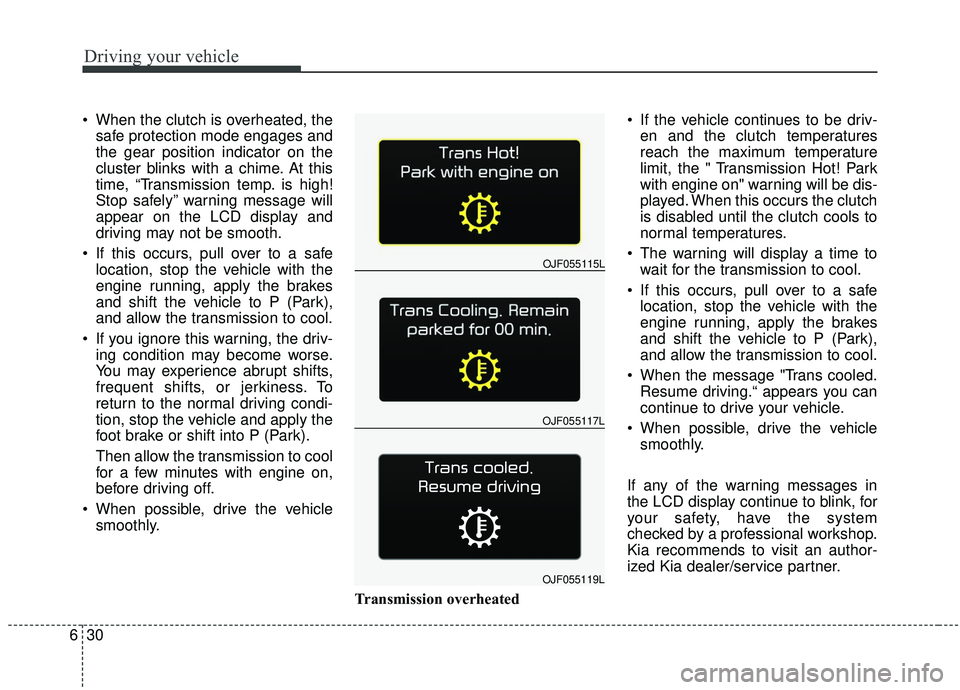
When the clutch is overheated, the
safe protection mode engages and
the gear position indicator on the
cluster blinks with a chime. At this
time, “Transmission temp. is high!
Stop safely” warning message will
appear on the LCD display and
driving may not be smooth.
If this occurs, pull over to a safe location, stop the vehicle with the
engine running, apply the brakes
and shift the vehicle to P (Park),
and allow the transmission to cool.
If you ignore this warning, the driv- ing condition may become worse.
You may experience abrupt shifts,
frequent shifts, or jerkiness. To
return to the normal driving condi-
tion, stop the vehicle and apply the
foot brake or shift into P (Park).
Then allow the transmission to cool
for a few minutes with engine on,
before driving off.
When possible, drive the vehicle smoothly.
Transmission overheated If the vehicle continues to be driv-
en and the clutch temperatures
reach the maximum temperature
limit, the " Transmission Hot! Park
with engine on" warning will be dis-
played. When this occurs the clutch
is disabled until the clutch cools to
normal temperatures.
The warning will display a time to wait for the transmission to cool.
If this occurs, pull over to a safe location, stop the vehicle with the
engine running, apply the brakes
and shift the vehicle to P (Park),
and allow the transmission to cool.
When the message "Trans cooled. Resume driving.“ appears you can
continue to drive your vehicle.
When possible, drive the vehicle smoothly.
If any of the warning messages in
the LCD display continue to blink, for
your safety, have the system
checked by a professional workshop.
Kia recommends to visit an author-
ized Kia dealer/service partner.
OJF055117L
OJF055115L
OJF055119L
Page 321 of 564
631
Driving your vehicle
Transmission ranges
The indicator in the instrument clus-
ter displays the shift lever position
when the ignition switch is in the ON
position.
P (Park)
If you have done all of the above and
still cannot shift the lever out of P
(Park), see “Shift-Lock Release” in
this chapter.
WARNING
Shifting into P (Park) while thevehicle is in motion may
cause you to lose control of
the vehicle.
After the vehicle has stopped, always make sure the shift
lever is in P (Park), apply the
parking brake, and turn the
engine off.
When parking on an incline, block the wheels to prevent
the vehicle from rolling down.
For safety, always engage the parking brake with the shift
lever in the P (Park) position
except for the case of emer-
gency parking.
Do not use the P (Park) posi- tion in place of the parking
brake.
CAUTION
-
Holding the Vehicle Using
Accelerator Pedal
Do not attempt to hold yourvehicle on a hill by applying theaccelerator pedal. This cancause your clutch and transmis-sion to be damaged as a resultof overheating.
Page 324 of 564
Driving your vehicle
34
6
Shift lock system (if equipped)
For your safety, the Dual clutch trans-
mission has a shift lock system
which prevents shifting the transaxle
from P (Park) into R (Reverse)
unless the brake pedal is depressed.
To shift the transaxle from P (Park) or
N (Neutral) into R (Reverse):
1. Depress and hold the brake pedal.
2. Start the engine or turn the ignition
switch to the ON position.
3. Move the shift lever.
If the brake pedal is repeatedly
depressed and released with the shift
lever in the P (Park) position, a chat-
tering noise near the shift lever may
be heard. This is a normal condition. Shift-lock override
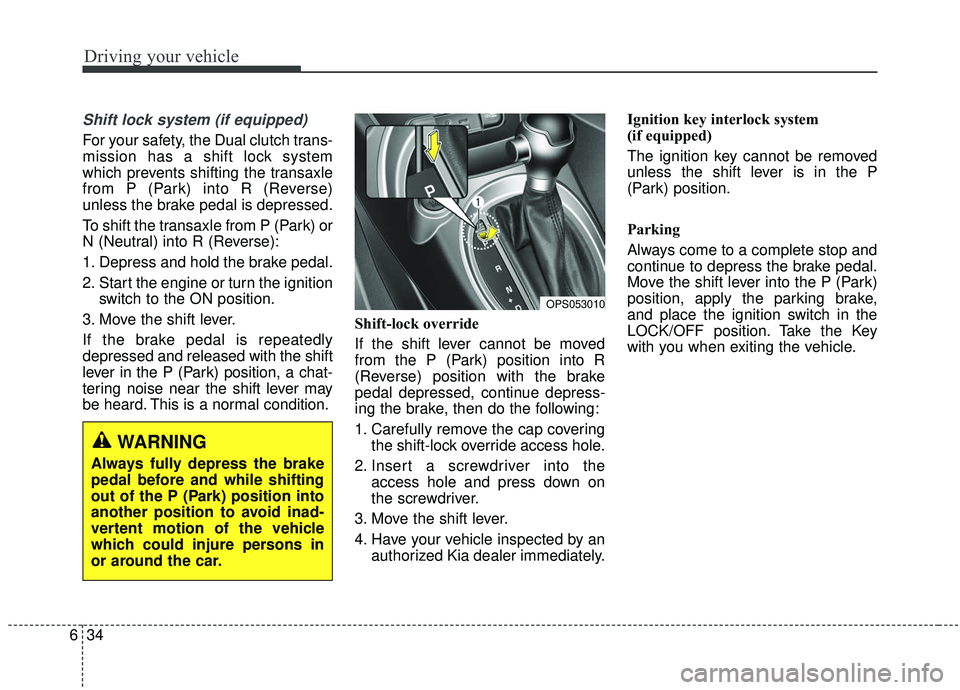
If the shift lever cannot be moved
from the P (Park) position into R
(Reverse) position with the brake
pedal depressed, continue depress-
ing the brake, then do the following:
1. Carefully remove the cap covering
the shift-lock override access hole.
2. Insert a screwdriver into the access hole and press down on
the screwdriver.
3. Move the shift lever.
4. Have your vehicle inspected by an authorized Kia dealer immediately. Ignition key interlock system
(if equipped)
The ignition key cannot be removed
unless the shift lever is in the P
(Park) position.
Parking
Always come to a complete stop and
continue to depress the brake pedal.
Move the shift lever into the P (Park)
position, apply the parking brake,
and place the ignition switch in the
LOCK/OFF position. Take the Key
with you when exiting the vehicle.
WARNING
Always fully depress the brake
pedal before and while shifting
out of the P (Park) position into
another position to avoid inad-
vertent motion of the vehicle
which could injure persons in
or around the car.
OPS053010
Page 357 of 564
667
Driving your vehicle
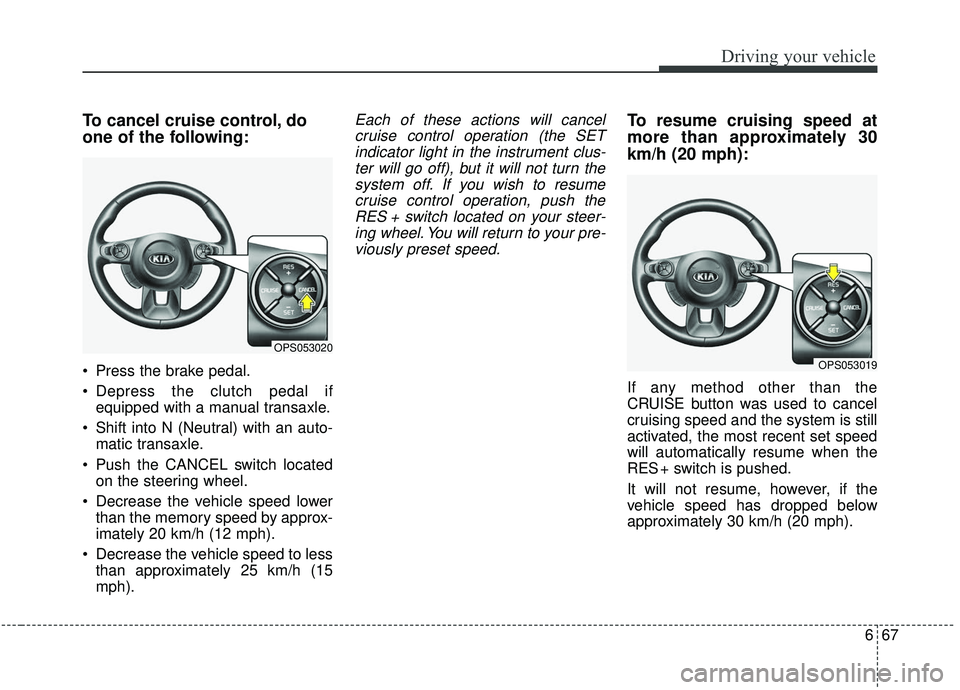
To cancel cruise control, do
one of the following:
Press the brake pedal.
Depress the clutch pedal ifequipped with a manual transaxle.
Shift into N (Neutral) with an auto- matic transaxle.
Push the CANCEL switch located on the steering wheel.
Decrease the vehicle speed lower than the memory speed by approx-
imately 20 km/h (12 mph).
Decrease the vehicle speed to less than approximately 25 km/h (15
mph).
Each of these actions will cancelcruise control operation (the SETindicator light in the instrument clus-ter will go off), but it will not turn thesystem off. If you wish to resumecruise control operation, push theRES + switch located on your steer-ing wheel. You will return to your pre-viously preset speed.To resume cruising speed at
more than approximately 30
km/h (20 mph):
If any method other than the
CRUISE button was used to cancel
cruising speed and the system is still
activated, the most recent set speed
will automatically resume when the
RES + switch is pushed.
It will not resume, however, if the
vehicle speed has dropped below
approximately 30 km/h (20 mph).
OPS053020
OPS053019
Page 391 of 564
6101
Driving your vehicle
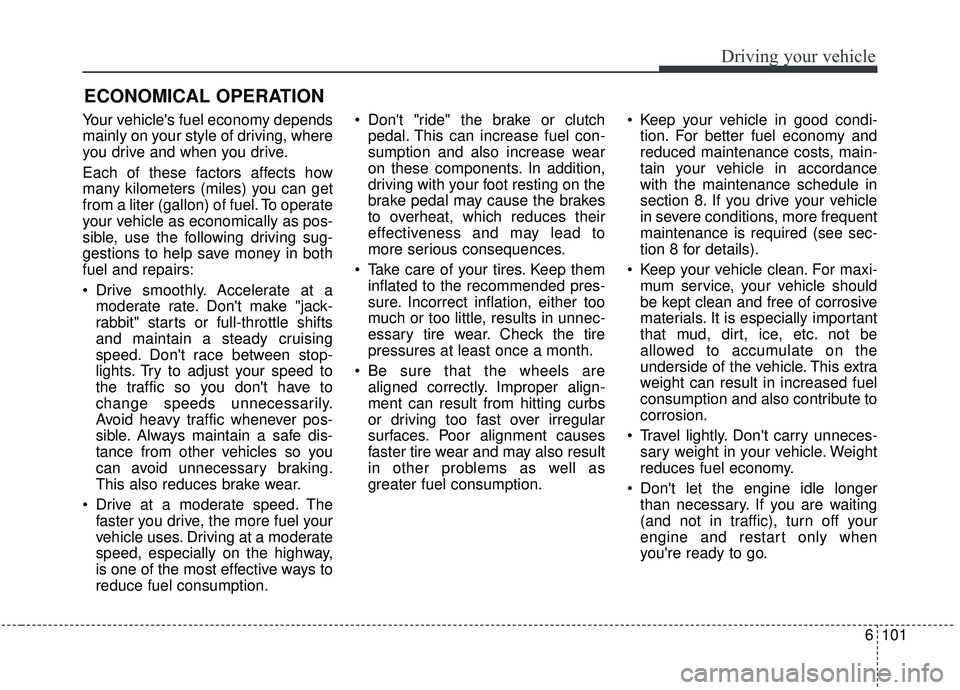
Your vehicle's fuel economy depends
mainly on your style of driving, where
you drive and when you drive.
Each of these factors affects how
many kilometers (miles) you can get
from a liter (gallon) of fuel. To operate
your vehicle as economically as pos-
sible, use the following driving sug-
gestions to help save money in both
fuel and repairs:
Drive smoothly. Accelerate at amoderate rate. Don't make "jack-
rabbit" starts or full-throttle shifts
and maintain a steady cruising
speed. Don't race between stop-
lights. Try to adjust your speed to
the traffic so you don't have to
change speeds unnecessarily.
Avoid heavy traffic whenever pos-
sible. Always maintain a safe dis-
tance from other vehicles so you
can avoid unnecessary braking.
This also reduces brake wear.
Drive at a moderate speed. The faster you drive, the more fuel your
vehicle uses. Driving at a moderate
speed, especially on the highway,
is one of the most effective ways to
reduce fuel consumption. Don't "ride" the brake or clutch
pedal. This can increase fuel con-
sumption and also increase wear
on these components. In addition,
driving with your foot resting on the
brake pedal may cause the brakes
to overheat, which reduces their
effectiveness and may lead to
more serious consequences.
Take care of your tires. Keep them inflated to the recommended pres-
sure. Incorrect inflation, either too
much or too little, results in unnec-
essary tire wear. Check the tire
pressures at least once a month.
Be sure that the wheels are aligned correctly. Improper align-
ment can result from hitting curbs
or driving too fast over irregular
surfaces. Poor alignment causes
faster tire wear and may also result
in other problems as well as
greater fuel consumption. Keep your vehicle in good condi-
tion. For better fuel economy and
reduced maintenance costs, main-
tain your vehicle in accordance
with the maintenance schedule in
section 8. If you drive your vehicle
in severe conditions, more frequent
maintenance is required (see sec-
tion 8 for details).
Keep your vehicle clean. For maxi- mum service, your vehicle should
be kept clean and free of corrosive
materials. It is especially important
that mud, dirt, ice, etc. not be
allowed to accumulate on the
underside of the vehicle. This extra
weight can result in increased fuel
consumption and also contribute to
corrosion.
Travel lightly. Don't carry unneces- sary weight in your vehicle. Weight
reduces fuel economy.
Don't let the engine idle longer than necessary. If you are waiting
(and not in traffic), turn off your
engine and restart only when
you're ready to go.
ECONOMICAL OPERATION
Page 439 of 564
Maintenance
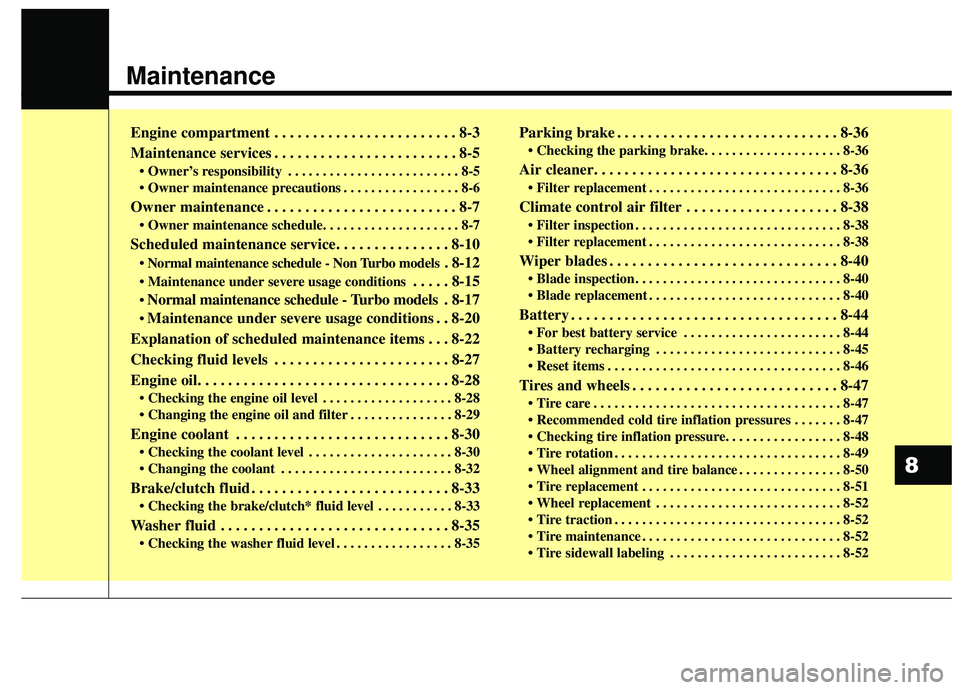
Engine compartment . . . . . . . . . . . . . . . . . . . . . . . . 8-3
Maintenance services . . . . . . . . . . . . . . . . . . . . . . . . 8-5
• Owner’s responsibility . . . . . . . . . . . . . . . . . . . . . . . . . 8-5
. . . . . . . . . . . . . . . . . 8-6
Owner maintenance . . . . . . . . . . . . . . . . . . . . . . . . . 8-7
Scheduled maintenance service. . . . . . . . . . . . . . . 8-10
. 8-12
. . . . . 8-15
Normal maintenance schedule - Turbo models . 8-17
Maintenance under severe usage conditions . . 8-20
Explanation of scheduled maintenance items . . . 8-22
Checking fluid levels . . . . . . . . . . . . . . . . . . . . . . . 8-27
Engine oil. . . . . . . . . . . . . . . . . . . . . . . . . . . . . . . . . 8-28
. . . . . . . . . . . . . . . . . . . 8-28
. . . . . . . . . . . . . . . 8-29
Engine coolant . . . . . . . . . . . . . . . . . . . . . . . . . . . . 8-30
. . . . . . . . . . . . . . . . . . . . . 8-30
. . . . . . . . . . . . . . . . . . . . . . . . . 8-32
Brake/clutch fluid . . . . . . . . . . . . . . . . . . . . . . . . . . 8-33
. . . . . . . . . . . 8-33
Washer fluid . . . . . . . . . . . . . . . . . . . . . . . . . . . . . . 8-35
. . . . . . . . . . . . . . . . . 8-35
Parking brake . . . . . . . . . . . . . . . . . . . . . . . . . . . . . 8-36
Air cleaner. . . . . . . . . . . . . . . . . . . . . . . . . . . . . . . . 8-36
. . . . . . . . . . . . . . . . . . . . . . . . . . . . 8-36
Climate control air filter . . . . . . . . . . . . . . . . . . . . 8-38
. . . . . . . . . . . . . . . . . . . . . . . . . . . . . . 8-38
. . . . . . . . . . . . . . . . . . . . . . . . . . . . 8-38
Wiper blades . . . . . . . . . . . . . . . . . . . . . . . . . . . . . . 8-40
. . . . . . . . . . . . . . . . . . . . . . . . . . . . . . 8-40
. . . . . . . . . . . . . . . . . . . . . . . . . . . . 8-40
Battery . . . . . . . . . . . . . . . . . . . . . . . . . . . . . . . . . . . 8-\
44
. . . . . . . . . . . . . . . . . . . . . . . 8-44
. . . . . . . . . . . . . . . . . . . . . . . . . . . 8-45
. . . . . . . . . . . . . . . . . . . . . . . . . . . . . . . . . . 8-46\
Tires and wheels . . . . . . . . . . . . . . . . . . . . . . . . . . . 8-47
. . . . . . . . . . . . . . . . . . . . . . . . . . . . . . . . . . . . \
8-47
. . . . . . . 8-47
. . . . . . . . . . . . . . . . . . . . . . . . . . . . . . . . . 8-49
. . . . . . . . . . . . . . . 8-50
. . . . . . . . . . . . . . . . . . . . . . . . . . . . . 8-51
. . . . . . . . . . . . . . . . . . . . . . . . . . . 8-52
. . . . . . . . . . . . . . . . . . . . . . . . . . . . . . . . . 8-52
. . . . . . . . . . . . . . . . . . . . . . . . . . . . . 8-52
. . . . . . . . . . . . . . . . . . . . . . . . . 8-52
8
Page 441 of 564
83
Maintenance
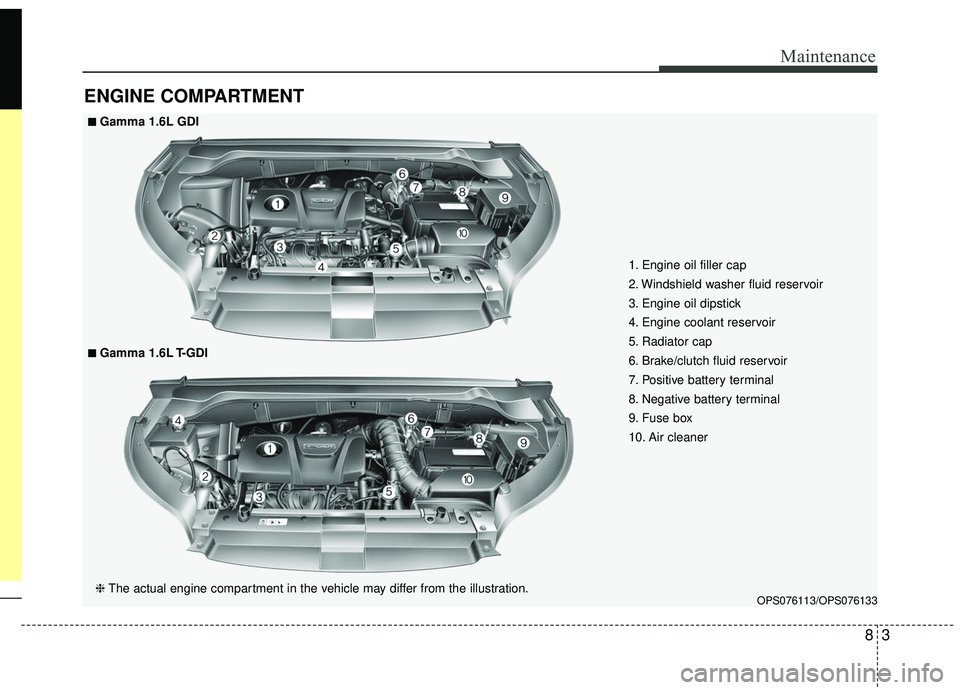
ENGINE COMPARTMENT
OPS076113/OPS076133
■ ■Gamma 1.6L GDI
❈ The actual engine compartment in the vehicle may differ from the illustration.
■ ■Gamma 1.6L T-GDI 1. Engine oil filler cap
2. Windshield washer fluid reservoir
3. Engine oil dipstick
4. Engine coolant reservoir
5. Radiator cap
6. Brake/clutch fluid reservoir
7. Positive battery terminal
8. Negative battery terminal
9. Fuse box
10. Air cleaner
Page 442 of 564
Maintenance
48
OPS076002N
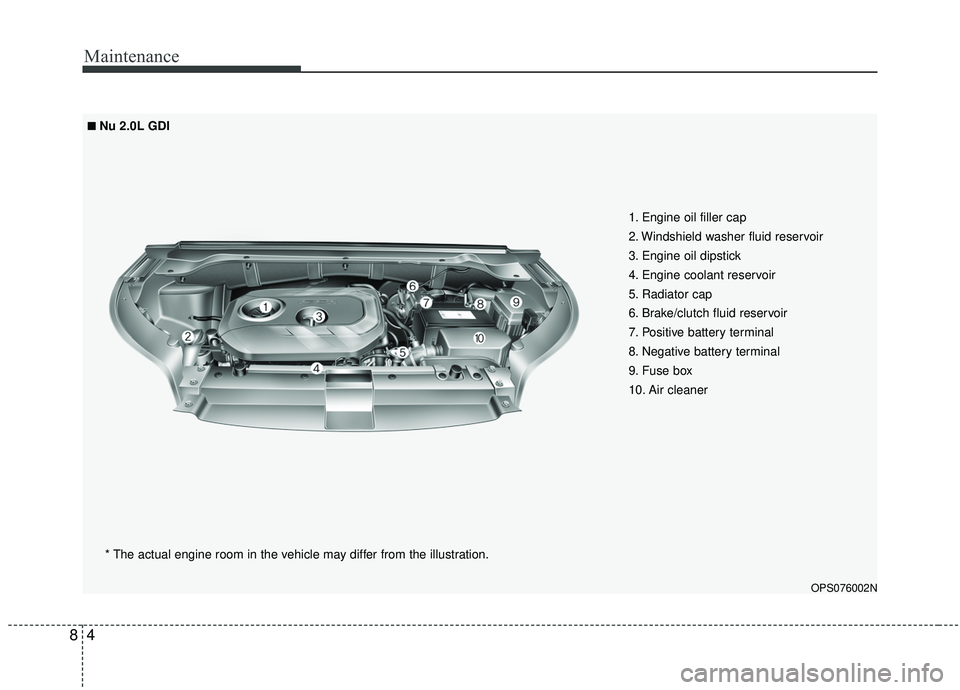
* The actual engine room in the vehicle may differ from the illustration.1. Engine oil filler cap
2. Windshield washer fluid reservoir
3. Engine oil dipstick
4. Engine coolant reservoir
5. Radiator cap
6. Brake/clutch fluid reservoir
7. Positive battery terminal
8. Negative battery terminal
9. Fuse box
10. Air cleaner
■ ■Nu 2.0L GDI
Page 452 of 564
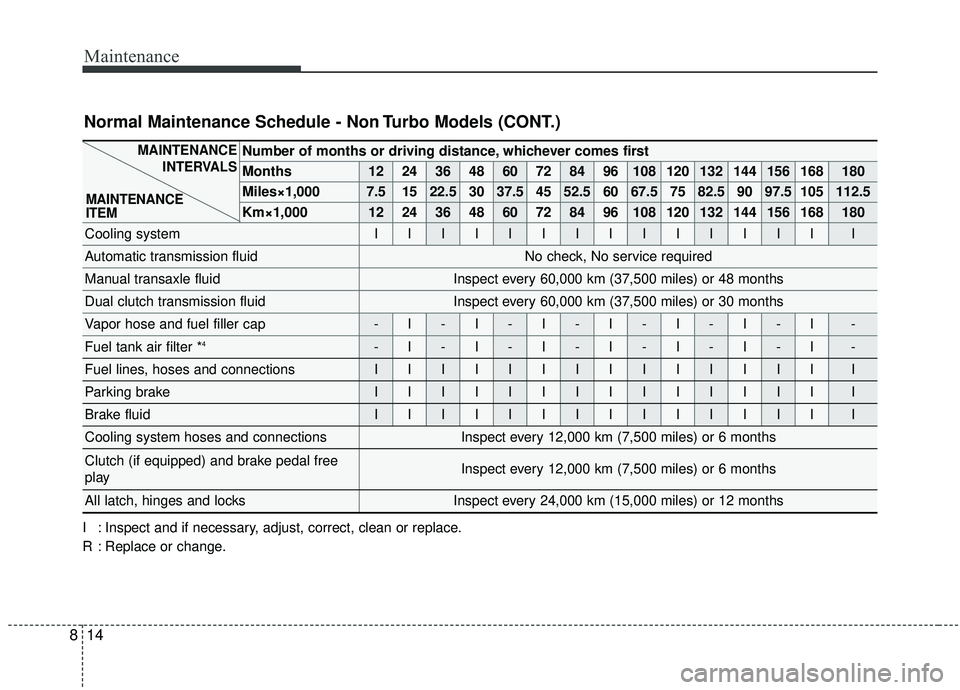
Maintenance
14
8
Number of months or driving distance, whichever comes first
Months1224364860728496108120132144156168180
Miles×1,0007.51522.530 37.5 45 52.5 60 67.5 75 82.5 90 97.5 105 112.5
Km×1,00012 24 36 48 60 72 84 96 108 120 132 144 156 168 180
Cooling systemIIIIIIIIIIIIIII
Automatic transmission fluidNo check, No service required
Manual transaxle fluidInspect every 60,000 km (37,500 miles) or 48 months
Dual clutch transmission fluidInspect every 60,000 km (37,500 miles) or 30 months
Vapor hose and fuel filler cap-I-I-I-I-I-I-I-
Fuel tank air filter *4-I-I-I-I-I-I-I-
Fuel lines, hoses and connectionsIIIIIIIIIIIIIII
Parking brakeIIIIIIIIIIIIIII
Brake fluidIIIIIIIIIIIIIII
Cooling system hoses and connectionsInspect every 12,000 km (7,500 miles) or 6 months
Clutch (if equipped) and brake pedal free
playInspect every 12,000 km (7,500 miles) or 6 months
All latch, hinges and locksInspect every 24,000 km (15,000 miles) or 12 months
MAINTENANCE
INTERVALS
MAINTENANCE
ITEM
Normal Maintenance Schedule - Non Turbo Models (CONT.)
I : Inspect and if necessary, adjust, correct, clean or replace.
R : Replace or change.
Page 453 of 564
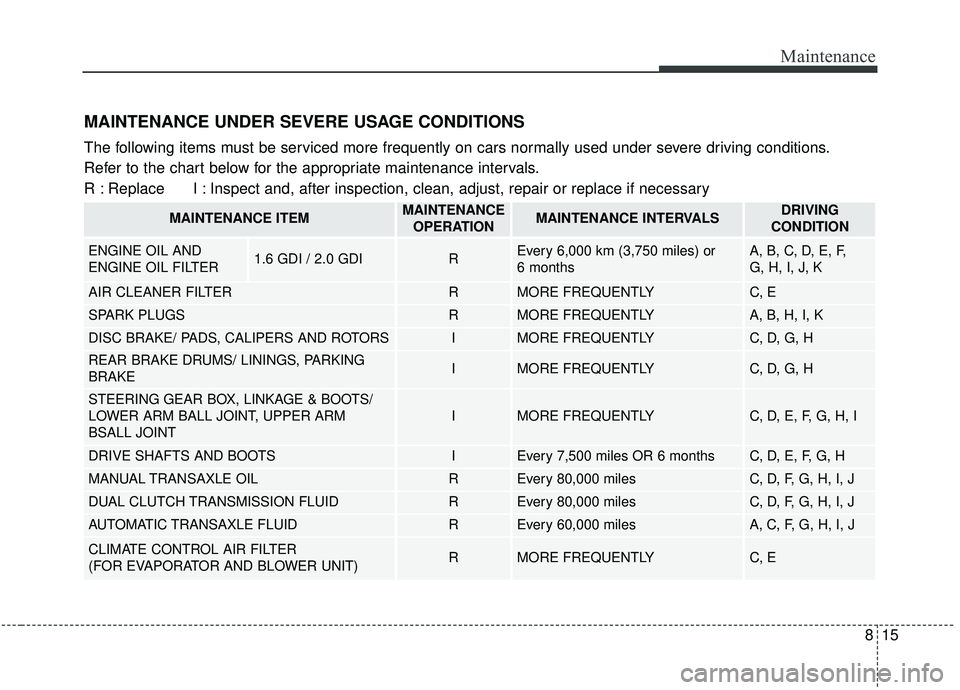
815
Maintenance
MAINTENANCE UNDER SEVERE USAGE CONDITIONS
The following items must be serviced more frequently on cars normally used under severe driving conditions.
Refer to the chart below for the appropriate maintenance intervals.
R : Replace I : Inspect and, after inspection, clean, adjust, repair or replace if neces\
sary
MAINTENANCE ITEMMAINTENANCEOPERATIONMAINTENANCE INTERVALSDRIVING
CONDITION
ENGINE OIL AND
ENGINE OIL FILTER1.6 GDI / 2.0 GDIREvery 6,000 km (3,750 miles) or
6 months A, B, C, D, E, F,
G, H, I, J, K
AIR CLEANER FILTERRMORE FREQUENTLYC, E
SPARK PLUGSRMORE FREQUENTLYA, B, H, I, K
DISC BRAKE/ PADS, CALIPERS AND ROTORSIMORE FREQUENTLYC, D, G, H
REAR BRAKE DRUMS/ LININGS, PARKING
BRAKEIMORE FREQUENTLYC, D, G, H
STEERING GEAR BOX, LINKAGE & BOOTS/
LOWER ARM BALL JOINT, UPPER ARM
BSALL JOINT
IMORE FREQUENTLYC, D, E, F, G, H, I
DRIVE SHAFTS AND BOOTSIEvery 7,500 miles OR 6 monthsC, D, E, F, G, H
MANUAL TRANSAXLE OILREvery 80,000 milesC, D, F, G, H, I, J
DUAL CLUTCH TRANSMISSION FLUIDREvery 80,000 milesC, D, F, G, H, I, J
AUTOMATIC TRANSAXLE FLUIDREvery 60,000 milesA, C, F, G, H, I, J
CLIMATE CONTROL AIR FILTER
(FOR EVAPORATOR AND BLOWER UNIT)RMORE FREQUENTLYC, E