belt KIA Sportage 2005 JE_ / 2.G Service Manual
[x] Cancel search | Manufacturer: KIA, Model Year: 2005, Model line: Sportage, Model: KIA Sportage 2005 JE_ / 2.GPages: 354, PDF Size: 2.78 MB
Page 89 of 354
Knowing your vehicle78 3
1
2
3
4
5
6
7
8
9
In order to help provide protection
in a severe collision, the airbags
must inflate rapidly. The speed of
airbag inflation has been deter-
mined by the Canadian Motor
Vehicle Safety Standard (CMVSS)
to reduce the likelihood of serious
or life-threatening injuries and is
thus a mandatory part of the airbag
design.
However, airbag inflation can also
cause injuries which normally can
include facial abrasions, bruises
and broken bones, because that
speed also causes the airbags to
expand with a great deal force.
There are even circumstances
under which contact with the
steering wheel airbag can cause
fatal injuries, especially if the
occupant is positioned exces-
sively close to the steering
wheel.
Noise and smokeWhen the airbags inflate, they make
a loud noise and they leave smoke
and powder in the air inside of the
vehicle. This is normal and is a result
of the ignition of the airbag inflator.
After the airbag inflates, you may feel
substantial discomfort in breathing
due to the contact of your chest to
both the safety belt and the airbag,
as well as from breathing the smoke
and powder.We strongly urge you
to open your doors and/or win-
dows as soon as possible after
impact in order to reduce discom-
fort and prevent prolonged expo-
sure to the smoke and powder.
Though smoke and powder are non-
toxic, it may cause irritation to the
skin (eyes, nose and throat etc). If
this is the case, wash and rinse with
cold water immediately and consult
the doctor if the symptom persists.
WARNING
Driver should sit as far back
(at least 10 inches (250 mm)
away) from the steering wheel
airbag as possible to reduce
the risk of injury or death in a
collision. The front passenger
should always move their seat
as far back as possible and sit
back in their seat.
Airbags inflate instantly in an
event of collision and passen-
gers may be injured by the
airbag expansion force if they
are not in proper position.
Airbag inflation may cause
injuries which normally
include facial or bodily abra-
sions, injuries by the broken
eyeglasses or burns by the
explosives.
KM CAN (ENG) 3 (~112).qxd 9/13/2004 4:50 PM Page 78
Page 138 of 354
415
Driving your vehicle
You must learn how to corner in a
4WD vehicle as soon as possible.
Do not rely on your experience in
conventional 2WD vehicles in
choosing safe cornering speed.
You must drive more slowly. Drive off-road carefully because
your vehicle may be damaged by
rocks or roots of trees. Become
familiar with the off-road conditions
you are going to drive before you
start.
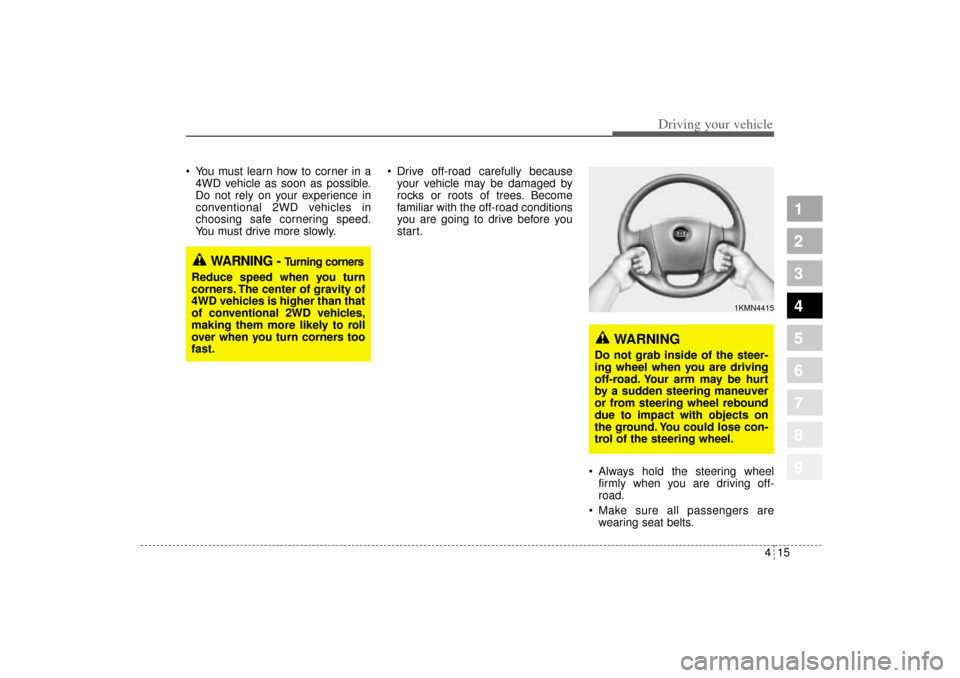
Always hold the steering wheel
firmly when you are driving off-
road.
Make sure all passengers are
wearing seat belts.
1
2
3
4
5
6
7
8
9
WARNING -
Turning corners
Reduce speed when you turn
corners. The center of gravity of
4WD vehicles is higher than that
of conventional 2WD vehicles,
making them more likely to roll
over when you turn corners too
fast.
WARNING
Do not grab inside of the steer-
ing wheel when you are driving
off-road. Your arm may be hurt
by a sudden steering maneuver
or from steering wheel rebound
due to impact with objects on
the ground. You could lose con-
trol of the steering wheel.
1KMN4415
KM CAN (ENG) 4.qxd 9/13/2004 4:48 PM Page 15
Page 140 of 354
417
Driving your vehicle
1
2
3
4
5
6
7
8
9
WARNING
Avoid high cornering speed.
Do not make quick steering
wheel movements, such as
sharp lane changes or fast,
sharp turns.
The risk of rollover is greatly
increased if you lose control
of your vehicle at high speeds.
In a collision, an unbelted per-
son is significantly more likely
to die compared to a person
wearing a seat belt.
Loss of control often occurs if
two or more wheels drop off
the roadway and the driver
over steers to re-enter the
roadway.
In the event your vehicle
leaves the roadway, do not
steer sharply.
Instead , slow down before
pulling back into the travel
lanes.
KM CAN (ENG) 4.qxd 9/13/2004 4:48 PM Page 17
Page 148 of 354
425
Driving your vehicle
1
2
3
4
5
6
7
8
9
Power steeringPower Steering uses energy from the
engine to assist you in steering the
vehicle. If the engine is off or if the
power steering system becomes
inoperative, the vehicle may still be
steered, but it will require increased
steering effort.
Should you notice any change in the
effort required to steer during normal
vehicle operation, have the power
steering checked by an Authorized
Kia Dealer.
✽ ✽
NOTICE• Never hold the steering wheel
against a stop (extreme right or
left turn) for more than 5 seconds
with the engine running. Holding
the steering wheel for more than 5
seconds in either position may
cause damage to the power steer-
ing pump.
• If the power steering drive belt
breaks or if the power steering
pump malfunctions, the steering
effort will greatly increase.
✽ ✽
NOTICEIf the vehicle is parked for extended
periods outside in cold weather
(below -10 °C/14 °F), the power
steering may require increased
effort when the engine is first start-
ed. This is caused by increased fluid
viscosity due to the cold weather and
does not indicate a malfunction.
When this happens, increase the
engine RPM by depressing accelera-
tor until the RPM reaches 1,500 rpm
then release or let the engine idle for
two or three minutes to warm up the
fluid.
STEERING WHEEL
KM CAN (ENG) 4.qxd 9/13/2004 4:48 PM Page 25
Page 170 of 354
447
Driving your vehicle
1
2
3
4
5
6
7
8
9
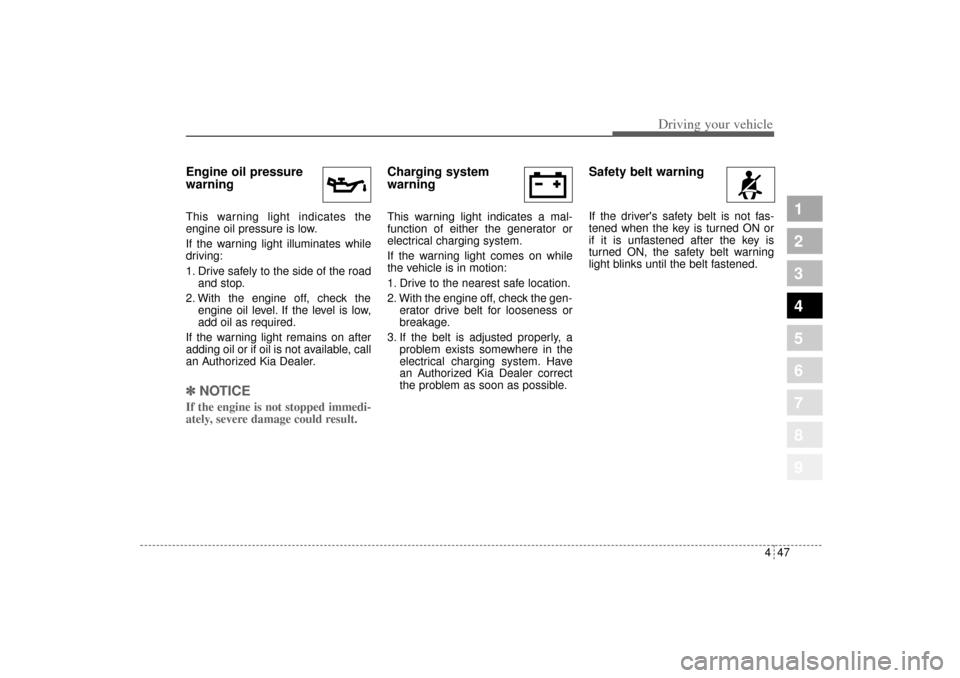
Engine oil pressure
warning This warning light indicates the
engine oil pressure is low.
If the warning light illuminates while
driving:
1. Drive safely to the side of the road
and stop.
2. With the engine off, check the
engine oil level. If the level is low,
add oil as required.
If the warning light remains on after
adding oil or if oil is not available, call
an Authorized Kia Dealer.✽ ✽
NOTICEIf the engine is not stopped immedi-
ately, severe damage could result.
Charging system
warning This warning light indicates a mal-
function of either the generator or
electrical charging system.
If the warning light comes on while
the vehicle is in motion:
1. Drive to the nearest safe location.
2. With the engine off, check the gen-
erator drive belt for looseness or
breakage.
3. If the belt is adjusted properly, a
problem exists somewhere in the
electrical charging system. Have
an Authorized Kia Dealer correct
the problem as soon as possible.
Safety belt warning If the driver's safety belt is not fas-
tened when the key is turned ON or
if it is unfastened after the key is
turned ON, the safety belt warning
light blinks until the belt fastened.
KM CAN (ENG) 4.qxd 9/13/2004 4:48 PM Page 47
Page 176 of 354
453
Driving your vehicle
1
2
3
4
5
6
7
8
9
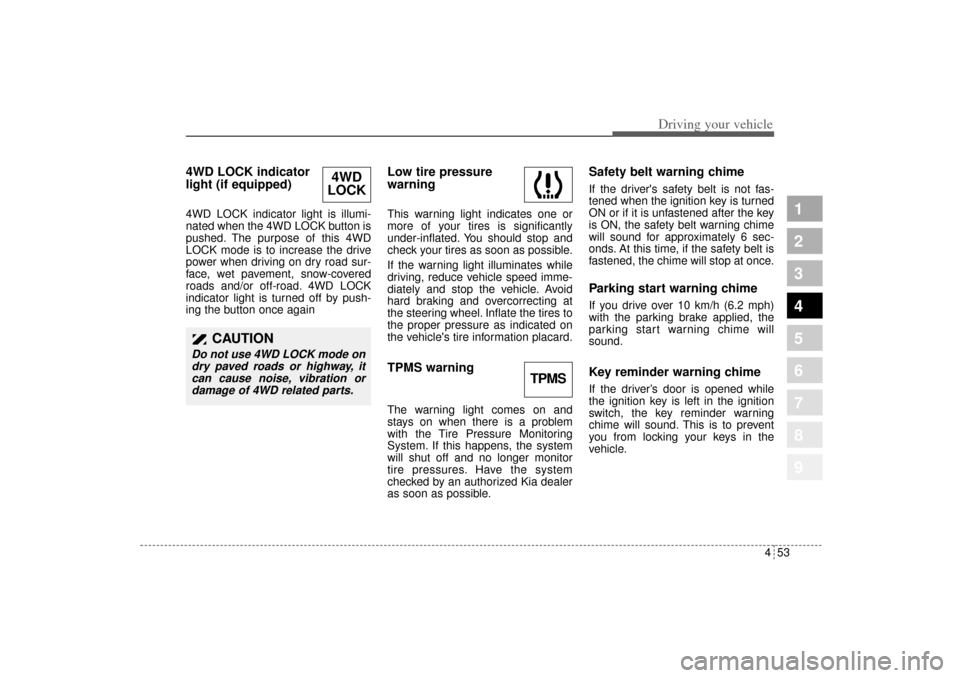
4WD LOCK indicator
light (if equipped) 4WD LOCK indicator light is illumi-
nated when the 4WD LOCK button is
pushed. The purpose of this 4WD
LOCK mode is to increase the drive
power when driving on dry road sur-
face, wet pavement, snow-covered
roads and/or off-road. 4WD LOCK
indicator light is turned off by push-
ing the button once again
Low tire pressure
warningThis warning light indicates one or
more of your tires is significantly
under-inflated. You should stop and
check your tires as soon as possible.
If the warning light illuminates while
driving, reduce vehicle speed imme-
diately and stop the vehicle. Avoid
hard braking and overcorrecting at
the steering wheel. Inflate the tires to
the proper pressure as indicated on
the vehicle's tire information placard.TPMS warning The warning light comes on and
stays on when there is a problem
with the Tire Pressure Monitoring
System. If this happens, the system
will shut off and no longer monitor
tire pressures. Have the system
checked by an authorized Kia dealer
as soon as possible.
Safety belt warning chime If the driver's safety belt is not fas-
tened when the ignition key is turned
ON or if it is unfastened after the key
is ON, the safety belt warning chime
will sound for approximately 6 sec-
onds. At this time, if the safety belt is
fastened, the chime will stop at once.Parking start warning chimeIf you drive over 10 km/h (6.2 mph)
with the parking brake applied, the
parking start warning chime will
sound.Key reminder warning chimeIf the driver’s door is opened while
the ignition key is left in the ignition
switch, the key reminder warning
chime will sound. This is to prevent
you from locking your keys in the
vehicle.
4WD
LOCK
CAUTION
Do not use 4WD LOCK mode on
dry paved roads or highway, it
can cause noise, vibration or
damage of 4WD related parts.
TPMS
KM CAN (ENG) 4.qxd 9/13/2004 4:48 PM Page 53
Page 227 of 354
Driving tips10 5Snow tires If you mount snow tires on your Kia,
make sure they are radial tires of the
same size and load range as the
original tires. Mount snow tires on all
four wheels to balance your vehicle’s
handling in all weather conditions.
Keep in mind that the traction provid-
ed by snow tires on dry roads may
not be as high as your vehicle's orig-
inal equipment tires. You should drive
cautiously even when the roads are
clear. Check with the tire dealer for
maximum speed recommendations.Do not install studded tires without
first checking local, state and munic-
ipal regulations for possible restric-
tions against their use.
Driving in flooded areas Avoid driving through flooded areas
unless you are sure the water is no
higher than the bottom of the wheel
hub. Drive through any water slowly.
Allow adequate stopping distance
because brake performance may be
affected.
After driving through water, dry the
brakes by gently applying them sev-
eral times while the vehicle is moving
slowly.
Reducing the risk of a rolloverThis multi-purpose passenger vehi-
cle is defined as a Sports Utility
Vehicle (SUV). SUV’s have higher
ground clearance and a narrower
track to make them capable of per-
forming in a wide variety of off-road
applications. Specific design charac-
teristics give them a higher center of
gravity than ordinary cars. An advan-
tage of the higher ground clearance
is a better view of the road, which
allows you to anticipate problems.
They are not designed for cornering
at the same speeds as conventional
passenger drive vehicles, any more
than low-slung sports cars are
designed to perform satisfactorily in
off-road conditions. Due to this risk,
driver and passengers are strongly
recommended to buckle their seat-
belts. In a rollover crash, an unbelt-
ed person is more likely to die than a
person wearing a seatbelt. There
are steps that a driver can make to
reduce the risk of a rollover. If at all
possible, avoid sharp turns or abrupt
maneuvers, do not load your roof
rack with heavy cargo, and never
modify your vehicle in any way.
1
2
3
4
5
6
7
8
9
WARNING
- Snow tire
size
Snow tires should be equivalent
in size and type to the vehicle's
standard tires. Otherwise, the
safety and handling of your
vehicle may be adversely affect-
ed.
KM CAN (ENG) 5.qxd 9/13/2004 4:48 PM Page 10
Page 228 of 354
511
Driving tips
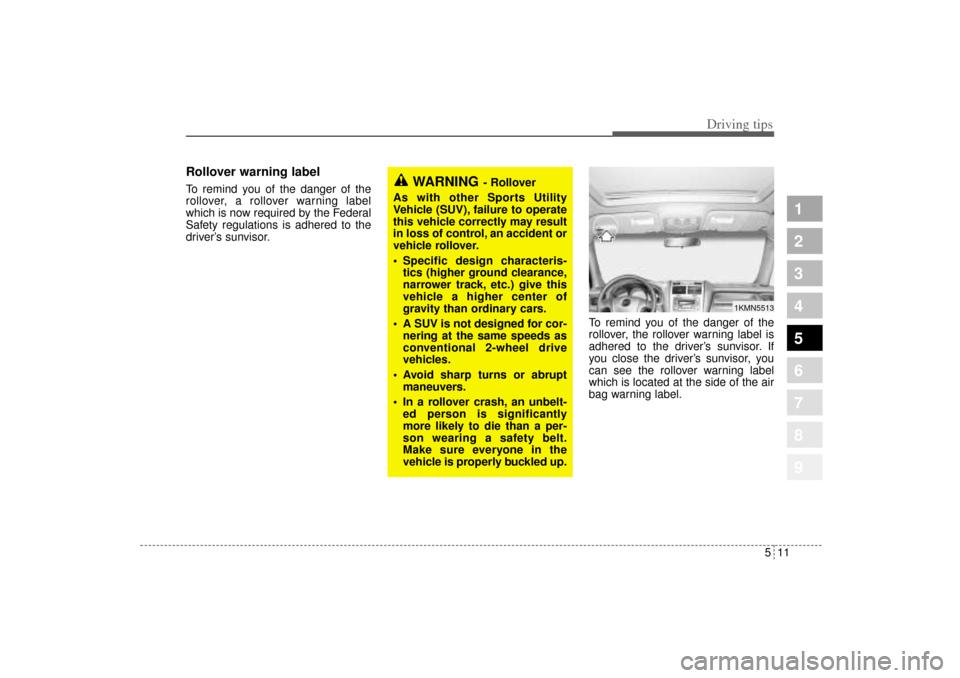
Rollover warning labelTo remind you of the danger of the
rollover, a rollover warning label
which is now required by the Federal
Safety regulations is adhered to the
driver’s sunvisor.
To remind you of the danger of the
rollover, the rollover warning label is
adhered to the driver’s sunvisor. If
you close the driver’s sunvisor, you
can see the rollover warning label
which is located at the side of the air
bag warning label.
1
2
3
4
5
6
7
8
9
WARNING
- Rollover
As with other Sports Utility
Vehicle (SUV), failure to operate
this vehicle correctly may result
in loss of control, an accident or
vehicle rollover.
Specific design characteris-
tics (higher ground clearance,
narrower track, etc.) give this
vehicle a higher center of
gravity than ordinary cars.
A SUV is not designed for cor-
nering at the same speeds as
conventional 2-wheel drive
vehicles.
Avoid sharp turns or abrupt
maneuvers.
In a rollover crash, an unbelt-
ed person is significantly
more likely to die than a per-
son wearing a safety belt.
Make sure everyone in the
vehicle is properly buckled up.
1KMN5513
KM CAN (ENG) 5.qxd 9/13/2004 4:48 PM Page 11
Page 233 of 354
Driving tips16 5
1
2
3
4
5
6
7
8
9
Getting familiar with off-road driv-
ingIt’s necessary for you to practice in
an area that’s safe and close to
home before you begin serious off-
road driving. Off-road driving
requires new and different driving
skills.
You need to tune your senses to dif-
ferent kinds of signals. For example,
constantly sweep the terrain with
your eyes looking for unexpected
obstacles. Listen for unusual tire,
gear, or engine sounds. Feel and
respond to the vibrations of the vehi-
cle with your hands, feet, and body
while still carefully controlling your
vehicle. You’ll also need to adjust
your expectations and greatly lower
the number of miles you expect to
cover in an hour or a day.Controlling your vehicle is the key to
successful off-road driving. One of
the best ways to control your vehicle
is to control your speed. Here are
some things to keep in mind when
traveling at higher speeds:
You approach things faster and you
have less time to scan the terrain
for obstacles.
You have less time to react.
You have much more vehicle
bounce when you drive over obsta-
cles, giving you less vehicle con-
trol.
You’ll need more distance for brak-
ing, especially since you’re on an
unpaved surface. Such terrain will
always be more “slippery” than a
paved road.
WARNING -
Off road driv-
ing
When you’re driving off-road,
bouncing and quick changes in
direction can easily throw you
out of position. This could
cause you to lose control of the
vehicle and crash. So, whether
you are driving on or off the
road, you and your passengers
should always wear safety belts.
KM CAN (ENG) 5.qxd 9/13/2004 4:48 PM Page 16
Page 257 of 354
Driving tips40 5
1
2
3
4
5
6
7
8
9
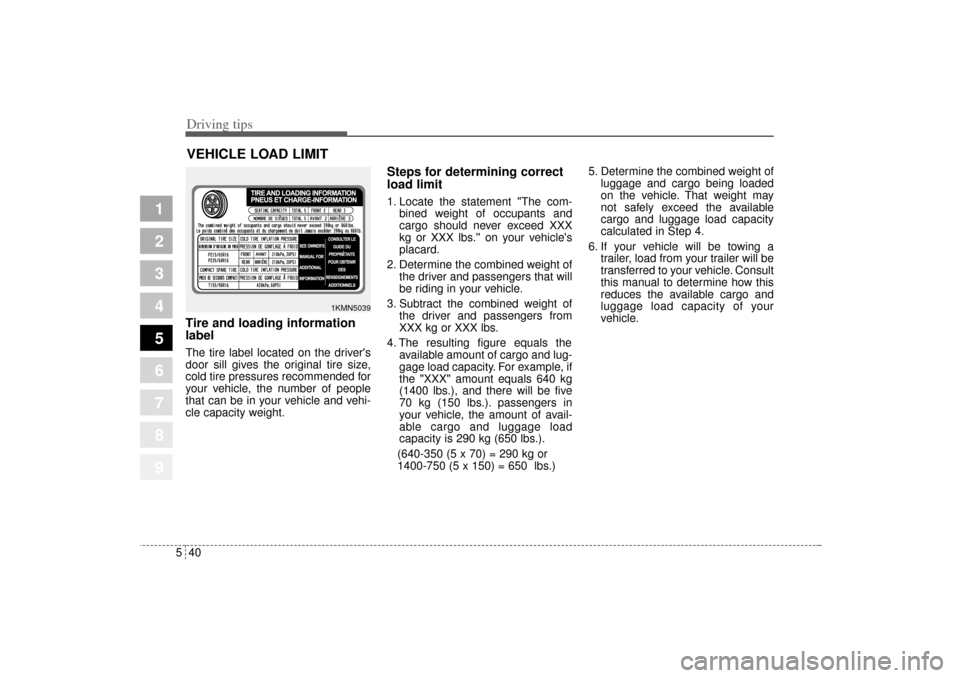
VEHICLE LOAD LIMITTire and loading information
labelThe tire label located on the driver's
door sill gives the original tire size,
cold tire pressures recommended for
your vehicle, the number of people
that can be in your vehicle and vehi-
cle capacity weight.
Steps for determining correct
load limit1. Locate the statement "The com-
bined weight of occupants and
cargo should never exceed XXX
kg or XXX lbs.'' on your vehicle's
placard.
2. Determine the combined weight of
the driver and passengers that will
be riding in your vehicle.
3. Subtract the combined weight of
the driver and passengers from
XXX kg or XXX lbs.
4. The resulting figure equals the
available amount of cargo and lug-
gage load capacity. For example, if
the "XXX" amount equals 640 kg
(1400 lbs.), and there will be five
70 kg (150 lbs.). passengers in
your vehicle, the amount of avail-
able cargo and luggage load
capacity is 290 kg (650 lbs.).
(640-350 (5 x 70) = 290 kg or
1400-750 (5 x 150) = 650 lbs.)5. Determine the combined weight of
luggage and cargo being loaded
on the vehicle. That weight may
not safely exceed the available
cargo and luggage load capacity
calculated in Step 4.
6. If your vehicle will be towing a
trailer, load from your trailer will be
transferred to your vehicle. Consult
this manual to determine how this
reduces the available cargo and
luggage load capacity of your
vehicle.
1KMN5039
KM CAN (ENG) 5.qxd 9/13/2004 4:48 PM Page 40