belt KIA Sportage 2005 JE_ / 2.G Workshop Manual
[x] Cancel search | Manufacturer: KIA, Model Year: 2005, Model line: Sportage, Model: KIA Sportage 2005 JE_ / 2.GPages: 354, PDF Size: 2.78 MB
Page 259 of 354
Driving tips42 5
1
2
3
4
5
6
7
8
9
Refer to your vehicle's tire and load-
ing information label for specific
information about your vehicle's
capacity weight and seating posi-
tions. The combined weight of the
driver, passengers and cargo should
never exceed your vehicle's capacity
weight.
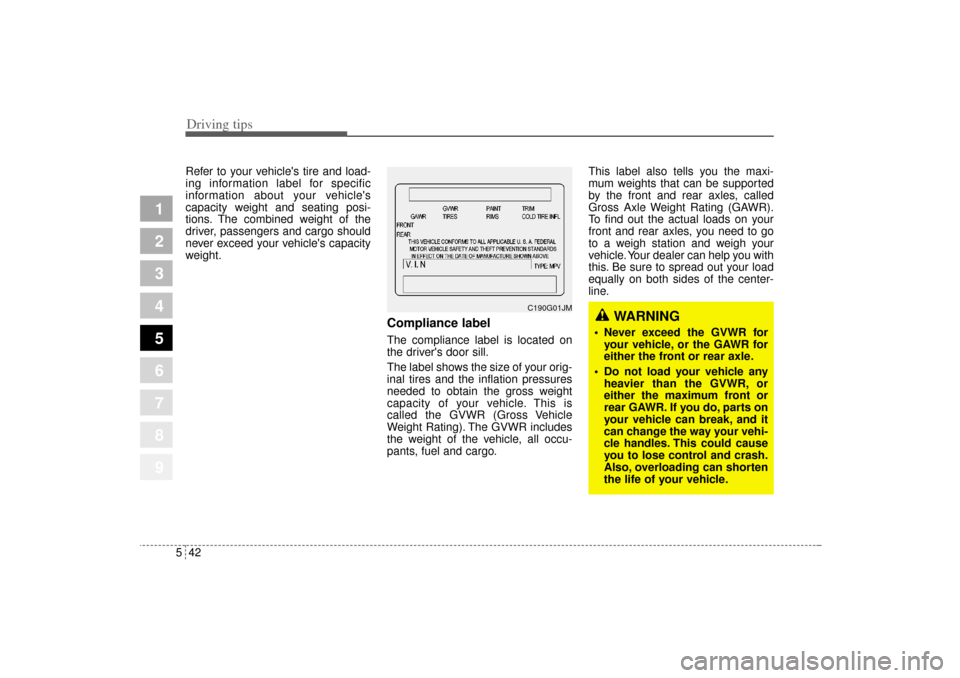
Compliance labelThe compliance label is located on
the driver's door sill.
The label shows the size of your orig-
inal tires and the inflation pressures
needed to obtain the gross weight
capacity of your vehicle. This is
called the GVWR (Gross Vehicle
Weight Rating). The GVWR includes
the weight of the vehicle, all occu-
pants, fuel and cargo.This label also tells you the maxi-
mum weights that can be supported
by the front and rear axles, called
Gross Axle Weight Rating (GAWR).
To find out the actual loads on your
front and rear axles, you need to go
to a weigh station and weigh your
vehicle. Your dealer can help you with
this. Be sure to spread out your load
equally on both sides of the center-
line.
WARNING
Never exceed the GVWR for
your vehicle, or the GAWR for
either the front or rear axle.
Do not load your vehicle any
heavier than the GVWR, or
either the maximum front or
rear GAWR. If you do, parts on
your vehicle can break, and it
can change the way your vehi-
cle handles. This could cause
you to lose control and crash.
Also, overloading can shorten
the life of your vehicle.
C190G01JM
KM CAN (ENG) 5.qxd 9/13/2004 4:48 PM Page 42
Page 294 of 354
1
2
3
4
5
6
7
8
9
Maintenance services / 7-3
Maintenance schedule / 7-4
Owner maintenance / 7-8
Engine compartment / 7-11
Engine oil and oil filter / 7-13
Engine cooling system / 7-15
Brakes and clutch / 7-18
Parking brake / 7-19
Drive belts / 7-20
Power steering / 7-21
Steering wheel / 7-22
Automatic transaxle / 7-23
Manual transaxle / 7-25
Rear differential (4WD) / 7-25
Transfer case (4WD) / 7-25
Lubricants and fluids / 7-26
Air cleaner / 7-27
Air conditioner air filter / 7-28
Wiper blades / 7-29
Maintenance
KM CAN (ENG) 7.qxd 9/13/2004 4:47 PM Page 1
Page 297 of 354
Maintenance4 7
1
2
3
4
5
6
7
8
9
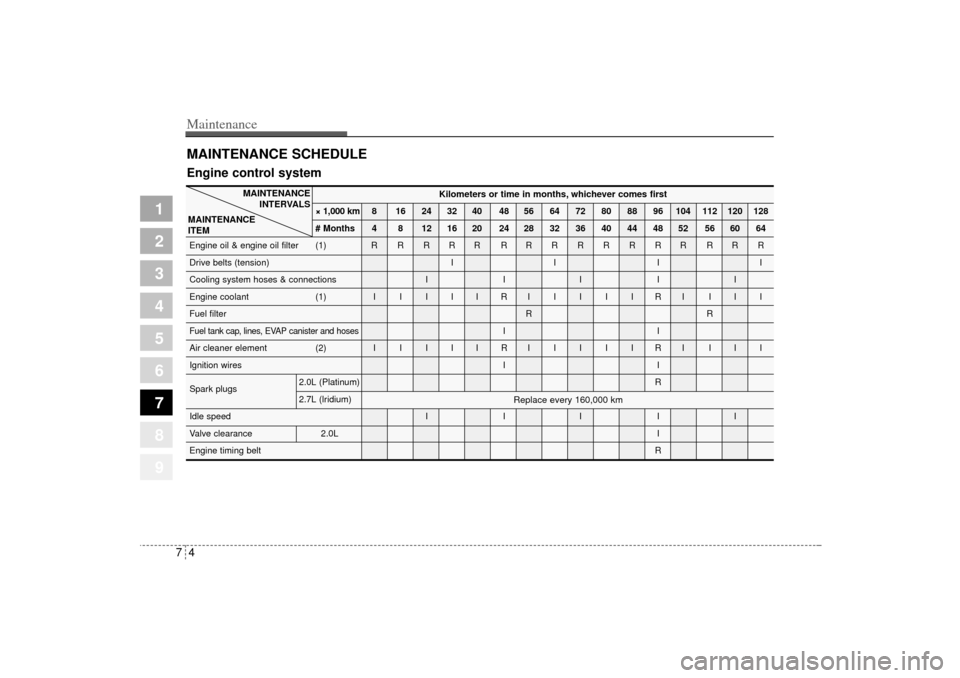
MAINTENANCE SCHEDULE
MAINTENANCE
INTERVALS
MAINTENANCE
ITEM
Engine control system
Kilometers or time in months, whichever comes first
× 1,000 km 8 16 24 32 40 48 56 64 72 80 88 96 104 112 120 128
# Months 4 8 12 16 20 24 28 32 36 40 44 48 52 56 60 64
Engine oil & engine oil filter (1) R R R R R RRRRRRRR RRR
Drive belts (tension) I I I I
Cooling system hoses & connections I I I I I
Engine coolant (1) I I I I I RIIIIIRI III
Fuel filterRR
Fuel tank cap, lines, EVAP canister and hoses
II
Air cleaner element (2) I I I I I RIIIIIRI III
Ignition wires I I
Spark plugs2.0L (Platinum)R
2.7L (lridium)
Idle speed I I I I I
Valve clearance 2.0LI
Engine timing beltRReplace every 160,000 km
KM CAN (ENG) 7.qxd 9/13/2004 4:47 PM Page 4
Page 299 of 354
Maintenance6 7
1
2
3
4
5
6
7
8
9
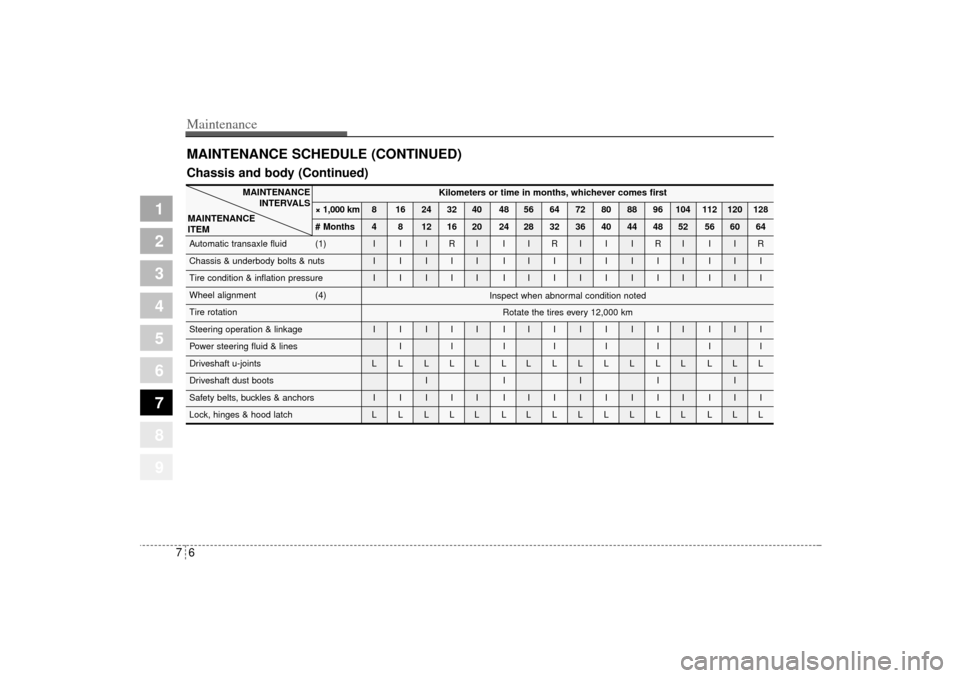
MAINTENANCE SCHEDULE (CONTINUED)
Kilometers or time in months, whichever comes first
× 1,000 km 8 16 24 32 40 48 56 64 72 80 88 96 104 112 120 128
# Months 4 8 12 16 20 24 28 32 36 40 44 48 52 56 60 64
Automatic transaxle fluid (1) I I I R I I I R I I I R I I I R
Chassis & underbody bolts & nuts I I I I I IIIIIIII III
Tire condition & inflation pressure I I I I I IIIIIIII III
Wheel alignment (4)
Tire rotation
Steering operation & linkage I I I I I IIIIIIII III
Power steering fluid & lines I I IIIIII
Driveshaft u-joints L L L L L LLLLLLLL LLL
Driveshaft dust boots I I I I I
Safety belts, buckles & anchors I I I I I IIIIIIII III
Lock, hinges & hood latch L L L L L LLLLLLLL LLL
MAINTENANCE
INTERVALS
MAINTENANCE
ITEM
Inspect when abnormal condition noted
Rotate the tires every 12,000 km
Chassis and body (Continued)
KM CAN (ENG) 7.qxd 9/13/2004 4:47 PM Page 6
Page 302 of 354

79
Maintenance
1
2
3
4
5
6
7
8
9
At least monthly: Check coolant level in the coolant
recovery reservoir.
Check the operation of all exterior
lights, including the stoplights, turn
signals and hazard warning flash-
ers.
Check the inflation pressures of all
tires including the spare.
At least twice a year
(i.e., every Spring and Fall) : Check radiator, heater and air con-
ditioning hoses for leaks or da-
mage.
Check windshield washer spray
and wiper operation. Clean wiper
blades with clean cloth dampened
with washer fluid.
Check headlight alignment.
Check muffler, exhaust pipes,
shields and clamps.
Check the lap/shoulder belts for
wear and function.
Check for worn tires and loose
wheel lug nuts.
At least once a year : Clean body and door drain holes.
Lubricate door hinges and checks,
and hood hinges.
Lubricate door and hood locks and
latches.
Lubricate door rubber weather-
strips.
Check the air conditioning system
before the warm weather season.
Check the power steering fluid
level.
Inspect and lubricate automatic
transaxle linkage and controls.
Clean battery and terminals.
Check the brake fluid level.
KM CAN (ENG) 7.qxd 9/13/2004 4:47 PM Page 9
Page 313 of 354
Maintenance20 7
1
2
3
4
5
6
7
8
9
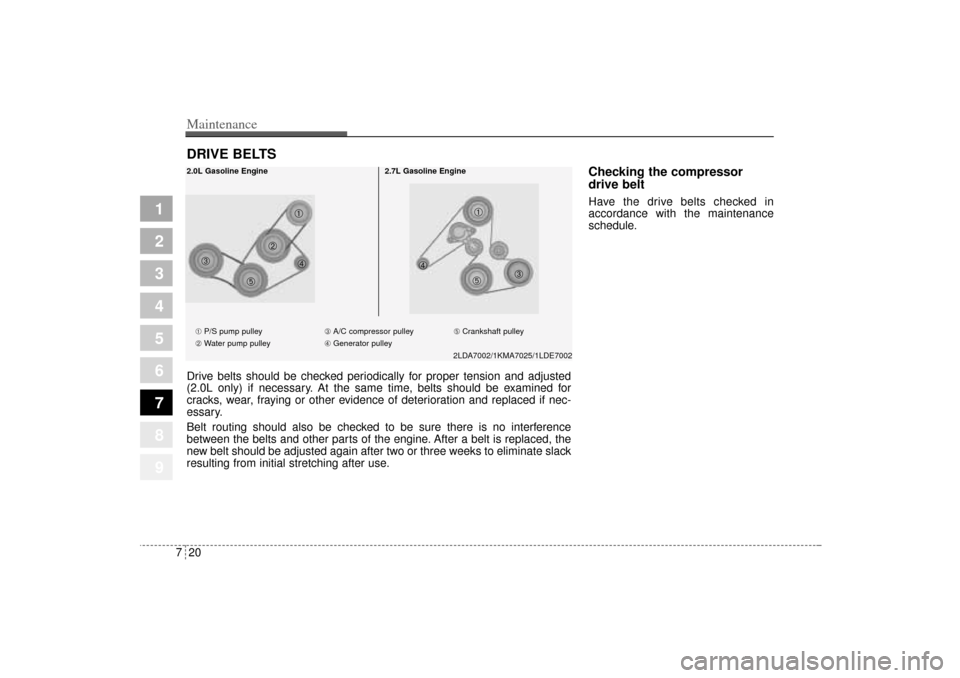
DRIVE BELTS
Checking the compressor
drive beltHave the drive belts checked in
accordance with the maintenance
schedule.
2LDA7002/1KMA7025/1LDE7002 ➀ P/S pump pulley
➁ Water pump pulley➂ A/C compressor pulley
➃ Generator pulley➄ Crankshaft pulley
2.0L Gasoline Engine 2.7L Gasoline Engine
➀➀
➃
➃ ➁
➄➄ ➂
➂
Drive belts should be checked periodically for proper tension and adjusted
(2.0L only) if necessary. At the same time, belts should be examined for
cracks, wear, fraying or other evidence of deterioration and replaced if nec-
essary.
Belt routing should also be checked to be sure there is no interference
between the belts and other parts of the engine. After a belt is replaced, the
new belt should be adjusted again after two or three weeks to eliminate slack
resulting from initial stretching after use.
KM CAN (ENG) 7.qxd 9/13/2004 4:47 PM Page 20
Page 331 of 354
Maintenance38 7
1
2
3
4
5
6
7
8
9
Wheel alignment and tire
balance The wheels on your vehicle were
aligned and balanced carefully at the
factory to give you the longest tire life
and best overall performance.
In most cases, you will not need to
have your wheels aligned again.
However, if you notice unusual tire
wear or your vehicle pulling one way
or the other, the alignment may need
to be reset.
If you notice your vehicle vibrating
when driving on a smooth road, your
wheels may need to be rebalanced.✽ ✽
NOTICEImproper wheel weights can dam-
age your vehicle's aluminum wheels.
Use only approved wheel weights.
WARNING
When replacing tires, never
mix radial, bias-belted, and
bias-type tires. All four tires
should be of the same size,
design and construction. Use
only the tire sizes listed on the
Tire Label found below the
door striker on the driver’s
side. Make sure that all tires
and wheels are the same size
and have the same load-carry-
ing capacity. Use only tire and
wheel combinations recom-
mended on the Tire Label or
by an Authorized Kia Dealer.
Failure to follow these precau-
tions can adversely affect the
safety and handling of your
vehicle.
(Continued)
(Continued)
The use of any other tire size
or type may seriously affect
ride, handling, ground clear-
ance, tire clearance, and
speedometer calibration.
Driving on worn-out tires is
very hazardous and will
reduce braking effectiveness,
steering accuracy, and trac-
tion.
It is best to replace all four
tires at the same time. If that is
not possible, or necessary,
then replace the two front or
two rear tires as a pair.
Replacing just one tire can
seriously affect your vehicle’s
handling.
KM CAN (ENG) 7.qxd 9/13/2004 4:47 PM Page 38
Page 334 of 354
741
Maintenance
1
2
3
4
5
6
7
8
9
3. Checking tire life (TIN : Tire
Identification Number) Any tires that are over 6 years, based
on the manufacturing date, tire
strength and performance, decline
with age naturally (even unused
spare tires). Therefore, the tires
(including the spare tire) should be
replaced by new ones. You can find
the manufacturing date on the tire
sidewall (possibly on the inside of the
wheel), displaying the DOT Code.
The DOT Code is a series of num-
bers on a tire consisting of numbers
and English letters. The manufactur-
ing date is designated by the last four
digits (characters) of the DOT code.
DOT : XXXX XXXX OOOO
The front part of the DOT means a
plant code number, tire size and
tread pattern and the last four num-
bers indicate week and year manu-
factured.
For example:
DOT XXXX XXXX 1602 represents
that the tire was produced in the 16th
week of 2002.
4. Tire ply composition and mate-
rialThe number of layers or plies of rub-
bercoated fabric in the tire. Tire man-
ufacturers also must indicate the
materials in the tire, which include
steel, nylon, polyester, and others.
The letter "R" means radial ply con-
struction; the letter "D" means diago-
nal or bias ply construction; and the
letter "B" means belted-bias ply con-
struction.
WARNING
A tire, more than 6 years old,
may sustain separation of cord
layers, inside the tire. Tire fail-
ure, due to separation of cord,
can cause serious accidents
and possibly injuries.
Therefore, make sure to check
the manufacturing date of the
tire and replace it within 6 years
of that date.
KM CAN (ENG) 7.qxd 9/13/2004 4:47 PM Page 41
Page 337 of 354

Maintenance44 7
1
2
3
4
5
6
7
8
9
Tire terminology and defini-
tionsAir Pressure: The amount of air
inside the tire pressing outward on
the tire. Air pressure is expressed in
pounds per square kilopascal (kPa)
or inch (psi).
Accessory Weight: This means the
combined weight of optional acces-
sories. Some examples of optional
accessories are, automatic transmis-
sion, power seats, and air condition-
ing.
Aspect Ratio: The relationship of a
tire's height to its width.
Belt: A rubber coated layer of cords
that is located between the plies and
the tread. Cords may be made from
steel or other reinforcing materials.
Bead: The tire bead contains steel
wires wrapped by steel cords that
hold the tire onto the rim.Bias Ply Tire: A pneumatic tire in
which the plies are laid at alternate
angles less than 90 degrees to the
centerline of the tread.
Cold Tire Pressure: The amount of
air pressure in a tire, measured in
pounds per square kilopascals (kPa)
or inch (psi) before a tire has built up
heat from driving.
Curb Weight: This means the weight
of a motor vehicle with standard and
optional equipment including the
maximum capacity of fuel, oil and
coolant, but without passengers and
cargo.DOT Markings: A code molded into
the sidewall of a tire signifying that
the tire is in compliance with the U.S.
Department of Transportation motor
vehicle safety standards. The DOT
code includes the Tire Identification
Number (TIN), an alphanumeric des-
ignator which can also identify the
tire manufacturer, production plant,
brand and date of production.
GVWR: Gross Vehicle Weight Rating
GAWR FRT: Gross Axle Weight
Rating for the front Axle.
GAWR RR: Gross Axle Weight
Rating for the rear axle.
KM CAN (ENG) 7.qxd 9/13/2004 4:47 PM Page 44
Page 348 of 354
755
Maintenance
1
2
3
4
5
6
7
8
9
INTERIOR CARE Interior general precautions Prevent caustic solutions such as
perfume and cosmetic oil from con-
tacting the dashboard because they
may cause damage or discoloration.
If they do contact the dashboard,
wipe them off immediately. See the
instructions that follow for the proper
way to clean vinyl.
Cleaning the upholstery and
interior trim Vinyl Remove dust and loose dirt from
vinyl with a whisk broom or vacuum
cleaner. Clean vinyl surfaces with a
vinyl cleaner.Fabric Remove dust and loose dirt from fab-
ric with a whisk broom or vacuum
cleaner. Clean with a mild soap solu-
tion recommended for upholstery or
carpets. Remove fresh spots imme-
diately with a fabric spot cleaner. If
fresh spots do not receive immediate
attention, the fabric can be stained
and its color can be affected. Also, its
fire-resistant properties can be
reduced if the material is not proper-
ly maintained.
Cleaning the lap/shoulder belt
webbing Clean the belt webbing with any mild
soap solution recommended for
cleaning upholstery or carpet. Follow
the instructions provided with the
soap. Do not bleach or re-dye the
webbing because this may weaken
it.Cleaning the interior window
glass If the interior glass surfaces of the
vehicle become fogged (that is, cov-
ered with an oily, greasy or waxy
film), they should be cleaned with
glass cleaner. Follow the directions
on the glass cleaner container.✽ ✽
NOTICEDo not scrape or scratch the inside
of the rear window. This may result
in damage to the rear window
defroster grid.
CAUTION
Using anything but recommend-
ed cleaners and procedures
may affect the fabric’s appear-
ance and fire-resistant proper-
ties.
WARNING
Never allow water or other liq-
uids to come in contact with
electrical/electronic compo-
nents inside the vehicle as this
may damage them.
KM CAN (ENG) 7.qxd 9/13/2004 4:47 PM Page 55