belt KIA Sportage 2005 JE_ / 2.G Owner's Guide
[x] Cancel search | Manufacturer: KIA, Model Year: 2005, Model line: Sportage, Model: KIA Sportage 2005 JE_ / 2.GPages: 354, PDF Size: 2.78 MB
Page 70 of 354
359
1
2
3
4
5
6
7
8
9
Knowing your vehicle
The importance of using
safety beltsThere are four very important rea-
sons to use safety belts even with an
airbag supplemental restraint sys-
tem. They:
help keep you in the proper posi-
tion (away from the airbag) when it
inflates.
reduce the risk of harm in rollover,
side impact (vehicles not equipped
with side and curtain airbags) or
rear impact collisions, because an
airbag is not designed to inflate in
such situations and even a side
curtain airbag is designed to inflate
only in certain side impact colli-
sions.
reduce the risk of harm in frontal or
side collisions which are not
severe enough to actuate the
airbag supplemental restraint sys-
tem.
reduce the risk of being ejected
from your vehicle.
✽ ✽
NOTICEYour vehicle’s Supplemental
Restraint System Control Module is
equipped with a recording device
that may record the use or status of
the safety belt restraint system by
the driver and front passenger in
certain collisions.
WARNING
- Airbags &
safety belts
• Even in vehicles with air bags,
you and your passengers
must always wear the safety
belts provided in order to min-
imize the risk and severity of
injury in the event of a colli-
sion or rollover.
Always wear your safety belt.
It can help keep you away
from the air bags during heavy
braking just before a collision.
(Continued)
(Continued)
If occupants are not wearing
safety belts or correctly seat-
ed, they cannot be protected,
and thus face serious injury or
death.
Driver’s and front passenger’s
airbag are designed to inflate
only in certain frontal colli-
sion, and side and curtain
airbags are designed to inflate
in certain side impacts.
Frontal airbags will generally
not provide protection in side
impacts (vehicles not
equipped with side and cur-
tain airbags) or rear impacts,
rollovers, less severe frontal
collisions. They will not pro-
vide protection from later
impacts in a multi-impact col-
lision.
(Continued)
KM CAN (ENG) 3 (~112).qxd 9/13/2004 4:50 PM Page 59
Page 71 of 354
Knowing your vehicle60 3
1
2
3
4
5
6
7
8
9
Airbag system components The main components of your SRS
are:
To indicate that your vehicle is
equipped with airbags, the corre-
sponding airbag covers are
marked with “SRS AIRBAG”.
- Driver’s airbag (see page 3- 61)
- Passenger’s airbag(see page 3- 62)
- Side airbag
(if equipped, see page 3- 69)
- Curtain airbag
(if equipped, see page 3- 69)
A diagnostic system that continual-
ly monitors the system operation.
Airbag warning light to warn you of
a possible problem with the sys-
tem.
Emergency power backup in case
your car’s electrical system is dis-
connected in a crash.The SRS uses a collection of sen-
sors to gather information about the
driver’s and front passenger’s seat
position, the driver’s and front pas-
senger’s safety belt usage and
impact severity.
The driver’s and front passenger’s
seat position sensors, which are
installed on the seat track, determine
if the seats are fore or aft of a refer-
ence position. Similarly, the safety
belt usage sensors determine if the
driver and front passenger’s safety
belts are fastened. These sensors
provide the ability to control the SRS
deployment based on how close the
driver’s seat is to the steering wheel,
how close the passenger’s seat is to
the instrument panel, whether or not
the safety belts are fastened, and the
severity of the impact.
(Continued)
If your vehicle has been sub-
jected to flood conditions (e.g.
soaked carpeting/standing
water on the floor of the vehi-
cle, etc.) or if your vehicle has
become flood damaged in any
way, do not attempt to start
the vehicle or put the key in
the ignition before discon-
necting the battery.
Disregarding this precaution
may cause airbag deployment,
which could result in serious
personal injury or death. If
your vehicle is subjected to
flooded conditions, before
starting the vehicle, have the
vehicle towed to an authorized
Kia dealer for inspection and
necessary repairs.
KM CAN (ENG) 3 (~112).qxd 9/13/2004 4:50 PM Page 60
Page 72 of 354
361
1
2
3
4
5
6
7
8
9
Knowing your vehicle
The advanced SRS offers the ability
to control the airbag inflation with two
levels. A first stage level is provided
for moderate-severity impacts. A sec-
ond stage level is provided for more
severe impacts.
According to the impact severity,
seating position and safety belt
usage, the SRSCM (SRS Control
Module) controls the airbag inflation.
Failure to properly wear safety
belts can increase the risk or
severity of injury in an accident.
Additionally, your SRS is equipped
with an occupant classification sys-
tem in the front passenger’s seat.
The occupant classification system
detects the presence of a passenger
in the front passenger’s seat and will
turn off the front passenger’s airbag
under certain conditions. For more
detail, see “Occupant Classification
System” later in this section.
CAUTION
If the seat position sensor is not
working properly, the SRS
airbag warning light ( ) on the
instrument panel will illuminate
even if there is no malfunction
of the SRS airbag system,
because the SRS airbag warn-
ing light is connected with the
seat position sensor. If the SRS
airbag warning light does not
illuminate when the ignition key
is turned to the "ON" position, if
it remains illuminated after illu-
minating for approximately 6
seconds, or if it illuminates
while the vehicle is being driv-
en, have an authorized Kia deal-
er inspect the seat position sen-
sor and the advanced SRS
airbag system as soon as possi-
ble.
AIR
BAG
WARNING
Modification to the seat struc-
ture can adversely affect the
seat position sensor and
cause the airbag to deploy at a
different level than should be
provided.
Failure to properly wear safety
belts can increase the risk or
severity of injury by causing
the airbags to deploy at a dif-
ferent level than should be
provided.
Do not place any objects
underneath the front seats
which could damage the seat
position sensor or interfere
with the occupant classifica-
tion system.
Do not place any objects that
may cause magnetic fields
near the front seat. These may
cause a malfunction of the
seat position sensor.
(Continued)
KM CAN (ENG) 3 (~112).qxd 9/13/2004 4:50 PM Page 61
Page 75 of 354
Knowing your vehicle64 3
1
2
3
4
5
6
7
8
9
Always be sure that you and all vehi-
cle occupants are seated and
restrained properly (sitting upright
with the seat in an upright position,
centered on the seat cushion, with
the person’s legs comfortably
extended, feet on the floor, and wear-
ing the safety belt properly) for the
most effective protection by the
airbag and the safety belt. The “PASSENGER AIRBAG OFF”
indicator illuminates after the igni-
tion key is turned to the “ON” posi-
tion or after the engine is started. If
the front passenger’s seat is occu-
pied by very small person, the
“PASSENGER AIRBAG OFF” indi-
cator will remain illuminated. If the
front passenger’s seat is occupied
by a person of adult size, the “PAS-
SENGER AIRBAG OFF” indicator
will turn off after 6 seconds.
If the front passenger's seat is
unoccupied, the “PASSENGER
AIRBAG OFF” indicator will turn
off, however the front passenger's
airbag will not deploy in frontal
crashes.
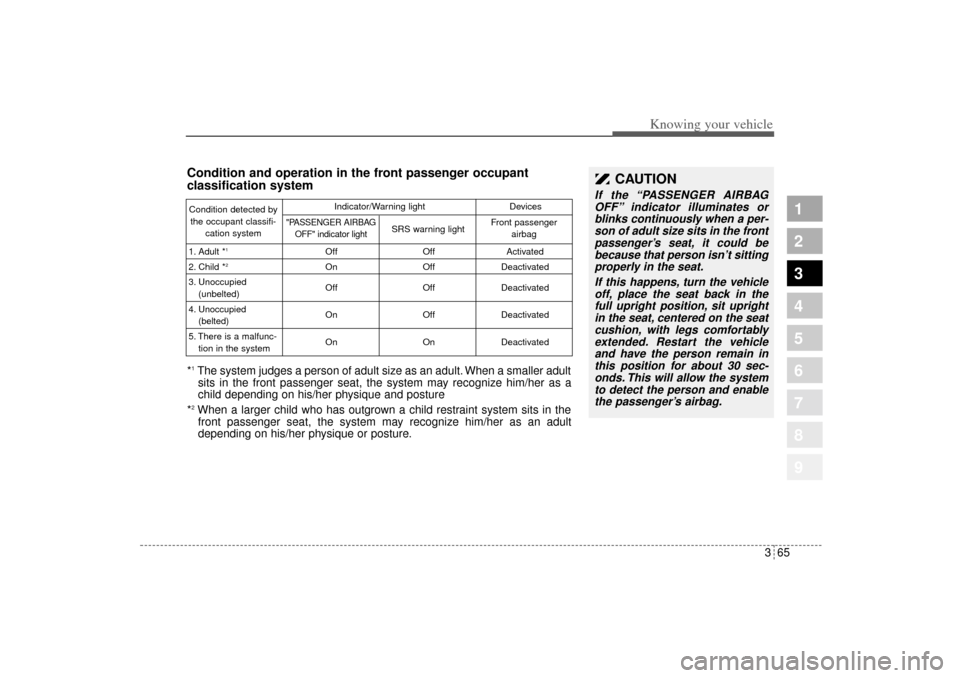
If the “PASSENGER AIRBAG OFF”
indicator illuminates, the front pas-
senger’s airbag will not deploy in
frontal crashes.
If the “PASSENGER AIRBAG OFF”
indicator is not illuminated, the
front passenger’s airbag will deploy
in frontal crashes.
WARNING
Even though your vehicle is
equipped with the occupant
classification system, do not
install a child restraint system
in the front passenger's seat.
The infant/child could be
severely injured or killed by an
airbag deployment in case of an
accident. A child restraint sys-
tem must never be placed in the
front seat. Children who are too
large for child restraint systems
should always occupy the rear
seat and use the available
lap/shoulder belts. Children are
afforded the most safety in the
event of an acident when they
are restrained by a proper
restraint system in the rear seat.
KM CAN (ENG) 3 (~112).qxd 9/13/2004 4:50 PM Page 64
Page 76 of 354
365
1
2
3
4
5
6
7
8
9
Knowing your vehicle
CAUTION
If the “PASSENGER AIRBAG
OFF” indicator illuminates or
blinks continuously when a per-
son of adult size sits in the front
passenger’s seat, it could be
because that person isn’t sitting
properly in the seat.
If this happens, turn the vehicle
off, place the seat back in the
full upright position, sit upright
in the seat, centered on the seat
cushion, with legs comfortably
extended. Restart the vehicle
and have the person remain in
this position for about 30 sec-
onds. This will allow the system
to detect the person and enable
the passenger’s airbag.
Condition and operation in the front passenger occupant
classification systemCondition detected by
the occupant classifi-
cation system
1. Adult *
1
2. Child *
2
3. Unoccupied
(unbelted)
4. Unoccupied
(belted)
5. There is a malfunc-
tion in the system Off
On
Off
On
OnOff
Off
Off
Off
OnActivated
Deactivated
Deactivated
Deactivated
Deactivated
"PASSENGER AIRBAG
OFF" indicator light
SRS warning lightFront passenger
airbag Indicator/Warning light Devices
*1The system judges a person of adult size as an adult. When a smaller adult
sits in the front passenger seat, the system may recognize him/her as a
child depending on his/her physique and posture
*2When a larger child who has outgrown a child restraint system sits in the
front passenger seat, the system may recognize him/her as an adult
depending on his/her physique or posture.
KM CAN (ENG) 3 (~112).qxd 9/13/2004 4:50 PM Page 65
Page 78 of 354
367
1
2
3
4
5
6
7
8
9
Knowing your vehicle
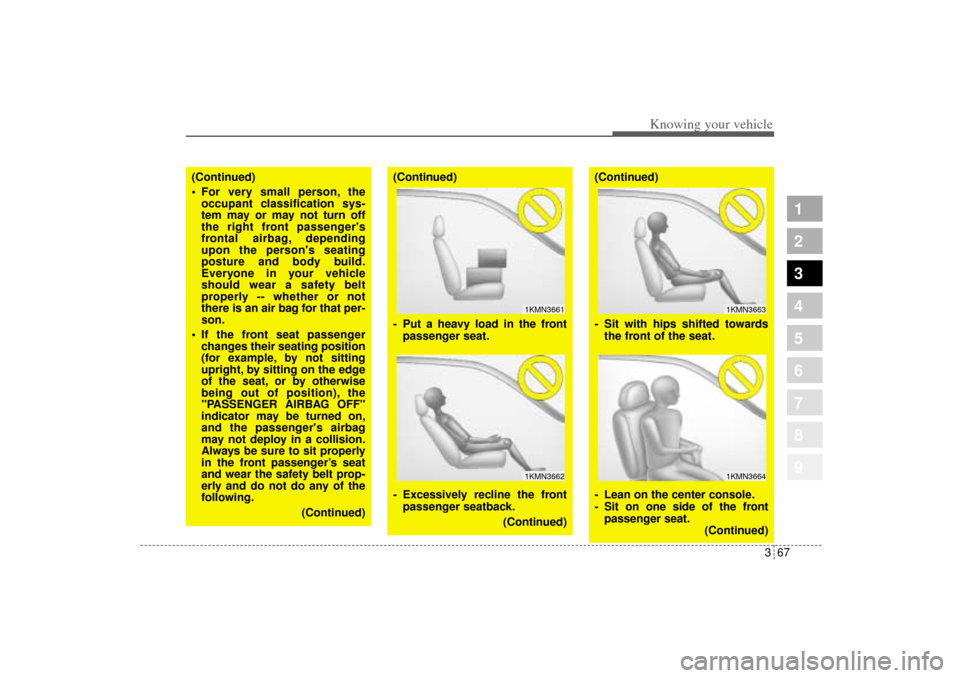
(Continued)
For very small person, the
occupant classification sys-
tem may or may not turn off
the right front passenger's
frontal airbag, depending
upon the person's seating
posture and body build.
Everyone in your vehicle
should wear a safety belt
properly -- whether or not
there is an air bag for that per-
son.
If the front seat passenger
changes their seating position
(for example, by not sitting
upright, by sitting on the edge
of the seat, or by otherwise
being out of position), the
"PASSENGER AIRBAG OFF"
indicator may be turned on,
and the passenger's airbag
may not deploy in a collision.
Always be sure to sit properly
in the front passenger’s seat
and wear the safety belt prop-
erly and do not do any of the
following.
(Continued)
(Continued)
- Put a heavy load in the front
passenger seat.
- Excessively recline the front
passenger seatback.
(Continued)
1KMN36611KMN3662
(Continued)
- Sit with hips shifted towards
the front of the seat.
- Lean on the center console.
- Sit on one side of the front
passenger seat.
(Continued)
1KMN36631KMN3664
KM CAN (ENG) 3 (~112).qxd 9/13/2004 4:50 PM Page 67
Page 80 of 354
369
1
2
3
4
5
6
7
8
9
Knowing your vehicle
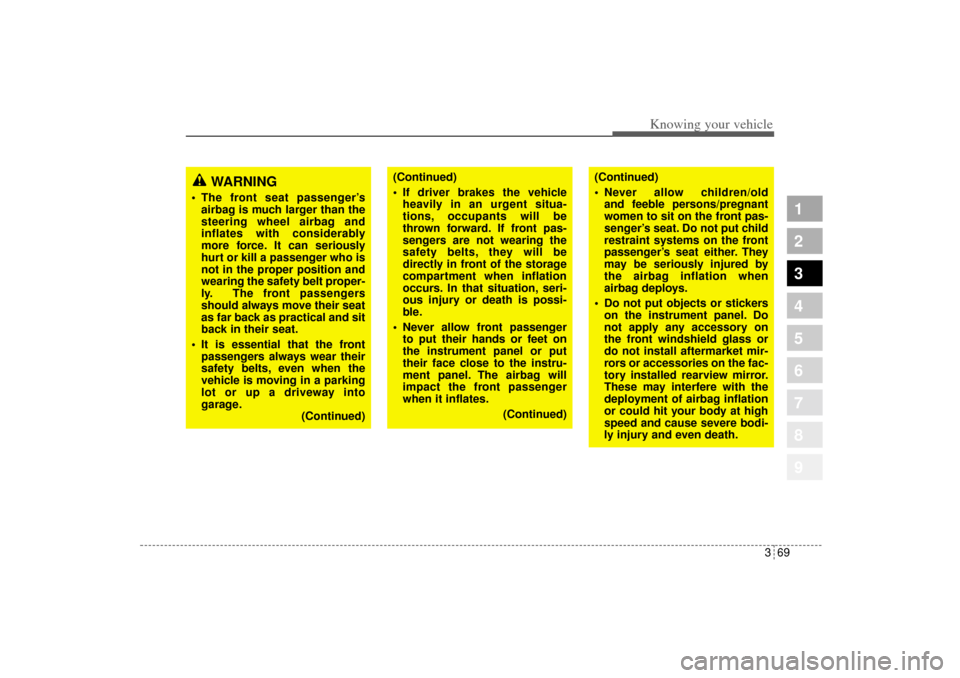
(Continued)
If driver brakes the vehicle
heavily in an urgent situa-
tions, occupants will be
thrown forward. If front pas-
sengers are not wearing the
safety belts, they will be
directly in front of the storage
compartment when inflation
occurs. In that situation, seri-
ous injury or death is possi-
ble.
Never allow front passenger
to put their hands or feet on
the instrument panel or put
their face close to the instru-
ment panel. The airbag will
impact the front passenger
when it inflates.
(Continued)
(Continued)
Never allow children/old
and feeble persons/pregnant
women to sit on the front pas-
senger’s seat. Do not put child
restraint systems on the front
passenger’s seat either. They
may be seriously injured by
the airbag inflation when
airbag deploys.
Do not put objects or stickers
on the instrument panel. Do
not apply any accessory on
the front windshield glass or
do not install aftermarket mir-
rors or accessories on the fac-
tory installed rearview mirror.
These may interfere with the
deployment of airbag inflation
or could hit your body at high
speed and cause severe bodi-
ly injury and even death.
WARNING
The front seat passenger’s
airbag is much larger than the
steering wheel airbag and
inflates with considerably
more force. It can seriously
hurt or kill a passenger who is
not in the proper position and
wearing the safety belt proper-
ly. The front passengers
should always move their seat
as far back as practical and sit
back in their seat.
It is essential that the front
passengers always wear their
safety belts, even when the
vehicle is moving in a parking
lot or up a driveway into
garage.
(Continued)
KM CAN (ENG) 3 (~112).qxd 9/13/2004 4:50 PM Page 69
Page 82 of 354
371
1
2
3
4
5
6
7
8
9
Knowing your vehicle
If the curtain airbag deploys, it
remains inflated for approximately
3 seconds. The curtain airbag
deployment occurs only on the
side of the vehicle affected by the
impact.
The side airbags (side and curtain
airbags) are not designed to
deploy during collisions from the
front or rear of the vehicle or in
most rollover situations.
The curtain airbags are designed
to deploy only during certain side-
impact collisions, depending on the
crash severity, angle, speed and
impact. The curtain airbags are not
designed to deploy in all side
impact situations.
WARNING
In order for side airbags (side
and curtain airbags) to pro-
vide its best protection, both
front seat occupants and both
outboard rear occupants
should sit in an upright posi-
tion with the seat belts proper-
ly fastened. Importantly, chil-
dren should sit in a proper
child restraint system in the
rear seat.
When children are seated in
the rear outboard seats, they
must be seated in the proper
child restraint system. Make
sure to put the child restraint
system as far away from the
door side as possible, and
secure the child restraint sys-
tem in a locked position.
(Continued)
(Continued)
Do not allow the passengers
to lean their heads or bodies
onto doors, put their arms on
the doors, stretch their arms
out of the window, or place
objects between the doors
and passengers when they are
seated on seats equipped with
side airbags.
Never try to open or repair any
components of the side cur-
tain airbag system. This
should only be done by an
authorized Kia dealer.
Failure to follow the above men-
tioned instructions can result in
injury or death to the vehicle
occupants in an accident.
KM CAN (ENG) 3 (~112).qxd 9/13/2004 4:50 PM Page 71
Page 85 of 354
Knowing your vehicle74 3
1
2
3
4
5
6
7
8
9
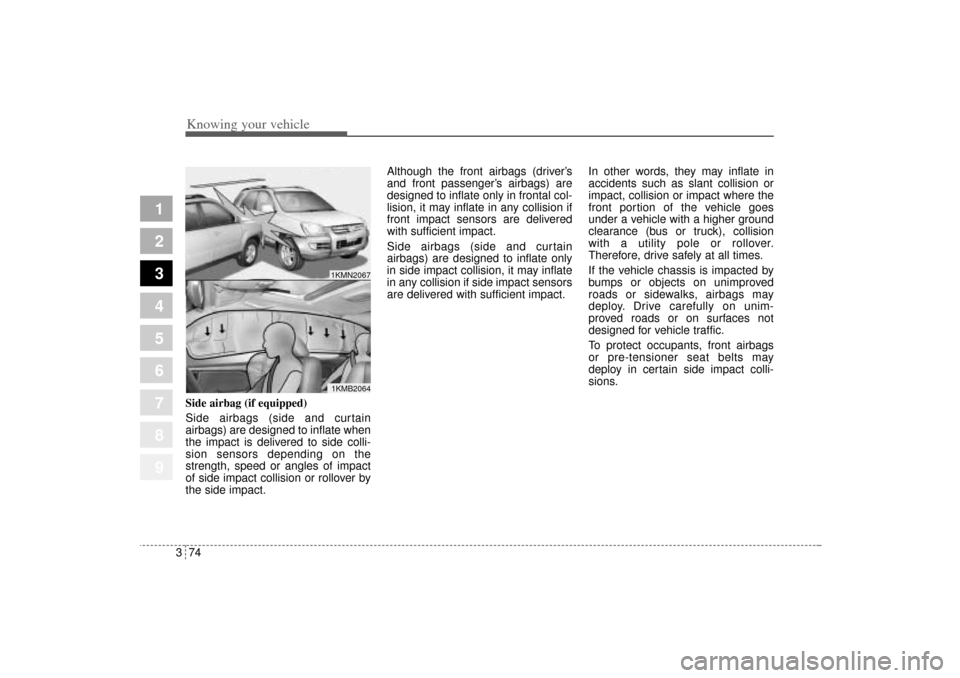
Side airbag (if equipped)
Side airbags (side and curtain
airbags) are designed to inflate when
the impact is delivered to side colli-
sion sensors depending on the
strength, speed or angles of impact
of side impact collision or rollover by
the side impact.Although the front airbags (driver’s
and front passenger’s airbags) are
designed to inflate only in frontal col-
lision, it may inflate in any collision if
front impact sensors are delivered
with sufficient impact.
Side airbags (side and curtain
airbags) are designed to inflate only
in side impact collision, it may inflate
in any collision if side impact sensors
are delivered with sufficient impact.In other words, they may inflate in
accidents such as slant collision or
impact, collision or impact where the
front portion of the vehicle goes
under a vehicle with a higher ground
clearance (bus or truck), collision
with a utility pole or rollover.
Therefore, drive safely at all times.
If the vehicle chassis is impacted by
bumps or objects on unimproved
roads or sidewalks, airbags may
deploy. Drive carefully on unim-
proved roads or on surfaces not
designed for vehicle traffic.
To protect occupants, front airbags
or pre-tensioner seat belts may
deploy in certain side impact colli-
sions.
1KMN20671KMB2064
KM CAN (ENG) 3 (~112).qxd 9/13/2004 4:50 PM Page 74
Page 86 of 354
375
1
2
3
4
5
6
7
8
9
Knowing your vehicle
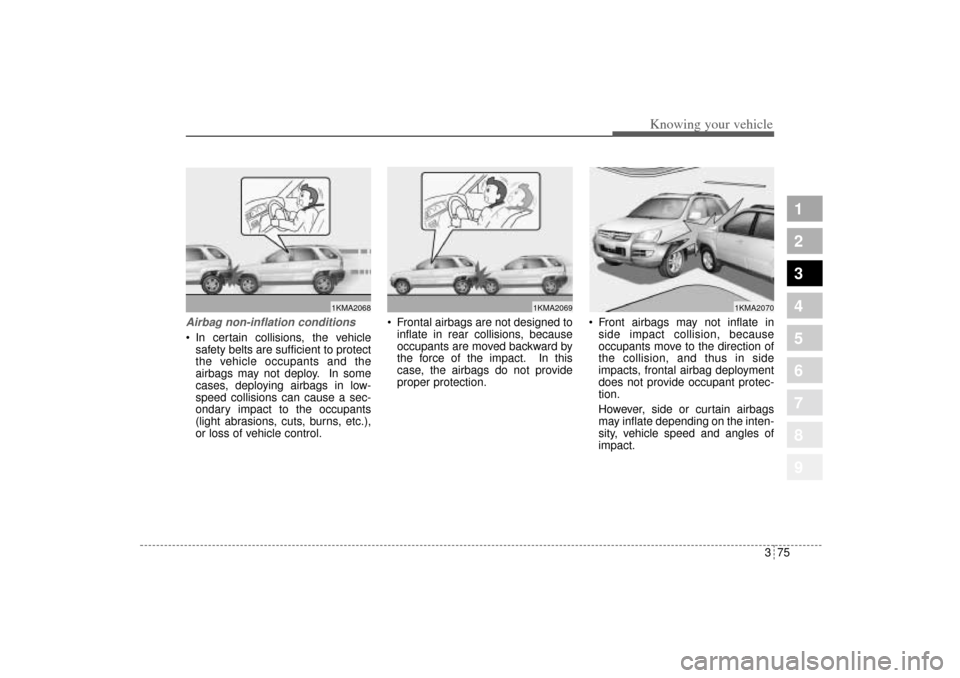
Airbag non-inflation conditions In certain collisions, the vehicle
safety belts are sufficient to protect
the vehicle occupants and the
airbags may not deploy. In some
cases, deploying airbags in low-
speed collisions can cause a sec-
ondary impact to the occupants
(light abrasions, cuts, burns, etc.),
or loss of vehicle control. Frontal airbags are not designed to
inflate in rear collisions, because
occupants are moved backward by
the force of the impact. In this
case, the airbags do not provide
proper protection. Front airbags may not inflate in
side impact collision, because
occupants move to the direction of
the collision, and thus in side
impacts, frontal airbag deployment
does not provide occupant protec-
tion.
However, side or curtain airbags
may inflate depending on the inten-
sity, vehicle speed and angles of
impact.
1KMA2069
1KMA2068
1KMA2070
KM CAN (ENG) 3 (~112).qxd 9/13/2004 4:50 PM Page 75